


Picture this. You have the papers. You know the land was your mother’s share. Your claim is true. Yet the judge closes the file with one line: you came too late. The Limitation Act in Pakistan decides how long you have to file a suit, appeal or application, and the clock often starts long before you notice it.
In April 2025, the Lahore High Court refused to revive a challenge to a 34-year-old gift deed without hearing a single witness. Then, on 13 November 2026, a five-judge Supreme Court bench changed how time is counted for heirs. Many now believe limitation has “ended” in inheritance cases. It has not. Here is what the law really says.
Quick answer: The Limitation Act, 1908 (Qanoon-e-Miyad-e-Samaat) still applies across Pakistan. Under Section 3, a late suit, appeal or application must be dismissed even if the other side never objects. There is no single deadline. Many suits get three years, Article 120 gives six years where no other Article fits, and a suit for possession after dispossession gets twelve years. For heirs, the six years now start only when an actual denial of their share is brought home to them.
Table of Contents
Judgment at a Glance: PLD 2025 Lahore 581
| Point | Details |
|---|---|
| Case | Muhammad Hafeez v. Muhammad Ramzan and 17 others |
| Citation | PLD 2025 Lahore 581 |
| Court | Lahore High Court (Justice Khalid Ishaq) |
| Case number | Writ Petition No. 10459 of 2019 |
| Decided on | 23 April 2025 |
| Laws involved | Limitation Act, 1908 (Section 3, Section 18, Article 120); Order VII Rule 11 CPC; Article 100, Qanun-e-Shahadat Order, 1984; Article 199 of the Constitution |
| Dispute | Challenge to a registered gift deed of 1981 and two land sales of 1984 |
| Delay | Suit filed on 24 November 2015, about 34 years after the gift deed |
| Result | Petition dismissed; rejection of the plaint as time-barred upheld |
| Later change | Supreme Court larger bench, 13 November 2026: a parent’s silence alone no longer bars the children’s inheritance claim |
IRAC: Can a True Claim Fail Just Because It Came Late?
| IRAC | Simple explanation |
|---|---|
| Issue | Can a grandson challenge a 34-year-old registered gift deed and later sales simply by calling it an inheritance claim, when his mother never challenged them in her lifetime? |
| Rule | Section 3 of the Limitation Act, 1908 requires late suits to be dismissed. Article 120 gives six years from when the right to sue accrues. Order VII Rule 11 CPC allows rejection of a plaint that is barred by law on its face. |
| Analysis | The mother lived 28 years after the gift and never objected. Buyers had held the land since 1984 under registered deeds. The plaint gave no reason for the 34-year delay. |
| Conclusion | The High Court held the suit plainly time-barred. The plaint was rightly rejected without evidence, and the writ petition was dismissed. |
What Is the Limitation Act in Pakistan, and Is It Still in Force?
The Limitation Act, 1908 fixes time limits for civil suits, appeals and many applications. It extends to the whole of Pakistan, has applied since 1 January 1909, and has been amended many times but never replaced. The real deadlines sit in its First Schedule, which gives each kind of case its own period and its own starting point.
You can read the official text on the Pakistan Code website or download the Punjab Code PDF of the Limitation Act, 1908. Urdu versions found online are mostly unofficial translations. Use them to understand the law, but never to count days for a real case.
The “Limitation Act 1963” and “Limitation Act 1980” that people search for are Indian and UK laws. In Pakistan, the 1908 Act still governs. A recent federal change, the Limitation (Amendment) Act, 2023, gave 30 days instead of 7 to appeal against a death sentence.
Limitation Act in Pakistan: Key Deadlines in One Table
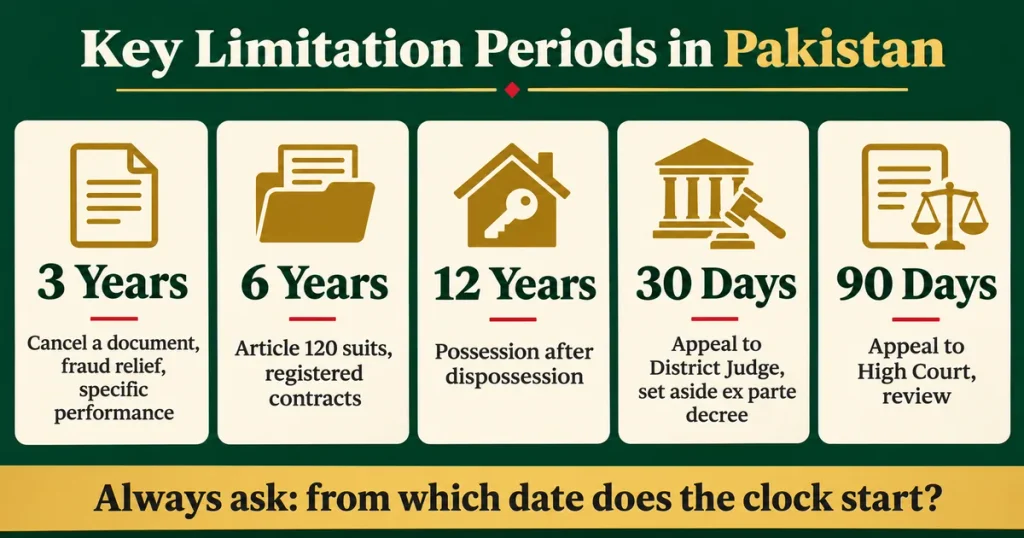
Here are the deadlines under the Limitation Act in Pakistan that people ask about most. Each one runs from a different event, so read the last column carefully.
| What you want | Article | Time limit | Clock starts from |
|---|---|---|---|
| Cancel a document not covered elsewhere | 91 | 3 years | When the facts entitling cancellation become known to you |
| Declare a document forged | 92 | 3 years | When its issue or registration becomes known to you |
| Relief based on fraud | 95 | 3 years | When the fraud becomes known to you |
| Specific performance of an agreement | 113 | 3 years | Date fixed for performance, or notice of refusal |
| Breach of an unregistered contract | 115 | 3 years | When the contract is broken |
| Breach of a registered written contract | 116 | 6 years | Same start as a similar unregistered contract |
| Any suit not covered elsewhere (e.g. declaration) | 120 | 6 years | When the right to sue accrues |
| Possession after dispossession | 142 | 12 years | Date of dispossession |
| Set aside an ex parte decree | 164 | 30 days | Date of decree, or knowledge if summons was not duly served |
| Civil appeal to a District Judge | 152 | 30 days | Date of the decree or order |
| Civil appeal to a High Court | 156 | 90 days | Date of the decree or order |
| Review of judgment (general) | 173 | 90 days | Date of the decree or order |
| Appeal against a death sentence | 150 | 30 days | Date of the sentence |
| Any application not covered elsewhere | 181 | 3 years | When the right to apply accrues |
Two warnings. First, a special or local law can set its own deadline (Section 29). Second, provinces can change the Schedule. For example, Khyber Pakhtunkhwa deleted Articles 147 and 148 through a provincial amendment in 2016. Always check the latest official text before you count.
So when someone says “you have three years,” ask one more question: three years from what? That second question often decides the whole case.
Article 120: The Six-Year Rule Most People Get Wrong
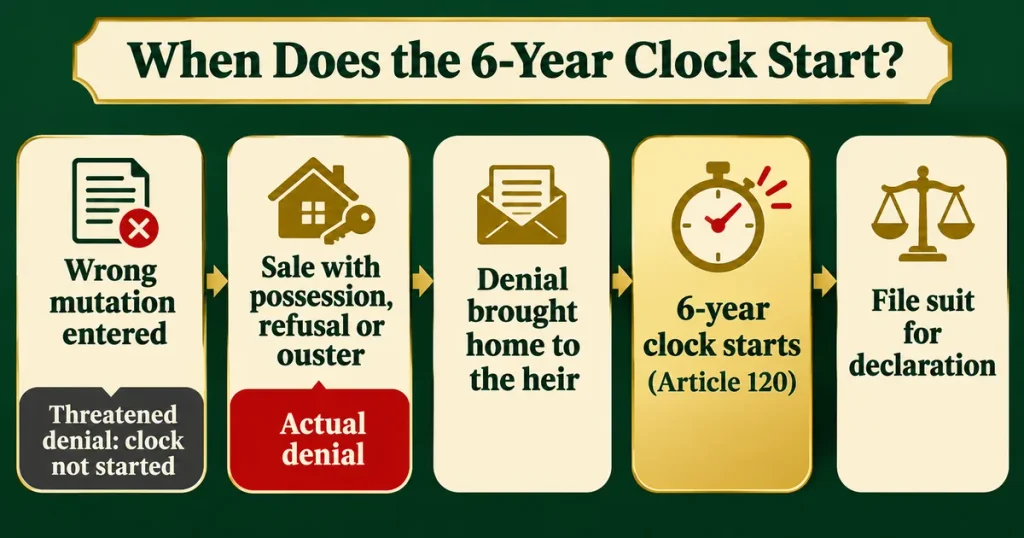
Under the Limitation Act in Pakistan, Article 120 is the residuary Article. It applies only when no other Article in the First Schedule covers the suit. The period is six years from when the right to sue accrues. As the Lahore High Court noted (para 10), the Supreme Court in Saadat Khan (PLD 2023 SC 362) held that a suit for declaration of ownership under Section 42 of the Specific Relief Act, 1877 falls under Article 120.
The key question is not the date on the oldest paper. It is the date the right to sue accrued. Courts separate a “threatened” denial, such as a wrong mutation (intiqal) in the revenue record, from an “actual” denial, such as a co-sharer selling land beyond his share and handing possession to a buyer. An actual denial forces you to sue within six years. Our guide on a civil suit for declaration explains how such suits are framed.
Section 3: Why the Judge Checks Limitation Even If No One Objects
Section 3 is the heart of the Limitation Act in Pakistan. A suit, appeal or application filed after the prescribed period shall be dismissed, even if limitation is never raised as a defence. In PLD 2025 Lahore 581 (para 14), the High Court said every court and forum must examine limitation on its own. That is why a strong case can die at the very first stage.
Sections 4, 5 and 12: Court Holidays, Late Appeals and Copy Time
Section 4: if the period ends on a day the court is closed, you may file on the day it reopens.
Section 5 lets a court admit an appeal, or an application for revision, review or leave to appeal, after time has run if you show “sufficient cause.” It does not cover ordinary civil suits, so a late suit cannot be rescued by a condonation application. Courts also expect every day of delay to be explained.
Section 12 excludes the first day of the period and, for appeals and reviews, the day of judgment and the time needed to obtain a copy. Keep your copy application receipt safe.
Section 14: Filed in the Wrong Court? Your Time May Be Saved
Section 14 can exclude the time you spent pursuing another civil case in good faith and with due diligence, on the same matter, in a court that could not hear it because of a defect of jurisdiction or a similar cause.
It is not automatic. If you knowingly chose a wrong forum or let the case sleep, the court may refuse. Keep certified copies of the earlier plaint and the order returning or dismissing it.
Sections 6 to 9: Does Childhood or Illness Stop the Clock?
Sometimes. Under Section 6, if a person was a minor or of unsound mind when the clock was meant to start, they can file within the same period after that disability ends. Section 7 covers one of several joint claimants under disability, and Section 8 caps these extensions.
Section 9 is the trap. Once time has started running, no later disability or inability to sue stops it. Proof of date of birth and medical records matter here.
Section 18: Can Fraud Save a Late Claim?
Yes, but only when fraud kept you from knowing your right, or a document you needed was fraudulently hidden. The clock then starts when you first learn of the fraud. Relying on Salamat Ali (PLD 2022 SC 353), the Lahore High Court said you must plead the fraud with particulars and the date of knowledge, and prove it through positive evidence (para 8).
Section 18 also does not postpone time against a person who took the property in good faith and for valuable consideration. So “I found out last month” is not enough when the record shows open possession and old registered sales.
Sections 19, 20, 23 and 29: When the Clock Restarts or Changes
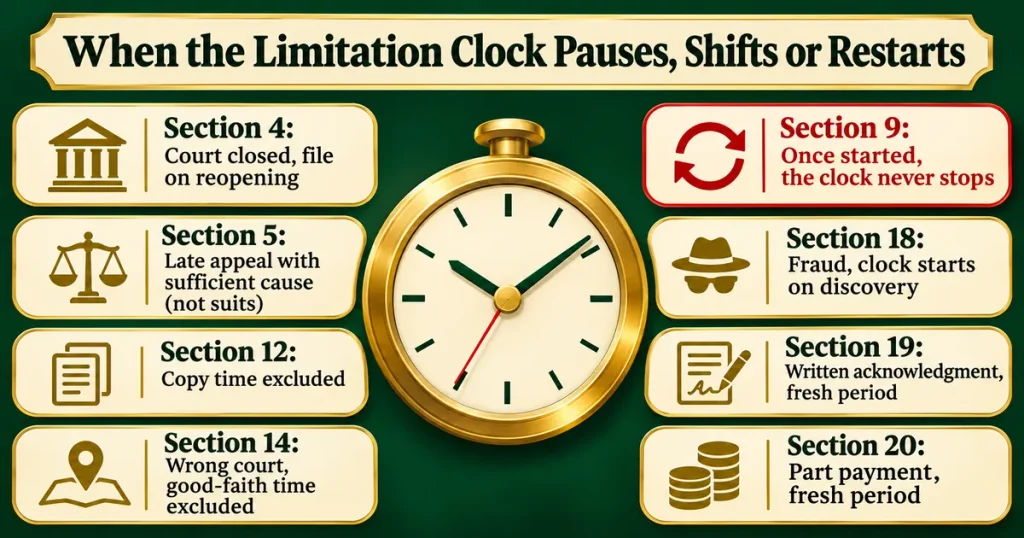
Section 19: a written acknowledgment of liability, signed before the period expires, starts a fresh period from the date of signing. An oral promise does not.
Section 20: a payment towards a debt, or of interest on a legacy, made before expiry, can start a fresh period from the date of payment.
Section 23: a continuing wrong creates a fresh period at every moment it continues. The lasting effect of a completed wrong, such as an old sale, does not.
Section 29: a special or local law, such as a revenue, banking, service or tax law, may fix its own period, which then works as if it were in the First Schedule.
Is Adverse Possession (Article 144) Still Part of the Law?
No. Article 144 once gave twelve years to a person holding land adversely, and Section 28 then extinguished the owner’s right. In Maqbool Ahmad (1991 SCMR 2063), the Shariat Appellate Bench of the Supreme Court held these provisions against Islamic injunctions, and they ceased to have effect from 31 August 1991. Section 28 was later omitted from the Act.
Article 142 remains: a dispossessed owner must sue for possession within twelve years of dispossession. If someone is occupying your land, read our guide on illegal possession of property in Pakistan.
The 34-Year-Old Gift Deed: Facts of PLD 2025 Lahore 581
The land, about 41 kanals, lay in Tehsil Shahkot, District Nankana Sahib. On 3 September 1981, the owner, Elahi Bakhsh, executed a registered gift deed (hiba nama) in favour of his sons. A mutation followed in January 1982. In March 1984, the sons sold the land through registered sale deeds, and the buyers took cultivating possession.
The owner’s daughter, the petitioner’s mother, got nothing under the gift. She died on 1 December 2009, about 28 years later, without ever challenging it. On 24 November 2015, her son and a co-plaintiff sued for declaration and permanent injunction, claiming the bedridden owner had lost his judgment and the brothers had colluded with revenue staff.
On 8 July 2017, the Civil Judge at Shahkot disposed of the defendants’ Order VII Rule 11 application, treating the case as one between co-owners and ignoring limitation and third-party rights. On 24 December 2018, the Additional District Judge, Shahkot, allowed their civil revision and rejected the plaint as time-barred. The grandson then filed a writ petition. No evidence was ever recorded.
What Each Side Argued Before the Lahore High Court
The petitioner argued that limitation does not matter in inheritance claims, so every later transaction denying an heir’s right can be cancelled. He added that limitation was a mixed question of law and fact, needing evidence. He relied on Khan Muhammad v. Mst. Khatoon Bibi (2017 SCMR 1476).
The buyers argued the suit was plainly barred and a full trial would waste time. The mother, alive until 2009, never challenged the gift or the sales, and her heirs lived in the same village. They relied on Mst. Grana (PLD 2014 SC 167), Lal Khan (PLD 2011 SC 657) and Agha Syed Mushtaque Ali Shah (2016 SCMR 910).
Why the High Court Said the Suit Came Too Late
Justice Khalid Ishaq’s reasoning comes down to five points.
- The predecessor’s silence. Where a predecessor never challenged a transaction in her lifetime and third-party rights arose, a simple claim of inheritance does not remove limitation (para 6).
- No blanket exemption. Limitation gives way only in exceptional cases: a female heir suing in her lifetime alleging fraud; a deprived female heir still receiving income; a co-sharer in deemed possession for all; no third-party rights; or no waiver and acquiescence (para 6). In the court’s words, a claim of inheritance “must cross the bridge of limitation, waiver and acquiescence” (para 12).
- Order VII Rule 11. When the plaint itself shows the bar, recording evidence would be futile (para 13).
- Unexplained delay. The plaint did not explain 34 years, and even a void order must be challenged within limitation (para 14).
- Old registered document. Article 100 of the Qanun-e-Shahadat Order, 1984 raised a presumption in favour of the 34-year-old gift deed (para 14).
Since a writ petition under Article 199 is not a second appeal or revision, and no jurisdictional error appeared, the petition was dismissed (paras 15 and 16).
What the Lahore High Court Did and Did Not Decide
The court did decide that this particular plaint was time-barred on its face and was rightly rejected under Order VII Rule 11 CPC.
It did not decide whether the gift deed was valid or whether the owner really lacked capacity, because no evidence was recorded. It did not say every delayed female inheritance claim must fail. It expressly kept exceptions for fraud, concealment, continued payment of income, deemed possession and the absence of third-party rights.
Did the Supreme Court End Limitation in Inheritance Cases?
No. On 13 November 2026, a five-judge larger bench headed by Justice Shahid Waheed announced its judgment in Civil Appeal No. 909 of 2013 (Mst. Meraj Bibi v. Mst. Zar Gula) and connected cases from three High Courts. It answered nine questions on limitation in inheritance (wirasat) claims. The Limitation Act in Pakistan still applies to heirs, but the way time is counted has changed.
Key points of the Supreme Court judgment:
- Six years still apply. Article 120 governs heirs’ suits for declaration, joint possession and partition, running from an actual denial brought home to the heir.
- A wrong mutation alone does not start the clock. It is only a threatened denial. A sale with possession, a gift claimed against the heir, a refused demand or physical ouster can be an actual denial.
- Signed it yourself? Three years. If the heir personally signed the document she wants cancelled, Article 91 gives three years from knowing the facts.
- The burden is on the defendant to prove the actual denial and its date. The plaintiff must still plead when and how she came to know.
- Children can claim a dead parent’s share. Successors take the claim as it stood. A parent’s silence alone is not a bar.
- Silence is not waiver. A bare relinquishment of accrued inheritance is void.
- Honest buyers keep some protection. If a buyer proves the legal shields, the heir can still recover the market value of her share and mesne profits from the co-heir who sold.
- Partition is not barred while the heir remains in joint possession.
These principles apply to suits pending on, or filed after, 13 November 2026; finally decided cases are not reopened. Read our full breakdown of the Supreme Court judgment on inheritance and our guide on limitation in inheritance cases in Pakistan.
Old Approach vs New Rule: What Changed for Heirs
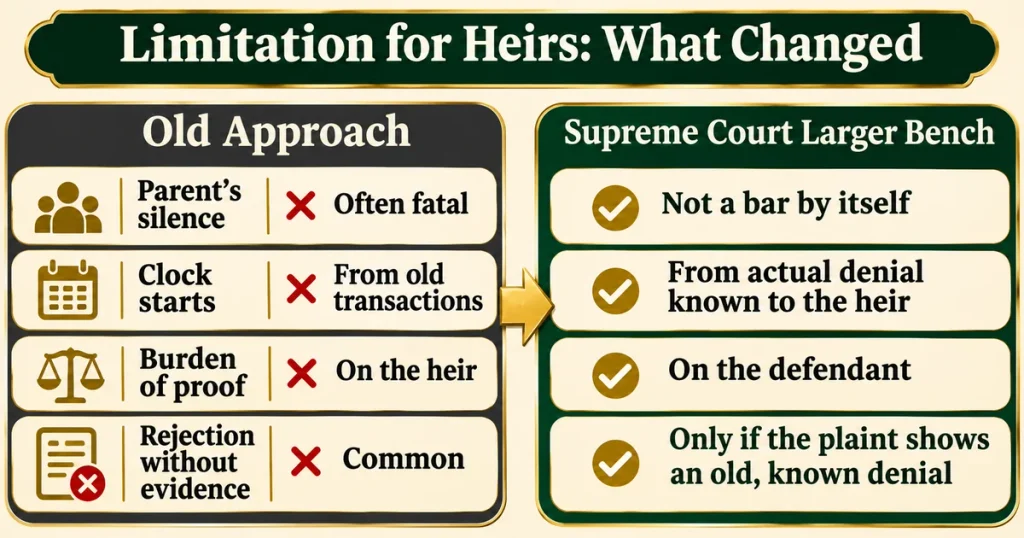
| Question | Approach in PLD 2025 Lahore 581 | Supreme Court larger bench |
|---|---|---|
| Parent never challenged in her lifetime | Children usually could not revive the claim | Parent’s silence alone is not a bar; children take the claim as it stood |
| When does the six-year clock start? | Old transactions and long silence weighed heavily | From an actual denial brought home to the heir |
| Who must prove the delay? | Plaintiff had to explain every day of delay | Defendant must prove the actual denial and its date |
| Can the plaint be rejected without evidence? | Yes, where the plaint showed a long unexplained delay | Usually needs evidence, unless the plaint itself shows a known actual denial over six years old |
| Third-party buyers | Their rights weighed heavily against the claim | Protected only if they prove the legal shields; the heir may still recover value from the seller |
For a case like PLD 2025 Lahore 581, a court applying the new test would ask when an actual denial was brought home to the mother or her children, and whether the buyers can prove their protection. Nobody can predict that answer without the full record. If your own suit or appeal is pending, discuss the new judgment with your lawyer now.
How to Calculate Your Limitation Period in 7 Steps
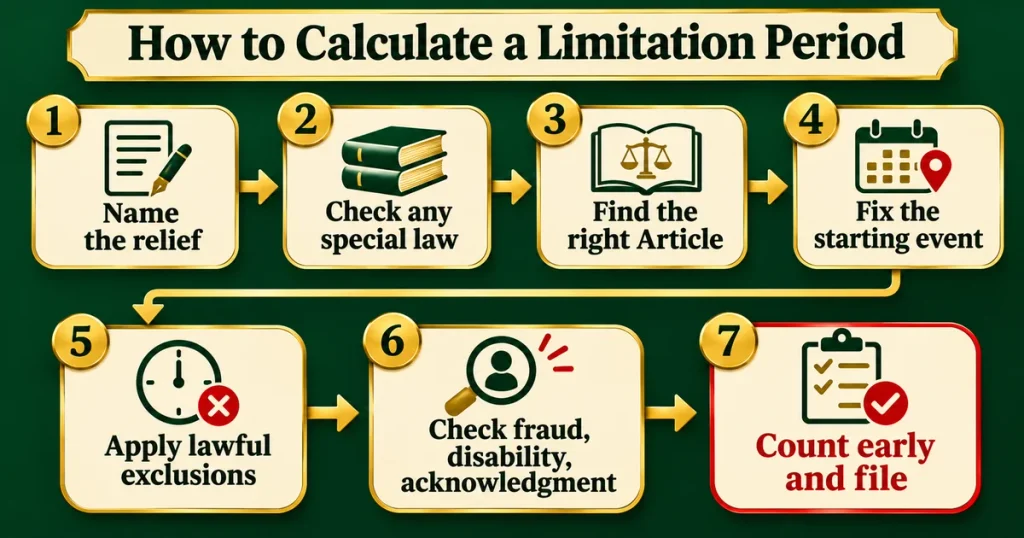
- Name the exact relief: cancellation, declaration, possession, specific performance, money, appeal or review.
- Check for a special law: revenue, banking, service, tax and tribunal laws often carry their own deadlines.
- Find the right Article: use Article 120 only after confirming no specific Article fits.
- Fix the starting event: breach, refusal, knowledge, dispossession, discovery of fraud or actual denial.
- Apply lawful exclusions: Sections 4, 12, 14 and 15 (time under a court stay) may add days back.
- Check disability, fraud, acknowledgment and payment: Sections 6 to 9, 18, 19 and 20.
- Count conservatively: never plan to file on the last day, and keep a document for every date in your timeline.
Evidence to Collect Before You File an Old Case
Old cases are won or lost on paper. Before you meet a lawyer about any deadline under the Limitation Act in Pakistan, gather:
- The document that created your right: inheritance record, registry or agreement
- Certified copies of the disputed gift deed, sale deeds and mutations
- Fard, jamabandi and khasra girdawari showing possession over the years
- Proof of when you first learned of the denial: notices, letters, messages or witnesses
- Written refusals, legal notices, and records of rent or crop share you received
- Written acknowledgments, payment receipts and papers of any earlier case
- Your CNIC and the family registration certificate (FRC) from NADRA
Common mistakes: trusting promises like “we will give your share later,” pleading fraud without dates, and waiting for an elder to act. Check your inheritance mutation record now. Daughters and sisters should also read about women’s inheritance rights in Pakistan.
FAQs on the Limitation Act in Pakistan
What is the 12-year limitation period in Pakistan?
Twelve years is the period under Article 142 to recover possession of immovable property after you were dispossessed or stopped possessing it, counted from the date of dispossession. The old twelve-year adverse possession rule under Article 144, with Section 28, ceased to have effect in 1991 after Maqbool Ahmad (1991 SCMR 2063).
What is the 6-year limitation period?
Six years is the period under Article 120 for any suit not covered by another Article, counted from when the right to sue accrues. Declaration suits often fall here. Article 116 also gives six years for breach of a registered written contract. For heirs, the six years now run from an actual denial brought home to them.
Is the Limitation Act 1908 still in force in Pakistan?
Yes. The Limitation Act, 1908 still applies across Pakistan, with later amendments. A recent federal change, the Limitation (Amendment) Act, 2023, extended the time to appeal a death sentence from 7 to 30 days. The 1963 and 1980 Limitation Acts are Indian and UK laws and do not apply here.
Where can I read the Limitation Act 1908 PDF?
The official English text is on the Pakistan Code website and as a PDF on the Punjab Code website, both linked above. Most Urdu PDFs online are unofficial translations. Use them to understand the law, but check the official text and any provincial amendment before counting a real deadline.
Does Section 5 of the Limitation Act apply to a civil suit?
No. Section 5 lets a court admit certain late appeals and applications, such as revision, review or leave to appeal, if you show sufficient cause. It does not extend the time for filing an ordinary civil suit. A late suit must be dismissed under Section 3 unless another section lawfully excludes or postpones time.
Does limitation still apply to inheritance claims now?
Yes. The five-judge bench did not abolish limitation. Under Article 120, an heir has six years from an actual denial of her share that was brought home to her. A wrong mutation alone does not start time, and the defendant must prove the denial and its date. Partition is not barred while the heir is in joint possession.
Can children claim their late mother’s inheritance share?
Under the Supreme Court’s larger bench ruling of 13 November 2026, yes. Successors take the claim as it stood: already barred, partly run, or starting fresh from their own knowledge. A parent’s silence alone is not a bar, unlike the approach in PLD 2025 Lahore 581, where the mother’s lifelong silence proved fatal.
Can a time-barred plaint be rejected without recording evidence?
Yes, under Order VII Rule 11 CPC, when the bar is clear from the plaint itself, as the Lahore High Court held in PLD 2025 Lahore 581. In inheritance cases, however, the Supreme Court now treats limitation as a mixed question of law and fact. Evidence is usually needed unless the plaint itself shows a known actual denial more than six years old.
Conclusion: A True Case Still Needs the Right Date
The Limitation Act in Pakistan does not care how strong your papers are if you arrive after the deadline. PLD 2025 Lahore 581 shows how a 34-year delay ended a claim before a single witness was heard. The Supreme Court’s new ruling gives heirs fairer rules on when the clock starts, but it did not switch the clock off.
So ask two questions today, not tomorrow: Am I legally right? And how much time does the law still give me? If you are unsure, take your documents to a qualified lawyer this week.
Disclaimer: This article is for legal awareness only and is not legal advice. Every case depends on its own facts, documents and evidence. For your specific matter, consult a qualified lawyer.