
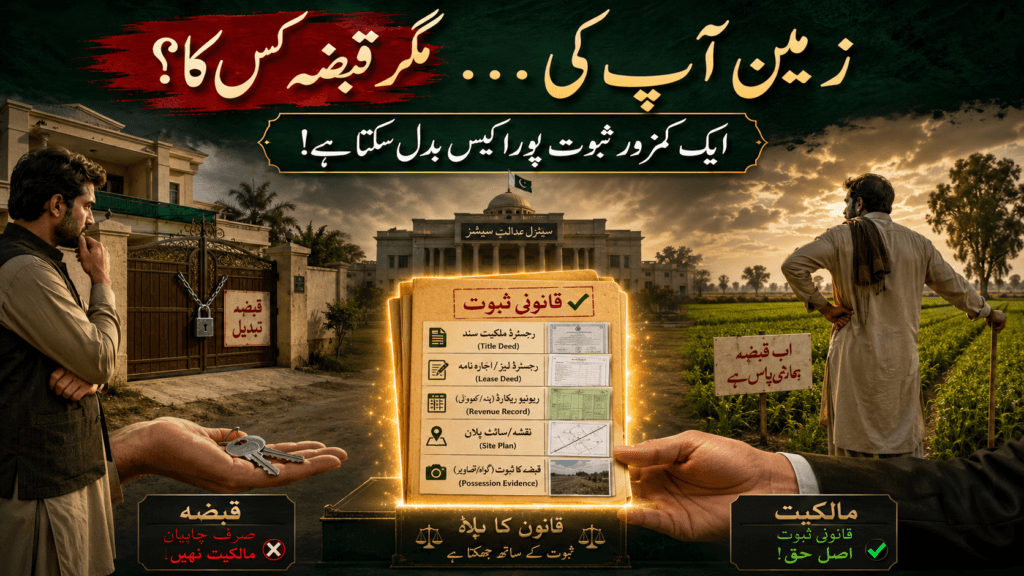
A house, plot, shop, or piece of agricultural land may represent a family’s entire savings. The shock becomes much worse when someone changes the locks, occupies part of the property, raises construction, or refuses to leave. In that moment, many people assume that ownership papers alone will automatically win the case. Pakistani law is more careful than that. A court may ask who actually owns the property, who was in lawful possession, how possession changed, what authority the accused had, and whether the evidence proves a criminal offence.
Illegal Possession of Property in Pakistan is therefore not simply a question of “who is sitting on the land today?” It may involve the Illegal Dispossession Act, 2005, civil remedies, revenue records, demarcation, inheritance rights, tenancy, or competing government claims. The Sindh High Court judgment reported as 2024 YLR 1243, Roshan Ali and 3 others v. The State, shows how a ten-year conviction can collapse when the complainant cannot prove that he was the lawful owner or lawful occupier of the exact disputed land.
Table of Contents
IRAC Analysis: Why Failure to Prove Lawful Possession Led to Acquittal
| IRAC | Simple Explanation |
|---|---|
| Issue | Whether the appellants could legally be convicted under sections 3 and 4 of the Illegal Dispossession Act, 2005 when the complainants failed to establish that they were the lawful owners or lawful occupiers of the disputed land. |
| Rule | The Illegal Dispossession Act, 2005 protects lawful owners and lawful occupiers of immovable property. In a criminal case, the prosecution must prove the charge beyond reasonable doubt. |
| Analysis | The High Court found that the disputed land was government property claimed by the Sindh Irrigation Department and the National Highway Authority. The complainants produced no title deed, record of rights, registered deed, or valid lease proving ownership or lawful possession. The Tapedar also confirmed that the complainants had no title or lease over the disputed parcel. Therefore, they did not fall within the statutory definitions of “owner” or “occupier,” and the prosecution failed to establish the essential foundation of the offence. |
| Conclusion | The Sindh High Court held that the prosecution failed to prove the appellants’ guilt beyond reasonable doubt. The appeal was allowed, the conviction and sentence were set aside, and the appellants were acquitted. |
The central lesson for Illegal Possession of Property in Pakistan is powerful: physical possession, long cultivation, a mutation entry, or a personal claim cannot automatically replace proof of lawful ownership or lawful occupation.
Judgment at a Glance: Government Land and Illegal Possession Acquittal
| Point | Detail |
|---|---|
| Case | Roshan Ali and 3 others v. The State |
| Citation | 2024 YLR 1243 |
| Court | Sindh High Court, Hyderabad Bench |
| Judge | Justice Zulfiqar Ali Sangi |
| Appeal | Criminal Jail Appeal No. S-180 of 2016 |
| Decision date | 2 October 2023 |
| Hearing dates | 7 and 21 August 2023 |
| Counsel for appellants | Muhammad Sachal Awan and Waqar Ahmed Memon |
| Counsel for complainant | Badal Gahoti |
| For the State | Ms. Rameshan Oad, A.P.G. |
| Trial case | Criminal Case No. 18 of 2012, re: Sarfraz and another v. Roshan and others, arising from Complaint No. 87 of 2011 under sections 3 and 4, P.S. Hala |
| Law involved | Sections 2(c), 2(d), 3 and 4, Illegal Dispossession Act, 2005 |
| Trial Court result | Ten years’ imprisonment, Rs. 20,000 fine each, two months’ simple imprisonment in default, and restoration of possession within one week |
| High Court result | Appeal allowed; conviction and sentence set aside; appellants acquitted |
| Key principle | The Act protects lawful owners and lawful occupiers. Where that foundational status is not proved, criminal liability cannot be assumed. |
The reported judgment records the hearing dates and counsel appearances noted above.
The Trial Court had also directed that if possession was not restored within one week, DSP Hala would assist the complainants because the police station in-charge had failed to execute the earlier interim restoration order.
In Illegal Possession of Property in Pakistan, an interim restoration order can therefore become as practically important as the eventual trial judgment.
What Does Illegal Possession of Property in Pakistan Mean in Law?
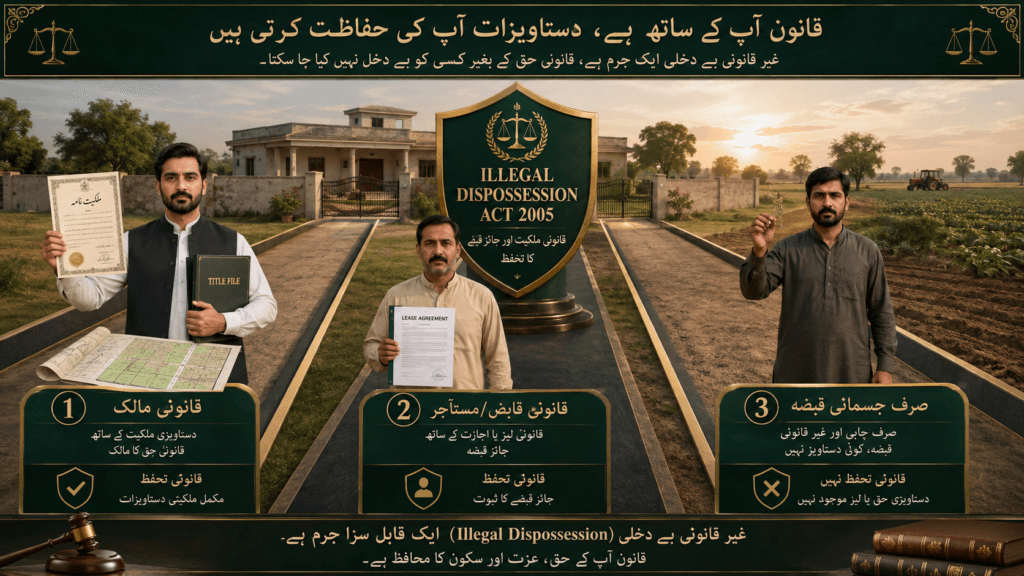
The main federal statute is the Illegal Dispossession Act, 2005 (Act XI of 2005). Its purpose is to protect lawful owners and lawful occupiers of immovable property against illegal or forcible dispossession. The Act extends to the whole of Pakistan. The official text is available on the Pakistan Code website.
For Illegal Possession of Property in Pakistan, four statutory ideas matter from the beginning:
- Court means the Court of Session.
- Occupier means a person who is in lawful possession of property.
- Owner means the person who actually owns the property at the time of dispossession otherwise than through a process of law.
- Property means immovable property.
This is why a person who merely says, “My family has used this land for decades,” may still have to prove the legal basis of that possession. Long use can be relevant evidence, but the Sessions Court still has to determine whether the complainant falls within the protection of the Act. In Illegal Possession of Property in Pakistan, lawful status must be proved, not merely asserted.
Section 3: When Illegal Occupation Becomes a Criminal Offence
Section 3(1) targets entry upon property without lawful authority and with the intention to dispossess, grab, control, or occupy it from the owner or occupier. A violation may carry imprisonment extending to ten years, fine, and compensation under the Code of Criminal Procedure.
The law was amended by the Illegal Dispossession (Amendment) Act, 2017 (Act XXVIII of 2017). The Ministry of Law and Justice lists the amendment, and the Senate records Act XXVIII of 2017 as passed on 21 June 2017 and published on 4 July 2017. Read the official Ministry entry here.
The amendment added section 3(3). It covers forcible and wrongful dispossession of an owner or occupier where the act does not fall within section 3(1). That provision may lead to imprisonment extending to three years, fine, or both, in addition to any other applicable punishment, with compensation also contemplated by the statute. This added provision is essential when researching Illegal Possession of Property in Pakistan today.
This distinction matters in Illegal Possession of Property in Pakistan because every property conflict should not be forced into one legal box. The precise allegations, lawful authority, intention, manner of entry, previous possession, and evidence determine which provision—if any—applies.
Is an FIR the First Step Under the Illegal Dispossession Act?
Not in the simple way many online guides suggest. Section 4 states that a contravention of section 3 is triable by the Court of Session on a complaint, and the offence under this Act is non-cognizable. The Court may, however, direct police action within the statutory process, including arrest at any stage of the proceedings.
That means Illegal Possession of Property in Pakistan under this particular Act should not be explained as merely “go to the police and lodge an FIR.” For Illegal Possession of Property in Pakistan, the special statutory complaint route must be identified before procedural advice is given. Separate offences under other laws may arise on particular facts, but the special complaint mechanism under the Illegal Dispossession Act must be kept distinct.
For a separate Supreme Court-based explanation of this route, read Qanooni Dastak’s guide on the Illegal Dispossession Act 2005.
The Procedure: 15 Days, 60 Days and Seven-Day Adjournments
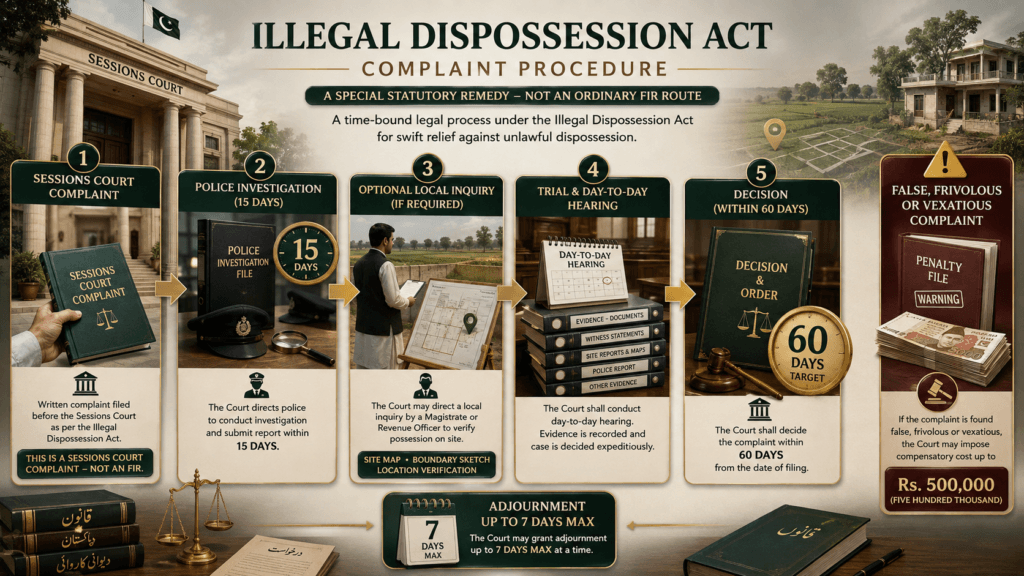
The Act creates a focused procedure. On receiving a complaint, the Court may direct the officer-in-charge of a police station to investigate and forward the investigation within 15 days. The Court may extend that period where good reasons are shown.
Where a local inquiry is necessary, the Court may direct a Magistrate or revenue officer to conduct the inquiry and submit a report within the period fixed by the Court. The statutory framework also allows that report to be treated as evidence.
After cognizance, the Court is to proceed with the trial from day to day and the statute says the case should be decided within 60 days, with sufficient reasons recorded for delay. An adjournment should not exceed seven days.
There is another safeguard that many general articles miss. If, after trial, a complaint is found to be false, frivolous, or vexatious, the Court may award compensatory cost up to Rs. 500,000 to the person complained against. The procedure is also explained in Qanooni Dastak’s detailed Supreme Court guide.
For a person facing Illegal Possession of Property in Pakistan, these timelines show why a properly prepared complaint matters. A poorly prepared Illegal Possession of Property in Pakistan complaint can lose time on issues that should have been clarified before filing. Vague property descriptions, missing title documents, uncertain boundaries, or inconsistent possession claims can turn a supposedly fast remedy into a contested evidentiary dispute.
Section 6: Can the Court Attach the Disputed Property?
Section 6 deals with attachment in a narrow situation. If the Court is satisfied that none of the persons was in possession immediately before the commission of the alleged offence, it may attach the property until the final decision of the case.
In an attachment situation, the Court also determines how the property will be managed and safeguarded against natural decay or deterioration.
This is different from handing possession to a complainant. For Illegal Possession of Property in Pakistan, the distinction matters because attachment preserves the disputed property while the criminal case remains undecided. A section 6 order in Illegal Possession of Property in Pakistan is therefore protective rather than a final declaration of title.
The official Act should always be checked for the exact statutory conditions. Read the Illegal Dispossession Act, 2005 on Pakistan Code.
Section 7: Can the Court Restore Possession Before the Final Judgment?
Yes, in an appropriate case. During trial, if the Court is satisfied that a person is prima facie not in lawful possession, section 7 provides that the Court shall direct that person, as interim relief, to put the owner or lawful occupier in possession.
If the order is not obeyed, the Court may take steps necessary to secure restoration, authorize an official to take possession, and require police assistance. The Act further treats failure by the officer-in-charge of the police station to provide required assistance as misconduct for which the Court may direct departmental action.
The Supreme Court discussion in PLD 2024 Supreme Court 1152, Niaz Ahmed and another v. Aijaz Ahmed and others, is particularly useful. The Supreme Court rejected the idea that the Act applies only to professional “qabza mafia.” A family member may also face proceedings where the statutory ingredients are present. The Court also upheld an interim restoration order under section 7 while making clear that the main complaint still had to be independently decided on evidence.
The full case explanation is available in our Supreme Court guide to the Illegal Dispossession Act 2005.
This is an important balance in Illegal Possession of Property in Pakistan: interim protection may be available, but interim relief is not the same thing as final conviction. That distinction should remain clear in every Illegal Possession of Property in Pakistan case analysis.
Section 8 and Appeal: What Happens After Trial?
If the Court finally finds that an owner or occupier was illegally dispossessed or that property was grabbed in contravention of section 3, section 8 permits restoration of possession if it has not already been restored under section 7. The Court may obtain police assistance for that purpose.
Section 8A provides an appeal to the High Court, within 30 days, against the orders specified in that provision.
For Illegal Possession of Property in Pakistan, missing an available appellate deadline can create a separate procedural problem. Section 9 applies the Code of Criminal Procedure unless the Act provides otherwise.
The 2017 amendment is the reason a modern guide to Illegal Possession of Property in Pakistan should never rely only on the original 2005 text.
The Story Behind 2024 YLR 1243: How the Dispute Started
The complaint alleged that on 15 September 2011, the accused, together with Muhammad Soomar, forcibly occupied the “MUHAG” of the complainant’s land bearing Survey Nos. 568, 569-2, 396/5, 394/4 and 529, situated in Deh Shekhani, Tapo Bhit Shah. According to the complainant, this amounted to unlawful and illegal dispossession.
The complaint was filed before the Sessions Judge Hyderabad and transferred to the IV Additional Sessions Judge Hyderabad. Reports were called from SHO Police Station Hala and the concerned Mukhtiarkar. Cognizance was taken on 30 January 2012.
Copies of the case papers were supplied to the accused and a charge was framed. They pleaded not guilty and claimed trial. After creation of Judicial District Matiari, the case was transferred to the Sessions Judge Matiari and later to the Additional Sessions Judge Matiari on 22 June 2013.
One accused, Muhammad Soomar, died during the trial, so proceedings against him were abated on 2 March 2013. During the High Court appeal, appellant Manthar also died.
This procedural history shows why a complete Illegal Possession of Property in Pakistan judgment summary must follow not only the property claim but also what happened to each accused during the litigation.
What Evidence Did the Complainant Produce?
The prosecution record was extensive.
PW-1 Sarfaraz Ahmed produced:
- the complaint;
- copies of Form VII;
- a letter of the Executive Engineer addressed to the Assistant Engineer Hala Sub-Division;
- an application addressed to the Executive Engineer Hala;
- a report submitted to the Assistant Executive Engineer Hala;
- sketches;
- applications addressed to DPO Matiari, SPO Hala and DCO Matiari;
- an application addressed to the Secretary Irrigation and Power Department;
- a letter submitted by AEE to EXN;
- a statement;
- a list containing names of flood affectees;
- a certified copy of a petition filed by an accused with order dated 12 December 2012; and
- a certified copy of the revision application against an order passed on an application under section 7 of the Illegal Dispossession Act, together with the order dated 28 August 2013.
PW-2 Sufi Saleem Pervez produced copies of Rubkari, Irrigation Department record and a payment receipt.
PW-3 Iqbal Ahmed, PW-4 Abdul Ghani alias Adloo, and PW-5 Gul Muhammad were also examined.
PW-6, Tapedar Muhammad Ayoub, produced his authority letter, a sketch of the disputed land, report dated 3 December 2011, and entries of Deh Form VII and Form VII-B.
The accused were examined under section 342 Cr.P.C. They denied the allegations, described the prosecution witnesses as interested, claimed innocence, declined to be examined on oath, and did not lead defence evidence.
This part of 2024 YLR 1243 is a reminder that Illegal Possession of Property in Pakistan is often won or lost not by the number of documents filed, but by what those documents actually prove about the exact disputed property. In Illegal Possession of Property in Pakistan, document quality matters more than document volume.
Why the Trial Court Convicted the Accused
On 22 August 2016, the Additional Sessions Judge Matiari convicted the appellants in Criminal Case No. 18 of 2012 arising from Complaint No. 87 of 2011 under sections 3 and 4 of the Illegal Dispossession Act, 2005.
Each appellant was sentenced to ten years’ imprisonment and a Rs. 20,000 fine. In default of payment, the defaulting accused was to undergo a further two months’ simple imprisonment.
The Trial Court also ordered restoration of possession within one week. If the accused failed to comply, DSP Hala was directed to assist in restoring the property because the police station in-charge had not executed the interim restoration order.
For anyone researching Illegal Possession of Property in Pakistan, the dramatic part of this case is not only that the Trial Court imposed a ten-year sentence. It also demonstrates how Illegal Possession of Property in Pakistan can involve radically different conclusions at trial and appeal when the evidence is reassessed. The High Court ultimately found the foundation of the prosecution case legally insufficient.
What the Appellants Argued Before the High Court
The appellants argued that they had been falsely implicated.
Their counsel submitted that:
- the complainants were not owners of the disputed land;
- they were not in lawful possession of the property;
- no official witness had stated that the property belonged to the Irrigation Department;
- both the Irrigation Department and National Highway Department were claiming the disputed land;
- the complainant side had failed to produce evidence of a lease;
- the appellants were not in possession of land belonging to the complainant side; and
- the Trial Court had failed to consider that the land had not been leased to the complainant side because of a ban on lease.
Their central request was acquittal because, according to them, the complainant had failed to prove the case.
What the Complainant Argued
The complainant’s counsel argued that the disputed area was in the “muhag” of the complainant side’s land and that they were therefore entitled to possession.
It was argued that the complainant side had possessed the land on the basis of a lease. According to counsel, when the previous lease expired, they applied for a fresh lease.
Counsel maintained that sufficient evidence had been brought on record and that the Trial Court had correctly appreciated that evidence while convicting the accused. The appeal, according to the complainant, should therefore be dismissed.
The conflict therefore went to the heart of Illegal Possession of Property in Pakistan: was this actually the complainants’ lawfully held property, or government land over which they could not prove title or a valid lease? That question became decisive.
The High Court Found the Land Was Government Property
On reassessment of the prosecution evidence, the High Court found that the disputed land belonged to the Government and that two public authorities were claiming it: the Irrigation Department, Government of Sindh, and the National Highway Authority under the Federation, Government of Pakistan.
The complainant side nevertheless claimed that it had possession, while the accused were said to have occupied the same land in 2011 after being affected by heavy rain.
What PW-1 Admitted in Cross-Examination
PW-1 Sarfaraz Ahmed admitted that he did not know whether the disputed land was government land. He voluntarily said it was “muhaga” land that had been given to them.
He also said that he did not know about an application submitted by him or his brother to the concerned department for lease of the land which had been refused.
PW-1 denied knowledge of FIR No. 58 of 2012 dated 3 May 2012 at Police Station Bhit Shah, alleging that Roshan had occupied Irrigation Department land. The judgment records that the matter was pending before the Civil Judge, Hala.
He also said he did not know about a National Highway Department notice dated 20 January 2012 issued to Roshan requiring him to vacate the land.
Most importantly, even the complainant did not know whether the disputed land had actually been leased to them. He relied instead on the assertion that his family had cultivated the land since the time of their forefathers.
The High Court considered these circumstances important and concluded that the complainant party was not the owner of the disputed land and that its possession was not shown to be lawful.
In Illegal Possession of Property in Pakistan, long historical use can be evidence, but it should not automatically be confused with a legally established right to occupy the exact parcel in dispute.
PW-2’s Admissions Made the Ownership Claim Even Weaker
PW-2 Sufi Saleem Pervez also claimed ownership, yet admitted during cross-examination that the land in possession of the accused persons was “pai land.”
He admitted that the documents produced by him were not lease documents.
He also acknowledged that the concerned SDO had submitted a report to the Executive Engineer stating that PW-2 had submitted an application requesting that the land be leased to him.
Most importantly, PW-2 admitted that he had not produced any title document, record of rights, or registered deed before the Court to prove ownership of the disputed land.
The High Court noted that both witnesses who claimed to be owners had failed to produce any document showing either that the relevant government department had leased the disputed land to them or that they had otherwise been legally permitted to occupy it.
If your Illegal Possession of Property in Pakistan dispute involves title documents, mutation, a disputed gift or a fraudulent transfer, a criminal complaint may not answer every ownership question.
A strong Illegal Possession of Property in Pakistan strategy may therefore require attention to the underlying civil right as well. In such cases, our guide to a Civil Suit for Declaration explains why the validity of the underlying title or document may have to be determined separately.
The Tapedar’s Evidence Became the Turning Point
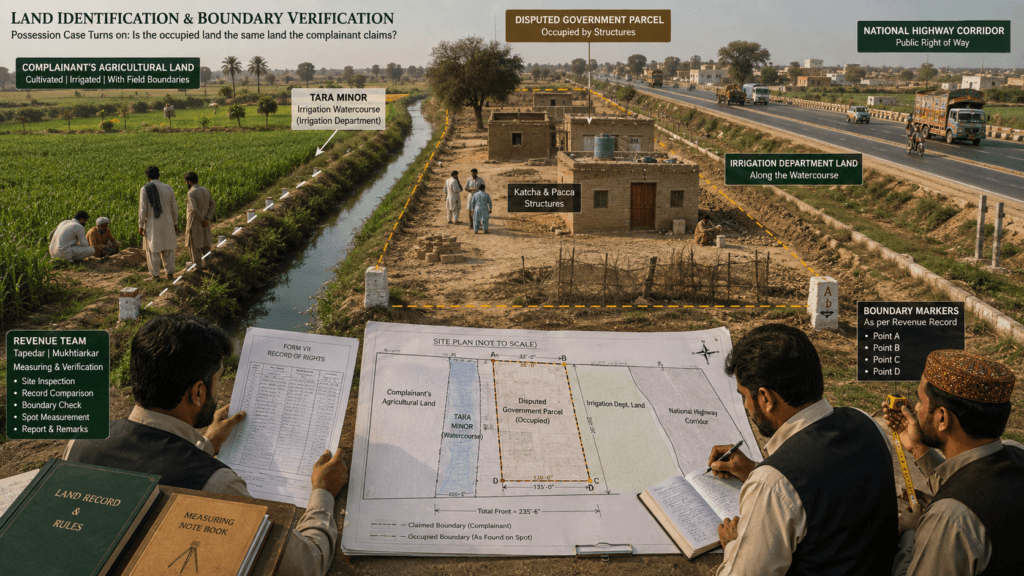
PW-6 Muhammad Ayoub, the Tapedar authorized by the Mukhtiarkar, became one of the most important official witnesses.
He stated that the disputed land was government property. According to his evidence, it was situated adjacent to one bank of the branch known as Tara Minor, whereas the complainant side’s land was situated on the opposite bank.
He further stated that the accused had no right over the disputed land because it belonged to the Government.
He also said that only Roshan was residing on the disputed land, while the other accused were residing in Hala Town.
During cross-examination, the Mukhtiarkar’s report was confronted to the Tapedar.
According to that report, the Mukhtiarkar and Tapedar had again personally visited the site and found that the respondents on the complainant side had themselves occupied government land by constructing katcha and pacca houses without title documents.
The report placed the disputed land between land pertaining to the Irrigation Department and the National Highway Authority.
The Tapedar also admitted that the complainant had no title and no lease over the disputed land.
After considering PW-1, PW-2 and PW-6, the High Court considered the position sufficiently clear and stated that there was no need to discuss the evidence of the remaining prosecution witnesses in detail.
This evidence shows why site identity and official record can become decisive in Illegal Possession of Property in Pakistan. A court must know precisely which land is alleged to have been taken.
If the land claimed by the complainant and the land physically occupied are not legally shown to be the same parcel, criminal liability may become difficult to establish.
For another modern example where demarcation and criminal intent became critical, read Property Possession in Pakistan: Lahore High Court Lessons. That case explains why every encroachment allegation does not automatically become a criminal dispossession case.
Why “Owner” and “Occupier” Were Decisive
The High Court returned to the purpose and statutory definitions under the Illegal Dispossession Act, 2005.
The Act was enacted to protect lawful owners and lawful occupiers of immovable property from illegal or forcible dispossession.
The Court noted that an “occupier” under section 2(c) is a person in lawful possession, while an “owner” under section 2(d) is the person who actually owns the property at the time of dispossession otherwise than through a process of law.
After examining PW-1, PW-2 and the revenue official, the High Court concluded that the complainant side did not fall within either protected category in relation to the disputed parcel.
That does not mean government land can be occupied freely.
It means something more precise: the complainant in a criminal case must establish his own lawful status and the ingredients of the offence. A criminal conviction cannot be obtained merely by proving that the accused may also lack title.
This distinction is essential when explaining Illegal Possession of Property in Pakistan. Courts are not choosing the “less unlawful” possessor. They are deciding whether the prosecution has proved the charged criminal offence against the accused according to law.
Benefit of Doubt: One Reasonable Doubt Can Be Enough
The High Court concluded that the prosecution had failed to prove guilt beyond reasonable doubt.
It relied on Muhammad Mansha v. The State, 2018 SCMR 772, where the Supreme Court reiterated that many doubtful circumstances are not required. Even one circumstance creating reasonable doubt in the mind of a prudent person can entitle the accused to the benefit of doubt as a matter of right rather than grace.
The judgment also referred to:
- Tariq Pervez v. The State — 1995 SCMR 1345
- Ghulam Qadir and 2 others v. The State — 2008 SCMR 1221
- Muhammad Akram v. The State — 2009 SCMR 230
- Muhammad Zaman v. The State — 2014 SCMR 749
In Illegal Possession of Property in Pakistan, therefore, a serious accusation—and even an earlier conviction—cannot remove the prosecution’s burden to prove every essential ingredient through reliable evidence. The criminal standard remains central.
The Final Decision: Ten-Year Conviction Set Aside
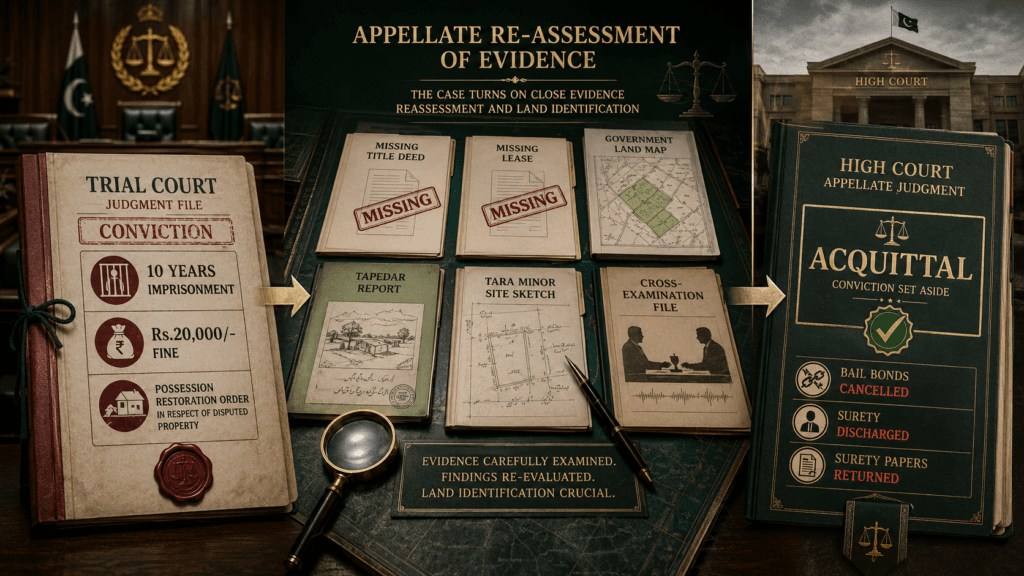
The High Court concluded that the Trial Court had not evaluated the evidence in its true perspective and had therefore arrived at an erroneous conclusion by finding the appellants guilty.
The criminal appeal was allowed.
The conviction and sentence were set aside, and the appellants were acquitted of the charge.
Because the appellants were on bail, their bail bonds were cancelled and the surety was discharged. The Additional Registrar was directed to return the surety papers after proper verification and identification. The criminal appeal was disposed of accordingly.
The final result makes 2024 YLR 1243 especially valuable for understanding Illegal Possession of Property in Pakistan: before asking whether the accused was an illegal occupant, a court may first need a clear answer to whether the complainant was actually the lawful owner or lawful occupier protected by the statute.
Criminal Complaint or Civil Suit: Which Route Fits Your Property Dispute?
Not every property dispute belongs in the same court.
A criminal complaint under the Illegal Dispossession Act focuses on the statutory allegations of unlawful entry, grabbing, control, occupation, or forcible wrongful dispossession.
A civil court may instead need to decide issues such as:
- ownership;
- declaration;
- cancellation of a document;
- recovery of possession;
- permanent injunction;
- inheritance;
- partition; or
- another private property right.
A useful rule is: do not choose the forum from emotion; choose it from the legal wrong that the evidence can prove.
If the dispute concerns a fake gift mutation or doubtful title document, read our Civil Suit for Declaration guide.
If the real conflict is between heirs or co-sharers, read Inheritance Dispute in Pakistan and Partition of Inherited Land in Pakistan.
This is particularly important because Illegal Possession of Property in Pakistan may appear criminal on the surface while the actual dispute concerns title, boundaries, co-ownership, tenancy, inheritance, or the validity of a document.
Good analysis of Illegal Possession of Property in Pakistan starts by separating these legal relationships.
What If a Brother, Heir, Spouse or Relative Takes Possession?
A family relationship does not automatically create lawful authority to break locks, remove another person, or take exclusive control of property.
The Supreme Court ruling discussed in our Illegal Dispossession Act 2005 guide confirms that the statute is not restricted only to professional land grabbers or organised “qabza mafia.”
But the opposite mistake is also dangerous.
Every co-sharer or heir should not automatically be labelled a criminal trespasser. Joint ownership, constructive possession, inheritance shares, partition, family settlements, gifts and earlier possession can create complex civil questions.
For Illegal Possession of Property in Pakistan involving inherited joint land, first identify whether the person in possession is:
- a stranger;
- tenant;
- co-owner;
- legal heir;
- licensee; or
- a person claiming through a document.
That classification can completely change the legal analysis and prevent criminal proceedings from being wrongly used as a shortcut around a genuine co-ownership dispute.
What If a Tenant Refuses to Vacate the Property?
A tenant who entered the property lawfully should not automatically be treated in the same way as a stranger who allegedly broke into the property.
Questions may arise about:
- whether a tenancy legally existed;
- whether it was terminated;
- which rent law applies;
- whether rent remains unpaid;
- whether the landlord has obtained an eviction order;
- whether possession initially began lawfully; and
- whether any later conduct creates a separate criminal issue.
Therefore, Illegal Possession of Property in Pakistan involving a tenant requires careful classification. A landlord-tenant dispute may need the appropriate rent or eviction remedy instead of automatically being converted into a land-grabbing complaint.
What If the Other Side Shows Only a Mutation?
A mutation entry can be important revenue evidence, but it is not always the final word on ownership.
If the underlying transaction is disputed, a court may examine the deed, gift, inheritance, consent, possession, revenue history, witnesses and surrounding evidence.
Our article on a Property Ownership Dispute in Sindh explains a recent example where mutation alone did not settle the question of title.
This matters in Illegal Possession of Property in Pakistan because a complainant should not assume that one mutation entry automatically proves both ownership and lawful possession of the exact disputed site.
What If the Property Boundary Itself Is Disputed?
Boundary disputes may require reliable demarcation, maps, survey numbers, revenue records and on-site verification.
A criminal complaint can become weak if the allegedly occupied strip is not proved to form part of the complainant’s property.
The lesson from 2024 YLR 1243 is especially strong here. The official witness placed the disputed government land on one bank of Tara Minor and the complainant side’s own land on the opposite bank.
So, where Illegal Possession of Property in Pakistan is really a boundary-identification case, accurately identifying the property may be as important as producing the ownership document itself.
That is why an Illegal Possession of Property in Pakistan complaint should match the documentary record to the physical site before filing.
What If the Property Is Inherited and One Heir Occupies Everything?
This is one of the most sensitive forms of property litigation.
Suppose a father dies leaving sons and daughters, but one son remains in physical possession of the entire house or agricultural land. The answer is not automatically that every other heir can immediately label him an illegal occupier under criminal law.
First determine:
- whether inheritance has opened;
- who the legal heirs are;
- whether shares remain joint;
- whether partition has taken place;
- whether a family settlement exists;
- whether any heir has transferred his or her share;
- whether one co-sharer has actually excluded another;
- what possession existed before the dispute; and
- which civil, revenue or criminal remedy legally fits the facts.
For related guidance, see Inheritance Dispute in Pakistan and Partition of Inherited Land in Pakistan.
What If a Forged Sale Deed, Gift Deed or Power of Attorney Is Being Used?
Sometimes the possession problem is only the visible part of a deeper title dispute.
The other side may rely on:
- a forged sale deed;
- disputed gift deed;
- fraudulent mutation;
- unauthorized power of attorney;
- fake agreement;
- disputed inheritance entry; or
- document allegedly executed by a person who never owned the property.
In such circumstances, merely seeking physical possession may not solve the underlying title problem.
Depending on the facts, the affected person may need declaratory, cancellation, injunction, possession, criminal, or revenue remedies.
Our Civil Suit for Declaration guide explains why the validity of the underlying document may itself become the central issue.
For Illegal Possession of Property in Pakistan, this distinction prevents a weak title dispute from being disguised as a simple possession case.
Government Land Requires a Different Level of Care
Government land creates an especially important warning.
A private person cannot simply prove that the accused also lacks ownership and then assume that the private complainant must win.
The complainant must still establish the lawful right on which his own case depends.
That is exactly what happened in 2024 YLR 1243. The evidence pointed toward government ownership, while the complainant side could not prove title, a valid lease, or lawful authorization over the disputed parcel.
Illegal Possession of Property in Pakistan therefore requires the court to examine the complainant’s own lawful status—not merely weaknesses in the accused person’s claim.
What Evidence Should You Preserve Immediately?
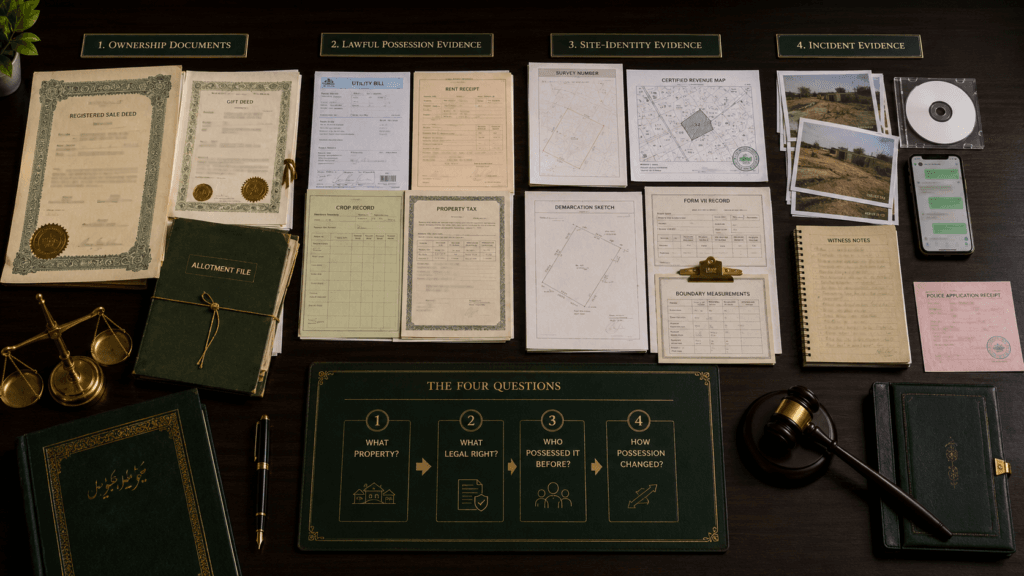
If you believe you have been unlawfully dispossessed, preserve evidence before it disappears or changes.
Depending on the facts, useful material may include:
- registered sale deed, gift deed, allotment letter, lease, inheritance papers or another title document;
- certified revenue record and mutation history;
- possession evidence such as utility bills, property-tax receipts, rent receipts, photographs, crops, tenancy papers or business records;
- dated photographs or video of broken locks, fresh construction, blocked entry, damaged gates or changed possession;
- CCTV footage before it is overwritten;
- messages, notices, threats, admissions and correspondence;
- police applications and proof of receipt where legally relevant;
- witness names and contact details;
- site plan, survey numbers, khasra details or demarcation material where identity is disputed; and
- a date-wise timeline explaining lawful possession, the alleged dispossession and every step taken afterward.
For Illegal Possession of Property in Pakistan, the evidence should answer four practical questions:
What property is disputed?
What lawful right did you have?
Who possessed it before the incident?
How and when did possession change?
A well-prepared Illegal Possession of Property in Pakistan file should make each answer easy for the court to verify.
Ten Steps to Take After Alleged Illegal Dispossession
- Do not use private force to retake the property. A strong ownership claim does not justify violence or an unlawful counter-entry.
- Secure certified title and revenue documents. Do not depend only on old photocopies or screenshots.
- Identify the exact land. Survey numbers, plot numbers, measurements, boundaries and maps should correspond with the area actually occupied.
- Preserve possession evidence. Show how you were using or lawfully occupying the property before the alleged dispossession.
- Record the incident lawfully. Preserve photographs, CCTV, messages and witness details without fabricating or altering evidence.
- Prepare a chronology. Exact dates often expose inconsistencies hidden inside a general story.
- Check the legal status of the other person. Stranger, tenant, co-sharer, heir and licensee are not legally identical situations.
- Choose the correct remedy. Depending on the facts, this may involve a Sessions Court complaint, civil declaration, injunction, recovery of possession, cancellation, partition, revenue proceedings or more than one lawful remedy.
- Disclose existing litigation. Hidden civil suits, stay orders, revenue proceedings or competing cases can seriously damage credibility.
- Obtain case-specific legal advice before filing. Criminal allegations carry serious consequences for both sides, including potential compensatory costs where a complaint is ultimately found false, frivolous or vexatious.
Following these steps can make an Illegal Possession of Property in Pakistan claim clearer and less vulnerable to the kind of evidentiary failure seen in 2024 YLR 1243.
Punjab Readers Should Also Check the Current Provincial Route
The federal Illegal Dispossession Act extends throughout Pakistan, but provincial mechanisms can also become relevant.
Punjab currently operates an official Protection of Ownership of Immovable Property (POIP) portal connected with its provincial property-protection framework. The official portal describes its purpose as protecting lawful property owners against illegal occupation. Visit the official Punjab POIP portal.
Because Punjab’s property-protection framework has changed since 2025, a Punjab property owner should verify the current statute, forum and procedure applicable on the date of filing rather than relying on an old online explanation.
For revenue-record, demarcation, mutation and boundary issues in Punjab, readers can separately consult our guide to the Punjab Land Revenue Ordinance 2026, which also explains the current position after the later 2026 amendment legislation.
This provincial route should not be confused with the federal criminal complaint discussed in 2024 YLR 1243. Illegal Possession of Property in Pakistan can involve more than one legal framework, so location and facts matter.
Seven Legal Lessons You Should Remember
- Possession is not automatically ownership. Physical control may be relevant evidence, but lawful ownership or lawful occupation must be established where the Act requires it.
- The Sessions Court complaint route matters. The special offence under the Illegal Dispossession Act is non-cognizable and triable on complaint before the Court of Session.
- The 2017 amendment matters. Modern legal guidance should account for section 3(3), local inquiry, false-complaint costs, restoration provisions and the appeal framework.
- Interim restoration is possible. Section 7 can operate during the trial when its statutory conditions are satisfied.
- Civil and criminal questions are not identical. Title, inheritance, partition or document cancellation may require a civil or revenue forum even where criminal allegations also exist.
- Government land changes the analysis. A private complainant must prove his own lawful status over the disputed property; weakness in the accused person’s title does not automatically prove the complainant’s criminal case.
- Reasonable doubt protects the accused. A criminal conviction cannot stand merely because a property dispute looks suspicious.
These lessons make Illegal Possession of Property in Pakistan easier to understand without turning every possession dispute into a criminal prosecution. They also keep Illegal Possession of Property in Pakistan focused on provable legal ingredients rather than labels.
Frequently Asked Questions
Which Law Mainly Deals With Illegal Possession of Property in Pakistan?
The Illegal Dispossession Act, 2005 is the main federal statute discussed in this article. It protects lawful owners and lawful occupiers of immovable property and extends throughout Pakistan. Provincial laws and other civil, criminal, revenue, tenancy or inheritance laws may also apply depending on the facts.
Which Court Hears a Complaint Under the Illegal Dispossession Act?
The Act defines the Court as the Court of Session, and section 4 makes a contravention of section 3 triable there on a complaint. Qanooni Dastak’s Supreme Court guide also explains the Sessions Court procedure.
Is the Offence Cognizable?
No. Section 4 states that the offence under the Act is non-cognizable. That is why Illegal Possession of Property in Pakistan under this Act should not be reduced to a simple “FIR first” formula.
What Is the Maximum Punishment?
Under section 3(2), contravention of section 3(1) may lead to imprisonment extending to ten years, fine and compensation.
The 2017 amendment also added section 3(3), which addresses specified forcible and wrongful dispossession outside subsection (1) and may carry imprisonment extending to three years, fine, or both. The amendment is officially listed by the Ministry of Law and Justice and Senate of Pakistan.
Can Possession Be Restored Before the Final Conviction?
Yes. Section 7 provides an interim restoration mechanism during trial where the statutory conditions are satisfied.
The Supreme Court decision discussed in our Illegal Dispossession Act 2005 guide is an important example of interim restoration without treating the interim order as a final conviction.
Can a Brother or Legal Heir Be Proceeded Against?
Potentially, yes. Family relationship by itself does not create immunity under the Act.
But the Court must still examine lawful authority, previous possession, co-ownership, inheritance rights and the manner of entry. Every family property dispute is not automatically a criminal offence.
Can a Tenant Be Treated as an Illegal Occupant?
It depends on the tenancy, its termination, the applicable rent law, possession history and the alleged conduct.
A tenant dispute should not automatically be converted into a land-grabbing case without examining the legal basis on which possession began and continued.
Does a Mutation Completely Prove Ownership?
Not necessarily.
A mutation is important revenue material, but disputed title may require examination of the underlying transaction and other evidence. Our Civil Suit for Declaration and Property Ownership Dispute in Sindh guides explain this issue further.
Can a Person Claim Protection if the Land Actually Belongs to the Government?
A person relying on the Illegal Dispossession Act must establish that he is the lawful owner or lawful occupier protected by the statute.
In 2024 YLR 1243, the complainant side failed because the disputed parcel was government land and they could not prove title or a lease over it.
Why Were the Accused Acquitted in 2024 YLR 1243?
The High Court found that the complainants were neither proved owners nor lawful occupiers of the disputed property.
The revenue evidence pointed toward government ownership, the complainant side had no proved title or lease, and the prosecution failed to prove guilt beyond reasonable doubt.
The Trial Court conviction was therefore set aside.
Is a Civil Suit Enough to Stop a Criminal Complaint?
Not automatically.
A civil case may decide ownership, gift, inheritance, partition or another private right, while a criminal court may separately examine alleged illegal dispossession where the statutory ingredients exist.
The Supreme Court case discussed in our related guide explains that pending civil litigation does not by itself defeat an otherwise maintainable complaint under the Act.
What Is the Most Important Lesson for Illegal Possession of Property in Pakistan?
Do not rely on emotion, possession alone, or one revenue entry.
Prove your lawful right. Identify the exact property. Preserve evidence of previous possession. Choose the correct forum. Make sure the facts actually satisfy the legal remedy you invoke.
Conclusion: Before You Say “Qabza,” Prove the Right the Law Protects
Illegal Possession of Property in Pakistan can destroy savings, divide families and trigger years of litigation. But the law does not decide these cases through labels.
“Owner,” “tenant,” “heir,” “qabza group,” “old possession,” and “mutation holder” are starting points—not automatic legal conclusions.
2024 YLR 1243 gives a powerful warning.
The complainant side produced witnesses and a large number of documents. The Trial Court even imposed ten years’ imprisonment. Yet the High Court looked closely at the exact land, the competing government claims, the missing title and lease, the Tapedar’s evidence and the criminal burden of proof.
Once the complainants could not establish that they were the lawful owners or lawful occupiers of the disputed parcel, the conviction could not survive.
A strong case about Illegal Possession of Property in Pakistan begins with the correct property, correct legal right, correct evidence and correct forum. That is the safest way to approach Illegal Possession of Property in Pakistan without confusing physical control with a legally protected right.
If any one of those foundations is missing, even a serious allegation may fail.
Disclaimer
This article is for general legal awareness and educational purposes only. It is not legal advice and does not create a lawyer-client relationship. Property disputes depend on title documents, previous possession, site identity, applicable provincial law, criminal allegations, limitation, tenancy, inheritance, revenue record and other case-specific facts. Consult a qualified lawyer before filing or defending proceedings.