

“I will never sign. You cannot leave without my permission.” Many Pakistani wives hear some version of this line. Relatives add pressure, someone forwards an online fatwa, and the woman starts to believe she is stuck for life. So is khula without husband consent even possible in Pakistan, or does his refusal lock the courtroom door?
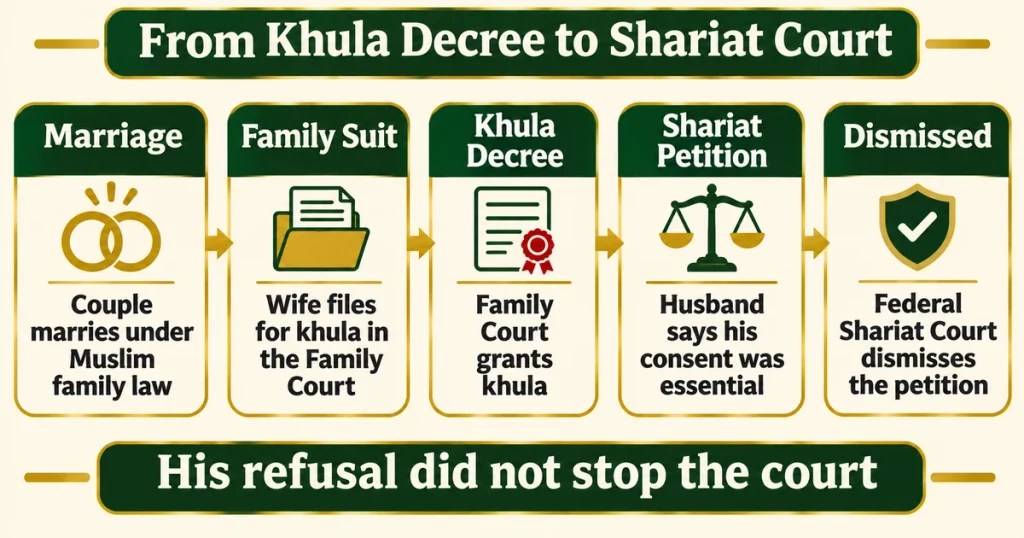
That exact question reached the Federal Shariat Court in PLD 2023 FSC 286. A husband whose wife had obtained khula from a Family Court argued that khula without husband consent is against Islam. The Court disagreed and dismissed his petition at the very first hearing.
But the ruling is not a licence to divorce yourself on WhatsApp, and it does not leave husbands without rights. Below, we explain what the Court decided, what it left open, how newer Supreme Court rulings protect the wife’s own choice, and how to protect your dower (haq mehr) before you file.
Table of Contents
Judgment at a Glance: PLD 2023 FSC 286
| Point | Detail |
|---|---|
| Case | Khurram Shehzad v. Federation of Pakistan through Ministry of Law and Justice Commission of Pakistan, Islamabad and another |
| Citation | PLD 2023 Federal Shariat Court 286 |
| Court | Federal Shariat Court of Pakistan (Shariat jurisdiction under Article 203-D) |
| Bench | Dr. Syed Muhammad Anwer, A.C.J. and Khadim Hussain M. Shaikh, J. |
| Case number | Shariat Petition No. 11-I of 2022 |
| Decided on | 7 February 2023 |
| Law involved | Section 10(4), Family Courts Act, 1964; Article 203-D of the Constitution |
| Main question | Is khula without husband consent repugnant to the Injunctions of Islam? |
| Result | Petition dismissed in limine; Full Bench ruling in PLD 2014 FSC 43 followed |
IRAC: How the Shariat Court Answered the Husband
| IRAC | Analysis |
|---|---|
| Issue | Is Section 10(4) of the Family Courts Act, 1964 un-Islamic because Family Courts use it to grant khula without the husband’s consent? |
| Rule | Article 203-D lets the Federal Shariat Court test a law against the Quran and Sunnah. In Saleem Ahmad and others v. Government of Pakistan (PLD 2014 FSC 43), a Full Bench had already held that the Quran creates no specific bar on a competent court decreeing khula when reconciliation fails. |
| Analysis | The husband relied on Surah Al-Baqarah 2:237 and several ahadith. The Bench reproduced the 2014 reasoning: courts exist to settle disputes, so they cannot be powerless when a husband refuses divorce and reconciliation fails. |
| Conclusion | Petition dismissed in limine. Section 10(4) stands, and the husband’s refusal alone does not stop a Family Court from granting khula. Khula is a single irrevocable divorce, so no halala is needed if the couple later remarries. |
7 Truths About Khula Without Husband Consent
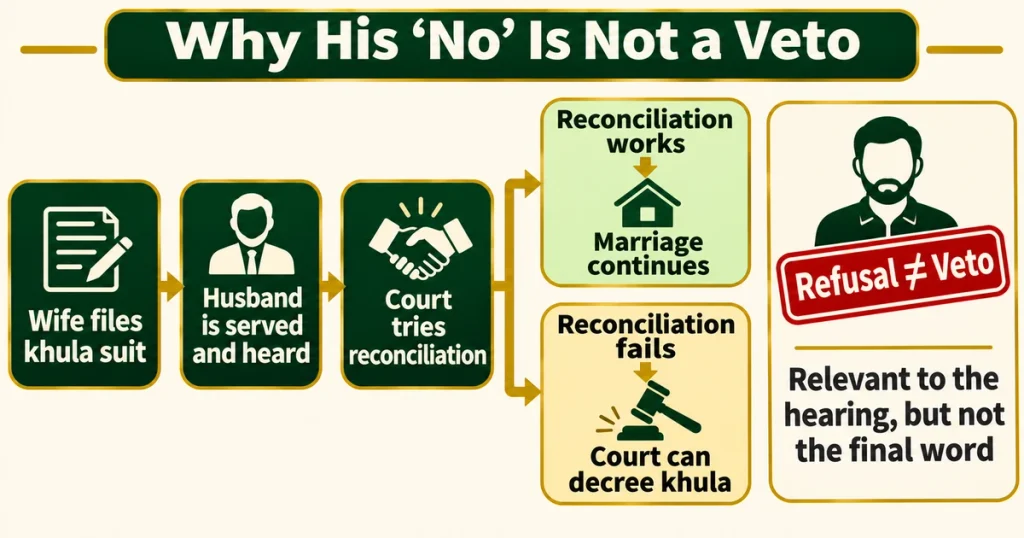
- His refusal is not a veto. A competent Family Court can decree khula once reconciliation fails.
- The court process cannot be skipped. A private “I take khula” message does not end a marriage.
- He still has rights. He must be served, and he can appear, reconcile or contest money claims.
- Her consent matters too. A court cannot force khula on a wife who sued on other grounds.
- Your remedy can change your money rights. Khula and statutory dissolution treat dower differently.
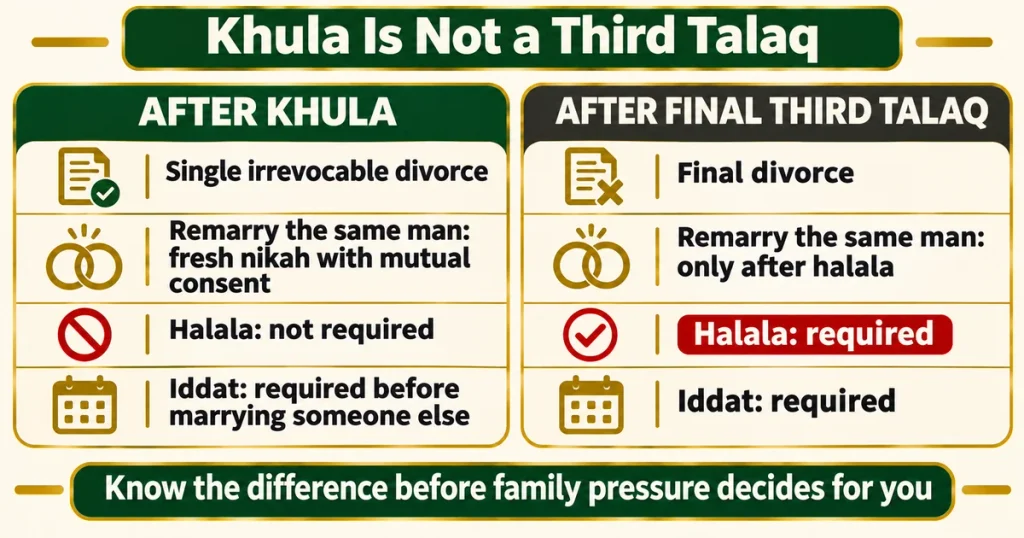
- Khula is not a third talaq. The same couple can remarry with a fresh nikah, without halala.
- Iddat still applies. She must complete iddat before marrying someone else.
The Marriage Behind This Case
The facts come from the husband’s own petition, which the order reproduces. Khurram Shehzad stated that he married respondent No. 2 on 12 January 2009. His wife later filed Family Suit No. 24 of 2022 before the Family Court, Mandi Bahauddin, and on 4 March 2022 that court granted her khula.
He objected that the decree was passed without his consent, which he called “essentially required.” Instead of only attacking the decree, he attacked the law. He asked the Federal Shariat Court to declare Section 10(4) of the Family Courts Act, 1964 un-Islamic and void, and to direct the Federation to amend it.
The order does not reproduce the wife’s pleadings or the Family Court’s reasons, so we do not guess why she sought khula.
The Husband’s Argument: “My Consent Was Essential”
His counsel argued that khula without husband consent, granted by ordinary courts, goes against the Injunctions of Islam. He relied on:
- Surah Al-Baqarah 2:237, which speaks of “he in whose hand is the marriage tie”;
- a hadith in Sunan Ibn Majah that divorce belongs to the husband;
- the narration of Jamilah bint Salul, who could not live with Thabit and agreed to return his garden; and
- a report that divorce is for men and the waiting period is for women.
His core point was simple: if divorce lies in the husband’s hand, a judge cannot take it out of his hand.
What the Court Had on Record
This was a dismissal in limine, meaning at the preliminary stage. Only the petitioner and his counsel appeared, and no evidence was recorded. The Bench also noted that his attached documents concerned his own family case. So the order rules on the validity of the law, not on the merits of his marriage.
The Law Behind Khula in Pakistan
Four pieces of law explain how khula works in Pakistan:
- Family Courts Act, 1964. Family Courts hear dissolution suits, including khula. Section 10 sets the pre-trial stage, where the judge must try to reconcile the spouses. In Punjab, the 2015 amendment placed the key rule in Section 10(5): if reconciliation fails in a dissolution suit, the court “shall immediately pass a decree.”
- Section 12-A of the same Act asks Family Courts to decide a case, including a dissolution suit, within six months.
- Dissolution of Muslim Marriages Act, 1939. It gives separate statutory grounds, such as cruelty, failure to maintain for two years, or an additional marriage in breach of the Muslim Family Laws Ordinance, 1961.
- Article 203-D of the Constitution. It lets the Federal Shariat Court strike down any law repugnant to the Quran and Sunnah.
The Pakistani rule on khula without husband consent grew from case law. The Lahore High Court recognised judicial khula in Mst. Balqis Fatima v. Najm-ul-Ikram Qureshi (PLD 1959 Lahore 566), and the Supreme Court endorsed it in Mst. Khurshid Bibi v. Muhammad Amin (PLD 1967 SC 97).
Why the Federal Shariat Court Said His “No” Is Not a Veto
The 2023 Bench treated the question as already settled. A Full Bench had examined it in Saleem Ahmad (PLD 2014 FSC 43), and paragraph 4 of the 2023 order reproduces that reasoning.
According to it, the verses pressed by the challengers do not specifically bar a court from decreeing khula when reconciliation fails. The Full Bench then asked a plain question: “After all what are the Courts of law established for?” Courts decide every kind of dispute, including dissolution on statutory grounds. So there was no reason they could not decide khula when a husband refuses divorce altogether and all reconciliation efforts fail.
In paragraph 6, the 2023 Bench said it held the same view after weighing the petitioner’s points. It was not even the first repeat attempt: in an order dated 7 February 2022 (Shariat Petition No. 10-I of 2021), the Court had pointed another petitioner to Saleem Ahmad.
Paragraph 5 went further and called khula “a unique right given by Islam to women.” That line explains the whole judgment: khula without husband consent exists because khula is her remedy, not his favour.
Final Decision: Petition Dismissed in Limine
The Court held that the petition had no merit and dismissed it in limine. Section 10(4) was not declared un-Islamic, PLD 2014 FSC 43 remains the controlling FSC view, and this order did not set aside the Mandi Bahauddin khula decree.
For wives, the message is clear: khula without husband consent remains available, and a husband cannot block a khula suit forever by refusing to agree. You can read the full order on the Federal Shariat Court website.
What the Court Did and Did Not Decide
It decided that the Quran contains no specific bar on a court granting khula after reconciliation fails; khula is a single irrevocable divorce; the same spouses may remarry by fresh nikah without halala; and iddat applies before she marries someone else.
It did not decide how much dower a khula wife must return, whether this couple’s decree was right on its facts, or questions of custody and maintenance. Nor did it say a wife can divorce herself privately, or that notice and reconciliation can be skipped.
Is Khula Without Husband Consent Valid in Islam?
This is where online answers clash. Many classical Hanafi, Shafi’i and Hanbali jurists treated khula as a mutual agreement and required the husband’s consent. Some Maliki jurists gave arbitrators and judges wider power to separate a couple in serious discord. That is why popular fatwa sites often say khula without husband consent is invalid, or call court separation faskh instead.
Pakistani courts took the judicial route. Khurshid Bibi relied on Surah Al-Baqarah 2:229, which allows a wife to give something for her release when the spouses fear they cannot keep within Allah’s limits. Later, the Federal Shariat Court, whose very job is to test laws against the Quran and Sunnah, upheld judicial khula in 2014 and again in 2023.
So separate two questions. A personal religious doubt can be discussed with a trusted scholar. But your legal status in Pakistan, for a fresh Nikahnama, NADRA records or inheritance, follows the Family Court decree, not a fatwa from abroad.
Newer Supreme Court Rule: Khula Cannot Be Forced on the Wife
Khula without husband consent is allowed. Khula without the wife’s consent is not. In Dr. S.H.K. v. W.K. and others (PLD 2026 SC 91), decided on 19 September 2025, the wife sued for dissolution on cruelty, non-maintenance and her husband’s second marriage, but the Family Court granted khula instead.
The Supreme Court held that khula is a distinct remedy grounded in the wife’s consent and cannot replace a statutory ground. It also rejected the idea that khula depends on the husband’s willingness. Her marriage was dissolved and she kept her dower.
Two 2026 rulings pushed the same line:
- May 2026: a three-member bench led by the Chief Justice held that khula should not ordinarily be granted without the wife’s clear consent where she sued on cruelty and money rights are at stake.
- October 2026: a five-member bench held that a wife cannot be forced into khula and lose her dower, and that shiqaq (a serious, continuing breakdown of the marriage) can justify dissolution under section 2(ix) of the 1939 Act even without proof of cruelty.
| Whose consent? | Legal position |
|---|---|
| Husband’s consent to khula | Not needed; his refusal is not a veto once reconciliation fails |
| Wife’s consent to khula | Needed; a court should not impose khula when she sued on other grounds |
For the full filing route under this rule, read our guide on the Khula Process in Pakistan.
Khula or Dissolution Under the 1939 Act: Your Dower Depends on It
Both routes end the marriage, but the money results can differ sharply.
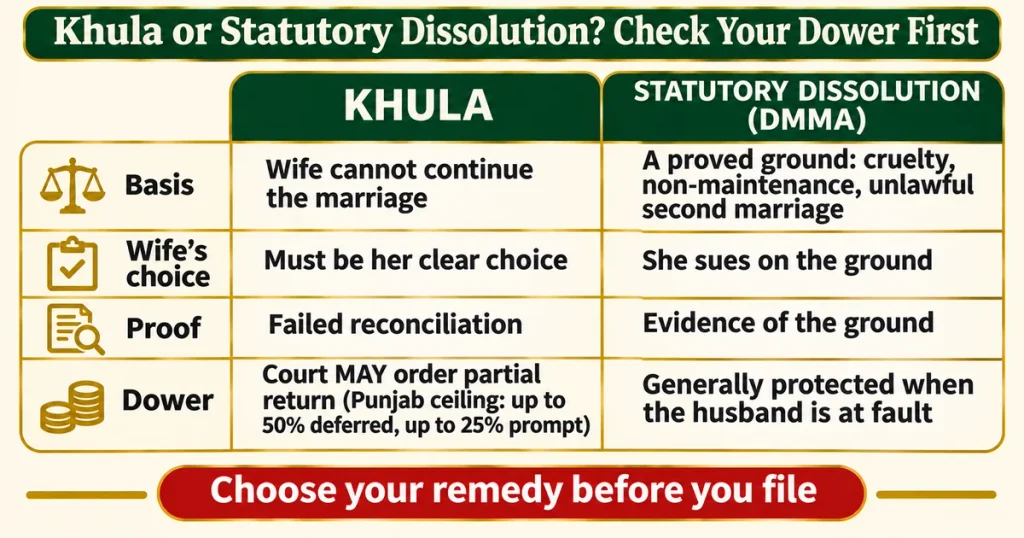
Khula rests on the wife’s inability to continue the marriage, and she may have to return some benefits. In Punjab, Section 10(5) says the court may direct a khula wife to surrender up to 50% of her deferred dower or up to 25% of her admitted prompt dower. That is a ceiling, not a fixed rule. The provision has faced a Federal Shariat Court challenge, yet the Supreme Court still applied it in January 2026. Other provinces and Islamabad may differ. Our guide on dower return in khula explains this.
Statutory dissolution depends on proving a ground such as cruelty, non-maintenance or an unlawful second marriage. Where the fault lies with the husband, the wife’s dower is generally protected.
So do not file khula by reflex. If you have strong statutory grounds, read our guide on grounds for khula and dissolution first, and opt for khula only as a clear, written choice.
What Can a Husband Still Do If He Refuses Khula?
A husband is not erased from the case just because khula without husband consent is allowed. Under the normal procedure, he can:
- receive summons and file a written statement;
- attend reconciliation and genuinely try to save the marriage;
- contest dower, dowry or maintenance claims with evidence; and
- raise real jurisdiction or service objections.
Section 14(2) of the Family Courts Act bars an ordinary appeal against a decree dissolving a marriage, apart from a narrow exception. Any further challenge usually goes to the High Court and must show a legal error, not just his refusal. Ignoring the summons is risky too: after lawful service, the court may proceed in his absence. And as this case shows, Shariat petitions against the khula law itself have failed.
After Khula: Remarriage, Halala and Iddat
Paragraph 5 of the judgment answers three common questions:
- Can he take her back? No. Khula operates as a single irrevocable divorce.
- Can they remarry each other? Yes, if both want to, through a fresh nikah with mutual consent. No halala is required.
- When is halala relevant? Only where a husband’s third talaq has become final and he later wants to remarry the same woman.
The Court also held that iddat is incumbent on the wife if she wants to marry someone else after khula. Its length can depend on facts such as pregnancy, so take case-specific advice before any new nikah.
Paperwork matters too. In Punjab, Section 21-B requires the Family Court to send a certified copy of the decree to the Chairman of the Arbitration Council. Follow up at your Union Council so the dissolution is recorded and your NADRA status can be updated.
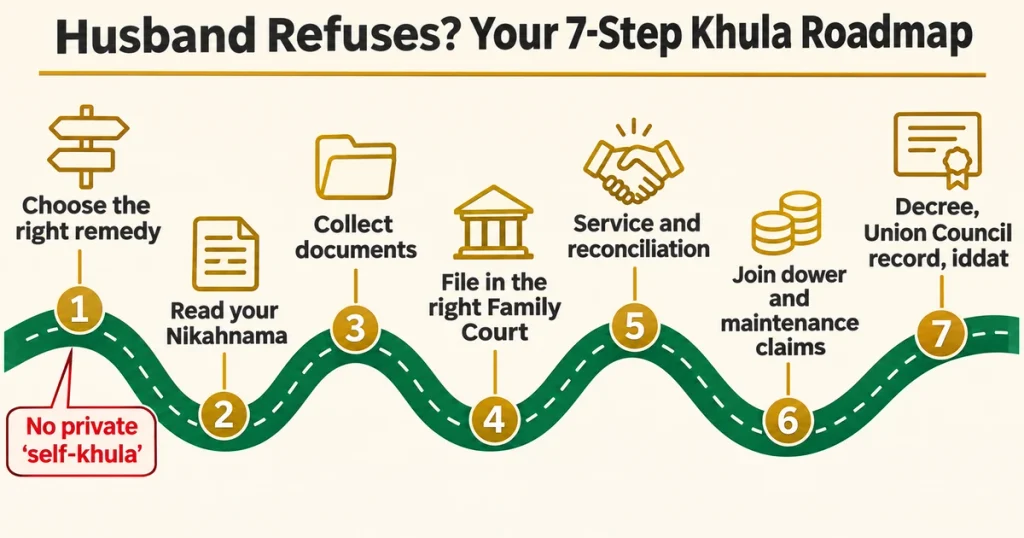
How to Get Khula Without Husband Consent: 7 Steps
- Choose the right remedy. Options include judicial khula, dissolution under the 1939 Act, delegated divorce (talaq-e-tafweez) if your Nikahnama gives you that right, or mutual divorce. Our guide to the divorce procedure in Pakistan compares them.
- Read your Nikahnama. Check the dower amount, whether it is prompt or deferred, any house or gold promised, and the delegated-divorce column.
- Collect documents. Keep the Nikahnama, both CNIC copies, current addresses, the dowry list and proof of any statutory ground.
- File in the right Family Court. Usually this is where the wife ordinarily resides. If the marriage or husband is abroad, read our guide on marriage in Pakistan and foreign nikah.
- Let service and reconciliation run. Attend every hearing. If reconciliation fails, the court moves to a decree.
- Join your money claims. Claim dower, maintenance and dowry articles in the same suit where the law allows.
- Close the file properly. Get certified copies, complete the Union Council record and observe iddat.
Evidence to Keep and Mistakes to Avoid
Before filing for khula without husband consent, preserve abusive messages and voice notes, medical reports, complaint copies, proof that maintenance stopped, proof of a second marriage, the dowry list with receipts, and names of witnesses.
The costliest mistakes are treating a foreign fatwa as Pakistani law, declaring khula privately instead of filing a suit, choosing khula when strong statutory grounds could protect your dower, and remarrying before the decree and iddat are both complete.
Frequently Asked Questions
Can a woman get khula without husband consent in Pakistan?
Yes. In PLD 2023 FSC 286, the Federal Shariat Court reaffirmed its 2014 Full Bench view that a competent Family Court can decree khula when reconciliation fails, even if the husband refuses. His refusal is relevant to the hearing, but it is not a veto. She must still file a suit, he must be served, and the court must first attempt reconciliation.
Is khula valid in Islam if the husband does not agree?
Scholars differ. Many classical jurists required the husband’s consent, so some fatwa sites call court khula invalid. Pakistani courts, starting with Khurshid Bibi in 1967, recognised judicial khula, and the Federal Shariat Court upheld it in 2014 and 2023. Inside Pakistan, your legal status follows the Family Court decree.
What happens if my husband does not agree or never comes to court?
The case continues. The Family Court will serve him and attempt reconciliation. If he still refuses, the court can decree khula once reconciliation fails. If he deliberately stays away after lawful service, the court may proceed in his absence. Give his correct address and phone number to avoid service delays.
Can a wife divorce her husband without his consent?
Not privately. She needs a court decree, either for khula or for dissolution under the Dissolution of Muslim Marriages Act, 1939. The only out-of-court route is delegated divorce (talaq-e-tafweez), and only if the husband validly delegated that right in the Nikahnama. A WhatsApp message or stamp-paper declaration does not end a marriage.
Does a wife lose her haq mehr in khula?
Not automatically, and PLD 2023 FSC 286 did not decide this point. In Punjab, Section 10(5) lets the court direct surrender of up to 50% of deferred dower or 25% of admitted prompt dower, as a ceiling. If she proves a statutory ground such as cruelty instead, her dower is generally protected.
Can a husband appeal against a khula decree?
Section 14(2) of the Family Courts Act, 1964 bars an ordinary appeal against a decree dissolving a marriage, apart from a narrow exception. A husband may take legal advice on a High Court challenge if the decree has a real legal defect, such as no lawful service. His refusal alone is not a ground.
Is halala required if they want to remarry after khula?
No. The Federal Shariat Court explained that khula operates as a single irrevocable divorce. If both former spouses agree, they can remarry through a fresh nikah, without any intermediary marriage. Halala becomes relevant only where a husband’s third talaq has attained finality and he later wants to remarry the same woman.
Is iddat required after khula?
Yes, if she wants to marry someone else. The Federal Shariat Court said in PLD 2023 FSC 286 that iddat is incumbent on the wife before marrying another man after khula. Its length can depend on her circumstances, such as pregnancy, so confirm the decree date and iddat period with a lawyer or scholar first.
Conclusion: His Refusal Is Not the Last Word
PLD 2023 FSC 286 settles one fear for Pakistani wives: khula without husband consent is available through a competent Family Court once reconciliation fails. The Federal Shariat Court refused to call that judicial power un-Islamic and dismissed the challenge at the first hearing.
Yet the route still matters. Khula is a court remedy, not a private declaration. It is her choice, so no court should force it on her, and the label on your suit can decide your dower. Read your Nikahnama, choose the remedy that fits your facts, and protect your money claims before the decree. More guides are in our Khula and Divorce section.
Disclaimer
This article is for legal awareness only and is not legal advice. Every family case depends on its own facts, documents, province and evidence. For your specific matter, consult a qualified family lawyer.