
A marriage may end before rukhsati, but the financial dispute can continue for years. In this case, a woman obtained khula after her marriage remained unconsummated. The Family Court ordered her to return only 25% of the admitted prompt dower. The Lahore High Court later directed her to return the entire 15 tolas of gold. The dispute finally reached the Supreme Court of Pakistan.
The Supreme Court corrected that result. It held that, in Punjab, section 10(5) of the Family Courts Act, 1964 places a clear limit on what a wife may be directed to surrender in a khula case. Her liability was reduced from 15 tolas to 3.75 tolas.
This judgment is an important explanation of Khula Law in Pakistan because it separates khula from talaq, explains prompt and deferred dower, protects bridal gifts from recovery and warns courts against applying a precedent from another province without checking the local law.
The case is Mst. Rafia Yaqoob v. Suleman Ayub, reported as 2026 SCMR 561. It was decided on 23 January 2026 by Justice Shahid Waheed, Justice Musarrat Hilali and Justice Salahuddin Panhwar. Justice Musarrat Hilali authored the judgment.
Table of Contents
IRAC Analysis: Why the Wife Had to Return Only 3.75 Tolas
| Element | Simple Explanation |
|---|---|
| Issue | Could a wife in Punjab be ordered to return the entire prompt dower merely because the marriage was never consummated, or was her liability limited to 25% under section 10(5)? |
| Rule | In Punjab, section 10(5) allows the Family Court to direct surrender of up to 25% of admitted prompt dower or up to 50% of deferred dower in a khula case. |
| Analysis | The law makes no distinction between consummated and unconsummated marriages. The High Court also relied on a Khyber Pakhtunkhwa precedent where Punjab’s amended section 10(5) did not apply. |
| Conclusion | The Supreme Court set aside the High Court judgment and restored the order requiring return of only 3.75 tolas, being 25% of the admitted 15 tolas prompt dower. |
Judgment at a Glance: Khula, Dower and 15 Tolas Dispute
| Detail | Information |
|---|---|
| Case Title | Mst. Rafia Yaqoob v. Suleman Ayub |
| Citation | 2026 SCMR 561 |
| Court | Supreme Court of Pakistan |
| Bench | Justice Shahid Waheed, Justice Musarrat Hilali and Justice Salahuddin Panhwar |
| Author Judge | Justice Musarrat Hilali |
| Case Number | Civil Petition for Leave to Appeal No. 2159 of 2025 |
| Decision Date | 23 January 2026 |
| Marriage Date | 1 December 2017 |
| Prompt Dower | 15 tolas of gold ornaments |
| Rukhsati | Did not take place |
| Marriage Status | Unconsummated |
| Family Court | Khula granted; wife to surrender 25% |
| Appellate Court | Family Court decree upheld |
| Lahore High Court | Wife ordered to return all 15 tolas |
| Supreme Court | High Court judgment set aside; only 3.75 tolas returnable |
| Key Provision | Section 10(5), Family Courts Act, 1964, as applicable in Punjab |
| Final Result | Appeal allowed |
Khula Law in Pakistan Before Rukhsati: Why the Gold Dispute Continued
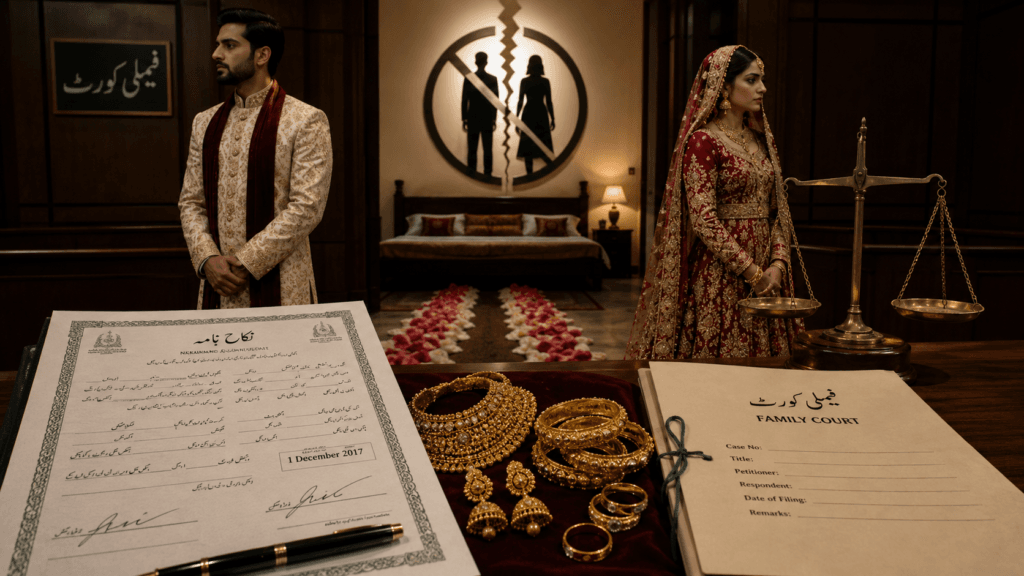
Rafia Yaqoob and Suleman Ayub married on 1 December 2017. Columns 13 and 14 of the nikahnama recorded 15 tolas of gold ornaments as prompt dower.
Rukhsati never took place, and the marriage remained unconsummated. The wife later filed a suit for dissolution of marriage through khula.
One fact remained important throughout the case: she did not state that the admitted prompt dower was unpaid. The husband also did not deny that the nikahnama recorded 15 tolas.
This factual position shaped the result under Khula Law in Pakistan. The dispute was not whether dower existed. The real question was how much could lawfully be surrendered as zar-e-khula.
Khula Law in Pakistan Protects Bridal Gifts from Recovery
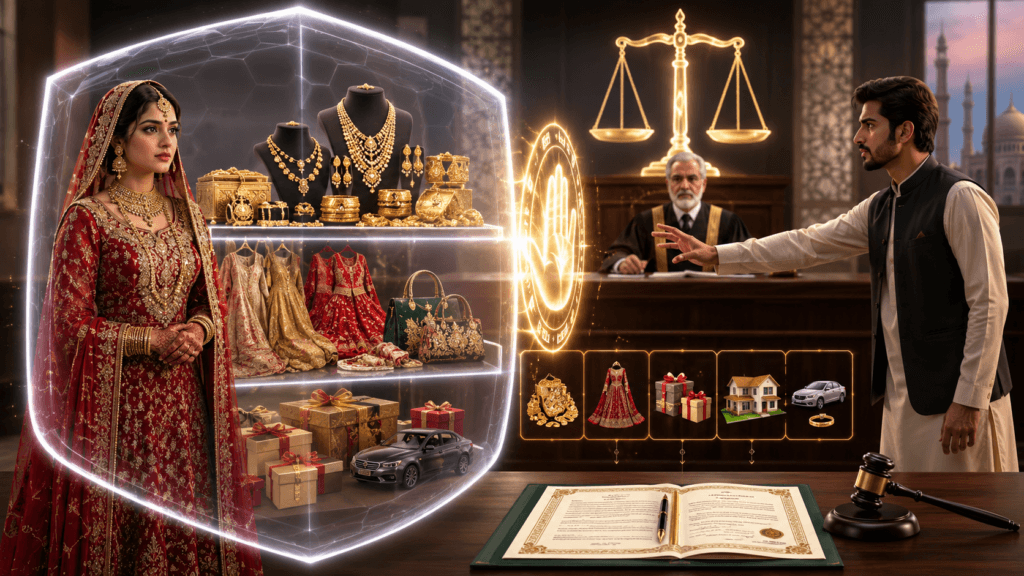
The husband denied the wife’s allegations and said that he was ready to perform his marital obligations. He also claimed that gold ornaments, dresses and other items had been given to her for the marriage and demanded their recovery.
The Supreme Court drew a clear distinction between dower, dowry, bridal gifts, wedding presents and a husband’s personal property.
Items voluntarily given by the husband or his family to the bride in connection with marriage become the bride’s absolute property. They cannot later be reclaimed merely because the marriage ended.
This principle is important under Khula Law in Pakistan. A husband cannot label every gift, dress or ornament as his own property and demand its return in khula proceedings.
The Supreme Court agreed that the courts below had correctly refused to entertain the claim for those additional items.
The financial result of khula may also depend on why the marriage failed and which spouse was responsible. Read our detailed guide on Grounds for Khula in Pakistan to understand how cruelty, non-maintenance and marital misconduct may affect Haq Mehr.
Khula Law in Pakistan: The Family Court Applied the 25% Limit
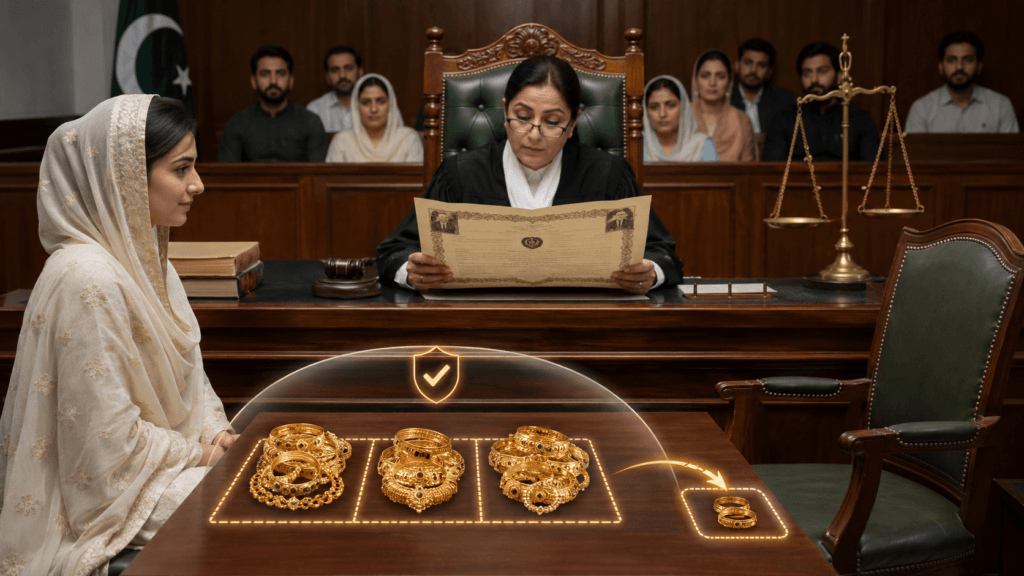
The husband did not appear during reconciliation proceedings before the Family Court. After recording the wife’s statement, the Family Court dissolved the marriage through khula on 17 December 2018.
It directed the wife to surrender 25% of the admitted prompt dower under section 10(5) of the Family Courts Act, 1964, as applicable in Punjab.
The husband challenged that decree, but the Appellate Court dismissed his appeal on 8 April 2019 and upheld the 25% condition.
At that stage, Khula Law in Pakistan limited the wife’s liability to one-fourth of the admitted prompt dower.
The Lahore High Court Raised the Liability from 3.75 to 15 Tolas
The Lahore High Court, Rawalpindi Bench, interfered with the concurrent findings of the Family Court and Appellate Court.
Because rukhsati had not taken place and the marriage remained unconsummated, the High Court directed the wife to return the entire 15 tolas of gold.
The financial result changed dramatically. Instead of 3.75 tolas, she became liable for all 15 tolas.
She approached the Supreme Court and argued that the High Court had ignored the clear wording of section 10(5). The decisive question for Khula Law in Pakistan was whether non-consummation could override a statutory maximum.
The Wife Had Accepted the 25% Condition
The Supreme Court carefully examined the record.
It noted that the wife had never challenged the condition requiring her to surrender 25% of the prompt dower. In her petition, she stated that the Family Court and Appellate Court judgments were consistent with law and facts.
She did not claim that the admitted prompt dower was unpaid, and she did not dispute the figure of 15 tolas.
The Supreme Court therefore did not remove the 25% condition. The wife had accepted that limited liability. The real issue was whether the High Court could increase it from 25% to 100%.
Section 10(5): The Core Rule of Khula Law in Pakistan
Section 10(5), as applicable in Punjab, provides that when reconciliation fails and marriage is dissolved through khula, the Family Court may direct the wife to surrender:
- up to 25% of her admitted prompt dower; or
- up to 50% of her deferred dower.
The words “up to” create a maximum ceiling. They do not impose an automatic fixed amount in every case.
For prompt dower, the maximum is 25%. For deferred dower, the maximum is 50%.
This is the central statutory rule of Khula Law in Pakistan for cases arising in Punjab. Courts must apply the text actually in force rather than rely on general assumptions about what a wife should return.
Khula Law in Pakistan Creates No Harsher Rule for an Unconsummated Marriage
The Supreme Court read section 10(5) according to its plain wording.
It found no distinction between a marriage where rukhsati occurred and one where it did not, or between a consummated and unconsummated marriage.
The Punjab provision does not say that a wife must return the whole prompt dower when the marriage remains unconsummated. A court cannot insert that condition into the law.
Once a wife seeks dissolution through khula in Punjab, the return of dower is controlled by section 10(5). Non-consummation does not permit the court to cross the statutory ceiling.
This is one of the clearest recent principles of Khula Law in Pakistan.
Khula and Talaq Are Different Legal Routes
The Lahore High Court relied on Qur’anic verse 2:237 while deciding the dower issue.
The Supreme Court held that this reliance was misplaced because the verse concerns divorce through talaq, while the present case involved dissolution through khula.
The Court added that section 10(5) was clear and unambiguous. There was no need to enter into a wider religious discussion when the governing statute directly answered the question.
In talaq, the husband initiates divorce. In khula, the wife seeks dissolution through the Family Court after reconciliation fails. Financial consequences cannot automatically be transferred from one route to the other.
A proper understanding of Khula Law in Pakistan requires the court to identify the exact mode of dissolution before deciding the effect on mahr.
One Province’s Precedent Could Not Control Another Province’s Law

The High Court relied on Mst. Tayyeba Ambreen v. Shafqat Ali Kayani, reported as 2023 SCMR 246.
The Supreme Court explained that the earlier case arose from Khyber Pakhtunkhwa, where Punjab’s amended section 10(5) did not apply. The statutory framework was materially different.
A judgment cannot be applied mechanically merely because both cases concern khula and dower. A court must first ask whether the same provincial amendment and legal wording apply.
The High Court overlooked that difference.
This gives Khula Law in Pakistan an important provincial dimension. A rule applied in one province may not automatically govern a case arising in another province.
The Simple Calculation That Protected 11.25 Tolas
The admitted prompt dower was 15 tolas of gold.
The maximum permitted return was 25%.
25% of 15 tolas = 3.75 tolas
The High Court had ordered return of all 15 tolas, which was four times the amount restored by the Supreme Court.
The wife was therefore protected from returning the remaining 11.25 tolas.
This calculation makes Khula Law in Pakistan easy to understand. The result must come from the governing statute, not from social pressure or an assumption that non-consummation always requires full return.
Khula Law in Pakistan: The Supreme Court Restored Legal Protection

The Supreme Court converted the petition into an appeal and allowed it.
It set aside the Lahore High Court judgment dated 18 March 2025 and restored the Appellate Court judgment dated 8 April 2019.
The wife was directed to return only 3.75 tolas of gold. Her khula decree remained effective, while the husband’s claim for bridal gifts and wedding items remained unsuccessful.
The final result under Khula Law in Pakistan protected her from returning all 15 tolas while respecting the limited zar-e-khula condition she had accepted.
Five Practical Lessons from Khula Law in Pakistan
First, an unconsummated marriage does not automatically require full return of prompt dower in a Punjab khula case.
Second, section 10(5) places a maximum ceiling of 25% on admitted prompt dower and 50% on deferred dower.
Third, bridal gifts and presents are different from dower and ordinarily become the bride’s property.
Fourth, khula and talaq must not be treated as the same legal route.
Fifth, provincial amendments matter. Lawyers and families should check the law applicable in the province where proceedings are filed.
These lessons make Khula Law in Pakistan more predictable for ordinary families facing emotionally difficult litigation.
Practical Checklist Before Filing or Defending a Khula Case
Keep the following documents and information ready:
- original nikahnama;
- clear copies of columns 13 and 14;
- proof of whether dower was prompt or deferred;
- receipts or proof of payment;
- list of bridal gifts and presents;
- evidence showing ownership of disputed items;
- plaint and written statement;
- reconciliation proceedings;
- Family Court decree;
- appellate and constitutional court orders;
- details of the province whose law applies.
The Nikahnama also determines important rights relating to marriage registration and payment of dower. Read our complete explanation of the Muslim Family Laws Ordinance to understand marriage records, talaq, maintenance and Haq Mehr in Pakistan.
The wording of pleadings also matters. In this case, the wife had not pleaded that the prompt dower was unpaid and had accepted the 25% condition.
Careful pleadings can therefore change the result under Khula Law in Pakistan.
Final Takeaway: Khula Must Follow the Statute, Not Assumptions
The Supreme Court’s message is direct.
A court in Punjab cannot order a wife to return the entire prompt dower merely because rukhsati did not occur or the marriage remained unconsummated.
Section 10(5) sets the maximum at 25% of admitted prompt dower and 50% of deferred dower. It creates no harsher rule for an unconsummated marriage.
The judgment also protects bridal gifts, keeps khula separate from talaq and prevents careless reliance on precedents from a different provincial framework.
For families, lawyers and women seeking dissolution, Khula Law in Pakistan becomes easier to understand through this judgment: read the nikahnama, identify the type of dower, check the applicable provincial law and calculate the liability within the statutory ceiling.
Frequently Asked Questions
1. What did the Supreme Court decide in 2026 SCMR 561?
The Court held that, in Punjab, the wife could be directed to return only 25% of the admitted prompt dower. From 15 tolas of gold, her maximum liability was 3.75 tolas.
2. Must a wife return the entire dower if rukhsati never took place?
Not under the Punjab provision applied in this case. Section 10(5) does not distinguish between consummated and unconsummated marriages.
3. What is the maximum return of prompt dower in Punjab?
A Family Court may direct surrender of up to 25% of the admitted prompt dower when granting khula.
4. What is the maximum return of deferred dower in Punjab?
Section 10(5) permits surrender of up to 50% of deferred dower in a khula case.
5. Can a husband recover bridal gifts after khula?
Gifts and presents given by the husband or his family to the bride ordinarily become her absolute property. They are different from dower and cannot simply be reclaimed as the husband’s personal property.
6. Why was the Lahore High Court judgment set aside?
The High Court exceeded the statutory limit, treated non-consummation as a reason for full return and relied on legal reasoning and precedent that did not fit the Punjab khula framework.
7. Does this ruling apply identically in every province?
The central holding directly concerns section 10(5) as applicable in Punjab. Provincial family-law amendments may differ, so the local law must be checked.
Disclaimer
This article explains a reported Supreme Court judgment for public legal awareness. It is not legal advice. Family cases depend on their own pleadings, evidence, nikahnama terms and applicable provincial law. A qualified family lawyer should be consulted before legal action.