
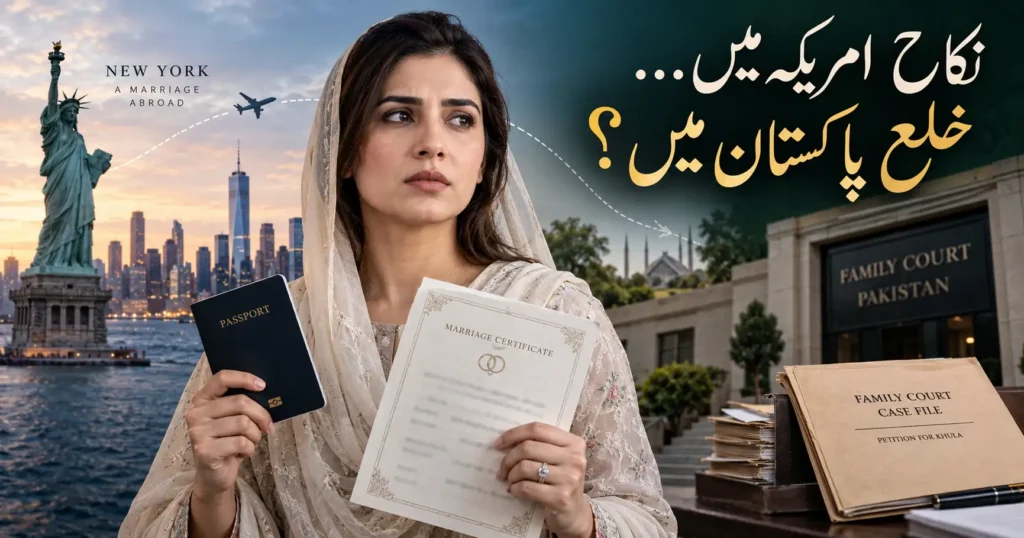
The Nikah took place in New York. The wife was living in the United States. The husband returned to Pakistan. When the relationship broke down, the wife did something many overseas Pakistanis may not expect: she filed for khula in a Family Court in Karachi.
The husband objected. His argument was straightforward—if the marriage happened in America and the wife was living there, how could a Pakistani court hear the case?
The dispute eventually reached the Supreme Court of Pakistan.
In 2024 SCMR 634, the Court explained an important rule about Marriage in Pakistan: the country where a Nikah was performed does not, by itself, decide where a dissolution case can be filed. In a suit for dissolution of marriage or dower, the wife’s ordinary residence can create an additional basis of territorial jurisdiction.
But this judgment is often capable of being overstated. It did not give every overseas wife a right to file anywhere in Pakistan. It did not decide every question about foreign marriages. And it did not convert nationality or a family address into automatic jurisdiction.
This guide explains what the Supreme Court actually decided, how the case moved from New York to Karachi, what evidence mattered, how khula procedure works, and what an overseas spouse should check before filing a family case in Pakistan.
Table of Contents
Judgment at a Glance of 2024 SCMR 634
| Point | What the Record Shows |
|---|---|
| Case | Sohail Ahmed v. Mst. Samreena Rasheed Memon and another |
| Citation | 2024 SCMR 634 |
| Court | Supreme Court of Pakistan |
| Bench | Muhammad Ali Mazhar, Syed Hasan Azhar Rizvi and Irfan Saadat Khan, JJ |
| Decision Date | 20 December 2023 |
| Marriage | Registered in New York, USA, according to Islamic law |
| Wife | Dual citizen of Pakistan and USA |
| Dower | US$5,000 |
| Family Suit | Filed in Karachi East through a duly constituted attorney |
| Core Issue | Whether the Pakistani Family Court had jurisdiction |
| Key Law | Rule 6, Family Courts Rules, 1965; Section 10, Family Courts Act, 1964 |
| Supreme Court Result | Petitions dismissed; leave to appeal refused |
The reported judgment confirms the case title, bench, date and challenge to the Sindh High Court order. It also records the New York marriage, dual nationality, US$5,000 dower and filing of the Karachi family suit.
IRAC: Could the Wife File Khula in Karachi?
| IRAC | Legal Position |
|---|---|
| Issue | Could a wife living in the USA pursue dissolution in Karachi when the marriage had been registered in New York? |
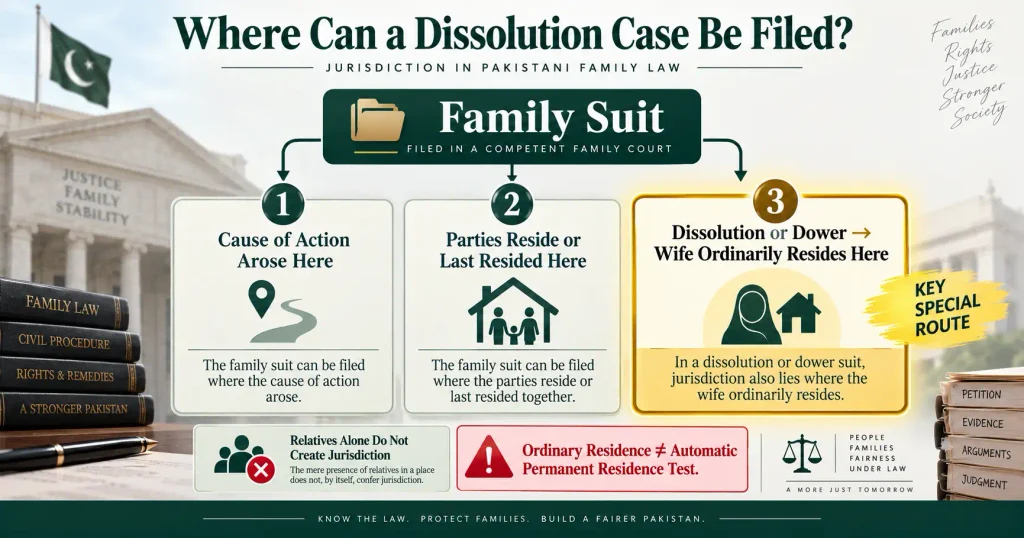
| Rule | Rule 6 allows jurisdiction where the cause of action arose, where the parties reside or last resided together, and—specifically for dissolution or dower—where the wife ordinarily resides. |
| Analysis | The wife lived in the USA when proceedings began, but she had studied in Karachi, usually came to Pakistan and visited her family in Karachi from time to time. |
| Conclusion | On those facts, the Supreme Court upheld the Pakistani Family Court’s jurisdiction and refused leave to appeal. |
The proviso to Rule 6 expressly gives additional jurisdiction in dissolution and dower suits to the court within whose local limits the wife ordinarily resides. (KP Code)
That small phrase—“ordinarily resides”—became the turning point of the case.
A New York Nikah Became a Karachi Court Case
The marriage began outside Pakistan.
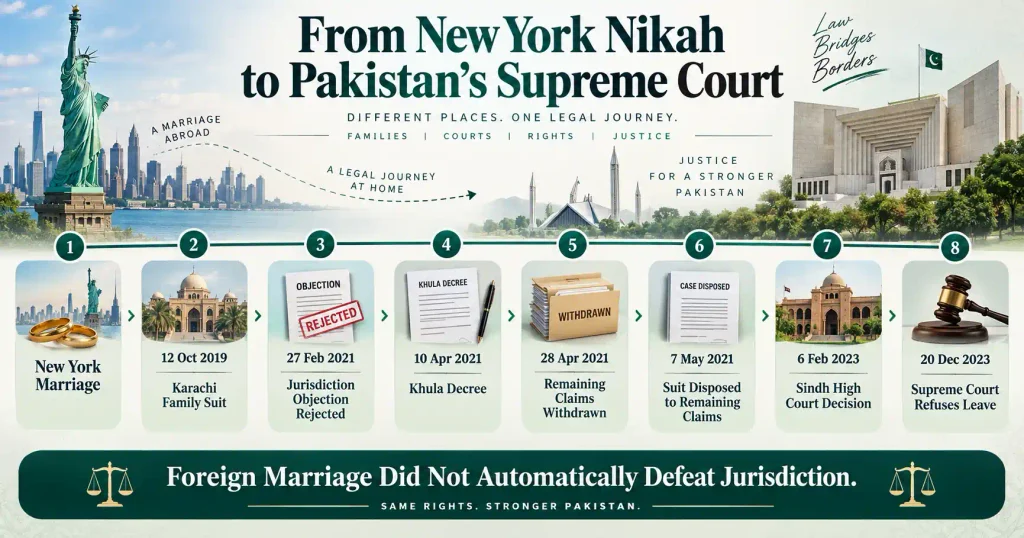
According to the judgment, Sohail Ahmed and Samreena Rasheed Memon contracted a marriage in New York, USA, registered according to Islamic law. The wife was a dual Pakistani-American citizen and the agreed dower was US$5,000.
The judgment then records the wife’s allegation that within nine months the husband behaved harshly and irresponsibly and returned to Pakistan. That statement is part of the factual background; it should not be confused with a final finding after a complete trial proving every allegation of misconduct.
As the relationship deteriorated, the wife acted through her duly constituted attorney and filed Family Suit No. 3414 of 2019 on 12 October 2019 before the Family Judge, Karachi East. She sought dissolution of marriage by way of khula along with another family claim.
This is where the real Marriage in Pakistan question began.
Could Karachi hear a matrimonial dispute when the Nikah took place thousands of kilometres away?
Why the Husband Said Karachi Had No Jurisdiction
The husband challenged the forum rather than simply accepting the family proceedings.
On 17 December 2019, he applied for dismissal of the suit or return of the plaint. His position was that Pakistani courts lacked jurisdiction because the marriage had been solemnised in the USA and, according to him, the cause of action had also arisen there.
The Family Court rejected that objection on 27 February 2021. The husband then challenged the order before the Sindh High Court.
At first glance, his argument may sound intuitive: foreign marriage, foreign residence, foreign dispute.
But Rule 6 contains something more.
For dissolution of marriage and dower, the normal territorial rules are supplemented by another connecting factor—the place where the wife ordinarily resides.
That became decisive.
What “Ordinarily Resides” Really Meant Here
One of the most useful parts of 2024 SCMR 634 is the Supreme Court’s treatment of ordinary residence.
The Court did not equate it with permanent residence.
The wife was admittedly living in the United States when the suit was instituted. Yet the record showed that she had acquired her education in Karachi, usually came to Pakistan and visited her family in Karachi from time to time.
The Court held that the wording of Rule 6 was intended to relax the normal rule of territorial jurisdiction for a wife seeking dissolution or dower and to take her convenience into account, subject to law.
The official Family Courts Rules state that jurisdiction ordinarily exists where the cause of action wholly or partly arose or where the parties reside or last resided together. The proviso then adds the wife’s ordinary residence for dissolution and dower cases. (KP Code)
That distinction matters enormously in Marriage in Pakistan cases involving overseas spouses.
What the Judgment Does Not Say
The decision should not be rewritten as:
“An overseas Pakistani woman can file khula wherever her parents live.”
That is too broad.
Nor does the judgment say:
“Pakistani nationality automatically creates Family Court jurisdiction.”
It does not.
The Court decided jurisdiction on the particular facts before it. A future litigant should therefore plead and document the facts showing why the selected Family Court has territorial jurisdiction instead of relying on citizenship or a convenient Pakistani address alone.
Can an Overseas Wife File Through an Attorney?
The judgment records that the wife instituted proceedings through a duly constituted attorney while she was living in the USA.
For overseas couples, this makes Marriage in Pakistan a question of both procedure and proper territorial jurisdiction.
The Family Courts Rules also contemplate presentation of a female plaintiff’s plaint through her agent. (KP Code)
But there is an important limitation.
2024 SCMR 634 was not a blanket ruling that an attorney can replace the wife at every possible stage of every family case. Personal evidence, reconciliation, identification, cross-examination or another procedural requirement may raise separate questions depending on the case and applicable law.
For Marriage in Pakistan disputes involving a spouse abroad, the safer approach is to prepare the power of attorney carefully, verify its execution and authentication requirements, and check whether the court requires personal participation at any stage.
Reconciliation Was Not Just a Formal Step
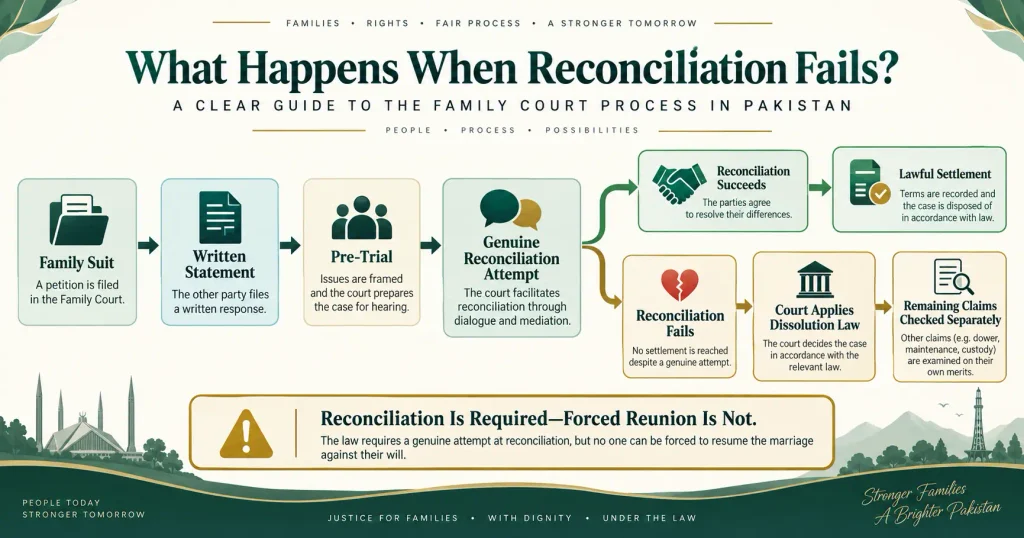
After the jurisdiction objection failed, the Family Court conducted reconciliation proceedings.
The reconciliation did not succeed.
On 10 April 2021, the Family Court ordered dissolution of marriage by way of khula and prepared a preliminary decree on the same day. Other prayer clauses remained for further proceedings.
Section 10 of the Family Courts Act requires the Family Court at the pre-trial stage to identify the disputed points and attempt compromise or reconciliation where possible. The statutory text further provides for a dissolution decree where reconciliation fails in the circumstances covered by the provision.
The Supreme Court described reconciliation as a genuine legal obligation, not an empty box that a court merely ticks before moving ahead.
But genuine reconciliation is different from forced continuation of a marriage.
Where the legally required reconciliation fails, the Family Court must proceed according to the statutory framework.
For a fuller explanation of this issue, readers can also see Qanooni Dastak’s guide to Khula Without Husband Consent.
Did the Wife Have to Prove Every Marital Allegation?
This is another place where a judgment can easily be misunderstood.
The Supreme Court did not conduct a full trial to determine whether every allegation about the husband’s conduct was independently proved.
Its central reasoning concerned:
- territorial jurisdiction;
- the meaning and purpose of Rule 6;
- reconciliation under Section 10;
- the khula decree; and
- what happened after the remaining prayers were withdrawn.
The judgment states that after genuine reconciliation efforts fail, the statutory proviso applied by the Court permits dissolution without first recording evidence on the khula issue in the manner suggested by the husband’s challenge.
This distinction is important in Marriage in Pakistan litigation.
A khula claim should not automatically be confused with a wife seeking dissolution on an independent statutory ground such as cruelty or another legally recognised ground. Different causes of action can involve different evidence and different consequences for dower and other financial rights.
Why the Preliminary Decree Became Final
Khula did not immediately end every claim pending in the suit.
After the preliminary decree was passed, the case continued in relation to the remaining prayer clauses.
Then, on 28 April 2021, the wife filed a statement supported by her attorney’s affidavit withdrawing those remaining prayers. On 7 May 2021, the Family Court disposed of that part of the suit as withdrawn.
The husband challenged this development as well.
The Supreme Court held that because the remaining prayers had been withdrawn, the preliminary decree for dissolution already passed and prepared would be deemed the final decree.
That conclusion was tied to the procedural history of this case.
It does not create a rule that every preliminary decree in every Marriage in Pakistan dispute automatically becomes final without looking at what remains pending.
What Happened in the Sindh High Court
The husband had filed two constitutional petitions.
One challenged the Family Court’s jurisdiction. The other challenged what happened after the remaining claims were withdrawn.
The Sindh High Court consolidated the petitions and dismissed them through its order dated 6 February 2023.
The matter then reached the Supreme Court through Civil Petitions Nos. 488-K and 489-K of 2023.
The Supreme Court examined the record and found no legal or factual defect requiring interference.
What the Supreme Court Finally Decided
The Supreme Court agreed with the courts below.
It held that the Family Court had properly exercised jurisdiction on the facts of the case.
The decision therefore adds an important jurisdiction lesson to Marriage in Pakistan where spouses have connections with more than one country.
It also accepted the khula decree passed after failed reconciliation and held that once the wife withdrew her remaining prayers, the preliminary decree was to be treated as the final decree.
There was another striking fact in the record.
After the preliminary khula decree, the wife contracted a second marriage in the United States. The judgment also records that the husband had made applications to the concerned Pakistani authorities seeking permission to solemnise another marriage.
The Supreme Court observed that the marriage between the parties stood dissolved and that the petitioner was unnecessarily dragging the respondent into litigation.
The petitions were dismissed and leave to appeal was refused.
That is the actual final relief in 2024 SCMR 634.
What the Supreme Court Did Not Decide
A strong legal article is as clear about the limits of a judgment as it is about the rule.
The Court did not decide that every foreign Nikah comes within Pakistani jurisdiction.
It did not decide that nationality alone proves ordinary residence.
It did not hold that having parents or relatives in a Pakistani city automatically allows a wife to file there.
It did not decide whether every foreign marriage must be registered in Pakistan in the same way.
It did not decide the immigration, citizenship or foreign-law consequences of the Pakistani khula decree.
And it did not turn the wife’s allegations about the husband’s behaviour into a general finding of proved cruelty.
These limits make 2024 SCMR 634 more useful, not less. They show exactly where its authority should be used.
Marriage Registration Still Matters
A jurisdiction judgment should not distract couples from the basic legal record of the marriage itself.
Section 5 of the Muslim Family Laws Ordinance, 1961 states that every marriage solemnised under Muslim law must be registered in accordance with the Ordinance. (Pakistan Code)
The Nikahnama can later become crucial evidence of matters such as:
- identities of the spouses;
- date and place of Nikah;
- agreed dower;
- prompt or deferred dower terms;
- special conditions recorded in the Nikahnama; and
- other contractual particulars.
For a detailed section-by-section explanation, see Muslim Family Laws Ordinance Guide.
When Marriage in Pakistan has a foreign element, preserve both the Pakistani documents, if any, and the original foreign marriage record. Do not assume that a photograph of a certificate on WhatsApp will be enough if authenticity later becomes disputed.
Check Marriage Age Before the Nikah
Marriage-age law is another area where old internet articles can be dangerous.
There is no safe reason to rely on an outdated nationwide chart without checking the law applying to the exact province or territory.
For example, the Punjab Child Marriage Restraint Act, 2026, which came into force in May 2026, defines a child as a male or female under 18 and prohibits a Nikah Registrar from registering a child marriage.
That is a major current-law change for Punjab.
Anyone planning a Marriage in Pakistan should therefore verify the applicable age rule where the Nikah will actually take place, rather than relying on an older judgment or social-media post.
For adult-choice marriages and documentation, see Court Marriage in Pakistan.
Build the Evidence File Before a Dispute
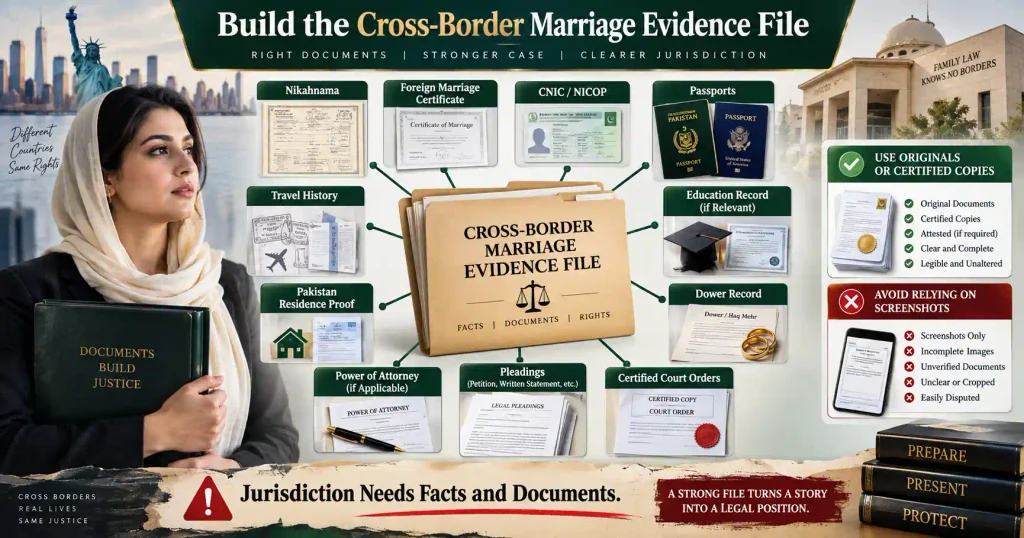
Cross-border family litigation becomes much harder when documents are scattered between two countries.
Before filing—or before defending—a claim, preserve the best available originals and certified records.
Useful documents may include:
- Nikahnama;
- certified marriage-registration record;
- foreign marriage certificate;
- CNIC or NICOP;
- passports;
- relevant entry and exit history;
- Pakistani residence material;
- education records where residence becomes relevant;
- proof of the family address relied upon;
- dower record;
- valid power of attorney, where used;
- previous pleadings;
- certified Family Court orders; and
- lawfully obtained communications relevant to a pleaded issue.
In a Marriage in Pakistan jurisdiction dispute, dates can be as important as documents.
Prepare a simple chronology showing when the marriage took place, where each spouse lived, when separation occurred, when Pakistan was visited, where the suit was instituted and what relief was claimed.
A clear timeline can expose a weak jurisdiction objection—or a weak jurisdiction claim—very quickly.
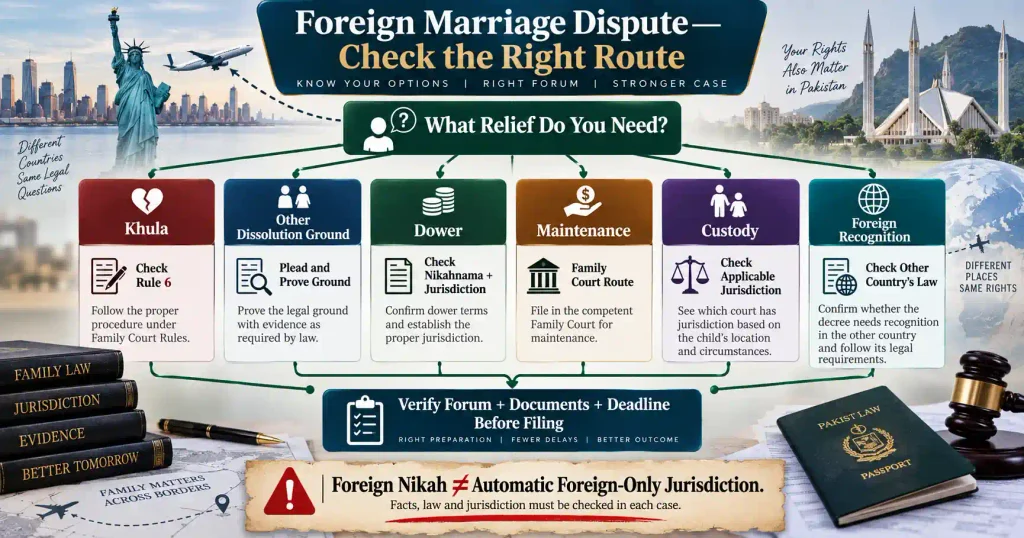
Which Court Should You Approach?
Do not begin with the question, “Which court is nearest to me?”
Begin with:
What exact relief do I need?
A matrimonial dispute may involve khula, dissolution on another statutory ground, dower, maintenance, dowry articles, custody, visitation or several claims together.
For dissolution and dower, Rule 6 specifically recognises the wife’s ordinary residence as an additional jurisdictional basis. (KP Code)
Other claims still require the correct legal and territorial analysis.
That means a person dealing with Marriage in Pakistan should check three things before filing:
- Remedy: What exactly are you asking the court to grant?
- Forum: Which Family Court has territorial jurisdiction?
- Evidence: What facts and documents establish that jurisdiction and claim?
The wording of the plaint matters. The documents matter. The selected court matters.
Filing first and investigating jurisdiction later can waste months.
Do Not Ignore Deadlines and Appeal Limits
Family litigation has procedural deadlines, but they must be matched with the correct order or decree.
The Family Courts Rules provide a 30-day period for an appeal where an appeal lies, excluding the time required to obtain copies, while allowing extension for sufficient cause. (KP Code)
However, Section 14 of the Family Courts Act also places important restrictions on appeals from dissolution decrees. A person should therefore not assume that every family decree carries an ordinary right of appeal merely because a general appeal period exists.
The Act also states a six-month statutory period for disposal of family cases, including dissolution suits, and provides a route to seek High Court directions when a case exceeds that period.
The practical rule is simple: obtain the certified order or decree promptly and identify the exact statutory remedy before counting the limitation period.
Seven Lessons From 2024 SCMR 634
The first lesson is that the place of Nikah is important, but it does not automatically control territorial jurisdiction.
The second is that ordinary residence is not identical to permanent residence.
The third is that jurisdiction must still be proved through the actual facts connecting the wife with the selected local limits.
The fourth is that a foreign-based wife is not automatically excluded from Pakistani Family Courts merely because she is abroad when proceedings begin.
The fifth is that reconciliation under Section 10 is a genuine judicial duty, not merely a ceremonial step.
The sixth is that once the remaining prayers in this particular case were withdrawn, the preliminary khula decree became final.
The seventh is that Marriage in Pakistan cases involving two countries require more—not less—attention to jurisdiction, documents and procedural history.
Common Mistakes That Can Damage a Family Case
One mistake is assuming that a marriage performed abroad must always be dissolved abroad.
Another is writing a Pakistani address in the plaint without preserving evidence supporting the claimed ordinary residence.
A third is confusing khula with every other form of dissolution. The legal ground matters because the consequences can differ.
A fourth is treating allegations as proved facts. Courts distinguish what a party says from what the evidence establishes and what the judgment actually decides.
A fifth is ignoring dower and other connected claims while focusing only on dissolution.
A sixth is using an incomplete or poorly authenticated power of attorney in a cross-border matter.
A seventh is assuming that a khula decree necessarily has the same legal effect in every foreign country. Recognition abroad may depend on that country’s own law.
And perhaps the most avoidable mistake is continuing to rely on screenshots when original or certified records are available.
A careful Marriage in Pakistan case should therefore begin with the correct forum, complete documents and the exact relief required.
A well-prepared Marriage in Pakistan case should begin with the correct forum, complete documents and a clear understanding of the relief being claimed.
Why This Case Matters to Overseas Pakistanis
Modern Pakistani families often live across borders.
For overseas families, Marriage in Pakistan may involve residence, jurisdiction and documents spread across more than one country.
One spouse may work in Dubai. Another may have citizenship in Canada. A couple may marry in New York but retain close residential and family links with Karachi. Documents may exist in several countries while the actual family dispute eventually reaches a Pakistani court.
That is why Marriage in Pakistan can no longer be understood only through the location of the wedding ceremony.
2024 SCMR 634 shows that jurisdiction is a legal question built from statutory rules and real facts.
For the wife in this case, her education in Karachi, regular visits and family connection formed part of the factual basis considered by the Supreme Court. The Court did not treat her residence in America as automatically shutting the Pakistani courthouse door.
But the judgment is equally a warning against shortcuts.
A claimant still has to establish the territorial link recognised by law.
For another important matrimonial issue, read Second Marriage Law in Pakistan.
FAQs About Marriage in Pakistan
Can a marriage performed abroad be dissolved in Pakistan?
Yes, potentially—but not merely because one or both spouses are Pakistani. The Pakistani Family Court must have jurisdiction under the applicable law. In 2024 SCMR 634, the Supreme Court upheld Karachi jurisdiction despite a New York marriage because the wife’s ordinary-residence facts brought the case within Rule 6.
Must a wife permanently live in Pakistan to file khula?
No. The Supreme Court specifically distinguished ordinary residence from permanent residence. In that case, the wife was living in the USA, but her education in Karachi, usual visits to Pakistan and visits to her family in Karachi were relevant. The result remains fact-specific and does not create jurisdiction in every city.
Can an overseas wife file through a power of attorney?
The wife in 2024 SCMR 634 filed through a duly constituted attorney, and the Family Courts Rules contemplate presentation of a female plaintiff’s plaint through an agent. However, this does not mean an attorney automatically replaces every personal procedural requirement. The authority, authentication and later court requirements should be checked carefully.
Does failed reconciliation automatically mean khula?
In the statutory framework applied in 2024 SCMR 634, the Family Court had a duty to make genuine reconciliation efforts, and after reconciliation failed it proceeded with dissolution by khula. But khula should not be confused with every other ground for dissolution. The pleadings and legal basis of the wife’s claim remain important.
Does a foreign Nikah remove Pakistani jurisdiction?
No. The place where the ceremony occurred is not the sole jurisdiction test. Rule 6 also looks at where the cause of action arose, where the parties reside or last resided together and, in dissolution or dower suits, where the wife ordinarily resides. The correct answer therefore depends on the particular facts.
What documents should an overseas spouse preserve?
Preserve the Nikahnama, foreign marriage certificate, CNIC or NICOP, passports, relevant travel history, Pakistani residence evidence, dower record, valid power of attorney and certified court documents. If ordinary residence is disputed, records showing the genuine connection with the selected jurisdiction may become especially important.
Can every khula decree be appealed within 30 days?
No. This requires care. The Family Courts Rules provide a general 30-day appeal period where an appeal is legally available, but Section 14 of the Family Courts Act restricts appeals from dissolution decrees. Always identify whether the particular decree is appealable before applying a general limitation period.
Did the Supreme Court prove cruelty against the husband?
No. The judgment records the wife’s allegation about harsh and irresponsible behaviour, but its central holdings were about jurisdiction, ordinary residence, reconciliation, khula procedure and finality after withdrawal of the remaining prayers. It should not be cited as though the Supreme Court conducted a full trial and independently proved every misconduct allegation.
Conclusion: A Foreign Nikah Does Not End the Question
A marriage may begin in New York and still raise a lawful family dispute in Karachi.
That is the practical importance of Marriage in Pakistan after 2024 SCMR 634.
The Supreme Court did not create automatic Pakistani jurisdiction for every overseas marriage. It applied Rule 6 to real facts: the wife was abroad, but she had relevant links with Karachi and the law specifically recognised the wife’s ordinary residence in dissolution and dower cases.
The judgment also reinforces another important principle. Family proceedings should not become an endless technical battle after the lawfully required process has run its course.
For anyone facing a cross-border Marriage in Pakistan dispute, the safest sequence is to identify the correct remedy, establish the correct forum, preserve the best documents, plead jurisdiction accurately and check the exact procedural remedy before filing or challenging an order.
The country where the wedding happened is one fact.
It is not always the final legal answer.
Disclaimer
This article is for general legal awareness and is not a substitute for advice on an individual case. Family-law rights can depend on the province or territory, nature of relief, documents, residence facts and current amendments. Foreign recognition of a Pakistani decree may also depend on the law of the other country.
The article is based principally on 2024 SCMR 634 and the official statutory material checked up to 18 September 2026. (Pakistan Code)
Official sources worth linking in the article: Pakistan Code — Muslim Family Laws Ordinance 1961 · Pakistan Code — Family Courts Act 1964 · Family Courts Rules 1965 — Official KP Code · Punjab Child Marriage Restraint Act 2026