

Two adults may choose each other, yet their happiest decision can suddenly become a legal emergency. A frightened couple may face family pressure, threats, a false abduction allegation, or the fear that their Nikah will be treated as invalid because the bride’s father did not agree.
The law does not decide an adult woman’s future through family anger. For a Muslim woman who is adult, sane and legally capable, the Supreme Court has confirmed that her marriage is not invalid merely because her Wali did not consent. However, court marriage in Pakistan is not a shortcut around age limits, free consent, witnesses, Nikah registration or any existing marriage. A lawful choice still requires careful documentation.
This guide explains the real procedure, required documents, current age rules, protection options and five important judgments in simple English. It also separates the binding legal rule from observations that are often quoted out of context.
Quick answer: A court does not normally perform the Nikah. In common use, court marriage in Pakistan describes a freely chosen marriage that is solemnised through a Nikah Khawan or licensed Nikah Registrar, documented through a Nikahnama and registered with the relevant local authority. A lawyer may prepare supporting papers, but an affidavit alone is not a marriage.
Table of Contents
Court Marriage in Pakistan: Judgment at a Glance
| Question | Verified legal position |
|---|---|
| Can an adult Muslim woman marry by her own choice? | Yes, if she is sui juris, meaning adult, sane and legally capable. |
| Is consent of the Wali essential for validity? | No. The Supreme Court held that absence of Wali’s consent does not invalidate her marriage. |
| Is free consent of the bride necessary? | Yes. A forced Nikah cannot be defended as a free-choice marriage. |
| Does a judge perform the marriage? | Ordinarily, no. Nikah is solemnised and registered under Muslim family law and local registration rules. |
| Is a free-will affidavit enough? | No. It may support the record of consent, but it cannot replace Nikah, witnesses, Nikahnama or registration. |
| Can parents file a criminal case? | A complaint may be filed, but a genuine statement of free will by an adult woman can destroy a false abduction story. Every case still depends on its facts. |
| Which judgment carries the highest authority? | Hafiz Abdul Waheed v. Mrs Asma Jehangir, PLD 2004 Supreme Court 219. |
What Does Court Marriage Actually Mean?
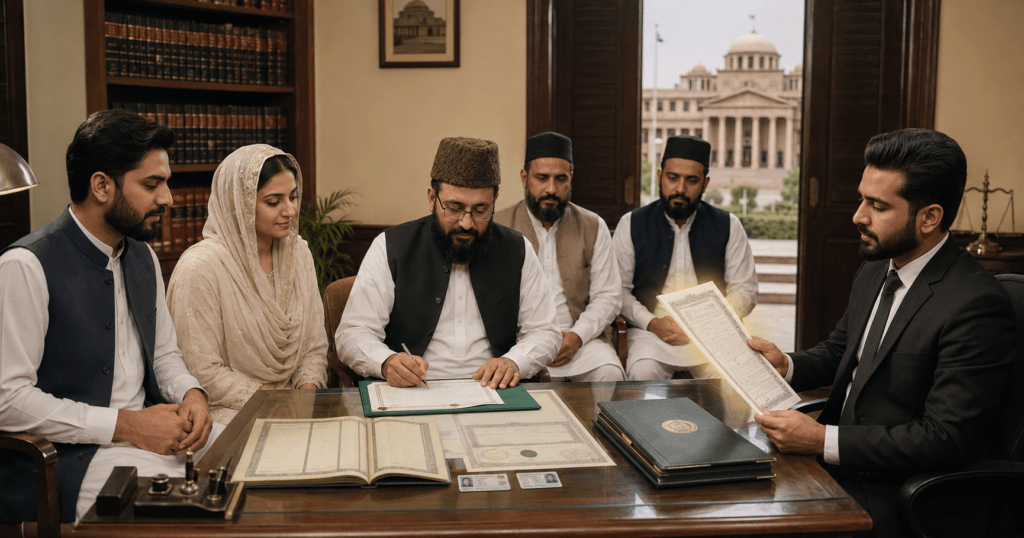
There is no separate statutory Muslim marriage called court marriage in Pakistan under the Muslim Family Laws Ordinance, 1961. The popular phrase is used when a couple chooses to marry without a traditional family-arranged ceremony, often with help from a lawyer and a licensed Nikah Registrar.
The legal marriage is created by the Nikah, not by sitting inside a courtroom or lawyer’s office. The place is not what makes it valid. What matters is legal capacity, genuine consent, offer and acceptance, competent witnesses, dower and compliance with registration and age laws.
This distinction matters because some agents selling court marriage in Pakistan services make a dangerous promise: “Sign one affidavit and you are married.” That is wrong. An affidavit can record that the bride and groom are acting voluntarily, but it is only supporting evidence. It cannot perform the function of a Nikahnama.
For a broader explanation of marriage, dower and family rights, readers may also consult our guide on Marriage in Pakistan.
IRAC Analysis of the Leading Supreme Court Rule
| IRAC element | Simple explanation |
|---|---|
| Issue | Whether court marriage in Pakistan involving a sui juris Muslim woman requires the consent of her Wali, and whether its absence makes the marriage invalid. |
| Rule | A Muslim adult woman’s own consent is indispensable. Under the rule affirmed by the Supreme Court, Wali’s consent is not required to validate her marriage. |
| Application | Saima Waheed stated that she had married Muhammad Arshad by her own choice. Her father challenged the marriage and sought her recovery. The Lahore High Court decided the matter by a 2-1 majority, and the Supreme Court later confirmed the controlling rule. |
| Conclusion | The marriage could not be declared invalid merely because the Wali had not consented. Questions about the existence or validity of a disputed marriage belong before the competent Family Court. |
The Saima Waheed Case: A Private Choice Became a National Legal Question

The modern legal history of court marriage in Pakistan cannot be explained without Hafiz Abdul Waheed v. Miss Asma Jehangir and another, reported as PLD 1997 Lahore 301. Saima Waheed was a fourth-year college student. The judgment records that she married Muhammad Arshad on 26 February 1996. Her father later approached the Lahore High Court and challenged both her custody and the claimed marriage.
The case was placed before a three-member bench because court marriage in Pakistan raised a major question: can an adult Muslim woman marry without the consent of her Wali?
The judges did not give one unanimous opinion. Justice Ihsan-ul-Haq Chaudhry concluded in dissent that Saima and Arshad were not validly married.
Justice Malik Muhammad Qayyum disagreed. He held that a sui juris Muslim woman could marry without Wali’s consent and treated the Federal Shariat Court ruling in Muhammad Imtiaz v. The State, PLD 1981 FSC 308, as binding under Article 203-GG of the Constitution.
Justice Khalil-ur-Rehman Ramday also refused to invalidate the marriage. He strongly criticised secret relationships and runaway marriages, stressed the importance of parents and family consultation, and made several wider social observations. Yet his final legal conclusion was clear: the material before the Court did not justify declaring the marriage invalid.
The final order was therefore a 2-1 majority. It declared that a marriage contracted without Wali’s consent was not invalid, dismissed the father’s petition and left Saima free to reside wherever she wished. This became a foundational ruling on court marriage in Pakistan.
This distinction is essential when writing about court marriage in Pakistan. The dissenting opinion and the majority’s moral observations must not be presented as the binding result. The operative majority order controls.
PLD 2004 Supreme Court 219: The Rule That Settled the Controversy
The dispute over court marriage in Pakistan reached the Supreme Court in Hafiz Abdul Waheed v. Mrs Asma Jehangir and another, reported as PLD 2004 Supreme Court 219. This is the strongest authority among the five judgments reviewed for this article.
For court marriage in Pakistan, the Supreme Court confirmed that the consent of a Wali is not required for a sui juris Muslim woman to contract a valid marriage. It also held that decisions of the Federal Shariat Court made within its jurisdiction bind High Courts and courts subordinate to them under Article 203-GG of the Constitution.
The Court dismissed the criminal appeal challenging Saima’s marriage and declared that it was not invalid because of the absence of Wali’s consent.
The Supreme Court also gave another important procedural lesson for court marriage in Pakistan. A habeas corpus petition under section 491 of the Code of Criminal Procedure is designed to examine unlawful custody. It should not become a substitute for a complete family trial.
Where the existence or validity of a marriage is genuinely disputed, that question falls within the exclusive domain of the Family Court.
This balance is important. The law protects an adult woman’s liberty, but it also sends complicated factual disputes to the proper forum where evidence can be recorded.
Three Supporting Judgments and One Necessary Warning
PLD 2011 Lahore 37: Free Will Defeated an Abduction Allegation
In Mst Naila Parveen and another v. State, PLD 2011 Lahore 37, a free-choice marriage became connected with remarriage and a criminal allegation.
Naila Parveen and Shahid Latif had first married, separated through a dissolution decree and later married each other again. Naila’s brother then lodged FIR No. 316 of 2010 under section 365-B of the Pakistan Penal Code and alleged abduction.
Naila was sui juris. She appeared and stated that nobody had abducted her and that she had acted voluntarily. The Lahore High Court relied on the registered Nikah, her statement and section 7(6) of the Muslim Family Laws Ordinance. It held that the prosecution story could not stand and quashed the FIR.
The Court also repeated that an adult woman’s Nikah is not invalid for want of Wali’s permission. This makes the case useful for understanding how free consent, registration and a direct statement by the woman may protect court marriage in Pakistan from a false criminal allegation.
PLD 2005 Lahore 316: Useful, but Not for Today’s Age Rule
Mst Hajra Khatoon and another v. SHO Fateh Jang, PLD 2005 Lahore 316, is sometimes cited for court marriage in Pakistan because it involved a registered Nikahnama and an FIR that was ultimately quashed. The Court relied on the leading Wali-consent cases.
However, the girl was recorded as approximately 13 years and 11 months old, and the judgment applied the old Hudood-era and child-marriage framework then in force.
That part must not be used to tell readers the present minimum age. Punjab’s law changed in 2026, and other jurisdictions have also enacted later child-protection laws.
The lesson is simple: an old case may remain useful on one legal point while becoming unsafe on another. Court marriage in Pakistan must follow the age law operating at the place and time of the proposed Nikah.
PLD 2010 Karachi 131: A Khula and Remarriage Case
Muhammad Ayub Khan v. Mst Shehla Rasheed, PLD 2010 Karachi 131, is sometimes placed in a collection about court marriage in Pakistan, but it is not a primary free-choice marriage authority.
It concerned a decree of khula and whether the same spouses could remarry each other without an intervening marriage.
The Sindh High Court treated court-pronounced khula as one divorce and recognised the possibility of remarriage between the same spouses. PLD 2011 Lahore 37 later cited it.
It should therefore be used for the narrow remarriage point, not as the main precedent for an adult woman’s first marriage without Wali’s consent.
Current Minimum Age Rules: Never Rely on an Old Blog

Age is the first legal checkpoint for court marriage in Pakistan. The rules have changed quickly, and an old judgment or online chart can expose the couple, witnesses, Nikah Khawan and registrar to criminal proceedings.
The following position was checked up to 30 July 2026:
| Jurisdiction | Verified minimum age | Official source |
|---|---|---|
| Punjab | 18 for both male and female | Punjab Child Marriage Restraint Act 2026 |
| Sindh | 18 for both male and female | Sindh Child Marriages Restraint Act 2013 |
| Islamabad Capital Territory | 18 for both male and female | ICT Child Marriage Restraint Act 2025 |
| Balochistan | 18 for both male and female | Balochistan Child Marriages Restraint Act 2025 |
| Khyber Pakhtunkhwa, AJK and Gilgit-Baltistan | Obtain current local advice before the Nikah; do not assume that another province’s amendment applies. | Check the latest law and notification applicable to the exact place of solemnisation. |
The safe practical rule for court marriage in Pakistan is not to arrange a marriage involving anyone below 18. Never move a child across a provincial boundary to avoid a stronger law. Newer statutes may treat that conduct as trafficking or child abuse.
This article concerns Muslim adults. Marriages involving non-Muslim citizens may also engage their own personal laws, registration rules and documentary requirements.
Seven Legal Requirements Couples Should Understand
1. Both Parties Must Have Legal Capacity
For court marriage in Pakistan, the bride and groom must satisfy the applicable age law and possess the mental capacity to understand the marriage.
A person who cannot give real consent cannot be made part of a valid free-choice process merely through signatures.
2. Consent Must Be Free and Personal
Consent obtained through threats, confinement, fraud, intoxication or pressure is not genuine consent.
In a dispute over court marriage in Pakistan, the most important person is the alleged victim. Her independent statement may reveal whether the case concerns a voluntary marriage or an actual offence.
The Supreme Court rule protects choice; it does not protect coercion.
3. Offer and Acceptance Must Take Place
There must be a clear offer and acceptance of marriage in the same meeting in the manner required by the applicable Muslim personal law.
The Nikah Khawan should ensure that both parties understand what is being asked and answer freely.
4. Competent Witnesses Must Attend
Court marriage in Pakistan should be performed before legally competent witnesses, and their complete identity details should be entered correctly.
In standard Sunni practice, couples commonly arrange two adult Muslim male witnesses carrying valid original CNICs. They should obtain specific advice where a different school of personal law applies.
5. Dower Must Be Clearly Recorded
In court marriage in Pakistan, the amount and nature of Haq Mehr should be discussed before signing.
The Nikahnama should clearly state how much is prompt, how much is deferred and whether any property or special term forms part of the dower.
Empty columns create future litigation. Read our detailed guide to the Muslim Family Laws Ordinance for related rights concerning registration, dower, divorce and polygamy.
6. The Nikahnama Must Be Completed Honestly
Names, CNIC numbers, addresses, marital status, ages, dower and special conditions must be correct.
The bride should personally read columns 16 to 20 and any delegated right of divorce before signing. No person should ask her to sign a blank form.
7. The Marriage Must Be Registered
For court marriage in Pakistan, section 5 of the Muslim Family Laws Ordinance, 1961 requires every Muslim marriage to be registered.
Registration creates reliable proof and protects access to dower, maintenance, inheritance, immigration and family records.
Non-registration should never be treated as a clever privacy tool. Even where it does not automatically erase an otherwise valid Nikah, it can produce serious evidentiary, administrative and penal consequences.
Step-by-Step Procedure for Court Marriage in Pakistan
Step 1: Check Age, Identity and Existing Marital Status
Before court marriage in Pakistan, inspect the original CNIC or other legally accepted NADRA identity record.
Confirm the date of birth under the law applicable to the place of solemnisation. If either person was previously married, collect the final divorce, khula or death record and confirm that the earlier marriage has legally ended.
Step 2: Choose a Genuine Licensed Nikah Registrar
Do not rely only on an online agent offering court marriage in Pakistan.
Confirm that the Nikah Registrar is licensed and authorised for the relevant territorial jurisdiction. Ask where the original register will be maintained and which Union Council, Municipal Committee or local authority will issue the computerized certificate.
Step 3: Prepare the Documents
Document requirements for court marriage in Pakistan can vary by province, local council, nationality and previous marital status.
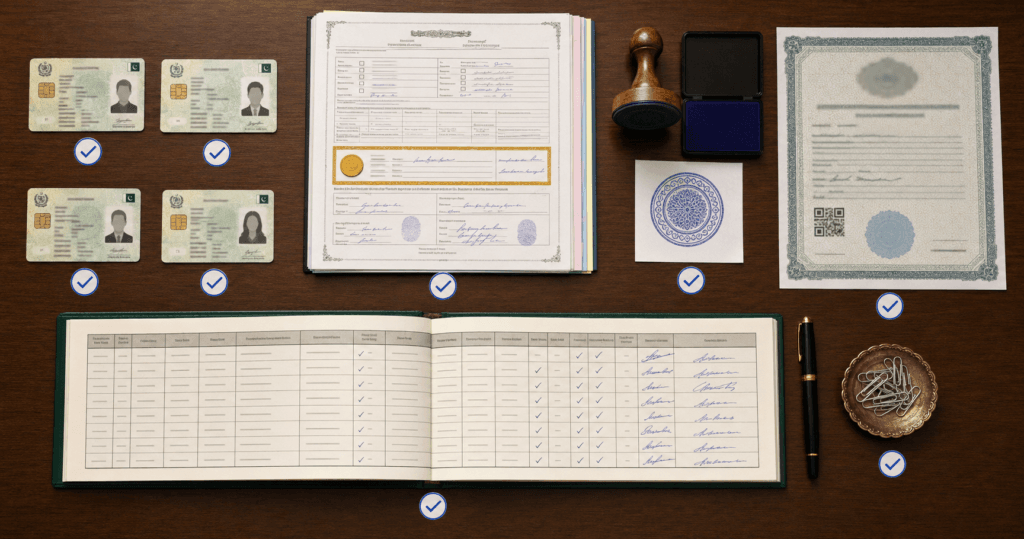
A normal adult Muslim case commonly requires:
| Person or record | Documents commonly required |
|---|---|
| Bride | Original CNIC and copies; recent photographs if locally required |
| Groom | Original CNIC and copies; recent photographs if locally required |
| Witnesses | Original CNICs and copies |
| Parents’ identity record | Some local authorities request copies for computerized registration |
| Previously divorced person | Effective divorce certificate, khula decree and/or Union Council record, as applicable |
| Widow or widower | Death certificate of the former spouse |
| Foreign national | Passport, visa or status documents and any locally required NOC or marital-status proof |
Punjab’s Local Government Department states that the concerned Union Council or Municipal Committee issues the computerized Marriage Registration Certificate and lists a registered Nikahnama plus identity documents among the required record.
Readers should check the latest official Punjab registration guidance or the equivalent authority in their own jurisdiction.
Step 4: Settle Dower and Nikahnama Conditions
Discuss Haq Mehr, maintenance expectations, residence, delegated divorce and any lawful special condition before the ceremony.
A rushed signature can create a dispute lasting years.
Step 5: Record Free Will Where There Is a Real Risk
A lawyer may prepare an affidavit stating age, identity, free consent and absence of abduction.
The woman may also record an independent statement before the competent authority if a genuine threat exists and counsel advises it.
Remember: this record supports consent; it does not replace the Nikah.
Step 6: Perform the Nikah
The Nikah Khawan should obtain clear offer and acceptance in the presence of witnesses.
The completed Nikahnama should be read, checked and signed by the parties, witnesses and authorised persons. Obtain copies immediately.
Step 7: Register the Nikahnama
After court marriage in Pakistan, make sure the Nikah Registrar enters the marriage in the official register and forwards or completes the record required by the relevant local authority.
Do not leave the office with only an affidavit or an unnumbered photocopy.
Step 8: Obtain the Computerized Marriage Certificate
After court marriage in Pakistan, apply to the concerned Union Council, Municipal Committee or other authorised local body for the computerized Marriage Registration Certificate.
Check every spelling, CNIC number and date before accepting it. This certificate is a local-government vital-event record; it should not be confused with an FRC or ordinary identity document issued directly by NADRA.
Step 9: Preserve Evidence and Address Threats Lawfully
Keep certified copies, photographs of the signed Nikahnama, registrar details and safe electronic backups.
If there is a credible threat, submit a written complaint to the relevant police officers and obtain legal advice about protective constitutional relief.
Do not respond to family pressure with threats, violence or fabricated papers.
Is Permission from Parents or a Court Required?
For court marriage in Pakistan involving a sui juris Muslim woman, parental or Wali consent is not a condition that determines the validity of her marriage under PLD 2004 Supreme Court 219. Her own free consent is essential.
That does not mean the Supreme Court encouraged secrecy or disrespect. The 1997 majority judgment contained strong observations about family consultation, social responsibility and the dangers of secret relationships.
The correct legal message has two parts:
- Parents cannot replace an adult woman’s consent or invalidate her lawful choice merely by refusing it.
- Adult children should seek safe family dialogue where possible, provided consultation does not become coercion, confinement or violence.
No general order from a judge is required before two legally capable Muslim adults can marry.
A court becomes relevant when liberty, protection, custody, a false criminal case or the validity of a disputed marriage requires judicial determination.
Can Police Arrest a Couple After a Free-Will Marriage?

In court marriage in Pakistan, a Nikahnama is important evidence, but it is not a blanket immunity from investigation.
Police may receive a complaint alleging kidnapping, coercion, forged age documents, child marriage or an existing marital tie.
Where the woman is adult and independently confirms that she left and married voluntarily, an allegation of abduction may lose its factual foundation.
PLD 2011 Lahore 37 is a strong example: the adult woman’s statement and registered marriage contradicted the brother’s story, and the High Court quashed the FIR.
However, no blog can promise that every FIR will automatically disappear. Courts examine age, consent, documents, the alleged offence and the available evidence.
Anyone facing an FIR should obtain immediate criminal and family-law advice rather than hiding or posting inflammatory videos online.
Which Court Decides Whether the Marriage Is Valid?
For court marriage in Pakistan, the Supreme Court in PLD 2004 Supreme Court 219 warned against deciding a complicated marriage dispute inside summary habeas corpus proceedings.
A petition about unlawful custody can protect personal liberty, but the Family Court is the proper forum for a full dispute about the existence or validity of marriage.
This forum distinction prevents two opposite mistakes:
- treating an adult woman as property to be returned to her family; and
- declaring every disputed document genuine without recording evidence.
The same constitutional concern for dignity and personal hearing also appears in our guide to Women Rights in Pakistan.
What If One Party Was Already Married?
Court marriage in Pakistan cannot erase an existing marriage through a new affidavit.
A divorced person should confirm that the divorce or khula has become legally effective and obtain the relevant certificate.
Where a Muslim man already has a subsisting marriage, section 6 of the Muslim Family Laws Ordinance requires prior written permission of the Arbitration Council before contracting another marriage.
Failure may trigger statutory consequences, including immediate payment of the existing wife’s dower and punishment. The issue should never be hidden from the registrar or the proposed spouse.
PLD 2010 Karachi 131 and PLD 2011 Lahore 37 dealt with remarriage between the same spouses after khula or dissolution.
Those judgments cannot be converted into a general licence for every remarriage problem. The number and legal effect of previous divorces, the decree and section 7 requirements must be checked.
Our separate guides on Khula Law in Pakistan and Divorce Procedure in Pakistan explain those routes.
Court Marriage in Pakistan: Common Myths That Put Couples at Risk
| Myth | Legal reality |
|---|---|
| “A lawyer’s stamp creates the marriage.” | A lawyer may prepare documents, but Nikah and lawful registration create the marital record. |
| “Parents can cancel an adult woman’s Nikah.” | Mere disapproval does not invalidate the free marriage of a sui juris Muslim woman. |
| “Any person who says he is a Qazi can register it.” | Verify the licence and territorial authority of the Nikah Registrar. |
| “An unregistered Nikah is safer.” | It creates proof, inheritance, maintenance, immigration and identity problems. |
| “Old puberty cases still decide today’s age.” | New provincial and territorial child-marriage statutes must be followed. |
| “A marriage certificate ends every FIR.” | Genuine criminal allegations still require investigation; age and free consent remain decisive. |
| “Every court-marriage case belongs in habeas corpus.” | A disputed marriage’s validity belongs before the competent Family Court. |
Court Marriage in Pakistan: A Practical Safety Checklist
- Confirm that both parties satisfy the current age law for the exact jurisdiction.
- Inspect original identity documents and never alter a date of birth.
- Verify that any earlier marriage has legally ended.
- Use a licensed Nikah Registrar with territorial authority.
- Arrange competent witnesses carrying original CNICs.
- Decide Haq Mehr and record prompt and deferred portions.
- Read every Nikahnama column before signing.
- Never sign a blank Nikahnama or blank affidavit.
- Obtain the registered Nikahnama and computerized certificate.
- Keep safe copies with trusted persons.
- Seek urgent legal help if there is confinement, violence, a missing-person report or an FIR.
- Do not use agents who promise secrecy, fake age papers or guaranteed police protection.
Costly Mistakes to Avoid After Court Marriage in Pakistan
The first mistake is treating the affidavit as the marriage. It is only evidence of a statement.
The second is using a false age or fake CNIC. That can turn a lawful adult choice into a criminal case.
The third is leaving important Nikahnama columns blank, especially dower, delegated divorce and special conditions.
The fourth is failing to verify the Nikah Registrar’s licence or jurisdiction.
The fifth is delaying registration and losing the original record.
The sixth is hiding an earlier marriage, divorce or khula.
The seventh is assuming that a woman’s recorded consent cures every defect. Consent cannot legalise child marriage, forgery or an otherwise prohibited relationship.
The eighth is provoking the family through threatening social-media content. Preserve evidence, remain respectful and use lawful protection channels.
The ninth is quoting PLD 1997 Lahore 301 incompletely. One judge dissented, but the final order was a 2-1 majority holding that absence of Wali’s consent did not invalidate the marriage.
The tenth is using PLD 2005 Lahore 316 as today’s age law. Its age reasoning arose under an old legal framework and must not override the statutes now in force.
Final Takeaway
Court marriage in Pakistan protects the lawful choice of two capable adults; it does not remove legal safeguards.
The strongest rule comes from PLD 2004 Supreme Court 219: a sui juris Muslim woman’s marriage is not invalid merely because her Wali did not consent.
The safest marriage is not the one with the most stamps. It is the one built on verified age, independent consent, a properly completed Nikahnama, competent witnesses, honest marital-status documents and prompt registration.
Family disagreement can be painful, but it cannot turn an adult woman into someone else’s property.
At the same time, couples should not allow haste, an unlicensed agent or fake papers to damage the future they are trying to protect.
Frequently Asked Questions
Is court marriage in Pakistan legal?
Yes. A freely chosen Muslim marriage between legally capable adults is lawful when the requirements of Nikah, applicable age law, and registration are satisfied.
“Court marriage” is a popular expression, not a separate type of marriage created by a judge.
Can an adult Muslim woman marry without her father’s permission?
Yes. PLD 2004 Supreme Court 219 confirms that a sui juris Muslim woman can marry by her own choice and that absence of Wali’s consent does not make the marriage invalid.
Does the bride need to appear before a judge?
Not as a general condition of marriage. She must personally and freely consent to the Nikah.
A judicial or official statement may become useful where threats, custody allegations or a criminal complaint arise.
Is a free-will affidavit compulsory?
It is often prepared as supporting evidence, but it is not the Nikah and cannot replace a registered Nikahnama.
Its need and form depend on the facts and local legal advice.
Which documents are normally needed?
Original CNICs and copies of the bride, groom and witnesses are commonly required.
Previous divorce, khula or death records are needed where applicable. Local authorities may request additional documents.
What is the legal age for court marriage in Pakistan?
Punjab, Sindh, Islamabad Capital Territory and Balochistan currently set 18 as the minimum for both sexes.
Because legislation is jurisdiction-specific and can change, verify the current rule where the Nikah will occur.
Is an unregistered Nikah invalid?
Non-registration does not necessarily erase every otherwise valid Muslim Nikah, but section 5 requires registration.
Failure creates serious proof, administrative and possible penal consequences. Registration should never be skipped.
Can parents register an abduction FIR after the marriage?
They may make a complaint, but an adult woman’s independent statement that she left voluntarily can defeat a false abduction allegation.
Age, consent and evidence must still be examined in every case.
Can the High Court decide whether a disputed Nikahnama is genuine?
The High Court may protect liberty in appropriate constitutional or habeas proceedings.
However, PLD 2004 Supreme Court 219 explains that a full dispute about the existence or validity of marriage belongs before the competent Family Court.
Can the same couple remarry after khula?
The reviewed judgments recognise remarriage between the same spouses after one khula or dissolution in appropriate circumstances, without an intervening marriage.
The parties must still check the number and effect of previous divorces, iddat, and statutory requirements before acting.
Disclaimer
This article provides general legal awareness about Muslim marriage law in Pakistan and was updated with legislation available up to 30 July 2026.
It is not a substitute for advice on a specific case. Age rules, registration requirements and available remedies may differ by jurisdiction and facts. Consult a qualified family and criminal-law advocate before taking legal action.