
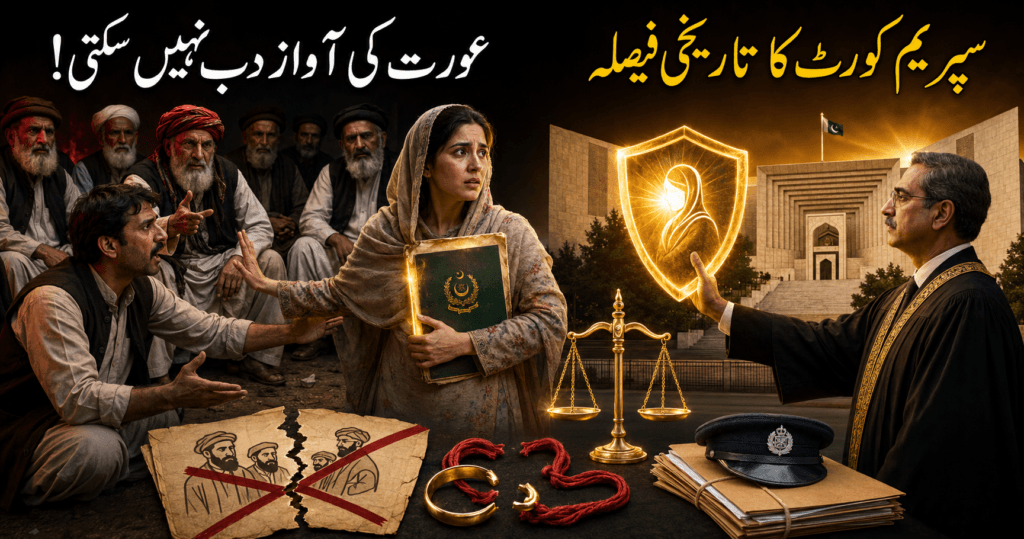
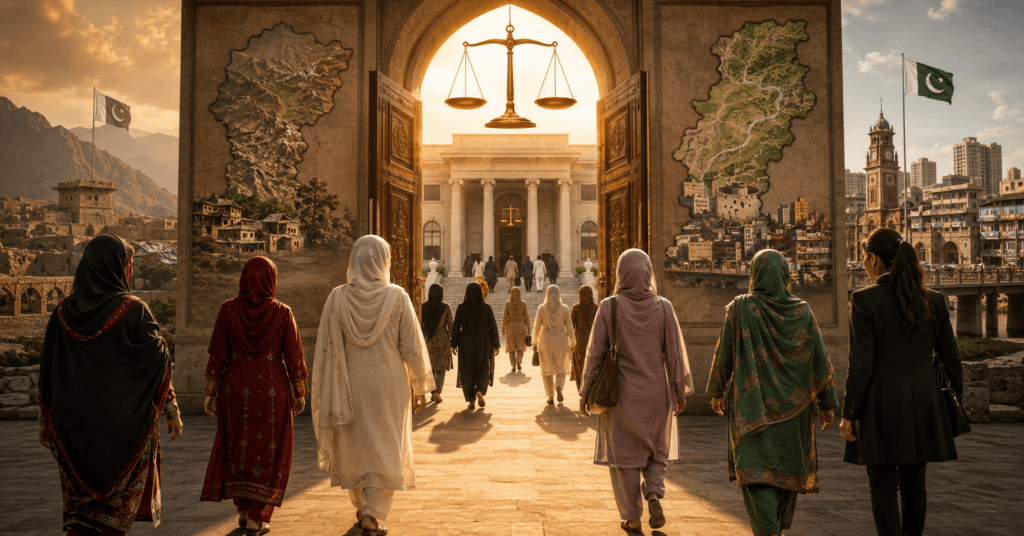
Imagine being told that your future, marriage, property or personal safety has been decided in a village gathering where you were never invited to speak. There is no trained judge, no evidence tested under law, no appeal and no guarantee that your own voice will even be heard. For many women, this was not a fictional fear but a harsh reality produced by illegal jirgas and panchayats.
In National Commission on the Status of Women v. Government of Pakistan (PLD 2019 Supreme Court 218), the Supreme Court delivered a landmark ruling on women rights in Pakistan, access to justice and the constitutional limits of informal dispute resolution. The Court held that no jirga, panchayat or council of elders can act as a civil or criminal court. It also made one point unmistakably clear: when a woman’s rights are involved, a male relative cannot automatically speak in her place.
Table of Contents
Judgment at a Glance: Women Rights in Pakistan Case
| Point | Details |
|---|---|
| Case | National Commission on the Status of Women through Chairperson and others v. Government of Pakistan through Secretary Law and Justice and others |
| Citation | PLD 2019 Supreme Court 218 |
| Connected matters | Constitution Petition No. 24 of 2012 and Civil Petition No. 773-P of 2018 |
| Bench | Mian Saqib Nisar, C.J. and Ijaz-ul-Ahsan, J. |
| Hearing date | 31 December 2018 |
| Decision date | 16 January 2019 |
| Central issue | Whether jirgas and panchayats can decide civil or criminal matters and impose or enforce their decisions |
| Constitutional provisions | Articles 4, 8, 10-A, 25, 175 and 203 |
| International instruments | UDHR, ICCPR and CEDAW |
| Main ruling | Informal bodies cannot exercise judicial power; their civil or criminal orders are illegal |
| Limited lawful role | Voluntary mediation, arbitration, negotiation or reconciliation in civil disputes only |
| Women-specific protection | A woman must be allowed to participate personally if she wishes; male kin cannot replace her where her rights are involved |
| FATA ruling | FATA Interim Governance Regulation, 2018 declared unconstitutional |
| Final result | Constitutional petition disposed of; KPK civil petition dismissed as withdrawn |
IRAC Analysis of the Women Rights in Pakistan Case
| IRAC element | Supreme Court’s approach |
|---|---|
| Issue | Can a jirga, panchayat or council of elders lawfully decide civil rights, determine criminal guilt, impose punishment or enforce orders? |
| Rule | Only courts established or authorised by the Constitution or law may exercise judicial jurisdiction. Every person is entitled to lawful treatment, fair trial, due process and equality before law. |
| Analysis | Jirgas generally lacked legal authority, fixed procedure, recognised rules of evidence, trained judges, predictable outcomes and meaningful appeal. Women were often absent, represented through men or subjected to discriminatory customary outcomes. |
| Conclusion | Jirgas acting as courts are illegal. They may facilitate voluntary settlement of a civil dispute within law, but cannot decide crimes, compel participation or enforce their own orders. |
Why This Case Matters for Women Rights in Pakistan
This was not a private property dispute between one woman and her relatives. The petition raised a wider constitutional question affecting women and vulnerable communities across Pakistan. The National Commission on the Status of Women, its members and human-rights activists approached the Supreme Court under Article 184(3) of the Constitution.
They challenged informal bodies known as jirga, panchayat, faislo or council of elders. Operating in tribal and rural areas across the provinces, some were deciding family conflicts, civil claims and criminal accusations or imposing fines, forced settlements and punishments.
The petitioners relied on a research report titled “Women, Violence and Jirgas – Consensus and Impunity in Pakistan.” It described women being traded as compensation, forced into marriage, punished for the alleged conduct of male relatives, denied personal hearings or represented only through male family members. These practices placed women rights in Pakistan directly against patriarchal customs enforced without lawful authority.
The Human Cost Behind the Constitutional Question
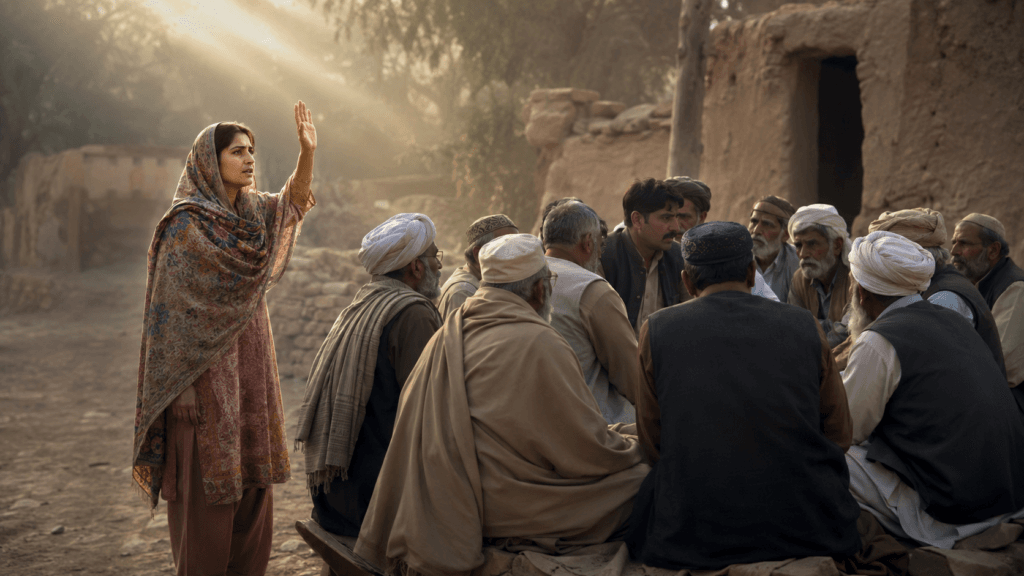
The question sounded technical: can an informal gathering exercise judicial power? Its consequences were human. An unlawful decision could damage life, liberty, dignity, reputation, body or property. For an excluded woman, her marriage, freedom or legal rights could be discussed as though she were an object rather than a citizen.
The Supreme Court recognised that access to justice is not merely a route to another right. It is a right in itself and the means through which other rights are protected and restored. Women rights in Pakistan therefore cannot depend on where a woman lives, how powerful her family is, whether she understands legal procedure or whether village elders permit her to speak.
The Court rejected the idea that lack of awareness can justify loss of protection. The State must remain vigilant for every person whose rights it is bound to protect. That positive duty gives women rights in Pakistan real meaning.
What the Petitioners Asked the Supreme Court to Do
The petitioners argued that parallel bodies violated lawful treatment, dignity, liberty, equality, fair trial and access to justice. They sought invalidation of jirga orders and action against those conducting illegal proceedings.
Government law officers did not defend honour killings, vanni, swara, karo-kari or forced marriage. They accepted that such practices violated women rights in Pakistan and the country’s international commitments.
No party objected to the petition’s maintainability. The Court found that it involved a matter of public importance connected with the enforcement of fundamental rights, satisfying Article 184(3) of the Constitution.
Seven Constitutional Protections Confirmed by the Court

Together, these protections define how women rights in Pakistan must operate in real legal proceedings.
1. Every Woman Has the Right to Be Treated According to Law
Article 4 protects every citizen, wherever that person may be, and also protects non-citizens while they are in Pakistan. No action harmful to life, liberty, body, reputation or property may be taken except in accordance with law.
Local custom cannot authorise what the Constitution forbids. A jirga cannot compel a woman to do what the law does not require, stop her from performing a lawful act or decide her life without legal authority. This is foundational to women rights in Pakistan.
2. A Harmful Custom Cannot Override Fundamental Rights
Article 8 makes any law, custom or usage void to the extent that it conflicts with fundamental rights. Long acceptance cannot transform an unconstitutional practice into a lawful one.
Tradition may explain why a practice exists, but it cannot excuse honour-based retaliation, forced marriage, discrimination or violence. A harmful custom cannot receive legal protection simply because it has been followed for generations.
The same principle also applies to family property disputes. Read how courts have protected women against coercive customs and informal settlements under inheritance law in Pakistan.
3. Civil Rights and Criminal Charges Require a Fair Trial
Article 10-A guarantees fair trial and due process when civil rights, obligations or criminal charges are determined. That requires lawful jurisdiction, notice, an opportunity to be heard and application of recognised law.
Informal bodies may rely on hearsay, follow no fixed procedure and provide no dependable right of appeal. Such a process cannot legally determine guilt. Due process is essential to women rights in Pakistan, particularly where unequal social power makes an informal hearing unsafe or one-sided.
4. Equality Before Law Includes Equality Between Women and Men
Article 25 declares that citizens are equal before law and prohibits discrimination based on sex. The Constitution also permits the State to make special provisions for the protection of women and children.
The Supreme Court found the negligible representation of women in patriarchal councils incompatible with equality. A system dominated by influential men cannot become fair or equal merely because it is described as traditional.
5. Only Lawfully Authorised Courts Can Decide Cases
Article 175 limits judicial power to courts authorised by the Constitution or law. A self-appointed group cannot become the judge and executioner of a community.
By making its own rules, deciding guilt and enforcing punishments, an illegal jirga intrudes into legislative, judicial and executive authority. Its adjudicatory order therefore has no legal effect.
6. A Woman Has the Right to Her Own Voice
One of the strongest safeguards for women rights in Pakistan concerns a woman’s personal participation.
Even in lawful and voluntary civil mediation, a woman whose rights are involved cannot simply be represented through male relatives. If she wants to speak, she must be given an opportunity for personal hearing.
Her consent is not interchangeable with the wishes of her father, brother, husband, uncle or another family elder. Equality becomes meaningless if the woman herself is excluded from a process that directly affects her life or property.
7. Rural or Tribal Residence Cannot Reduce Constitutional Protection
After the Twenty-Fifth Amendment, former FATA became part of Khyber Pakhtunkhwa. There was no rational basis for giving its residents a separate and inferior system of justice.
Administrative difficulty may require transition time, but it cannot justify denying fundamental rights. Equality extends women rights in Pakistan beyond major cities to every village and tribal community.
A woman living in a remote area possesses the same constitutional rights as a woman living in Islamabad, Lahore, Karachi or Peshawar.
These protections flow directly from the Constitution of the Islamic Republic of Pakistan, particularly Articles 4, 8, 10-A, 25 and 175. These provisions protect lawful treatment, fair trial, equality and the jurisdiction of legally authorised courts.
Is Every Jirga or Panchayat Illegal?
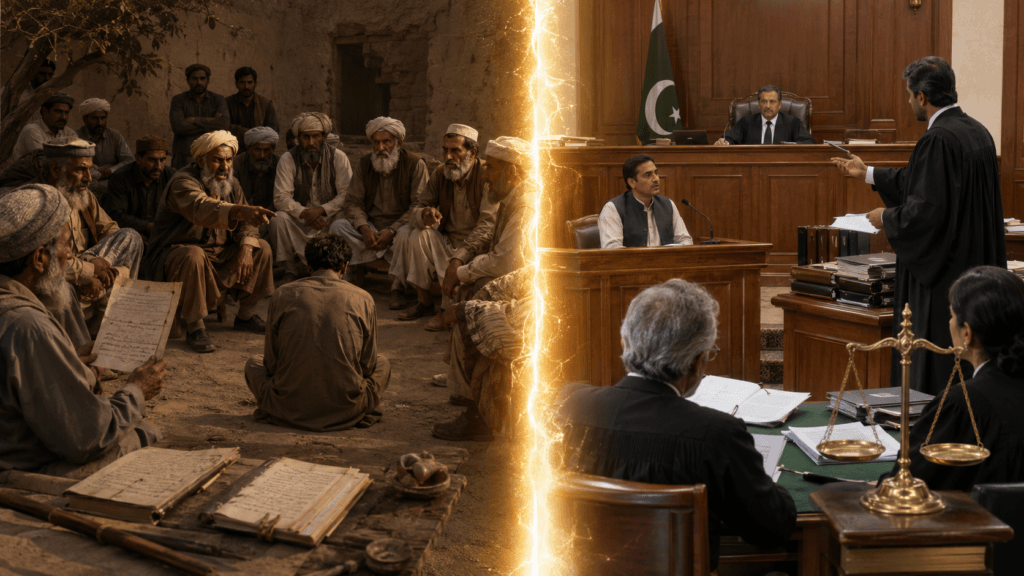
No. This is the most important distinction made in the judgment.
The Supreme Court did not hold that the words “jirga” or “panchayat” are automatically illegal. A gathering may assist parties through mediation, arbitration, negotiation or reconciliation when:
- The dispute is civil and not criminal.
- Every party participates voluntarily.
- Consent is free and informed.
- The proposed settlement remains within the law.
- The forum does not impose punishment.
- No person is forced to obey its decision.
- Any enforceable legal relief is obtained through a competent court.
A settlement reached by elders does not automatically carry the force of a court decree. It must remain lawful and, where enforcement is needed, it must pass through the courts.
This limited space for consensual dispute resolution cannot be used as a back door to defeat women rights in Pakistan.
International Protection of Women Rights in Pakistan
The Supreme Court connected the Constitution with the Universal Declaration of Human Rights, the International Covenant on Civil and Political Rights and the Convention on the Elimination of All Forms of Discrimination Against Women.
These international instruments require:
- Equality before law;
- Protection against discrimination;
- Access to effective legal remedies;
- Equal treatment before courts and tribunals;
- Equal legal capacity in civil matters;
- Equal rights concerning contracts and property.
Article 15 of CEDAW particularly recognises women’s equal legal capacity in civil matters. The message was practical: justice cannot remain a paper guarantee available only to educated, wealthy or powerful citizens.
Why Informal Jirgas Failed the Test of Justice
The Supreme Court identified serious defects in informal adjudication. These bodies were not governed by recognised civil, criminal or evidence procedures.
Their decision-makers were not required to possess legal education or judicial training. Outcomes could depend on hearsay, personal influence, social position or the wishes of powerful elders.
There was no predictable procedure, recognised standard of evidence, binding precedent or dependable right of appeal. Women and financially weaker parties could remain unheard or unequally represented.
The system did not merely create a risk of an incorrect decision. It lacked the legal authority necessary to decide anyone’s rights in the first place.
For women rights in Pakistan, procedure matters because a promise of equality becomes hollow if a woman is absent, silenced or forced to accept a decision made by others.
The Connected FATA Case
The judgment also decided a connected challenge involving the FATA Interim Governance Regulation, 2018.
The Regulation was promulgated on 29 May 2018. On 30 May 2018, the Twenty-Fifth Constitutional Amendment removed Article 247(7) and merged former FATA with Khyber Pakhtunkhwa.
Despite the merger, the Regulation preserved a different justice arrangement involving:
- Commissioners acting in a judicial capacity;
- Councils of Elders deciding disputes;
- Qaumi Jirgas;
- A separate system for civil and criminal matters.
The KPK Government challenged the Peshawar High Court ruling against these provisions but did not press its petition before the Supreme Court. Instead, it requested six months to establish the required judicial infrastructure.
The Supreme Court held that former FATA residents and other KPK residents became similarly placed after the merger. A separate justice system for only one part of the province was discriminatory.
The FATA Interim Governance Regulation, 2018 was declared unconstitutional under Articles 4, 8, 25, 175 and 203 of the Constitution.
KPK received six months to develop infrastructure and spread a uniform system of ordinary courts. This part of the ruling confirmed that women rights in Pakistan and access to lawful justice cannot shrink because of geography.
Duties for Women Rights in Pakistan
To make women rights in Pakistan enforceable, the Supreme Court issued practical directions to police and government authorities:
- Police must remain vigilant where crimes connected with jirga activities go unreported.
- When a complaint alleges danger to life, liberty or property, police must verify it and take stringent action.
- Action may be taken against persons convening, operating or executing an illegal jirga decision.
- A person committing an offence and those who aided the illegal body may be proceeded against under law.
- Complainants threatened because of jirga decisions must receive protection.
- Police stations in areas where illegal jirgas are common should have adequate staff and backup support.
- Accessible complaint centres should help people approach authorities without fear.
- Public-awareness campaigns should explain legal rights and the consequences of participating in illegal kangaroo courts.
- Print media, electronic media and non-profit organisations should promote awareness of the rule of law.
- Police were directed to introduce nationwide standard operating procedures within two months and submit a compliance report to the Supreme Court.
These directions matter because women rights in Pakistan cannot be protected through declarations alone. A threatened woman needs a reachable police station, immediate protection and a legal system prepared to act.
Effective policing therefore forms a practical part of women rights in Pakistan, especially where local influence creates fear.
The Supreme Court’s Final Decision

The Supreme Court disposed of Constitution Petition No. 24 of 2012 with detailed declarations and directions.
Civil Petition No. 773-P of 2018 was dismissed as withdrawn.
The final legal position was clear:
- Jirgas and panchayats have no authority to adjudicate civil or criminal matters.
- Any decision issued through assumed judicial power is illegal.
- Voluntary alternative dispute resolution is limited to lawful civil disputes.
- A woman must be given a personal hearing if she desires it and her rights are involved.
- A male relative cannot automatically replace the affected woman.
- Crimes resulting from illegal jirga orders must be investigated and prosecuted.
- Persons assisting or executing an illegal order may also face legal proceedings.
- The FATA Interim Governance Regulation, 2018 was unconstitutional.
- KPK received six months to establish a uniform system of ordinary courts.
The ruling moved women from the margins of informal decision-making to the centre of constitutional protection.
Practical Checklist: What Should an Affected Woman or Family Do?
To protect women rights in Pakistan, immediate evidence and lawful action matter. If an informal body threatens to decide a marriage, criminal accusation, property claim or personal dispute:
- Do not treat its criminal order or punishment as a lawful court judgment.
- Preserve messages, notices, recordings, names of participants and details of threats.
- Report any threat to life, liberty or property to the relevant police station.
- Request immediate protection where there is a genuine risk of violence.
- Do not sign a settlement under pressure.
- Obtain independent legal advice before accepting a civil compromise.
- Make sure the affected woman gives her own free and informed consent.
- Approach a competent court if protection, declaration, injunction or enforcement is required.
- Contact relevant women-protection or legal-aid institutions where available.
- In an emergency, prioritise physical safety and contact law-enforcement authorities immediately.
This checklist supports women rights in Pakistan, but the correct legal remedy depends on the facts of each case.
Frequently Asked Questions
1. What did PLD 2019 Supreme Court 218 decide?
The Supreme Court held that jirgas, panchayats and councils of elders cannot act as civil or criminal courts. Their judicial orders are illegal because no Constitution or law gives them such jurisdiction.
2. Are all jirgas banned in Pakistan?
No. A jirga may assist with voluntary mediation, arbitration, negotiation or reconciliation in a civil dispute. It cannot decide criminal guilt, impose punishment, compel participation or enforce an order itself.
3. Can a jirga decide a murder, assault or honour-crime allegation?
No. Only an institution authorised under law can determine criminal responsibility. A jirga may report a suspected crime to police but cannot conduct a criminal trial or punish anyone.
4. Can a woman be represented only by her male relatives?
Not where her rights are involved and she wishes to be heard. The Supreme Court held that male kin cannot replace her personal participation, even in a permitted mediation or arbitration process.
5. Can a jirga force a woman into marriage?
No. Forced marriage, giving a woman as compensation and honour-based retaliation violate constitutional protections. Such directions have no lawful judicial authority and may also involve criminal offences.
6. Does a voluntary jirga settlement automatically become enforceable?
No. A settlement reached by elders has no automatic force as a court decree. It must concern a lawful civil dispute, rest on voluntary consent and, where necessary, be enforced through a competent court.
7. Which constitutional articles protect women in this case?
The judgment particularly applied Articles 4, 8, 10-A, 25 and 175. Article 203 was also relevant to the FATA issue. These provisions protect lawful treatment, fair trial, equality and constitutionally authorised courts.
8. What must police do after receiving a complaint about an illegal jirga?
Police must verify the complaint, protect threatened persons and take action against those conducting or executing an illegal decision. Any connected criminal offence must also be investigated.
9. Why was the FATA Interim Governance Regulation struck down?
After former FATA merged with KPK, its residents became similarly placed with other provincial residents. A separate and inferior justice structure lacked a rational basis and violated equality, access to justice and separation of powers.
10. Why is this judgment important for women rights in Pakistan?
It confirms that custom cannot defeat equality, due process or a woman’s own voice. Women rights in Pakistan require access to lawful courts, personal participation and police action against illegal jirga decisions.
Conclusion
PLD 2019 Supreme Court 218 confirms that justice cannot change its meaning at the edge of a city or village. A woman does not lose her identity, legal capacity or right to speak because influential elders prefer an informal process.
The lasting message for women rights in Pakistan is simple: culture may support voluntary peace, but it cannot become a parallel court. Consent must be real, women must be heard and criminal matters must go to lawful authorities.
Disclaimer
This article is for general legal awareness and is based on the reported judgment in PLD 2019 Supreme Court 218. It is not a substitute for professional legal advice. Laws, procedures and available remedies may depend on the facts and jurisdiction of an individual case.