

For decades, the Supreme Court had the final word on what Pakistan’s Constitution means. Then, within a single week in November 2025, Parliament changed that. A new court was born: the Federal Constitutional Court of Pakistan, known in Urdu as Wafaqi Aaini Adalat.
Today, its rulings on questions of law bind every court in the country, including the Supreme Court. It hears disputes between governments, fundamental rights cases and most appeals against High Court writ orders. More than 22,000 cases moved to it from the Supreme Court.
So if you have a constitutional petition, a writ appeal or a NAB case, this court may now decide your fate. Here is everything you need to know: how it was made, who sits on it, what it can do and how to file a case there.
Table of Contents
The FCC at a Glance
Here is the Federal Constitutional Court of Pakistan in one table.
| Point | Detail |
|---|---|
| Official name | Federal Constitutional Court of Pakistan (FCC or FCCP) |
| Urdu name | وفاقی آئینی عدالت |
| Created by | Constitution (Twenty-seventh Amendment) Act, 2025 (Act No. XXXII of 2025) |
| In force from | 13 November 2025 |
| Constitutional home | Articles 175B to 175L (Chapter 1A, Part VII of the Constitution) |
| First Chief Justice | Justice Amin-ud-Din Khan (oath on 14 November 2025) |
| Number of judges | 7, including the Chief Justice |
| Retirement age | 68 years; the Chief Justice serves a fixed 3-year term |
| Seat | Islamabad (Constitution Avenue, G-5/2); it may sit elsewhere with the President’s approval |
| Procedure | Federal Constitutional Court (Practice and Procedure) Rules, 2026 |
| Official website | fccp.gov.pk |
8 Shocking Facts About the FCC Most Pakistanis Don’t Know
- Its word binds even the Supreme Court. Under the new Article 189(1), any FCC decision on a question or principle of law binds “all other courts in Pakistan including the Supreme Court”.
- It was created within a week. The bill was tabled in the Senate on 8 November 2025. It became law on 13 November 2025.
- Its judges serve three years longer. FCC judges retire at 68. Supreme Court judges retire at 65.
- Its Chief Justice has a fixed term. He serves three years and then retires, whatever his age.
- Every province gets an equal share. The Constitution requires an equal number of judges from each province and at least one from the Islamabad High Court.
- Over 22,000 cases switched courts by law. Pending constitutional matters were transferred from the Supreme Court automatically. The state news agency APP put the figure at 22,910 by 24 December 2025.
- It can pull a case from any court. If a case raises a substantial question about interpreting the Constitution, the FCC can call for its record from any court, even on its own motion.
- A constitutional petition costs just Rs 2,500. That is the court fee under the 2026 Rules. Lawyers’ fees are separate.
What Is the Federal Constitutional Court of Pakistan?
The Federal Constitutional Court of Pakistan is a separate apex court for constitutional matters. It sits beside the Supreme Court, not inside it. Its powers are written in Articles 175B to 175L, a new chapter added to Part VII of the Constitution.
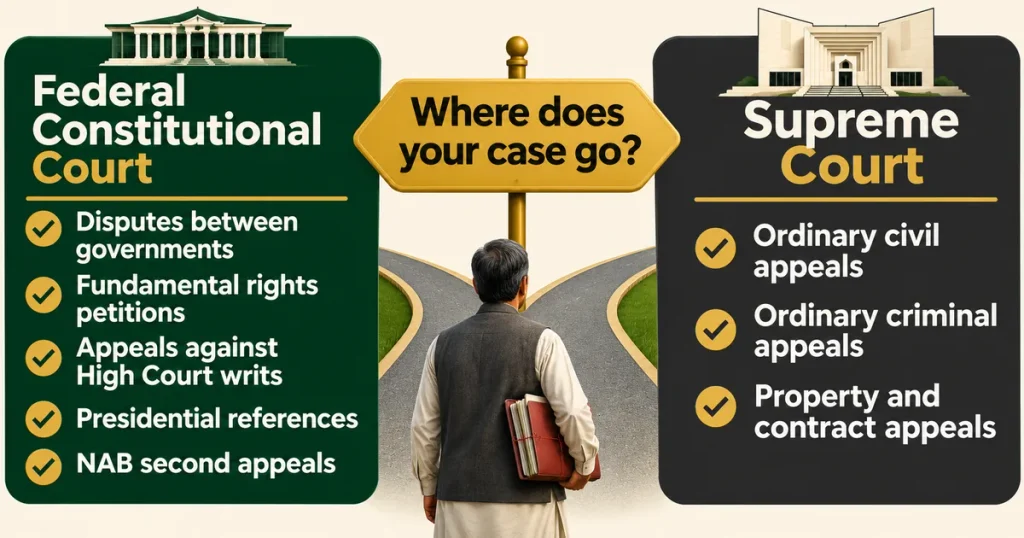
Think of it as a division of work. The FCC now handles disputes between governments, fundamental rights petitions of public importance, appeals against High Court writ orders and presidential references. The Supreme Court keeps ordinary civil and criminal appeals under Article 185.
The idea is not new. Supporters trace it back to the Charter of Democracy signed by the PPP and PML-N in 2006. The FCC also replaced the Supreme Court’s constitutional benches, which the 26th Amendment had created only a year earlier.
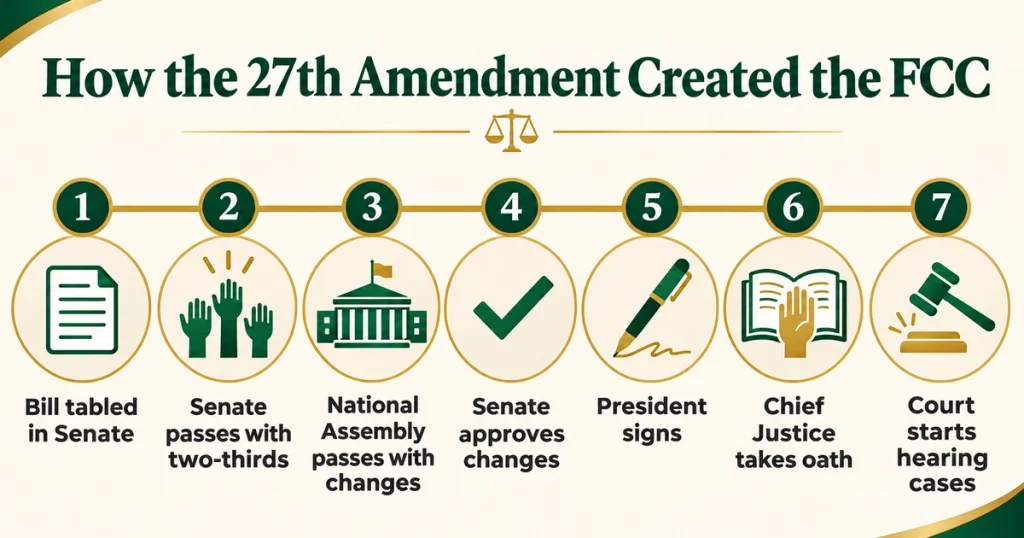
How the 27th Amendment Created the Court Within a Week
Changing the Constitution needs a two-thirds majority in both houses of Parliament. The government secured it in just six days.
| Date | What happened | Votes |
|---|---|---|
| 8 November 2025 | Federal cabinet approved the draft; Law Minister Azam Nazeer Tarar tabled the bill in the Senate | — |
| 10 November 2025 | Senate passed the bill; opposition members walked out | 64 for, 0 against |
| 12 November 2025 | National Assembly passed it with changes; PTI boycotted the vote | 234 for, 4 against |
| 13 November 2025 | Senate approved the Assembly’s changes; President Asif Ali Zardari signed it the same day | 64 for, 4 against |
| 14 November 2025 | Justice Amin-ud-Din Khan took oath as the first Chief Justice before the President | — |
| 17 November 2025 | Bench completed with seven judges; the court began hearing cases | — |
The 64 votes in the 96-member Senate were exactly the two-thirds needed. In the 336-member National Assembly, the bar was 224 votes. The four votes against in the Assembly came from JUI-F members.
The Week Two Supreme Court Judges Resigned
The new court was born amid a storm. On 13 November 2025, Justice Syed Mansoor Ali Shah and Justice Athar Minallah resigned from the Supreme Court in protest. In his letter, Justice Shah called the amendment a “grave assault on the Constitution of Pakistan”. The President accepted both resignations the next day.
On 15 November 2025, Justice Shams Mehmood Mirza of the Lahore High Court also resigned, citing principle. Reports also said that Justice Musarrat Hilali of the Supreme Court declined to join the FCC, after which Justice (retd) Syed Arshad Hussain Shah was appointed. Their objections are part of the wider debate explained later on this page.
Meet the 7 Judges Who Sit on the FCC
Seven judges serve on the Federal Constitutional Court of Pakistan, in the order listed on its website. Four came from the Supreme Court, two from High Courts and one was a retired judge.
| # | Judge | Oath | Came from |
|---|---|---|---|
| 1 | Chief Justice Amin-ud-Din Khan | 14 November 2025 | Judge of the Supreme Court and head of its Constitutional Bench |
| 2 | Justice Syed Hasan Azhar Rizvi | 14 November 2025 | Judge of the Supreme Court |
| 3 | Justice Aamer Farooq | 14 November 2025 | Judge of the Supreme Court; former Chief Justice of the Islamabad High Court |
| 4 | Justice Ali Baqar Najafi | 14 November 2025 | Judge of the Supreme Court |
| 5 | Justice Muhammad Karim Khan Agha | 15 November 2025 | Judge of the Sindh High Court |
| 6 | Justice Rozi Khan Barrech | 17 November 2025 | Chief Justice of the Balochistan High Court |
| 7 | Justice (retd) Syed Arshad Hussain Shah | 17 November 2025 | Former Chief Judge of the Supreme Appellate Court, Gilgit-Baltistan |
When the court started, the Chief Justice formed three benches. Bench I had the Chief Justice, Justice Najafi and Justice Shah. Bench II had Justice Rizvi and Justice Agha. Bench III had Justice Farooq and Justice Barrech. You can see the judges’ profiles on the FCC judges page.
How FCC Judges Are Appointed, and When They Retire
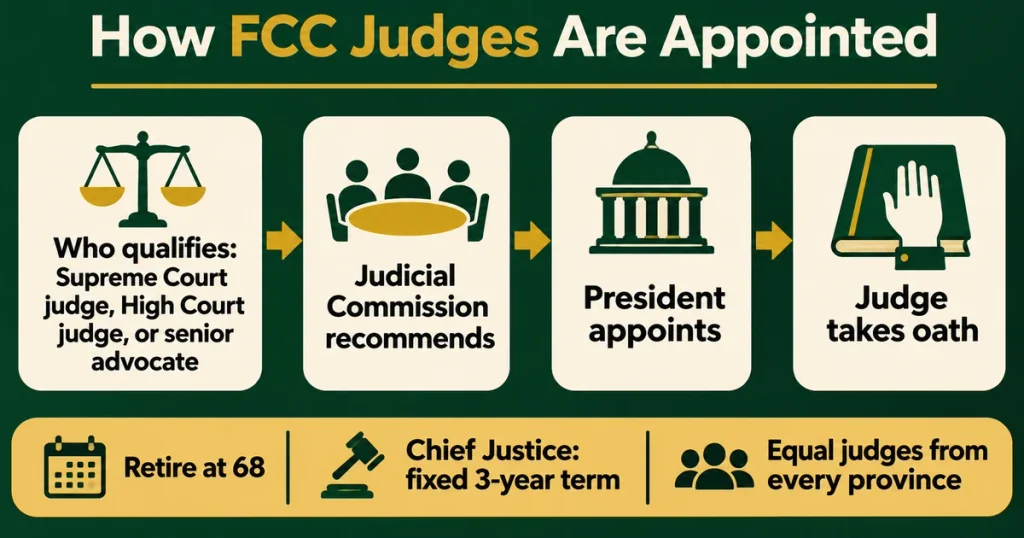
The first Chief Justice and the first batch were picked under a one-time rule: the President appointed them on the Prime Minister’s advice. From now on, the Judicial Commission of Pakistan recommends judges under Article 175A, and the President appoints them. The Commission now includes the chief justices of both the FCC and the Supreme Court.
- Who can become an FCC judge (Article 175C): a Pakistani citizen who is or was a Supreme Court judge, or a High Court judge for at least five years, or a High Court advocate for at least twenty years who is also an advocate of the Supreme Court.
- How many judges: Parliament decides by law; until then, the President fixes the number. Each province must have an equal number, plus at least one judge from the Islamabad High Court (Article 175B). Reports put the sanctioned strength at 13, but seven judges were serving by November 2026.
- Seniority: counted from the date a judge takes office; if two join on the same day, the older one is senior (Article 175C(3)).
- Retirement: at 68. The Chief Justice serves three years and then retires, even if he is younger than 68 (Article 175I).
- Acting judges: if a seat is empty, the President can appoint an acting Chief Justice or an acting judge (Articles 175J and 175K).
8 Powers That Make the FCC So Important
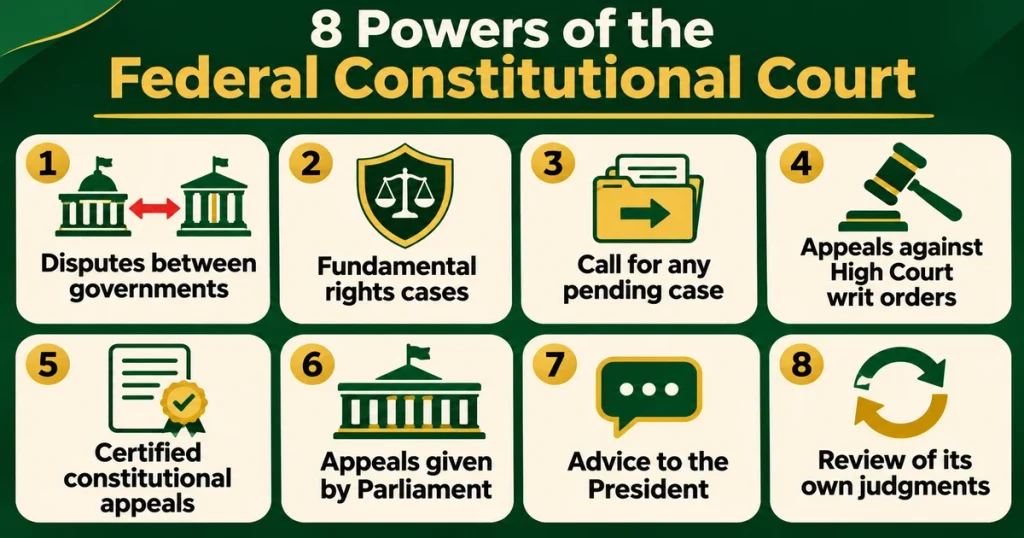
The Constitution gives the Federal Constitutional Court of Pakistan eight main powers. Here they are in plain words.
- Disputes between governments (Article 175E(1)). Only the FCC can hear a dispute between the federal and a provincial government, or between provinces. Here it gives declaratory judgments only.
- Fundamental rights cases (Article 175E(3)). Where a question of public importance about fundamental rights arises, the FCC can pass orders like a High Court writ. But it acts only when a person files an application.
- Pulling up any pending case (Article 175E(5)). If a case anywhere raises a substantial question about interpreting the Constitution, the FCC can call for its record and pass orders, on its own motion or otherwise.
- Appeals against High Court writ orders (Article 175F(1)(c)). Most appeals against High Court decisions under Article 199 now come here, but only if the FCC grants leave. There is no appeal in rent and family cases, except guardianship.
- Certified constitutional appeals (Article 175F(1)(b)). If a High Court certifies that a case involves a substantial question of constitutional interpretation, the appeal lies to the FCC.
- Appeals that Parliament assigns (Article 175F(1)(a)). Parliament can send other appeals here by law. The National Accountability (Amendment) Act, 2026 did exactly that: a second appeal in NAB cases now lies to the FCC within 30 days of the High Court’s decision.
- Advice to the President (Article 175H). The President can ask the FCC for its opinion on any question of law of public importance. This power used to belong to the Supreme Court.
- Reviewing its own judgments (Article 175G). The FCC can review its own decisions, subject to law and its Rules.
Is the FCC Above the Supreme Court? What Article 189 Says
The Constitution now answers this in two lines. Article 189(1) says an FCC decision on a question or principle of law binds all other courts “including the Supreme Court”. Article 189(2) says a Supreme Court decision binds all other courts “except the Federal Constitutional Court”.
The FCC has relied on this. In its judgments, it has said that its rulings bind every court in the country and that Supreme Court judgments are only persuasive for it.
The Supreme Court sees the relationship differently. On 6 May 2026, a bench of Chief Justice Yahya Afridi and Justice Shahid Bilal Hassan called the two courts “coordinate courts” with separate jurisdictions. It said Article 189 keeps the law consistent but does not make one court subordinate to the other.
So both views exist. For an ordinary litigant, the practical rule is simpler: on a point of law, follow what the FCC has decided, and file your case in the court that has jurisdiction over it.
FCC vs Supreme Court: Where Does Your Case Go Now?
| Your case | Which court |
|---|---|
| Dispute between the federal and a provincial government | FCC |
| Fundamental rights petition of public importance, filed directly | FCC (a High Court writ under Article 199 is still available) |
| Appeal against a High Court writ (Article 199) decision | FCC, if it grants leave (no appeal in rent and family cases, except guardianship) |
| Appeal on a constitutional question certified by a High Court | FCC |
| Second appeal in a NAB case | FCC, within 30 days |
| Presidential reference | FCC |
| Ordinary civil appeal, such as a property or contract suit | Supreme Court (Article 185) |
| Ordinary criminal appeal | Supreme Court (Article 185) |
The Supreme Court’s 6 May 2026 judgment confirmed this split: writ matters go to the FCC, while regular civil and criminal appeals stay with the Supreme Court.
Over 22,000 Cases Shifted: The FCC’s First Year in Numbers
Articles 175E(4) and 175F(2) moved pending constitutional matters from the Supreme Court to the FCC automatically. According to the state news agency APP, the Supreme Court had 56,608 pending cases on 13 November 2025, and 22,910 had moved to the FCC by 24 December 2025. Later reports give slightly different totals, around 22,200 to 22,300.
The workload has been heavy. Radio Pakistan reported on 13 November 2026 that the Federal Constitutional Court of Pakistan decided 8,735 cases in its first year, while 6,657 new cases were filed. Its seat is in Islamabad, but under Article 175L it can sit elsewhere, and it has already held sittings in Karachi.
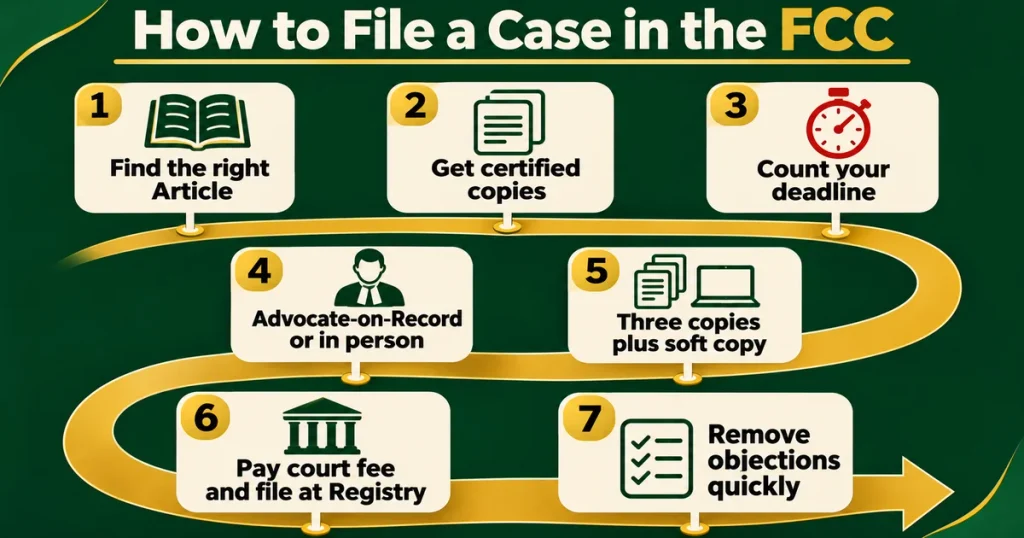
How to File a Case in the FCC: Step by Step
The Federal Constitutional Court of Pakistan is not a court for every complaint. Before anything else, make sure your matter actually falls within its jurisdiction. Then follow these steps, which are based on the Federal Constitutional Court (Practice and Procedure) Rules, 2026.
- Find the right Article. Decide whether your case is a fundamental rights petition (Article 175E(3)), a petition for leave to appeal against a High Court writ order (Article 175F(1)(c)) or another route. A wrong route can sink a good case.
- Get certified copies. Obtain the certified copy of the High Court judgment or order you want to challenge, along with the important record.
- Count your deadline at once. Most petitions must be filed within 60 days. The full list is in the next section.
- Choose who will file. A petition can be filed by an Advocate-on-Record or by the party in person. A person appearing in person must follow the same discipline as an Advocate-on-Record. From 1 January 2027, only Advocates-on-Record on the FCC’s own roll can act before it.
- Prepare the petition. State the points of law and the necessary facts clearly. File at least three copies along with a soft or scanned copy.
- Pay the court fee and file. File at the Registry in Islamabad or at a notified Branch Registry. Check the latest filing notices on the FCC Notifications page first.
- Answer any objection quickly. If the Registry raises objections, remove them within the time given, usually 14 days. If it refuses to receive your petition, you can appeal to the Judge-in-Chambers within 14 days.
After filing, you can track your case, check cause lists and apply for adjournments, early hearings or certified copies through the FCC website.
FCC Court Fees and Deadlines You Cannot Afford to Miss
These fees and deadlines of the Federal Constitutional Court of Pakistan come directly from the Third Schedule and the Orders of its Rules, published in the Gazette on 16 September 2026.
| Proceeding | Court fee |
|---|---|
| Constitution petition | Rs 2,500 |
| Petition for leave to appeal | Rs 2,500 |
| Appeal where the value is up to Rs 1 million, or cannot be counted in money | Rs 2,500 |
| Appeal where the value is above Rs 1 million | Rs 100 extra for every Rs 100,000, up to a maximum of Rs 10,000 |
| Review application | Half the fee paid in the original case |
| Caveat or concise statement | Rs 500 |
| Petition to proceed as a pauper | Rs 100 |
| Transfer application | Rs 2,500 |
| Habeas corpus, and Article 175E(3) petitions arising from criminal proceedings | No court fee |
If your appeal comes after leave is granted, the fee you paid on the leave petition is credited. A review also needs a security deposit of Rs 50,000, which can be forfeited. A frivolous review can bring costs of at least Rs 25,000.
| Proceeding | Time limit |
|---|---|
| Petition for leave to appeal (civil) | 60 days from the High Court judgment or final order, or from refusal of a certificate |
| Petition for leave to appeal (criminal) | 60 days from the judgment or final order |
| Appeal after a certificate, leave or under a law | 60 days from the judgment, certificate or grant of leave, as the case may be |
| Second appeal in a NAB case | 30 days from the High Court’s decision |
| Review application | 30 days from the date the judgment is announced |
| Restoring an appeal dismissed for non-prosecution | 30 days |
| Appeal against refusal to receive a petition | 14 days |
| Habeas corpus petition | Must be fixed for hearing within 7 days of filing |
The court can extend some time limits for sufficient cause, but never plan on it. Fees in the Rules can also be revised every three years, so check the latest notifications before you file.
Official FCC Links You Can Trust
- Official website: fccp.gov.pk
- Judgments: fccp.gov.pk/judgements
- Judges: fccp.gov.pk/judges
- Rules and notifications: fccp.gov.pk/notifications
- 27th Amendment (Gazette copy): National Assembly of Pakistan
- Contact: +92 51 111 322 322, [email protected]
7 FCC Judgments That Have Already Changed the Rules
In its first year, the Federal Constitutional Court of Pakistan has decided cases on taxes, land, property and the limits of other courts. Here are seven that matter to ordinary people and businesses.
| Case | When | What the FCC decided |
|---|---|---|
| D.G. Khan Cement Co. v. Federation of Pakistan (super tax), C.A. 1243 of 2020 and connected cases | Short order 27 January 2026; detailed judgment April 2026 | Upheld super tax under sections 4B and 4C of the Income Tax Ordinance, 2001, but held that income exempt from income tax stays outside super tax |
| Super tax adjustment, F.C.P.L.A. 1276 and 1277 of 2026 | August 2026 | Allowed eligible tax credits to be adjusted against super tax liability |
| Sher Muhammad Mughari v. Federation of Pakistan, C.P.L.A. 1442-K of 2022 and connected cases | Short order 7 May 2026 | Declared section 7E of the Income Tax Ordinance (tax on deemed income from immovable property) unconstitutional and void |
| Matracon Pakistan (Pvt) Ltd v. Appellate Tribunal, KP (sales tax on construction services) | February 2026 | Upheld KP’s sales tax on construction services and explained the FCC’s power under Article 175E(5) |
| Monal restaurant case (MCI and CDA v. Monal Group) | Short order 13 July 2026; detailed judgment 2 October 2026 | Set aside parts of the Supreme Court’s 2024 Monal decision and left questions of ownership and lease to the civil court |
| Khaliq Dad v. CDA (land compensation), C.P.L.A. 5595 of 2024 and connected cases | 11 November 2026 | Refused fresh valuation beyond the awards, but ordered CDA to settle lawful compensation, plot and rehabilitation claims within six months |
| CDA v. Maqbool Hussain (Sectors C-13 to C-16), F.C.P.L.A. 624 of 2026 | 17 November 2026 | Held that delay alone does not justify paying today’s market rate, but CDA must pay verified dues; read our full guide on land acquisition |
You can download FCC judgments from the court’s official judgments page. For simple explanations of new rulings, follow our Federal Constitutional Court judgments section.
Supporters vs Critics: The Great FCC Debate
Few constitutional changes in Pakistan have divided opinion like this one. Here is what each side says, in their own terms.
What Supporters Say
- A promise kept. The government says the FCC fulfils the 2006 Charter of Democracy. The Pakistan Bar Council and the Supreme Court Bar Association said in a joint statement that a court with equal provincial representation had been their demand for nearly two decades.
- Faster justice for ordinary people. Supporters argue that political and constitutional cases used to crowd out ordinary appeals. With the FCC handling those, the Supreme Court can focus on civil and criminal cases.
- Clearer rules. Law Minister Azam Nazeer Tarar has argued that a dedicated court brings consistency to constitutional decisions. Supporters also point out that the FCC cannot start a fundamental rights case on its own; someone must file an application.
What Critics Say
- A blow to judicial independence. The judges who resigned objected strongly. Justice Mansoor Ali Shah wrote that the amendment “subjugates the judiciary to executive control”. The International Commission of Jurists and Amnesty International raised similar concerns.
- How the first judges were chosen. The first Chief Justice and judges were appointed on the Prime Minister’s advice. Critics say this gave the executive too much say over the new court.
- A rushed process. The UN human rights chief, Volker Türk, said the changes were adopted hastily without broad consultation. PTI boycotted the vote, and several lawyers’ groups protested.
The debate continues, including inside the courts themselves, as the Supreme Court’s “coordinate courts” judgment shows. What is not in doubt is that the FCC is now part of the Constitution, and its decisions shape real cases every day.
FAQs About the Federal Constitutional Court of Pakistan
What is the Federal Constitutional Court of Pakistan?
The Federal Constitutional Court of Pakistan is a separate apex court for constitutional matters, created by the 27th Amendment on 13 November 2025. It hears disputes between governments, fundamental rights petitions of public importance, appeals against High Court writ orders and presidential references. Its decisions on questions of law bind all other courts.
Who is the Chief Justice of the FCC?
Justice Amin-ud-Din Khan is the first Chief Justice of the FCC. He took oath before President Asif Ali Zardari on 14 November 2025. Under Article 175I, the Chief Justice serves a fixed three-year term and then retires, whatever his age. Before this, he was a Supreme Court judge.
Is the FCC higher than the Supreme Court?
Under Article 189(1), FCC decisions on questions of law bind all courts, including the Supreme Court, while Supreme Court decisions do not bind the FCC. However, the Supreme Court held in May 2026 that the two are coordinate courts with separate jurisdictions, and neither hears appeals against the other.
Can I file my case directly in the FCC?
Only in limited cases. You can file directly if your matter raises a question of public importance about fundamental rights under Article 175E(3). Most people reach the FCC through a petition for leave to appeal against a High Court decision. Ordinary civil and criminal appeals still go to the Supreme Court.
How much does it cost to file a case in the FCC?
Under the FCC Rules, 2026, the court fee is Rs 2,500 for a constitution petition or a petition for leave to appeal. Appeals cost up to Rs 10,000, depending on the value. Habeas corpus petitions carry no court fee. Lawyers’ fees, copies and other charges are separate.
What is the time limit to appeal to the FCC?
A petition for leave to appeal must usually be filed within 60 days of the High Court’s judgment or final order. A review application must be filed within 30 days of the judgment, and a NAB second appeal within 30 days of the High Court’s decision. Missing a deadline can end your case.
Can the FCC take suo motu notice?
Not in the old sense. Under Article 175E(3), the FCC can hear a fundamental rights matter only when someone files an application. But under Article 175E(5), it can call for the record of any pending case on its own motion if a substantial constitutional question arises. It can also start contempt proceedings itself.
Where is the FCC and how can I contact it?
The FCC’s permanent seat is in Islamabad, at Constitution Avenue, G-5/2. Under Article 175L, it can also sit at other places with the President’s approval, and it has held sittings in Karachi. You can call +92 51 111 322 322 or visit fccp.gov.pk.
Conclusion
The Federal Constitutional Court of Pakistan has changed who has the last word on the Constitution. Its rulings on the law now bind every court, its judges serve under new rules, and thousands of cases have moved to it in a single year.
Supporters see a long-awaited reform. Critics see a threat to judicial independence. Either way, if your case involves a fundamental right, a High Court writ or a dispute between governments, the FCC may be where it ends.
So know the route, count your deadline and keep your documents ready. For more simple guides on the rulings that shape your rights, explore our landmark judgments.
Disclaimer: This page is for legal awareness only and is not legal advice. Every case depends on its own facts, documents and evidence. For your specific matter, consult a qualified lawyer.