


Your father passed away years ago. Your brother kept the land. The patwari wrote an inheritance mutation (intiqal) you never saw, and every relative told you the same thing: “It is too late now. Time has finished your claim.”
On 13 November 2026, five judges of the Supreme Court of Pakistan gave a very different answer. This Supreme Court judgment on inheritance, 106 pages long, says your share never dies with time. But it also says that one thing can still lock the courtroom door on you. Most families have no idea what it is.
In this guide you will find that one thing. You will see when the 6-year clock really starts, what never starts it, what happens when a brother sells your share to a stranger, whether children can claim a dead mother’s share, and the 10 questions every trial court must now ask. If your family has a land dispute (wirasat ka jhagra), read till the end. The smallest detail in your file may decide your case.
Table of Contents
Judgment at a Glance: C.A. No. 909 of 2013
| Point | Details |
|---|---|
| Court | Supreme Court of Pakistan (Appellate Jurisdiction), Larger Bench of five judges |
| Bench | Justice Shahid Waheed (author), Justice Naeem Akhter Afghan, Justice Aqeel Ahmed Abbasi, Justice Shakeel Ahmad, Justice Miangul Hassan Aurangzeb |
| Lead case | C.A. No. 909 of 2013, Mst. Meraj Bibi & another v. Mst. Zar Gula (deceased) through LRs & others |
| Connected matters | 18 appeals and petitions in total, from the Peshawar High Court, the Lahore High Court and the High Court of Balochistan |
| Hearing | 7 October 2026, at Islamabad |
| Announced | 13 November 2026, by the Supreme Court sitting at its Lahore Branch Registry |
| Reporting | Approved for reporting; law report citation awaited |
| Main laws | Limitation Act 1908 (Article 120, Article 91, sections 2(8), 9 and 18); Specific Relief Act 1877 (section 42); Transfer of Property Act 1882 (section 41); Qanun-e-Shahadat 1984 (Articles 114 and 122); West Pakistan Muslim Personal Law (Shariat) Application Act 1962 |
| Result in one line | An heir’s title never lapses with time. Only the court remedy can be barred, and only six years after a known overt act denying the heir’s share. The nine questions of law were answered, and the 18 cases were sent back to regular benches for decision on merits. |
| Official copy | Read the full judgment on the Supreme Court website |
The Whole Case in 4 Boxes (IRAC)
| IRAC | What the Court said |
|---|---|
| Issue | When, if ever, does time run against an heir? Can silence, delay, a sale to a stranger, the death of the heir or old custom take away a share in inheritance? |
| Rule | Article 120 of the Limitation Act 1908 gives six years “from when the right to sue accrues”. Article 91 gives three years to cancel a document. Section 18 delays the clock in cases of fraud. Section 28 and Article 144, which once let time destroy ownership, stopped working on 31 August 1991. Surah Al-Nisa (4:7) calls each share “an appointed share”. |
| Analysis | A Muslim’s estate vests in the heirs at the moment of death. No law can now end that title by lapse of time; only the remedy can be barred. Between co-heirs, the right to sue starts only on an “actual denial”, meaning an overt act against the heir’s title, brought home to the heir. A wrong mutation is only a “threatened denial” and starts nothing. Against an honest buyer in open possession, the heir is also charged with what ordinary care would have shown. |
| Conclusion | The “rule of the known overt act”: an inheritance suit is out of time only if the defendant proves a known actual denial more than six years before the suit (or, for a document the heir signed, knowledge of the facts more than three years before). In every other case, the suit is within time. |
Why 18 Families’ Cases Landed Before Five Judges

For decades, two families with the same story could get two opposite results. One bench of the Supreme Court said no limitation runs against a co-sharer in inheritance. Another bench said limitation applies with full force, especially once land is sold to outsiders. Lower courts had to pick one line, and litigants had to pray they got the right judge.
The Court described this problem in one painful line: “A right that depends upon which Bench one draws is not a right secured; it is a lottery ticket” (para 3). The record showed that courts below, each following one line of Supreme Court cases, had reached opposite results on almost the same facts (para 7). So the questions were sent to a Larger Bench to end the confusion, and this Supreme Court judgment on inheritance is its answer.
The 18 matters came from suits for declaration, joint possession and partition, where heirs claimed their shares and the other side pleaded that they had come too late. You can read our earlier coverage of limitation in inheritance judgements to see how mixed the old rulings were.
Three Kinds of Land, Three Different Battles
The Court said limitation cannot be answered in the abstract, because the record of title is different for different land (paras 16 to 19):
- Agricultural land in settled areas. On a death, the revenue staff must enter an inheritance mutation, and it passes into the jamabandi. The State makes this entry, often without notice to absent or female heirs. So the mutation says very little about what any heir actually knew.
- Urban property. Houses and plots rarely get an inheritance mutation. Title sits in registered deeds and in the records of development authorities, cantonment boards and housing societies. Heirs are usually cut out by a positive act, such as a transfer on an affidavit that leaves a sister’s name out.
- Unsettled areas. Where no settlement record exists, land is held by possession and custom. The first written record of an heir’s exclusion may be the first record of rights itself.
The Three Arguments That Clashed in Court
Lawyers and two amici curiae (court advisers) argued three very different positions (paras 11 to 13):
- “Limitation never touches inheritance.” Inheritance is a divine right, so no man-made time limit can cut it, and no limitation runs against a co-sharer.
- The middle path. Inheritance vests on death and a mutation creates no title. Time should start only from a denial the heir knows about. Successors inherit a live claim but cannot revive a dead one. One amicus, Mr. Obaid-ur-Rehman Khan, suggested that giving up a share should be valid only through a registered deed.
- “Limitation applies with full force.” Limitation bars the remedy, not the right, and Islamic law itself (the Majalla) recognised time limits. Without limitation, every land title in Pakistan would stay uncertain forever.
The bench did not simply pick one side. It built a rule from all three, as you will see below.
What the Quran and Sunnah Say About Your Share
Before touching any statute, the Court began “where the right itself begins”. Articles 2A and 227 of the Constitution and section 4 of the Enforcement of Shari’ah Act 1991 require inheritance law to be read in the light of the Quran and Sunnah (para 22). These are the Court’s English renderings of the meaning:
- Surah Al-Nisa 4:7: “For men is a share of what parents and near relatives leave, and for women is a share of what parents and near relatives leave, be it little or much: an appointed share.” The Court explained that the word mafrudan marks the share as fixed by command, not offered as a favour.
- Surah Al-Nisa 4:11 and 4:12: These verses fix the shares of children, parents and spouses. Verse 12 ends with the words “without harm being caused”, which the Court read as forbidding any arrangement made to defeat the heirs.
- Surah Al-Nisa 4:19: “O you who believe, it is not lawful for you to inherit women against their will.”
- Surah Al-Baqarah 2:188: “And do not consume one another’s property by falsehood, nor offer it to the authorities so that you may consume a portion of other people’s property sinfully while you know.” The Court called this a direct warning against misusing courts and officials.
- Surah Al-Fajr 89:19: “And you devour inheritance, devouring it altogether.”
The Court also recalled the first inheritance case in Islam (Jami’ al-Tirmidhi No. 2092; Sunan Abi Dawud No. 2891). The uncle of the two daughters of Sa’d ibn al-Rabi’ had taken all their property. After the verse of inheritance was revealed, the Prophet (peace be upon him) ordered two-thirds for the daughters, one-eighth for their mother, and the rest for the uncle. The Court called it “a balancing decree”: the wrong was undone, but the uncle kept his own lawful part.
From these sources the Court drew six conclusions (para 53). The heir’s title vests at death and cannot be lost by silence or bare giving up. A share leaves an heir only by a recognised transfer with free consent. Islam allows the State to regulate stale claims, but the classical method bars the hearing, not the right. Fear of a powerful opponent, which describes most excluded women, is a lawful excuse. Possession by a co-heir is presumed to be with the others’ tolerance. And distribution of an estate is a duty to be done promptly.
That last point carries a warning for every family. The Court said that undivided estates destroy relationships, waste property and multiply heirs, and that “Delay is the soil in which the plea of limitation grows” (para 51). If you want to know who gets what in the first place, see our guide on inheritance law in Pakistan.
The Laws Behind the Ruling, in Plain English
| Law | What it says | Why it matters to you |
|---|---|---|
| Limitation Act 1908, Article 120 | Six years for any suit with no other fixed period, counted from when the right to sue accrues | Governs a suit for a declaration of your share against your co-heirs |
| Limitation Act 1908, Article 91 | Three years to cancel a document, from when you learn the facts | Applies only to a document you signed yourself |
| Limitation Act 1908, section 18 | Fraud that hides your right delays the clock until you discover it | Protects heirs kept in the dark, but not against an honest buyer |
| Limitation Act 1908, sections 2(8) and 9 | A successor counts as the same “plaintiff”; once time starts, it does not stop | Decides what your children inherit: a live claim or a dead one |
| Section 28 and Article 144 | Once let 12 years of adverse possession destroy ownership | Ceased to have effect on 31 August 1991 (Maqbool Ahmad, 1991 SCMR 2063) and have since been omitted |
| Specific Relief Act 1877, section 42 | You “may” sue anyone “denying, or interested to deny” your title | A threat lets you sue but does not force you to |
| Transfer of Property Act 1882, sections 41 and 44 | Protects a careful buyer from an “ostensible owner”; a co-owner may sell only his own share | Decides whether a buyer from your brother keeps your land |
| Punjab Land Revenue Act 1967, sections 42(7), 52 and 53 | An inheritance mutation may be attested without the affected heir present; entries are presumed true until disproved | A mutation is the State’s tax ledger, not your title deed |
| Qanun-e-Shahadat 1984, Articles 114 and 122 | Estoppel; the burden of proving facts within a party’s special knowledge | Shifts the burden onto the brother who holds your share |
| Pakistan Penal Code 1860, section 498A | Depriving a woman of inheritance by deceitful or illegal means: 5 to 10 years, or a fine of Rs 1 million, or both | Criminal protection, currently for women only |
You can read the official text of the Punjab Land Revenue Act 1967 on the Board of Revenue website. One current-law check matters here: the Limitation (Amendment) Act 2023 changed Article 150 of the First Schedule. It did not touch Article 120, so the six-year period still stands.
Time Can Lock the Court Door, Not Your Title
Here is the first surprise. The Court refused to say that limitation never applies to inheritance. Only the Shariat courts can strike down a law as against Islam (Articles 203D and 203G). That route was used in Maqbool Ahmad (1991 SCMR 2063) to end section 28 and Article 144, but Article 120 was never touched. So an ordinary civil court cannot switch off Article 120 for a whole class of cases (para 121). “The civil court may interpret the statute; it may not repeal it.”
But the second surprise matters more. With section 28 gone, no law in Pakistan now ends ownership by lapse of time. The Limitation Act only bars remedies. Your title, which vested at your father’s death, survives every passing year. If your remedy is ever barred, the person in possession holds the land because of that bar, not because time made him the owner. In the Court’s words: “Time can lock the courtroom door; it cannot change the name on the title” (para 123).
So the real question is not whether limitation applies. It is when the six-year clock starts. And that is where this judgment changes everything.
What Starts the 6-Year Clock, and What Never Does

The Court adopted a simple but powerful split from the Saadat Khan case (PLD 2023 SC 362). A threatened denial of your title gives you the option to sue, and each new threat renews that option. An actual denial gives you a cause of action you must act on. “A threat to one’s title is an invitation to sue; a repudiation of it is a summons” (para 125).
| These START the clock (actual denial) | These NEVER start the clock |
|---|---|
| Your share, or more land than the seller’s own share, is sold to someone else and possession is handed over | A wrong or incomplete inheritance mutation |
| A gift, sale, relinquishment or settlement deed or mutation is set up in someone else’s name, claiming it came from you or your father | The same wrong entry repeated in every new jamabandi |
| You demand your share and it is refused | Your brother stops giving you your share of crops or rent |
| You are physically pushed out, with a claim that he is the sole owner | Spoken refusals without any overt act |
| A written notice denying your title and claiming sole ownership is handed to you personally | Long possession by the heir in possession, however many years |
| One heir takes the whole price or compensation for joint land acquired by the State, as if he were the only owner |
The Court said these acts are only examples of one test, not a closed list (para 129). Its summary of the right-hand column is unforgettable: “Whispers in the patwarkhana do not amount to a declaration of war.” The written notice in the left column is the one way an heir in possession can start the clock himself, openly.
The Clock Stays Still Until You Know
An overt act alone is not enough. Between co-heirs, the possession of one is the possession of all, so the excluded heir is still in “constructive possession”. A denial only exists once it is brought home to the heir (para 130). “An assertion never communicated is no assertion at all.” This is not new law, the Court said; it declares a line running back to Ghulam Ali (PLD 1990 SC 1).
Knowledge can be proved directly or inferred from circumstances (para 132). Courts may infer it if you lived in the same village, took part in proceedings about the land, watched the land being built on nearby for years, took part of the price or compensation, or made a demand yourself. But one thing can never prove knowledge on its own: a revenue entry. “The record is maintained by the State for fiscal purposes, and heirs, particularly women, have no reason to inspect it.” The law even allows an inheritance mutation to be attested without the heir present (section 42(7), Punjab Land Revenue Act).
Who Must Prove What in Court
The Court flipped the usual burden in a way that protects excluded heirs (para 134):
- The plaintiff proves that he or she is an heir and that the property belonged to the deceased.
- The defendant who relies on a gift, sale, relinquishment, settlement or custom must prove it strictly, before limitation is even discussed.
- The defendant who pleads limitation must prove an actual denial and its date.
- The plaintiff must state the date and manner of knowledge in the plaint itself. The defendant may then prove earlier knowledge.
“He who holds another’s share must explain how; he who says the claim is late must show when the clock started.”
The 9 Questions and the Supreme Court’s 9 Answers
These are the nine questions of law at the heart of this Supreme Court judgment on inheritance, with the Larger Bench’s answers in simple words (paras 186 to 194).
| No. | Question | The Supreme Court’s answer |
|---|---|---|
| 1 | Is a suit for a share in inherited property bound by a fixed time limit, and from when? | Yes. Article 120: six years from an actual denial brought home to the heir. A wrong mutation and its repetition are threatened denials and start nothing. Article 142 applies only if the heir was in actual possession and was thrown out. Article 91 applies only to a document the heir signed. Articles 123 and 127 never apply to Muslim heirs. A partition suit is not barred while the heir is still in joint possession. |
| 2 | Can mere lapse of time defeat an heir, even where fraud is alleged? | No. Title is never extinguished by time. Only the remedy is barred, and only six years after a known actual denial. Fraud that hides the denial delays the clock (section 18), except against an honest buyer for value. A fraudulent deal the heir was not part of does not bind him and need not be cancelled. |
| 3 | If an heir dies without claiming, can his own heirs claim? | Yes. The share vested in him and passed to his heirs, who can sue. But they take the claim as it stood: barred if six years ran out in his lifetime after he knew; the balance if time had started; a fresh start from their own knowledge if he never knew. A parent’s silence is never, by itself, a bar. |
| 4 | Does silence, inaction or delay mean the heir gave up the share? | No. Silence is never waiver or relinquishment. A bare relinquishment of accrued inheritance is void. A share leaves an heir only by a lawful transfer (sale, gift, exchange, takharuj or an honest family settlement) made with free consent after the heir knew the share, and strictly proved. |
| 5 | Can estoppel or acquiescence be used against an heir? | Never in favour of the co-heir who caused the exclusion. In favour of an outside buyer, only if the buyer proves four things: the heir knew his right; the heir knew of the transfer; the heir represented something by words or conduct (silence counts only where there was a duty to speak); and the buyer relied on it to his loss. |
| 6 | What happens when inherited land is sold to a third party? | The buyer gets no better title than the seller had. A co-heir’s sale passes only his own share. The excluded heir is bound only if section 41 or estoppel is proved. A sale with possession is an actual denial; against an honest buyer in open possession, time runs from what ordinary care would have revealed. The buyer’s part is fitted into the seller’s share on partition where possible. |
| 7 | What protection does an honest buyer get? | Three shields, each to be proved by the buyer: section 41 (with real consent of the heirs, never inferred from a mutation or silence), estoppel on the four elements, and limitation. Long possession alone gives no title. A buyer who did not check the family tree, the inheritance record and the seller’s possession is not in good faith. If the buyer is protected, the heir can claim the market value of the share on the date of decree, plus mesne profits, from the selling co-heir. |
| 8 | Do years of possession, conduct, payment and notice affect the heir’s claim? | Yes, but only as evidence of the elements above, never on their own. The court must record a finding on each element. No single factor, and no number of years, is decisive. |
| 9 | If the deceased died under custom, before the Shariat Application law reached his area, is that devolution “past and closed”? | Generally yes, as to that death, where no law reaches back. But not in Khyber Pakhtunkhwa (where every Muslim is deemed to have died under Shariah), not for limited estates of women, not where custom is not strictly proved, and not for customary mutations made after Shariah became the rule. In Punjab, section 2-A confirms male heirs who took agricultural land under custom before 15 March 1948 as absolute owners. |
The Court then condensed everything into one “bright line” (para 195). A suit concerning a share in inheritance is out of time only if the defendant proves an actual denial of the claimant’s right, brought home to the claimant or his predecessor more than six years before the suit. For a document the heir himself signed, the period is three years from knowing the facts. In every other case, the suit is within time. The Court called this “the rule of the known overt act”.
Forged Thumbprint or Signed Paper? Two Very Different Clocks
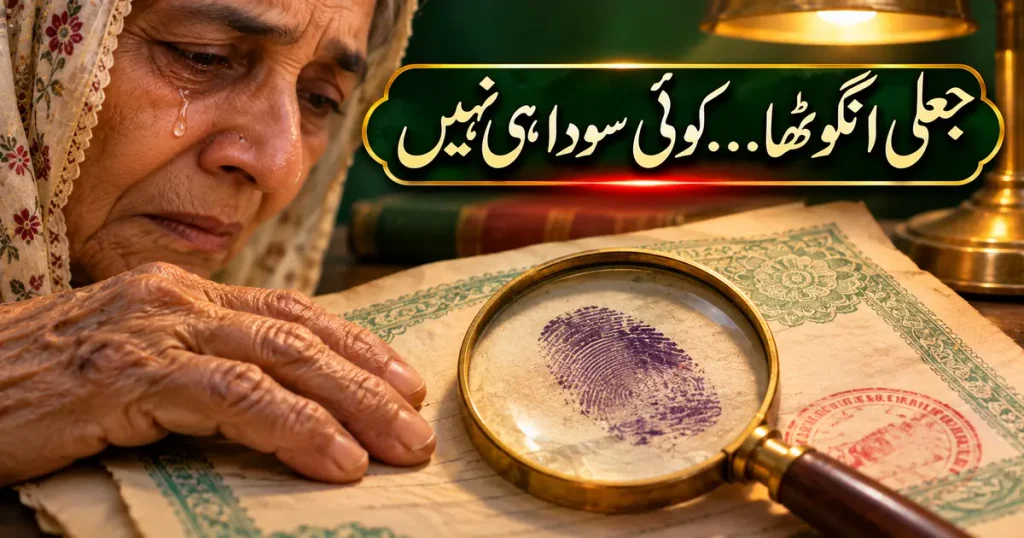
The Court said fraud “wears many coats”: the forged thumb impression on a gift mutation, the “oral gift” never made, the affidavit that drops a sister’s name, the relinquishment signed by a woman who could not read it (para 135). The question is simple: did the paper produce any legal effect against you?
- You never signed it (forgery, or a deal you were not part of). It does not bind you. It is void against you, so you do not need to sue to cancel it, and the three-year Article 91 does not apply. Your suit is for a declaration of your share, joint possession or partition under Article 120 (para 139). “A forgery is not a defective transaction; it is no transaction at all.”
- You signed it, but under pressure, coercion or a lie. Now the document is voidable at your request. You must sue to set it aside under Article 91, within three years of learning the facts (para 140). Even then, the person who benefits must prove that you signed freely and understood it.
- It was a bare relinquishment of your share. That is void anyway, so Article 91 does not even arise.
One line from this part sums up the Court’s balance: “Fraud excuses ignorance; it does not excuse indifference” (para 141). Once you know you have been cheated, you get six years to act. The Court also held that between family members, silence where there is a duty to speak is itself fraud. A brother who knows his sister has no idea about the gift mutation he procured, and lets her believe the land is still joint, is hiding it “as surely as if he had hidden the register” (para 142). But fraud must be pleaded with full particulars and dates (Order VI, Rule 4 CPC), and section 18 never helps against an honest buyer for value.
Why Your Silence Is Never Your Consent
Families often throw four pleas at an excluded heir together: relinquishment, waiver, estoppel and acquiescence. The Court said piling up four weak pleas cannot make one strong one (para 143).
- Relinquishment. A vested share is property, and property cannot simply be “released”. It can leave you only by a lawful transfer. “A share cannot be shrugged off like a coat; it must be conveyed like land” (para 144). A relinquishment by a woman of her accrued inheritance is void under section 23 of the Contract Act 1872, and the same principle protects male heirs too.
- Proof needed for any settlement. Whoever relies on a relinquishment, family settlement or takharuj must prove that the heir knew her exact share, had independent advice or a truly free choice, and that the legal form of transfer was followed. A line saying “consent given” in a mutation is not proof (para 145). Without a written document made at the time, after the heir was told her share, this burden will “rarely” be met (para 184).
- Waiver and acquiescence. Both need real knowledge. A sister who was never told about the mutation had nothing to object to, so her silence means nothing.
- Estoppel. The co-heir who made the exclusion “knew the truth because he made the falsehood”. He can never plead estoppel from his own deception (para 150). The Court affirmed Abrar Hussain v. Mst. Bibi Shahida (PLD 2026 SC 42) on this point.
The Court’s rule for every judge is now fixed: no heir shall be held to have waived, abandoned, acquiesced in or been estopped from claiming a share unless the court records, on evidence, that the heir knew of both the right and the act that defeats it (para 152).
Can Children Claim a Dead Mother’s Share? Yes, But Read This

Many families still believe a 2021 news headline: “A woman’s inheritance can be claimed only in her lifetime, and her children cannot claim after her death.” The Larger Bench addressed that headline directly. It said this is “not what the case decided, and it is not the law” (para 104).
In that case (Saadat Khan, PLD 2023 SC 362), two sisters had been left out of a 1935 mutation. Decades later, part of the land was acquired by the government, and their brother took the whole compensation as if he were the only owner. The sisters knew about it and still did not sue within six years. Their children’s claim failed for that reason alone. “Had they never known of it, their heirs’ claim would have been as alive as their own.”
The Court also rejected the older reasoning that the heirs of an excluded heir have no locus standi (no right to sue) because their parent did not sue (para 153). The share vested in your mother at your grandfather’s death, and on her death it passed to you. “A share that passes by inheritance does not die with the heir; it changes hands, not character.” This is good news for grandchildren too, who often ask about their rights as legal heirs.
But the successor takes the claim exactly as it stood (para 154):
- If your mother knew of an actual denial and six years passed in her lifetime, your claim is barred.
- If the clock had started but not finished, you get only the remaining time.
- If she never knew of any actual denial, time starts from your own knowledge.
You must state in your plaint which of these applies. Her ignorance can be shown from circumstances such as distance, seclusion, illiteracy or dependence on the brother in possession (para 155). But if the other side proves an overt act done in her knowledge, a bare claim that “she never knew” will fail.
Your Brother Sold Your Share. Who Loses Now?

This is the hardest kind of case, the Court said, because a stranger stands in the middle: a buyer who paid full price, built a house and raised a family on land that partly belonged to a sister he never met (para 168). Both are innocent. One must bear the loss.
The Court’s answer protects the honest buyer and the heir kept in the dark, and puts the cost on the one person who knew everything: the heir who sold. “The land follows the title, the loss follows the wrong” (para 178). Here is how it works:
- No better title. A buyer gets only what the seller owned. A co-heir can sell his own undivided share (section 44), and that part is fitted into his share on partition (para 176).
- The buyer’s duty of care. In a country where inheritance mutations are attested without the heirs, a careful buyer must at least check the inheritance mutation or succession record, ask about the family tree, and ask every heir shown there and people in the area who know the family (para 174). A buyer who buys the whole from one heir when the record shows others is treated as having notice. “The law does not ask the purchaser to be a detective; it asks him not to be wilfully blind.”
- Your clock against an honest buyer. A sale with possession is an actual denial. Against a buyer in good faith who openly occupies the land, time runs from what ordinary diligence would have shown you, not only from what you actually knew (para 175). A mutation alone is still never notice.
- If the buyer is protected. He keeps the land, and you recover the market value of your share on the date of the decree, plus mesne profits (income lost), from the brother who sold (para 178). Against the brother, time runs only from your actual knowledge of the sale. You can sue the brother and the buyer together in one suit.
- If the buyer proves nothing. He keeps only the seller’s share, and his remedy for the rest lies against the seller.
Died Under Custom? The Province-by-Province Answer
Question nine is vital for old agricultural land, because many families still divide land along lines first drawn by custom (rewaj). The Court traced, territory by territory, when Shariah became the rule (paras 159 to 167).
| Area | When Shariah governs | What the Court held |
|---|---|---|
| Khyber Pakhtunkhwa, settled districts | Every Muslim is deemed to have died under Shariah, whenever he died (section 3(2), NWFP Act 1935) | Nothing is “past and closed” only because of custom. For deaths before 6 December 1935, no claim could arise before 1950. The old view that claims had to be filed between 1950 and 1962 is disapproved. |
| Former PATA (KP) | Deemed Shariah death, as in Mst. Farida (PLD 1991 SC 213) | No enforceable claim before 15 January 1976; time runs only from a known denial after that date. |
| Former FATA | Custom (riwaj) until the 2018 merger | Whether old deaths there are covered was left open; for later deaths, Shariah applies. |
| Punjab and Islamabad | From 15 March 1948 | For earlier deaths, proved custom governs, and section 2-A makes a male heir who took agricultural land under custom its absolute owner. Women’s limited estates ran their course, then succession opened under Shariah. Bahawalpur follows the same 1948 date. |
| Sindh | Non-agricultural property from 7 October 1937; agricultural land from the Sind Amendment Act 1950 | Custom must be proved “with particular rigour”. |
| Balochistan | Settled districts: 7 October 1937 (non-agricultural) and 31 December 1962 (all property); tribal areas from 1976 | Old devolutions under proved tribal custom are closed, subject to limited estates. |
Two rules apply everywhere. First, a mutation made under custom after Shariah became the rule is a nullity against the heirs it leaves out. Second, even where an old devolution is closed, the male heir who took under custom will himself die under Shariah, so his own daughters, widow and other heirs inherit from him (para 161).
The 10 Questions Every Trial Court Must Now Ask
To stop “lottery” outcomes, the Court ordered trial courts to frame separate issues whenever limitation is pleaded: the governing law (if custom is claimed), the divesting transaction, the actual denial and its date, knowledge and its date, and the buyer’s good faith where a buyer is a party (para 196). Limitation is a mixed question of law and fact. It cannot be decided on the pleadings alone unless the plaint itself shows a known actual denial more than six years old.
Courts must then take these 10 steps in order, recording a finding at each (para 197):
- Heirship and estate. Is the plaintiff (or the predecessor) an heir, and was the property part of the estate? If not, the suit fails on merits.
- Governing law. Did the deceased die under Shariah or under proved custom? If a limited estate is involved, when did it end?
- Divesting transaction. Is a gift, sale, relinquishment, settlement, takharuj or custom relied on, and is it strictly proved? A bare relinquishment is void and ignored.
- Special law. Does a special statute fix its own period? If so, it governs.
- Nature of the relief. Partition while in joint possession, or merely resisting another’s claim: no limitation. Avoiding a document the heir signed: Article 91. Everything else: Article 120.
- Actual denial. Has the defendant proved one of the overt acts listed earlier? If not, the suit is within time, however old the mutation.
- Knowledge. When was the denial brought home to the claimant (or predecessor)? Never from a revenue entry alone. Against an honest buyer in open possession, include what ordinary diligence would have shown. Fraud delays the clock until discovery.
- Successors. Did the predecessor know? Barred, balance, or a fresh start, as explained above.
- Computation. Count six years (Article 120) or three years (Article 91), applying sections 4 to 25, including the rules on minority and other disability and on written acknowledgment (section 19).
- Third parties. Separately, has the buyer proved section 41 or estoppel? If not, the transfer binds only the seller’s own share. If yes, the heir’s remedy is value and mesne profits against the selling co-heir.
5 Orders for Patwaris, NADRA Records and Housing Societies

The Court said limitation is rarely the true cause of an heir’s loss. The real cause is an exclusion made at the very start, usually in the record, usually without notice, and usually against a woman (para 202). So, using its power under Article 187 of the Constitution, it directed:
- No inheritance mutation without all heirs. Revenue authorities in every province must not attest an inheritance mutation without (a) a NADRA family registration record or equal proof of all heirs, (b) written notice to every heir, including female heirs at their own address, and (c) a recorded statement of any heir said to be getting less than her share.
- Personal appearance before any gift or relinquishment mutation. Before attesting a gift, sale, relinquishment or settlement mutation of inherited land, the revenue officer must record the heir’s personal appearance, identity, and a statement that she was told her exact share. For a female heir, this should happen before a woman revenue officer where one is available. If this is not done, courts may consider it when deciding whether the heir knew.
- No society or authority transfer without proper papers. Registering authorities, development authorities, cantonment boards and cooperative housing societies must not transfer property on inheritance except on a succession certificate, letters of administration or a court decree, and must give written notice to all heirs first.
- First settlements must list all Shariah heirs. Settlement officers, including in the merged tribal districts, must record all heirs under Shariah and notify them of objection proceedings.
- Trial courts must frame the issues and decide quickly. Where limitation is pleaded, courts must frame the issues listed above, decide them on evidence, and try to decide such suits expeditiously.
Copies of the judgment were sent to the federal Ministry of Law and Justice, all provincial law secretaries, the Attorney-General, the Advocates-General and the Law and Justice Commission for necessary action (para 207). If your family is about to get an inheritance mutation (intiqal) attested, these orders are your shield. Ask for them by name.
4 Reforms the Court Wants Parliament to Make
These are recommendations to the Legislature and the Law and Justice Commission, not law yet (para 203):
- Any relinquishment, settlement or takharuj of an inherited share should be made only by a registered deed, signed after the heir is told her share.
- The Limitation Act should get a special article for heirs’ suits, fixing the period and its starting point by statute, plus an outer “long-stop” after which an honest buyer who paid value and took open possession cannot be disturbed.
- Section 498A of the Penal Code should be amended, or a companion offence created, so that depriving any heir, man or woman, by deceit or illegal means becomes a crime, while keeping the special protection for women.
- A legal duty, with a reasonable deadline, should be placed on heirs and revenue and registering authorities to complete distribution of an estate after its devolution is recorded.
The third point answers a real gap. Today section 498A protects only women, yet brothers are excluded by brothers and orphaned grandsons by uncles (para 77). In the Court’s words: “The shield for the sister should not leave the brother’s back bare” (para 79).
What the Supreme Court Did Not Decide
Reading a landmark judgment correctly means knowing its limits. Do not let anyone stretch this Supreme Court judgment on inheritance beyond what it actually says:
- It did not decide the 18 cases themselves. Having answered the nine questions, the bench sent every appeal and petition back to regular benches for decision on merits (para 206). Nobody has “won” or “lost” land through this judgment yet.
- It does not reopen finished cases. No decree or order that has attained finality, and no transaction closed by such a decree, will be reopened. The principles govern suits pending on, or filed after, 13 November 2026, and appeals, revisions and petitions arising from them (para 204).
- It left two questions open. Whether old deaths in the former FATA are covered by the Shariah deeming rule (para 163), and whether Article 141 or Article 120 governs a suit after a saved limited estate ends on the holder’s death (para 156).
- It did not rule on section 498A’s validity, and it did not make registration of relinquishment compulsory. Both are left to the Legislature (paras 79 and 184).
- It is not a general “discovery rule”. The knowledge rule is confined to suits between co-owners and people claiming through them. Other Article 120 suits are not affected (para 131).
One more point about its reach. Under Article 189 of the Constitution of Pakistan, as amended by the 27th Amendment, a Supreme Court decision on a question of law binds all other courts in Pakistan except the Federal Constitutional Court. So every High Court and civil court must now follow this test in inheritance cases.
Before vs After: What Changes for Your Family
Here is how this Supreme Court judgment on inheritance changes the most common family situations.
| Your situation | What some courts said before | The rule now |
|---|---|---|
| A wrong intiqal is 20 or 40 years old | Time ran from the mutation date | A mutation alone never starts the clock |
| Your mother died without suing | Her children had no right to sue | Her children can sue, taking the claim as it stood |
| A sister stayed silent for years | Silence meant waiver, estoppel or acquiescence | Silence is never consent; estoppel never helps the co-heir who excluded her |
| “There is no limitation in inheritance” | Some benches said limitation was “not attracted” | Limitation applies, but only from a known overt act |
| A forged gift or thumb impression | Heirs were told to sue within 3 years to cancel it | A forgery binds nobody and need not be cancelled |
| A brother sold the land to a stranger | Results depended on the bench | An honest, careful buyer is protected; a careless one gets only the seller’s share |
| The patwari attested the mutation quietly | No notice to female heirs | NADRA family record and written notice to every heir required |
What to Do Now: Evidence Checklist and Next Steps
If your share is stuck, collect these papers first. Each one helps prove heirship, the estate, or the date you came to know:
- Death certificate of the deceased and the NADRA Family Registration Certificate (FRC) showing all heirs
- Certified copies of the inheritance mutation, jamabandi and fard for every khasra
- Any gift deed, sale deed, relinquishment paper, registry or housing society transfer file
- Proof of your possession or share, such as receipts of crop or rent money
- Letters, messages, notices or witnesses showing exactly when and how you learned of any sale, gift or refusal
Then follow these steps:
- Write down your “knowledge date”. Note when, where and from whom you first learned of the overt act. The Court requires this in the plaint (Order VII, Rule 6 CPC).
- Identify the kind of paper against you. If you never signed it, Article 120 applies. If you signed it under pressure, Article 91 gives you only three years from learning the facts, so move fast.
- Think before you send a written demand. A demand that is refused is an actual denial, and it starts your six years. Send it when you are ready to act, then act.
- If the land was sold, sue the seller and the buyer together. The court will decide limitation separately against each.
- File in the right forum. These claims are civil suits for declaration, joint possession and partition. Our guide on the civil suit for declaration explains the basics.
- Women heirs can also consider section 498A where they were deprived by deceitful or illegal means. A lawyer can advise whether the facts fit.
- Buyers should check before paying. Ask for the inheritance mutation and the family tree, speak to every heir and to neighbours, and get the heirs’ written consent.
- Heirs in possession should distribute promptly. If you claim the whole, the Court’s advice is to say so openly and in writing. Concealment will not start any clock.
Mistakes That Can Still Kill a Strong Claim
- Waiting more than six years after you clearly learned of a sale, gift or refusal
- Letting three years pass after learning the facts behind a paper you signed under pressure
- Writing “fraud” in the plaint without dates and particulars (Order VI, Rule 4 CPC)
- As a successor, not stating what your parent knew and when
- Taking part of the sale price or compensation, which a court may use to infer your knowledge
- Trusting headlines that say “no time limit in inheritance” or “only in her lifetime”
FAQs on the Supreme Court Judgment on Inheritance
Is there any time limit to claim inheritance in Pakistan now?
Your ownership never expires. The court remedy has a six-year limit under Article 120, but the clock starts only when a co-heir does an overt act against your title (such as a sale with possession, a gift mutation, a refusal or physical exclusion) and you come to know of it. If no such act happened, or you never knew, your suit is within time, however old the matter.
Does a wrong intiqal start the 6-year limitation period?
No. The Court held that a wrong or incomplete inheritance mutation, and its repetition in each new jamabandi, is only a “threatened denial”. It gives you the option to sue but does not start the clock. A mutation is the State’s revenue record, not a title deed, and its existence alone can never prove that you knew about it.
Can children or grandchildren claim a deceased mother’s share?
Yes. Her share vested in her at her father’s death and passed to her own heirs, so they can sue. But they take the claim as it stood. If she knew of an actual denial and six years passed in her lifetime, the claim is barred. If she never knew, time runs from the children’s own knowledge. The old belief that a woman’s claim dies with her is wrong.
My sister signed a paper giving up her share. Is it valid?
A bare relinquishment of accrued inheritance is void, so it can be ignored. A share can leave an heir only by a lawful transfer such as sale, gift, exchange or takharuj, made with free consent after she knew her exact share. If she signed a gift or settlement deed under pressure, she must sue under Article 91 within three years of learning the facts.
What if my brother has already sold my share to a buyer?
The buyer gets only what your brother owned, unless he proves section 41 protection or estoppel. A careful buyer who checked the record and asked all heirs may keep the land, and you can then recover the market value of your share plus mesne profits from your brother. A buyer who shut his eyes keeps only your brother’s share.
Is this Supreme Court judgment on inheritance a new law?
No. The Court said it declares the law “as it has always stood” on a correct reading of the statutes. Parliament has not passed any new inheritance law. The Court only recommended reforms, such as registered relinquishment deeds and a special limitation article for heirs. Its principles apply to suits pending on, or filed after, 13 November 2026.
Will this judgment reopen my old case that was already decided?
No. The Court made clear that no decree or order that has attained finality, and no transaction closed by such a decree, will be reopened. If your case is still pending in any court, including in appeal, revision or a petition, the new principles apply to it.
Can a brother deprived of inheritance file a case under section 498A?
At present, no. Section 498A of the Pakistan Penal Code protects only women. The Supreme Court has recommended that Parliament extend criminal protection to every heir, man or woman. Until that happens, a deprived brother’s main remedy is a civil suit for declaration, joint possession or partition, and a lawyer can check whether other offences fit his facts.
Conclusion: Your Share Waits for You, But Not Forever After You Know
For years, Pakistani families lost land to one sentence: “It is too late now.” This Supreme Court judgment on inheritance ends that fear for heirs who were kept in the dark. A wrong mutation, a quiet patwari entry, a brother’s long possession or a parent’s silence cannot take your share. But the judgment also carries a clear warning. Once you know that your share has been openly denied, you have six years, and the law expects you to act.
The Court ended where it began, with the Quran’s promise of an appointed share. The law of limitation, it said, may close the courtroom door on one who knowingly stays away, “but it will never be used to lock out one who was never told the door was open” (para 208). Keep following our Supreme Court judgements for more rulings that protect your family’s rights.
Disclaimer: This article is for legal awareness only and is not legal advice. Every case depends on its own facts, documents and evidence. For your specific matter, consult a qualified lawyer.