
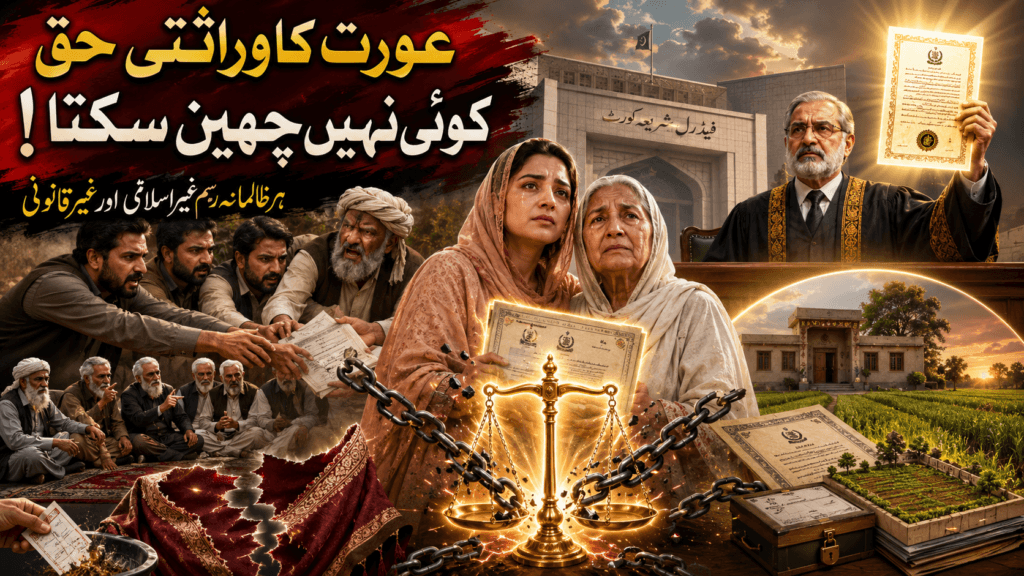
A sister is not asking for charity when she asks for her inheritance. A widow is not breaking a family when she asks for her lawful property. A daughter is not being greedy when she demands the share that Allah Almighty has already fixed for her.
Yet across Pakistan, many women are pressured into giving up their property. Sometimes the pressure comes through a Jirga. Sometimes it is hidden behind family honour, emotional blackmail, a local tradition, or the words, “You are married now, so you have no share here.”
In a historic judgment reported as PLD 2025 Federal Shariat Court 1, the Federal Shariat Court gave a clear national answer. Under inheritance law in Pakistan, no custom, family practice or local tradition can lawfully take away a woman’s inheritance.
The Court did not limit its ruling to one district or one custom. It declared that every practice—whatever its name—that wholly or partly deprives a woman of her inheritance is un-Islamic, illegal, void and without legal force.
This judgment is therefore not only about “Chaddar” or “Parchi.” It is a shield for daughters, sisters, mothers and widows throughout Pakistan.
Table of Contents
IRAC: Can a Custom Defeat a Woman’s Qur’anic Share?
| IRAC Element | Simple Explanation |
|---|---|
| Issue | Can a local custom, Jirga decision, family pressure or emotional blackmail deprive a woman of her full inheritance share? |
| Rule | The Holy Qur’an and Sunnah grant inheritance rights to eligible female heirs. Article 203-D allows the Federal Shariat Court to examine laws and practices against Islamic injunctions. Section 498-A of the Pakistan Penal Code criminalises depriving women of inheritance through deceitful or illegal means. |
| Analysis | The petitioner challenged the alleged customs of Chaddar and Parchi in District Bannu. Government reports showed that women were being deprived of property through many methods, even where authorities denied the existence of a custom under that exact name. The Court held that the name of the practice was not important. Its effect was important. |
| Conclusion | Every custom or usage that denies a woman her inheritance wholly or partly is un-Islamic, illegal, void and without legal force. Serious cases may also lead to criminal action under Section 498-A PPC. |
The Court’s ruling makes the central principle of inheritance law in Pakistan simple: a social custom cannot defeat a right granted by the Holy Qur’an and Sunnah.
Judgment at a Glance: A National Ruling for Every Woman
| Detail | Information |
|---|---|
| Case Title | Syeda Fouzia Jalaal Shah v. Federation of Pakistan through Secretary Law and Justice and 14 others |
| Citation | PLD 2025 Federal Shariat Court 1 |
| Petition Number | Shariat Petition No. 10/I of 2023 |
| Court | Federal Shariat Court of Pakistan |
| Date of Hearing | 25 February 2025 |
| Date of Decision | 19 March 2025 |
| Bench | Chief Justice Iqbal Hameedur Rahman, Justice Khadim Hussain M. Shaikh, Justice Dr. Syed Muhammad Anwer and Justice Ameer Muhammad Khan |
| Author Judge | Justice Dr. Syed Muhammad Anwer |
| Petitioner’s Counsel | Hammad Saeed Dar, appearing with the petitioner |
| Main Constitutional Provision | Article 203-D of the Constitution |
| Important Criminal Law | Section 498-A, Pakistan Penal Code |
| Other Important Law | Section 13, Enforcement of Shari’ah Act, 1991 |
| Customs Challenged | Chaddar and Parchi |
| Wider Practice Discussed | Haq Bakhshwai or Haq Bakhshwana |
| Final Result | Petition partially accepted |
| National Declaration | Every custom depriving women of inheritance is un-Islamic, illegal and void |
| Personal Relief | Refused because individual property relief was outside the Court’s Shariat jurisdiction |
The reported judgment identifies the dispute as a women’s inheritance case under Article 203-D, Section 498-A PPC and Section 13 of the Enforcement of Shari’ah Act, 1991.
How One Woman Challenged a Deeply Rooted Injustice
The petitioner, Syeda Fouzia Jalaal Shah, approached the Federal Shariat Court against an alleged practice in District Bannu, Khyber Pakhtunkhwa.
She said the practice was known as:
- Chaddar; or
- Parchi.
According to her petition, women could be brought before a Jirga and pressured to surrender their ancestral property. Some women were completely excluded. Others were forced to accept property of much lower value than their actual inheritance share.
The petitioner also raised the case of her mother, Syeda Iftikhar Bibi. She alleged that her mother had been deprived of inheritance from both her father and her husband because of the local custom.
This factual background gave the Court an opportunity to examine whether a local custom could survive when it directly conflicted with Islamic inheritance law in Pakistan.
Chaddar and Parchi: What Did the Petitioner Allege?
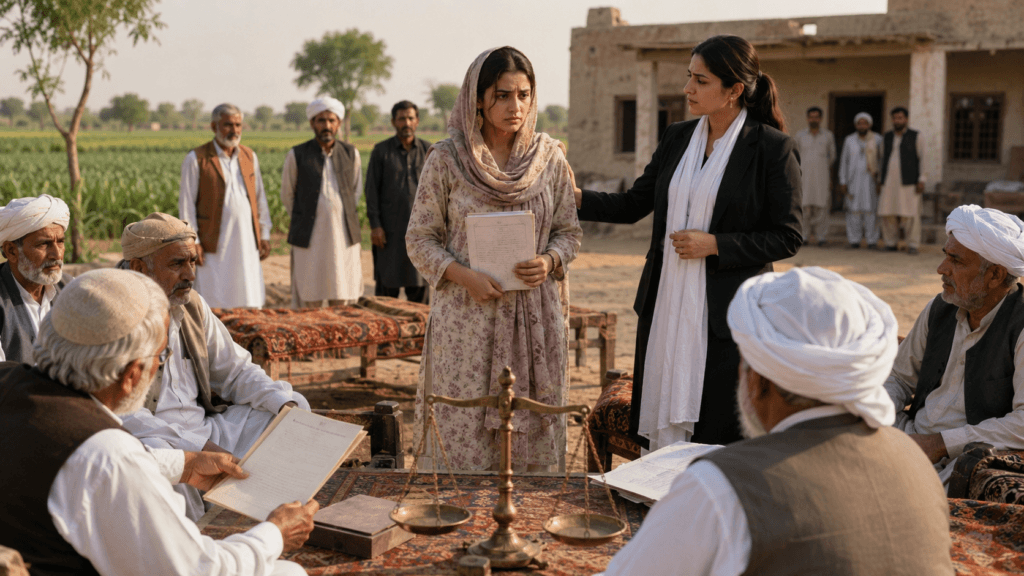
The judgment does not treat Chaddar or Parchi as harmless traditions.
The petitioner alleged that these practices were used to:
- Deny women their ancestral property;
- Pressure them through a Jirga;
- Force them to accept less valuable property;
- Make them surrender rights in favour of male relatives; and
- Present the surrender as a respected family settlement.
A woman living in a traditional family may find it difficult to refuse elders, brothers or a tribal gathering. Her silence may be treated as consent even when she is frightened, dependent or emotionally pressured.
That is why the judgment goes beyond written law. It examines the social methods through which inheritance law in Pakistan is often defeated in real life.
A daughter does not lose her lawful entitlement merely because her brothers control the family property. Read our practical guide on the Daughter Share in Father’s Property in Pakistan.
The Qur’anic Foundation of the Petitioner’s Case
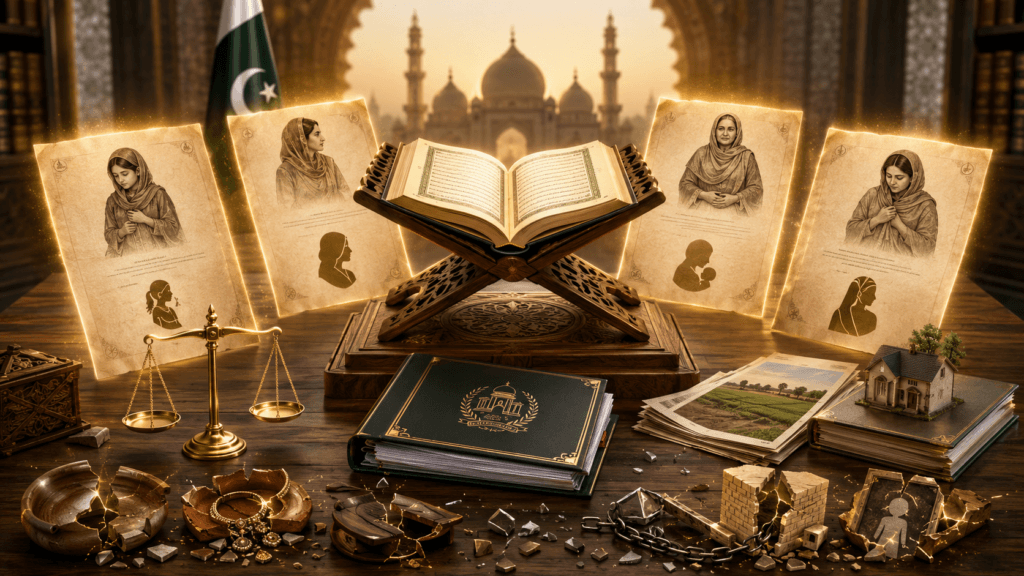
The petitioner relied on verses 7, 11, 12 and 14 of Surah An-Nisa.
These verses explain that inheritance is not reserved for male family members. Eligible men and women both receive shares from the estate of a deceased person.
The petitioner also relied on:
Ghulam Ali v. Mst. Ghulam Sarwar Naqvi, PLD 1990 Supreme Court 1
That precedent explained important principles concerning women’s inheritance.
The Federal Shariat Court also discussed the warnings in the Holy Qur’an against:
- Devouring the property of orphans;
- Consuming inheritance unlawfully; and
- Taking another person’s property because of love for wealth.
The judgment further referred to traditions reported in Jami al-Tirmidhi, Sunan Abu Dawud and Sunan Ibn Majah.
One tradition cited by the Court warns that a person who deprives an heir of inheritance faces deprivation in the Hereafter.
The moral and legal message is direct: inheritance law in Pakistan is connected not only with civil ownership but also with a serious religious duty.
Why the Federal Shariat Court Called for National Reports
After admitting the petition, the Court issued notices to federal and provincial authorities.
Responses were received from bodies including:
- Ministry of Law and Justice;
- Government of Khyber Pakhtunkhwa;
- Government of Balochistan;
- Punjab Commission on the Status of Women;
- Sindh Commission on the Status of Women;
- Principal Secretary to the Governor of Khyber Pakhtunkhwa;
- Provincial law departments; and
- Women’s property-rights institutions.
This was important because the Court was not dealing with only one private family dispute. It wanted to understand how women were being deprived of property across Pakistan and what government institutions were doing about it.
The Khyber Pakhtunkhwa Response Revealed a Harsh Reality
The Khyber Pakhtunkhwa authorities denied that an official custom called Chaddar or Parchi existed in the province.
At the same time, they acknowledged that women were being deprived of property through coercion, force, fraud and other methods.
The KP Government referred to:
Khyber Pakhtunkhwa Enforcement of Women’s Property Rights Act, 2019
This law established a special mechanism through the Provincial Ombudsperson.
Where a woman has been unlawfully deprived of ownership or possession, the Ombudsperson may direct:
- Restoration of possession;
- Transfer or correction of title;
- Action by the Deputy Commissioner;
- Assistance from the police; and
- Submission of an implementation report.
The government response stated that an Ombudsperson’s decision should be implemented within 60 days. It also reproduced the requirement that the concerned Deputy Commissioner submit an implementation report within seven days.
These remedies form an important practical part of inheritance law in Pakistan, particularly for women who cannot afford years of ordinary civil litigation.
Former FATA and the End of Customary Exclusion
The Directorate of Social Welfare, Special Education and Women Empowerment acknowledged that customary law had earlier operated in the former FATA.
Under those customs, women could be denied the Shari inheritance rights granted by the Holy Qur’an and Sunnah.
After the merger of the tribal areas into Khyber Pakhtunkhwa, the laws applying in settled areas also became applicable in the merged districts.
The Directorate maintained that customs such as Chaddar and Parchi were not officially reported. However, it accepted the broader problem and explained the legal remedies now available to women.
The Court treated this carefully. It did not allow a dispute over the name of a practice to hide the act of deprivation.
The Complaint Statistics That Could Not Be Ignored
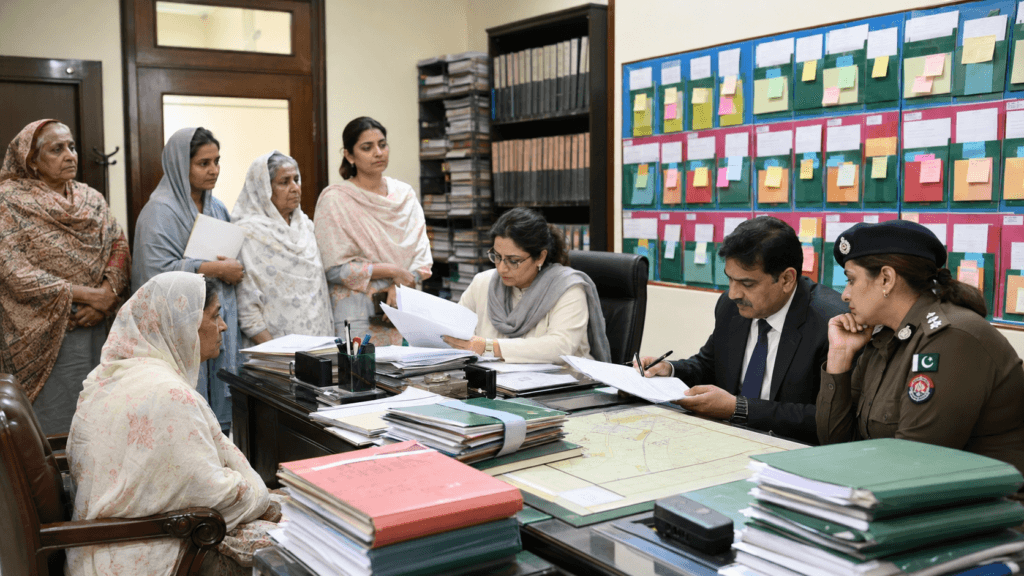
One government response referred to 1,702 complaints from 38 districts. These complaints came from vulnerable groups, including:
- Widows;
- Orphans;
- Elderly women;
- Economically disadvantaged women; and
- Other women facing property disputes.
The matters included inheritance, movable property, immovable property and dowry articles.
A later detailed report recorded the following position as of 3 May 2024:
| Complaint Status | Number |
|---|---|
| Total complaints filed | 1,742 |
| Disposed of or closed | 552 |
| Referred to courts or departments | 140 |
| Put on hold | 25 |
| Under process | 1,025 |
These figures showed that the violation of inheritance law in Pakistan was not rare or limited to one village.
Thousands of women had already approached only one provincial office concerning property-rights issues.
Punjab Identified the Laws—but Enforcement Still Matters
The Punjab Commission on the Status of Women stated that it had not received a complaint specifically using the names Chaddar or Parchi.
However, it identified several laws protecting women’s property and inheritance rights:
- Succession Act, 1925;
- Punjab Land Revenue Act, 1967;
- Punjab Land Revenue Rules, 1968;
- Letters of Administration and Succession Certificates Act, 2021; and
- Section 498-A of the Pakistan Penal Code.
The Punjab response also referred to Articles 23 and 24 of the Constitution, which protect the right to acquire, hold and dispose of property and prohibit unlawful deprivation.
The Commission acknowledged that a female heir’s inheritance is a statutory right. It also referred to Surah An-Nisa as the basis for determining Muslim inheritance shares.
The presence of laws is important. But the judgment also shows that inheritance law in Pakistan will protect women only when police, revenue departments, courts and provincial institutions enforce those laws.
Section 498-A PPC: Taking a Woman’s Share Is a Crime

Section 498-A of the Pakistan Penal Code is one of the most powerful parts of this judgment.
It applies where a person uses deceitful or illegal means to deprive a woman of movable or immovable property at the opening of succession.
The punishment may include:
- Imprisonment of at least five years;
- Imprisonment extending up to ten years;
- A fine of Rs.1 million; or
- Both imprisonment and fine.
Readers may review the official Pakistan Penal Code, 1860 on Pakistan Code, particularly Section 498-A, which provides criminal punishment for illegally depriving a woman of inheritance.
- This means that depriving a woman of inheritance is not merely a private disagreement between siblings. In serious cases, it can be a criminal offence.
The Federal Shariat Court encouraged relevant provincial authorities to consider initiating criminal proceedings in grave cases under Section 498-A PPC.
Under inheritance law in Pakistan, a brother cannot automatically avoid responsibility by saying the matter is only a “family issue.”
What Balochistan Told the Court
The Government of Balochistan identified several departments connected with women’s inheritance protection:
- Board of Revenue Balochistan;
- Women Development Department;
- Commission on the Status of Women; and
- Social Welfare Department.
The provincial response also referred to directions issued by the Balochistan High Court in:
Muhammad Sajid Tareen v. Government of Balochistan, C.P. No. 901 of 2021
That matter was decided on 19 July 2021.
Balochistan’s response also stressed the need to implement Section 498-A PPC so that women are not deprived of property through illegal methods.
Sindh’s Legislative Gap Drew Serious Concern
The judgment made a significant observation about Sindh.
According to the material before the Court:
- Punjab had an enforcement law for women’s property rights;
- Khyber Pakhtunkhwa had its 2019 law;
- Islamabad Capital Territory had a 2020 law;
- Balochistan had a similar Bill pending; but
- Sindh did not have a comparable dedicated enforcement law at that time.
The Sindh Commission on the Status of Women was active in advocacy, meetings, training and research. However, the Court noted that the Commission lacked direct statutory power to enforce its decisions in the same manner as an Ombudsperson under a dedicated property-rights law.
The Court treated Sindh’s position as a serious exception requiring attention from lawmakers and members of the Sindh Assembly.
This part of the judgment is important because inheritance law in Pakistan should not protect a woman differently merely because she lives in another province.
The Court’s Most Important Observation: The Name Does Not Matter

Several government departments said that no custom named Chaddar or Parchi had been officially reported.
The Court identified the weakness in that approach.
Authorities accepted that women were being deprived of inheritance, but they focused on whether the unlawful practice carried a particular name.
The Court held that:
The name of the illegal action is not important. The act itself is important.
A family may not use the words Chaddar or Parchi. It may use another explanation:
- Family honour;
- Riwaj;
- Jirga settlement;
- Bridal expenses;
- A verbal promise;
- Emotional duty;
- A brother’s financial difficulty;
- A symbolic gift;
- Less valuable land;
- A forced relinquishment; or
- A private family paper.
The legal question remains the same: did the woman receive her full lawful share?
This is one of the strongest principles in the judgment and a major development in inheritance law in Pakistan.
Haq Bakhshwai and Haq Bakhshwana: Giving Up Rights Under Pressure
The Court discussed a wider practice commonly known as:
- Haq Bakhshwai; or
- Haq Bakhshwana.
The expression broadly means “giving up rights.”
The Court observed that this practice exists throughout Pakistan in different forms. Those who benefit may try to place an artificial legal cover over an unlawful act.
Women may be asked or pressured to surrender inheritance in favour of male relatives through:
- Force;
- Emotional blackmail;
- Family dependence;
- Jirga pressure;
- Fear of breaking relationships; or
- Social shame.
The Court refused to examine every custom separately by name. Instead, it created one national rule covering all such practices.
That approach makes inheritance law in Pakistan stronger. A harmful practice cannot escape the law merely by changing its name.
Four Earlier Judgments Also Rejected Anti-Women Customs
The Federal Shariat Court referred to earlier decisions in which superior courts had considered customs that excluded women from ancestral property:
- Satto v. Mst. Sughran and others, 1969 SCMR 296
- Fazaldad v. Mst. Noor Nishan and others, 1969 SCMR 607
- Muhammad Iqbal and others v. Durab Khan, 1976 SCMR 149
- Fatima Bibi v. Nur Muhammad Shah, PLD 1951 Lahore 147
The Court accepted that some old customs were gradually fading. However, it warned that they were deeply rooted and continued to appear in new forms.
This history shows that the struggle to enforce inheritance law in Pakistan has continued for decades.
Section 13 of the Enforcement of Shari’ah Act, 1991
The Court also relied on Section 13 of the Enforcement of Shari’ah Act, 1991.
This provision requires the State to take effective measures to:
- Eradicate social evils;
- Promote Islamic virtues;
- Encourage what is right; and
- Prevent what is wrong.
The Court connected action against inheritance deprivation with the Islamic principle of Amr bil Ma’roof wa Nahi Anil Munkar.
It said that protecting women’s property is a duty of the Islamic State. Authorities may also publicise criminal actions and decisions taken against offenders. Public awareness can discourage others from committing the same offence.
Inheritance law in Pakistan therefore places responsibility not only on affected women. The State and its institutions must also act.
Why the Court Could Not Directly Restore the Mother’s Property
The petitioner requested personal relief for her mother, Syeda Iftikhar Bibi.
The Federal Shariat Court declined that part of the request because it was relief in personam.
In simple words, the Court could examine whether a law, custom or general practice was against the Holy Qur’an and Sunnah. However, it could not use this Shariat petition to decide the complete individual property dispute and directly transfer a particular property to the petitioner’s mother.
The refusal did not mean that the mother had no inheritance right. It only meant that the particular personal relief had to be claimed before the proper legal forum.
This distinction is important when understanding inheritance law in Pakistan.
The Final Decision: Every Anti-Women Inheritance Custom Is Void

The petition was partially accepted.
The Court rejected the request for direct personal relief but accepted the broader challenge against the custom.
The Federal Shariat Court declared that any custom or usage is:
- Un-Islamic;
- Illegal;
- Void;
- Without legal force; and
- Open to criminal consequences
where it denies a woman her inheritance wholly or partly.
The declaration applies:
- To Chaddar;
- To Parchi;
- To Haq Bakhshwai;
- To Haq Bakhshwana;
- To customs with any other name;
- To District Bannu;
- To Khyber Pakhtunkhwa; and
- To every province and area of Pakistan.
The Court also held that action may be taken against perpetrators under Section 498-A PPC.
Partial Deprivation Is Also Illegal
A major strength of this judgment is that it covers both complete and partial deprivation.
The law is violated not only where a woman receives nothing.
It may also be violated where she is forced to accept:
- Less land than her lawful share;
- Land of much lower value;
- A small amount of money instead of property;
- A delayed or conditional share;
- An unfair exchange;
- A paper share without possession; or
- A family settlement imposed through pressure.
Under inheritance law in Pakistan, changing the form of deprivation does not make it lawful.
What This Judgment Does Not Automatically Decide
The judgment should be understood carefully.
It does not mean that every family settlement or transfer made by a woman is automatically void.
A competent adult woman may deal with her property according to law. However, this judgment attacks customs and practices used to deprive women of inheritance, especially where there is:
- Force;
- Deceit;
- Emotional blackmail;
- Jirga pressure;
- Illegal means;
- Family domination; or
- Partial or complete denial of the Qur’anic share.
The true facts, free consent and legal validity of each private transaction may still require examination by the proper court.
A Practical Checklist for Every Female Heir
A daughter, sister, mother or widow facing an inheritance dispute should collect:
- Death certificate of the deceased;
- Her own CNIC;
- Family Registration Certificate;
- Complete list of legal heirs;
- Mutation of inheritance;
- Fard or revenue record;
- Property title documents;
- Khasra, khewat and khatooni details;
- Bank and movable-property records;
- Copies of any family settlement;
- Any relinquishment or gift document;
- Messages or recordings showing pressure;
- Jirga papers or written decisions;
- Proof of the market value of properties offered;
- Evidence of possession; and
- Names of witnesses who know the family history.
A woman should not sign a relinquishment document merely because family members say it is only a formality.
She should obtain independent legal advice and ensure that the property, value and legal effect of every document are clearly explained.
10 Essential FAQs About Women’s Inheritance
1. Can a family custom override inheritance law in Pakistan?
No. The Federal Shariat Court declared that every custom denying a woman her inheritance wholly or partly is un-Islamic, illegal and without legal force.
2. Is the judgment limited to Chaddar and Parchi?
No. It applies to every practice, regardless of its name, that deprives a woman of her lawful inheritance.
3. Can a Jirga lawfully take away a daughter’s share?
A Jirga decision cannot override the Holy Qur’an, statutory law or a woman’s lawful property rights.
4. What is Haq Bakhshwana?
It is a practice in which a woman is made to surrender her inheritance, often in favour of male relatives. The Court treated such forced or emotionally pressured deprivation as an illegal social practice.
5. Is giving a woman less valuable property also illegal?
It can amount to partial deprivation where she is pressured to accept property worth less than her lawful share.
6. What punishment can apply under Section 498-A PPC?
A person who uses deceitful or illegal means to deprive a woman of inheritance may face imprisonment from five to ten years, a fine of Rs.1 million, or both.
7. Can a woman complain to an Ombudsperson?
Special property-rights laws in some jurisdictions provide an Ombudsperson mechanism. The exact forum and procedure depend on the province or territory.
8. Why did the Court not restore the petitioner’s mother’s property?
The Federal Shariat Court held that direct individual property relief was outside the scope of the Shariat petition. The personal claim could still be pursued before the proper forum.
9. Can a woman voluntarily transfer inherited property?
A competent woman may deal with her property according to law. However, any transaction affected by pressure, deceit or illegal custom may be challenged.
10. Does inheritance law in Pakistan apply to agricultural land?
Muslim women’s inheritance rights also extend to agricultural property. Local customs cannot lawfully exclude them from such land.
Conclusion: A Woman’s Share Is a Right, Not a Favour
This judgment speaks to every Pakistani family.
It tells brothers that a sister’s share is not theirs to grant or refuse.
It tells Jirgas that custom cannot replace law.
It tells government departments not to hide behind the name of a practice.
It tells provincial institutions to act continuously, vigilantly and proactively.
Most importantly, it tells every Pakistani woman that the inheritance granted to her by the Holy Qur’an is not a gift from male relatives.
Under inheritance law in Pakistan, her share is a lawful, religious and protected right.
The Federal Shariat Court has removed the excuse of custom. Whether the practice is called Chaddar, Parchi, Haq Bakhshwai, family honour or anything else, the legal test is now clear:
Did the woman receive her complete lawful inheritance—or was she deprived of it?
Legal Disclaimer
This article is written for legal awareness and educational purposes only. It is not legal advice and does not create a lawyer-client relationship. Every inheritance dispute depends on its own facts, documents, applicable personal law and provincial procedure. Affected persons should consult a qualified lawyer.