

A land record may suddenly show another person as owner. A mutation may say you gifted land that you never intended to give. A deed may be used against you, or a relative may deny a right you believe the law gives you. In such disputes, a Civil Suit for Declaration can become the central remedy—but only when the correct right, cause of action, forum, evidence and consequential relief are pleaded.
The Supreme Court judgment reported as 2025 SCMR 955, Mst. Ramzanu Bibi v. Ibrahim (deceased) through L.Rs. and others, is a strong example. It was decided by the Supreme Court of Pakistan on 25 March 2025 by Amin-ud-Din Khan and Shahid Waheed, JJ.
The Court examined an alleged oral gift, Mutation No. 914, a disputed thumb impression, fraud, burden of proof and limitation. It ultimately allowed the appeal and decreed the plaintiff’s suit.
This guide explains when a Civil Suit for Declaration may be appropriate, what Section 42 of the Specific Relief Act requires, what evidence to preserve, how limitation should be tested and what the Supreme Court actually decided.
Table of Contents
Judgment at a Glance: 2025 SCMR 955
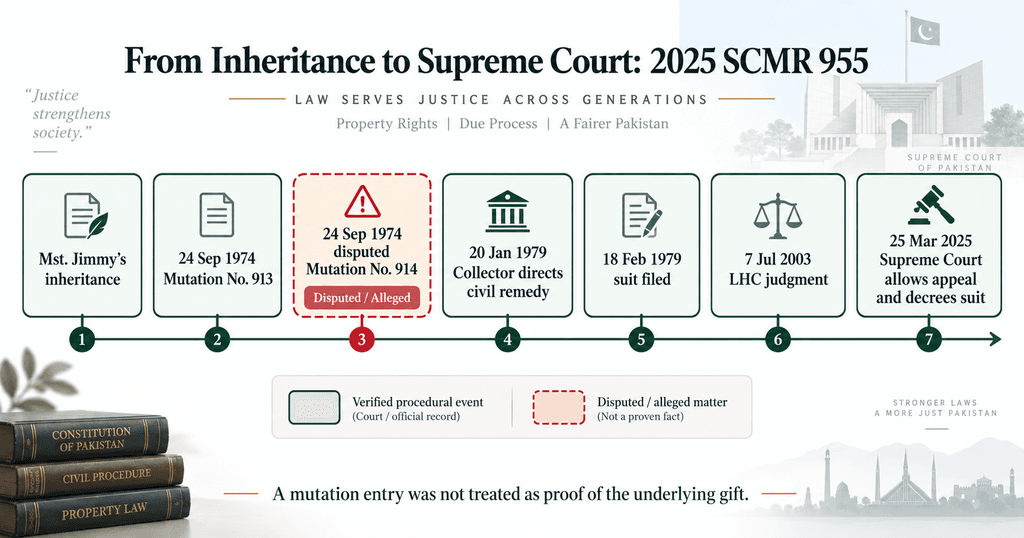
| Point | Verified Position |
|---|---|
| Citation | 2025 SCMR 955 |
| Case | Mst. Ramzanu Bibi v. Ibrahim (deceased) through L.Rs. and others |
| Court | Supreme Court of Pakistan |
| Bench | Amin-ud-Din Khan and Shahid Waheed, JJ. |
| Appeal | C.A. No. 113-L of 2010 |
| Decision Date | 25 March 2025 |
| High Court Judgment Challenged | Lahore High Court, Rawalpindi Bench, C.R. No. 43 of 1991, dated 7 July 2003 |
| Main Dispute | Alleged oral gift reflected in Mutation No. 914 dated 24 September 1974 |
| Plaintiff’s Position | She had not made the gift, had not appeared for the mutation and alleged fraud |
| Defence Position | She voluntarily made the gift; reliance was also placed on a Roznamcha entry |
| Key Evidence | Mutations Nos. 913 and 914, Roznamcha entry, defence witnesses and fingerprint report Exh. P-1 |
| Supreme Court Result | Appeal allowed; judgments and decrees below set aside; suit decreed with costs throughout |
The Supreme Court held, among other things, that the beneficiaries had to prove the transaction behind the disputed mutation and that the plaintiff’s suit was not time-barred on the facts found by the Court.
IRAC Table: Why Mutation No. 914 Failed
| IRAC | Analysis |
|---|---|
| Issue | Whether Ramzanu Bibi had made a valid oral gift, whether Mutation No. 914 proved it, and whether her declaratory suit was barred by limitation. |
| Rule | Mutation does not itself confer title. A beneficiary relying on a disputed mutation must prove the original transaction. Section 42 permits a declaration where legal character or property right is denied, subject to its consequential-relief proviso. |
| Analysis | The beneficiaries did not properly plead or prove the date, time, place, witnesses, acceptance and informed nature of the alleged gift. The fingerprint expert found that the disputed thumb impression did not match Ramzanu Bibi’s verified impression. The Supreme Court also rejected the limitation approach adopted below. |
| Conclusion | The Supreme Court allowed the appeal and decreed Ramzanu Bibi’s suit with costs. |
What a Civil Suit for Declaration Actually Does
Section 42 of the Specific Relief Act, 1877 is the starting point. In simple terms, a person entitled to a legal character or a right to property may sue a person who denies, or is interested in denying, that right and ask the civil court to declare the legal position. The current text published by Pakistan Code also retains an important proviso concerning further relief.
A Civil Suit for Declaration should identify:
- the exact legal right claimed;
- who is denying or interested in denying that right;
- the mutation, instrument, record or conduct creating the dispute; and
- the declaration the court is being asked to make.
The proviso to Section 42 is especially important. If further relief is available but the plaintiff asks only for a bare declaration, the court cannot grant it. Depending on the facts, possession, cancellation or injunction may also be required.
This is one of the biggest weaknesses in many copied plaints: the title may say “suit for declaration,” but the prayer does not ask for all the relief that the plaintiff actually needs.
The official statutory text can be checked through the Pakistan Code — Specific Relief Act, 1877.
How Ramzanu Bibi’s Inherited Land Became a Gift Dispute
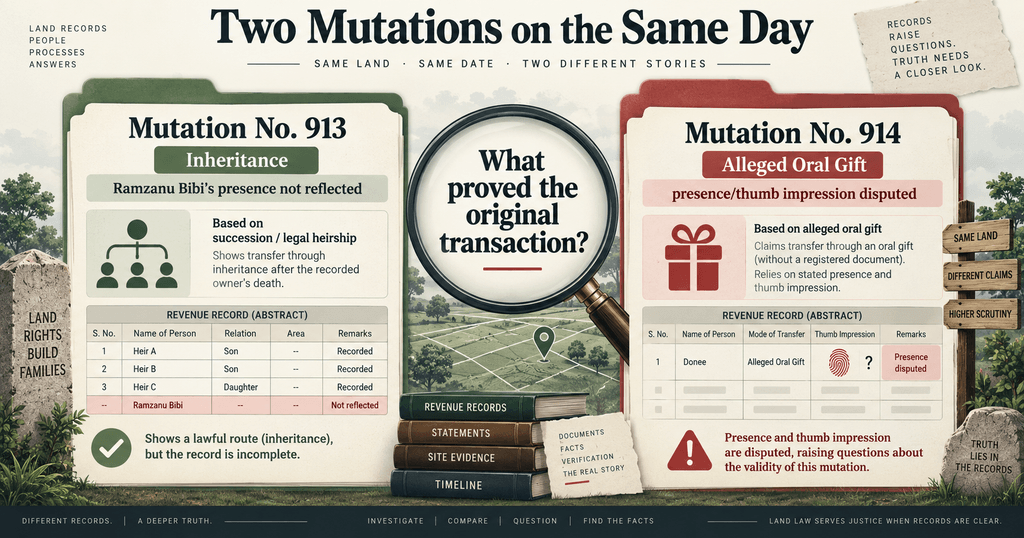
Mst. Jimmy inherited 33 kanals and 16 marlas from her father, Nawaz Khan. After her death, her property devolved upon her husband Jummay Khan, daughter Ramzanu Bibi and sister Mst. Millie. Ramzanu Bibi’s share measured 16 kanals and 18 marlas in Mouza Boharwal Kalan, Tehsil Chunian, District Kasur.
On 24 September 1974, Mutation No. 913 recorded inheritance from Mst. Jimmy. The judgment noted that this mutation did not show Ramzanu Bibi’s presence.
On the same date, Mutation No. 914 showed her land as orally gifted to Ibrahim and Shadi and carried a thumb impression attributed to Ramzanu Bibi.
Ramzanu Bibi denied making the gift and denied appearing for Mutation No. 914. She first challenged it before the Collector, Chunian. On 20 January 1979, the Collector dismissed that challenge while observing that she had a civil-court remedy.
She filed her suit on 18 February 1979.
The defence, however, claimed that she had voluntarily appeared before the Patwari and that her statement regarding the gift had been entered in Roznamcha Waqiati at serial No. 499 on 14 September 1974.
Keeping these versions separate is important: an allegation by one side is not automatically a judicial finding.
Mutation Is Evidence of an Entry, Not the Original Transaction
One of the strongest lessons from 2025 SCMR 955 is that the Supreme Court looked behind the mutation.
The Court explained that mutation proceedings are administrative in nature and record changes principally for land-revenue purposes. A mutation does not itself confer ownership.
When its authenticity is challenged, the person relying on it must return to the original transaction and prove that transaction.
Therefore, a Civil Suit for Declaration involving an alleged sale, gift or transfer should not merely say:
“The mutation is wrong.”
The real questions may be:
- Was there a genuine transaction?
- Who made the offer or declaration?
- Was it accepted?
- Was the transferor actually present?
- Is the signature or thumb impression genuine?
- Was the act voluntary?
- Was possession transferred where legally relevant?
- What independent evidence supports the transaction?
This distinction is particularly important in land litigation. A revenue entry may be relevant evidence, but it does not automatically replace proof of substantive ownership.
In Punjab, Section 53 of the Punjab Land Revenue Act provides a specific declaratory route where a person in possession considers himself aggrieved by an entry relating to his right.
The official Punjab legislation can be consulted through the Punjab Land Revenue Act, 1967 — official Punjab source.
The Beneficiaries Had Three Burdens to Discharge
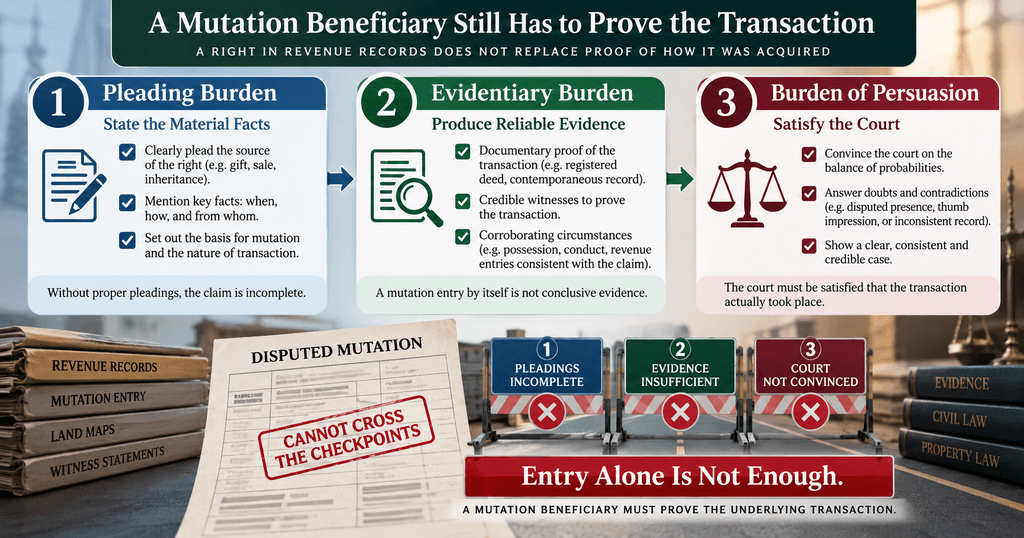
In this Civil Suit for Declaration, the Supreme Court described a threefold burden on the beneficiaries of Mutation No. 914.
First: pleading burden. They had to state material particulars of the alleged oral gift. The Court referred to important details such as the date, time, place and witnesses to the proposal and acceptance.
Because the alleged donor was an illiterate woman, the Court also expected the defence to explain that her decision had been voluntary, intelligent and conscious.
Second: evidentiary burden. They had to produce evidence capable of proving the gift.
Third: burden of persuasion. They still had to satisfy the court that the original transaction was genuine.
The Court found major gaps.
The written statement did not provide the required particulars. Five defence witnesses were examined, yet the Supreme Court found that their evidence did not establish the necessary details.
Ibrahim, one of the alleged donees, did not sufficiently prove matters such as acceptance, witnesses or the informed nature of the alleged gift identified by the Court.
That is an important lesson in every Civil Suit for Declaration involving a disputed mutation: a favourable entry does not remove the need to prove how the claimed right actually arose.
For disputes specifically involving gifts, readers can also see Qanooni Dastak’s Gift Deed Law in Pakistan.
Fingerprint Evidence Exposed a Serious Contradiction
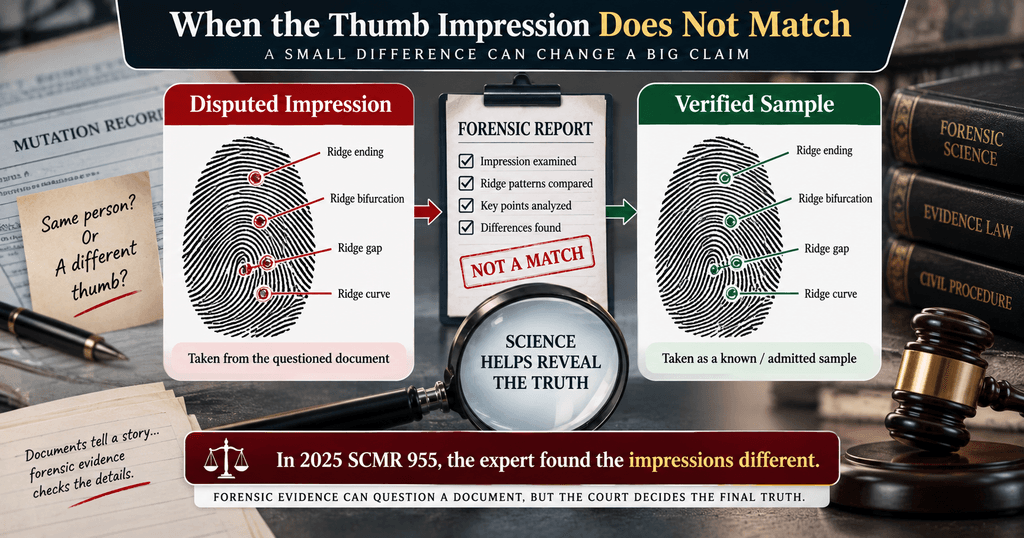
Ramzanu Bibi maintained that she had not appeared before the revenue officer for Mutation No. 914. She therefore sought forensic comparison of the thumb impression attributed to her.
The trial court allowed the request.
Fingerprint expert Muhammad Idrees (PW-1) produced report Exh. P-1. According to the Supreme Court, the disputed thumb impression on Mutation No. 914 differed from Ramzanu Bibi’s verified impression.
The expert also produced a comparison chart and thumb impressions obtained in open court. The Supreme Court observed that the defence did not successfully counter the forensic evidence through cross-examination.
This evidence materially strengthened Ramzanu Bibi’s challenge.
Where execution is genuinely disputed in a Civil Suit for Declaration, preserve:
- the original document or official record;
- genuine specimen signatures or thumb impressions;
- certified copies of the relevant proceedings;
- evidence showing who appeared before the authority; and
- the record necessary for expert comparison.
Expert evidence is not automatically necessary in every property dispute. But where identity, signature or thumb impression is a central issue, it may become highly important.
Fraud Must Be Supported by Facts
Ramzanu Bibi alleged fraud and collusion. The Supreme Court ultimately found the purported transaction tainted by fraud and deceit, but only after examining the pleadings, circumstances, witnesses, revenue record and forensic evidence.
A properly drafted Civil Suit for Declaration should therefore do more than repeatedly use the word “fraud.”
The plaint should explain:
- what was allegedly done;
- who was involved;
- which mutation, deed or instrument resulted;
- when the problem became known;
- how the plaintiff’s right was affected; and
- what evidence supports the allegation.
The Supreme Court also noticed unusual circumstances surrounding the two mutations sanctioned on the same date, the different identifying persons and the dispute about Ramzanu Bibi’s presence.
This judgment does not establish that every old mutation or family gift is fraudulent.
It shows that a court may examine the transaction beneath the paperwork where genuine fraud, forgery or impersonation is properly raised and proved.
Limitation: Article 95 Was Not the Right Rule Here
For this Civil Suit for Declaration, the courts below treated limitation as fatal. The Supreme Court disagreed.
The lower approach relied on Article 95 of the Limitation Act after referring to Ramzanu Bibi’s knowledge of the transaction.
The Supreme Court held that Article 95 did not fit her facts. Her position was not that fraud had induced her to participate in a transaction; her case was that she never participated in Mutation No. 914 at all and that someone else had impersonated her.
The Court instead examined Article 120.
Her plaint asserted ownership and sought declaration together with consequential relief, including possession. Article 120 provides a six-year period for a suit for which no other limitation period is supplied elsewhere in the Schedule, running from when the right to sue accrues.
The Supreme Court explained that the right to sue becomes significant when the opposing party denies or clearly threatens the asserted right.
Here, the respondents denied her claim before the Collector. After the Collector’s order dated 20 January 1979 directed her towards civil court, she instituted the suit on 18 February 1979.
The Supreme Court held the suit timely.
This part of the judgment must not be oversimplified.
A Civil Suit for Declaration should never be filed on either of these assumptions:
- “Fraud means there is no limitation”; or
- “Every declaration suit automatically gets six years.”
Instead, identify:
- the exact relief;
- the applicable Schedule Article;
- the legally relevant starting event;
- when the right to sue accrued;
- knowledge or discovery where legally relevant;
- any special or local law; and
- whether later documents or third-party rights affect the analysis.
For more detail, see Qanooni Dastak’s Limitation Act in Pakistan.
Section 42’s Proviso: Why Bare Declaration Can Fail
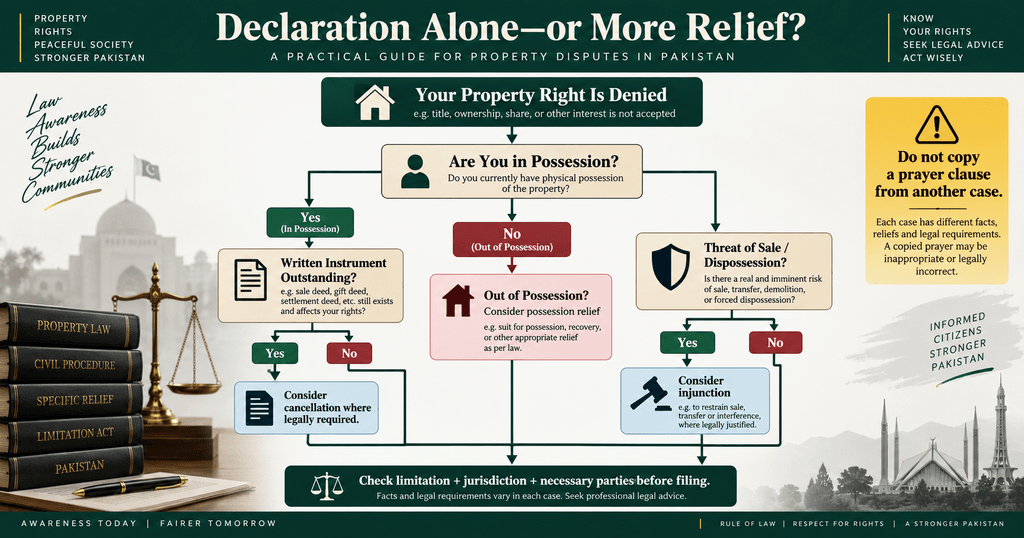
A common drafting mistake is to ask only:
“Declare me the owner.”
That may not be enough.
Before filing a Civil Suit for Declaration, check:
- Is the plaintiff in possession or out of possession?
- Is a registered instrument still outstanding?
- Is cancellation required?
- Is the defendant threatening transfer or dispossession?
- Is an injunction required?
- Have later purchasers or transferees entered the picture?
- Are all persons whose rights may be affected before the court?
Section 42 itself contains the important proviso against granting a mere declaration where further relief was available but omitted.
Separately, Section 39 of the Specific Relief Act deals with cancellation of a written instrument that is void or voidable and may cause serious injury if left outstanding.
So declaration and cancellation may sometimes work together, but they are not the same remedy.
Similarly, where the plaintiff has already lost possession, possession may have to be claimed as consequential relief depending on the facts.
The correct prayer should follow the dispute—not a downloaded sample.
Which Court Should Hear a Property Declaration Suit?
A Civil Suit for Declaration cannot be filed in a forum merely for convenience.
For immovable-property litigation, the Code of Civil Procedure generally requires suits concerning rights or interests in immovable property to be filed within the local jurisdiction where the property is situated, subject to the statutory wording and exceptions.
The CPC also provides that a suit should be instituted in the lowest grade of court competent to try it.
Therefore, check three separate questions:
- Territorial jurisdiction — where is the property situated?
- Pecuniary jurisdiction — which court can hear a claim of the relevant value?
- Subject-matter jurisdiction — is this dispute legally triable by that civil court, or does a special law provide another forum or limitation?
The official procedural law can be checked through the Pakistan Code — Code of Civil Procedure, 1908.
Court fee and valuation must also be verified under the law applicable in the relevant province or territory. A valuation copied from somebody else’s plaint may be completely wrong for another case.
Revenue Correction or Civil Title Dispute?
Not every incorrect land entry presents exactly the same problem.
A simple clerical or administrative correction may fall within the powers given to revenue authorities under the relevant land-revenue law.
A disputed ownership right, fraud allegation, gift, sale, title document or substantive civil right can present a very different question.
For Punjab, Section 53 of the Punjab Land Revenue Act expressly recognises a suit for declaration by a person aggrieved by an entry in a record concerning a right of which that person is in possession.
That means the first question should not simply be:
“Where can I get the mutation cancelled?”
The better question is:
“Am I asking for correction of a record, or does a court first need to decide who actually owns the right behind that record?”
That distinction can determine the correct forum.
Documents and Evidence to Preserve Before Filing
Before a Civil Suit for Declaration is drafted, obtain certified copies where available instead of relying only on photographs or informal printouts.
| Document / Evidence | Why It Matters |
|---|---|
| Current Fard / record-of-rights | Shows the present revenue position |
| Disputed mutation | Identifies the entry, date, parties and proceedings |
| Earlier Jamabandi / periodical record | Helps trace changes over time |
| Title deed / registered instrument | Shows the claimed source of title |
| Inheritance mutation and death record | Important where title arises through succession |
| Family tree / relationship record | Connects claimant with predecessor where relevant |
| Roznamcha and revenue proceedings | May show how the disputed mutation began |
| Previous revenue or court orders | Establish proceedings, dates and denial |
| Signature / thumb-impression material | Important where execution is disputed |
| Possession evidence | Relevant where possession is in issue |
| Later sale, gift or transfer records | Identifies possible third-party rights |
| Witness details | Helps locate persons with direct knowledge |
In a Civil Suit for Declaration based on impersonation or forgery, one reliable original official record may be more useful than a pile of weak photocopies.
Ten Pre-Filing Checks Before You Sign the Plaint
Before a Civil Suit for Declaration is filed, prepare a one-page chronology showing:
original title → disputed transaction → mutation → date of knowledge → first objection → revenue proceedings → dispossession, if any → later transfers → proposed filing date.
Then ask:
- What exact legal right does the plaintiff claim?
- Who is denying or interested in denying that right?
- What mutation, deed, instrument or conduct creates the cloud?
- Is declaration enough, or are possession, cancellation or injunction also required?
- Which limitation provision applies to each relief?
- Which court has territorial and pecuniary jurisdiction?
- Have beneficiaries, heirs, transferees and necessary authorities been identified?
- Is fraud pleaded through specific facts rather than broad accusations?
- Which certified documents or expert evidence will prove the case?
- Is lawful interim protection needed to prevent further transfer, construction or dispossession?
These checks turn a Civil Suit for Declaration from a generic form into a case-specific remedy.
Current Section 42: Verify the Version That Applies to Your Jurisdiction
The Pakistan Code currently publishes Section 42 with wording substituted through the Specific Relief (Amendment) Act, 2023, Act XXXIII of 2023. Parliament’s official record confirms the enactment.
The published federal text retains the declaration rule and consequential-relief proviso. It also contains a subsection referring to disposal of a suit within six months and an appeal within ninety days.
However, anyone filing a Civil Suit for Declaration should verify the statutory version applicable to the relevant province or territory.
Civil and property matters may involve provincial adaptations, local amendments, land-revenue legislation, court-fee rules and jurisdiction-specific provisions. A federal compilation should therefore not be mechanically applied to every province without checking the law applicable to the actual forum.
This is an important current-law safeguard that was missing from the older version of this article.
What the Supreme Court Did—and Did Not Decide
The Supreme Court did decide that:
- the respondents had failed to prove the alleged gift;
- the fingerprint evidence supported Ramzanu Bibi;
- Mutation No. 914 did not itself confer title;
- the limitation reasoning below was flawed;
- her suit was timely on the facts; and
- the judgments and decrees below had to be set aside.
The Supreme Court then decreed her suit with the requested relief and imposed costs on the respondents throughout.
But the Court did not decide that:
- every mutation is invalid;
- every oral gift is suspicious;
- every gift by a woman is defective;
- every old property transaction is fraudulent; or
- every delayed fraud claim automatically survives limitation.
The judgment expressly recognised that an oral gift can legally be made. The problem was the failure to prove this particular alleged gift and the evidence surrounding Mutation No. 914.
That distinction is essential when relying on 2025 SCMR 955 in another Civil Suit for Declaration.
Practical Effect for Property Owners
If a revenue entry changes against you, obtain certified copies and trace the transaction behind it.
If a signature or thumb impression is disputed, preserve the original official record and genuine comparison material.
If the other party relies on a gift, sale or transfer, identify what evidence is required to prove the underlying transaction.
If you are out of possession, facing a registered document or at risk of further alienation, check whether your Civil Suit for Declaration also requires possession, cancellation or injunction.
Most importantly, do not assume you can wait indefinitely.
2025 SCMR 955 protected Ramzanu Bibi because of the specific pleadings, chronology and findings in her case. It is not authority for ignoring limitation in a different dispute.
For related property issues, readers can also review Qanooni Dastak’s Women Inheritance Rights, Gift Deed Law in Pakistan and Limitation Act in Pakistan.
Conclusion: The Court Looks Beyond the Entry
A wrong mutation can look final because it appears in an official record. But 2025 SCMR 955 shows that a court may examine the transaction behind that entry, the evidence supporting it and the point at which the claimant’s right was actually denied.
A Civil Suit for Declaration can be a powerful remedy where legal character or property rights are genuinely disputed.
Its strength comes from:
- correct relief;
- correct forum;
- timely filing;
- complete pleadings;
- necessary parties; and
- reliable evidence.
Before filing, trace the title, obtain certified records, check limitation and determine whether declaration must be combined with cancellation, possession or injunction.
The purpose is not merely to attack a paper entry. It is to ask the competent court for the complete lawful relief that the facts require.
Frequently Asked Questions About Civil Suit for Declaration
1. What is a Civil Suit for Declaration in Pakistan?
A Civil Suit for Declaration asks a competent civil court to formally determine a legal character or right, including a property right, when another person denies or is interested in denying it. Section 42 of the Specific Relief Act is the main statutory provision. The plaint should identify the precise right, the denial and any further relief required by Section 42’s proviso.
2. Can a wrong mutation be challenged through a declaratory suit?
Yes, where the dispute concerns title or another civil right and the civil court has jurisdiction. In 2025 SCMR 955, the Supreme Court confirmed that mutation does not itself confer title and required the beneficiaries to prove the original transaction. Depending on the facts, declaration may need to be combined with possession, injunction, cancellation or other consequential relief.
3. Does a mutation prove ownership by itself?
No. In 2025 SCMR 955, Mutation No. 914 did not by itself establish ownership in favour of its beneficiaries. The Supreme Court required proof of the alleged oral gift behind the mutation. Revenue entries may have evidentiary importance, but they do not automatically replace proof of the lawful transaction from which the claimed title arises.
4. Must possession or cancellation always be claimed with declaration?
No. It depends on possession, the document being challenged and the relief actually available. But Section 42’s proviso is important: where further relief is available and the plaintiff omits it, a bare declaration cannot be granted. The prayer should therefore be settled only after examining possession, instruments, later transfers and threatened harm.
5. What did the Supreme Court decide in 2025 SCMR 955?
The Court held that the beneficiaries failed to prove the alleged oral gift reflected in Mutation No. 914. The fingerprint evidence supported Ramzanu Bibi’s denial, the mutation did not itself confer title and the limitation reasoning of the courts below was flawed. The Supreme Court allowed the appeal, set aside the earlier judgments and decreed her suit with costs.
6. Was Ramzanu Bibi’s suit barred by limitation?
No. On the particular facts of 2025 SCMR 955, the Supreme Court held Article 95 inapplicable and examined Article 120. The denial before the Collector and the Collector’s order dated 20 January 1979 were important to the Court’s analysis. The suit filed on 18 February 1979 was held timely. Another case may have a different limitation starting point.
7. What documents should be collected before filing?
Start with certified copies of the disputed mutation, current and earlier revenue records, title documents, inheritance record, relevant revenue orders and possession evidence. If execution is disputed, preserve original signature or thumb-impression material for possible expert comparison. Also obtain later transfer documents and prepare a chronology showing knowledge, denial and prior proceedings.
8. Where should a property declaration suit be filed?
For immovable-property disputes, territorial jurisdiction is generally connected with where the property is situated under the Code of Civil Procedure, subject to its statutory wording and exceptions. The court must also have pecuniary and subject-matter competence. Court fee and valuation depend on the applicable law and relief, so provincial or local amendments should be checked before filing.
Legal Disclaimer
This article is for legal awareness and general educational purposes. It is based primarily on 2025 SCMR 955 and the statutory provisions discussed above.
It is not legal advice for a particular dispute. Limitation, jurisdiction, valuation, court fee, necessary parties, evidence and available relief can change with the facts and with the law applicable in a particular province or territory.