

A stamp paper can look official, carry a QR code and show a convincing serial number—and still deserve a closer check. E stamp verification lets you compare the paper in your hand with the record held by the issuing government system before you sign, pay money or rely on the document.
The safest method is simple: identify the issuing province, open only the official portal, enter the correct stamp number, and compare the returned status, amount, deed type, parties and other available details with the full document. A successful search is useful, but it is not a substitute for checking ownership, signatures, authority or registration.
This guide covers e stamp verification online in Punjab, Sindh, Khyber Pakhtunkhwa, Balochistan and Islamabad. It also explains Punjab’s SMS 8100 route, how to use a QR code safely, and what your CNIC can and cannot do.
Quick Answer: How to Verify E Stamp Paper Online
To verify e stamp paper online, you only need the stamp number and the official portal of the province or territory that issued it. Follow these five steps:
- Check which province or territory issued the stamp.
- Open that government’s official e-stamping portal (links in the table below).
- Enter the e-stamp number. For Rs 100 or Rs 200 vendor stamps, use the Stamp ID / Serial Number option instead.
- Read the stamp status first, for example issued, used, delisted or cancelled.
- Match the amount, date, deed type, parties and property with the paper in your hand.
In Punjab, you can also send eStamp [space] 16-digit stamp number by SMS to 8100. If any detail does not match, stop and ask the issuing authority before you sign or pay.
Table of Contents
Verify Your E-Stamp First: Official Routes
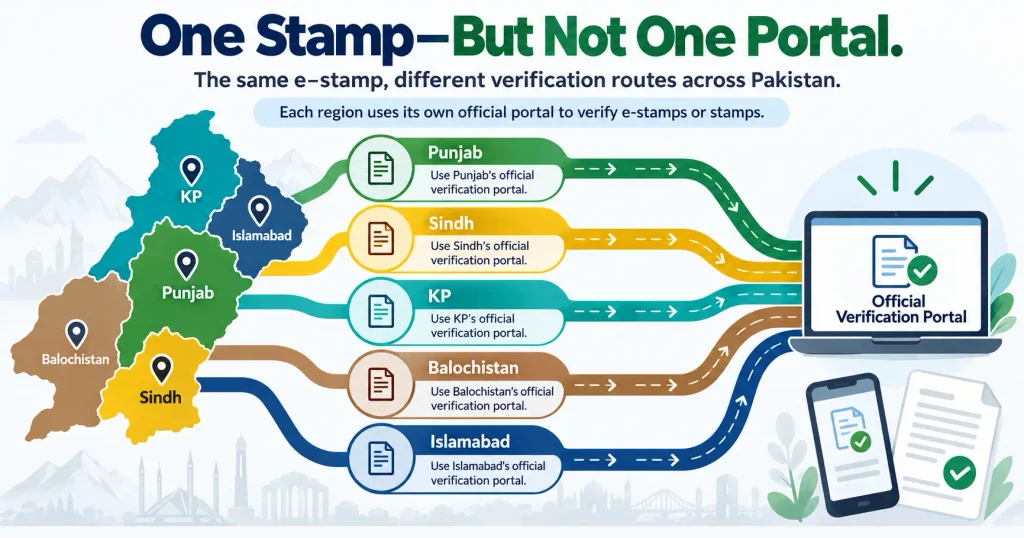
If you need e stamp verification online, start with the government system of the province or territory that issued the document. Pakistan does not have one public e-stamp database covering every jurisdiction, so using the correct official portal is the first and most important step.
| Issued in | Official route | What to enter | Extra check |
|---|---|---|---|
| Punjab | Punjab e-Stamping portal or SMS to 8100 | E-stamp number (16 digits for SMS); Stamp ID/serial no. for Rs 100/200 vendor stamps | Scan the QR code, then compare every detail |
| Sindh | Sindh e-Stamping Citizen Portal | Unique e-stamp ID; Stamp ID/serial no. for vendor stamps | Match stamp, deed and payment details |
| Khyber Pakhtunkhwa | KP e-Stamping portal (E-Verify) | E-stamp number printed on the certificate | Authorised white-paper stamps can be genuine |
| Balochistan | Balochistan e-Stamping portal | E-stamp number printed on the certificate | Never check it on another province’s portal |
| Islamabad (ICT) | Route printed on the ICT certificate | ID or QR code on the certificate | Confirm with the ICT office that issued it |
An e stamp online verification check should do more than confirm that a number exists. Where the portal provides the information, compare the status, amount, transaction type, parties and other available details with the actual certificate.
For e stamp verification, check the complete domain before entering any number. A private website may explain the process, but only the relevant government system should be treated as the verification source.
What E Stamp Verification Actually Confirms
Proper e stamp paper verification therefore means checking both authenticity and consistency. A government record may exist, but the certificate in your hand should still match the official amount, instrument, parties, date and any other material information displayed by the portal.
The aim of e stamp verification is to test the stamp record, not to certify the whole transaction. A genuine stamp number can be copied onto another page, and a genuine certificate can be attached to a false or different agreement.
The important question is therefore not only, “Does this number exist?” It is also, “Does the government record match this exact document?”
A proper check has two parts:
- Confirm that the stamp exists in the official database.
- Compare every material field in the online record with the paper or PDF presented to you.
If a party name, amount, property description, deed type or status is materially different, stop the transaction until the discrepancy is properly explained through the issuing authority.
In short, proper e stamp paper verification means checking both authenticity and consistency. A government record may exist, but the certificate in your hand should still match the official amount, instrument, parties, date and any other material information displayed by the portal.
Which Number Should You Enter?
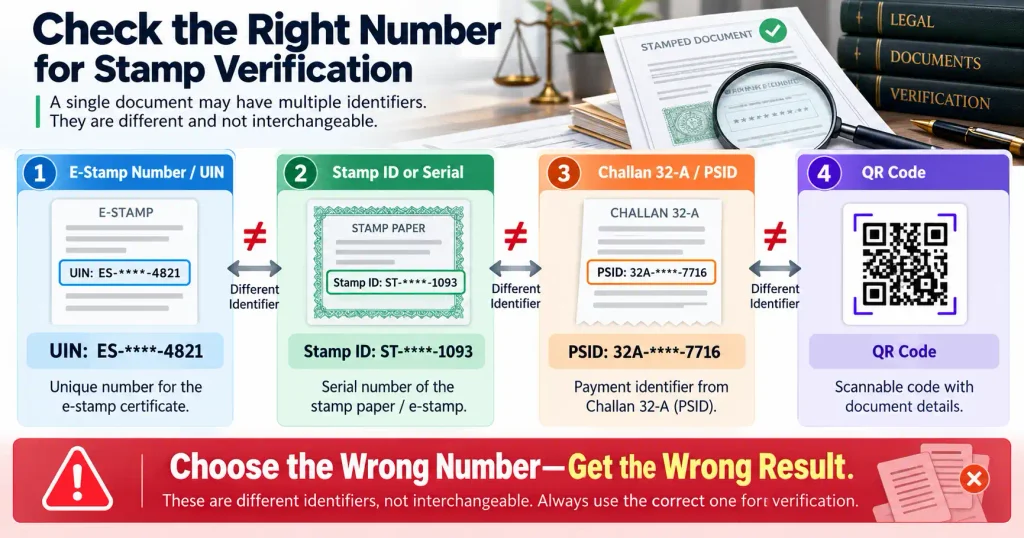
Several numbers may appear on one document. Using the wrong number is one of the simplest reasons a genuine document can produce a “not found” result.
| Number or feature | What it usually means | Safe approach |
|---|---|---|
| E-stamp number / UIN | Main identifier of an issued e-stamp | Usually the first number to try |
| Stamp ID / serial number | May apply to some low-denomination or vendor-issued stamps | Use only the matching search field |
| Challan 32-A / e-challan / PSID | Payment or application reference | Do not assume it is the issued stamp number |
| QR code | Shortcut to a verification route or record | Check the domain and then compare the details |
For e stamp ID verification of Rs 100 or Rs 200 papers issued by a stamp vendor, the Punjab and Sindh portals offer a separate “Stamp ID / Serial Number” search. If the main e-stamp number field returns nothing, try that option before you assume the paper is fake.
This is why e stamp verification should not end with a QR scan. A QR code is useful, but it is not a verdict. Someone can copy a genuine QR code from another certificate.
For a valuable transaction, manually enter the e-stamp number as well and compare the complete record with the complete document.
Can You Do E Stamp Verification by CNIC?
Many people search for online e stamp verification by CNIC. The honest answer is that public portals verify a stamp through its own number or ID, not through your CNIC alone. Your CNIC is linked to the challan and may appear inside the result, so it is a detail you compare, not the search key.
Punjab offers one useful CNIC route. According to the Board of Revenue’s e-Stamping FAQs, you can SMS Challan [space] your 13-digit CNIC without dashes to 8100 to receive your last two paid challan numbers. This tells you about payments made against your CNIC. It does not prove that the stamp handed to you is genuine. For that, verify the e-stamp number itself.
Be careful with websites or WhatsApp numbers that ask for your CNIC or a photo of it to “verify” a stamp. The official routes in this guide ask for the stamp number, not a picture of your identity card.
E Stamp Verify Online: 7 Checks Before You Trust It
If you want to verify e stamp details safely, do not stop after finding a number in the database. Use the correct government portal, check the current status and compare every material detail shown online with the paper or PDF in front of you.
1. Identify the issuing jurisdiction
Check which government issued the certificate. Do not choose the portal merely from where the buyer, seller, lawyer or property dealer lives.
The issuing jurisdiction controls the verification route.
2. Find the correct identifier
Locate the e-stamp number or UIN first. If your document is a low-denomination vendor stamp or follows an e-challan route, select the specific search option shown by that government portal.
3. Open the official government portal
Avoid search advertisements, shortened links and websites asking you to upload a CNIC or full legal document simply to perform e stamp verification.
Use the relevant official provincial service.
4. Enter the number exactly
Type every letter and digit carefully. Watch for similar characters such as zero and “O” or one and “I”.
Do not remove prefixes or change the number format unless the official portal itself requires it.
5. Read the status before anything else
A record may exist but carry a status such as issued, used, utilised, cancelled, refunded, delisted, pending or another system-specific description.
Never treat “record found” as the end of the check.
6. Compare every material detail
Match whichever fields the portal displays, including:
- stamp amount;
- issue date;
- deed or instrument;
- applicant and parties;
- available CNIC information;
- property particulars;
- payment or challan details;
- page information; and
- issuing bank or vendor details.
One serious mismatch is enough reason to pause.
7. Preserve the result
Save a dated screenshot or PDF showing the official domain and result.
For an important property or commercial transaction, repeat e stamp verification immediately before execution, registration or release of payment rather than relying on a result obtained several days earlier.
E Stamp Verification by QR Code: Scan, Then Compare
A QR code is the fastest way to open a stamp’s record, but it is only a shortcut. Anyone can copy a genuine QR code onto a fake paper. Use it this way:
- Scan the code with your phone camera or a trusted scanner app.
- Before opening the link, read the full web address. Official routes use government domains: gov.pk (Punjab and KP), gos.pk (Sindh) and gob.pk (Balochistan).
- Read the status first, for example whether the stamp shows as used or cancelled.
- Match the stamp number, amount, date, deed type, party names and property with the paper in your hand.
- Type the stamp number manually on the official portal as a second check.
If the code opens a short link, a WhatsApp chat, a social media page or a private website, stop. In Punjab, Rule 9 of the e-stamp rules recognises QR scanning as one of the official verification methods, as the next section explains.
Punjab E Stamp Verification: Web, SMS and Rule 9
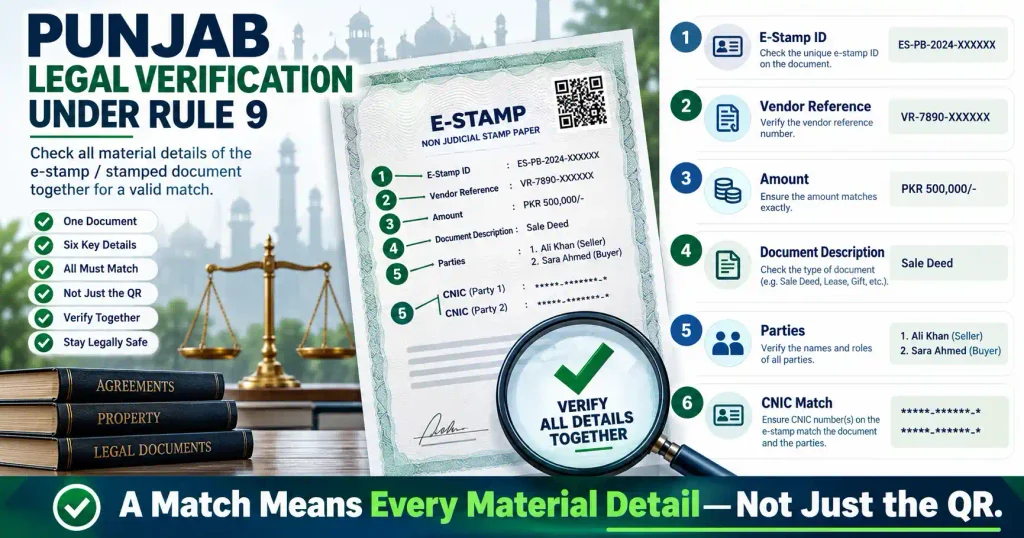
Punjab has an especially useful legal verification framework.
Rule 9 of the Punjab E-Stamp Rules, 2016 requires a registration authority, before registering a document, to verify information printed on the e-stamp. The rule refers to the e-stamp ID, ex-officio vendor’s reference number, amount, document description, parties’ names and CNIC numbers.
Rule 9 further provides for verification through the e-stamping system by entering the unique e-stamp ID, through QR-code scanning, and through the unique Challan ID. Crucially, the rule states that where the retrieved information does not match the specified printed information, the e-stamp is to be considered fake and tampered.
That gives Punjab e stamp verification a very practical meaning: compare the fields; do not merely scan the code.
Punjab’s current PLRA guidance also states that the system-generated certificate contains a unique stamp number, QR code, applicant information, amount paid and transaction type and can be verified using the QR code or stamp number.
How to Verify a Punjab E-Stamp by SMS (8100)
Punjab also lets you check a stamp by SMS. The Board of Revenue’s e-Stamping FAQs list these formats for the short code 8100:
- eStamp [space] 16-digit e-stamp number: returns the stamp details.
- Challan [space] 13-digit CNIC without dashes: returns your last two paid challan numbers.
- Info: returns general information.
Treat the SMS reply like a web result and compare it with every detail printed on the certificate. If the portal or SMS does not respond, the helpline listed on the same official page is (042) 111-22-22-77, Monday to Saturday, 8:00 AM to 5:00 PM.
If you are still at the stage of obtaining the stamp rather than checking one already issued, read Qanooni Dastak’s Stamp Paper Online guide for the broader challan, payment and issuance process.
Sindh E Stamp Verification: Stamp, Deed and Payment
For Sindh e stamp verification, open only the Government of Sindh e-Stamping Citizen Portal. Use its web verification option, enter the unique e-stamp ID printed on the certificate, and read the full record. If you only hold a Challan 32-A, use the portal’s separate challan option instead.
Check the address bar carefully. The genuine Sindh portal ends in gos.pk. Search results sometimes show look-alike websites that copy the portal’s name on a .online or .com address. Do not enter any stamp or CNIC details there.
Sindh’s official e-stamping user material shows why a simple “number found” result is not enough.
The verification example in the official guide includes stamp status, total stamp amount, challan and payment information, deed details, district or taluka, property address and property value.
In Sindh, e stamp verification is strongest when you compare the stamp, deed and payment fields together. That makes e stamp verification particularly useful for detecting a genuine number attached to the wrong deed or property.
If the number exists but the property address, deed type, amount or transaction details differ from the certificate before you, do not proceed merely because the system returned a record.
Also distinguish between an issued e-stamp and a challan or payment reference. A genuine payment record does not automatically prove that the final document being presented is the correct certificate.
KP: E-Verify and the 2026 White-Paper Rollout
Khyber Pakhtunkhwa’s official e-stamping portal currently provides an “E-Verify” facility using the stamp-paper number. The government describes web-based verification as part of the system created to reduce fake stamp-paper fraud.
There is also an important 2026 development.
The KP Revenue & Estate Department launched an e-vendor module for specified low-denomination e-stamps printed on white paper. The official announcements describe QR-code-based authentication, prescribed security features and a phased district rollout.
So, a stamp printed on white paper is not automatically fake.
What matters is whether it was issued by an authorised route, carries the required features and matches the government database. Perform e stamp verification through KP’s official system instead of deciding authenticity merely from the colour or appearance of the paper.
Balochistan and Islamabad: Do Not Mix the Portals
Balochistan has its own e-stamping service. Its official citizen-services portal directs the public to the Government of Balochistan e-stamping system.
A Balochistan-issued number should therefore be checked on that system, not on Punjab or Sindh portals.
Islamabad followed a separate digital transition. The CDA reported in early February 2026 that the e-stamp system had been successfully launched in the Federal Capital, with an E-Stamp Center at F-8 Markaz. The Deputy Commissioner Islamabad also announced that from 13 February 2026 no office, court or authority in ICT would accept manual judicial or non-judicial stamp papers.
For an ICT-issued e-stamp, use the ID or QR code printed on the certificate, make sure it opens an official government address, and confirm the record with the ICT office that issued it. A manual stamp paper offered for a new document in Islamabad after 13 February 2026 is a serious red flag.
Jurisdiction is therefore the first check in every e stamp verification. A genuine number searched in the wrong provincial system may naturally produce no useful result.
What If the Portal Says “No Record Found”?
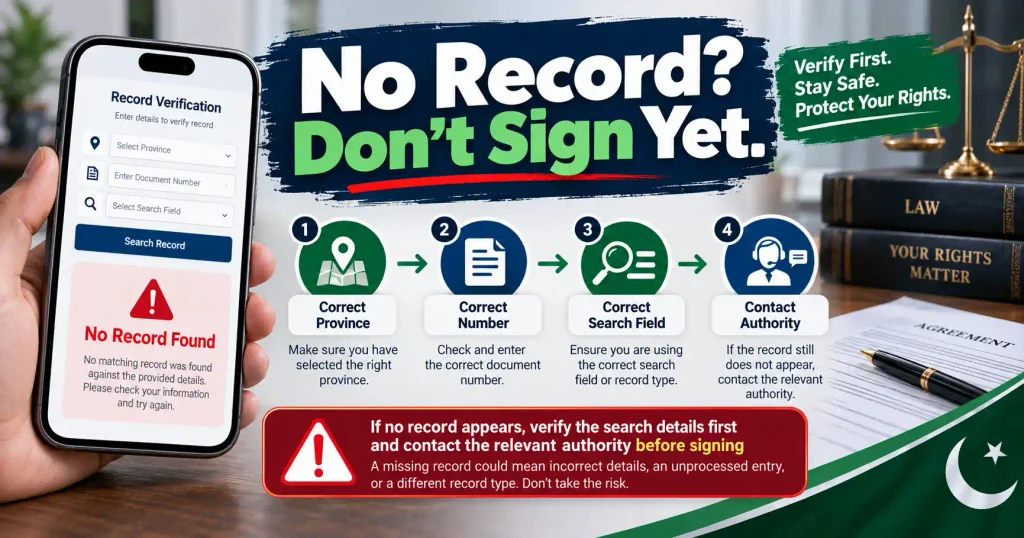
“No record found” is a warning, but it is not automatic proof that the paper is forged.
Work through these checks:
- Confirm the correct province or territory.
- Re-enter the number and inspect confusing characters.
- Check whether you selected the e-stamp, challan or serial-number field.
- Confirm whether the document was only recently issued.
- Retry if the official system is temporarily unavailable.
- Contact the issuing bank, authorised vendor or revenue authority if the record remains missing.
Do not sign, release payment, register a document or hand over possession while an important discrepancy remains unresolved.
Save the unsuccessful e stamp verification screen before contacting anyone. The date, official domain and displayed message may later become useful evidence.
Delisted or Expired? Check Your E-Stamp’s Validity Date
Many low-denomination e-stamps, such as the Rs 100 or Rs 200 papers that stamp vendors issue for affidavits and undertakings, print a “Delisted On / Validity” date. Sindh’s portal shows the same field as “Expired On / Validity”. The Punjab and Sindh verification pages also note that a transaction is valid for one week from its date of issuance, but the date printed on your own certificate is the one to follow.
- Check the validity date before you sign, submit or hand over the stamp.
- A delisted or expired status does not automatically mean the stamp is fake. It may simply have passed its use period.
- If your stamp lapsed before you could use it, ask the issuing vendor, bank or stamp office whether you need a fresh stamp or a refund application.
8 Red Flags You Should Never Ignore
A professional-looking certificate can still fail e stamp verification. Pause and investigate if:
- The QR code opens a private, shortened or misspelled website.
- The number cannot be found on the correct official system.
- The online amount differs from the printed amount.
- The deed type or stated purpose is different.
- A party’s name, CNIC detail or legal role does not match.
- Property particulars differ from the online record.
- The status shows cancellation, refund, previous use or another restriction.
- The other party refuses to provide the full certificate and shows only a cropped screenshot.
A single red flag may eventually have an innocent explanation. It is still a reason to stop until the issue is properly resolved.
Pressure to “sign now and verify later” should increase caution, not reduce it.
A Verified Stamp Does Not Prove the Whole Deal

This distinction can prevent serious disputes.
E stamp verification mainly helps answer whether the stamp record exists and whether the displayed particulars correspond with the certificate. It does not, by itself, prove:
- ownership of property;
- legal capacity of the parties;
- genuineness of signatures or thumb impressions;
- validity or scope of a power of attorney;
- absence of mortgages, litigation or inheritance claims;
- adequacy of stamp duty for the real transaction;
- lawful execution of the document; or
- compliance with registration requirements.
For property transactions, use a layered due-diligence process. Qanooni Dastak’s Property Law in Pakistan guide explains wider title and transaction checks.
Where forged documents or document substitution are suspected, also review Fake Sale Deed in Pakistan.
If someone is signing or selling through an attorney, separately verify the authority using the General Power of Attorney in Pakistan guide. A genuine stamp cannot cure an invalid, revoked or insufficient authority.
What the Stamp Act Means for Your Document
Stamp authenticity, adequate duty and legal validity are three different questions.
The Stamp Act, 1899 remains part of the stamp-law framework, subject to provincial amendments, schedules and local rules. Section 35 in the Pakistan Code text broadly provides that an instrument chargeable with duty should not be admitted in evidence, acted upon, registered or authenticated unless it is duly stamped, subject to the statutory provisos and applicable procedure.
For practical purposes, ask:
- Authenticity: Does the stamp exist and match the official record?
- Sufficiency: Was the proper duty paid for the actual instrument and transaction?
- Legal validity: Are title, authority, consent, execution and registration legally sound?
E stamp verification primarily assists with the first question and may expose information relevant to the second. It does not automatically answer the third.
Notarisation is also separate. A notary stamp cannot turn false ownership or defective authority into a valid transaction. Qanooni Dastak’s Notary Public guide explains that distinction.
Suspect a Fake Stamp? Preserve Evidence First
If a stamp appears altered, reused or fabricated, preserve the e stamp verification result before changing or destroying anything.
Keep:
- the complete original paper or PDF;
- clear images of every page;
- the QR destination;
- screenshots of the government result;
- Challan 32-A and payment receipts;
- bank transaction details;
- emails and messages;
- advertisements or representations made to you;
- the complete agreement; and
- all continuation sheets.
Also record when you discovered the discrepancy.
Depending on the transaction, contact the issuing bank or authorised vendor and the relevant Board of Revenue, Treasury/Collector office or Sub-Registrar for confirmation.
If the facts indicate forgery, cheating or another criminal offence, seek case-specific legal advice regarding a police complaint or other competent proceedings.
Where a fake portal, online impersonation, hacked account or other digital deception is involved, the National Cyber Crime Investigation Agency (NCCIA) may be relevant to the cyber element. NCCIA’s current official guidance provides complaint channels and asks complainants to preserve supporting evidence.
There is no single limitation period that can safely be stated for every civil suit, criminal complaint, refund, cancellation or correction remedy. The applicable deadline depends on the legal cause of action, jurisdiction and relief claimed.
Do not delay obtaining transaction-specific advice simply because the document can still be searched online.
Final E-Stamp Safety Checklist
Before relying on any stamp, confirm that you have:
- identified the correct issuing jurisdiction;
- used the official government route;
- selected the correct e-stamp, challan or serial-number field;
- matched the number exactly;
- checked where the QR code leads;
- understood the current status;
- matched the amount, date and deed type;
- compared parties and available CNIC details;
- checked property information where relevant;
- matched payment particulars where displayed;
- reviewed every continuation sheet;
- checked whether proper stamp duty was paid;
- separately verified title and authority;
- checked execution and registration requirements; and
- saved a dated e stamp verification result.
If one material point remains unexplained, pause the transaction.
The purpose of e stamp verification is to detect risk before money, possession or legal rights change hands—not to discover the problem after a dispute has begun.
Frequently Asked Questions About E Stamp Verification
How Can I Verify E Stamp Paper Online?
To verify e stamp paper online, first identify the province or territory that issued it and open the relevant official government verification system. Enter the e-stamp number or other identifier requested by that portal. Then compare the returned status, amount, parties, deed type and other available details with the actual certificate. Do not rely only on a QR scan or screenshot.
Can I do e stamp verification by CNIC?
Not directly. Public portals verify a stamp through its own number or ID, and your CNIC only appears inside the record for comparison. In Punjab, you can SMS Challan [space] your 13-digit CNIC without dashes to 8100 to get your last two paid challan numbers. That confirms a payment, not the stamp in your hand, so always verify the e-stamp number too.
Is scanning the QR code enough to verify a stamp?
No. Scan the QR code, make sure it opens the appropriate official route, and then compare the returned details with the complete certificate. A genuine QR code may be copied from another document, so a successful scan alone does not prove that the paper presented to you is genuine.
Why does my e-stamp show no record found?
Possible reasons include using the wrong province, entering the wrong number, selecting the wrong search field, a temporary portal problem or a suspicious certificate. Recheck the inputs and obtain confirmation from the issuing authority if the result remains missing. Do not proceed with an important transaction until the issue is resolved.
Does a verified e-stamp prove property ownership?
No. E stamp verification verifies the stamp record, not the seller’s ownership. Title must be checked through the relevant registered instruments, revenue or society records, inheritance position, possession and any litigation, mortgage, attachment or other rights affecting the property.
Can the same e-stamp be used for another transaction?
Do not accept a stamp for another transaction merely because the number is genuine. Compare the parties, purpose, amount, property details and current status. A copied or reused certificate may still contain a genuine number belonging to an earlier or completely different transaction.
Is stamp paper verification online possible for old papers?
Usually not. Government e-stamping portals only hold e-stamps issued through their own systems, so an older manual (printed) stamp paper will not appear there. Its genuineness is normally confirmed through the issuing treasury or stamp office and the vendor’s sale register. For any important deal, ask the Sub-Registrar or a lawyer to confirm the paper before you sign. In Islamabad, manual stamp papers are no longer accepted for new documents.
Can someone misuse my e-stamp PDF?
An unused e-stamp does not, by itself, make you liable for anything. A document binds you only when you sign or otherwise execute it, and forging your signature is a criminal offence. Keep the original PDF and payment receipt safe, note the “Delisted On / Validity” date, and ask anyone holding a copy to delete it, preferably in writing. If you suspect misuse, contact the issuing vendor or the e-stamping helpline and get legal advice.
Conclusion: Verify the Record, Then Verify the Deal
E stamp verification is one of the quickest ways to expose a fake, altered, cancelled, reused or mismatched stamp before a transaction moves forward. But the strongest check does more than find a genuine number—it compares the complete government record with the complete document.
Verify the stamp. Then verify the people, property, authority, duty and registration requirements.
Those few checks before signing may prevent a much longer dispute afterwards.
Legal-awareness disclaimer: This article provides general legal information for Pakistan and was reviewed against official material available on 20 October 2026. Stamp duties, portal features, provincial rules and procedures can change. It is not legal advice for a particular transaction or dispute. For an important matter, confirm the current position with the relevant authority and a qualified lawyer.
I issued few low denomination form and download the pdf file estamp for print i share it with my colleague. Now I am afraid he can misuse it against me as pdf file code to open and print is with him.
The purpose of issuing stamp was to give it to bank for printing their diff sort of undertakings. And I also mention in reason section “agreement in favor of xyz bank”
The issue is although this reason appears on face of stamp paper but when I verify it, this reason not appear in online verification. Portal. So my question is whether that reason is saved in govt record or not. In case of any misuse can we get the exact reason for issuance? To avoid misuse by any third party who have the file and code
Dear Saad, sorry for the late reply!
Please don’t worry too much. The reason you entered is saved in the government e-stamping record, even though the public verification page doesn’t show it. If there’s ever a dispute, that record can be obtained from the Board of Revenue, and a court can summon it too.
Also check the “Delisted On / Validity” date printed on your stamps. Low-denomination stamps have a short validity, and after that date they’re delisted.
And remember, a stamp paper on its own doesn’t make you liable for anything. An undertaking binds you only if you sign it. If someone forges your signature, that’s a criminal offence and you can report it.
A few simple things you can do right away. Ask your colleague on WhatsApp to delete the file, because that written message also becomes proof that you asked. Keep the PDF and payment receipt safe with you. Let the bank know in writing that these stamps were issued only for its undertakings. And if you ever need the official record, you can call the Punjab e-Stamping helpline at 042-111-22-22-77.
By the way, which city are you in?