
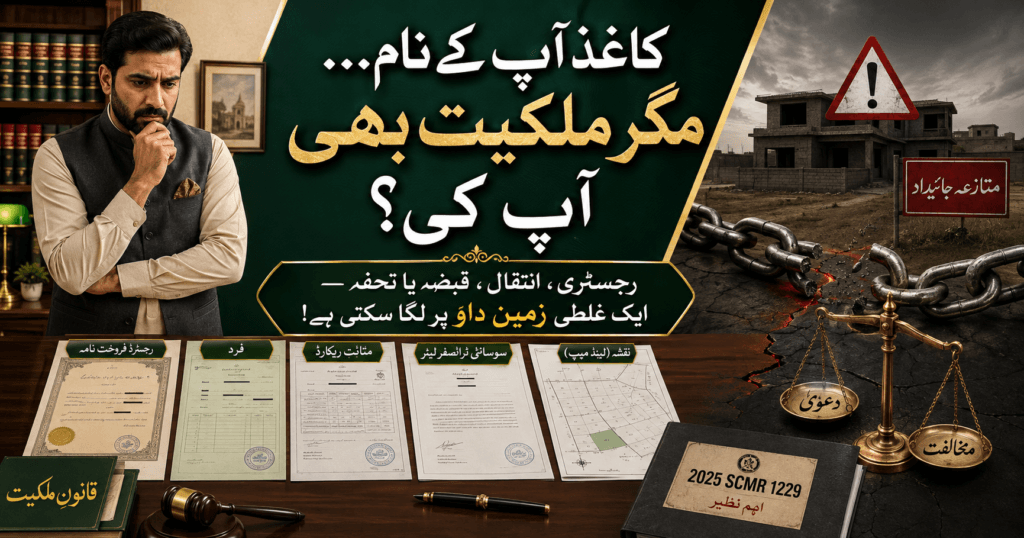
A property document can look perfect and still hide a serious legal defect. A mutation may show your name, a housing society may issue a transfer letter, or someone may claim that a house was gifted years ago. But when a dispute reaches court, the real question is not simply, “Whose name appears on the paper?”
Property Law in Pakistan looks deeper. Courts may examine the original title, legal authority of the transferor, registration, possession, inheritance rights, witnesses, revenue entries, housing-society records, limitation and the evidence behind the transaction. A single weak link in that chain can turn valuable property into years of litigation.
This guide explains the law in easy English for buyers, sellers, owners, heirs, overseas Pakistanis and families dealing with property disputes. It also explains an important Supreme Court judgment, 2025 SCMR 1229, where a housing-society entry could not save an alleged property gift that was not properly proved.
Table of Contents
IRAC: Can a Society Transfer Prove Ownership Without a Valid Gift?
| IRAC | Short Legal Position |
|---|---|
| Issue | Could the petitioner keep property transferred into his name in a cooperative society’s record when the alleged oral gift from the deceased owner was disputed? |
| Rule | A Muslim-law gift requires declaration, acceptance and delivery of possession. Where a written instrument itself operates to transfer present rights in immovable property, registration requirements may also become relevant. |
| Analysis | The alleged donee failed to establish important facts supporting the gift, including delivery of possession and reliable proof relating to the donor. The respondent proved through evidence that she was the deceased owner’s daughter. |
| Conclusion | The Supreme Court found no illegality or perversity in the concurrent findings against the petitioner. The civil petition was dismissed and leave to appeal was refused. |
The IRAC is deliberately short because the real value of the judgment lies in understanding why an official-looking record did not replace proof of the transaction behind it.
Judgment at a Glance: Supreme Court Ruling in 2025 SCMR 1229
| Point | Detail |
|---|---|
| Citation | 2025 SCMR 1229 |
| Case | Muhammad Dawood v. Mst. Sakeena Farooque alias Aziza and others |
| Court | Supreme Court of Pakistan |
| Bench | Muhammad Ali Mazhar and Aqeel Ahmed Abbasi, JJ |
| Decision Date | 26 March 2025 |
| Property | Quarter No. 225, Block-14, Babul Islam Cooperative Housing Society, Kemari, Karachi |
| Dispute | Alleged oral gift and subsequent society transfer |
| Important Laws | Transfer of Property Act, 1882; Registration Act, 1908; Specific Relief Act, 1877; Muslim gift law |
| Result | Petition dismissed; leave refused |
| Practical Lesson | A record entry cannot repair an underlying transaction that has not been legally proved |
The respondent had filed a suit seeking declaration, cancellation of documents, possession and permanent injunction. She claimed that her mother owned the property and that the petitioner had got it transferred into his own name through the cooperative society. The petitioner relied on an alleged declaration of oral gift. The Trial Court decided against him, and the High Court maintained that judgment.
This makes the decision highly relevant to Property Law in Pakistan because it joins together title, gift, possession, registration, evidence and the legal value of a housing-society entry.
What Does Property Law in Pakistan Really Protect?
Many people use the words “land” and “property” as if they mean exactly the same thing. Legally, the subject is wider.
The Pakistan Institute of Development Economics’ research on property rights explains that property may include tangible and intangible rights, while land is a form of immovable property. The same research identifies constitutional protection, provincial revenue systems, the Transfer of Property Act, the Registration Act and special local laws as important parts of the legal framework.
For ordinary citizens, Property Law in Pakistan commonly becomes relevant to:
- houses;
- residential plots;
- agricultural land;
- commercial property;
- flats and apartments;
- inherited property;
- joint family property;
- gifts and Hiba;
- sale and purchase;
- mortgages;
- leases;
- possession;
- powers of attorney;
- mutations and Fard;
- housing-society transfers; and
- property litigation.
Why Can Two Similar Property Cases Have Different Results?
Because property disputes are document-specific and fact-specific.
A registered urban plot and inherited agricultural land may not follow exactly the same administrative route. A cooperative housing-society dispute may involve special legislation. An inheritance case may require personal law. A fraudulent sale through an attorney raises questions different from a genuine sale by the owner.
That is why Property Law in Pakistan should never be reduced to one sentence such as “mutation proves ownership” or “possession makes you owner.”
Which Laws Control Property Law in Pakistan?
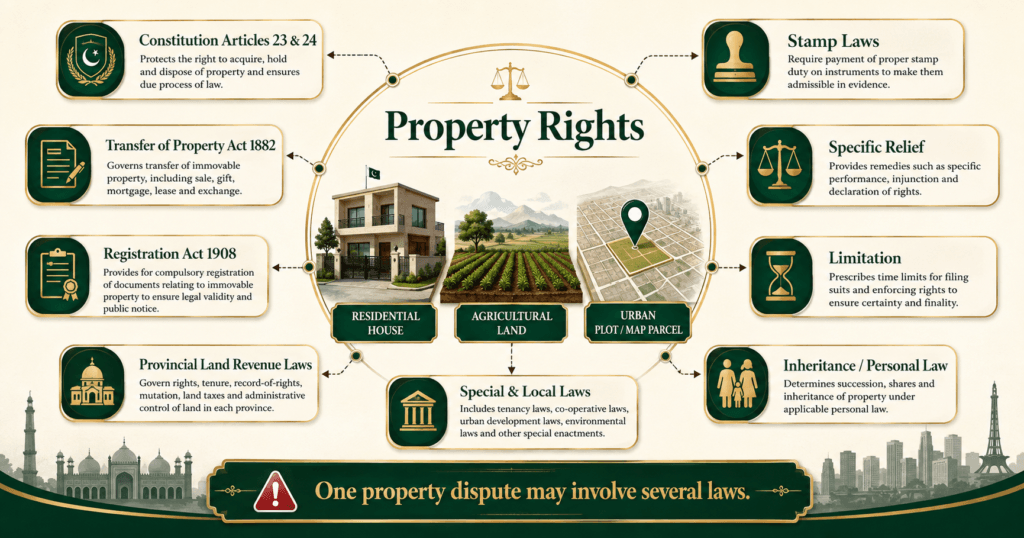
There is no single statute called the complete “Property Law Code of Pakistan.”
Different laws perform different functions.
The official Pakistan Code database contains the federal statutory framework, including major laws dealing with property and civil rights. The official database separately lists the Transfer of Property Act, 1882 and Registration Act, 1908.
| Law | Why It Matters |
|---|---|
| Constitution of Pakistan | Protects property rights subject to constitutional and lawful restrictions |
| Transfer of Property Act, 1882 | Regulates major forms of transfer between living persons |
| Registration Act, 1908 | Determines compulsory registration of specified instruments and consequences of non-registration |
| Provincial Land Revenue Laws | Govern land records, mutations, revenue administration and related proceedings |
| Stamp Laws | Govern stamping and fiscal requirements for instruments |
| Specific Relief Act, 1877 | Provides civil remedies such as declaration, cancellation and injunction in appropriate cases |
| Limitation Act, 1908 | Regulates time limits for suits, appeals and certain applications |
| Illegal Dispossession Act, 2005 | Creates a special remedy for qualifying unlawful dispossession cases |
| Personal and Succession Laws | Affect inheritance and succession |
| Special / Local Laws | May govern cooperative societies, development authorities, cantonments and other special property systems |
The PIDE property-rights study similarly explains that land-revenue legislation, the Transfer of Property Act, the Registration Act and special local laws can overlap.
What Constitutional Protection Does Property Receive?
Articles 23 and 24 are particularly important.
Article 23 recognizes a citizen’s right to acquire, hold and dispose of property, subject to the Constitution and reasonable restrictions imposed by law in the public interest. Article 24 provides protection against compulsory acquisition or taking of property except according to law and the constitutional framework governing public purpose and compensation. The PIDE study also identifies Articles 172 and 173 as relevant to the wider constitutional property framework.
Property Law in Pakistan: Is Mutation the Same as Ownership?
No. This distinction can save a buyer from a major mistake.
A mutation, commonly called Intiqal, records a change relating to rights in the revenue system. It can be important evidence and an important part of the ownership history, but the entry must still have a valid legal transaction behind it.
Suppose a mutation says that land was gifted to A.
If B challenges that mutation, the court may ask:
- Did the alleged donor actually make the gift?
- Did the donee accept it?
- Was possession delivered where legally required?
- Who witnessed the transaction?
- Did the donor own the property?
- Was fraud involved?
- Was the mutation based on a genuine document or statement?
A mutation cannot magically create a valid gift if the gift itself never happened.
This distinction is also explained in Qanooni Dastak’s guide to Hiba law and disputed gift mutations, where the underlying transaction—not merely the revenue entry—remains critical.
The practical lesson under Property Law in Pakistan is:
Trace the right behind the record. Do not examine the record in isolation.
Property Law in Pakistan: What Is the Difference Between Title, Mutation and Possession?
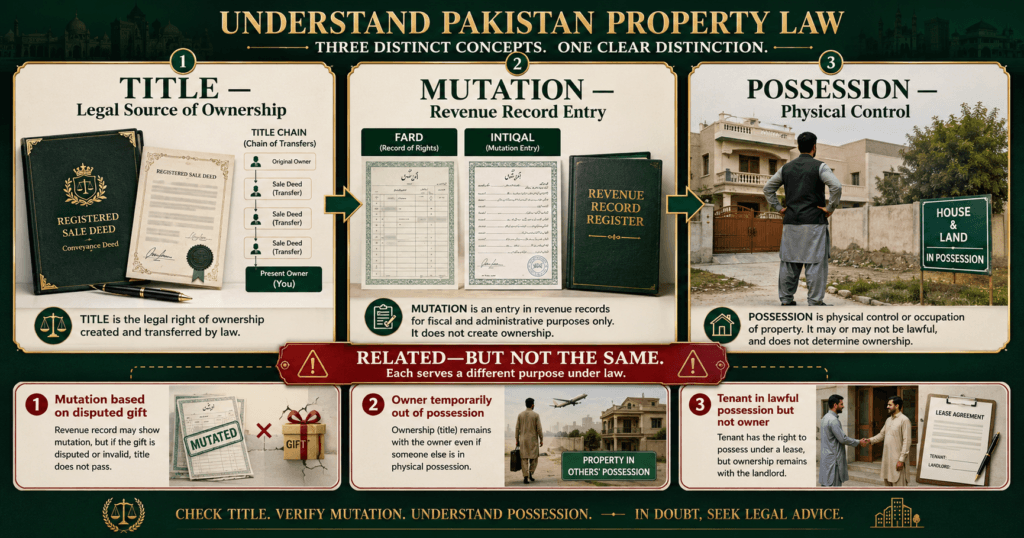
These three ideas are often mixed together.
Title
Title concerns the legal basis of ownership.
That basis may arise through:
- sale;
- inheritance;
- gift;
- allotment;
- court decree;
- grant; or
- another legally recognized source.
Mutation
Mutation records a change in the relevant revenue record. Its evidentiary value depends on the circumstances and the transaction behind it.
Possession
Possession concerns actual control or occupation of property.
A person can possess property without being its owner. A tenant is the easiest example.
Similarly, an owner may temporarily be out of physical possession without losing title merely for that reason.
This is why Property Law in Pakistan requires title documents, record entries and physical possession to be investigated together rather than treated as interchangeable concepts.
Property Law in Pakistan: When Does Registration Become Critical?
Registration is one of the strongest safeguards in property transactions.
The Supreme Court explained in 2025 SCMR 1229 that registration provides public evidence of documents, gives notice of transactions and helps prevent fraud, deception and forgery.
Section 17 of the Registration Act deals with compulsory registration of specified documents, while section 49 addresses the legal effect of failing to register documents that the law requires to be registered.
But one important distinction must be understood.
Oral Gift and Written Instrument Are Not Always the Same Question
The Supreme Court discussed the difference between a Muslim-law oral gift and an instrument that itself purports to transfer present rights in property.
Earlier authorities discussed in the judgment explain that where the written instrument itself operates as the transaction transferring rights in present property, registration requirements may become decisive. A memorandum merely recording an earlier completed oral gift can raise a different question.
Property Law in Pakistan therefore requires you to ask:
What exactly does this document do?
Do not decide registration merely by looking at the heading “Gift Deed,” “Declaration” or “Memorandum.”
Its legal effect matters.
Can a Registered Document Still Be Challenged?
Yes.
Registration is important, but it does not turn every document into an unquestionable truth.
Depending on the facts and applicable law, disputes may still involve allegations such as:
- forgery;
- impersonation;
- fraud;
- coercion;
- lack of authority;
- absence of ownership in the transferor;
- defective execution; or
- other legally recognized defects.
This is why good Property Law in Pakistan due diligence checks both the registered document and how that document came into existence.
Property Law in Pakistan: Why Did the Gift Fail in 2025 SCMR 1229?
This is the most important case study in this guide.
The disputed property originally belonged to Mst. Hoor Bai. The petitioner claimed that she had orally gifted the property to him and that the housing society later transferred it into his name.
The respondent challenged that position.
The Trial Court framed questions concerning:
- whether the respondent was the deceased owner’s daughter;
- whether Hoor Bai owned the property;
- whether she had gifted it to the petitioner; and
- whether the disputed transfer documents should be cancelled.
What Evidence Helped the Daughter?
The respondent produced three witnesses supporting her relationship with the deceased owner.
The Supreme Court observed that she discharged the burden of proving that relationship and that the evidence was not displaced in cross-examination.
What Evidence Was Missing From the Alleged Gift?
The petitioner’s case had serious evidentiary weaknesses.
The judgment records that he failed to prove important matters including the donor’s presence in Pakistan at the relevant time and delivery of possession pursuant to the alleged gift.
For readers dealing with similar disputes, Qanooni Dastak’s detailed guide on a valid gift in Pakistan explains the three essential elements and the evidence courts commonly examine.
The Three Essential Elements of Muslim Gift
The Supreme Court restated three core ingredients:
- declaration by the donor;
- acceptance by the donee; and
- delivery of possession.
The donor must genuinely divest himself or herself of dominion and ownership, and the donee must acquire the legally required control over the gifted property.
That principle is central to Property Law in Pakistan because family disputes often arise years after the alleged donor has died.
At that stage, courts need evidence—not merely family claims.
Why Could the Housing-Society Record Not Save the Alleged Gift?
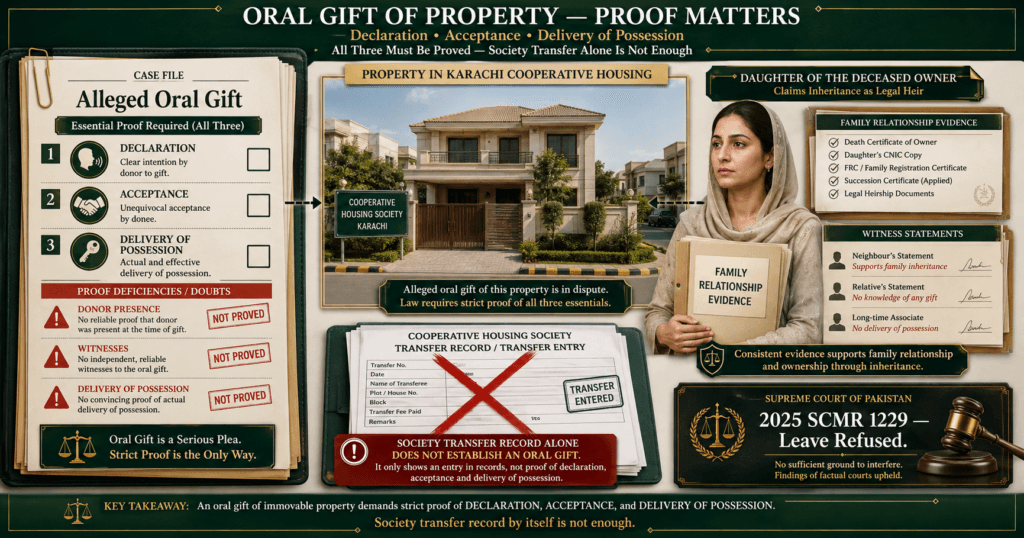
Because the society entry was based on an underlying transaction that the petitioner failed to prove.
The Supreme Court noted that despite the evidentiary problems, the society had transferred the property into the petitioner’s name. That transfer was ultimately treated as unsustainable in the litigation, and the Supreme Court found no reason to interfere with the concurrent findings of the courts below.
This gives property buyers a powerful rule:
A later record entry cannot automatically cure a defective source of title.
When dealing with housing-society property, Property Law in Pakistan requires you to examine both levels:
Level 1: society or authority record
Level 2: the transaction that legally supports that record
Property Law in Pakistan: What Should You Check Before Accepting a Hiba?
If a property is being transferred through Hiba, check more than the mutation.
Ask:
- Who owns the property today?
- Is the donor legally competent to make the gift?
- What property is being gifted?
- Was the declaration clear?
- When and where was it made?
- Who heard it?
- Did the donee accept it?
- Was acceptance during the donor’s lifetime?
- Was possession delivered?
- What happened to possession afterward?
- Did the donor continue acting as exclusive owner?
- Is there a written document?
- Does the document merely record an earlier oral gift or itself transfer title?
- Does registration law apply?
- Is the property description precise?
- Do later revenue or society records support the same transaction?
The Supreme Court-based Hiba guide on Qanooni Dastak provides further examples of why a mutation cannot substitute for proof of declaration, acceptance and possession.
Property Law in Pakistan: Can One Heir Keep the Entire Inherited Property?
Not merely because that heir controls the papers or occupies the property.
Inheritance introduces another layer of law.
The first questions should be:
- Who actually owned the property when the deceased died?
- Which succession or personal law applies?
- Who were the legal heirs at the relevant time?
- Was any part of the property validly transferred before death?
- Has an inheritance mutation or succession process been completed?
- Has any heir been omitted?
- Is an alleged gift being used to defeat the inheritance claim?
The Zafar & Associates inheritance-law resource discusses inheritance categories and succession procedures, including applications relating to succession certificates.
For female heirs, Qanooni Dastak’s guide on women’s inheritance rights in Pakistan explains why physical control by sons or brothers does not by itself erase a woman’s lawful inherited interest.
Why Should a Buyer Care About the Seller’s Family?
Because inherited property can become dangerous when one family member tries to sell more than he legally owns.
Before purchasing inherited property, identify:
- the deceased owner;
- all relevant legal heirs;
- inheritance documents;
- each seller’s share;
- any relinquishment or transfer;
- pending disputes; and
- any minor or otherwise legally protected interest.
A cheap property can become extremely expensive once undisclosed heirs appear.
Property Law in Pakistan: Can a Co-Owner Sell the Entire Joint Property?
Ownership of a share and exclusive ownership of a specific physical portion are not always the same thing.
A co-owner may legally hold an undivided interest in a larger property.
Suppose a person owns 25% of unpartitioned agricultural land and tells a buyer:
“That corner beside the road is completely mine.”
The buyer should not rely on the statement alone.
The CityLaws property-law guide similarly identifies the co-sharer’s own share as an important limit in a sale.
Before buying joint property, check:
- ownership shares;
- partition status;
- revenue record;
- physical possession;
- private partition claims;
- pending partition proceedings;
- access;
- boundaries; and
- rights of other co-sharers.
Property Law in Pakistan makes this investigation especially important when the buyer is shown a specific physical portion of land that is still legally joint.
Property Law in Pakistan: Does a Power of Attorney Make the Attorney the Owner?
No.
A power of attorney ordinarily authorizes one person to act for another. It does not automatically transfer ownership to the attorney.
The document must be read carefully.
Important questions include:
- Is the power of attorney genuine?
- Who signed it?
- Was the required authentication or registration completed?
- Which property does it cover?
- Does it expressly authorize sale?
- Does it authorize receipt of sale consideration?
- Is the authority general or specific?
- Was it revoked?
- Was the principal alive when the act was performed?
- Did the attorney act within the wording of the authority?
- Did the attorney transfer property to himself or a related person?
The Qanooni Dastak guide on power of attorney explains an important Supreme Court principle: a “general” power of attorney does not automatically provide unlimited authority to sell immovable property.
This is an essential Property Law in Pakistan due diligence rule for overseas owners who authorize relatives to manage their land.
Can Long Possession Alone Turn Someone Into the Owner?
Do not rely on a one-line internet answer.
Possession disputes require careful analysis of how the possession began and what legal relationship existed between the parties.
For example, possession may belong to:
- an owner;
- tenant;
- licensee;
- caretaker;
- co-heir;
- co-sharer;
- purchaser;
- mortgagee;
- unauthorized occupier; or
- another person claiming a legal right.
These positions are not interchangeable.
One competitor guide states adverse possession very broadly as though very long unauthorized occupation simply turns the occupier into the “real or legal owner.”
That statement is too broad to use as a safe rule for an actual Pakistani property dispute. Property Law in Pakistan requires the applicable limitation law, nature of possession, title, relationship between the parties and relief claimed to be examined together.
If the issue involves forcible or unlawful occupation, read Qanooni Dastak’s detailed guide to illegal possession of property in Pakistan.
Property Law in Pakistan: What Must a Buyer Verify Before Paying?
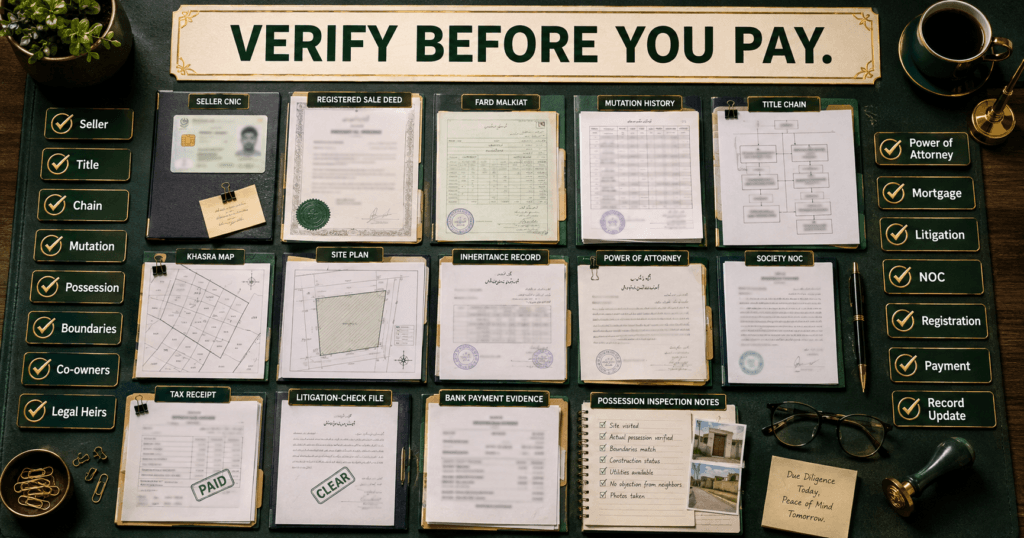
This is where legal awareness can save lakhs—or crores.
The PIDE study explains the importance of land records in recording and enforcing property rights, while the CityLaws guide also recommends checking title, original documents, mutation, encumbrances and legal compliance before purchase.
Use this practical due-diligence sequence.
1. Verify the Seller
Match the seller’s identity with the ownership record and original documents.
2. Find the Source of Title
Ask how the seller became owner.
Was it through:
- sale;
- inheritance;
- Hiba;
- allotment;
- court decree; or
- another lawful transfer?
3. Trace the Earlier Title Chain
Do not inspect only the latest paper.
A defective earlier transaction can create trouble later.
4. Check the Current Land or Society Record
Depending on the property, obtain the relevant:
- Fard;
- record of rights;
- mutation;
- allotment record;
- society record; or
- authority record.
5. Study the Mutation History
A sudden transfer shortly before sale deserves careful examination.
6. Match the Property Description
Compare:
- plot number;
- khasra number;
- area;
- share;
- boundaries;
- block;
- location; and
- site plan.
7. Visit the Property
See who actually possesses it.
Ask neighbours or other reliable local sources where appropriate.
8. Check Co-Ownership
Find out whether the seller owns the whole property or only an undivided share.
9. Check Inheritance
If any owner has died, identify the legal heirs.
10. Check the Power of Attorney
If an attorney is appearing for the owner, read the actual authority.
11. Check Mortgages and Encumbrances
Determine whether another person, bank or institution has an interest in the property.
12. Search for Litigation
A property subject to an injunction or ownership suit requires special caution.
13. Check Society or Development Authority Requirements
Confirm relevant transfer permission, NOC, dues, allotment status and other applicable requirements.
14. Complete Registration Where Required
Do not postpone a legally required registration simply because payment has already been made.
15. Preserve Payment Evidence
Use a traceable payment method and preserve receipts, banking evidence and acknowledgments.
16. Update the Relevant Record
After completing the transaction, ensure the appropriate revenue, authority or society record reflects it.
This is one of the most practical applications of Property Law in Pakistan: verify first, pay later.
Property Law in Pakistan: Are Housing-Society Papers Enough?
Not necessarily.
Pakistan has a large number of properties managed through housing societies, cooperative societies, development authorities and other special systems.
PIDE notes that property within such schemes can follow procedures different from ordinary revenue transfers because the society or authority’s own land and membership structure may be involved.
Check:
- society’s legal status;
- allotment letter;
- membership;
- transfer letter;
- lease or title structure;
- transfer fee;
- dues;
- NOC requirements;
- cancellation history;
- possession;
- development status;
- building restrictions;
- pending litigation; and
- underlying legal title.
Most importantly, remember 2025 SCMR 1229.
A society had entered the property in the petitioner’s name, but his underlying gift claim was not proved. The record could not replace the missing legal foundation.
Which Court or Authority Handles a Property Dispute?
This may be one of the most underestimated questions in Property Law in Pakistan.
Not every property dispute belongs before the same forum.
Depending on the dispute, proceedings may involve:
- civil courts;
- revenue authorities;
- succession forums;
- cooperative or special courts;
- Sessions Courts under a special criminal statute; or
- another statutory forum.
The correct forum depends on:
- nature of the right;
- cause of action;
- relief requested;
- applicable statute; and
- special jurisdiction created by law.
What Happened With the Cooperative Forum in 2025 SCMR 1229?
The Supreme Court examined the Sindh Co-operative Societies Act, 2020 and the related rules concerning disputes touching the business of a cooperative society. The judgment discussed the special court mechanism and appeal provisions.
The Court also noticed drafting and cross-reference problems in the statutory scheme and directed that the judgment be sent to relevant Sindh authorities for attention to those issues.
This part of the judgment provides another lesson:
A property case is not only about who is right. It is also about where the dispute must legally be decided.
Which Remedy Can Protect Your Property?
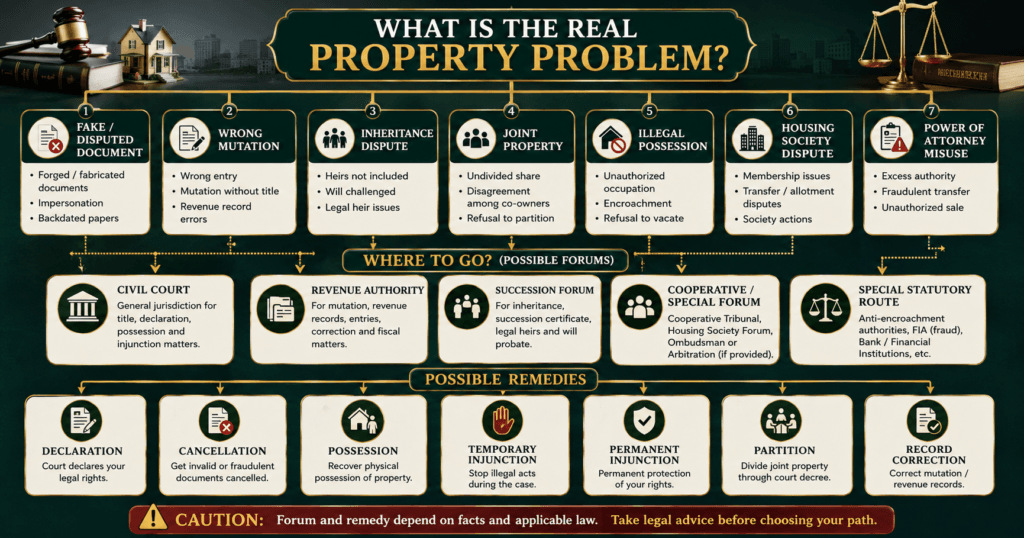
Property Law in Pakistan may require different remedies in different cases.
A claimant may potentially need:
Declaration
Where the court is asked to determine or declare a legal right or status.
Cancellation
Where a disputed document or instrument is challenged on legally sustainable grounds.
Possession
Where the person entitled to possession seeks recovery.
Permanent Injunction
Where future interference with a legal right needs to be restrained.
Temporary Injunction
Where urgent interim protection is needed while litigation continues.
Partition
Where joint property needs to be legally divided.
Record Correction
Where revenue or another official record requires correction through the legally available procedure.
Specific Performance
Where an enforceable property agreement is sought to be performed, subject to the applicable law and facts.
Special Statutory Remedy
Certain disputes may fall under special legislation rather than ordinary civil proceedings.
For a practical example of a civil property dispute involving mutation and title, Qanooni Dastak’s guide on a civil suit for declaration explains why the person relying on a gift mutation may still have to prove the gift itself.
Property Law in Pakistan: Can Delay Destroy a Strong Property Case?
Yes.
This is another area where dangerous blanket statements appear online.
There is no universal rule that every property or inheritance case can be filed at any time.
The legal time limit may depend on:
- nature of the suit;
- relief claimed;
- date of the disputed transaction;
- date of knowledge;
- fraud;
- possession;
- acknowledgment;
- legal disability;
- the applicable article in the Schedule; and
- any special statute.
The Qanooni Dastak guide to the Limitation Act in Pakistan explains how limitation can affect genuine property claims and why the applicable starting point must be identified carefully.
Never rely on:
“Inheritance has no limitation.”
or:
“It is an old property matter, so nothing can be done.”
Both statements can be dangerously incomplete.
Property Law in Pakistan requires the exact cause of action, denial of right, knowledge, possession and requested relief to be examined.
Property Law in Pakistan: Why Does Your Province Matter?
Land administration is substantially connected with provincial laws and institutions.
PIDE explains that provincial revenue departments perform central functions in land administration and maintenance of records.
This means a procedure used in Punjab should not automatically be copied for Sindh, Khyber Pakhtunkhwa, Balochistan or another jurisdiction.
There may also be:
- local amendments;
- provincial revenue rules;
- special housing-society legislation;
- digitized land-record systems;
- development-authority rules; and
- separate procedural mechanisms.
What Changed in Punjab in 2026?
Punjab’s official legislation database lists the Punjab Land Revenue (Amendment) Act, 2026, Act XLII of 2026.
Readers dealing with Punjab revenue proceedings can study Qanooni Dastak’s updated guide to the Punjab Land Revenue amendment framework. The article explains the legislative progression from the earlier ordinance to the current 2026 Act.
So an old 2012 or 2022 property guide may still provide useful background, but current provincial legislation should always be checked before taking legal action.
The UN-Habitat land and property rights resource remains useful for understanding Pakistan’s land-administration framework, while newer statutory developments must be checked separately.
Property Law in Pakistan: 17 Questions to Ask Before Signing Anything
Use this checklist before buying, selling, gifting, inheriting or litigating property.
- Who is the present legal owner?
- What is the original source of title?
- Is the earlier chain of title complete?
- Does the owner’s identity match the documents?
- Is the property inherited?
- Are all relevant heirs identified?
- Is the property jointly owned?
- Has a lawful partition taken place?
- Is anyone acting through power of attorney?
- Does that authority cover the proposed transaction?
- Does the instrument require registration?
- Have the relevant stamp requirements been checked?
- Does the mutation match the underlying transaction?
- Who has actual possession?
- Is there any mortgage, litigation or injunction?
- Does a society or authority approval apply?
- Has any limitation period started running?
If several answers are unclear, do not treat that as a minor paperwork problem.
It may be a title problem.
7 Red Flags That Should Stop a Property Buyer
1. “Pay Today, Documents Later”
Urgency is not proof of ownership.
2. Seller Refuses to Show Original Documents
Copies alone may not be enough for proper verification.
3. Recent Mutation With No Clear Source
Find out what transaction produced it.
4. Attorney Wants to Sell but Authority Is Vague
Read the document before paying.
5. Inherited Property but Only One Heir Appears
Identify the others.
6. Seller Has Papers but Someone Else Has Possession
Investigate why.
7. Society Record Exists but Earlier Title Is Missing
Remember the lesson of 2025 SCMR 1229: a later entry does not automatically establish the underlying transaction.
These warning signs are where Property Law in Pakistan becomes practical rather than academic.
Frequently Asked Questions About Property Law in Pakistan
What is Property Law in Pakistan?
Property Law in Pakistan is the legal framework governing ownership, transfer, possession, registration, inheritance, gifts, land records and disputes concerning property. It includes constitutional protections, statutes, provincial revenue laws, personal law and judicial precedent.
What are the main property laws in Pakistan?
Important statutes include the Transfer of Property Act, 1882, Registration Act, 1908, relevant provincial land-revenue legislation, stamp laws, Specific Relief Act, 1877, Limitation Act, 1908 and special property laws. Different laws may apply together. The Pakistan Code is an official federal source for statutory texts.
Is mutation proof of ownership in Pakistan?
Mutation is an important revenue record, but it should not automatically be treated as conclusive proof of the transaction that allegedly created ownership. Where the underlying sale, gift, inheritance or other transaction is disputed, that transaction may need independent legal proof.
What is the difference between registry and mutation?
A registered instrument records a document through the registration system where registration applies. Mutation concerns the relevant revenue record. They perform different legal and administrative functions.
Can an oral gift of property be valid in Pakistan?
A Muslim-law oral gift may be legally recognized when its required ingredients are proved. The Supreme Court in 2025 SCMR 1229 restated declaration, acceptance and delivery of possession as essential components.
Does every Muslim gift require a registered gift deed?
The answer cannot safely be reduced to yes or no without examining the transaction. The Supreme Court has distinguished an oral gift from a written instrument that itself operates to transfer rights in present property. The nature and legal effect of the document are important.
Can a gift mutation alone prove Hiba?
Not necessarily. If Hiba is disputed, the beneficiary may still have to prove the actual gift, including the legally required elements. Qanooni Dastak’s Hiba Law in Pakistan guide discusses this distinction in detail.
Can a housing-society transfer letter prove final ownership?
A society record can be important, but it does not automatically cure defects in the legal transaction behind it. In 2025 SCMR 1229, the society transfer could not rescue an alleged gift that was not properly proved.
Can a power of attorney holder sell property?
It depends on the authority granted by the instrument and the applicable legal requirements. A general label does not itself create every possible power. Read Qanooni Dastak’s power of attorney guide for the Supreme Court-based principles.
Does a power of attorney make someone the owner?
No. Authority to act for an owner and ownership itself are different concepts.
Can one co-owner sell joint property?
A co-owner may deal with his or her lawful interest, but a buyer should verify whether the seller owns only an undivided share or an exclusively partitioned portion. The distinction can be critical.
Can one heir sell the entire inherited property?
A person cannot safely be assumed to own the entire estate merely because he is one legal heir or possesses the documents. The shares and rights of all relevant heirs must be examined.
Does long possession automatically create ownership?
No simple automatic rule should be assumed. The legal character of possession, source of possession, ownership history, relationship between the parties, limitation and relief claimed must all be examined.
What should I check before buying property in Pakistan?
At minimum, investigate the seller, source and chain of title, original documents, current land or society record, mutation history, possession, boundaries, co-ownership, inheritance, attorney authority, encumbrances, litigation, approvals, registration and payment evidence.
Can illegal possession be challenged in Pakistan?
Yes, but the correct remedy depends on the facts. Civil remedies and special statutory remedies may differ. Qanooni Dastak’s guide on illegal possession of property explains the Illegal Dispossession Act framework and related issues.
Is there one limitation period for every property dispute?
No. Different claims and remedies may have different limitation rules. The starting point can also depend on facts such as knowledge, denial, fraud or possession.
Which court deals with property cases in Pakistan?
There is no single answer. Depending on the nature of the dispute, jurisdiction may lie with a civil court, revenue authority, succession forum, cooperative or special court, Sessions Court under special legislation, or another statutory forum.
What was the final result in Muhammad Dawood v. Mst. Sakeena Farooque?
The Supreme Court found no illegality or perversity in the judgments and decrees below. The civil petition was dismissed and leave to appeal was refused.
Conclusion: Your Name on the Record Is Only the Beginning
Property Law in Pakistan teaches one lesson again and again: ownership should be traced, not assumed.
A mutation must have a lawful transaction behind it.
A gift must be proved through its required ingredients when challenged.
A power of attorney must contain the authority actually exercised.
A co-owner cannot be treated as exclusive owner of every part of joint property merely because he controls it.
A society record should be checked against the legal source of title.
Possession should be investigated, not confused with ownership.
And even a genuine claim can face serious difficulty if the wrong forum or limitation period is ignored.
The Supreme Court’s judgment in 2025 SCMR 1229 brings many of these principles together. The petitioner had a society entry in his favour, but the Court focused on the transaction behind that entry. The alleged gift was not proved through the necessary evidence, and the Supreme Court refused to disturb the concurrent findings against him.
That is the safer way to understand Property Law in Pakistan:
Check the person. Check the property. Check the transaction. Check the evidence. Then check the record.
A few careful checks before signing can prevent years of litigation after signing.
Important Legal Disclaimer
This article is written for legal awareness and educational purposes. It is not a substitute for legal advice in a particular case. Property rights and procedures may differ according to the province, property type, personal law, statutory amendments, transaction, documents, limitation period and forum. Anyone dealing with an actual sale, inheritance, gift, possession dispute or litigation should have the complete original record reviewed under the law applicable to that matter.