
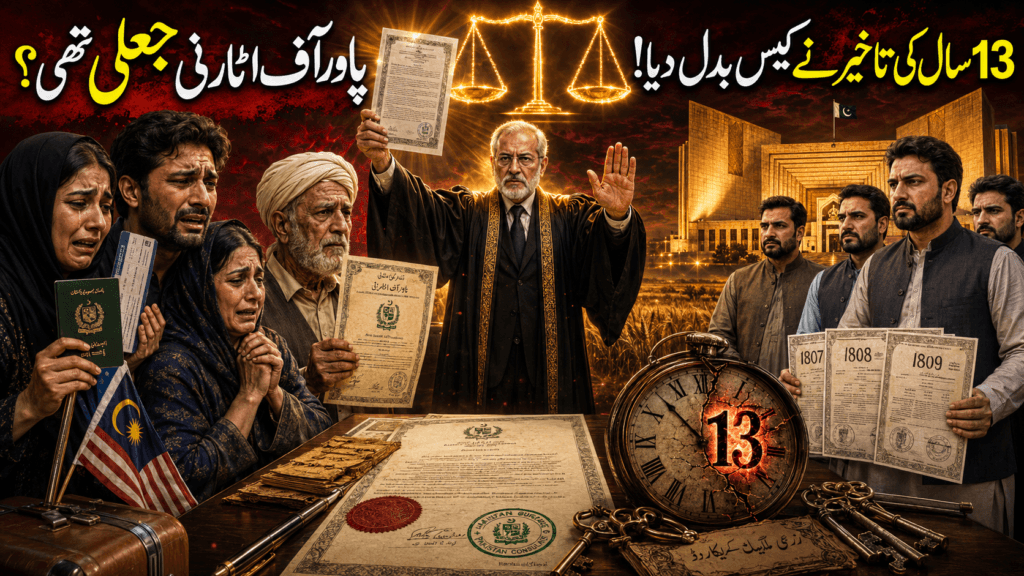
A document signed for convenience can later decide who controls land worth an entire family’s future. That is why a general power of attorney in Pakistan should never be treated as a harmless formality. It may authorise another person to manage, sell, transfer, or deal with property, but every power depends on its wording, authentication, supporting evidence, and timely legal challenge.
The Supreme Court of Pakistan examined these questions in Mst. Iqbal Bibi and others v. Kareem Hussain Shah and others, reported as 2024 SCMR 1233. The dispute involved family members living in Malaysia, their father acting as attorney in Pakistan, three old mutations, an allegation of forgery, and a civil suit filed more than thirteen years later. The judgment offers an important warning: a serious allegation cannot replace proof, and delay can defeat even a strongly worded property claim.
Table of Contents
IRAC Analysis: How the Court Examined the General Power of Attorney
| Part | Simple explanation |
|---|---|
| Issue | Was the 1990 power of attorney forged, were the related mutations illegal, and was the suit filed within the prescribed limitation period? |
| Rule | A person alleging fraud must prove it. A power of attorney authenticated before a recognised authority carries a legal presumption under Article 95 of the Qanun-e-Shahadat Order, 1984. A declaratory or forgery-based claim must also be filed within the applicable limitation period. |
| Analysis | The respondents did not prove forgery and did not properly challenge the document when evidence was recorded. The document had been authenticated by the Consulate General of Pakistan in Malaysia and registered in Pakistan. The respondents challenged the 1990 transactions after approximately 13 years, 7 months and 6 days. |
| Conclusion | The Supreme Court allowed the appeal, set aside the judgments and decrees of the courts below, and declared the appellants owners of the disputed Khasras. |
Judgment at a Glance: General Power of Attorney Dispute
| Detail | Information |
|---|---|
| Case title | Mst. Iqbal Bibi and others v. Kareem Hussain Shah and others |
| Citation | 2024 SCMR 1233 |
| Court | Supreme Court of Pakistan |
| Bench | Munib Akhtar, Shahid Waheed and Irfan Saadat Khan, JJ. |
| Author judge | Irfan Saadat Khan, J. |
| Decision date | 1 February 2024 |
| Appeal | Civil Appeal No. 1229 of 2018 |
| Property | 2 kanals in Khasra No. 558/2/1 and 6 kanals 19 marlas in Khasra No. 558/2/2 |
| Location | Mauza Khui Narran, Tehsil and District Haripur |
| Main document | Power of attorney dated 5 October 1990 |
| Disputed mutations | Mutation Nos. 1807, 1808 and 1809 |
| Main laws | Articles 95 and 119, Qanun-e-Shahadat Order, 1984; section 42, Specific Relief Act, 1877; Articles 92 and 120, Limitation Act, 1908 |
| Forum journey | Civil Judge → Additional District Judge → Peshawar High Court, Abbottabad Bench → Supreme Court |
| Final relief | Appeal allowed; earlier judgments set aside; appellants declared owners |
The case was Civil Appeal No. 1229 of 2018 and arose from a judgment of the Peshawar High Court, Abbottabad Bench.
What Is a General Power of Attorney in Pakistan?
A general power of attorney in Pakistan is a legal document through which one person, known as the principal, authorises another person, known as the attorney or agent, to act on the principal’s behalf.
Depending on its wording, the attorney may be authorised to:
- manage property;
- appear before government offices;
- sign applications and documents;
- collect rent;
- pursue court cases;
- deal with revenue authorities;
- execute a sale; or
- complete a property transfer.
However, the word “general” does not automatically mean unlimited. The attorney can lawfully perform only those acts that fall within the powers granted by the document.
For example, authority to supervise land does not necessarily include authority to sell it. In contrast, where a general power of attorney in Pakistan expressly allows the attorney to sell any land to any person, the wording may support a later sale or mutation.
A power of attorney also does not make the attorney the owner. It only permits the attorney to act as a representative of the principal.
The authority to manage property is different from the authority to make a gift, as explained in our judgment-based guide on [Gift Deed Through Power of Attorney].
A Family Abroad, a Father in Pakistan, and Three Old Mutations
The respondents were living in Malaysia. They claimed ownership of:
- 2 kanals in Khasra No. 558/2/1; and
- 6 kanals and 19 marlas in Khasra No. 558/2/2.
The land was situated in Mauza Khui Narran, Tehsil and District Haripur.
On 22 June 2004, the respondents filed Suit No. 204/1 of 2004 before the Senior Civil Judge, Haripur. The matter was assigned to Civil Judge-V.
They asked the court to declare them owners of the land and to hold that the appellants had no lawful interest in it.
The respondents alleged that the power of attorney in favour of their father, Gohar Shah, was false and fabricated. On that basis, they challenged Mutation Nos. 1807, 1808 and 1809 and requested correction of the revenue record.
The appellants denied those allegations and defended the property transactions.
The 1990 Document That Became the Heart of the Dispute

The appellants relied on a power of attorney dated 5 October 1990.
According to the evidence, it had been:
- executed by the respondents in favour of their father, Gohar Shah;
- endorsed by the District Sub-Registrar, Abbottabad, on 30 October 1990; and
- accompanied by powers relating to the sale of all or any of the respondents’ lands in Pakistan to any person.
The Registry Moharrar of Tehsil Haripur produced an attested copy of the document and the relevant extract from the official register.
The detailed judgment records that Mutation Nos. 1807, 1808 and 1809 were attested on 15 November 1990. The reported headnote contains a differing date, but the detailed factual discussion repeatedly records 15 November 1990.
The entire dispute therefore depended on one central question: was this general power of attorney in Pakistan genuine, or was it a forged document used to create unlawful mutation entries?
The Evidence Produced Before the Trial Court
The Civil Judge framed ten issues. Each side produced three witnesses.
The respondents produced attested copies of:
- Mutation No. 1807;
- Mutation No. 1808;
- Mutation No. 1809;
- Mutation No. 2072 dated 16 June 1993; and
- the later power of attorney dated 24 September 1998 in favour of Syed Iftikhar Hussain Shah.
The Halqa Patwari also produced:
- Fard Jamabandi for 1988–89;
- Fard Jamabandi for 1991–92;
- Fard Jamabandi for 1992–93;
- Fard Jamabandi for 1996–97;
- Fard Jamabandi for 2001–02;
- Fard Jamabandi for 2004–05;
- Aks Shajra; and
- Roznamcha Wakiati.
The appellants relied on the Registry Moharrar, who produced the attested 1990 instrument and the registration extract.
This evidence shows how a dispute over a general power of attorney in Pakistan should be examined. A court does not decide forgery merely from suspicion or family disagreement. It examines official endorsements, registration books, certified copies, witnesses, revenue entries and the conduct of the parties.
Why the First Three Courts Accepted the Respondents’ Claim
The Civil Judge decreed the respondents’ suit on 26 November 2010. The respondents subsequently started execution proceedings.
The appellants filed an appeal on 27 December 2010. It was heard by the Additional District and Sessions Judge-I, Haripur, who dismissed it on 29 February 2012.
The appellants then approached the Peshawar High Court, Abbottabad Bench. The High Court dismissed their civil revision on 18 May 2016 and upheld the judgments of the two lower courts.
The High Court reasoned that where a claimant remained in possession, each fresh Jamabandi could create a fresh cause of action against an incorrect revenue entry.
It also observed that a mutation based on an unproved original power of attorney could be treated as void, with limitation calculated from the date when the plaintiff learned about it.
The respondents therefore reached the Supreme Court with three decisions in their favour. But concurrent findings do not become immune from interference where they are based on a clear error of law.
The Appellants’ Argument: The Courts Ignored Authentication and Delay
The appellants argued that the lower courts had ignored the legal presumption attached to the document.
Their counsel stated that the general power of attorney in Pakistan had first been authenticated by the Consulate General of Pakistan in Malaysia and was then registered in Pakistan.
They also argued that:
- the transactions took place in 1990;
- the civil suit was filed after approximately 13 years, 7 months and 6 days;
- Article 120 of the Limitation Act prescribed six years for the type of declaratory relief relied upon by the respondents;
- no proper ground for exemption from limitation had been pleaded under Order VII, Rule 6 of the Code of Civil Procedure; and
- every later Jamabandi could not revive an already time-barred claim.
The appellants maintained that the High Court should have corrected these legal errors rather than treating all findings as protected concurrent findings.
The Respondents’ Argument: We Sued After Learning About the Mutations
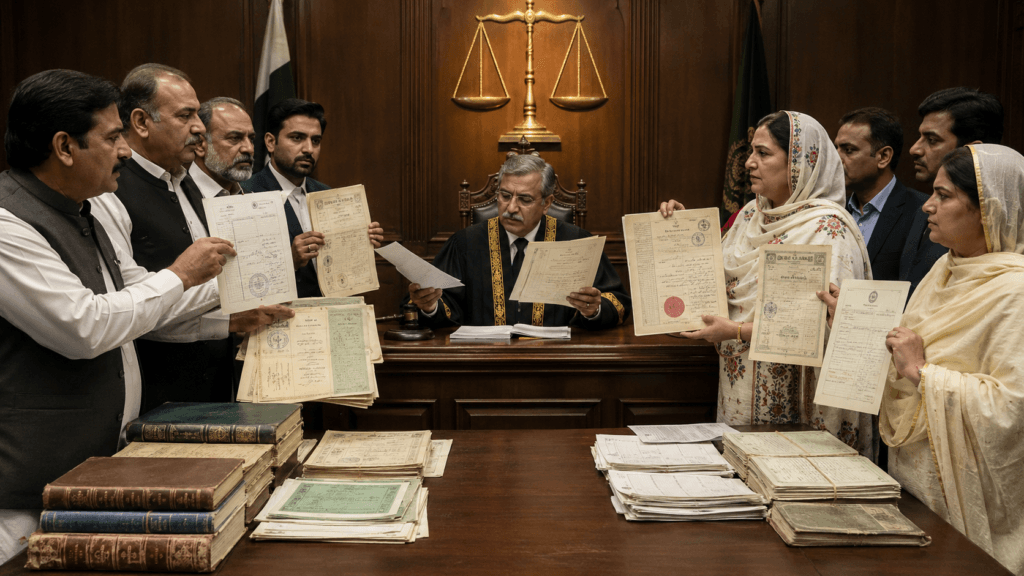
The respondents relied heavily on the three judgments already passed in their favour.
Their counsel argued that the limitation period did not begin until Iftikhar Hussain Shah discovered the allegedly illegal mutation entries in the revenue record.
They further maintained that:
- the courts below had fully examined the witnesses and record;
- the mutations had been found false and fabricated;
- concurrent findings should not be disturbed unless shown to be perverse or legally defective; and
- the appeal should be dismissed with costs.
The respondents therefore treated the issue mainly as a concluded factual dispute.
The Supreme Court, however, had to decide whether the respondents had actually discharged the burden of proving forgery and whether their claim was legally within time.
General Power of Attorney in Pakistan: Who Must Prove Forgery?

This became the first decisive legal question.
Article 119 of the Qanun-e-Shahadat Order, 1984 provides that the burden of proving a particular fact lies on the person who asks the court to believe that fact exists.
The respondents’ entire case was built on the allegation that the 1990 document was fraudulent. The Supreme Court therefore held that the burden of proving that allegation rested on them.
The Court found that they failed to discharge that burden. More importantly, they did not properly challenge the authenticity of the document during the evidence stage when it was proved through the Registry Moharrar and official record.
This is a major lesson for anyone challenging a general power of attorney in Pakistan. Merely describing a document as “fake,” “forged” or “fabricated” is not enough.
The allegation must be supported through reliable evidence, which may include:
- handwriting comparison;
- fingerprint or thumb-impression examination;
- testimony of the executant;
- evidence of attesting witnesses;
- consular records;
- registration records;
- identity documents;
- travel records; or
- evidence showing that the alleged executant could not have appeared before the authority.
Fraud must be clearly pleaded and legally proved.
Article 95: Why Authentication Created a Legal Presumption

Article 95 of the Qanun-e-Shahadat Order deals specifically with powers of attorney.
Readers may consult the official text of the Qanun-e-Shahadat Order, 1984, published in the Pakistan Code.
It requires the court to presume due execution and authentication where the document appears to have been executed before and authenticated by a recognised authority, including:
- a notary public;
- a court;
- a judge;
- a magistrate;
- a Pakistan Consul;
- a Pakistan Vice Consul; or
- a representative of the Federal Government.
In this case, the document had been authenticated by the Consulate General of Pakistan in Malaysia and was later registered in Pakistan.
The Supreme Court held that it therefore qualified for the statutory presumption of execution and authentication under Article 95.
The Court also referred to earlier judgments explaining that authentication is more than an ordinary stamp or attestation. It indicates that the authenticating authority satisfied itself regarding the identity of the person signing and the fact of execution.
Because the respondents produced no satisfactory evidence of forgery, the general power of attorney in Pakistan carried a presumption of truth and genuineness. Its admissibility could not be rejected merely on the basis of an unsupported allegation.
Does Article 95 Make Every Power of Attorney Untouchable?
No.
The presumption under Article 95 is strong, but it can be rebutted.
A challenger may still prove that:
- the document was forged;
- the signature or thumb impression was false;
- the executant never appeared before the authority;
- the authentication record was manipulated;
- the attorney exceeded the powers granted;
- the principal lacked capacity;
- the document was obtained through fraud or coercion; or
- the authority had already been revoked.
The judgment does not say that registration automatically makes every document genuine. It says that an authenticated and registered instrument cannot be defeated by a bare denial.
A person challenging a general power of attorney in Pakistan must therefore present evidence strong enough to overcome the legal presumption.
Can an Overseas General Power of Attorney Be Used in Pakistan?
An overseas Pakistani may authorise someone to act in Pakistan through a properly executed and authenticated power of attorney.
In this case, authentication by the Consulate General of Pakistan in Malaysia, followed by registration in Pakistan, became a central reason for applying Article 95.
However, overseas principals should not sign broad documents casually. They should clearly state:
- the name and identity of the attorney;
- the precise property involved;
- whether sale is permitted;
- whether gift is permitted;
- whether the attorney may receive the sale price;
- whether possession may be delivered;
- whether mutation may be sanctioned;
- whether litigation may be filed or defended;
- whether the attorney may appoint another representative; and
- when the authority will end.
A general power of attorney in Pakistan should also be monitored after execution. The principal should obtain updated revenue records and verify that the attorney has not acted beyond the intended authority.
The Limitation Trap: Why Thirteen Years Changed the Result

The transactions were made in 1990. The respondents filed their suit on 22 June 2004—approximately 13 years, 7 months and 6 days later.
The Supreme Court noted several important circumstances:
- the respondents lived in Malaysia but had visited Pakistan several times after 1990;
- Gohar Shah died in 1993 without challenging the mutations;
- the respondents appointed Iftikhar Hussain Shah as attorney in 1998;
- no effort was made between 1998 and 2004 to verify the mutation entries; and
- the claim that the mutations were discovered only in 2004 appeared difficult to accept.
The Court found it beyond comprehension that the respondents remained unaware of an allegedly fabricated instrument and the resulting property transfers for more than a decade.
It therefore held that the suit was hopelessly time-barred.
This is one of the strongest warnings in the judgment. A person challenging a general power of attorney in Pakistan should not wait until years have passed, witnesses have died, and property entries have remained unchallenged.
Article 92 or Article 120: Which Limitation Period Applies?
The Supreme Court discussed two provisions of the Limitation Act, 1908.
Article 92
Article 92 applies to a suit seeking a declaration that an issued or registered instrument is forged.
It provides:
- limitation period: three years;
- starting point: when the issue or registration becomes known to the plaintiff.
The Supreme Court observed that Article 92 could have been more relevant to the respondents’ allegation that the registered instrument was forged.
Article 120
Article 120 is a residuary provision. It applies where no other limitation period is specifically provided.
It provides:
- limitation period: six years;
- starting point: when the right to sue accrues.
The respondents relied on Article 120. However, even under that provision, their suit was filed far too late.
The correct limitation article in a dispute involving a general power of attorney in Pakistan depends on the main relief claimed. A court will examine whether the plaintiff is seeking cancellation, declaration of forgery, declaration of title, possession, or another substantive remedy.
Calling a document “void” does not automatically remove every limitation period.
Does Every New Jamabandi Restart Limitation?
No. The answer depends on whether the owner faces only a threatened denial or an actual denial of rights.
Threatened or apprehended denial
A wrong entry in the revenue record may sometimes amount only to a threatened denial where the true owner remains in actual or constructive possession.
In that situation, a later adverse entry may provide another cause of action.
Actual denial
The position changes where the beneficiary of a sale or gift mutation also takes physical possession.
Taking possession under the disputed transaction is an actual denial of the former owner’s proprietary rights. Once the affected person knows about that denial, the limitation period begins to run.
Later repetition of the same entry in subsequent Jamabandis does not provide a fresh limitation period.
The Supreme Court explained that where possession has passed under a disputed sale or gift, the affected owner cannot indefinitely postpone litigation by relying on each newly prepared Jamabandi.
For a case involving a general power of attorney in Pakistan, the court will therefore examine:
- when the mutation was entered;
- who obtained possession;
- when the claimant learned about the transaction;
- whether ownership was actually denied; and
- whether the suit was filed within time after that denial.
Why the Supreme Court Interfered With Three Concurrent Findings
Ordinarily, the Supreme Court does not interfere merely because it might form a different view of the evidence.
Concurrent findings may, however, be disturbed where they are:
- contrary to the available evidence;
- patently improbable;
- perverse;
- based on misreading or non-reading;
- affected by jurisdictional error; or
- founded on an incorrect legal principle.
In this case, the limitation error was apparent from the record. The High Court had linked limitation to later Jamabandis even though the transactions had remained unchallenged for more than thirteen years.
The Supreme Court found that the lower courts had misread the law of limitation. It therefore had lawful grounds to interfere despite the three concurrent decisions.
Final Decision: The Delayed Challenge Failed

The Supreme Court allowed the appeal.
It:
- set aside the impugned judgment and decree;
- reversed the decisions of the courts below;
- declared the appellants owners of the disputed Khasras; and
- directed the parties to bear their own costs.
The respondents lost because of two connected failures:
- they did not prove that the 1990 document was forged; and
- they filed their suit after an unexplained and legally fatal delay.
The ruling therefore protects an authenticated general power of attorney in Pakistan where no satisfactory proof of forgery is produced and the challenge is brought long after the limitation period has expired.
What This Judgment Does Not Permit
The judgment should not be misunderstood as giving attorneys unlimited freedom.
It does not permit an attorney to:
- act beyond the written authority;
- secretly transfer property for personal benefit;
- ignore the principal’s instructions;
- fabricate consideration;
- use a revoked instrument;
- impersonate the principal; or
- rely on a forged or improperly authenticated document.
The Supreme Court upheld the transaction because the document carried a statutory presumption, the allegation of forgery was not proved, and the suit was time-barred.
Every general power of attorney in Pakistan must still be interpreted according to its wording and surrounding evidence.
Practical Checklist Before Signing a GPA
Before signing, the principal should:
- verify the attorney’s CNIC and complete address;
- describe the property precisely;
- define each authorised act separately;
- state clearly whether sale or gift is permitted;
- specify whether the attorney may receive money;
- restrict transfers to the attorney or close relatives where necessary;
- require written accounts and copies of every transaction;
- retain certified copies of the instrument;
- check later registration and mutation entries; and
- use a special power of attorney where broad authority is unnecessary.
A narrowly drafted document is often safer than a broad general power of attorney in Pakistan.
Practical Checklist Before Challenging a GPA
A person preparing a challenge should obtain:
- a certified copy of the instrument;
- consular authentication records;
- Sub-Registrar records;
- mutation registers;
- Fard and Jamabandi;
- Roznamcha Wakiati;
- Aks Shajra;
- possession evidence;
- utility bills;
- identity and travel records;
- admitted signatures or thumb impressions;
- expert evidence where forgery is alleged; and
- proof of the exact date of knowledge.
The plaint should clearly explain:
- how the document was allegedly forged;
- who participated in the fraud;
- when the fraud became known;
- why the claim was not filed earlier;
- which limitation provision applies; and
- what relief is being sought.
A challenge to a general power of attorney in Pakistan must be built on dates, documents and evidence—not suspicion alone.
Frequently Asked Questions
1. What is a general power of attorney in Pakistan?
It is a document through which a principal authorises an attorney to perform several specified acts on the principal’s behalf. The actual authority depends on the wording of the document.
2. Does a general power of attorney transfer ownership?
No. It creates authority to act but does not itself make the attorney owner of the property.
3. Can an attorney sell the principal’s land?
Yes, where the document clearly authorises sale and all other legal requirements are fulfilled. The attorney cannot lawfully exceed the authority granted.
4. Is an authenticated power of attorney automatically genuine?
It receives a legal presumption under Article 95 where the required conditions are met. However, the presumption may still be rebutted through convincing evidence of forgery or improper execution.
5. Who must prove that the document is forged?
The party alleging forgery carries the burden of proving that allegation under Article 119 of the Qanun-e-Shahadat Order, 1984.
6. Can a Pakistani living abroad execute a power of attorney?
Yes. Proper authentication through a recognised authority and compliance with registration and other applicable legal requirements are important.
7. What was important about the Malaysian authentication in this case?
The document was authenticated by the Consulate General of Pakistan in Malaysia and registered in Pakistan. This brought it within the presumption provided by Article 95.
8. How long is the limitation period for challenging a forged registered instrument?
Article 92 provides three years from the date when the issue or registration becomes known to the plaintiff. Different relief may attract another provision, so the exact claim must be examined carefully.
9. Does every new Jamabandi create a fresh cause of action?
No. Where an actual denial of ownership has already occurred, repetition of the entry in later Jamabandis generally does not restart limitation.
10. What is the main lesson of 2024 SCMR 1233?
A challenge to an authenticated general power of attorney in Pakistan requires clear proof and timely legal action. Unsupported allegations and unexplained delay can defeat the entire claim.
Conclusion: A Powerful Document Demands Immediate Attention
The property dispute in 2024 SCMR 1233 started with a document executed in 1990 and ended in the Supreme Court more than three decades later.
The respondents alleged forgery, but they failed to prove it. They also waited more than thirteen years before filing their suit. Authentication, official registration, burden of proof and limitation ultimately decided the case.
A general power of attorney in Pakistan can protect a lawful transaction, but it can also expose a family to serious risk when its language is broad or its use is not monitored.
The safest approach is precision when signing, regular verification after execution, and immediate legal action when misuse or forgery is discovered.
Disclaimer
This article is for general legal awareness and is based on Mst. Iqbal Bibi and others v. Kareem Hussain Shah and others, 2024 SCMR 1233. It is not a substitute for professional legal advice. The validity, use, revocation, registration and limitation of a power of attorney depend on its wording, evidence and individual facts. Consult a qualified lawyer before taking legal action.