


A seal can look final—and still fail in court. In a major 2026 inheritance judgment, Pakistan’s Federal Constitutional Court examined a three-page compromise carrying a Notary Public seal. Two pages were unsigned, the property was not properly identified, and the daughters said they had never given free and informed consent. The stamp did not end the inquiry.
That ruling matters far beyond one family. A careless document can affect a home, land, inheritance, visa, admission, business deal or power of attorney. This guide explains in easy English what a Notary Public may legally do in Pakistan, what a seal cannot prove, how to verify the person and the document, and the 13 safeguards that can protect female heirs from losing property through doubtful paperwork.
Quick answer: A Notary Public is an authorised statutory officer who can verify, authenticate, certify or attest the execution of certain documents and perform other functions allowed by law. Notarisation can support proof of execution, but it does not automatically cure fraud, blank or unsigned pages, vague property, unlawful terms, lack of consent, or a legal requirement for registration or further attestation.
Table of Contents
IRAC: Why the Official Seal Could Not Save the Compromise
| IRAC element | What the Court examined |
|---|---|
| Issue | Could a court enforce a three-page notarised compromise when its first two pages were unsigned, the property was unidentified, and the daughters disputed free and informed consent? |
| Rule | Due execution must be genuinely verified under section 8 of the Notaries Ordinance. A compromise recorded under Order XXIII Rule 3 CPC must be lawful. An agreement may be void for uncertainty under section 29 of the Contract Act, while fraud, misrepresentation or want of jurisdiction may be challenged under section 12(2) CPC. |
| Analysis | Pages 1 and 2 carried no signatures or thumb impressions of the parties and no signatures of counsel, witnesses or identifiers. The expression “Ghair Mutadawia” did not identify the land. The execution record and later mutation also demanded scrutiny, while strict proof of the daughters’ understanding and voluntary surrender was missing. |
| Conclusion | The Federal Constitutional Court accepted the appeal, set aside the Balochistan High Court judgment, revived the inheritance suit and issued 13 safeguards for instruments affecting women’s inheritance rights. |
What Is a Notary Public in Pakistan?
A Notary Public is a person appointed by the competent government under the Notaries Ordinance, 1961 to perform specified notarial acts. The appointment belongs to the authorised person—not to a stamp shop, clerk, desk or online directory.
Section 8 of the Ordinance includes functions such as verifying, authenticating, certifying or attesting the execution of an instrument; administering an oath or taking an affidavit; performing specified work involving negotiable instruments and mercantile documents; preparing or authenticating instruments intended to operate abroad; and translating or verifying translations.
The law also deals with the certificate of practice, official seal and register of notaries. This is why a lawyer’s signboard, social-media profile or marketplace listing is not enough evidence of a current appointment.
Provincial rules can affect the practical process
Appointment procedure, territory, forms and fees can be affected by provincial laws, amendments and notifications. Punjab has enacted the official Notaries (Amendment) Act, 2025, while the Khyber Pakhtunkhwa Code publishes the West Pakistan Notaries Rules, 1965. For a disputed or high-value matter, confirm the latest position with the relevant provincial Law or Home Department and the official Gazette.
What a Notary Public Can—and Cannot—Do
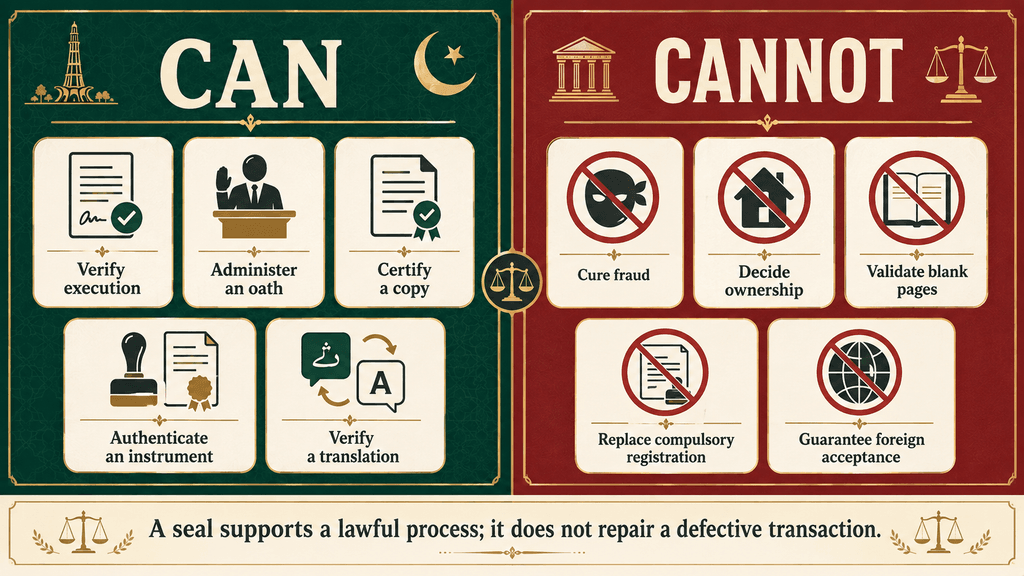
The core job is not merely to watch ink touch paper. Where execution is being authenticated, the Notary Public should connect a real person, a complete instrument and a genuine act of signing. The signature and official seal are essential formal parts of a notarial act under section 8(2), but they do not give the underlying transaction unlimited legal force.
| A Notary Public may do within lawful authority | A notarial seal cannot automatically do |
| Verify, authenticate, certify or attest execution | Prove that every factual statement in the document is true |
| Administer an oath or take an affidavit | Decide ownership or resolve a property dispute |
| Perform specified commercial and negotiable-instrument functions | Cure fraud, coercion, misrepresentation or undue influence |
| Prepare or authenticate certain instruments for use abroad | Make vague, uncertain or unlawful terms enforceable |
| Translate or verify a translation | Replace compulsory registration before the proper authority |
| Complete an authorised act with a Notary Public signature and seal | Replace HEC, IBCC, MOFA, apostille or embassy action where required |
The receiving authority controls what it will accept. A university, bank, court, embassy or foreign employer may ask for a certified copy, sworn affidavit, registration, departmental attestation, MOFA attestation, apostille or consular legalisation. Ask first; do not pay for the wrong process.
Which Documents May Need Notarisation?
There is no rule that every legal paper must be notarised. The correct route depends on the document, applicable law, place of use and recipient’s instructions.
| Document or purpose | Possible Notary Public role | Important check before signing |
| Affidavit, declaration or undertaking | Identity, oath or affirmation, signature and execution | The receiving forum may require an Oath Commissioner or another named officer. |
| Power of attorney | Identity, execution, signatures and supporting material | Property or overseas use may also require registration, consular processing, MOFA action or a prescribed digital route. |
| Agreement, deed or family settlement | Authentication of execution and page continuity | A Notary Public seal cannot cure uncertain property, unlawful terms or lack of free consent. |
| Certified copy | Comparison of the copy with the original | Confirm that the recipient accepts a copy certified by a Notary Public instead of the original or departmental certification. |
| Translation | Translation or verification of translation | The destination may require a certified translator, MOFA or embassy processing too. |
| Company or commercial instrument | Execution, authority and specified commercial formalities | Board authority, SECP record or foreign legalisation may still be necessary. |
If a document creates, declares, assigns, limits or extinguishes rights in immovable property, check the Registration Act, 1908. A Notary Public seal is not a substitute where registration is compulsory. For authority over property, also read our guide on power of attorney in Pakistan.
How to Get a Document Notarised Safely in Pakistan
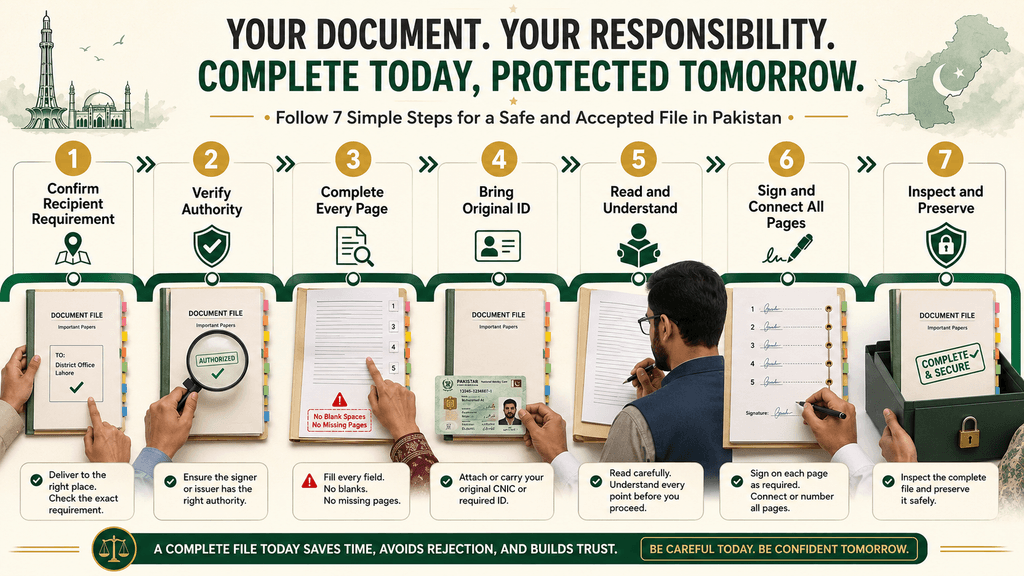
Step 1: Confirm the recipient’s requirement
Ask the court, department, bank, university, embassy or foreign organisation exactly what it needs. Note whether it asks for a Notary Public act, an oath, certified copies, registration, apostille, MOFA attestation or consular legalisation.
Step 2: Verify the authorised person
Ask the Notary Public for the current appointment or certificate details. Match the name, authorised area, signature and seal. For valuable land, inheritance or overseas documents, confirm the appointment through the competent provincial department or official Gazette.
Step 3: Complete every page before execution
Remove blank spaces, add every annexure and number all pages. Identify land with available title, registration or revenue details, including location, boundaries and relevant numbers. Never leave a property description to be filled in later.
Step 4: Bring original identity and records
Carry the original CNIC, NICOP or passport and the requested copies. If a copy is to be certified, take the original. For a company, authority or property transaction, bring the documents showing capacity and ownership.
Step 5: Read, translate and understand
Do not sign because a relative says the document is “only a formality.” Read every clause and annexure. Ask for an accurate explanation or translation in a language you understand. Obtain independent advice where inheritance or valuable property is at risk.
Step 6: Execute the complete instrument
Sign in the required person’s presence. Each relevant page of a multi-page instrument should be signed or initialled as appropriate, with witnesses and endorsements completed where required. The certification should connect the pages and annexures and, where suitable, mention the total page count.
Step 7: Inspect and preserve the final record
Before leaving, check names, dates, signatures, thumb impressions, seal, page count, annexures and any register or serial reference. Ask for an itemised receipt. Keep a full scan and physical copy—not only the last stamped page.
If the document is for foreign use, follow the official MOFA document-attestation guidance and, where applicable, the MOFA apostille procedure.
Notary Public vs Oath Commissioner, Registration and Apostille
These processes can appear similar at a counter, but they solve different legal problems.
| Process | Main function | Key limit |
| Notarisation | A Notary Public authenticates or attests execution and performs other statutory acts | The transaction must still be lawful, certain and properly executed. |
| Oath Commissioner | Administers an oath or affirmation for affidavits and sworn material within the authorised scope | Follow the Oath Act, 1873 and the receiving forum’s rule. |
| Registration | Places a qualifying document in the formal registration system | A stamp from a Notary Public does not replace compulsory registration. |
| MOFA attestation | Authenticates a signature or seal through the prescribed official chain for external use | It does not decide whether the underlying facts are true. |
| Apostille | Certifies the origin of a public document for use under the applicable international framework | It does not legalise the transaction itself; issued apostilles can be checked through the official verification page. |
The safest question is not “Where can I get a stamp?” It is “Which authority must verify which part of this document for its intended use?”
How to Verify a Notary Public in Pakistan
Use this seven-point check before trusting a high-value document:
- Ask for the full name and current appointment or certificate details.
- Confirm the authorised territorial area and any relevant limitation.
- Match the name on the seal with the certificate and identity.
- Check that the completed instrument carries a clear signature, seal and date.
- Ask for the Notary Public register or serial reference and a receipt where applicable.
- For a valuable, disputed or foreign-use document, verify through the competent Provincial Government department or official Gazette.
- Walk away from anyone willing to stamp blank paper, incomplete annexures or unsigned pages without checking identity and execution.
Private directories can help locate a nearby lawyer, but they do not replace the official register. “Near me” is a convenience search, not proof of legal authority. The safest Notary Public is one whose appointment is current and whose procedure is careful enough to create a reliable record.
Fees: Why a Single Online Price Can Mislead You
There is no reliable one-price answer for every province and every document. The amount quoted at a desk may combine separate items:
- The prescribed Notary Public fee;
- Stamp paper or e-stamp value;
- Drafting and legal advice;
- Translation or certified copies;
- Witness, travel, courier or urgent-service costs;
- Registration charges; and
- MOFA, apostille, embassy or departmental charges.
Ask the Notary Public or service provider for an itemised quote before work starts. Separate an official fee from private professional or logistical charges. An old blog post or marketplace listing may not reflect the current provincial schedule.
Can You Use an Online Notary Public While in Pakistan?
Sometimes an online platform connects a person in Pakistan with a Notary Public commissioned in another country, often for a document intended for that foreign jurisdiction. That does not automatically become a Pakistani notarial act under the 1961 Ordinance.
Before using a remote service, confirm:
- Which country’s law governs the act;
- Where the document will be used;
- Whether the recipient accepts a remote Notary Public service;
- Whether original signatures or personal appearance are required;
- Whether witnesses must be physically or remotely present under the applicable rule; and
- Whether registration, MOFA, apostille or consular processing still follows.
For an overseas power of attorney, a Pakistani mission may require personal presence, original identity, witnesses, page-wise signing or a prescribed digital process. Follow the official instructions of the mission serving your jurisdiction; the MOFA power-of-attorney guidance shows why an informal video call or WhatsApp scan may not be enough.
The 2026 Judgment Every Document Signer Should Know
The leading case is Mst. Bibi Amina and others v. Shamsullah and others, C.P.L.A. 143-Q/2025, decided by the Federal Constitutional Court of Pakistan on 4 June 2026. The bench comprised Chief Justice Amin-ud-Din Khan and Justice Ali Baqar Najafi. The decision is approved for reporting and is available as the official court judgment.
The petitioners were daughters and legal heirs of late Abdul Rehman and Mst. Bibi Sabza. They sued their brothers and other legal representatives for declaration and separate possession of their Shari shares in the parents’ estate.
During the suit, a written compromise was presented. The Trial Court passed judgment on 15 June 2021 under Order XXIII Rule 3 of the Code of Civil Procedure, 1908, and the decree followed on 16 June 2021. The daughters later alleged fraud, misrepresentation and concealment. They said their consent was not free or informed and the compromise was unlawful and uncertain. On 12 August 2022, they applied under section 12(2) CPC to set it aside.
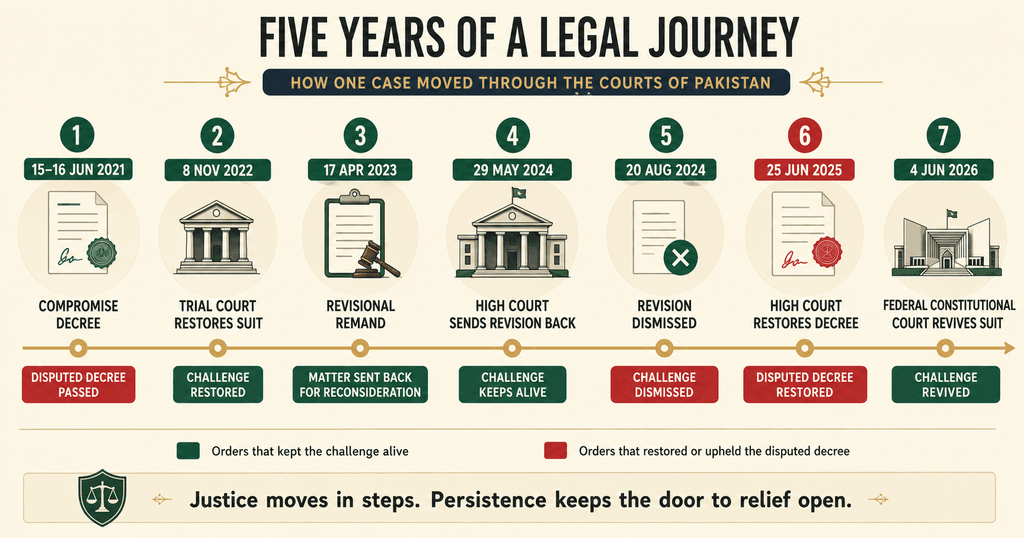
The verified court journey
- 15–16 June 2021: The compromise judgment and decree were passed.
- 8 November 2022: The Trial Court allowed the section 12(2) application, set aside the decree and restored the suit.
- 17 April 2023: The Revisional Court remanded the matter for issues and evidence.
- 29 May 2024: The High Court set aside that remand and sent the revision back for a fresh decision.
- 20 August 2024: The Revisional Court dismissed the revision, leaving the Trial Court’s order in place.
- 25 June 2025: The Balochistan High Court reversed the concurrent orders and restored the compromise decree.
- 4 June 2026: The Federal Constitutional Court accepted the daughters’ appeal, set aside the High Court judgment and revived the inheritance suit.
The case was originally filed before the Supreme Court and later transferred to the Federal Constitutional Court under the constitutional transition described in the judgment.
For safer private arrangements, read our guide on family settlement in Pakistan.
Two Document Defects the Court Could Not Ignore
Defect 1: Nobody could identify the property
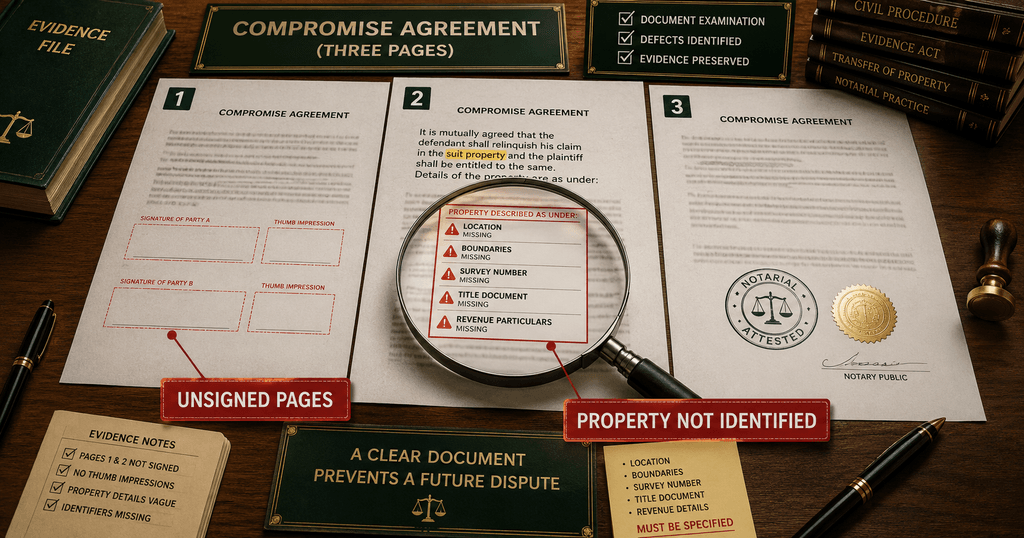
Clause 2 used the expression “Ghair Mutadawia,” meaning property outside the suit or not in dispute. But the clause gave no location, boundaries, survey numbers, title documents, revenue particulars, extent or value. The assets were not identified in the pleadings either.
Section 29 of the Contract Act, 1872 treats agreements as void when their meaning is uncertain or incapable of being made certain. The Court reasoned that valuable inheritance rights cannot be extinguished by an elastic phrase that lets one side identify the property later.
Defect 2: Two of the three pages were unsigned
Pages 1 and 2 bore no signatures or thumb impressions of the parties. They were also not signed by counsel, witnesses or identifiers. Only the third page contained the signatures, even though the instrument was stated to consist of three separate Rs.100 stamp-paper pages.
The Court did not treat this as a harmless cosmetic issue. If the unsigned pages were detached, the signed page could not be independently understood. That broken continuity created a risk of substitution, interpolation or later manipulation. The presence of a Notary Public seal did not answer those concerns.
Why a Notary Public Could Not Act Like a Rubber Stamp
Section 8 of the Notaries Ordinance uses the language of verification, authentication, certification and attestation. In this case, the Court found no indication that the person applying the seal had exercised the required care over the obvious defects.
Before authenticating a multi-page instrument, the Notary Public should be satisfied that the persons shown as executants duly executed it, the instrument is complete, its pages belong together and no blank, unsigned or unattested sheet has been inserted. Page-wise signatures or initials and a certification of the total number of pages are practical safeguards against substitution.
This does not mean that one missing initial automatically invalidates every document in Pakistan. The judgment was fact-specific. The Court assessed unsigned pages together with unidentified property, the execution history, the later mutation, the allegations of fraud and the absence of strict proof of the daughters’ informed consent.
Three Legal Rules That Worked Together
Section 29, Contract Act: uncertain property can defeat an agreement
The subject of an agreement affecting immovable property must be objectively identifiable. A later unilateral explanation cannot safely rescue a clause that leaves the property unknown. Judicial approval cannot give life to a compromise that is void for uncertainty.
Order XXIII Rule 3 CPC: only a lawful compromise may be recorded
A court must be satisfied that the agreement is lawful before passing a consent decree. It cannot use a compromise to extinguish rights in undisclosed property that was outside the suit and incapable of identification.
Section 12(2) CPC: a decree may be attacked on specified grounds
Section 12(2) provides a route to challenge a judgment, decree or order on fraud, misrepresentation or want of jurisdiction. Whether the remedy succeeds depends on the pleadings, evidence, limitation and facts. A Notary Public stamp does not bar that statutory challenge.
The judgment also discussed Article 114 of the Qanun-e-Shahadat Order, 1984. Estoppel could not be used mechanically to protect an instrument affected by illegality, uncertainty, fraud or lack of informed consent.
Why the Court Gave Female Heirs Stronger Protection
Pakistani courts have repeatedly recognised that women can be excluded from inheritance through family pressure, dependency, illiteracy, social domination or documents they do not fully understand. A signature, thumb impression, registration entry or mutation may be relevant evidence, but it does not by itself prove a conscious and voluntary surrender.
When brothers or other beneficiaries rely on a document that reduces a woman’s inherited share, they carry a heavy burden. They must show that she knew the exact property and rights affected, understood the legal result, acted freely and had access to independent and disinterested advice.
The Court referred to Ghulam Muhammad v. Zohran Bibi (2021 SCMR 19) and Phul Peer Shah v. Hafeez Fatima (2016 SCMR 1225). It also connected the protection of women’s property with Articles 4, 23, 24, 25 and 227 of the Constitution of Pakistan.
For the wider law, see our guides on women’s inheritance rights in Pakistan and a daughter’s share in her father’s property.
The 13 Safeguards for Women’s Inheritance Rights

The Court directed courts, revenue authorities and other forums to apply these safeguards whenever an instrument affects, reduces, compromises or extinguishes a woman’s inheritance rights:
| No. | Safeguard | Meaning in plain English |
| 1 | Heightened scrutiny | Treat the document as a potential deprivation of a vulnerable heir, not routine paperwork. |
| 2 | No automatic presumption | Execution, attestation, registration, mutation or apparent consent alone does not establish validity. |
| 3 | Heavy burden on the beneficiary | The person gaining from the transaction must prove free, informed and conscious consent through credible evidence. |
| 4 | Knowledge of exact rights | Prove that the woman knew the nature of the transaction and the precise property and inheritance affected. |
| 5 | Independent advice | Show access to competent, independent and disinterested advice. |
| 6 | Freedom from pressure | Exclude coercion, fraud, misrepresentation, undue influence, family control and social domination. |
| 7 | Real consideration | If payment is claimed, prove it was lawful, real, adequate, actually paid and objectively verifiable. |
| 8 | Read, explain and translate | Prove the entire instrument was explained in a language the executant fully understood. |
| 9 | Time to reflect | Allow reasonable time for thought and consultation without haste or pressure. |
| 10 | Scrutiny of one-sided terms | Treat an unconscionable or disproportionately harmful bargain with strict disapproval unless convincingly justified. |
| 11 | Explain every suspicion | The beneficiary must remove all suspicious circumstances; failure may justify an adverse inference. |
| 12 | Affirmative judicial finding | The court must expressly find voluntariness and informed consent before upholding the deprivation. |
| 13 | Protection at mutation stage | Revenue authorities must apply the same caution before sanctioning an inheritance-affecting mutation. |
These protections matter to daughters, sisters, widows, elderly owners and rural families. They also guide judges, revenue officers, lawyers, deed writers and every Notary Public handling an instrument that may reduce a woman’s inherited property.
What the Court Decided—and What It Did Not
The actual result
The petition was converted into an appeal and accepted. The Balochistan High Court judgment dated 25 June 2025 was set aside, and the inheritance suit was revived. The Court allowed the parties, if so advised, to amend the plaint to include other properties of both deceased parents so the whole controversy could be decided together.
Three claims the judgment does not support
The Court did not:
- Finally calculate or distribute each heir’s share;
- Declare every instrument bearing a Notary Public seal and an unsigned page automatically void; or
- Hold that a Notary Public seal, registration or mutation never has evidentiary value.
The decision turned on the complete factual picture. Its lesson is not “all stamped documents are invalid.” Its lesson is that an official-looking stamp cannot replace certainty, complete execution, lawful terms and genuine informed consent.
A 15-Point Safety Checklist Before You Sign
Before the appointment
- Confirm what the receiving authority requires.
- Verify the proposed Notary Public and territorial authority.
- Read the complete document and every annexure.
- Remove blanks and empty spaces.
- Number the pages and identify every attachment.
- Describe land through exact title and revenue particulars.
- Take independent advice if inheritance or valuable property is affected.
During execution
- Take original identity and supporting records.
- Ask for a translation or explanation you fully understand.
- Never sign only the last page of an unseen document.
- Sign or initial each relevant page as appropriate.
- Ensure witnesses, thumb impressions and photographs are added where legally or practically required.
- Check that the certification connects the full instrument and annexures.
After execution
- Keep a complete scan and physical copy, receipt and register reference.
- Complete registration, MOFA, apostille or consular processing only where the law or recipient requires it.
If a clause, page, signature, seal or later revenue entry looks suspicious, preserve the record and seek prompt legal advice. Delay can affect remedies and evidence.
Frequently Asked Questions
What does Notary Public mean in Pakistan?
It means a statutory officer appointed under the Notaries Ordinance to perform authorised functions such as verifying or attesting execution, administering oaths and handling specified commercial or translation-related acts.
Does a Notary Public stamp make a document legal?
No. The seal is evidence of a notarial act within lawful authority; it cannot cure fraud, coercion, uncertainty, incomplete execution, illegal terms or missing compulsory registration.
Must every page of a legal document be signed?
The 2026 judgment strongly supports page-wise signatures or initials and a clear total page count as protections for multi-page instruments. The legal effect of a missing signature still depends on the kind of document, governing law and complete facts.
How can I verify an authorised Notary Public?
Check the current appointment or certificate, authorised area, official seal, signature, date and register details. For land, inheritance or foreign-use papers, confirm through the relevant Provincial Government department or Gazette.
Is a Notary Public the same as an Oath Commissioner?
No. Their work can overlap for some affidavits and oaths, but the source and scope of authority differ. Follow the specific requirement of the receiving court, department or foreign authority.
Can I get a document notarised online in Pakistan?
Do not assume every video call or scanned-stamp service is valid. Check the governing country’s law, personal-appearance rules, the officer’s authority and the recipient’s acceptance. Foreign remote notarisation is not automatically a Pakistani notarial act.
Is notarisation enough for an overseas power of attorney?
Often not. Depending on destination and purpose, the document may require personal appearance, witnesses, a prescribed digital route, consular processing, MOFA attestation, apostille or registration.
How much does notarisation cost in Pakistan?
The official fee and total service cost can vary by province, document and extra work. Request an itemised quote separating the notarial fee from stamp paper, drafting, translation, copies, registration, courier and foreign-attestation charges.
Can unsigned pages be challenged despite a notarial seal?
Yes. Unsigned pages can create serious doubt about due execution, continuity and possible substitution. The person relying on the instrument may need to prove that every page formed part of the document knowingly executed.
Can a daughter challenge an inheritance compromise?
She may challenge it where the facts support fraud, misrepresentation, coercion, uncertainty, want of jurisdiction or lack of free and informed consent. The correct remedy and limitation period require advice on the specific record.
Did the 2026 judgment cancel all documents with unsigned pages?
No. It decided one dispute by examining several defects together. It offers strong safeguards but does not create an automatic rule invalidating every instrument because of one missing initial.
Conclusion: Trust the Process, Not Just the Stamp
A Notary Public holds an office of trust. That trust is earned by checking identity, reviewing a complete instrument, witnessing genuine execution and creating a reliable connection between every page, annexure, signature and seal.
The 2026 judgment gives families a memorable warning: never surrender property through vague words, never sign only the last page, and never treat a woman’s thumb impression as automatic proof of informed consent. A careful document should show who signed, what they understood, which property was affected and why the transaction was lawful.
Before valuable rights change, verify the authority, identify the property, understand every clause, protect each page and preserve the full record. The stamp should confirm a safe process—not distract you from a dangerous one.
Legal Disclaimer
This article provides general legal awareness, not legal advice, and does not create a lawyer-client relationship. Notarial, registration, attestation and inheritance requirements can vary by province, document, receiving authority and country of use. Verify the latest official procedure and obtain advice on the facts of your case.