

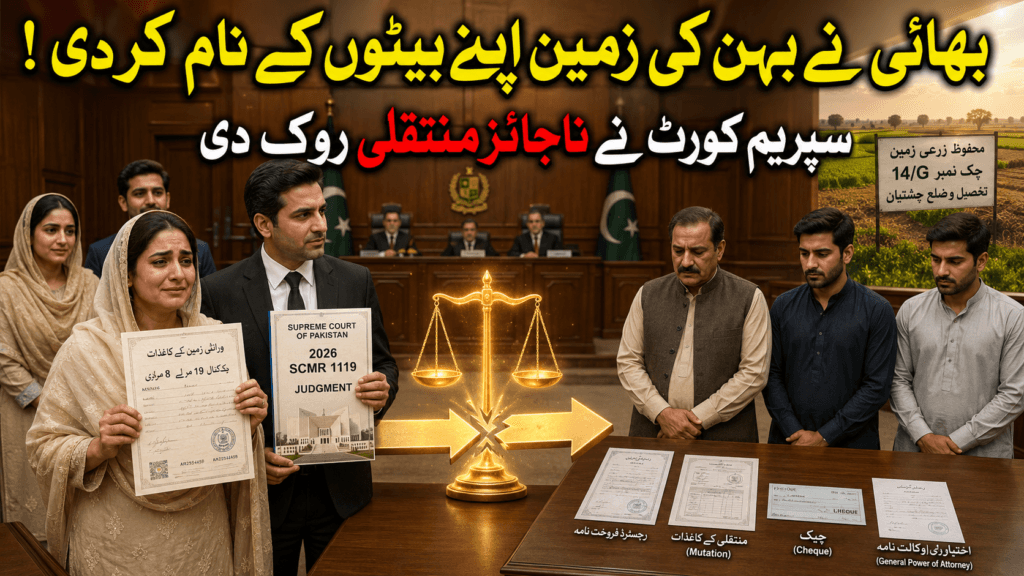
A trusted legal document became the centre of a painful family dispute. Mst. Farhat Iqbal had inherited land from her father. Because of close family relations, she gave her brother a general power of attorney (mukhtar nama) to manage it. Years later, she discovered that the same land had been transferred to her brother’s own sons.
This was not only a dispute about one piece of land. It raised a question that concerns thousands of women, elderly owners and overseas Pakistanis: can a trusted attorney use a power of attorney to move the owner’s property into the names of his own close relatives without clear permission?
In Javed Iqbal and others v. Mst. Farhat Iqbal (deceased) through legal representatives, 2026 SCMR 1119, the Supreme Court of Pakistan answered that question firmly. The Court held that an attorney cannot rely on vague authority, family trust or an unexplained cheque when transferring the principal’s property to his own sons. Clear authority, prior approval and informed consent must be proved.
Table of Contents
IRAC: Why the Supreme Court Rejected the Transfer
| IRAC Element | Simple Explanation |
|---|---|
| Issue | Could an attorney transfer the principal’s property to his own sons without proving express written consent, prior approval and informed permission? |
| Rule | A general power of attorney does not automatically include a right to sell property. A clear sale clause is required. When the buyer is the attorney himself or a close relative, special permission and informed consent of the principal must be proved. |
| Analysis | The purchasers were the attorney’s sons. No cogent evidence proved that Farhat Iqbal had expressly approved this sale. The alleged cheque did not establish a lawful bargain because there was no agreement to sell or reliable independent evidence. The changing version about consideration further weakened the defence. |
| Conclusion | The transaction violated the attorney’s fiduciary duties. The Supreme Court dismissed the appeal, leaving the decree in favour of Farhat Iqbal and her legal representatives intact. |
Judgment at a Glance: Every Key Detail in One Place
| Detail | Information |
|---|---|
| Case title | Javed Iqbal and others v. Mst. Farhat Iqbal (deceased) through L.Rs. |
| Citation | 2026 SCMR 1119 |
| Court | Supreme Court of Pakistan |
| Bench | Justice Shahid Bilal Hassan and Justice Shakeel Ahmad |
| Author judge | Justice Shahid Bilal Hassan |
| Appeal number | Civil Appeal No. 852 of 2025 |
| Date of hearing and decision | 6 April 2026 |
| Earlier High Court case | Civil Revision No. 408 of 2015/BWP |
| High Court judgment | Lahore High Court, Bahawalpur Bench, dated 6 October 2025 |
| Property | 1 kanal, 19 marlas and 8 sarsahi |
| Location | Chak No. 14/G, Chishtian |
| Original owner | Mst. Farhat Iqbal, who inherited the land from her father |
| Authority documents | Unregistered GPA executed in 2003; registered GPA dated 24 September 2005 |
| Attorney | Appellant No. 1, her brother |
| Beneficiaries of transfer | Appellants Nos. 2 and 3, the attorney’s sons |
| Challenged documents | Registered sale deed and mutation made in 2006 |
| Main laws | Section 39, Specific Relief Act, 1877; Sections 211, 214 and 215, Contract Act, 1872 |
| Counsel for appellants | S.A. Mahmood Khan Sadozai, Advocate Supreme Court |
| Counsel for respondent’s L.Rs. | Muhammad Aslam Khan Dhukkar, Advocate Supreme Court |
| Final result | Appeal dismissed; no order as to costs |
The Case That Turned Family Trust into a National Warning

Mst. Farhat Iqbal inherited 1 kanal, 19 marlas and 8 sarsahi of land from her father. The property was situated at Chak No. 14/G, Chishtian.
In 2003, because of close family relations, she executed an unregistered general power of attorney in favour of Appellant No. 1, her brother. Later, on 24 September 2005, she executed a registered power of attorney authorising him to manage the property.
The power of attorney gave management authority, not ownership. However, in 2006, the attorney used that authority to transfer the land through a registered sale deed and mutation to Appellants Nos. 2 and 3.
These two purchasers were not independent strangers. They were the attorney’s own sons.
Farhat Iqbal later alleged that the transaction had been completed without her consent and through misuse of the authority placed in her brother’s hands.
She revoked the authority through a registered deed in April 2009. On 5 May 2009, she filed a suit seeking cancellation of the sale deed and mutation.
The defendants claimed that the property had been purchased for valuable consideration. However, their amended written statement materially changed the alleged sale consideration without giving a satisfactory explanation.
The Supreme Court heard the matter as Civil Appeal No. 852 of 2025 against the Lahore High Court judgment. The reported judgment identifies the parties, bench, counsel and date of decision clearly.
From Trial Court to Supreme Court: Her Long Road for Justice

Farhat Iqbal’s suit was first decreed in her favour on 21 December 2012.
The matter was then remanded on 26 April 2013 for a fresh decision on certain issues. After reconsidering the record, the Trial Court again decreed her suit on 18 November 2014.
The Appellate Court reversed that decree on 8 May 2015.
Farhat Iqbal then filed a civil revision before the Lahore High Court, Bahawalpur Bench. On 6 October 2025, the High Court allowed her revision and restored the Trial Court’s decree.
The opposing parties approached the Supreme Court. Their appeal was ultimately dismissed on 6 April 2026. Her fight shows why power of attorney safeguards matter.
What the Appellants Asked the Supreme Court to Accept
The appellants argued that the Lahore High Court had misunderstood the evidence and the settled law.
According to them, Farhat Iqbal had willingly executed the authority in favour of Appellant No. 1. They claimed that she knew about the later transfer and had consented to it.
They also relied on the power of attorney, witness statements and surrounding circumstances. Their position was that the transaction involved valuable consideration and that the attorney’s sons were bona fide purchasers.
On this basis, they asked the Supreme Court to interfere with the findings of the Trial Court that had been restored by the High Court.
What Farhat Iqbal’s Side Said About the Broken Trust

The respondent’s counsel argued that the transaction was affected by fraud, misrepresentation and abuse of a fiduciary relationship.
The brother had received a power of attorney because of family trust, but allegedly used it to move the property to his own sons.
Her side maintained that there was no lawful authority and no genuine consideration. The unexplained change in the appellants’ version of the sale price made the transaction even more doubtful.
The respondent therefore asked the Court to uphold the High Court judgment and leave the Trial Court’s decree in place.
The One Question That Decided the Entire Case
The Supreme Court narrowed the dispute to one decisive question:
Could the attorney, acting under the power of attorney but without express written consent, validly transfer the principal’s property to his own sons, and had any such consent been legally proved?
It was admitted that the transferees were the attorney’s sons. This close relationship triggered a higher level of judicial caution.
The transaction was not treated like an ordinary sale between independent strangers. The attorney was handling entrusted property and stood in a fiduciary position.
He therefore had to act honestly, disclose all material facts and protect the owner’s interest.
The Evidence Record: What Existed and What Was Missing
The record contained:
- The 2003 unregistered authority;
- The registered document dated 24 September 2005;
- The 2006 registered sale deed;
- The mutation entered on the basis of the sale;
- The registered revocation deed from April 2009;
- The parties’ original and amended pleadings;
- Witness statements;
- The alleged cheque relied upon as payment.
These documents explained the history, but they did not answer the decisive question of consent.
What was missing mattered more.
There was no reliable proof that Farhat Iqbal had given prior approval for transfer to the attorney’s sons. There was no agreement to sell establishing the price and terms. There was no independent evidence connecting the alleged cheque with a genuine sale.
The changed version of consideration also remained unexplained.
The Supreme Court therefore examined substance rather than paperwork alone. The existence of a registered sale deed, mutation or power of attorney could not cure the absence of informed consent and a proved lawful bargain.
A General Power of Attorney Is Not an Unlimited Licence to Sell
The Court reaffirmed that a general power of attorney does not automatically grant authority to sell or dispose of immovable property.
If sale authority is intended, the document must contain a clear and separate clause for that purpose.
The word “general” does not turn the attorney into an owner. It also does not give him every possible power over the principal’s property.
Even a sale clause is not a free pass. The principal’s knowledge, intention and consent must remain clear. Where fraud or misrepresentation is alleged, courts must closely examine:
- The wording of the document;
- The purpose for which it was executed;
- The relationship between the parties;
- The identity of the buyer;
- The alleged sale price;
- The method of payment;
- The attorney’s conduct;
- The owner’s knowledge and approval.
This rule is especially important for women who sign documents for management, court work, revenue proceedings or convenience.
A power of attorney for management should not silently become ownership authority. A power of attorney must be read strictly, not stretched for the attorney’s personal benefit.
You may also read our detailed guide on Property Transfer Through Power of Attorney in Pakistan to understand when an attorney can legally sell or transfer immovable property.
Selling to His Own Sons Created a Serious Conflict of Interest
An attorney acting under written authority is an agent, not the owner.
When he transfers entrusted property to himself, his children or another close relative, personal interest enters the transaction. That conflict creates a duty to obtain the principal’s prior and informed approval.
The attorney must communicate with the principal and disclose:
- The identity of the proposed buyer;
- The relationship between the attorney and buyer;
- The proposed sale price;
- The payment method;
- The important terms of the sale;
- Any personal benefit received by the attorney;
- All material circumstances affecting the decision.
The owner must then give clear permission before the transaction is completed.
Without full disclosure and informed permission, the principal may repudiate the transaction.
The limits of a power of attorney were reinforced through Maqsood Ahmad v. Salman Ali, PLD 2003 SC 31, which required prior approval before an attorney transferred land to his brother.
The Court also relied on Jamil Akhtar v. Las Baba, PLD 2003 SC 494, where special permission was required for transfer to close fiduciary relations.
Why the Alleged Cheque Could Not Prove a Genuine Sale

The appellants referred to a cheque allegedly issued by the brother to his sister. The Supreme Court held that this cheque was not conclusive proof of a valid sale.
There was no agreement to sell or independent corroborative evidence showing a lawful bargain.
A payment instrument, standing alone, does not prove:
- Which property was being purchased;
- What price had been agreed;
- What terms had been settled;
- Whether the owner accepted that price;
- Whether the owner approved the attorney’s sons as buyers;
- Whether the cheque concerned the disputed transaction;
- Whether a genuine agreement existed before the transfer.
The defence was further weakened because the alleged sale consideration was materially changed in the amended written statement without explanation.
In property litigation, inconsistent versions about the price can damage the credibility of the entire transaction.
The Court therefore refused to treat the cheque as a substitute for consent, a genuine contract and reliable proof. A power of attorney cannot be used to fill gaps in a doubtful sale.
The Laws Behind the Protection

Section 39 of the Specific Relief Act, 1877
Section 39 of the Specific Relief Act, 1877 provides a legal remedy for cancelling a written document that is void or voidable and may cause serious harm if it remains in existence.
Farhat Iqbal sought cancellation of the registered sale deed and mutation because those documents affected her title and created a claim against her inherited property.
Section 211 of the Contract Act, 1872
An agent must conduct the principal’s business according to the principal’s directions.
The attorney cannot replace those directions with his own family interest. He cannot go beyond the authority that the owner actually granted.
Section 214 of the Contract Act, 1872
When difficulty or doubt arises, the agent must use reasonable diligence to communicate with the principal and seek instructions.
If the wording of the authority is unclear, the attorney should contact the owner instead of assuming that he has permission.
Silence cannot safely be converted into consent.
Section 215 of the Contract Act, 1872
When an agent deals on his own account without fully informing the principal and obtaining consent, the principal may repudiate the transaction.
A transfer to the attorney’s sons may benefit the attorney’s own family. It therefore demands complete disclosure and informed permission.
Together, these provisions make the core principle simple:
Authority creates responsibility.
A power of attorney is a position of trust, not a route to private gain. The reported headnote expressly links the dispute with Section 39 and Sections 211, 214 and 215.
The Earlier Supreme Court Cases That Strengthened the Power of Attorney Rule
The Court did not create this power of attorney protection from nothing. It applied a consistent line of binding precedents.
Fida Muhammad v. Pir Muhammad Khan — PLD 1985 SC 341
The Supreme Court held that general wording does not automatically include authority to sell or dispose of the principal’s property.
A clear and separate clause is required. Even then, the owner’s knowledge, intention and consent must remain clear.
Muhammad Taj v. Arshad Mehmood — 2009 SCMR 114
This precedent supported the strict approach towards an attorney’s powers and the need to protect the principal from unauthorised transactions.
Mst. Naila Kausar v. Sardar Muhammad Bakhsh — 2016 SCMR 1781
The Court referred to this authority while reaffirming protection against property transactions made through an attorney without proper authority and consent.
Maqsood Ahmad v. Salman Ali — PLD 2003 SC 31
The attorney transferred property to his brother. The Supreme Court held that prior approval of the principal was necessary because the buyer was the attorney’s close relative.
Jamil Akhtar v. Las Baba — PLD 2003 SC 494
The Court held that an attorney transferring the principal’s property to himself or close fiduciary relations must obtain special permission from the principal.
Muhammad Ashraf v. Muhammad Malik — PLD 2008 SC 389
The attorney transferred property to his son-in-law.
The Supreme Court held that the attorney was not competent to complete such a transaction without first obtaining the owner’s permission after disclosing all material circumstances.
Allah Bakhsh v. Muhammad Riaz — PLD 2025 SC 63
This recent precedent confirmed that transfer to an attorney’s sons or close relatives is legally unsustainable without prior permission, approval and consent.
The Court observed that evidence of special permission must be available to validate such a transaction.
The 2026 judgment therefore stands on a long and consistent legal foundation. It gives a clear warning to every attorney:
Family relationship does not reduce the duty of honesty. It increases the need for proof.
Another Supreme Court judgment, 2024 SCMR 978, dealt with a similar family sale of a woman’s land by her attorney. We have explained that case in detail in our guide on power of attorney misuse in Pakistan.
Why This Judgment Matters So Deeply for Women in Pakistan
Women often authorise brothers, sons or other male relatives to manage inherited land because they:
- Live in another city or country;
- Cannot frequently visit revenue offices;
- Face mobility or health problems;
- Lack experience in property procedures;
- Depend upon male relatives for official work;
- Believe that a brother or son will protect their interest;
- Do not receive copies of later revenue entries;
- Trust family relationships more than legal safeguards.
That trust can become dangerous when documents are broad, records are not checked and the owner is not informed about later transfers.
This judgment gives women a strong legal message:
Signing a power of attorney does not mean surrendering ownership.
The attorney must remain within the exact authority granted. A transfer to his close relatives cannot survive merely because it is registered or supported by a mutation.
The decision also helps:
- Elderly property owners;
- Overseas Pakistanis;
- Widows;
- Sisters living away from inherited land;
- Persons with disabilities;
- Owners who cannot personally attend official offices;
- Anyone who depends upon another person for property management.
Registration gives a document formal existence, but it does not cure fraud, conflict of interest or absence of informed consent.
What This Power of Attorney Judgment Does—and Does Not—Say
The Supreme Court did not hold that every sale completed through an attorney is invalid.
A lawful sale may still be possible where:
- The document clearly authorises sale;
- The attorney remains within the written authority;
- The principal knows about the proposed sale;
- The identity of the buyer is disclosed;
- The principal gives informed consent;
- Genuine consideration is proved;
- Payment is supported by reliable evidence;
- The transaction is free from fraud;
- No important fact is concealed;
- Any conflict of interest is fully disclosed.
The judgment targets misuse.
It is strongest where the attorney transfers property to himself or close relatives without proving special permission.
A power of attorney remains useful, but it must be drafted carefully, used honestly and supported by a transparent record.
Seven Red Flags That Should Never Be Ignored
1. Management Authority Suddenly Becomes a Sale
The document only authorises management, court proceedings or revenue work, but the attorney executes a sale deed.
2. The Buyer Belongs to the Attorney’s Family
The buyer is the attorney himself, his son, daughter, spouse, sibling, son-in-law or another close relative.
3. The Owner Never Receives the Documents
The owner is not given a copy of the sale deed, mutation, payment record or registration papers.
4. The Sale Price Keeps Changing
The amount stated in the original defence is later changed through an amended written statement or another document.
5. A Cheque Appears Without an Agreement
Payment is claimed through a cheque, but there is no agreement to sell or reliable proof connecting it with the property.
6. Prior Permission Cannot Be Produced
There is no separate written approval, independent witness or other reliable evidence showing the owner’s informed consent.
7. The Attorney Avoids Explaining the Transaction
The attorney refuses to provide documents, revenue records, payment details or a clear account of what happened.
Any one of these signs deserves immediate legal review. Several signs together may point towards serious misuse of a power of attorney.
A Practical Safety Checklist Before Signing Any Power of Attorney
For the Property Owner
- Mention every permitted act separately.
- State whether sale, gift, mortgage or exchange is allowed.
- Identify the property through complete registration or revenue details.
- Avoid vague clauses granting unlimited authority.
- Prohibit transfer to the attorney or close relatives unless separately approved.
- Require fresh written consent for every sale.
- Require the attorney to disclose the buyer and price.
- Mention the minimum acceptable sale price where appropriate.
- Fix a time limit for the authority.
- Keep certified copies of the document.
- Keep copies of your CNIC, ownership record and mutation.
- Regularly obtain updated revenue records.
- Check whether any sale deed or mutation has been entered.
- Revoke the authority through a registered deed when trust ends.
- Notify the attorney about the revocation.
- Inform the Sub-Registrar and revenue authorities.
- Seek legal advice before signing broad property powers.
For a Buyer Dealing Through a Power of Attorney
- Read the original authority, not only a photocopy.
- Verify the principal’s identity and ownership.
- Confirm that a clear sale clause exists.
- Check whether the identified property is covered.
- Contact the principal independently.
- Ask the principal to confirm the sale in writing.
- Obtain special approval where the buyer is related to the attorney.
- Verify consideration through a written agreement.
- Use a traceable and clearly identified payment method.
- Check whether the authority has been revoked.
- Obtain the latest ownership and mutation record.
- Examine the original sale documents.
- Seek professional legal advice before making payment.
The Supreme Court’s Final Decision: Trust Could Not Defeat Ownership

In deciding the power of attorney dispute, the Supreme Court found no cogent or reliable evidence that Farhat Iqbal had expressly consented or given prior approval for transfer to the attorney’s sons.
The alleged cheque did not prove a lawful transaction.
There was no agreement to sell or independent evidence showing a genuine bargain. The change in the defendants’ version of the sale consideration also remained unexplained.
The transfer was hit by the settled principles governing the fiduciary obligations of an attorney and could not be sustained.
The Supreme Court dismissed the appeal with no order as to costs.
As a result, the Lahore High Court judgment restoring the Trial Court’s decree remained effective. The challenged transaction could not defeat the rights asserted by Farhat Iqbal and, after her death, by her legal representatives.
This is a judgment about more than land.
It says that confidence placed in a family member is not permission to take advantage.
It says that an owner’s silence cannot be rewritten as consent.
It says that registration cannot legalise a transaction completed through abuse of trust.
Most importantly, it tells every woman that a trusted signature does not erase her title.
Frequently Asked Questions: Clear Answers Before Property Is Lost
1. Can an Attorney Sell Property Under a General Power of Attorney?
Not automatically.
The authority must contain a clear and specific sale clause. Courts will not readily infer a right to sell from vague words relating only to management, representation or general property work.
2. Can an Attorney Sell the Property to His Own Son?
Such a transaction requires the principal’s prior, express and informed permission.
A sale to the attorney’s son or another close relative creates a serious conflict of interest and receives stricter judicial scrutiny.
3. Is a Registered Sale Deed Always Safe from Cancellation?
No.
Registration does not protect a transaction based on fraud, misuse of authority, conflict of interest or lack of consent. A court may cancel a registered instrument where the legal requirements are not satisfied.
4. Does Mutation Itself Prove a Valid Sale?
No.
Mutation is primarily a revenue entry. It cannot replace proof of lawful authority, genuine consent, valid consideration and the underlying sale transaction.
5. Is a Cheque Enough to Prove Payment for Property?
Not by itself.
The cheque should be connected with a genuine agreement, identified property, settled terms and independent evidence. In this case, the alleged cheque did not prove a lawful bargain.
6. Can a Woman Challenge a Transfer Made by Her Brother?
Yes.
A family relationship does not take away her legal rights. She may seek cancellation where her brother exceeded his authority, acted dishonestly or transferred her property without informed consent.
7. What Happens After the Principal Revokes the Authority?
The revocation should be registered where required and communicated to the attorney, Sub-Registrar, revenue officials and concerned parties.
Prompt communication helps prevent later reliance upon an authority that has already ended.
8. Can Legal Heirs Continue the Case After the Woman Dies?
Yes, where the right to sue survives.
Mst. Farhat Iqbal died during the litigation, but her legal representatives continued to defend her rights before the Supreme Court.
9. Does This Judgment Invalidate Every Transaction Through an Attorney?
No.
It invalidates misuse, not honest agency. A properly authorised, transparent and genuinely approved transaction may remain valid.
10. What Is the Strongest Lesson of 2026 SCMR 1119?
Never treat a power of attorney as ownership.
The attorney must act within written authority, disclose conflicts, obtain informed permission and prove the transaction through reliable evidence.
Conclusion: A Signature of Trust Must Never Become a Tool of Dispossession
Farhat Iqbal’s power of attorney case shows how a simple family arrangement can turn into years of litigation.
Her brother was trusted to manage inherited land, but the land was transferred to his sons. The Supreme Court refused to allow vague authority, an unsupported payment claim and close family control to defeat the real owner’s rights.
For Pakistan’s women, the message from this power of attorney judgment is direct and hopeful:
Ownership remains yours unless the lawfully required authority and consent are clearly proved.
Courts can look beyond registration, mutation and family claims to examine the truth of the transaction.
Family trust deserves respect, but it cannot be used as a legal shortcut. An attorney who receives authority must protect the owner, disclose conflicts and remain within the limits of the document.
A woman’s inherited property is not a favour given by her family. It is her legal right.
Disclaimer: This article is for legal awareness and general education only. It is not a substitute for advice from a qualified lawyer. Property documents and facts differ from case to case. Obtain professional legal advice before filing a case, signing a document or completing a property transaction.