

A family settlement can save years of litigation—but it can also become the document that starts a dispute when one heir was never asked, never signed, or never authorised anyone to act. That is the real conflict behind Family Settlement in Pakistan and the Balochistan High Court judgment reported as 2026 YLR 931.
The case involved the estate of Malik Ahmed Jan, who left heirs from two marriages and properties in Quetta and Pishin. Some male heirs relied on an earlier private distribution, a 2012 arbitration agreement and award, and later arrangements. The female heirs said they had never consented and had been deprived of their Sharia shares. The High Court ultimately held that arrangements made without the consent or authority of affected heirs could not bind them.
Table of Contents
Judgment at a Glance of 2026 YLR 931
| Point | Details |
|---|---|
| Citation | 2026 YLR 931 |
| Court | Balochistan High Court |
| Bench | Muhammad Kamran Khan Mulakhail and Shaukat Ali Rakhshani, JJ. |
| Case | Shakira Akbar and 5 others v. Mst. Safia Kakar and 19 others |
| Appeal | Regular First Appeal No. 05 of 2023 |
| Decision date | 30 November 2024 |
| Core dispute | Family settlement/arbitration versus Sharia inheritance shares |
| Trial Court | Suit decreed on 30 November 2022 |
| High Court | Appeal dismissed; decree modified for identified third-party interests |
| Final direction | Estate to be partitioned with possession among all legal heirs as per Sharia |
The judgment does not treat a private family arrangement as automatically valid or automatically invalid. It asks who actually participated, whose rights were affected, what authority existed, what had already been transferred to third parties, and whether the distribution could lawfully stand.
IRAC: Why the Settlement Could Not Bind the Sisters
| IRAC | Summary |
|---|---|
| Issue | Could prior settlement, arbitration and distribution bind heirs who never consented or authorised representation? |
| Rule | A private arrangement cannot determine another heir’s property rights without legally sufficient consent or authority. |
| Analysis | The 2012 arbitration agreement, award and related agreement involved certain brothers and the legal heirs of one deceased brother. Other heirs had not consented or delegated authority. |
| Conclusion | Those arrangements could not bind the excluded heirs. The appeal was dismissed, subject to protection given to identified later proprietary interests. |
The High Court specifically found that the sisters and widow were not shown to have consented to or authorised the arrangements relied upon against them.
What Family Settlement in Pakistan Really Means

Family Settlement in Pakistan is not the name of one standalone federal statute. It is a practical arrangement through which family members may resolve competing claims, divide inherited property, acknowledge shares, or settle disputes.
Its legal effect depends on what the arrangement actually does. A settlement may concern inherited land, houses, shops, rent, sale proceeds, mutations, possession or arbitration. The real question is not merely whether a document says “family settlement,” but which legal rights it creates, confirms, changes or gives up.
Where immovable property is involved, registration law can also matter. Section 17 of the Registration Act, 1908 requires registration of specified instruments that create, declare, assign, limit or extinguish rights in immovable property.
Official Registration Act, 1908
Pakistani case law also recognises an important distinction. A proved family arrangement does not necessarily become invalid merely because it was unregistered where it operates as a family arrangement rather than a regular partition deed. The Lahore High Court Research Centre records this Supreme Court principle in Muhammad Akbar v. Province of Punjab.
How Family Settlement in Pakistan Reached Court
Malik Ahmed Jan died in 1991. He had contracted two marriages and left sons and daughters from both families. His estate included residential, commercial and agricultural properties in Quetta and Pishin.
The plaintiffs sought declaration of their Sharia shares, partition, possession, rent or mesne profits and cancellation of adverse mutation entries. They alleged that they had been deprived of their proper inheritance rights.
The appellants took a different position. They claimed that an earlier Family Settlement in Pakistan had taken place, that the properties had already been distributed, and that a later arbitration agreement and award reflected the family arrangement. They also relied on receipt of rent by some heirs as evidence of implementation.
A property dispute like this cannot safely be decided from one document alone. Courts may need the full chain: death and heirship, title record, alleged distribution, arbitration papers, rent, mutations, possession, sales and later conduct.
What the Trial Court Had to Decide
The Trial Court framed issues concerning estoppel, heirship, entitlement to inheritance and relief.
Additional issues asked whether a 1983 gift mutation had transferred one property to male heirs, whether the alleged 1997 family settlement had taken place, and whether an arbitration agreement dated 23 July 2012 and an award dated 5 December 2012 existed and affected the parties’ rights.
These issues show why Family Settlement in Pakistan disputes require separate treatment of allegations, documents and legal effect. The existence of a paper does not automatically establish that every heir is legally bound by it.
The Evidence That Weakened the Settlement Defence
The main evidentiary problem was not simply that the sisters later disagreed with the arrangement.
The High Court found that, except for three brothers and the legal heirs of deceased Asad Khan Kakar, the other heirs of Malik Ahmed Jan had not consented to or become parties to the arbitration agreement, award and related agreement.
The record also did not establish that the sisters had expressly or impliedly delegated authority to male heirs to enter arbitration or execute a contract for them.
That is a crucial evidence lesson for Family Settlement in Pakistan: consent should be capable of proof. A later statement that “everyone agreed” may not be enough when valuable inheritance rights are disputed.
Consent in Family Settlement in Pakistan Must Be Real
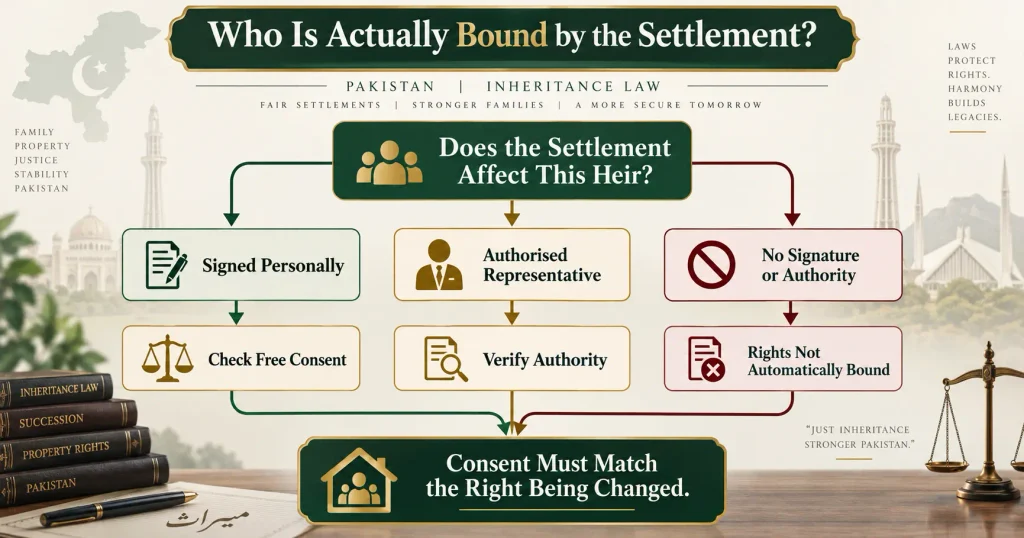
For Family Settlement in Pakistan, the judgment should not be reduced to the slogan that every family member must sign every document.
The legally safer point is narrower: if an arrangement affects an heir’s proprietary or inheritance rights, that heir cannot ordinarily be bound merely because other relatives decided the matter among themselves.
A brother can settle rights he lawfully controls. He cannot simply surrender or redistribute his sister’s share unless lawful authority exists.
This distinction becomes especially important where a woman, elderly person, overseas heir or another family member is said to have been represented by someone else.
Family Settlement in Pakistan: Must It Be Registered?
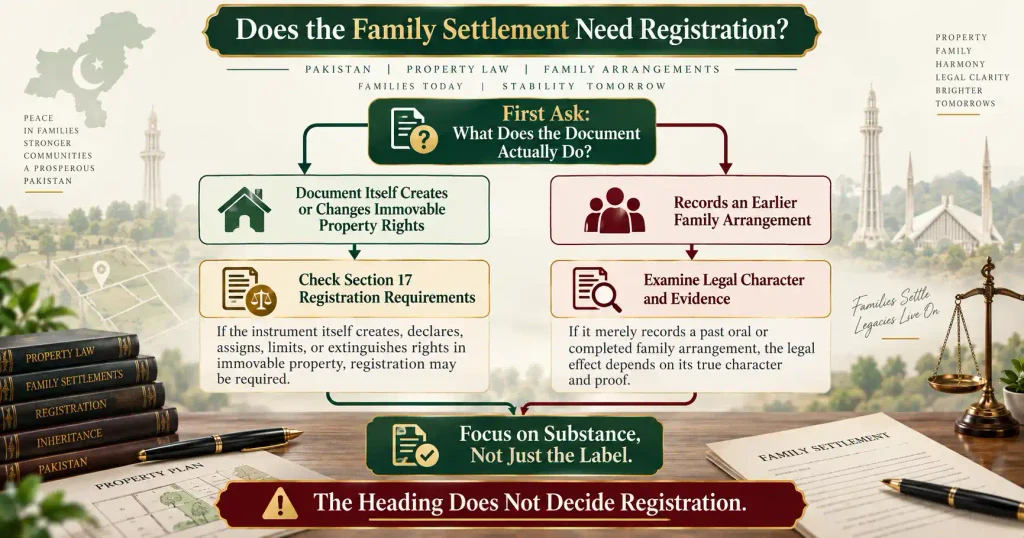
Registration is one of the areas where oversimplified advice creates trouble.
Section 17 of the Registration Act requires registration of certain instruments affecting immovable property. Section 49 states the consequences where a document legally required to be registered has not been registered.
But Family Settlement in Pakistan does not produce one registration answer for every document.
The Supreme Court principle reported by the Lahore High Court Research Centre is that where a family settlement is proved, it does not become invalid merely due to non-registration where it is properly characterised as a family arrangement rather than a regular partition deed.
The practical question is therefore: what does the document itself do?
If an instrument itself creates, declares, assigns, limits or extinguishes an immovable-property right, registration requirements require careful examination. If it merely records an already completed arrangement, the legal analysis may be different.
Do not decide registration merely from the document’s heading.
Why Arbitration Cannot Bind an Unauthorised Heir
For Family Settlement in Pakistan, the 2012 arbitration agreement and award were central to the defence.
The High Court found that the other heirs were neither parties to those agreements nor shown to have consented to them. It therefore rejected the argument that the private settlement had achieved finality against those heirs.
The lesson is practical: if inheritance rights are being submitted to arbitration, identify exactly whose rights are being decided and on what authority every representative acts.
An arbitration decision among three brothers cannot simply become a surrender of a sister’s property right if she did not join or lawfully authorise that process.
Family Settlement in Pakistan and Limitation
The old article stated the limitation point too broadly. In Family Settlement in Pakistan disputes, this distinction matters.
The High Court observed that every heir in an inheritance estate is considered to be in constructive possession on behalf of the legal heirs even where another heir is in exclusive physical possession. It therefore rejected reliance on Articles 142 and 144 of the Limitation Act in the circumstances before it.
However, the same passage expressly recognised that acquiescence and creation of third-party interests may matter.
So it would be unsafe to write:
“Inheritance cases have no limitation.”
That is not the rule.
The better questions are: when was the right denied, what did the claimant know, what conduct followed, was there acquiescence, which relief is being claimed, and have third-party rights arisen?
The Limitation Act, 1908 contains different periods and starting points for different legal remedies. (Pakistan Code)
Family Settlement in Pakistan and Later Purchasers
Family Settlement in Pakistan can become more complex after a sale. This judgment contains an important qualification.
The evidence concerned two properties at Jan Muhammad Road and Liaquat Bazaar that had been sold and mutations entered in favour of later owners. The High Court held that proprietary rights already created in favour of those subsequent owners could not be overturned in the circumstances before it.
The Court therefore did not simply cancel every transaction relating to the estate.
At the same time, it directed that money received by Saleem Kakar should be repaid to the remaining heirs or adjusted from his share.
This is more accurate than calling every later buyer automatically “bona fide.” The judgment protected the identified proprietary interests on the particular record before it.
What the High Court Actually Decided
The High Court dismissed the appeal and substantially maintained the Trial Court’s decree, subject to modification concerning the Garage at Jan Muhammad Road and Sakhi Hotel at Liaquat Bazaar, where later proprietary rights had arisen.
The Court directed that the estate of Malik Ahmed Jan described in the plaint, whether situated at Quetta, Pishin or elsewhere, be partitioned with possession among the legal heirs of both widows according to Sharia, with corresponding mutation.
The result of Family Settlement in Pakistan in this case was therefore broader than simply rejecting an agreement. The Court dealt with inheritance shares, partition, possession, later transfers and adjustment of sale proceeds.
What the Court Did Not Decide
The judgment did not hold that every Family Settlement in Pakistan is invalid unless every relative signs the same paper.
It did not prohibit private partition.
It did not hold that every unregistered family arrangement is void.
It did not say that limitation can never defeat an inheritance claim.
And it did not automatically cancel every later property transfer.
The narrower holding is that the arrangements relied upon in this case could not bind affected heirs whose consent or authority had not been established.
Seven Rules Before a Family Settlement Is Signed
A careful Family Settlement in Pakistan should pass seven checks:
- Identify every legal heir and verify the complete family tree.
- Confirm title and the exact property forming the estate.
- State every affected heir’s agreed share clearly.
- Obtain genuine consent from people whose rights change.
- Verify authority where anyone signs through a representative.
- Check registration, stamp, mutation and local requirements.
- Record possession, rent, payments and sale proceeds.
These checks cannot guarantee that litigation will never occur, but they make the transaction easier to understand and prove.
Evidence for Family Settlement in Pakistan
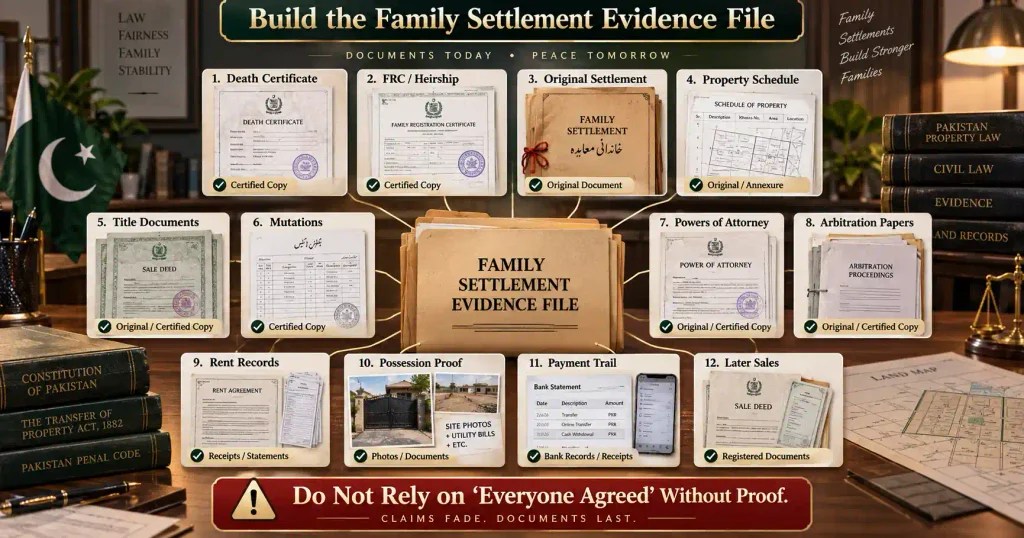
For Family Settlement in Pakistan, preserve the original settlement and all annexures.
Keep death certificates, FRC or other heirship material, original title documents, certified mutations, fard or other revenue record, registration papers, CNIC copies, powers of attorney, witness details, arbitration papers, rent records, bank/payment proof and possession evidence.
The Qanun-e-Shahadat Order, 1984 applies to judicial proceedings and governs how documentary and other evidence is proved. (Pakistan Code)
Official Qanun-e-Shahadat Order, 1984
A phone screenshot can help locate a document, but original and certified records should be preserved wherever available.
Family Settlement in Pakistan: Court and Relief

A dispute may require declaration, partition, separate possession, cancellation of a document, injunction, accounts, mesne profits or correction of a mutation.
Section 42 of the Specific Relief Act, 1877 permits a person claiming a right to property to seek a declaration against someone denying or interested to deny that right. Its proviso is particularly important: a person who can seek further relief should not omit it and ask only for declaration. (Pakistan Code)
Official Specific Relief Act, 1877
Before filing a Family Settlement in Pakistan case, check:
- competent forum and territorial jurisdiction;
- pecuniary jurisdiction where applicable;
- complete property description;
- all necessary heirs and later purchasers;
- limitation and date of knowledge or denial;
- whether cancellation, possession or injunction is also required;
- court fee, signatures, verification and supporting documents.
A revenue entry may require a revenue remedy, while a substantial dispute over civil title, declaration, cancellation or possession may require the competent civil court. Provincial land laws can affect the correct route.
Practical Effect for Families
A good settlement should reduce uncertainty. A bad one merely postpones the dispute.
Before signing, each heir should know the exact property, present title, proposed share, possession position, existing rent, liabilities, previous sales and what legal right is being surrendered or confirmed.
For Family Settlement in Pakistan, transparency is more valuable than speed. A settlement executed quickly can create years of litigation if the family tree is incomplete or consent is merely assumed.
Independent advice becomes particularly useful where an heir is parda-nasheen, dependent, elderly, abroad, illiterate or signing through another person.
Related Property and Inheritance Guides
A Family Settlement in Pakistan often overlaps with partition, female inheritance, old mutations and limitation. For connected issues, read Partition of Inherited Land in Pakistan, Inheritance Law in Pakistan for Women, Limitation in Inheritance Cases in Pakistan and Gift Mutation in Pakistan. These issues can change the correct evidence, forum and remedy even where relatives believed the estate had already been privately settled.
Frequently Asked Questions of 2026 YLR 931
1. What did 2026 YLR 931 decide on family settlements?
The Balochistan High Court held that the arbitration and related agreements before it could not bind heirs who had neither consented nor authorised anyone to act for them. The appeal was dismissed, partition was directed according to Sharia, and specific later proprietary interests were protected.
2. Did the Court cancel every later property transfer?
No. The High Court protected later proprietary rights in two identified properties and required adjustment or repayment of related sale proceeds. This is important because success in an inheritance dispute does not necessarily produce the same remedy against every later transaction.
3. Is Family Settlement in Pakistan legally valid?
Yes. Family Settlement in Pakistan can be legally effective, but its effect depends on consent, authority, property rights, evidence and applicable formalities. A settlement should not be used to determine an heir’s property right when that heir neither agreed nor lawfully authorised someone to act.
4. Can brothers divide inheritance without their sisters?
Brothers may deal with rights they legally control, but they cannot simply decide a sister’s inheritance share among themselves. If her proprietary rights are being compromised or distributed, her consent or valid authority must be established. That was a central issue in 2026 YLR 931.
5. Must every family settlement be registered?
Not automatically. Section 17 of the Registration Act applies to specified instruments affecting immovable-property rights. Pakistani case law also recognises that a proved family arrangement is not invalid merely for non-registration where it is not a regular partition deed. The document’s actual legal effect must therefore be examined.
6. Can arbitration bind an heir who never signed?
Not merely because other family members participated. In this judgment, the High Court found that excluded heirs had neither consented nor delegated authority, so the arbitration and later agreements could not be used to bind their inheritance rights.
7. What evidence should be kept for a settlement?
Keep the original agreement, property schedule, title documents, mutations, heirship record, CNIC copies, authority papers, witness details, possession evidence, rent accounts, arbitration documents, payment proof and later sale records. Certified official copies are particularly useful when originals become disputed.
8. Where can an excluded heir challenge the settlement?
The forum depends on the property and relief. A claimant may require declaration, partition, possession, cancellation, injunction, accounts or revenue correction. Check jurisdiction, limitation, necessary parties and consequential relief before filing rather than assuming one remedy fits every inheritance dispute.
Conclusion
Family Settlement in Pakistan can be one of the safest ways to resolve an inheritance dispute when the right people participate, the property is clearly identified and the agreement is genuinely understood.
The lesson of 2026 YLR 931 is not that families should avoid settlements. It is that a private arrangement cannot become a shortcut for deciding another heir’s property rights behind their back.
Verify the heirs, document consent, check registration and limitation, preserve the evidence and choose the correct legal route before the settlement itself becomes another lawsuit.
Disclaimer
This article is for general legal awareness in Pakistan. Family settlement, inheritance, partition, registration, limitation, revenue procedure and remedies depend on the facts, province, property and documents involved. It is not a substitute for advice from a lawyer who has reviewed the complete record.