
A daughter may be told, “Your father transferred everything during his lifetime, so you have no share.” Sometimes a genuine and completed lifetime transfer may leave less property in the estate. But sometimes the papers hide an unproved gift, fraud, coercion, or a transfer made after a court had already attached the property.
That is why daughter share in father property in Pakistan cannot be answered by one percentage or one mutation entry. First ask: when did the father die, what property remained in his ownership, who were the legal heirs, and was any earlier sale, gift, relinquishment, or mutation legally valid?
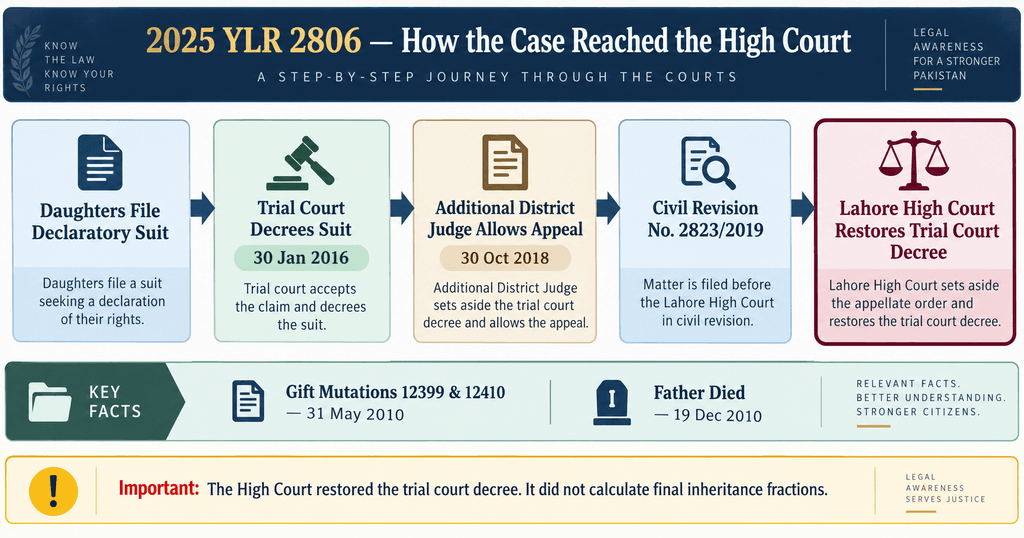
The Lahore High Court judgment reported as 2025 YLR 2806 is important because it shows how timing and court orders can change the result. Two daughters already had a maintenance decree against their father. His land was attached in execution, yet gift mutations were later entered in favour of his second wife and son. The High Court ultimately restored the trial court decree after examining that sequence.
Table of Contents
Judgment at a Glance: 2025 YLR 2806 Lahore
| Point | What the Record Shows |
|---|---|
| Case | Mst. Najma Naz and another v. Mst. Farzana Kanwal and 3 others |
| Court | Lahore High Court |
| Citation | 2025 YLR 2806 |
| Case number | Civil Revision No. 2823 of 2019 |
| Hearing date stated in opening report | 22 October 2024 |
| Main dispute | Gift mutations after attachment, maintenance execution and daughters’ inheritance |
| Gift mutations | Nos. 12399 and 12410 dated 31 May 2010 |
| Father’s death | 19 December 2010 |
| Trial Court | Suit decreed on 30 January 2016 |
| First Appeal | Allowed on 30 October 2018 |
| High Court | Appellate judgment set aside; trial court decree restored; revision accepted |
| Key laws | Family Courts Act 1964, CPC section 64, Specific Relief Act section 42, Punjab Land Revenue Act section 90 |
The reported PDF itself contains an internal date inconsistency. Its opening case line says the matter was heard on 22 October 2024, while a later printed line says 22 October 2025. The opening reported case particulars state 22 October 2024, so that is the date used in this article.
IRAC: Why the Post-Attachment Gifts Failed
| IRAC | Legal Analysis |
|---|---|
| Issue | Could the father transfer land through gift mutations after the executing court had already attached it for enforcement of his daughters’ maintenance decree? |
| Rule | The Family Court can execute its own decree. Section 17 of the Family Courts Act generally excludes the CPC except sections 10 and 11. The High Court further reasoned that even on the CPC argument, section 64 prevents a private transfer after attachment from defeating claims enforceable under that attachment. |
| Analysis | The land was attached on 20 January 2007. Auction was fixed for 26 May 2010. Gift mutations were entered on 31 May 2010, while the attachment remained in force until the execution petition ended on 14 September 2012. |
| Conclusion | The High Court set aside the appellate decree, restored the trial court decree and accepted the civil revision. |
This distinction matters for daughter share in father property in Pakistan. The High Court did not declare every lifetime gift to a wife or son invalid. It dealt with gifts made after judicial attachment in a case involving an existing and enforceable maintenance decree.
What Does a Daughter Inherit From Her Father?
For Muslim parties, section 2 of the West Pakistan Muslim Personal Law (Shariat) Application Act, 1962 makes Muslim Personal Law the rule of decision in questions of succession, whether testate or intestate, subject to other applicable enactments. (Pakistan Code)
Official text: West Pakistan Muslim Personal Law (Shariat) Application Act, 1962 — Pakistan Code
A daughter’s inheritance normally opens on her father’s death. Before death, she does not possess a vested inheritance share merely because she is an expected heir.
For daughter share in father property in Pakistan, identify the estate first, then all legal heirs, and only then calculate the share. The property available for inheritance is not necessarily everything the father once owned during his life.
You must also account for applicable estate liabilities and legally effective transactions. A surviving widow, mother, father, sons, other daughters, and in some cases descendants of a predeceased child can all affect the final distribution.
Daughter Share in Father Property in Pakistan: How Much Does She Get?
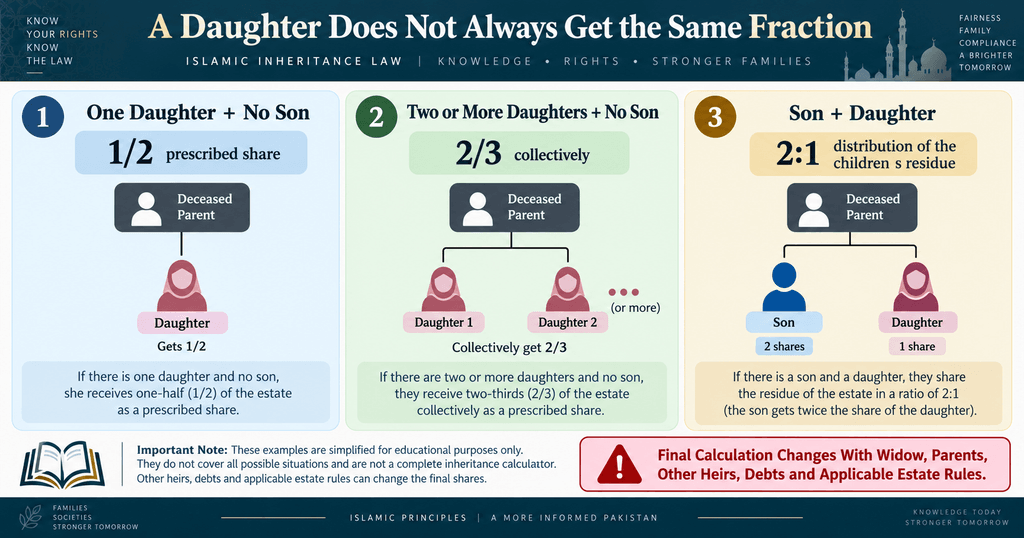
Under Muslim inheritance principles, the basic child-share rules include:
- One daughter and no son: she may take one-half as her prescribed share, subject to the full configuration of heirs.
- Two or more daughters and no son: they may collectively take two-thirds as their prescribed share, subject to the other heirs.
- Sons and daughters together: the children generally take the distributable residue in a 2:1 ratio, with each son receiving twice the portion of each daughter.
- Marriage does not remove a daughter from inheritance.
- Dowry or wedding expenses do not automatically replace inheritance.
The Federal Shariat Court has reproduced the Quranic rule concerning one daughter, multiple daughters, and sons inheriting with daughters. (Federal Shariat Court)
Official judicial source: Federal Shariat Court judgment discussing Quranic inheritance shares
The Supreme Court has also emphasized that property inherited by a woman belongs to her; her husband, father, brother or son does not acquire ownership over it merely because of the family relationship. (Supreme Court of Pakistan)
Official judgment: Supreme Court of Pakistan on women’s ownership and inheritance rights
For daughter share in father property in Pakistan, saying “a daughter always receives half” is therefore inaccurate. The final fraction depends on the complete family tree.
Simple 2:1 Example With One Son and One Daughter
Suppose Rs. 9,000,000 remains for one son and one daughter after prior claims have been dealt with.
Divide that residue into three units:
- Son = two units = Rs. 6,000,000
- Daughter = one unit = Rs. 3,000,000
This illustrates the 2:1 child ratio only. It is not a complete inheritance calculator because the existence of other heirs may change the calculation.
Married Daughter Share in Father Property in Pakistan
A married Muslim daughter does not lose her inheritance merely because she married or moved to her husband’s home.
Her husband’s income, the amount spent on her wedding, dowry given at marriage, or the fact that her brothers lived with and cared for the parents does not by itself extinguish her inheritance.
For daughter share in father property in Pakistan, if relatives say that a daughter already “gave up” her share, inspect the actual transaction.
A family settlement, release, relinquishment, gift, or other instrument must be examined on its own legal validity. A daughter should not sign a blank stamp paper, mutation statement, power of attorney, relinquishment document, or receipt merely because relatives describe it as a “formality.”
What If a Son or Daughter Died Before the Father?
Section 4 of the Muslim Family Laws Ordinance, 1961 deals with an important Pakistan-specific succession issue.
Where a son or daughter of the propositus dies before succession opens, the children of that predeceased son or daughter who are alive when succession opens may receive, per stirpes, a share equivalent to what their parent would have received if alive. (Supreme Court of Pakistan)
Official law: Muslim Family Laws Ordinance, 1961 — Pakistan Code
This can materially affect daughter share in father property in Pakistan. The family tree should therefore include predeceased sons and daughters and their surviving children, rather than listing only those heirs who personally appear before the revenue authorities.
Facts of 2025 YLR 2806: Allegations and Record
The petitioners were daughters of late Mohammad Nawaz. Their father had divorced their mother and contracted a second marriage with Farzana Kanwal.
The daughters alleged that the suit land originally belonged to their father and that the second wife, with assistance from revenue authorities, fraudulently got it transferred to herself and her son Hassan Nawaz through Gift Mutations Nos. 12399 and 12410 dated 31 May 2010.
They also alleged that these mutations were entered during their father’s serious illness. Mohammad Nawaz died on 19 December 2010.
The Trial Court decreed the daughters’ declaratory suit on 30 January 2016. The respondents appealed, and the Additional District Judge allowed the appeal on 30 October 2018. The daughters then filed Civil Revision No. 2823 of 2019.
A legally accurate reading must distinguish allegation from finding. Fraud and serious illness were part of the daughters’ pleaded case. The High Court’s decisive reasoning focused strongly on the maintenance decree, attachment order, execution record, and timing of the gift mutations.
The Maintenance Decree Changed the Property Dispute
Long before the inheritance litigation, the daughters had obtained a maintenance decree against their father. The Family Court directed him to pay maintenance until their marriages, and the decree survived challenge.
The daughters filed execution proceedings on 12 November 2004.
The record before the High Court showed that the father did not appear despite notices, bailable warrants were issued, and the executing court attached his land on 20 January 2007.
The executing court later fixed 26 May 2010 for public auction of the attached land.
The High Court also discussed the court auctioneer’s report, according to which threats and disorder obstructed the auction proceedings. Five days after the scheduled auction date, the disputed gift mutations were entered on 31 May 2010.
For daughter share in father property in Pakistan, this chronology is critical. The land was not simply gifted before an inheritance dispute emerged. It was transferred while a judicial attachment for enforcement of the daughters’ maintenance decree remained operative.
The Timeline Was the Strongest Evidence
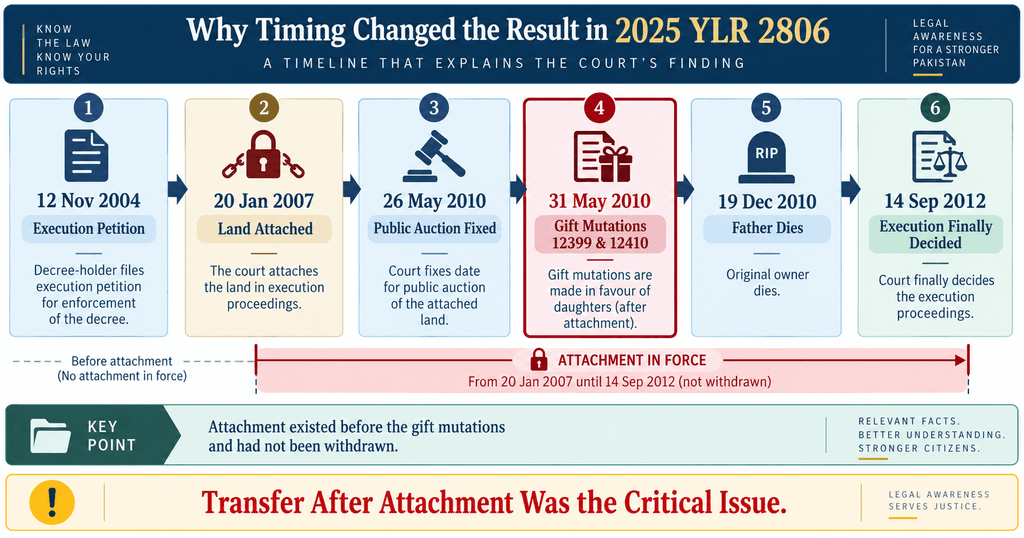
Both sides agreed that the land was under attachment when the gift mutations were entered.
The respondents argued that some maintenance payments had been made and questioned the attachment proceedings. But according to the High Court, they did not specifically identify the alleged irregularity or illegality.
The important dates were:
- 12 November 2004 — execution petition filed.
- 20 January 2007 — suit land attached.
- 26 May 2010 — public auction scheduled.
- 31 May 2010 — Gift Mutations Nos. 12399 and 12410 entered.
- 19 December 2010 — Mohammad Nawaz died.
- 14 September 2012 — execution petition finally decided; the attachment had not previously been withdrawn.
For daughter share in father property in Pakistan, this shows why certified dates can be more important than family explanations.
Obtain the mutation, underlying deed, attachment order, court proceedings, death certificate and later transfer documents before deciding what legal remedy is available.
Section 17 Family Courts Act and Section 64 CPC: An Important Correction
The earlier version of this article made section 64 CPC sound as though it directly and automatically governed Family Court execution. The judgment is more precise.
Section 17 of the Family Courts Act, 1964 generally provides that the Qanun-e-Shahadat and Code of Civil Procedure do not apply to Family Court proceedings, except CPC sections 10 and 11. (Pakistan Code)
Official text: Family Courts Act, 1964 — Pakistan Code
The High Court noted that section 13(3) empowers the Family Court to execute its own decree. It then reasoned that even if the CPC point raised by the respondents were considered, section 64 CPC itself prohibits private alienation after attachment.
Section 64 CPC provides that where attachment has been made, a private transfer or delivery of the attached property or an interest in it is void against claims enforceable under that attachment. (Pakistan Code)
Official law: Code of Civil Procedure, 1908 — Pakistan Code
That is the more accurate rule for this daughter share in father property in Pakistan judgment. It avoids suggesting that every CPC provision automatically applies to Family Courts.
Why the Lahore High Court Scrutinized the Gifts
The High Court concluded that the post-attachment gift transactions were an attempt to frustrate the daughters’ maintenance decree and deprive the minor daughters not only of the decreed maintenance but also of their inheritance.
The Court relied on Amjad Iqbal v. Mst. Nida Sohail and others, PLD 2015 SC 128, where sham Hiba and sale transactions had similarly been used to defeat a minor daughter’s maintenance decree.
The Lahore High Court further observed that the disputed gifts would deprive all the daughters of inheritance and that courts were not powerless to scrutinize the reasons and justification behind such gifts so that injustice was not done.
But this observation must remain tied to the facts.
A genuine and completed lifetime gift is legally different from inheritance. 2025 YLR 2806 does not create a blanket rule that a father can never gift property to one child, his wife, or another person.
That limitation is essential when explaining daughter share in father property in Pakistan.
What the High Court Did—and Did Not—Decide
The High Court found that the appellate court had not properly appreciated the legal position, pleadings and oral/documentary evidence.
It therefore:
- set aside the appellate judgment and decree dated 30 October 2018;
- restored the Trial Court judgment and decree dated 30 January 2016;
- decreed the plaintiffs’ suit; and
- accepted the civil revision.
But the reported judgment did not calculate the final fractional inheritance share of every heir. It did not conduct a complete partition of the estate. It also did not announce that every lifetime gift that disadvantages a daughter is automatically void.
Its practical lesson is narrower and stronger: a later private transfer cannot lawfully be used to defeat subsisting attachment claims, and courts can scrutinize transactions used in such circumstances.
Lifetime Gifts: When Father’s Property Leaves the Estate
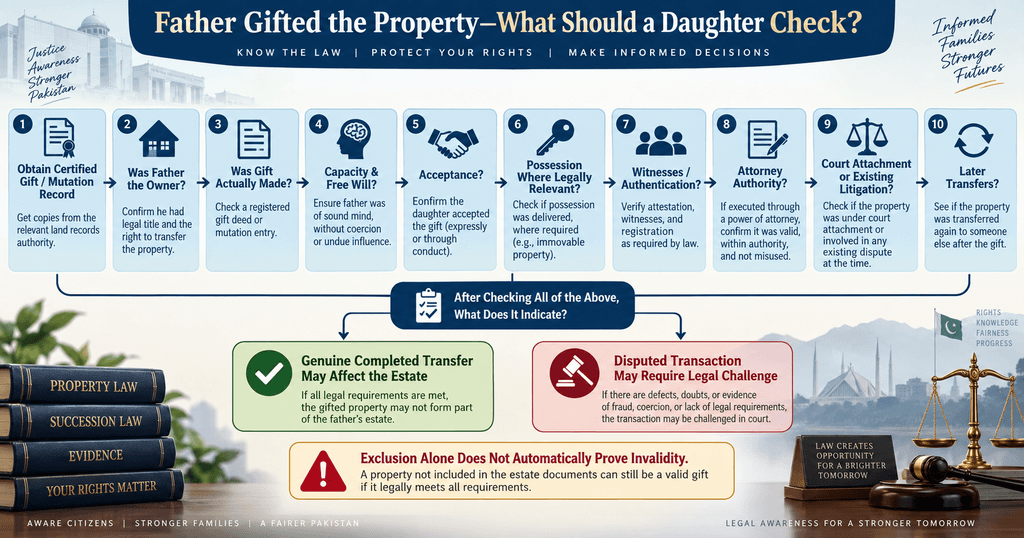
A father can generally deal with property he legally owns during his lifetime, including through a genuine gift, subject to the applicable law.
An expected heir does not automatically become the owner of the father’s property before succession opens.
However, a mutation entry by itself does not prove every disputed element of a gift.
Depending on the facts, a court may need to examine:
- whether the alleged donor actually made the gift;
- his legal capacity and free will;
- acceptance by the donee;
- delivery of possession where legally relevant;
- witnesses and surrounding circumstances;
- genuineness of the deed, signatures or thumb impressions;
- authority of any attorney or representative; and
- the timing of the gift in relation to litigation or attachment.
Where daughter share in father property in Pakistan is denied because relatives say “everything was gifted away,” the correct response is not to assume the gift is valid—or invalid. Obtain certified documents and test the transaction itself.
Read also: Gift Deed Law in Pakistan
Evidence File for a Daughter’s Inheritance Claim
Before filing a case, build one property evidence file. Depending on the dispute, preserve:
- Father’s death certificate.
- CNIC or identity details of relevant heirs.
- Complete family tree and FRC as supporting family information.
- Certified root title document.
- Current and historical fard/jamabandi where applicable.
- Certified inheritance, gift, sale, exchange or other mutations.
- Registered gift deed, hibanama, sale deed, relinquishment deed or power of attorney relied upon by another party.
- Mutation proceedings and statements recorded before revenue authorities.
- Possession, rent, cultivation or payment evidence where relevant.
- Maintenance decree, execution petition, attachment order and auction record where litigation existed.
- Later sale deeds or third-party transfers.
- Medical or capacity evidence only where it genuinely relates to a pleaded challenge.
For daughter share in father property in Pakistan, an FRC can support family identification, but it should not be treated as a substitute for ownership documents or proof of the disputed transaction.
Which Forum Protects Daughter Share in Father Property in Pakistan?
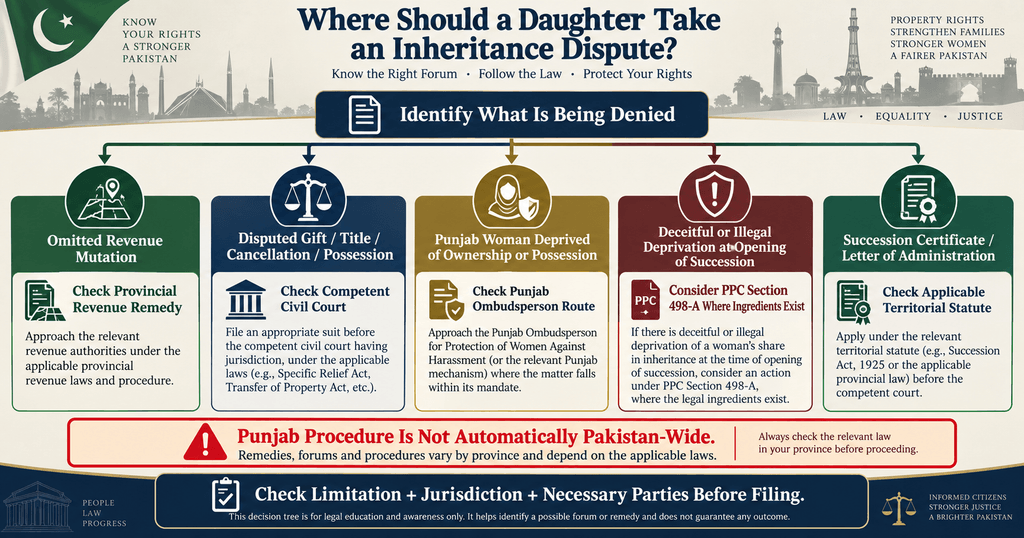
There is no single nationwide office or court for every inheritance dispute.
The correct forum depends on the property, province or territory, nature of the revenue record, possession, disputed instrument, and relief required.
Revenue Route for an Omitted Inheritance Mutation
For revenue-recorded land, inheritance mutation and related correction or partition proceedings may begin before the competent revenue authority under the applicable provincial land-revenue framework.
If a daughter has been omitted, obtain the sanctioned mutation, family/pedigree record and relevant title documents before deciding whether correction, appeal, revision, partition, or civil relief is appropriate.
Punjab has introduced safeguards aimed at protecting female heirs in inheritance mutation and partition proceedings. Official Punjab guidance also recognizes revenue authorities as a route where a woman has been denied inheritance. (Punjab Citizen’s Service Portal)
Official guidance: Punjab Commission on the Status of Women — Inheritance guidance
For succession certificates or letters of administration, check the territorial law rather than assuming one statute applies throughout Pakistan. The federal Letters of Administration and Succession Certificates Act, 2020 expressly extends to Islamabad Capital Territory, while Punjab enacted its own provincial legislation in 2021. (Pakistan Code)
Official federal law: Letters of Administration and Succession Certificates Act, 2020 — Pakistan Code
Civil Court for Disputed Gifts, Title or Possession
Civil proceedings may be necessary where the real controversy concerns:
- declaration of ownership;
- a disputed gift or sale instrument;
- cancellation or setting aside of a document;
- possession;
- permanent or temporary injunction;
- partition; or
- competing claims to title.
The prayer clause must match the actual legal problem.
For daughter share in father property in Pakistan, do not copy a prayer clause from another inheritance case. Identify the transaction blocking the daughter’s share, who is in possession, whether property has passed to later purchasers, which parties are necessary, whether consequential relief is required, and which limitation provision may apply.
Read also: Property Dispute Law in Pakistan
Punjab Ombudsperson for Women’s Property Deprivation
Punjab provides another important route.
Under the Punjab Enforcement of Women’s Property Rights Act, 2021, a woman deprived of ownership or possession through harassment, coercion, force or fraud may use the statutory Ombudsperson mechanism.
Official Punjab guidance says an aggrieved woman may make a complaint to the Ombudsperson Punjab. The process may include a preliminary inquiry and, where required, a report from the Deputy Commissioner of the district where the property is situated. (Punjab Citizen’s Service Portal)
Official Punjab source: Punjab Enforcement of Women Property Right Act, 2021 — PCSW
This is a Punjab-specific mechanism. It should not be described as automatically applicable throughout Pakistan.
PPC Section 498-A When Deprivation Is Deceitful or Illegal
There may also be a criminal-law dimension.
Section 498-A of the Pakistan Penal Code criminalizes depriving a woman, by deceitful or illegal means, from inheriting movable or immovable property at the time succession opens.
The current official text provides punishment of imprisonment that may extend to ten years but shall not be less than five years, or a fine of one million rupees, or both. (Pakistan Code)
Official law: Pakistan Penal Code, 1860 — Section 498-A
However, a denied daughter share in father property in Pakistan does not automatically convert every family property disagreement into a criminal offence. The ingredients of section 498-A must actually be present.
Likewise, an FIR or criminal case does not automatically establish civil title, cancel a deed, correct a mutation, deliver possession, or partition property. The civil, revenue and criminal questions must be kept legally separate.
Limitation: Do Not Rely on “There Is No Time Limit”
A common and dangerous statement in inheritance disputes is: “Inheritance cases have no limitation.”
The actual legal position is more fact-sensitive.
The Limitation Act, 1908 contains specific limitation periods for some remedies. For example, Article 91 concerns cancellation or setting aside of an instrument and ties the starting point to knowledge of the facts entitling the plaintiff to relief. Article 95 deals with relief based on fraud and also refers to when the fraud becomes known. (Pakistan Code)
Official law: Limitation Act, 1908 — Pakistan Code
But an inheritance dispute may also involve possession, co-sharership, denial, ouster, mutation, fraud, a registered instrument, or another cause of action. Those facts can materially affect limitation analysis.
Anyone pursuing daughter share in father property in Pakistan should therefore record when the disputed transfer first became known, obtain certified documents promptly, and identify the limitation article connected with the actual relief being claimed.
Common Mistakes in Daughter Share in Father Property in Pakistan Claims
Do not sign relinquishment papers without independent legal advice. Do not rely only on a verbal promise that “your brothers will pay you later.”
Do not assume that mutation is final proof of title—but equally, do not assume that every mutation is automatically invalid.
Do not start criminal proceedings merely to pressure relatives where the real dispute is about civil title. Do not omit later purchasers or other necessary parties. Do not calculate a fixed inheritance percentage without preparing the complete family tree.
The strongest daughter share in father property in Pakistan claim is built on certified evidence, correct jurisdiction, proper pleadings, and a remedy that matches the actual defect.
7 Steps to Protect Daughter Share in Father Property in Pakistan
- Confirm the death and heirs: Note the father’s death date and prepare the complete family tree, including predeceased children and their descendants.
- Identify the estate: Find the assets that were legally owned by the father when succession opened.
- Get certified records: Obtain title documents, mutations, registered instruments, and relevant court orders.
- Calculate after identifying all heirs: Do not apply a 1/2 or 2:1 formula before completing the heir structure.
- Investigate lifetime transfers: If property was gifted or sold before death, examine the transaction instead of assuming it valid or invalid.
- Choose the correct forum: Revenue, civil court, Punjab Ombudsperson, or criminal law may be relevant depending on the facts.
- Check before filing: Review limitation, possession, necessary parties, jurisdiction and consequential relief.
These steps turn daughter share in father property in Pakistan from a family argument into a document-based legal issue.
8 FAQs on Daughter Inheritance Rights
1. What did 2025 YLR 2806 establish about gifts made after attachment?
It did not invalidate all lifetime gifts. The Lahore High Court dealt with land that had already been attached for enforcement of a maintenance decree before the gift mutations were entered. The Court restored the trial court decree and treated the post-attachment transfers as an attempt to defeat enforceable rights. The chronology of attachment, execution and transfer was critical.
2. Did the High Court calculate the daughters’ final inheritance percentages?
No. The reported judgment did not conduct a complete inheritance calculation or partition among all legal heirs. It dealt with the effect of the disputed post-attachment gift transactions and restored the declaratory decree. Final daughter share in father property in Pakistan still depends on the complete estate and all relevant heirs.
3. What is a daughter’s share if there is one son and one daughter?
Where one son and one daughter inherit together as children/residuaries, the son generally receives twice the daughter’s portion from the distributable residue—a 2:1 ratio. Other fixed heirs and lawful estate liabilities must first be considered. Therefore, the ratio should not simply be applied to the gross value of the father’s entire property.
4. Does a married daughter lose inheritance from her father?
No. Marriage does not remove a daughter from her father’s heirs. Dowry, wedding expenses, or living with her husband do not automatically cancel inheritance. Any alleged release, settlement, gift or relinquishment should be examined as a separate legal transaction rather than accepted merely because relatives say she already received enough.
5. Can a father give all his property to one son while he is alive?
A father may make a genuine lifetime disposition of property he legally owns, subject to applicable law. But a disputed gift is not proved merely by showing a mutation entry. Capacity, free will, acceptance, possession where legally relevant, supporting documents and timing may require proof. An existing court attachment creates an additional legal restriction.
6. Can brothers leave their sister out of an inheritance mutation?
A daughter is a legal heir and should not be omitted merely because male relatives control the record. She should obtain the death record, complete heir information, certified ownership documents and mutation record, then pursue the competent revenue or civil remedy. In Punjab, the statutory women’s property-rights mechanism may also be relevant.
7. Which documents should a daughter collect before filing a property case?
Start with the death certificate, complete heir information, certified root title, current and historical land record, inheritance mutation, and any disputed gift, sale or relinquishment instrument. If earlier litigation existed, obtain certified court orders too. These documents establish what the father owned, what changed, when it changed, and which remedy may be required.
8. Can a daughter use section 498-A PPC and also pursue her property claim?
Potentially, yes, if the facts independently satisfy the requirements of each remedy. Section 498-A concerns deceitful or illegal deprivation of a woman’s inheritance when succession opens. A separate civil or revenue remedy may still be required to establish title, correct records, obtain possession or partition the property. One route does not automatically replace another.
Conclusion: Find the Estate Before Calculating the Share
Daughter share in father property in Pakistan begins with the estate and complete family tree, not one fixed percentage. A disputed lifetime transfer must be examined through its documents, timing, legal requirements and surrounding circumstances.
2025 YLR 2806 adds an important warning. Here, the property had been attached years before the gift mutations, and the Lahore High Court restored the daughters’ decree after examining the maintenance execution and transfer timeline.
The next lawful step is practical: obtain certified records, identify the transaction blocking the inheritance, check limitation and jurisdiction, and select the correct remedy. A daughter should not surrender a legal right because of family pressure, but no court result should be assumed before the evidence is examined.
Legal Note for Daughter Inheritance Disputes
This article is for general legal awareness and is not case-specific legal advice. Inheritance shares, limitation, forum, evidence and remedies depend on personal law, jurisdiction, title documents, possession, family tree, earlier transactions and litigation history. No particular outcome is guaranteed.