
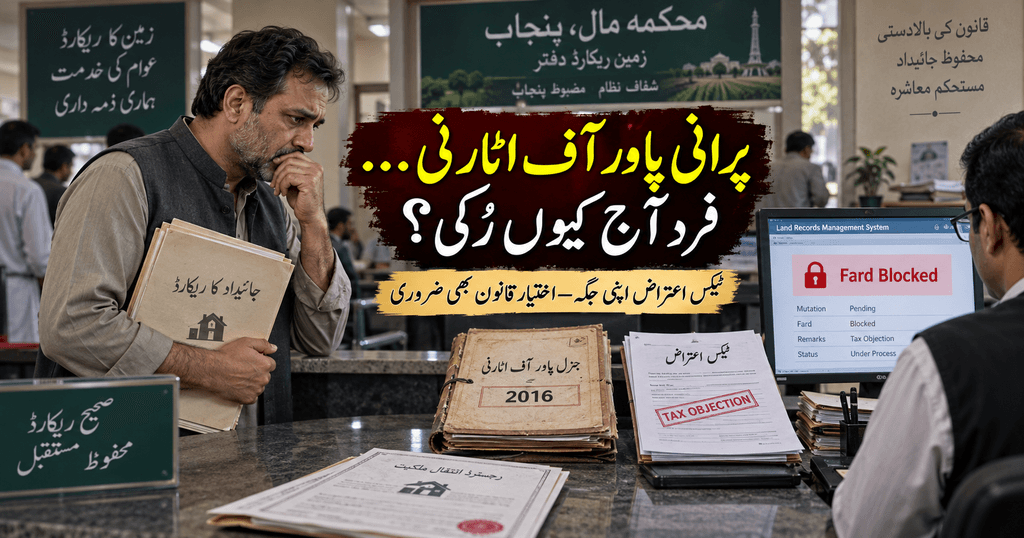
A registered owner may have a valid deed and mutation in his name, yet an old tax objection can still block the next property transaction. That is what happened in Ghazanfar Amin v. Province of Punjab and others, reported as 2025 CLC 1961 by the Lahore High Court, Bahawalpur Bench.
The judgment gives a careful answer about CVT on Power of Attorney in Pakistan. The Court did not declare every old CVT demand invalid or every General Power of Attorney tax-free. It held that, under the old Punjab regime, CVT was linked with acquisition of immovable property through a power of attorney. Tax recovery also had to follow the statute. A Sub-Registrar could not create a separate punishment by stopping Fard Malkiat without lawful authority.
Table of Contents
Judgment at a Glance: Ghazanfar Amin v. Province of Punjab
| Point | Details |
|---|---|
| Case | Ghazanfar Amin v. Province of Punjab and others |
| Citation | 2025 CLC 1961 |
| Court | Lahore High Court, Bahawalpur Bench |
| Judge | Tariq Saleem Sheikh, J. |
| Petition | Writ Petition No. 7027 of 2022 |
| Date heard | 26 October 2023 |
| GPA | Dated 22 June 2016; registered 28 June 2016 |
| Later title | Exchange Deed No. 554 dated 20 February 2020 |
| Alleged unpaid CVT | Rs. 25,024,000 |
| Main law | Section 6, Punjab Finance Act, 2010 as substituted in 2012 |
| Result | Fard restriction declared without lawful authority |
| What remained open | Lawful recovery from the person liable, subject to law |
The case did not involve a GPA executed in the petitioner’s favour. Respondent No. 4 had appointed Respondent No. 5 as attorney in 2016. The petitioner later obtained the property through a separate registered exchange transaction. That factual distinction is central to the judgment.
IRAC: Why the Petitioner Obtained Relief
| IRAC | Explanation |
|---|---|
| Issue | Could Fard Malkiat be refused because CVT was allegedly unpaid on an earlier General Power of Attorney? |
| Rule | Under the then-applicable section 6, CVT concerned acquisition of immovable property through specified modes. Assessment and recovery had to follow the statutory procedure. |
| Analysis | The petitioner acquired the land through a separate registered Exchange Deed personally executed by the owner, not through the old GPA. No Collector assessment order was shown, and no provision was identified allowing the Sub-Registrar to block Fard Malkiat. |
| Conclusion | The High Court allowed the petition and removed the Fard restriction, while preserving any lawful recovery against the person actually liable. |
For CVT on Power of Attorney in Pakistan, the IRAC shows why the Court separated possible tax liability from the legality of blocking Fard Malkiat.
Why CVT on Power of Attorney in Pakistan Matters for Property Owners
The value of 2025 CLC 1961 is that it separates three different questions: whether a tax liability existed, how that liability could lawfully be recovered, and whether officials had power to stop a land-record service.
For people searching CVT on Power of Attorney in Pakistan, this distinction is essential. Even if a tax objection exists, an authority still needs a legal basis for the action it takes. An audit objection does not automatically authorize every administrative restriction.
The judgment also shows why the real transaction matters. A GPA may be part of an old property record, while the present owner may have acquired title through a completely different registered instrument.
How the 2016 GPA Became a Fard Malkiat Dispute
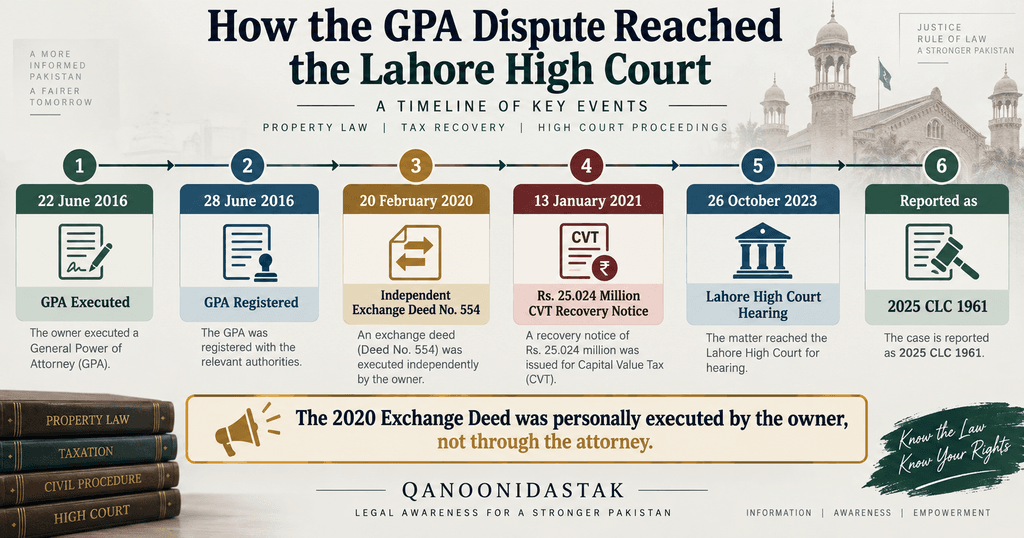
Muhammad Rizwan Sohail owned 46 kanals in Chak No. 13/G, Tehsil Chishtian, District Bahawalnagar. He appointed Nauraiz Asif as his General Attorney through a GPA dated 22 June 2016, which was registered on 28 June 2016.
Asif Rasheed owned another two kanals in the same area. On 20 February 2020, the two owners exchanged a total of 48 kanals with 48 kanals of agricultural land belonging to petitioner Ghazanfar Amin. The transaction was recorded through registered Exchange Deed No. 554.
The critical fact was that Muhammad Rizwan Sohail personally executed the Exchange Deed. The 2016 attorney did not execute it. The petitioner became owner of the 48 kanals and the land was mutated in his favour.
The property was later used for the Mubarak Town housing scheme. When the petitioner needed Fard Malkiat so that plots could be transferred to purchasers, the Halqa Patwari refused to issue it. The reason given was an audit objection alleging that Rs. 25,024,000 in CVT had not been paid on the old GPA. The Sub-Registrar had also issued a recovery notice dated 13 January 2021 to the earlier owner.
That is how CVT on Power of Attorney in Pakistan moved from an old tax issue into a direct obstacle for a later registered owner.
What the Parties Argued Before the High Court
Petitioner: The Old GPA Did Not Create My Title
The petitioner argued that his ownership came from the registered Exchange Deed dated 20 February 2020, not from the old General Power of Attorney. He also argued that the CVT notice was time-barred because more than the permitted period had passed.
His core position was straightforward: an alleged tax default connected with an earlier GPA could not lawfully be used to deny him Fard Malkiat when his title arose from an independent registered transaction.
Government: The CVT Demand Was Enforceable
The Assistant Advocate General first challenged maintainability, arguing that the petitioner was not an “aggrieved party” for Article 199 purposes.
On merits, the government contended that the notice was lawful and relied upon Supreme Court authority concerning CVT on powers of attorney executed in favour of strangers. The government side also sought to justify the restriction by referring to section 80 of the Punjab Land Revenue Act, 1967.
The High Court therefore had to examine both the old charging provision and the legal power claimed for stopping the Fard. That distinction shaped the Court’s treatment of CVT on Power of Attorney in Pakistan.
Which Documents Mattered Most in CVT on Power of Attorney in Pakistan
The Court’s reasoning turned on the transaction record rather than one isolated document. Important material included the registered 2016 GPA, the 2020 Exchange Deed, mutation in the petitioner’s favour, the audit objection and the January 2021 recovery notice.
Another serious point concerned the assessment process. The Court noted that the petitioner and Respondent No. 5, who were necessary parties for the relevant proceedings, had not been engaged or given an opportunity of hearing. A valid Collector assessment order was also absent from the record relied upon for recovery.
For any dispute involving CVT on Power of Attorney in Pakistan, do not examine the GPA alone. Read it together with the later deed, mutation, tax notice, assessment order, proof of service, hearing record and any injunction or attachment order.
The Old Punjab Rule Behind CVT on Power of Attorney in Pakistan
The case concerned section 6 of the Punjab Finance Act, 2010, as substituted through the 2012 legislation. Under the version relevant to the case, section 6(3) referred to a person who acquired immovable property through purchase, gift, exchange, power of attorney, surrender, relinquishment or certain long-term rights of use.
The important word was “acquires.”
The judgment also recorded an essential part of the legislative history: the Punjab CVT regime under section 6 was later abolished with effect from 1 July 2017. The official Punjab Gazette for the Punjab Finance Act, 2017 expressly states that section 6 of the Punjab Finance Act, 2010 was to be omitted.
Official Punjab Finance Act 2017 — Punjab Gazette copy
That history prevents a major legal mistake. This judgment dealt with an historical liability linked to a 2016 instrument. It should not be read as creating a fresh 2026 CVT charge on every GPA.
Why CVT on Power of Attorney in Pakistan Was Not Automatic for Every GPA
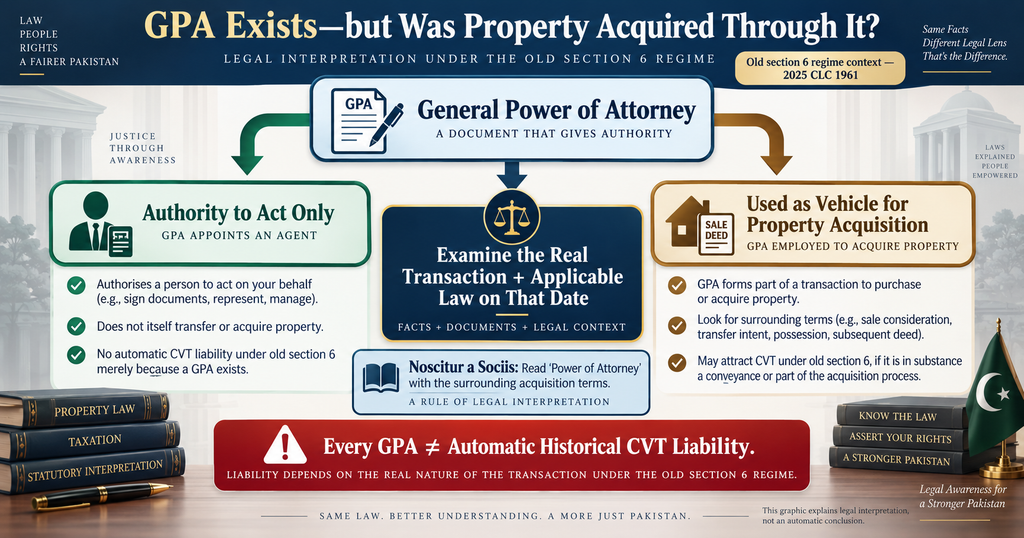
The High Court applied the interpretive principle noscitur a sociis. In simple words, where the meaning of a word is uncertain, its meaning can be understood from the words with which the legislature placed it.
In section 6(3), “power of attorney” appeared alongside purchase, gift, exchange, surrender, relinquishment and lease-related acquisition. Those expressions shared the context of acquiring or enjoying property rights.
The Court therefore concluded that CVT on Power of Attorney in Pakistan under the old provision was not automatically chargeable merely because a GPA existed. The relevant question was whether the person had acquired immovable property through that power of attorney.
The judgment went further and expressly observed that CVT might not be chargeable on every power of attorney and that a person was entitled to show why liability did not arise in a particular case.
This is narrower than saying “every GPA is exempt from CVT.” The correct rule is that the charging language and the actual transaction must fit.
The Court also relied on the established principle that fiscal legislation imposing a charge must be construed from clear statutory words. A tax cannot be created through assumption or by stretching a charging provision beyond its language.
Why Recovery of CVT on Power of Attorney in Pakistan Was Legally Questionable
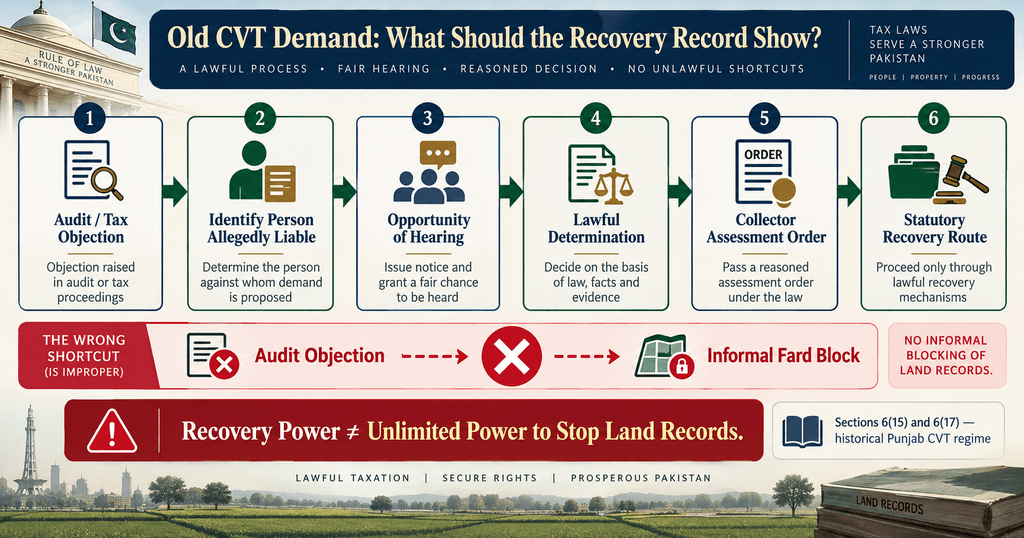
The Court did not stop after interpreting the charging provision. It also examined the machinery for assessment and recovery.
Relying on Abdul Hameed v. Province of Punjab and others, 2022 CLC 1083, the judgment explained that a CVT deficiency required lawful determination after hearing affected persons. A proper assessment order by the Collector under section 6(15) was also material.
In Ghazanfar Amin’s case, the petitioner and another necessary party had not been given an opportunity of hearing, while the Collector’s assessment order was missing. The Court held that these deficiencies cast serious doubt on the legality of the recovery proceedings.
Section 6(17) contained a separate recovery mechanism. Where tax had not been collected from the person liable, the amount could be recovered from that person as arrears of land revenue by following the Punjab Land Revenue Act, 1967.
This distinction is central to CVT on Power of Attorney in Pakistan: a statutory power to recover tax is not automatically a statutory power to block every service connected with the land.
Punjab Land Revenue Act, 1967 — official Punjab land-record source
Why CVT on Power of Attorney in Pakistan Could Not Justify This Fard Block
The government side could not identify a legal provision empowering the Sub-Registrar to prohibit issuance of Fard Malkiat merely because the old CVT objection remained outstanding.
The High Court also noted that there was no injunction or attachment order from a court or competent authority authorizing that restriction. It therefore declared the Sub-Registrar’s action unsustainable and without lawful authority.
That does not mean Fard Malkiat can never lawfully be restricted. An attachment order, injunction, statutory prohibition or other competent legal order may change the position.
The practical lesson from CVT on Power of Attorney in Pakistan is to ask one precise question whenever Fard is refused: what exact law, order or statutory power authorizes the refusal?
The Limitation Question in CVT on Power of Attorney in Pakistan
The petitioner relied on section 6(16), which provided a five-year limit for exercise of the specified audit and assessment powers. He argued that the 2021 notice concerning the 2016 GPA should therefore be struck down.
But the High Court did not finally decide that question.
The notice had been issued to Respondent No. 4 rather than the petitioner. Justice Tariq Saleem Sheikh observed that limitation could more appropriately be considered in proceedings brought by Respondent No. 4 if he chose to challenge that notice.
Therefore, it would be legally inaccurate to write that 2025 CLC 1961 declared the Rs. 25,024,000 CVT demand time-barred. It did not.
What the Court Decided—and What It Left Open
The Lahore High Court allowed the constitutional petition and declared the restriction on Fard Malkiat without lawful authority. The Court also held that the petitioner qualified as an aggrieved party because refusal of the Fard directly interfered with enjoyment of property registered in his name.
However, the judgment did not hold that every GPA was exempt from tax. It did not cancel every historical CVT liability, and it did not finally decide the limitation objection concerning Respondent No. 4’s notice.
Most importantly, the final paragraph expressly preserved the authorities’ ability, subject to law, to pursue allegedly unpaid CVT from the persons responsible for paying it.
This is the correct way to understand CVT on Power of Attorney in Pakistan after 2025 CLC 1961: the petitioner obtained relief against an unlawful Fard restriction, not a universal declaration that no historical CVT could be recovered.
CVT on Power of Attorney in Pakistan in 2026: Old Tax vs Current Stamp Duty
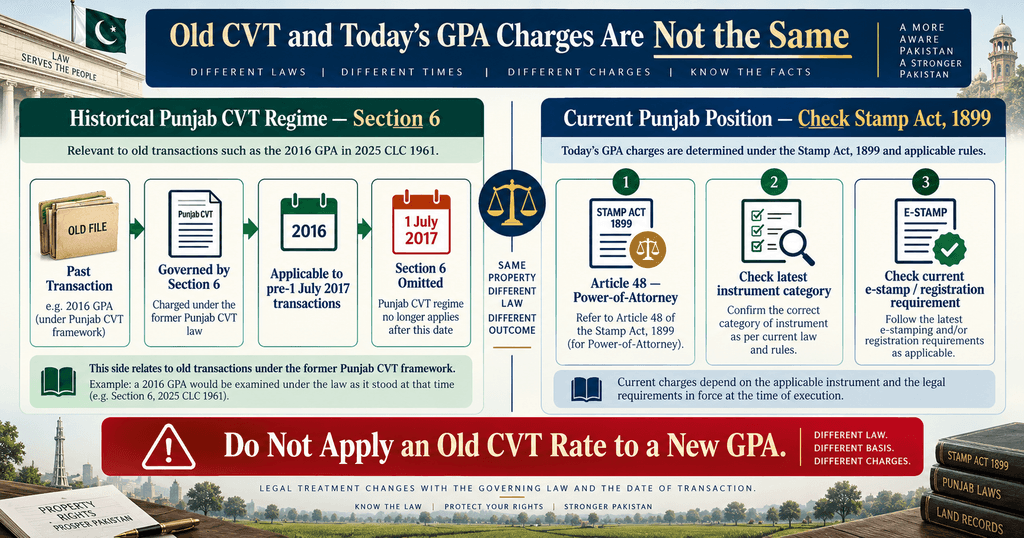
For a current Punjab property transaction, the historical CVT discussed in this judgment must be separated from present stamp duty.
The Punjab Finance Act, 2017 omitted section 6 of the Punjab Finance Act, 2010 with effect from 1 July 2017. Therefore, that specific provincial CVT charging regime is no longer the current section governing a new power of attorney. Historical liabilities arising while the old provision operated may, however, still produce disputes that must be resolved under the law applicable to them.
Powers of attorney remain separately relevant under the Stamp Act, 1899. The official Punjab Land Records Authority copy of the Stamp Act contains Article 48 — Power-of-Attorney, with the duty depending on the type and substance of the instrument.
Official Punjab Stamp Act, 1899 — PLRA copy
Because stamp provisions and rates can be amended, do not copy an old percentage from a judgment or an old deed. Confirm the current official schedule and e-stamp requirement on the actual execution date.
A person researching CVT on Power of Attorney in Pakistan in 2026 therefore needs to ask two separate questions: does an historical CVT liability survive from the period in which the old law applied, and what current stamp duty or registration requirement applies to the proposed GPA?
That is why CVT on Power of Attorney in Pakistan must always be researched by transaction date rather than by copying an old rate or repealed provision.
Does a GPA Transfer Ownership by Itself?
A General Power of Attorney normally authorizes another person to act for the principal. It should not automatically be treated as a conveyance simply because it concerns property.
The Lahore High Court itself discussed the difference between conventional registered transfers and practices in which transfer letters, agreements to sell or powers of attorney are sometimes used as substitutes for formal conveyancing.
The Registration Act, 1908 requires registration for specified instruments that create, declare, assign, limit or extinguish rights in immovable property. The actual substance and legal effect of the transaction therefore matter more than the label placed on a document.
This is why CVT on Power of Attorney in Pakistan cannot be understood by treating every GPA as if it were a registered sale deed.
Registration Act, 1908 — official Pakistan Code copy
For related Qanooni Dastak reading, see Power of Attorney Law in Pakistan and General Power of Attorney in Pakistan.
Documents to Preserve Before Challenging a CVT or Fard Objection

Before approaching any authority or court, build one chronological property file. Preserve:
- complete General or Special Power of Attorney;
- registration endorsement, document number, book and volume details;
- root title and later registered sale, gift or exchange deed;
- mutation and current Fard Malkiat;
- audit objection and tax demand notice;
- Collector’s assessment order, if one exists;
- proof of service and opportunity of hearing;
- tax challans or other payment record;
- any injunction, attachment or stay order;
- written application for Fard and written refusal or computerized objection; and
- correspondence with the Sub-Registrar, revenue office or Arazi Record Centre.
Dates are especially important in CVT on Power of Attorney in Pakistan because the applicable law may depend on when the GPA, acquisition, assessment and recovery steps occurred.
A photocopy of one document may not tell the complete story. Certified copies and the registration/revenue chain are far safer where authenticity or chronology is disputed.
Where to Challenge a Refusal Linked to CVT on Power of Attorney in Pakistan
Start by identifying who refused the Fard and why. Ask for written reasons and the exact legal provision, assessment order, attachment or other authority being relied upon.
Where the refusal concerns a Punjab land-record service, the relevant PLRA service or complaint channel may be used depending on the nature of the issue. The Punjab Land Records Authority also publishes official land laws and regulatory material for citizens.
Punjab Land Records Authority — official portal
Where a formal revenue order has already been passed, check whether the applicable statute provides an appeal, review or revision. Under the old section 6 framework reproduced in the judgment, certain orders were treated as Revenue Officer orders for appeal, review and revision purposes.
A constitutional petition under Article 199 may be available where an authority acts without lawful authority and the constitutional requirements are satisfied. But 2025 CLC 1961 does not mean that every Fard dispute belongs directly in the Lahore High Court.
Before filing, check limitation, territorial jurisdiction, subject-matter jurisdiction, necessary parties, the precise impugned action and the availability of an adequate alternate remedy. In a CVT on Power of Attorney in Pakistan dispute, the correct forum may differ depending on whether the real challenge concerns tax assessment, tax recovery or refusal of a land-record service.
Mistakes to Avoid in an Old CVT Dispute
A legally sound claim can become weak if the wrong proposition is pleaded. Avoid assuming that repeal automatically erased every liability that arose before repeal. Also avoid saying that the Lahore High Court cancelled the Rs. 25.024 million demand; the judgment did not do so.
Do not confuse current stamp duty with the historical CVT regime, litigate without obtaining the notice and assessment record, rely on mutation while ignoring the underlying registered instrument, or choose a forum before identifying the order actually affecting your rights.
For CVT on Power of Attorney in Pakistan, the safest sequence is: date first, transaction second, liable person third, authority fourth, remedy fifth.
Conclusion: Tax Recovery and Fard Restriction Are Different Questions
2025 CLC 1961 is not a blanket tax exemption. It is an important judgment about statutory interpretation, procedural fairness and limits on administrative power.
The Lahore High Court held that CVT on Power of Attorney in Pakistan under the old regime did not automatically attach to every General Power of Attorney. The relevant question was whether immovable property had actually been acquired through that instrument. In Ghazanfar Amin’s case, the petitioner acquired title through an independent registered Exchange Deed.
The authorities also failed to show lawful power for blocking his Fard Malkiat. The Court therefore removed that restriction while expressly preserving any lawful recovery that might be pursued against the person actually responsible.
For present-day transactions, check the current Punjab Stamp Act, registration requirements and official e-stamp position rather than treating the repealed section 6 CVT regime as today’s law.
Disclaimer
This article is for legal awareness and educational purposes only. It does not create a lawyer-client relationship and does not guarantee any result. Property, tax and revenue disputes depend on their facts, dates, documents, jurisdiction and the law applicable at the relevant time. Obtain current official records and case-specific professional advice before filing proceedings, executing a document or making payment.
FAQs About CVT, GPA and Fard Malkiat
1. Is CVT payable on every General Power of Attorney in Pakistan?
No. Under the old Punjab regime considered in 2025 CLC 1961, the Lahore High Court held that CVT was not necessarily chargeable on every GPA. The important question was whether immovable property had actually been acquired through the power of attorney. For a present-day transaction, current stamp duty and registration requirements should be checked separately.
2. Did 2025 CLC 1961 cancel the Rs. 25,024,000 CVT demand?
No. The Court struck down the restriction placed on the petitioner’s Fard Malkiat. It expressly left open lawful recovery of allegedly unpaid CVT from the person responsible, subject to law. The Court also did not finally decide the limitation challenge relating to the notice issued to Respondent No. 4.
3. Can a Sub-Registrar stop Fard Malkiat because of old unpaid CVT?
Not merely on the basis of an audit objection without lawful authority. In this case, no provision was shown empowering the Sub-Registrar to block Fard Malkiat, and no injunction or attachment order supported the restriction. A valid statutory prohibition or competent court or authority order may lead to a different result.
4. Is CVT on Power of Attorney in Pakistan still in force in Punjab in 2026?
The specific section 6 Punjab CVT regime discussed in 2025 CLC 1961 was omitted with effect from 1 July 2017. Historical liabilities can still generate disputes. Current powers of attorney remain subject to applicable stamp and registration law, including Article 48 of the Punjab Stamp Act compilation.
5. Does a General Power of Attorney transfer ownership by itself?
Generally, a GPA authorizes another person to act for the principal; it is not automatically a conveyance of ownership. If an instrument creates or transfers rights in immovable property, registration, stamp duty and substantive property law become important. Courts examine the actual wording, purpose and effect of the transaction rather than relying only on its title.
6. What documents should I keep in a CVT on Power of Attorney in Pakistan dispute?
Preserve the GPA, registration endorsement, root title, later registered transfer deed, mutation, current Fard, audit objection, tax notice, assessment order, payment challans, proof of service, hearing record and any injunction or attachment order. A clear chronological file helps establish whether the historical tax objection is legally connected with the present owner.
7. What should I do if the land record office refuses to issue my Fard?
Ask for written reasons and the exact provision or order relied upon. Obtain your registered title documents, mutation, tax notices and assessment record. Depending on the dispute, use the relevant PLRA or revenue remedy and check available appeal, review or revision procedures before choosing constitutional litigation.
8. Can I directly file a writ petition in the Lahore High Court over a Fard dispute?
Not automatically. Article 199 jurisdiction depends on legal standing, the nature of the impugned action and whether an adequate alternate remedy exists. In 2025 CLC 1961, the petitioner qualified as an aggrieved party because the restriction directly affected enjoyment of property registered in his name. Other cases may require a different statutory forum.