

A workplace should never force a person to choose between dignity and livelihood. Yet harassment can be hard to report when the accused can influence work, study, pay, promotion, training, or professional opportunity.
The Protection Against Harassment of Women at Workplace Act 2010 created a formal legal framework for complaints, inquiries, penalties, appeals, employer duties, and the Ombudsperson. Today, however, the law must be read carefully. The federal statute was widened in 2022, while Punjab has an adapted provincial text with its own amendments. A correct complaint begins by identifying the law and forum that actually apply.
This guide explains the Protection Against Harassment of Women at Workplace Act 2010 and PLD 2025 Lahore 759. That judgment did not decide an employee’s harassment claim; it dealt with the tenure, independence, and lawful removal of the Punjab Ombudsperson.
Table of Contents
Judgment at a Glance of PLD 2025 Lahore 759
| Point | Detail |
|---|---|
| Case | Nabila Hakim Ali Khan v. Government of the Punjab and others |
| Citation | PLD 2025 Lahore 759 |
| Court | Lahore High Court |
| Judge | Raheel Kamran, J. |
| Petition | Writ Petition No. 51439 of 2023 |
| Decision | 12 June 2025 |
| Main statute | Protection Against Harassment of Women at Workplace Act 2010 |
| Main issue | Removal of the Punjab Ombudsperson before fixed tenure ended |
| Result | De-notification declared null and void; petition allowed |
A later Punjab amendment fixed the Ombudsperson’s tenure at four years and barred extension or re-appointment. The Lahore High Court held that the four-year term applied while the petitioner was still serving.
IRAC Summary of PLD 2025 Lahore 759
| IRAC | Explanation |
|---|---|
| Issue | Could the Caretaker Government, with ECP involvement, permanently de-notify the Punjab Ombudsperson before statutory tenure ended? |
| Rule | Punjab Section 7 fixed a four-year tenure. The Act dealt with resignation but did not create an ordinary removal procedure. Due process also remained relevant. |
| Analysis | The Court held that a fixed-tenure office could not be ended casually. The Caretaker Government and ECP did not possess the asserted permanent-removal power used in this case. |
| Conclusion | The 4 August 2023 de-notification was set aside, and the petitioner was deemed to remain in office as if it had never been issued. |
The judgment itself summarized three central reasons: the office was a tenure post, the Caretaker Government lacked authority for the impugned de-notification, and ECP lacked authority for the permanent termination directed in this case.
What the Act Is Designed to Do
The Protection Against Harassment of Women at Workplace Act 2010 is not only a statement against misconduct. It creates an enforcement structure.
Depending on the applicable federal or provincial text, that structure includes an Inquiry Committee, Competent Authority, Ombudsperson, penalties, appeal or representation routes, employer duties, and a Code of Conduct.
For an ordinary reader, the practical questions are simple: what conduct counts, who can complain, where to file, what evidence to preserve, and which deadline applies.
Federal and Punjab Law Are Not Identical
The Protection Against Harassment of Women at Workplace Act 2010 was originally enacted federally. Punjab later adapted the statute and amended its provincial version. The federal law was also substantially widened through the 2022 amendments.
The current federal text now uses “any person” in the definition of complainant and includes specified former employees and a parent or guardian where the complainant is a minor. Its employee definition includes categories such as contractual, gig, temporary, part-time and freelance workers, students, performers, sportspersons, interns, trainees, domestic workers, home-based workers, and apprentices.
Readers dealing with a federal matter can consult the amended federal workplace harassment law.
Punjab, however, has its own adapted statutory wording. A federal definition, remedy, or deadline should not automatically be copied into a Punjab complaint. The applicable Punjab workplace harassment law should be checked separately.
What Can Legally Count as Harassment
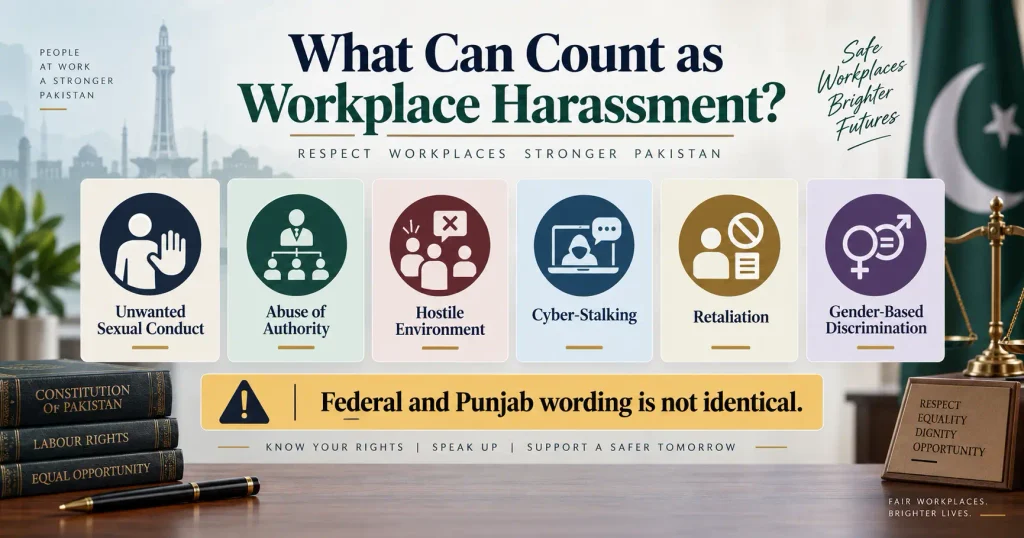
Under the amended federal Protection Against Harassment of Women at Workplace Act 2010, harassment includes specified unwelcome sexual advances, requests for sexual favours, stalking or cyber-stalking, sexual verbal, visual or written communication, physical conduct of a sexual nature, sexually demeaning conduct, and certain gender-based discrimination.
The law also addresses an intimidating, hostile, or offensive work environment, punishment for refusing an improper request, and conduct made a condition of employment.
Harassment may appear as abuse of authority, a hostile work environment, or retaliation after a refusal or complaint. A supervisor may misuse workplace power by linking an improper demand to promotion, evaluation, transfer, pay, training, or another professional advantage.
Repeated unwanted conduct may create an intimidating or offensive environment, while retaliation may involve threats, blocked opportunities, distorted evaluations, or other job-related pressure.
Not every rude remark, disagreement, transfer, or poor appraisal automatically becomes harassment. The statutory definition, context, workplace connection, and evidence still matter.
Workplace Can Extend Beyond the Office
The amended federal Protection Against Harassment of Women at Workplace Act 2010 uses a broad definition of workplace.
It covers places where professional services are rendered and situations linked with work outside a conventional office. The statutory wording includes settings such as educational institutions, gigs, concerts, studios, courts, highways, sporting facilities, and other places where work activities occur.
That can make remote work, digital communication, field duty, training, and work-related travel legally relevant.
Punjab law also recognizes situations linked to official work or official activity outside the physical office, but its wording is not identical.
How the Inquiry Process Works
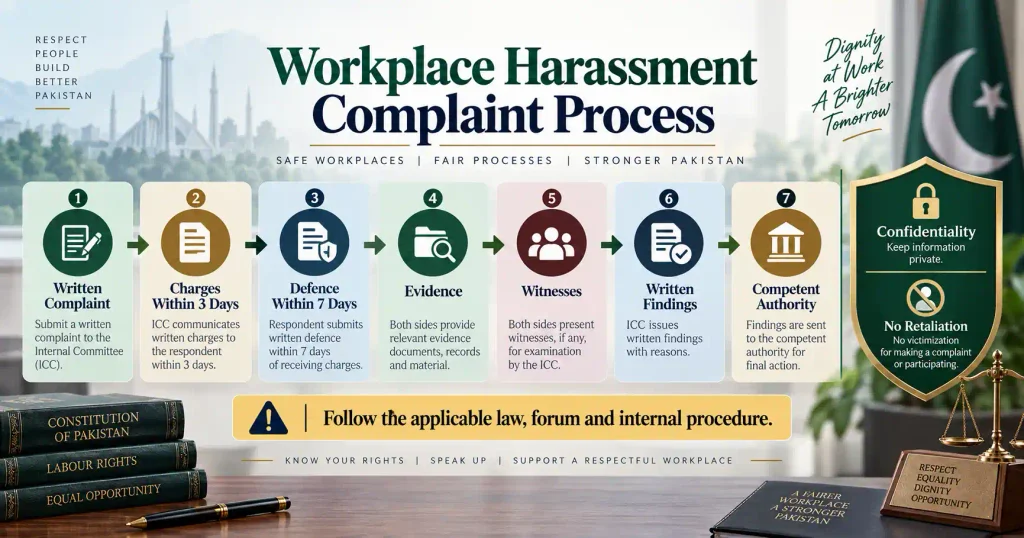
After a written complaint reaches the Inquiry Committee, the committee must communicate the charges and statement of allegations to the accused within three days.
The accused is then given seven days from communication of the charge to submit a written defence. Without reasonable cause, failure to respond may allow the committee to proceed ex parte.
The Inquiry Committee may examine relevant evidence and witnesses. The statutory safeguards also include confidentiality, protection against adverse action, representation or accompaniment, and written findings with reasons.
The committee must submit findings and recommendations to the Competent Authority within thirty days of initiation of the inquiry.
The Protection Against Harassment of Women at Workplace Act 2010 therefore protects the complainant while also giving the accused notice, defence, and a fair opportunity to answer the allegations.
What a Strong Complaint Should Contain
A complaint should be specific enough for the Inquiry Committee or Ombudsperson to understand the dispute without guessing.
Where relevant, include:
- the complainant and accused;
- their workplace or professional relationship;
- each important incident with a date or approximate period;
- the words, messages, demands, gestures, or conduct complained of;
- why the conduct was unwelcome;
- relevant witnesses;
- digital, documentary, audio, or video material;
- any earlier report to management;
- retaliation after refusal or reporting; and
- the relief requested.
Clear chronology is usually more useful than dramatic language.
Evidence to Preserve Before Filing
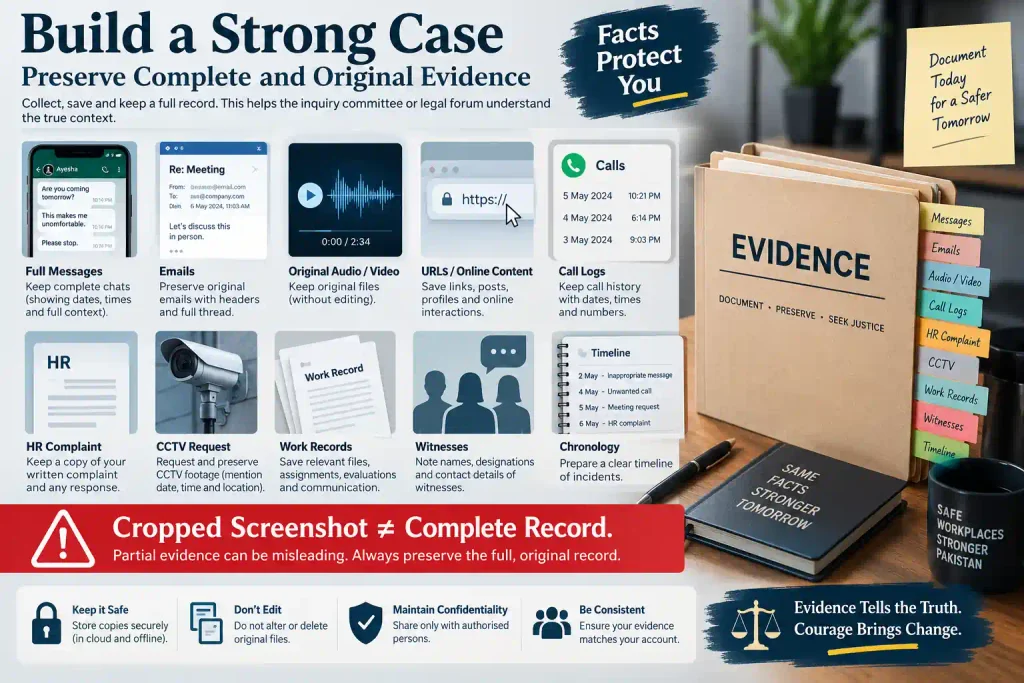
A case under the Protection Against Harassment of Women at Workplace Act 2010 may depend heavily on digital and surrounding evidence because harassment can occur without an independent eyewitness.
Preserve complete WhatsApp or SMS conversations, emails, original audio or video lawfully available to you, usernames, URLs, dates, timestamps, call logs, HR complaints, duty records, performance or transfer documents, CCTV preservation requests, witness details, and a dated chronology.
Do not delete the original conversation after taking screenshots. The complete source record is safer where authenticity or context is challenged.
The federal statutory Code also recognizes the practical difficulty of producing evidence where harassment takes place without witnesses and states that failure to report immediately does not itself affect the merits of the case.
Can You Complain to the Ombudsperson
Yes, where the applicable statute gives that option.
Under the federal Protection Against Harassment of Women at Workplace Act 2010, a complainant may choose the Ombudsperson or the Inquiry Committee.
The Ombudsperson must issue a written show-cause notice within three days of receiving the complaint. The accused then has five days after receipt to submit a written defence, subject to the statutory ex-parte rule.
The amended federal law also provides that the Ombudsperson shall decide a case or appeal within ninety days.
Under the current Punjab text, an employee may also choose between the Punjab Ombudsperson and the Inquiry Committee. Punjab Section 8 similarly provides a three-day show-cause period and five days for defence.
The correct Ombudsperson depends on the employer, territory, and governing statute.
What Employers Are Required to Do
The Protection Against Harassment of Women at Workplace Act 2010 places direct obligations on employers.
These include implementation of the law, adoption of the Code of Conduct, constitution of the Inquiry Committee, designation of the Competent Authority, and display of the Code as required by the applicable statute.
The current federal Protection Against Harassment of Women at Workplace Act 2010 also provides a District Court route for failure to comply with Section 11, with a statutory fine from Rs.25,000 to Rs.100,000 where liability is established.
Employers and employees can also review the official workplace Code of Conduct for the practical compliance framework.
Penalties After Harassment Is Proved
The Protection Against Harassment of Women at Workplace Act 2010 provides minor and major penalties.
Minor penalties include censure and specified employment-related sanctions.
Major penalties can include:
- reduction to a lower post or time-scale;
- compulsory retirement;
- removal from service;
- dismissal from service; and
- fine.
The 2022 federal amendment also added suspension or cancellation of a professional licence where applicable.
A complaint does not itself prove guilt. The forum must evaluate the allegation, defence, evidence, and procedure.
Likewise, failure to prove a complaint does not automatically mean it was malicious. The statutory provision dealing with action against a complainant refers to allegations found false and made with mala fide intention.
Appeals and Representation Deadlines
Deadlines under the Protection Against Harassment of Women at Workplace Act 2010 must be identified by procedural stage.
Under the federal text, a party aggrieved by a Competent Authority decision may appeal to the Ombudsperson within thirty days of written communication. A complainant aggrieved by the Competent Authority may also appeal within the statutory period.
A person aggrieved by an Ombudsperson decision under Section 8 may make a representation to the President or Governor, as applicable, within thirty days.
The amended federal law provides ninety days for deciding an Ombudsperson case or appeal and ninety days for deciding the representation.
These are procedural deadlines. They should not be casually converted into a universal thirty-day limitation period for every original harassment complaint.
For detailed procedural material, the official harassment complaint and appeal rules can be consulted.
Punjab Procedure Needs Its Own Check
For a Punjab matter, the adapted Protection Against Harassment of Women at Workplace Act 2010 should be used directly.
The Inquiry Committee communicates charges within three days of the written complaint, the accused gets seven days for defence, and the committee submits findings and recommendations within thirty days of initiation of the inquiry.
An aggrieved party may appeal a Competent Authority decision to the Punjab Ombudsperson within thirty days.
A direct complaint before the Ombudsperson triggers a three-day show-cause period and five days for the accused’s defence.
A person aggrieved by the Punjab Ombudsperson’s Section 8 decision may make a representation to the Governor within thirty days of communication of the decision.
This is why jurisdiction and procedural stage should be identified before counting time.
How PLD 2025 Lahore 759 Began
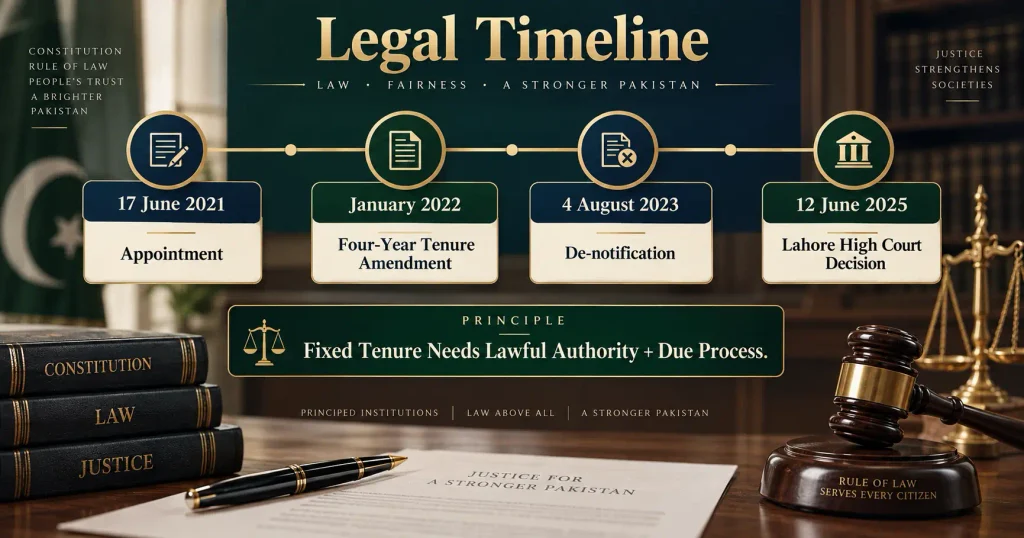
Nabila Hakim Ali Khan was appointed Punjab Ombudsperson on 17 June 2021 for two years.
During her tenure, Punjab inserted subsections (5) and (6) into Section 7. The amended provision fixed the Ombudsperson’s tenure at four years and barred extension or re-appointment.
The amendment came into force while she was still serving. The Government later gave effect to the four-year term.
The Caretaker Government then de-notified her on 4 August 2023, and she challenged that action under Article 199 of the Constitution.
What the Petitioner Argued
The petitioner argued that the Caretaker Government lacked lawful authority to remove her from a fixed-tenure statutory office.
She also argued that the Protection Against Harassment of Women at Workplace Act 2010 did not provide the Government or ECP with the ordinary removal power asserted against her.
Because the Ombudsperson performs quasi-judicial functions, security of tenure was also linked with institutional independence.
What the Government and ECP Argued
The Punjab Government relied on the petitioner’s earlier political activity and disputed whether the later four-year tenure applied to her appointment. ECP supported that position.
The Court instead examined the statute, caretaker powers, ECP’s election role, and the process actually followed.
Why the Four-Year Tenure Applied
The Lahore High Court held that when legislation says it comes into force “at once,” its provisions operate from commencement unless the law indicates otherwise.
Because the Punjab amendment came into force while the petitioner was still serving and did not limit the new tenure to future appointments, the Court held that the four-year term applied to her office.
Why the Removal Was Unlawful
Punjab Section 7 addressed resignation but did not prescribe the ordinary removal procedure relied upon against the petitioner.
The Court held that a fixed-tenure Ombudsperson could not be removed before expiry simply at executive will.
Under the Protection Against Harassment of Women at Workplace Act 2010, proven misconduct or incapacity may justify action, but lawful authority and due process would still be necessary.
The judgment therefore did not create permanent immunity. It protected statutory tenure against unlawful removal.
Article 10A and Due Process Mattered
The Court connected the dispute with Article 10A of the Constitution. Fair trial and due process had to inform the determination of civil rights and obligations.
The respondents had not shown a proper process proving misconduct or incapacity before the impugned de-notification.
Caretaker Powers Had Legal Limits
Under Section 230 of the Elections Act 2017, the Caretaker Government has a limited role.
The Court did not treat permanent removal of a fixed-tenure, quasi-judicial Ombudsperson as an ordinary temporary administrative step.
ECP Could Not Order Permanent Removal
The Lahore High Court accepted the ECP’s authority to protect free and fair elections, but that authority was not unlimited.
The Court found no material showing the required determination that the petitioner’s continuation could influence the election. It also distinguished temporary transfer or shuffling from permanent removal of a statutory office holder.
Political History Was Not Disqualification
Punjab Section 7 contained no automatic disqualification based on earlier political association.
The Court nevertheless stressed that an Ombudsperson must remain impartial and that political preference or extraneous considerations affecting official performance may amount to misconduct.
Final Order and Appointment Reform
The Lahore High Court allowed the petition and declared the 4 August 2023 de-notification null and void. The petitioner was deemed to remain in office as if the notification had never been issued.
The Court also identified a gap in the statutory appointment procedure.
It directed the relevant authorities to develop a comprehensive, transparent, and merit-based process, including broad public advertisement and objective evaluation, preferably involving the Public Service Commission.
For the Protection Against Harassment of Women at Workplace Act 2010, the institutional message is important: a forum created to protect workplace dignity should itself have credible appointment and tenure safeguards.
Practical Steps After Workplace Harassment
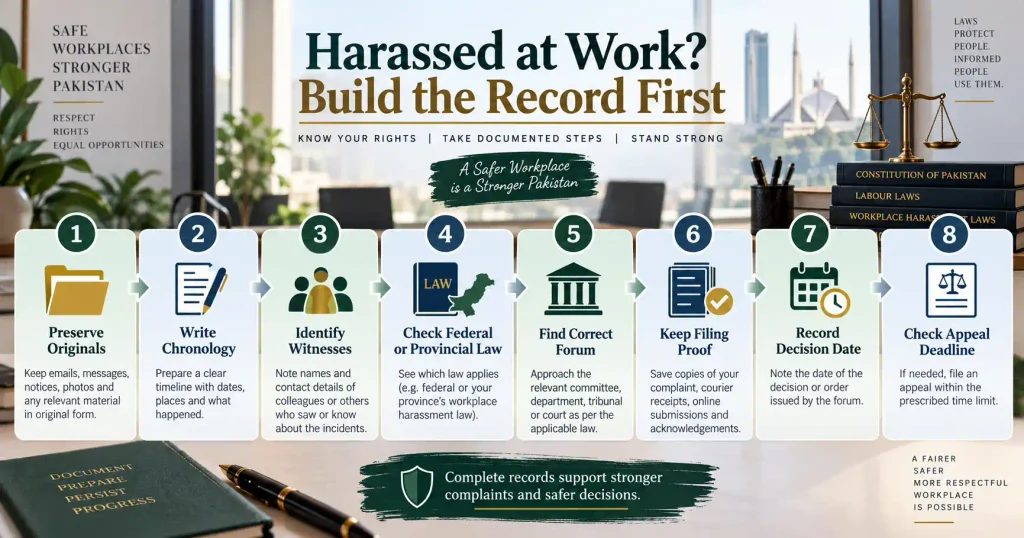
If harassment occurs, the Protection Against Harassment of Women at Workplace Act 2010 should be used with a clear focus on safety, evidence, jurisdiction, and procedure:
- Preserve original messages, files, and records.
- Write a dated chronology while memory is fresh.
- Identify witnesses and any earlier report.
- Check which federal or provincial law applies.
- Identify the Inquiry Committee and Competent Authority.
- Check whether a direct Ombudsperson route is available.
- Keep proof of every complaint or appeal filed.
- Record the date each order is communicated.
- Check the correct appeal or representation deadline.
- Avoid altering original evidence.
The Protection Against Harassment of Women at Workplace Act 2010 provides a legal route, but an individual case still turns on facts, evidence, jurisdiction, and procedure.
Mistakes That Can Weaken a Case
Common mistakes include deleting original messages, keeping only cropped screenshots, giving no chronology, mixing rumours with personal knowledge, applying federal wording automatically to Punjab, filing before the wrong forum, delaying CCTV preservation, missing an appeal deadline, or exaggerating facts.
A clear, preserved, and properly filed record is usually stronger than a long complaint unsupported by evidence.
What This Judgment Means for Complainants
PLD 2025 Lahore 759 does not guarantee success in a harassment complaint and does not reduce the need for proof.
Its importance is institutional.
A complainant needs an independent forum. If the Ombudsperson can be permanently removed without lawful authority or due process, confidence in that forum can suffer.
By protecting fixed tenure in this case, the Lahore High Court reinforced the institutional independence behind the Protection Against Harassment of Women at Workplace Act 2010.
That independence helps the Protection Against Harassment of Women at Workplace Act 2010 function as a credible complaint system.
Related Qanooni Dastak Guides
For practical filing steps under the Protection Against Harassment of Women at Workplace Act 2010, read Qanooni Dastak’s harassment complaint guide for Pakistan.
For the wider framework of women’s legal protections, see the guide on female rights in Pakistan and the Women Rights in Pakistan section.
Conclusion
The Protection Against Harassment of Women at Workplace Act 2010 gives workplace dignity a legal enforcement structure through complaint forums, inquiry procedure, employer duties, penalties, appeals, and institutional safeguards.
The federal law became broader after the 2022 amendment, while Punjab continues under its own adapted text. Those regimes should not be mixed casually.
PLD 2025 Lahore 759 adds another important principle. The Lahore High Court held that the Punjab Ombudsperson’s fixed tenure could not be ended through the authority and procedure used by the Caretaker Government and ECP.
The judgment strengthens the independence of the forum without deciding the merits of an ordinary harassment complaint.
For a real case, preserve evidence, identify the correct law and forum, state the facts precisely, and check every procedural deadline.
FAQs on Workplace Harassment Law
What did PLD 2025 Lahore 759 decide?
The Lahore High Court set aside the notification de-notifying the Punjab Ombudsperson. The Court held that the fixed-tenure office could not be permanently ended in the manner attempted by the Caretaker Government and ECP. The case concerned tenure, lawful authority, and due process rather than an employee’s harassment allegations.
Did the Court decide an employee harassment claim?
No. PLD 2025 Lahore 759 was a constitutional petition about the Punjab Ombudsperson’s tenure and removal. Its relevance to the Protection Against Harassment of Women at Workplace Act 2010 is institutional: an independent Ombudsperson is part of the system created to decide harassment complaints.
What conduct can legally amount to harassment?
Under the amended federal law, the definition covers specified unwelcome sexual advances, requests for sexual favours, stalking, cyber-stalking, sexual verbal, visual, written or physical conduct, sexually demeaning conduct, and certain gender-based discrimination. The governing provincial law must still be checked where applicable.
Who can complain under the federal law?
The amended federal Protection Against Harassment of Women at Workplace Act 2010 uses “any person” in the definition of complainant and also covers specified former employees and a parent or guardian where the complainant is a minor. Punjab cases must still be tested against the Punjab text.
Can harassment happen outside the office?
Yes, where the applicable law and facts establish the required work connection. The federal definition of workplace expressly includes work-linked situations outside the conventional office. Punjab law also recognizes situations linked to official work or official activity outside the office.
Can I go directly to the Ombudsperson?
Under federal law, a complainant may choose the Ombudsperson or Inquiry Committee. Under Punjab law, an employee also has a statutory choice. The competent forum depends on the employer, territory, and governing law.
What evidence should I preserve?
Preserve complete messages, emails, original audio or video lawfully available to you, URLs, usernames, timestamps, call logs, HR complaints, work records, CCTV preservation requests, witness details, and a dated chronology. Keep originals where possible because edited extracts may not show the full context.
What deadlines should I check first?
Identify the procedural stage first. Inquiry notice, defence, appeal, Ombudsperson proceedings, and representation can have different periods. Federal and Punjab procedures are not identical, so never assume one thirty-day period governs every original complaint.
Legal Awareness Disclaimer
This article is for general legal awareness and educational purposes only. It is not legal advice and does not guarantee any result. Workplace harassment law can differ by territorial jurisdiction, employment setting, forum, and later amendment. Anyone facing an actual complaint, inquiry, appeal, retaliation issue, or limitation question should obtain advice after showing the complete facts and documents.