

A disturbing WhatsApp message from a supervisor may look small at first. Then come unwanted calls, repeated pressure, an inappropriate demand, threats about a job, a hostile transfer, or fear that speaking up will destroy a career. Many employees remain silent because they do not know whether the law will protect them—or even where they should complain.
If you are searching for Harassment Complaint Pakistan, this guide explains not only what harassment means but also where to complain, what evidence to preserve and what legal process may follow.
If you are searching for Harassment Complaint Pakistan, you probably need more than a definition of workplace harassment. You need to know what conduct can be challenged, where a complaint can be filed, what evidence should be preserved, how quickly the legal process moves, and what happens if the harassment follows you outside the physical office.
A major Lahore High Court judgment, Umer Shehzad v. Ombudsperson (Mohtasib) Punjab and others, PLD 2026 Lahore 303, answers several of these questions. The Court examined WhatsApp messages, abuse of supervisory authority, an alleged incident outside the office, delayed reporting, a parallel criminal case and objections about an incomplete complaint. It ultimately maintained the finding of harassment and the major penalty of removal from service.
But this article goes further than the judgment. It explains the practical complaint process in Pakistan, the important difference between federal and Punjab law, the 2022 federal amendment, digital evidence, workplace nexus, retaliation, timelines and the mistakes that can weaken an otherwise genuine case.
Table of Contents
IRAC Summary: What Did the Lahore High Court Decide?
| IRAC | Simple Explanation |
|---|---|
| Issue | Could the Ombudsperson legally decide the complaint when an important alleged incident happened outside the office, criminal proceedings were also pending and WhatsApp evidence was challenged? |
| Rule | Workplace is not limited to office walls. The real question is whether the conduct is connected with employment, official activity or authority derived from the workplace. |
| Analysis | The accused was the complainant’s supervisory officer. The allegations involved inappropriate communications, service-related favours and threats concerning her appointment. The Court considered the employment hierarchy and WhatsApp communications together. |
| Conclusion | The Lahore High Court dismissed the constitutional petition. The Ombudsperson’s finding, affirmed by the Governor, remained intact. |
The judgment is particularly important because the Court did not say that every dispute between colleagues becomes workplace harassment. Instead, it drew a line between a genuinely private dispute and conduct enabled by workplace power.
Judgment at a Glance: Harassment Complaint Case
| Point | Detail |
|---|---|
| Case | Umer Shehzad v. Ombudsperson (Mohtasib) Punjab and others |
| Citation | PLD 2026 Lahore 303 |
| Court | Lahore High Court |
| Judge | Raheel Kamran, J. |
| Decision | 15 October 2025 |
| Complainant | Mst. Mehwish Riaz |
| Employment | Ad hoc teacher |
| Institution | Government Girls Vocational Institute, Satellite Town, Jhang |
| Accused | Supervisory officer |
| Key Evidence | WhatsApp communications, oral evidence and surrounding circumstances |
| Ombudsperson Decision | Guilty of harassment |
| Major Penalty | Removal from service |
| Governor | Representation dismissed |
| Lahore High Court | Constitutional petition dismissed |
| Standard of Proof | Preponderance of probabilities |
| Major Principle | Workplace nexus matters more than physical location |
What Counts as Workplace Harassment in Pakistan?
A Harassment Complaint Pakistan case may involve physical, verbal, written or digitally communicated conduct, depending on the applicable law and facts.
Workplace harassment is not restricted to physical assault inside an office.
Under the Punjab law considered in PLD 2026 Lahore 303, harassment includes unwelcome sexual advances, requests for sexual favours, verbal or written communication or physical conduct of a sexual nature, sexually demeaning attitudes and conduct that interferes with work or creates an intimidating, hostile or offensive environment.
The Punjab statutory Code also recognises three important manifestations: abuse of authority, creation of a hostile environment and retaliation. The official Punjab law expressly includes situations connected with official work or official activity outside the office.
The federal legal framework became broader after the Protection against Harassment of Women at the Workplace (Amendment) Act, 2022. The amended federal definition expressly includes stalking, cyberstalking, certain derogatory conduct and gender-based discrimination. It also states that a sufficiently serious single incident can constitute harassment. Read the official amended workplace harassment law.
Do Not Mix Federal and Provincial Law
This distinction is extremely important.
The federal law was significantly amended in 2022. Punjab, however, has its own adapted statutory text after devolution following the 18th Constitutional Amendment. The Punjab Laws website confirms that the original federal statute was adapted for Punjab with provincial amendments. Read the official Punjab workplace harassment law.
Therefore, it is unsafe to copy one definition from a federal website and assume that every word automatically applies identically in every province.
A good complaint begins by identifying the correct statute, employer and territorial forum.
Who Can File a Complaint?
The answer depends on the applicable law.
Under the federal amended framework, “complainant” now means any person making a harassment complaint. It expressly includes certain former employees and, where the complainant is a minor, a parent or guardian.
The federal definition of “employee” was also expanded to include categories such as regular and contractual employees, gig workers, temporary and part-time workers, freelancers, students, performers, artists, sportspersons, interns, trainees, domestic workers, home-based workers, apprentices and certain volunteers.
Punjab’s currently published statute uses its own wording. It defines a complainant as a woman or man and includes regular or contractual employees, interns and apprentices within its employee definition.
This is another reason why anyone preparing a Harassment Complaint Pakistan matter should first identify the jurisdiction instead of relying on a generic online template.
This is why a Harassment Complaint Pakistan applicant should identify the applicable federal or provincial law before choosing a forum.
How to File Harassment Complaint Pakistan: 11 Practical Steps
Step 1: Write Down the Incident Before Memory Fades
Start with facts.
Create a private chronology containing:
- the date of each incident;
- approximate time;
- location;
- what was said or done;
- name and designation of the accused;
- witnesses who saw or heard anything;
- messages, calls or emails connected with the incident;
- any threat involving appointment, salary, promotion, transfer or termination;
- when you first told another person;
- and what happened after you objected.
Avoid turning the complaint into a long emotional story without dates.
A detailed chronology can help separate a repeated pattern from isolated events and make it easier for the forum to understand the complaint.
For a Harassment Complaint Pakistan case, an accurate incident chronology can later become one of the most useful documents in the evidence file.
Step 2: Preserve the Original Digital Evidence
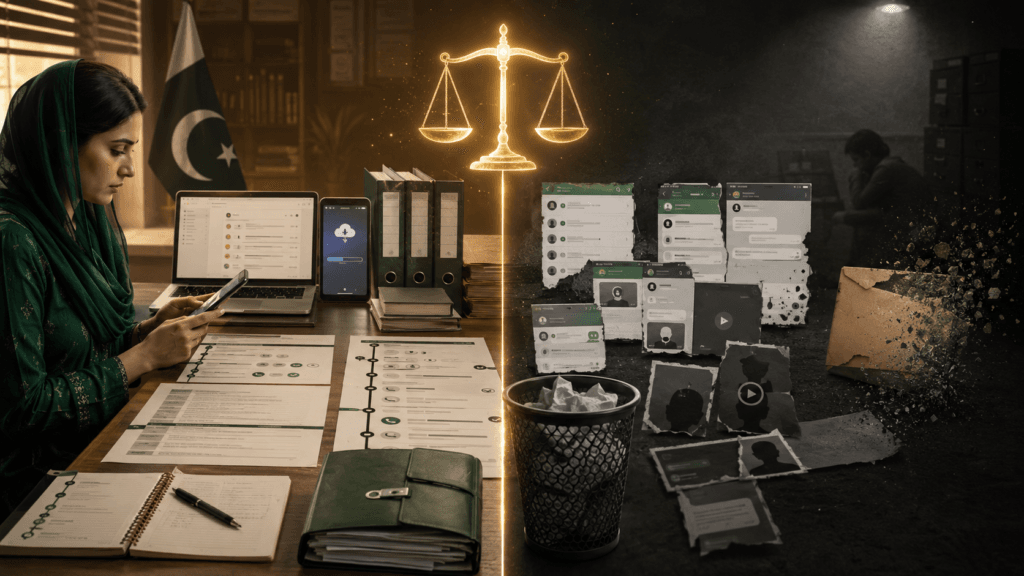
Digital evidence may disappear faster than physical documents.
If the matter involves WhatsApp, email or social media, preserve:
- the complete conversation;
- timestamps;
- sender details;
- phone numbers;
- profile information where relevant;
- voice messages;
- call logs;
- emails;
- original images or videos;
- office group messages;
- and backups.
Do not depend only on one cropped screenshot.
If possible, keep the original device and create a secure backup before deleting, blocking or changing anything.
In PLD 2026 Lahore 303, the accused later challenged the WhatsApp material. But the Court noted that he had not challenged the communication effectively during the inquiry or cross-examination and had not sought forensic verification at the relevant stage. His own position also indirectly acknowledged mobile communication between the parties.
The judgment does not create a rule that every screenshot is automatically genuine. It shows that digital evidence is examined with its surrounding circumstances and the way each party responds to it.
Digital evidence in a Harassment Complaint Pakistan matter should therefore be preserved in its complete and original form wherever possible.
Step 3: Identify the Workplace Nexus

This is one of the most powerful parts of the judgment.
The accused argued that the alleged serious incident occurred at the complainant’s residence rather than inside her office.
The Lahore High Court rejected the idea that geography alone decides jurisdiction.
The Court explained that the Act can apply where the disputed conduct arises from, is facilitated by, or is inseparably connected with employment—or where power obtained through office is used to exert pressure or seek compliance.
Ask these questions:
- Was the accused your supervisor?
- Did the accused control your appointment?
- Could the accused affect your transfer?
- Was promotion or training used as leverage?
- Were official favours mentioned?
- Was your job threatened?
- Did work-related communication continue outside office hours?
- Did the conduct create a hostile environment at work?
In many Harassment Complaint Pakistan disputes, proving this employment connection can be as important as proving the communication itself.
If the answer to these questions is yes, explain that connection clearly in the complaint.
Step 4: Decide Whether the Matter Is Truly Workplace-Linked
This protection should not be overstretched.
The Lahore High Court made clear that two colleagues having a purely private dispute does not automatically give the Ombudsperson jurisdiction.
The employment relationship must be more than accidental.
In the case before the Court, the parties were not dealing simply as equal private individuals. The complainant was subordinate to the accused officer, and she alleged that his workplace authority was being used against her.
This is why Harassment Complaint Pakistan should not be used as a label for every office argument, rude conversation or personal disagreement.
Correct legal classification strengthens genuine complaints.
A genuine Harassment Complaint Pakistan case becomes stronger when the complainant clearly explains why the misconduct was workplace-linked rather than purely personal.
Step 5: Choose Between the Inquiry Committee and Ombudsperson
Choosing the correct forum is one of the most important decisions in a Harassment Complaint Pakistan proceeding.
Many employees believe that they must first complain to HR and can approach the Ombudsperson only after the employer fails to act.
That is not what the statutory provision considered in PLD 2026 Lahore 303 says.
Section 8(1) gives an employee the option to prefer the complaint either to the Inquiry Committee or directly to the Ombudsperson. The complainant in this case chose the Ombudsperson.
Punjab’s official published Act reflects the same choice.
At the federal level, FOSPAH currently operates an online complaint registration system. Its current complaint form asks for information including the complainant, CNIC, department, accused, address, main points of complaint and affidavit. Use the official FOSPAH online complaint form.
Readers dealing with federal jurisdiction can use the official FOSPAH complaint registration page.
Step 6: Draft the Complaint So the Story Can Be Understood in One Reading
A strong complaint is not necessarily a long complaint.
It is a specific complaint.
Include:
- Your name and employment position.
- The name and designation of the accused.
- Your professional relationship with the accused.
- Dates or approximate periods of incidents.
- What conduct occurred.
- How the conduct was unwelcome.
- How the workplace or employment relationship was involved.
- Any job-related threat or misuse of authority.
- Names of relevant witnesses.
- Available documents and electronic evidence.
- Any earlier reporting.
- Any retaliation after reporting.
- The relief you seek.
A well-drafted Harassment Complaint Pakistan application should allow the Inquiry Committee or Ombudsperson to understand the allegations, workplace nexus and supporting evidence without guessing.
Rule 5, examined in PLD 2026 Lahore 303, contemplated a comprehensive statement of facts, relevant details, witness names and available supporting material such as documentary, audio or video evidence.
Step 7: Know What Happens After the Complaint
Anyone filing a Harassment Complaint Pakistan matter should record every notice, hearing and decision date because later remedies may carry statutory time limits.
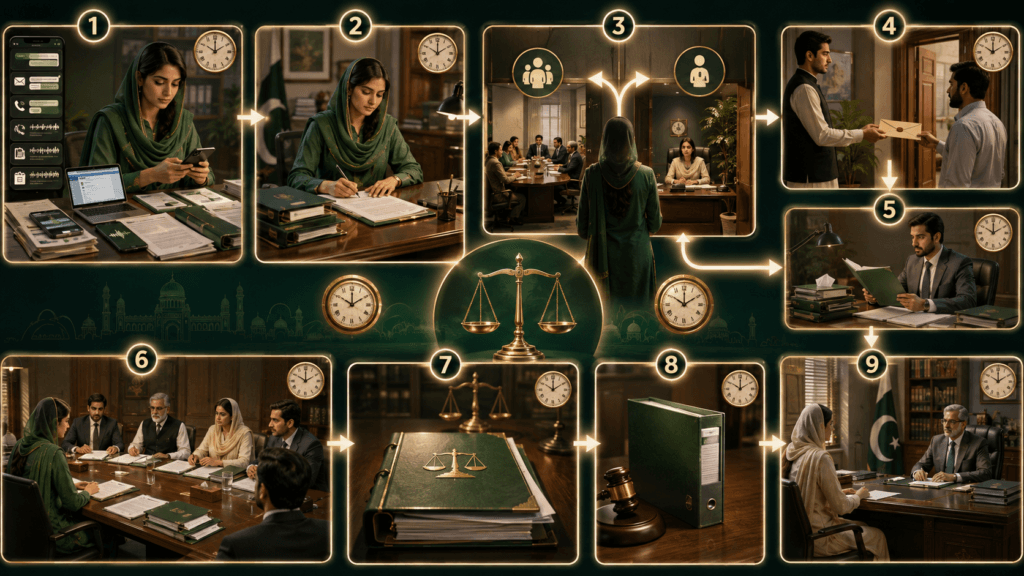
The process is not the same at every stage or under every jurisdiction, but some timelines are expressly stated in the legislation.
Punjab Ombudsperson Route
Under Section 8 of the Punjab law:
| Stage | Time |
|---|---|
| Ombudsperson issues show-cause notice | Within 3 days of receiving complaint |
| Accused submits written defence | Within 5 days after receiving notice |
| Failure without reasonable cause | Ex parte proceedings may follow |
| Decision | Ombudsperson records decision and informs parties/management |
These exact steps were reproduced and examined by the Lahore High Court.
Federal Inquiry Committee Route
Under the amended federal framework:
| Stage | Time |
|---|---|
| Charges communicated after written complaint | Within 3 days |
| Written defence by accused | Within 7 days |
| Inquiry Committee findings/recommendations | Within 30 days of initiation |
| Competent Authority imposes recommended penalty | Within 1 week of recommendations |
The inquiry evidence is to be treated as confidential, and adverse action should not be taken against the complainant or witnesses.
Federal Ombudsperson and Representation
The amended federal statute provides that the Ombudsperson should decide a case or appeal within 90 days. An aggrieved person may make a representation to the President or Governor, as applicable, within 30 days, and the amended provision gives the President or Governor 90 days to decide it.
Do not blindly apply federal timelines to a provincial case without checking the applicable statute.
Step 8: Protect Yourself Against Retaliation
Retaliation can sometimes begin after the complaint rather than before it.
Examples may include:
- threats to withdraw the complaint;
- sudden negative evaluations;
- unnecessary transfer;
- blocking promotion or training;
- gossip campaigns;
- isolation;
- pressure on witnesses;
- termination;
- alteration of responsibilities;
- or creating an unbearable working environment.
Retaliation after a Harassment Complaint Pakistan filing should also be documented carefully because post-complaint conduct may become relevant to the overall dispute.
Under the federal statutory procedure, adverse action against the complainant or witnesses is prohibited during inquiry, and the Inquiry Committee is to ensure that the employer or accused does not create a hostile environment to pressure the complainant.
Punjab’s published statutory text contains similar safeguards against adverse action and pressure during inquiry.
Record every material event that happens after your complaint.
Step 9: Do Not Assume Delay Means Consent
Fear can delay reporting.
A person may worry about:
- losing employment;
- being blamed;
- family reaction;
- reputation;
- workplace gossip;
- career damage;
- or being disbelieved.
PLD 2026 Lahore 303 expressly recognised this reality.
The Lahore High Court observed that women may initially refrain from reporting because of dignity, family honour and social stigma. The Court held that such initial silence should not automatically be treated as waiver, acquiescence or estoppel.
Therefore, delay in a Harassment Complaint Pakistan case should be examined in context rather than automatically being treated as proof that the conduct was accepted.
This does not mean that dates no longer matter. Delay can still require explanation depending on the facts.
It means silence is not automatically consent.
Step 10: Understand the Difference Between Harassment Proceedings and a Criminal Case
A serious incident may create more than one legal consequence.
In PLD 2026 Lahore 303, criminal proceedings concerning the occurrence were also pending. The accused argued that the Ombudsperson proceeding should therefore stop and raised the principle of double jeopardy.
The Court disagreed.
It explained that an Ombudsperson proceeding is a statutory workplace disciplinary process, while criminal proceedings determine criminal liability and punishment. The mere existence of one does not automatically extinguish the other.
This reasoning is consistent with broader Pakistani jurisprudence recognising that different legal wrongs can sometimes produce different proceedings.
A Harassment Complaint Pakistan proceeding and a criminal prosecution can therefore address different legal consequences arising from overlapping facts.
For a detailed Supreme Court discussion of workplace harassment, dignity and separate legal consequences, readers may also read Qanooni Dastak’s Women Harassment Law in Pakistan guide.
Step 11: If the Harassment Is Mainly Online, Check the Cybercrime Route Too
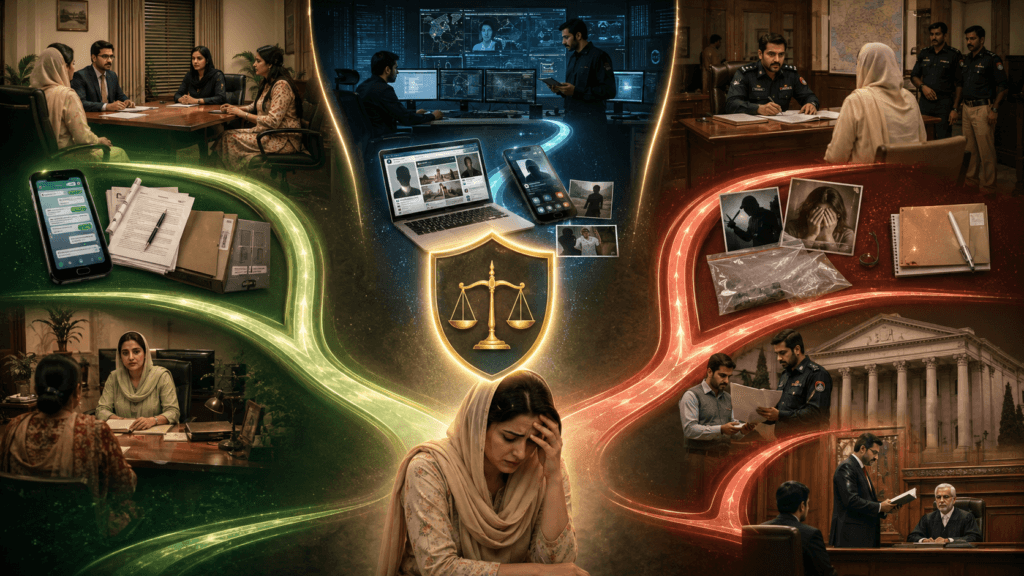
A WhatsApp message can form part of workplace harassment when it has an employment nexus.
But not every online harassment case is a workplace case.
If the conduct involves matters such as:
- fake profiles;
- impersonation;
- hacking;
- online blackmail;
- cyberstalking;
- manipulated intimate material;
- threats through online accounts;
- or other cybercrime;
a cybercrime complaint may also require consideration.
As of August 2026, the Government of Pakistan’s National Cyber Crime Investigation Agency (NCCIA) operates an online complaint registration portal and lists helpline 1799. Use the official NCCIA complaint portal.
The official NCCIA portal can be used to submit a cybercrime complaint online.
The correct route depends on the facts. Workplace harassment, cybercrime and a criminal offence can overlap, but they should not be confused.
The Real Story Behind PLD 2026 Lahore 303
Understanding the facts makes the legal principles much clearer.
Mst. Mehwish Riaz was serving as an ad hoc teacher at the Government Girls Vocational Institute, Satellite Town, Jhang. Umer Shehzad was posted as DM and was her supervisory officer.
According to the complaint, the officer allegedly cast indecent glances at her, sent inappropriate messages and attempted to establish illicit relations. She alleged that he referred to favours he had provided in service matters and demanded reciprocation.
More importantly, she alleged that he threatened to cancel her appointment if she refused.
According to her version, during the night between 14 and 15 September 2022, the petitioner came to her residence. She alleged that he forcibly entered and attempted a serious sexual offence. Rescue-15 was called, after which he allegedly fled.
These were allegations before the statutory forum; the Lahore High Court later reviewed whether the findings and jurisdiction could legally stand.
What Was the Officer’s Defence?
The petitioner denied the allegations.
He claimed that there was hostility because of administrative matters involving the complainant and her brother. He also argued that:
- the alleged residence incident did not happen at a workplace;
- criminal proceedings were already pending;
- WhatsApp screenshots were not forensically authenticated;
- the witnesses were insufficient;
- the complaint had not been properly verified;
- supporting material had not been properly annexed;
- and removal from service was disproportionate.
These objections gave the Lahore High Court an opportunity to address several important questions relevant to Harassment Complaint Pakistan cases.
Why WhatsApp Messages Became So Important
The Court did not look at the screenshots in isolation.
It examined:
- the supervisory relationship;
- the allegations of job-related pressure;
- the existence of mobile communication;
- the accused’s response during inquiry;
- whether authenticity was challenged at the appropriate stage;
- and whether the messages matched the broader alleged pattern.
The petitioner had not properly challenged the existence, content or context of the messages during his written defence or cross-examination. The Court considered his later challenge to be belated in the circumstances.
That gives both complainants and accused persons an important lesson.
A complainant should preserve authentic evidence carefully.
An accused person who genuinely says digital material is fake should raise that objection clearly and at the proper stage rather than waiting until later proceedings.
Does an Incident at Home Become Workplace Harassment?
Not automatically.
That qualification matters.
The Court did not hold that everything a colleague does at someone’s home becomes workplace harassment.
It found jurisdiction because the alleged residence incident could not be separated from an existing pattern allegedly involving supervisory authority, employment pressure and workplace-linked communication.
The Court even observed that, if the residence incident were temporarily left aside, the admitted supervisory relationship and uncontroverted digital communication were sufficient in the particular circumstances to attract the Act.
The principle can be expressed simply:
The law looks at the source of the power, not only the street address where the conduct happened.
What Standard of Proof Applies?
This question is often misunderstood.
An Ombudsperson proceeding is not a criminal trial.
PLD 2026 Lahore 303 explains that the Ombudsperson is not rigidly bound by the same technical rules that govern ordinary civil or criminal trials. Natural justice still matters, but the forum is designed to deal with sensitive workplace disputes without unnecessary procedural rigidity.
The applicable evidentiary standard identified by the Court was preponderance of probabilities, not proof beyond reasonable doubt.
In simple terms, the forum considers the evidence and circumstances as a whole and determines which version is more probable.
That is one reason patterns, digital communications, workplace hierarchy and surrounding conduct can be important even when there is no independent eyewitness to every event.
Can a Technical Mistake Destroy the Entire Complaint?
A complaint should always be prepared carefully.
But the Lahore High Court rejected the idea that every technical defect automatically destroys jurisdiction.
The petitioner argued that the complaint was defective because it was not properly verified and all supporting material had not been attached.
The Court examined Rule 5 and held that it describes the proper form and content of the complaint but does not prescribe automatic rejection for every omission.
It also noted that the Rules permit amendment during inquiry.
In the circumstances before it, the accused knew the allegations, had received an opportunity to respond and could not demonstrate prejudice caused by the alleged defects.
The lesson for a Harassment Complaint Pakistan applicant is not to file an incomplete complaint deliberately.
The lesson is that substantive justice should not automatically collapse because of a curable procedural irregularity.
What Evidence Should You Attach?
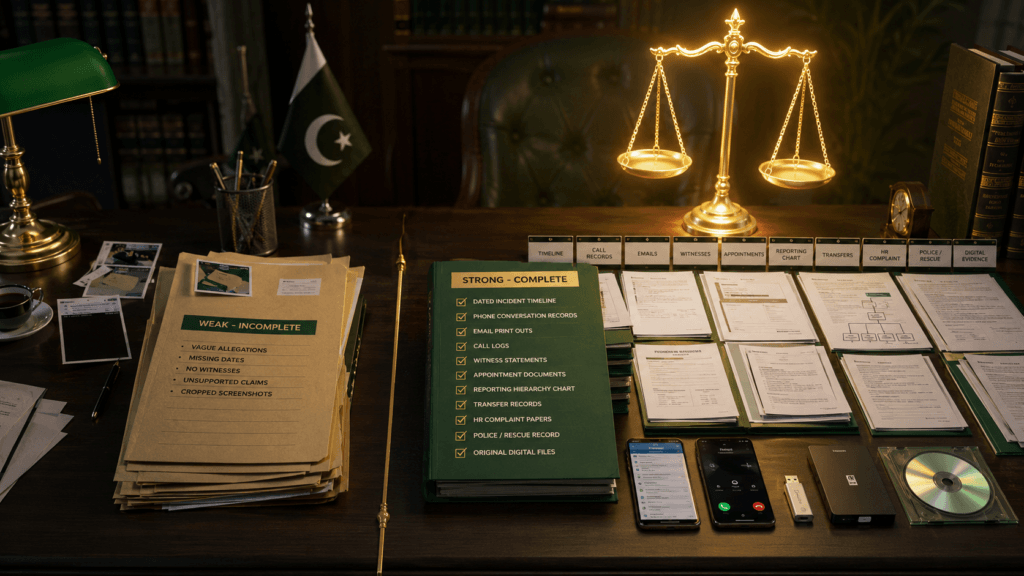
Evidence quality is often more important than evidence quantity.
The best Harassment Complaint Pakistan evidence file usually shows a connected sequence of events rather than a collection of unexplained screenshots.
A useful file may contain:
| Evidence | Practical Value |
|---|---|
| Complete WhatsApp conversation | Shows language, dates and context |
| Original phone/device | Helps preserve authenticity |
| Emails | Shows official communication |
| Call logs | Supports communication pattern |
| Voice messages | May support relevant allegations |
| CCTV preservation request | Can prevent footage from being overwritten |
| Appointment letter | Establishes employment relationship |
| Reporting hierarchy | Shows supervisory authority |
| Transfer/promotion documents | May show leverage or retaliation |
| HR complaint | Shows earlier reporting |
| Witness details | Identifies people with relevant knowledge |
| Police/Rescue record | May support immediate reporting in serious incidents |
| Medical material | May be relevant depending on allegations |
| Dated chronology | Connects separate incidents into an understandable sequence |
| Post-complaint messages | May show pressure or retaliation |
Never fabricate or edit evidence.
A weak case cannot safely be turned into a strong one by altering screenshots or inventing witnesses. False material can destroy credibility and may carry separate legal consequences.
What Protection Does the Law Give During an Internal Inquiry?
The process is supposed to protect fairness for both sides.
Under the federal amended framework:
- name;
- CNIC;
- address;
- contact details;
- email;
- subject of complaint;
- department;
- name of accused;
- department/address of accused;
- main points of the complaint;
- and affidavit.
- submit a clear written defence;
- deny disputed facts specifically;
- do not rely only on technical objections;
- challenge allegedly fake electronic evidence promptly;
- seek forensic examination where genuinely necessary;
- cross-examine relevant witnesses;
- preserve your own communications;
- and identify contradictions with evidence rather than speculation.
- office walls do not alone determine jurisdiction;
- employment nexus is critical;
- purely private disputes remain distinguishable;
- abuse of supervisory authority can establish the link with work;
- WhatsApp evidence may carry probative value;
- a criminal case does not automatically stop workplace proceedings;
- the complainant may have a direct Ombudsperson route;
- delayed reporting is not automatically consent;
- minor complaint defects may be curable;
- and the standard before the Ombudsperson is preponderance of probabilities.
- I have identified the correct federal or provincial law.
- I know which Ombudsperson or Inquiry Committee has jurisdiction.
- My complaint contains specific facts rather than general accusations.
- I have created a dated incident chronology.
- I have preserved complete digital communications.
- I have not edited original evidence.
- I have identified witnesses.
- I have explained the relationship between the accused and my employment.
- I have identified any misuse of supervisory power.
- I have preserved appointment, transfer, promotion or termination records.
- I have kept evidence of any retaliation.
- I have signed and verified the complaint where required.
- I have preserved a complete copy of everything filed.
- I understand the relevant appeal or representation deadline.
- I will obtain professional legal advice if the facts involve serious criminal allegations or complicated jurisdiction.
- inquiry evidence is treated as confidential;
- both parties may be represented or accompanied by specified persons such as a CBA representative, friend or colleague;
- adverse action should not be taken against the complainant or witnesses;
- the complainant should not be pressured through a hostile environment;
- and the Inquiry Committee must give written findings with reasons.
- employees know where complaints go;
- Inquiry Committee members understand their role;
- complainants are not pressured;
- accused persons receive a fair opportunity to respond;
- evidence is preserved;
- confidentiality is respected;
- retaliation is monitored;
- findings are reasoned;
- and lawful decisions are implemented.
- name;
- CNIC;
- address;
- contact details;
- email;
- subject of complaint;
- department;
- name of accused;
- department/address of accused;
- main points of the complaint;
- and affidavit.
- submit a clear written defence;
- deny disputed facts specifically;
- do not rely only on technical objections;
- challenge allegedly fake electronic evidence promptly;
- seek forensic examination where genuinely necessary;
- cross-examine relevant witnesses;
- preserve your own communications;
- and identify contradictions with evidence rather than speculation.
- office walls do not alone determine jurisdiction;
- employment nexus is critical;
- purely private disputes remain distinguishable;
- abuse of supervisory authority can establish the link with work;
- WhatsApp evidence may carry probative value;
- a criminal case does not automatically stop workplace proceedings;
- the complainant may have a direct Ombudsperson route;
- delayed reporting is not automatically consent;
- minor complaint defects may be curable;
- and the standard before the Ombudsperson is preponderance of probabilities.
- I have identified the correct federal or provincial law.
- I know which Ombudsperson or Inquiry Committee has jurisdiction.
- My complaint contains specific facts rather than general accusations.
- I have created a dated incident chronology.
- I have preserved complete digital communications.
- I have not edited original evidence.
- I have identified witnesses.
- I have explained the relationship between the accused and my employment.
- I have identified any misuse of supervisory power.
- I have preserved appointment, transfer, promotion or termination records.
- I have kept evidence of any retaliation.
- I have signed and verified the complaint where required.
- I have preserved a complete copy of everything filed.
- I understand the relevant appeal or representation deadline.
- I will obtain professional legal advice if the facts involve serious criminal allegations or complicated jurisdiction.
FOSPAH’s 2023–24 annual report also explains that complaints may be submitted through more than one route, including in person, by post, online and by email. ([FOSPAH][6])
This is particularly useful for a person searching Harassment Complaint Pakistan because many older articles discuss only the law but never show the reader where the process actually begins.
Punjab Help and Initial Guidance
For Punjab residents who first need general guidance about women-related legal issues, the Punjab Commission on the Status of Women has long operated the 1043 helpline. Official PCSW material identifies 1043 as a means of providing information, support and redress guidance. (Punjab Citizen Services Website)
Guidance from a helpline, however, should not be confused with formally filing a statutory complaint before the legally competent forum.
Important Lessons for the Accused Person Too
Fairness is not one-sided.
The accused is entitled to know the allegations and respond.
PLD 2026 Lahore 303 provides several practical defence lessons:
The High Court noted that the petitioner’s defence had not effectively countered important aspects of the complainant’s evidence at the appropriate stage.
A fair anti-harassment system must protect genuine complainants without denying procedural fairness to accused persons.
Why the High Court Refused to Re-Try the Entire Case
The Lahore High Court was exercising constitutional jurisdiction under Article 199.
It explained that a High Court reviewing harassment proceedings does not automatically become another appellate court tasked with reassessing every witness and every factual finding.
Interference is normally justified where findings are perverse, contrary to law or unsupported by evidence.
In this case, the Ombudsperson had examined evidence and reached findings. The Governor had considered the representation. The Lahore High Court found the resulting conclusions reasonable on the available record.
That is why the writ petition failed.
Final Decision in PLD 2026 Lahore 303
PLD 2026 Lahore 303 therefore makes Harassment Complaint Pakistan law especially important for disputes involving supervisory authority, WhatsApp communication and conduct extending beyond office premises.
The Lahore High Court dismissed the constitutional petition.
The Court found no jurisdictional defect or legal infirmity sufficient to disturb the findings of the Ombudsperson and Governor. The conclusion of guilt remained intact, as did the major penalty of removal from service.
For anyone researching Harassment Complaint Pakistan, this judgment now provides several important principles in one place:
Practical Checklist Before You File
Before pressing “submit,” check the following:
A carefully prepared Harassment Complaint Pakistan file can help the competent forum understand the incidents, evidence, workplace connection and relief being requested without unnecessary confusion.
Frequently Asked Questions About Harassment Complaint Pakistan
Where can I file a workplace harassment complaint in Pakistan?
Depending on the applicable law and jurisdiction, a complaint may be filed before an organization’s Inquiry Committee or the relevant Ombudsperson. Under the Punjab statutory provision considered in PLD 2026 Lahore 303, an employee has the option to choose either forum.
Can I directly approach the Ombudsperson?
Under Section 8(1) of the Punjab law considered by the Lahore High Court, yes. The complainant does not necessarily have to complete the internal Inquiry Committee process before approaching the Ombudsperson.
Can a man file a workplace harassment complaint?
Punjab’s currently published law defines complainant as a woman or man. The amended federal statute uses the broader phrase “any person.” The applicable jurisdiction must still be established.
Are students and interns covered?
Interns are included under the Punjab published employee definition. The amended federal definition goes further and includes students, interns, trainees, freelancers, gig workers, domestic workers and several other categories.
Can WhatsApp messages prove harassment?
WhatsApp messages can be relevant evidence, but their value depends on authenticity, context and surrounding evidence. PLD 2026 Lahore 303 did not hold that every screenshot must automatically be accepted.
Do WhatsApp screenshots always need forensic verification?
Not automatically in every Ombudsperson matter. In PLD 2026 Lahore 303, the Court considered the accused’s failure to challenge the messages properly at the relevant stage and assessed them with the wider circumstances. Where authenticity is genuinely disputed, the issue should be raised promptly.
Can harassment outside the office still fall under workplace law?
Yes, where a sufficient connection with official work or employment authority exists. The Lahore High Court held that the statutory concept of workplace is not limited to the physical office.
Does a late complaint automatically fail?
No. The Court recognised that dignity concerns, family honour and social stigma may delay disclosure. Initial silence does not automatically amount to consent, waiver or acquiescence.
Can criminal proceedings and the Ombudsperson case continue at the same time?
Potentially, yes. The Lahore High Court held that a criminal prosecution and workplace harassment proceeding have different legal purposes, so the existence of one does not automatically bar the other.
What proof standard does the Ombudsperson use?
PLD 2026 Lahore 303 confirms the civil standard of preponderance of probabilities, rather than the criminal standard of proof beyond reasonable doubt.
What if my complaint is not perfectly drafted?
Prepare it properly wherever possible. However, the Lahore High Court held that certain verification or annexure defects were not automatically fatal in the case before it where the accused knew the allegations, received full opportunity to respond and showed no resulting prejudice.
Where can I report cyber harassment?
Where the conduct amounts to cybercrime, the NCCIA operates the current federal cybercrime complaint portal and lists helpline 1799. A workplace-linked online message may require consideration under workplace harassment law as well.
Conclusion: The Office Door Is No Longer the Legal Boundary
The most important lesson from Harassment Complaint Pakistan law in 2026 is that workplace dignity does not disappear when an employee walks out of an office building.
A supervisor may misuse power through a service file, transfer threat, WhatsApp message or after-hours communication. When employment authority is the source of the pressure, the law can examine the real connection rather than focusing only on physical location.
But the opposite protection matters too: every personal dispute between colleagues is not workplace harassment.
PLD 2026 Lahore 303 therefore gives a balanced rule. Courts and statutory forums must look for a genuine employment nexus, evaluate the evidence in context, protect procedural fairness and avoid allowing technicalities to defeat substantive justice.
For a genuine complainant, the strongest first steps are simple: preserve the evidence, record the facts, identify the workplace connection, choose the correct legal forum and act carefully.
Disclaimer
This article is for legal awareness and educational purposes only. It is not professional legal advice and does not create a lawyer-client relationship.
Harassment law and jurisdiction may differ according to the province, federal or provincial employer, nature of employment, applicable statute, evidence and facts. A cybercrime complaint, criminal proceeding, service matter and workplace harassment proceeding may involve different forums.
For a personal dispute, especially one involving threats, violence, criminal allegations, employment termination or complex jurisdiction, consult a qualified Pakistani advocate and verify the latest official law before taking legal action.
The statute also permits the Inquiry Committee to seek documentary, audio or video material.
These safeguards matter because a complaint mechanism is meaningless if speaking up immediately puts the complainant’s job in danger.
What Penalties Can Be Imposed?
The exact penalties depend on the applicable statutory framework.
Under the amended federal law, minor penalties include measures such as censure and withholding promotion or increment. Major penalties include reduction to a lower post or time scale, compulsory retirement, removal from service, dismissal, and—in the amended federal text—suspension or cancellation of a professional licence where applicable. Fine and compensation mechanisms also appear in the statute.
The uploaded judgment itself involved one of the most serious service consequences: removal from service. The Ombudsperson imposed that penalty, the Governor maintained the decision and the Lahore High Court found no basis for constitutional interference.
What Must Employers Do?
A safe workplace requires more than displaying a poster.
Punjab’s published Act requires covered employers to implement the law, incorporate the Code of Conduct into management policy, form the required Inquiry Committee and designate a competent authority. It also requires the Code to be displayed in a language understood by the majority of employees.
A responsible employer should therefore ensure:
For a Harassment Complaint Pakistan, a fair workplace process should protect confidentiality, prevent pressure and give both the complainant and the accused a proper opportunity to present their case.
An effective Harassment Complaint Pakistan mechanism also requires employers to preserve confidentiality, prevent pressure and ensure that both sides receive procedural fairness.
An organization that has an Inquiry Committee only on paper is not necessarily providing an effective complaint system.
What If Your Organization Has No Inquiry Committee?
That itself can be an important compliance issue.
The Punjab Act places responsibility on the employer to constitute the committee and implement the Code. Its published text also provides for a complaint before the Ombudsperson where an employer fails to comply with the statutory responsibility, with financial penalties available against an employer found guilty of such non-compliance.
The absence of an effective internal committee should therefore not automatically mean that an employee has no remedy.
Federal FOSPAH Complaint: What Information Is Currently Required?
FOSPAH’s current online complaint page includes a dedicated harassment section.
The form presently requests information such as:
FOSPAH’s 2023–24 annual report also explains that complaints may be submitted through more than one route, including in person, by post, online and by email. ([FOSPAH][6])
This is particularly useful for a person searching Harassment Complaint Pakistan because many older articles discuss only the law but never show the reader where the process actually begins.
Punjab Help and Initial Guidance
For Punjab residents who first need general guidance about women-related legal issues, the Punjab Commission on the Status of Women has long operated the 1043 helpline. Official PCSW material identifies 1043 as a means of providing information, support and redress guidance. (Punjab Citizen Services Website)
Guidance from a helpline, however, should not be confused with formally filing a statutory complaint before the legally competent forum.
Important Lessons for the Accused Person Too
Fairness is not one-sided.
The accused is entitled to know the allegations and respond.
PLD 2026 Lahore 303 provides several practical defence lessons:
The High Court noted that the petitioner’s defence had not effectively countered important aspects of the complainant’s evidence at the appropriate stage.
A fair anti-harassment system must protect genuine complainants without denying procedural fairness to accused persons.
Why the High Court Refused to Re-Try the Entire Case
The Lahore High Court was exercising constitutional jurisdiction under Article 199.
It explained that a High Court reviewing harassment proceedings does not automatically become another appellate court tasked with reassessing every witness and every factual finding.
Interference is normally justified where findings are perverse, contrary to law or unsupported by evidence.
In this case, the Ombudsperson had examined evidence and reached findings. The Governor had considered the representation. The Lahore High Court found the resulting conclusions reasonable on the available record.
That is why the writ petition failed.
Final Decision in PLD 2026 Lahore 303
PLD 2026 Lahore 303 therefore makes Harassment Complaint Pakistan law especially important for disputes involving supervisory authority, WhatsApp communication and conduct extending beyond office premises.
The Lahore High Court dismissed the constitutional petition.
The Court found no jurisdictional defect or legal infirmity sufficient to disturb the findings of the Ombudsperson and Governor. The conclusion of guilt remained intact, as did the major penalty of removal from service.
For anyone researching Harassment Complaint Pakistan, this judgment now provides several important principles in one place:
Practical Checklist Before You File
Before pressing “submit,” check the following:
A carefully prepared Harassment Complaint Pakistan file can help the competent forum understand the incidents, evidence, workplace connection and relief being requested without unnecessary confusion.
Frequently Asked Questions About Harassment Complaint Pakistan
Where can I file a workplace harassment complaint in Pakistan?
Depending on the applicable law and jurisdiction, a complaint may be filed before an organization’s Inquiry Committee or the relevant Ombudsperson. Under the Punjab statutory provision considered in PLD 2026 Lahore 303, an employee has the option to choose either forum.
Can I directly approach the Ombudsperson?
Under Section 8(1) of the Punjab law considered by the Lahore High Court, yes. The complainant does not necessarily have to complete the internal Inquiry Committee process before approaching the Ombudsperson.
Can a man file a workplace harassment complaint?
Punjab’s currently published law defines complainant as a woman or man. The amended federal statute uses the broader phrase “any person.” The applicable jurisdiction must still be established.
Are students and interns covered?
Interns are included under the Punjab published employee definition. The amended federal definition goes further and includes students, interns, trainees, freelancers, gig workers, domestic workers and several other categories.
Can WhatsApp messages prove harassment?
WhatsApp messages can be relevant evidence, but their value depends on authenticity, context and surrounding evidence. PLD 2026 Lahore 303 did not hold that every screenshot must automatically be accepted.
Do WhatsApp screenshots always need forensic verification?
Not automatically in every Ombudsperson matter. In PLD 2026 Lahore 303, the Court considered the accused’s failure to challenge the messages properly at the relevant stage and assessed them with the wider circumstances. Where authenticity is genuinely disputed, the issue should be raised promptly.
Can harassment outside the office still fall under workplace law?
Yes, where a sufficient connection with official work or employment authority exists. The Lahore High Court held that the statutory concept of workplace is not limited to the physical office.
Does a late complaint automatically fail?
No. The Court recognised that dignity concerns, family honour and social stigma may delay disclosure. Initial silence does not automatically amount to consent, waiver or acquiescence.
Can criminal proceedings and the Ombudsperson case continue at the same time?
Potentially, yes. The Lahore High Court held that a criminal prosecution and workplace harassment proceeding have different legal purposes, so the existence of one does not automatically bar the other.
What proof standard does the Ombudsperson use?
PLD 2026 Lahore 303 confirms the civil standard of preponderance of probabilities, rather than the criminal standard of proof beyond reasonable doubt.
What if my complaint is not perfectly drafted?
Prepare it properly wherever possible. However, the Lahore High Court held that certain verification or annexure defects were not automatically fatal in the case before it where the accused knew the allegations, received full opportunity to respond and showed no resulting prejudice.
Where can I report cyber harassment?
Where the conduct amounts to cybercrime, the NCCIA operates the current federal cybercrime complaint portal and lists helpline 1799. A workplace-linked online message may require consideration under workplace harassment law as well.
Conclusion: The Office Door Is No Longer the Legal Boundary
The most important lesson from Harassment Complaint Pakistan law in 2026 is that workplace dignity does not disappear when an employee walks out of an office building.
A supervisor may misuse power through a service file, transfer threat, WhatsApp message or after-hours communication. When employment authority is the source of the pressure, the law can examine the real connection rather than focusing only on physical location.
But the opposite protection matters too: every personal dispute between colleagues is not workplace harassment.
PLD 2026 Lahore 303 therefore gives a balanced rule. Courts and statutory forums must look for a genuine employment nexus, evaluate the evidence in context, protect procedural fairness and avoid allowing technicalities to defeat substantive justice.
For a genuine complainant, the strongest first steps are simple: preserve the evidence, record the facts, identify the workplace connection, choose the correct legal forum and act carefully.
Disclaimer
This article is for legal awareness and educational purposes only. It is not professional legal advice and does not create a lawyer-client relationship.
Harassment law and jurisdiction may differ according to the province, federal or provincial employer, nature of employment, applicable statute, evidence and facts. A cybercrime complaint, criminal proceeding, service matter and workplace harassment proceeding may involve different forums.
For a personal dispute, especially one involving threats, violence, criminal allegations, employment termination or complex jurisdiction, consult a qualified Pakistani advocate and verify the latest official law before taking legal action.