
Marriage is not only a private relationship. For many people, it is a matter of faith, family, honour, identity and legal status. When such a relationship breaks down, the courtroom should not become a place of humiliation. The court must protect both sides, examine the evidence carefully, and decide the case according to law.
This Lahore High Court judgment is an important decision on Christian Divorce in Pakistan. The case was reported as PLD 2026 Lahore 206. It was decided by Justice Jawad Hassan on 23 February 2026. The petitioner was Shahroz, and the respondents included the Additional District Judge and others. The dispute arose between Christian spouses under the Divorce Act, 1869.
The real beauty of this judgment is that the Court did not look at the matter as a routine divorce file. It looked at dignity, evidence, religious freedom, fair trial, cruelty, desertion and the duty of courts to write proper judgments. The High Court made it clear that Christian matrimonial cases must not be decided through sketchy or stereotypical reasoning.
This case is very important for understanding Christian Divorce in Pakistan because it explains that courts should not focus only on one allegation if other legal grounds are also available. If cruelty is pleaded, it must be examined. If separation is admitted, desertion must be considered. If adultery is alleged, it must be proved strictly. And if lower courts fail to apply the law properly, the High Court can interfere under Article 199 of the Constitution.
This judgment makes Christian Divorce in Pakistan easier to understand for ordinary readers because it explains how courts should protect dignity, evidence and fair trial.
Table of Contents
IRAC: Simple Legal Understanding of the Case
| Part | Explanation |
|---|---|
| Issue | Whether the lower courts properly decided the petition for judicial separation or dissolution of marriage between Christian spouses under the Divorce Act, 1869. |
| Rule | Christian matrimonial relief under the Divorce Act, 1869 requires statutory grounds, proper evidence, fair procedure, and a reasoned judgment. |
| Analysis | The lower courts mainly focused on failure to prove adultery, but did not properly examine cruelty, desertion, admitted separation, dignity, Article 20 religious freedom and Article 10-A fair trial. |
| Conclusion | Lahore High Court allowed the writ petition, set aside the lower court judgments, and remanded the case to the trial court for fresh adjudication. |
Judgment at a Glance: Christian Divorce Remand by Lahore High Court
| Point | Details |
|---|---|
| Case Title | Shahroz v. Additional District Judge and others |
| Citation | PLD 2026 Lahore 206 |
| Court | Lahore High Court |
| Judge | Justice Jawad Hassan |
| Writ Petition | Writ Petition No. 2092 of 2024 |
| Decision Date | 23 February 2026 |
| Hearing Dates | 9 February 2026 and 23 February 2026 |
| Parties | Christian husband and wife |
| Main Law | Divorce Act, 1869 |
| Other Laws | Constitution of Pakistan, CPC, Qanun-e-Shahadat Order |
| Main Grounds Discussed | Adultery, cruelty and desertion |
| Final Result | Lower court judgments set aside; matter remanded to trial court |
Case Background: From Adultery Claim to Cruelty and Desertion
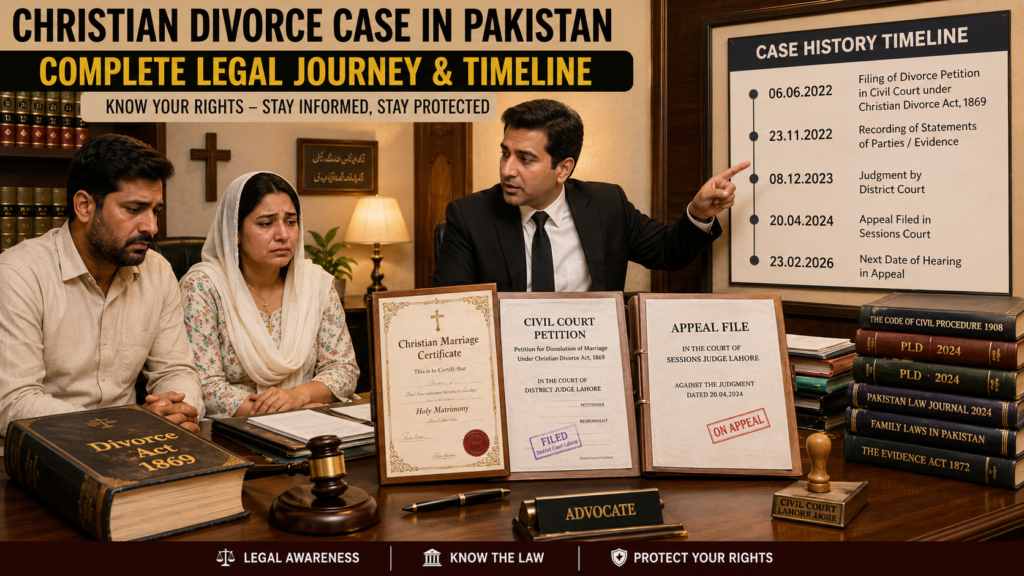
The petitioner and respondent No.3 were Christians by faith. They contracted marriage under the Catholic school of thought on 06 June 2022. After the relationship became disputed, the petitioner first filed a petition before the Civil Judge, Mianwali under Section 10 of the Divorce Act, 1869. His first petition was based on the ground of adultery.
The wife resisted that petition. The Civil Court dismissed it on 23 November 2022. The petitioner then filed an appeal. During the pendency of that appeal, he withdrew both the main petition and the appeal with permission to file a fresh petition. This permission was granted.
After that, the petitioner filed a fresh petition for judicial separation or dissolution of marriage under Sections 7 and 10 of the Divorce Act, 1869. This time, the main ground was cruelty. He claimed that the wife’s conduct caused him mental distress and agony, and that he could not reasonably be expected to live with her.
The wife again contested the petition. The trial court framed two main issues: whether the plaintiff was entitled to a decree for dissolution or separation of marriage, and whether he had no cause of action. Both parties appeared in evidence. The husband appeared as PW-1 and the wife appeared as DW-1. After hearing the matter, the Civil Judge dismissed the petition on 08 December 2023. The petitioner filed an appeal before the Additional District Judge, Mianwali, but that appeal was also dismissed on 20 April 2024.
After losing before both lower courts, the petitioner approached the Lahore High Court through a constitutional petition under Article 199 of the Constitution. This is how the matter reached the High Court.
The facts show that Christian Divorce in Pakistan should always be examined through the exact statutory grounds pleaded by the parties.
Why This Judgment Matters for Christian Divorce Cases
This judgment matters because it gives a balanced and dignified direction for Christian Divorce in Pakistan. The Court did not say that divorce should be granted automatically. It also did not say that allegations should be accepted without proof. Instead, it said that every legally available ground must be examined properly.
For lawyers and litigants, Christian Divorce in Pakistan is not only about filing a petition; it is about proving the correct legal ground.
This is why Christian Divorce in Pakistan requires careful drafting, proper evidence and a complete reading of the Divorce Act, 1869.
The lower courts dismissed the matter mainly because adultery was not proved. But the High Court noticed that the petitioner had also raised cruelty. The record also showed that the parties had been living separately. Therefore, desertion was also a legally relevant question. The lower courts should have framed proper issues and examined these grounds instead of treating the case only as an adultery case.
This is the central message of the judgment: justice is not served when a court ignores important parts of the case.
Petitioner’s Arguments
The petitioner’s counsel argued that both courts below misread the pleadings and evidence. According to him, the lower courts decided the case on adultery by applying Sections 10 and 11 of the Divorce Act, 1869, even though the petitioner had also relied on cruelty.
He argued that cruelty was recognized as a ground in previous judgments. He referred to Ameen Masih v. Federation of Pakistan and Saima v. Additional District Judge. He also relied on the idea that Section 7 of the Divorce Act had earlier allowed courts to act on principles followed by English divorce courts, and that modern understanding of matrimonial breakdown should not be ignored.
The petitioner appeared in the witness box and stated that the wife behaved in such a way that he could not reasonably be expected to live with her. His counsel argued that this part of his statement was not properly challenged. He further argued that the wife admitted that the parties had been living separately for more than one and a half years, and by the time of hearing the period had become more than two years.
On this basis, the petitioner requested the High Court to set aside the lower court judgments and grant relief.
His argument also shows that Christian Divorce in Pakistan may involve more than one ground, especially where cruelty and separation are both present.
Respondent’s Arguments
The respondent’s counsel opposed the petition. He argued that the lower courts had properly examined the evidence and rightly dismissed the petition. According to the respondent’s side, adultery and cruelty were not proved. The wife was also stated to be willing for reconciliation.
This was an important part of the case because the High Court had to balance both sides. The Court could not simply accept the petitioner’s version. It had to see whether the lower courts followed proper legal procedure and whether the evidence was considered according to law.
The respondent’s position reminds us that Christian Divorce in Pakistan cannot be granted merely on allegations unless the legal standard of proof is satisfied.
What the Trial Court Did
The trial court mainly focused on adultery. It observed that under Section 11 of the Divorce Act, where a husband files a petition on the ground of adultery, the alleged adulterer is ordinarily required to be made a co-respondent. The trial court noted that the petitioner had not named the alleged adulterer, had not shown positive efforts to trace that person, and had not produced documentary proof to support the allegation.
The trial court also held that because adultery was not proved, the claim of mental distress and agony could not help the petitioner. In short, the trial court treated the cruelty argument as dependent on adultery.
This was where the High Court found a serious problem. Cruelty should have been examined as a separate ground. The court should not have rejected cruelty simply because adultery was not proved.
This approach became problematic because Christian Divorce in Pakistan must not be reduced to one allegation only.
Where cruelty is pleaded, Christian Divorce in Pakistan requires the court to examine cruelty separately and independently.
What the Appellate Court Did
The Additional District Judge also dismissed the appeal. The appellate court observed that the petitioner had failed to prove adultery in the first round as well as in the second round of litigation. It also held that if the ground of mental distress and agony was available, it should have been mentioned earlier.
The High Court found that the appellate judgment was sketchy and stereotypical. It did not discuss the evidence of PW-1 and DW-1 in detail. It did not properly examine whether cruelty or desertion could be considered. It simply upheld the trial court’s decision without giving a complete legal analysis.
For Christian Divorce in Pakistan, this part of the judgment is very important. It shows that appellate courts must not just repeat the trial court’s conclusion. They must independently examine whether the trial court correctly applied the law.
An appellate judgment in Christian Divorce in Pakistan should clearly discuss the evidence, pleadings and legal grounds before confirming dismissal.
Two Moot Points Framed by the High Court
The Lahore High Court identified two main questions.
First, whether the allegations of adultery and cruelty had been decided after strict compliance with the evidentiary discipline required under the Civil Procedure Code and the Divorce Act, 1869.
Second, whether the plea of desertion was legally available on the facts and whether it was properly examined by the lower courts.
These two questions changed the direction of the case. The High Court did not treat the case as only an adultery dispute. It treated it as a broader matrimonial case involving proper evidence, proper issues and proper judicial reasoning.
These moot points are important because Christian Divorce in Pakistan depends on both statutory compliance and constitutional fairness.
Strict Proof of Adultery
The High Court explained that Christian marriage is treated as a solemn and enduring civil status. It is not dissolved lightly. There is no concept similar to divorce at will. Relief depends on strict proof of statutory grounds.
This means that if a party alleges adultery, the allegation must be proved through reliable and legally admissible evidence. An affidavit alone may not be enough. The evidence may require corroboration through witnesses or surrounding circumstances. This strict approach exists because allegations of adultery can damage dignity, reputation and personal honour.
The Court also linked this point with Article 14 of the Constitution, which protects dignity. It held that discussing or relying upon adultery in the absence of proper evidence is not only contrary to procedure but can also affect constitutional dignity.
This is a strong lesson for Christian Divorce in Pakistan. Serious allegations should not be made casually. If made, they must be supported by serious proof.
In Christian Divorce in Pakistan, an allegation of adultery should be handled with great care because it directly affects honour and dignity.
The judgment teaches that Christian Divorce in Pakistan should never be based on suspicion or unsupported accusations.
Cruelty Must Not Be Ignored
The petitioner had relied upon cruelty. He said that the conduct of the wife caused mental distress and agony. His counsel argued that there is no fixed standard for cruelty because it depends on conduct, behaviour and circumstances.
The High Court did not finally decide whether cruelty was proved. Instead, it held that the lower courts failed to examine this ground properly. This is a fair approach because the High Court was exercising constitutional jurisdiction, not sitting as a trial court.
In matrimonial cases, cruelty can be physical, mental or emotional. It may depend upon facts. Therefore, if cruelty is pleaded, the court should frame a proper issue, allow evidence, read the statements carefully and then decide whether the legal ground is made out.
This makes the judgment highly useful for understanding Christian Divorce in Pakistan because it reminds civil courts that cruelty cannot be buried under the failure of another allegation.
This is a major lesson for Christian Divorce in Pakistan because cruelty may exist even where adultery is not proved.
A fair trial in Christian Divorce in Pakistan requires the court to examine each pleaded ground on its own facts.
Desertion: More Than Living Separately
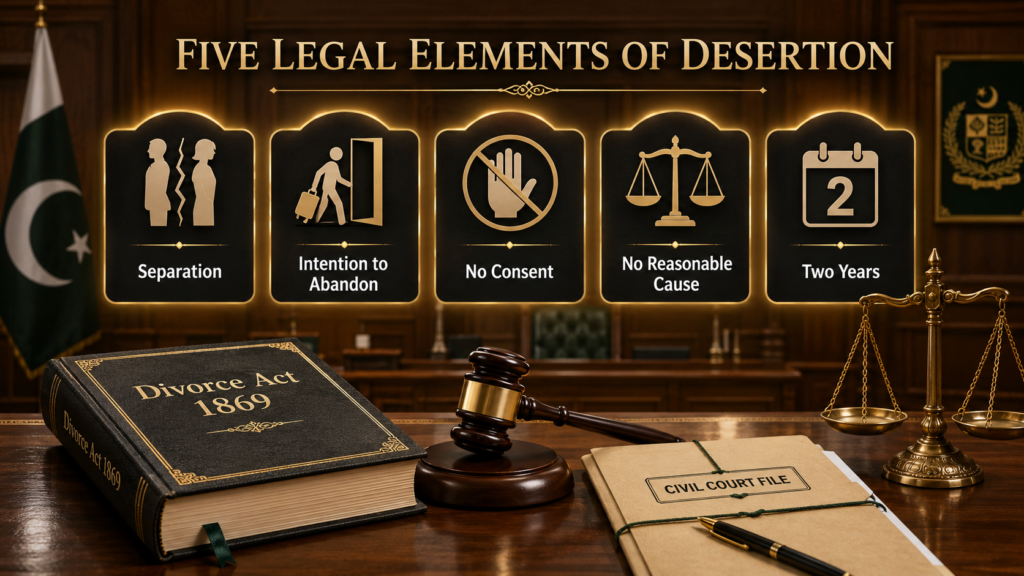
The High Court gave special attention to desertion. Section 3(9) of the Divorce Act explains desertion as abandonment against the wish of the person charging it. Section 22 allows judicial separation on the ground of desertion without reasonable excuse for two years or upwards.
But desertion is not just physical separation. The Court explained that it has essential ingredients. There must be actual separation. There must be intention to permanently abandon the matrimonial union. The separation must be without consent of the other spouse. It must be without reasonable cause. The required statutory period must also be completed.
The Court also explained that desertion may be actual or constructive. Actual desertion may occur when one spouse physically leaves. Constructive desertion may arise where conduct makes cohabitation impossible.
In this case, the wife admitted that the parties were living apart, although they had limited telephonic contact. The husband also appeared before the Court and stated that he had become engaged to another person and wanted formal separation. The High Court observed that the marital relationship had, in substance, ceased to operate as a matrimonial union.
This does not mean the High Court granted divorce directly. It means the trial court should have examined desertion as a legal ground.
Constitutional Protection of Christian Matrimonial Separation
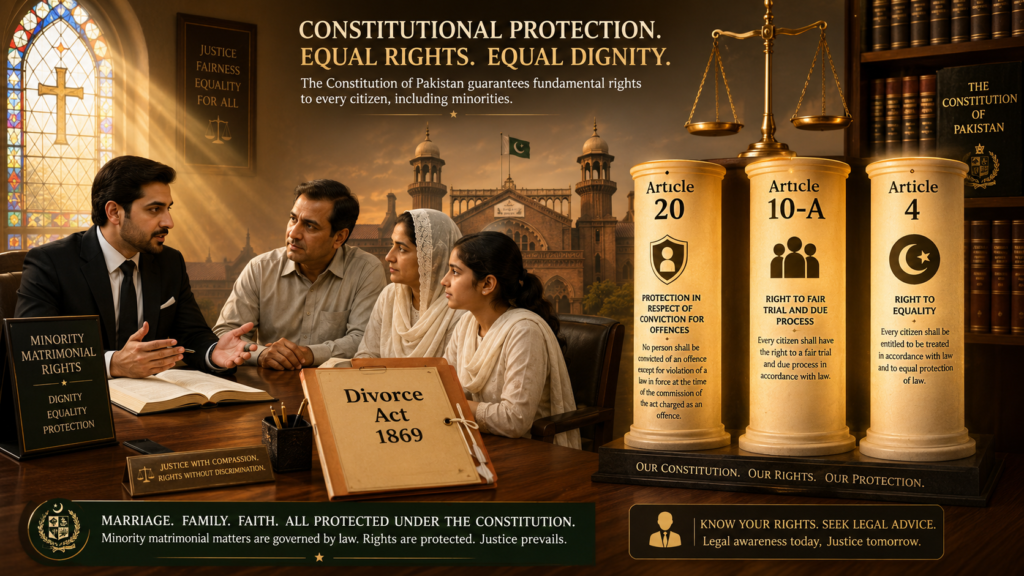
One of the most powerful parts of this judgment is the discussion on Article 20 of the Constitution. Article 20 protects the right of every citizen to profess, practice and propagate religion, subject to law, public order and morality. It also protects the right of every religious denomination to manage its religious institutions.
The High Court held that the right of Christian citizens to seek dissolution or judicial separation through civil courts is connected with their freedom to profess and practice religion and manage matters arising out of their religious law.
This makes Christian Divorce in Pakistan not just a family law issue, but also a constitutional rights issue. Minority matrimonial cases must be handled with sensitivity, equality and respect for faith-based autonomy.
The Court referred to constitutional principles showing that Article 20 protects Muslims and non-Muslims alike. It also protects individuals within their own faith communities. This means that a Christian citizen seeking matrimonial relief cannot be denied meaningful access to law merely because the courts failed to frame issues properly.
For deeper legal reading, readers may also check the official Pakistan Code page of the Divorce Act, 1869, because this statute is the basic law behind Christian matrimonial relief in Pakistan. The constitutional angle can also be understood through the official Constitution of the Islamic Republic of Pakistan available on Pakistan Code, especially where Article 20, Article 10-A, and Article 4 are discussed in relation to religious freedom, fair trial, and treatment according to law.
Fair Trial and Article 10-A
The judgment also discussed Article 10-A of the Constitution, which guarantees fair trial and due process. The High Court held that after Article 10-A became part of fundamental rights, courts are bound to follow procedural steps and avoid anything that causes prejudice to the rights of parties.
The Court also referred to Article 4, which says every citizen has the right to be dealt with in accordance with law. No action harmful to reputation, life or liberty should be taken except according to law.
In simple words, when a court ignores a pleaded ground, fails to consider admitted facts, or writes a sketchy judgment, it may affect fair trial. That is why Christian Divorce in Pakistan must be decided through proper procedure and careful reasoning.
Article 199 and the High Court’s Limited Role
The High Court explained that under Article 199 it can review judgments to see whether lower courts acted according to law and properly considered the evidence. But it cannot take over the role of the civil court. It cannot re-record evidence or pass a decree by acting like a trial court.
This is why the High Court did not decide the factual controversy itself. It did not say that the petitioner must get a decree. It said the lower court must decide the case again after framing proper issues and allowing both parties a meaningful opportunity.
This approach is legally balanced. It protects the petitioner’s right to have all grounds examined. It also protects the respondent’s right to contest the case.
Final Decision of the Lahore High Court
The Lahore High Court allowed the writ petition. It set aside the judgments and decrees dated 08 December 2023 and 20 April 2024 passed by the Civil Judge 1st Class, Mianwali and the Additional District Judge, Mianwali.
The matter was remanded to the trial court for fresh adjudication strictly in accordance with law. The Court directed that the trial court should render a reasoned and speaking judgment and avoid sketchy or stereotypical observations. The trial court was also directed to decide the matter within two months from receipt of the certified copy of the judgment.
Both parties were given liberty to move appropriate applications for framing of proper issues and production of additional evidence. The trial court was directed to decide such applications according to law while ensuring procedural fairness and meaningful hearing.
This final relief is very important in Christian Divorce in Pakistan because it shows that the High Court preferred fair re-trial over one-sided final relief.
Directions to District Judiciary and Punjab Judicial Academy
The judgment did not stop with the parties. The High Court also issued wider institutional directions.
The Director General, District Judiciary, Punjab was directed to circulate copies of the judgment to all District and Sessions Judges in Punjab. The purpose was to sensitize subordinate judiciary to strictly observe procedural discipline under the Divorce Act, Qanun-e-Shahadat Order and constitutional protections under Article 20.
The Court further directed that courts should ensure matrimonial causes of minority communities are decided with respect for faith-based autonomy, evidentiary rigor and equality before law.
A copy of the judgment was also ordered to be sent to the Director General, Punjab Judicial Academy. The Academy was directed to start appropriate training and workshops for subordinate judiciary on the interpretation and application of the Christian Divorce Act and constitutional principles discussed in the judgment.
These directions make the judgment more than a private matrimonial dispute. It becomes a guide for future cases.
The wider training direction is also relevant because Punjab Judicial Academy is the official judicial training institution connected with capacity building of judges and court staff in Punjab.
Key Legal Lessons from This Case
This judgment should also be read with our earlier guides on Divorce Procedure in Pakistan and Qanun e Shahadat Order because Christian Divorce in Pakistan depends not only on matrimonial law but also on proper pleadings, evidence, witnesses and fair trial procedure.
First, courts must not decide Christian matrimonial cases through technical shortcuts. If a case involves serious personal rights, substantial justice should not be defeated by incomplete reasoning.
Second, adultery must be proved strictly. It affects dignity and reputation. Courts must be careful before relying on such allegations.
Third, cruelty must be examined independently. A cruelty ground cannot be rejected merely because adultery is not proved.
Fourth, desertion is a serious legal ground. If parties are admittedly living apart, the court should examine whether the ingredients of desertion are present.
Fifth, Article 20 protects the religious freedom of Christian citizens. Their matrimonial disputes must be decided with respect for their faith-based legal framework.
Sixth, Article 10-A requires fair trial and due process. A court must give proper opportunity and write a reasoned judgment.
Seventh, Article 199 allows the High Court to interfere where lower courts ignore material evidence or fail to apply the law correctly.
Practical Checklist for Christian Matrimonial Cases
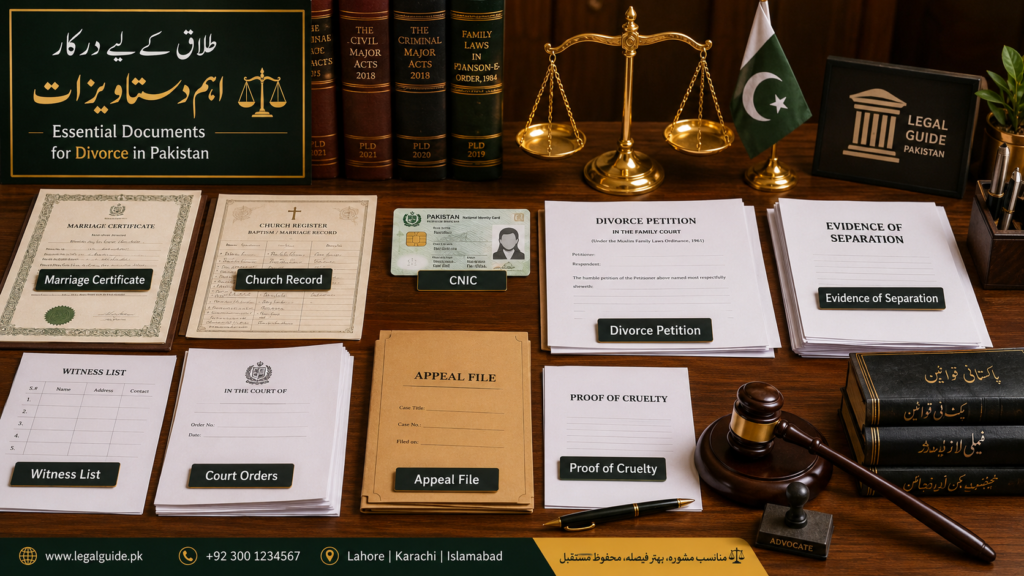
Anyone involved in such a dispute should keep documents ready before going to court. These may include:
- Marriage certificate
- Church marriage record, if available
- CNIC copies of both spouses
- Previous petition and appeal documents
- Certified copies of all court orders
- Evidence of separation
- Call records or messages, if legally relevant
- Witness list
- Any proof of cruelty
- Any proof relating to desertion
- Any documentary evidence supporting the pleaded ground
- Properly drafted plaint or petition with clear facts
A weak file can damage even a genuine case. A properly prepared file helps the court decide fairly.
Conclusion
Christian Divorce in Pakistan is a sensitive legal subject because it involves marriage, faith, dignity, minority rights, evidence and fair trial. PLD 2026 Lahore 206 is an important Lahore High Court judgment because it reminds courts that justice cannot be delivered through incomplete reasoning.
The High Court did not accept allegations blindly. It did not grant relief without trial. It did not ignore the respondent’s right to contest the case. Instead, it restored the case to the proper legal path. It directed the trial court to frame proper issues, allow evidence, examine cruelty and desertion, and decide the matter through a reasoned judgment.
This judgment gives a strong message: Christian matrimonial cases must be handled with dignity, sensitivity and legal discipline. Allegations must be proved. Rights must be protected. Minority faith-based matrimonial law must be respected. And every person, regardless of religion, deserves a fair hearing under the Constitution of Pakistan.
Disclaimer
This article is for legal awareness and educational purposes only. It is not legal advice. For any personal matrimonial dispute, consult a qualified lawyer with complete documents and facts.
FAQs
What is the main point of PLD 2026 Lahore 206?
The main point is that courts must properly examine adultery, cruelty and desertion in Christian matrimonial cases and must not decide such matters through sketchy reasoning.
Did the Lahore High Court grant divorce directly?
No. The High Court set aside the lower court judgments and remanded the case to the trial court for fresh adjudication.
Why was adultery not accepted automatically?
Because adultery is a serious allegation affecting dignity and reputation. It requires cogent and legally admissible evidence.
Can cruelty be a separate ground?
Yes. If cruelty is pleaded, it should be examined separately on the basis of facts and evidence.
What is desertion under the Divorce Act, 1869?
Desertion means abandonment against the wish of the person charging it. It requires separation, intention to abandon, lack of consent, lack of reasonable cause and completion of the statutory period.
Why is Article 20 important in this case?
Article 20 protects religious freedom. The Court connected Christian matrimonial relief with the constitutional right of Christian citizens to manage matters arising from their religious law.
Why is Article 10-A important?
Article 10-A guarantees fair trial and due process. A court must follow proper procedure and give both parties a meaningful hearing.
What mistake did the lower courts make?
They mainly focused on adultery and did not properly examine cruelty, desertion and admitted separation.
What does a speaking judgment mean?
A speaking judgment explains facts, issues, evidence, law, reasoning and final conclusion clearly.
Is this judgment useful for future cases?
Yes. It gives guidance to trial courts, appellate courts, lawyers and litigants about how Christian matrimonial cases should be handled.