


A case can look strong outside the courtroom and still become weak when the judge asks one basic question: how will this fact be proved? A photocopy may exist, a witness may support your story, a WhatsApp message may appear genuine, or a registered deed may be on record. Yet none should be treated as automatically conclusive. The Qanun e Shahadat Order controls relevance, admissibility, documentary proof, electronic material, witnesses, presumptions, burden of proof and cross-examination.
The Qanun e Shahadat Order is Pakistan’s principal evidence law. It was promulgated as President’s Order No. X of 1984 on 28 October 1984. Article 1 extends it to the whole of Pakistan and generally applies it to judicial proceedings before courts, courts-martial, tribunals and authorities exercising judicial or quasi-judicial powers, while expressly excluding proceedings before an arbitrator. Readers can check the official Qanun-e-Shahadat Order, 1984 on Pakistan Code.
Table of Contents
Evidence Law at a Glance: What the Order Actually Controls
| Point | Position |
|---|---|
| Law | Qanun-e-Shahadat, 1984 |
| Legal form | President’s Order No. X of 1984 |
| Promulgation | 28 October 1984 |
| Territorial extent | Whole of Pakistan |
| Core subject | Relevancy, proof, witnesses, documents, presumptions and burden of proof |
| Documentary evidence | Articles 72–89 and related presumptions |
| Burden of proof | Articles 117–129 |
| Examination of witnesses | Articles 130–161 |
| Modern-device evidence | Article 164 and related electronic-evidence provisions |
| Latest enacted amendment checked | Qanun-e-Shahadat (Amendment) Act, 2025 |
| 2026 proposal | Committee-reported Bill; not treated here as enacted law |
The official Pakistan Code records the law as President’s Order No. X of 1984 with a promulgation date of 28 October 1984. The Sindh Judicial Academy has also published a consolidated version identifying Federal Act No. XLI of 2025 as the latest amendment incorporated into its text.
IRAC Framework: Turning an Allegation into Legally Provable Fact
| IRAC | Evidence Question |
|---|---|
| Issue | What disputed fact must actually be proved? |
| Rule | Which Article of the Qanun e Shahadat Order or special statute controls that proof? |
| Analysis | Is the material relevant, admissible, authentic and proved through the legally required method? |
| Conclusion | Has the party discharged the burden attached to that fact? |
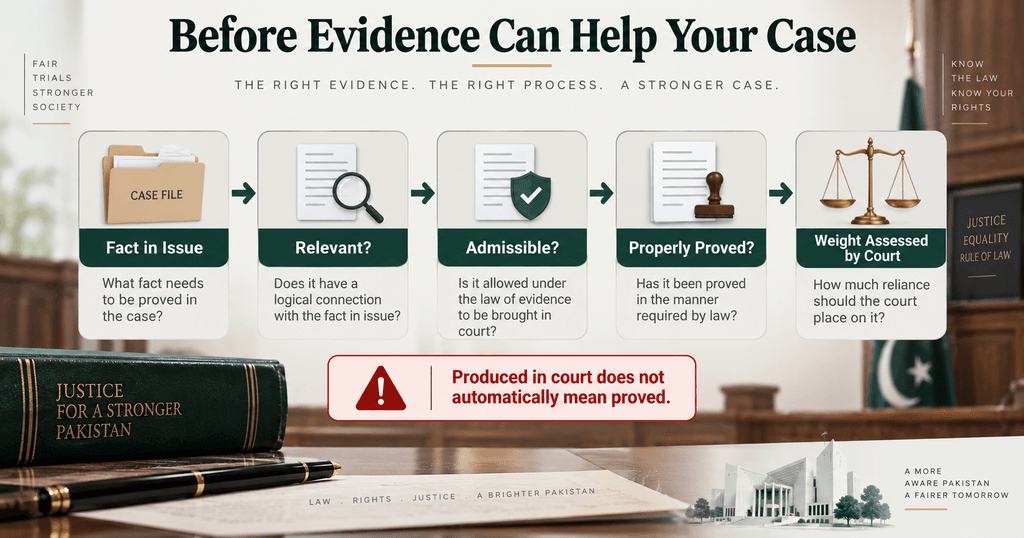
This framework separates possession of material from legal proof. The Qanun e Shahadat Order asks not only whether something exists, but why it is relevant, whether the law permits it, how it is proved and what evidentiary weight it deserves.
Relevance Comes Before Volume of Evidence
Article 18 states the basic rule that evidence may be given of facts in issue and of other facts declared relevant by the Order. The following Articles cover connections such as the same transaction, cause or effect, motive, preparation, conduct, conspiracy, intention and ordinary course of business.
Parties often collect papers that do not prove the point they think they prove. A mutation may show a revenue entry without proving the validity of the transaction behind it. A bank transfer may show that money moved without proving why it was paid.
Identify each disputed fact first and then match evidence to it. The Qanun e Shahadat Order works best when a case is built fact-by-fact rather than page-by-page.
Witness Competency, Direct Knowledge and Privilege
Article 3 deals with competency to testify. Generally, a person may testify unless the court considers that the person cannot understand the questions or give rational answers because of tender years, extreme old age, disease or another similar cause.
The law also regulates communications during marriage, affairs of State, official communications and professional communications. Article 9 protects professional communications between advocate and client, subject to statutory exceptions, including communications made in furtherance of an illegal purpose.
Article 71 generally requires oral evidence to be direct. If a fact could be seen, the evidence should ordinarily come from a person who says that he or she saw it; the same principle applies to matters heard or otherwise personally perceived.
So the practical question is not merely “Who supports me?” It is: What did this witness personally see, hear or do, and can that evidence lawfully be received? The Qanun e Shahadat Order places importance on direct, testable evidence rather than repetition of another person’s story.
Admissions and Confessions Need Context
Articles 30 onward regulate admissions. Article 45 makes clear that an admission is not automatically conclusive proof, although in an appropriate case it may operate as estoppel.
Confessions receive stricter treatment in criminal proceedings. Article 38 deals with a confession made to a police officer, Article 39 addresses confession while an accused is in police custody, and Article 40 concerns the limited part of information that distinctly relates to a discovered fact.
The Qanun e Shahadat Order therefore does not support the shortcut: “He admitted it, so the case is over.” The court must consider who made the statement, to whom it was made, the surrounding circumstances and the legal purpose for which it is relied upon.
Where the alleged admission appears in a digital conversation, preserve the complete conversation rather than only the sentence that appears helpful.
Dying Declarations and Statements of Unavailable Persons
Article 46 covers specified statements made by persons who are dead, cannot be found, have become incapable of giving evidence, or whose attendance cannot reasonably be obtained.
One familiar category is a statement about the cause of a person’s death or the circumstances of the transaction resulting in death where that person’s cause of death is in question.
Article 46 also covers specified business, interest, public-right and relationship statements. Relevance does not mean automatic truth. Even where the Qanun e Shahadat Order makes a statement relevant, the court still evaluates reliability in light of the whole record.
Original, Copy or Certified Record? The Documentary Proof Ladder
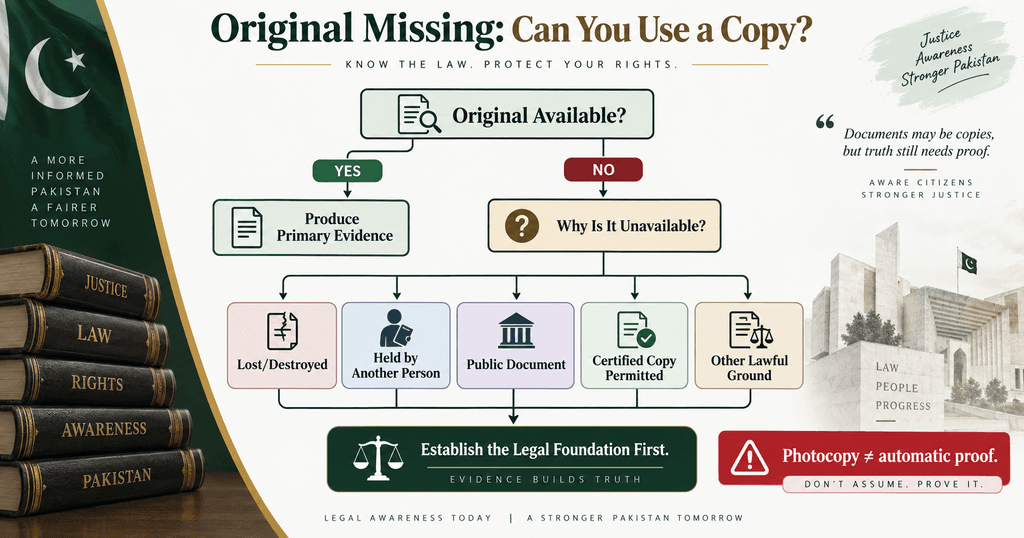
Article 72 allows the contents of documents to be proved by primary or secondary evidence. Article 73 defines primary evidence principally as the document itself produced for inspection of the court, while Article 74 identifies forms of secondary evidence.
Article 75 states the general rule that documents must be proved by primary evidence except where the law permits otherwise. Article 76 identifies circumstances in which secondary evidence may be given. Depending on the particular clause and facts, these may include loss or destruction of the original, an original held by another person who does not produce it after the legally required process, public documents, or documents for which certified copies are legally permitted.
The Qanun e Shahadat Order therefore does not create a blanket rule that “a photocopy is enough.” A party relying on secondary evidence should be ready to establish the legal basis that permits departure from the original.
This becomes particularly important in disputes involving gifts, old sale transactions and powers of attorney. See Gift Deed Law in Pakistan and Property Law and Power of Attorney Fraud for related examples.
Registered Does Not Mean Automatically Proved: Article 79
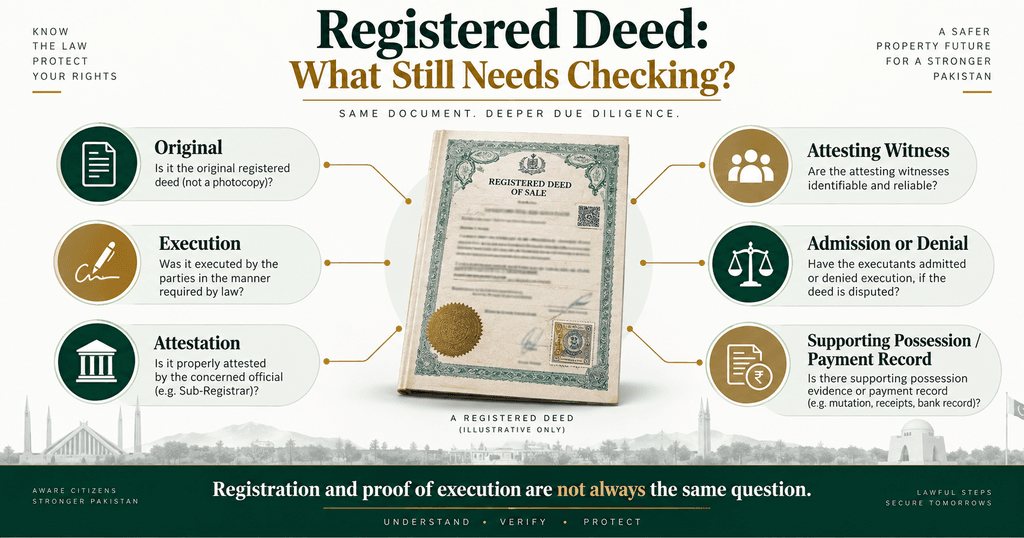
Article 79 deals with proof of execution of a document required by law to be attested. Related Articles address situations where no attesting witness can be found, execution is admitted, or an attesting witness denies or does not remember execution.
This distinction is important in property and inheritance disputes. Registration may be significant, but registration, execution, attestation, consideration, possession and legal validity are not necessarily the same issue.
Before relying upon an important deed, check:
- whether the original is available;
- whether the document is legally required to be attested;
- who executed and attested it;
- whether the attesting witnesses are available;
- whether execution is admitted or specifically denied;
- whether secondary evidence is being sought and on what statutory basis;
- what independent record supports possession, payment or surrounding circumstances.
The Qanun e Shahadat Order forces a useful distinction between “this document exists” and “this document has been proved in the manner required by law.”
Public Records and Certified Copies
Articles 85 to 89 distinguish public and private documents and deal with certified copies and proof of public documents. The following Articles create presumptions concerning specified categories of documents.
This matters in disputes involving court files, public registers, registered instruments and revenue records. A certified copy may have an evidentiary status that an ordinary photocopy does not, but the existence of a certified public record does not necessarily settle the underlying title or transaction.
For example, a certified mutation may establish what entry appears in the revenue record. Whether that entry proves the claimed ownership may still require examination of the transaction and substantive property law.
For related property-proof issues, see Property Sales in Pakistan.
Electronic Evidence: Preserve the Source, Not Just the Screenshot

Pakistan’s evidence law expressly recognises electronic material. The official Electronic Transactions Ordinance, 2002 introduced important electronic-document concepts into the evidentiary framework.
Article 46-A recognises statements in electronic documents generated, received or recorded by an automated information system while it is in working order as relevant facts. Article 73 also contains provisions concerning outputs and reproductions of electronic documents.
Article 164 was later substituted through the Criminal Laws (Amendment) Act, 2023. The provision accommodates evidence or witnesses recorded by the court through modern devices or techniques, depending upon the nature and circumstances of the case.
The Qanun e Shahadat Order therefore clearly accommodates modern technology, but authenticity still matters.
Where a party relies upon CCTV, email, WhatsApp, photographs, audio recordings or other electronic material, preserve as much of the original source as reasonably possible: the device or original file, complete conversation, dates, timestamps, account details, backups and available metadata. If authenticity is genuinely disputed, expert or forensic material may become important.
A screenshot is neither automatically worthless nor automatically decisive. The real questions are what it proves, where it came from, whether it is authentic, and whether the other party can fairly test it.
Burden of Proof: Who Must Establish the Fact?
Articles 117 to 129 contain the central burden-of-proof provisions. Article 117 concerns the person who asks the court to determine a legal right or liability dependent upon facts asserted by that person. Article 118 addresses the party who would fail if no evidence were produced.
Article 120 is especially practical. A person who wants to give particular evidence must establish any preliminary fact necessary to make that evidence admissible. One statutory illustration concerns secondary evidence of a lost document: the loss has to be established before secondary evidence of its contents can be relied upon.
Article 122 deals with facts especially within the knowledge of a person.
The Qanun e Shahadat Order therefore does not allow accusation to replace proof. In fraud, inheritance or property litigation, the burden may move from issue to issue according to the pleadings, admissions, denials and nature of the particular fact.
For a connected property context, see Inheritance Dispute in Pakistan.
Cross-Examination Tests Reliability
Articles 130 onward regulate the production and examination of witnesses. Examination-in-chief presents the witness’s evidence. Cross-examination tests it. Re-examination may deal with matters arising from cross-examination within the permitted scope.
Cross-examination may expose contradictions, bias, lack of personal knowledge, missing documents or changed versions. Article 140 deals with previous statements in writing and Article 151 addresses impeaching the credit of a witness.
The Qanun e Shahadat Order also gives the judge an active role. Article 131 concerns admissibility of evidence and Article 161 concerns the court’s power to put questions or order production in accordance with law.
A witness should therefore be prepared not only for what he intends to say, but also for the documents and earlier statements through which his evidence may be tested.
Special Forums Can Change the Evidence Rules
A professional evidence guide must state an important limitation: the Qanun e Shahadat Order does not operate identically in every statutory forum.
Article 1 itself excludes proceedings before an arbitrator. More importantly for ordinary citizens, section 17 of the official Family Courts Act, 1964 provides that, save as otherwise expressly provided by or under that Act, the Qanun-e-Shahadat and Code of Civil Procedure do not apply to Family Court proceedings concerning Part I of the Schedule.
That Part includes matters such as dissolution of marriage, dower, maintenance, custody, guardianship, dowry and specified personal property matters.
A party in a Family Court matter should therefore not mechanically apply ordinary civil evidence procedure without first checking the special statutory procedure applicable to that forum.
What Changed in 2023 and 2025—and the Status of the 2026 Bill
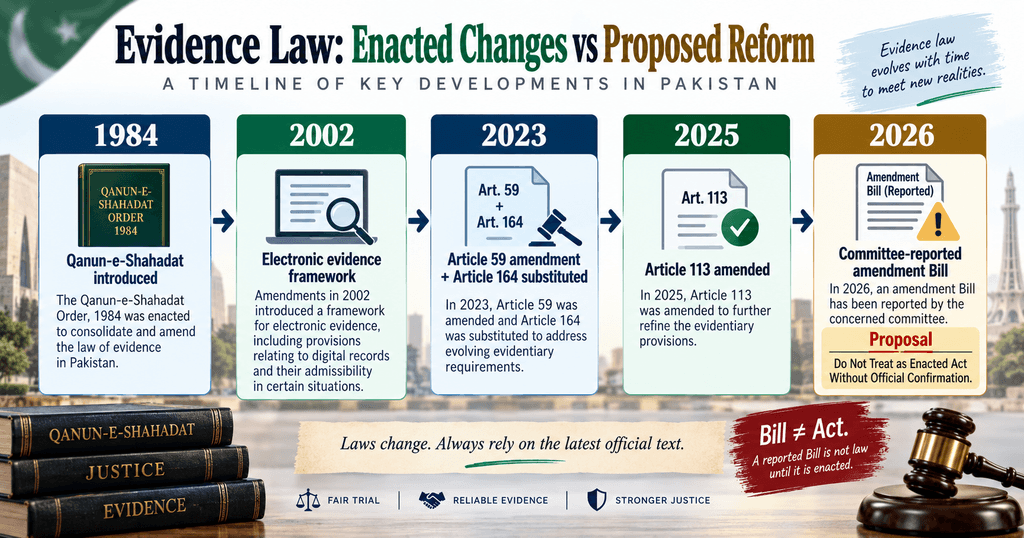
The Qanun e Shahadat Order has continued to change after 1984.
The Qanun-e-Shahadat (Amendment) Act, 2023 amended Article 59 by adding “bomb disposal” to the fields in which expert opinion may become relevant. The National Assembly’s official Acts record lists the amendment as Act No. XXXIX of 2023.
The Criminal Laws (Amendment) Act, 2023 separately substituted Article 164, which deals with evidence available through modern devices or information systems.
The Qanun-e-Shahadat (Amendment) Act, 2025 is Act No. XLI of 2025. The consolidated version published by the Sindh Judicial Academy records the amended wording “rule of pleading” in Article 113 and identifies Federal Act No. XLI of 2025 dated 24 December 2025 as the source of that substitution.
There is also a 2026 legislative proposal. The official Qanun-e-Shahadat Amendment Bill committee report proposed changes to Articles 59, 61 and 84 concerning forensics and expert reference. The National Assembly Orders of the Day subsequently included motions for consideration and passage of that Bill.
However, for this update, no corresponding Qanun-e-Shahadat (Amendment) Act, 2026 appears in the official National Assembly or Senate Acts lists checked through 5 September 2026. Accordingly, this article treats the 2026 measure as a legislative proposal rather than enacted current law.
That distinction is important: a Bill, a committee report, a motion for passage and an enacted Act are different legal stages.
Evidence Preparation Before Filing: Build a Proof Map
Before filing or defending a case, write each important allegation in one column and the evidence that will prove or disprove it in another.
For a property or inheritance dispute, preserve original deeds, certified registration and revenue records, mutations, payment material, possession evidence, powers of attorney, death and family records, and witness details.
For digital disputes, preserve original devices or files where practical, complete chats, audio or video, account information, timestamps and backups.
For criminal matters, preserve the complaint or FIR material together with any relevant medical, forensic, recovery, CCTV, photographic, digital or witness record.
The Qanun e Shahadat Order rewards early preparation because originals disappear, witnesses become unavailable and digital information can be overwritten.
Common Qanun e Shahadat Order Evidence Mistakes to Avoid
Common evidence problems include:
- treating a photocopy as automatically equal to the original;
- confusing registration with proof of execution;
- treating a mutation as if it answers every title question;
- producing a cropped digital conversation without preserving the source;
- failing to identify an attesting witness in time;
- assuming an allegation automatically shifts the entire burden to the other side;
- ignoring contradictions in earlier statements;
- overlooking a special statute that changes ordinary evidence procedure.
More evidence is not necessarily better evidence. The objective is to collect the right proof for the right disputed fact.
Qanun e Shahadat Order: What to Do When Evidence Is Missing, Disputed or Withheld
If an original document is missing, first establish why it is unavailable and whether Article 76 or another applicable provision permits secondary evidence.
If the original is held by another person, use the legally applicable process for notice or production instead of assuming that a copy will automatically be accepted.
If execution of an attested document is denied, examine Articles 79 to 82. If handwriting, signature, electronic authenticity or another technical matter is genuinely disputed, consider whether expert evidence under Article 59 and related provisions becomes relevant.
If a public record matters, obtain the proper certified copy from the competent authority. If electronic material may disappear, preserve it promptly and avoid unnecessary alteration of the source.
The Qanun e Shahadat Order provides rules of proof; it does not create every civil or criminal remedy. The relief available depends upon the substantive law, forum, pleadings and proved facts. No evidence rule guarantees a favourable result.
Conclusion: Good Facts Need Good Proof
The Qanun e Shahadat Order is best understood as a method for testing a case. The court asks what fact matters, who must prove it, whether the evidence is relevant, whether it is admissible, whether documents or electronic records have been properly proved, and what survives cross-examination.
For litigants, the practical lesson is simple: preserve originals, obtain certified records early, keep complete digital material, identify witnesses, understand the burden attached to each allegation and check whether a special statute changes ordinary procedure.
Strong facts are valuable. Strong, legally provable facts are what a court can act upon.
Frequently Asked Questions
1. What is the Qanun e Shahadat Order?
The Qanun e Shahadat Order is Pakistan’s principal law of evidence. It regulates relevant facts, oral and documentary evidence, admissions, confessions, expert opinion, public documents, presumptions, burden of proof and examination of witnesses. It was promulgated as President’s Order No. X of 1984.
2. Does the Qanun e Shahadat Order apply to every court proceeding?
Not in exactly the same way. Article 1 generally applies it to judicial proceedings before courts, courts-martial, tribunals and judicial or quasi-judicial authorities, but excludes arbitration. Special statutes can alter the ordinary position. Section 17 of the Family Courts Act, 1964 is an important example.
3. Can a photocopy be used instead of the original document?
Sometimes, but not automatically. Articles 72 to 76 distinguish primary and secondary evidence. A party relying on secondary evidence must bring the case within a legally recognised situation, such as loss or destruction of the original, non-production by another person after the required process, or a public document for which certified proof is permitted.
4. Is a registered sale deed or gift deed automatically proved?
No. Registration may be important, but the court may still need to examine execution, attestation, authenticity and the substantive law governing the transaction. Where a document is required by law to be attested, Article 79 and related provisions can become important to its proof.
5. Are WhatsApp messages, CCTV footage and other digital records admissible?
They can be relevant and admissible in appropriate cases. Pakistan’s evidence framework recognises electronic documents and modern-device evidence through provisions including Article 46-A, electronic-document rules connected with the Electronic Transactions Ordinance, 2002, and Article 164. Authenticity, context, source integrity and the purpose for which the material is produced still matter.
6. Who carries the burden of proof?
Generally, the person asking the court to determine a legal right or liability on facts asserted by that person must prove those facts. The burden can move on particular issues. Article 122 also deals with a fact especially within a person’s knowledge.
7. What should I do if original or digital evidence may disappear?
Preserve the best available source immediately. For documents, locate the original or obtain the proper certified public record. For electronic evidence, preserve the original device or file where practical, complete conversations, dates, timestamps, account details and backups. Obtain case-specific advice before altering or discarding important material.
8. Was the Qanun e Shahadat Order amended in 2026?
A 2026 amendment Bill was reported by the National Assembly Standing Committee and proposed changes to Articles 59, 61 and 84. However, the official Acts lists checked for this article did not show a corresponding Qanun-e-Shahadat (Amendment) Act, 2026 as of 5 September 2026. The proposal should therefore not be presented as enacted current law unless a later official Act or Gazette confirms it.
Qanun e Shahadat Order Legal Disclaimer
This article is for legal awareness and educational purposes only. It is not legal advice for a particular dispute. Evidence questions depend on pleadings, substantive law, forum, facts, available record, objections and current legislation. Obtain case-specific advice from a qualified lawyer before filing, admitting, abandoning or relying upon important evidence.