

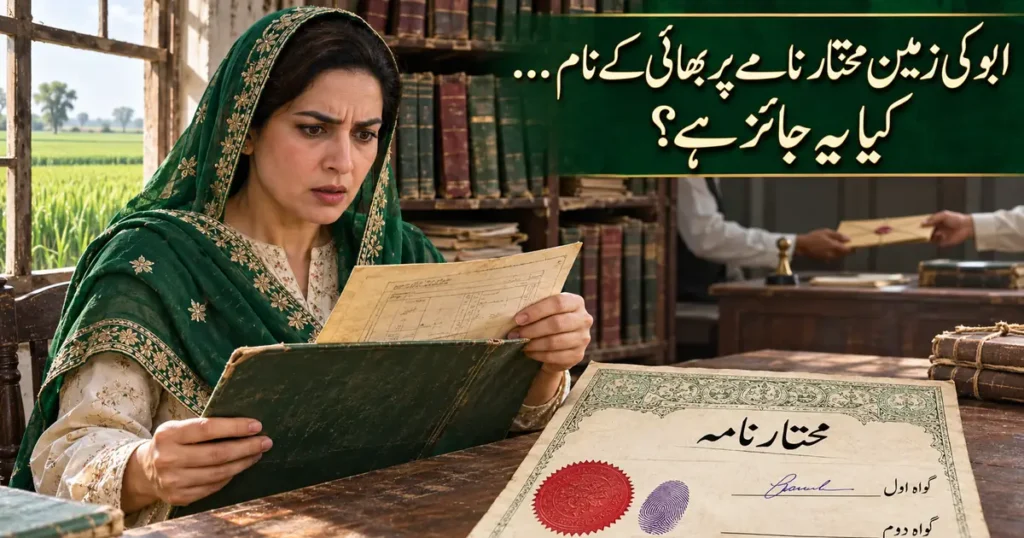
One signature on a stamp paper can quietly move a family’s land, and the heirs may only find out at the patwari’s desk after a funeral. That is what a daughter in Gujranwala discovered. Power of attorney law in Pakistan decides whether such a transfer survives, and in 2026 MLD 320 the Lahore High Court answered clearly.
A son, claiming to be his father’s general attorney, had sold more than 98 kanal to his own real brother just 17 days before the father died. The courts refused to let that sale defeat the daughter’s inheritance.
This guide explains the judgment and the wider power of attorney law in Pakistan in plain words: what a power of attorney (mukhtar nama) is, how a valid one is made, when it ends, what an attorney cannot do, and what heirs should do if family land was shifted behind their back.
Table of Contents
Judgment at a Glance: 2026 MLD 320
| Point | Detail |
|---|---|
| Court | Lahore High Court, Lahore |
| Bench | Justice Ch. Muhammad Iqbal (single bench) |
| Case | Civil Revision No. 1913 of 2014 |
| Citation | 2026 MLD 320 |
| Date of decision | 30 April 2025 |
| Parties | Muhammad Mansha and 5 others (petitioners) v. Saleem Bibi (respondent) |
| Came from | Civil Judge, Gujranwala dismissed the suit (13 March 2010); Additional District Judge, Gujranwala decreed it on appeal (17 May 2014) |
| Law involved | Contract Act 1872 (ss. 188, 214); Qanun-e-Shahadat Order 1984 (Arts. 17, 79, 80, 129(g)); Specific Relief Act 1877 (ss. 39, 42); CPC (s. 115) |
| Result | Revision dismissed; the daughter’s appellate decree stands; no order as to costs |
The Case in Four Lines: IRAC Summary
| IRAC | In simple words |
|---|---|
| Issue | Was the general power of attorney validly made and proved, and could the attorney sell his father’s land to his own brother? |
| Rule | Two attesting witnesses for a disputed attested document (Arts. 17, 79 QSO); Art. 80 if a witness is dead; withheld evidence is presumed adverse (Art. 129(g)); explicit permission needed for a sale to a close relative; fraud destroys all that rests on it |
| Analysis | One marginal witness; no Sub-Registrar, Patwari, Tehsildar or gift witness produced; no Art. 80 effort; no permission for the sale to the brother; fraud found |
| Conclusion | The power of attorney and the transactions based on it could not stand; the appellate decree for the daughter was upheld |
Power of Attorney Law in Pakistan: The Basics
Under power of attorney law in Pakistan, a power of attorney is a written document in which one person, the principal, allows another person, the attorney or agent, to act in his name. In Urdu it is usually called a mukhtar nama. The attorney can only do what the document allows, and only while that authority lasts.
Which Laws Govern a Power of Attorney?
Power of attorney law in Pakistan is not one single statute. Five laws work together:
- Powers-of-Attorney Act, 1882: an act done by the attorney under the power counts as the principal’s own act (section 2).
- Contract Act, 1872, Chapter X: the attorney’s authority (section 188), duties (sections 211 to 218) and how the agency ends (section 201).
- Registration Act, 1908: registration and authentication before the Sub-Registrar.
- Stamp Act, 1899: the stamp duty payable on the document.
- Qanun-e-Shahadat Order, 1984: how a disputed power of attorney is proved in court.
General vs Special Power of Attorney
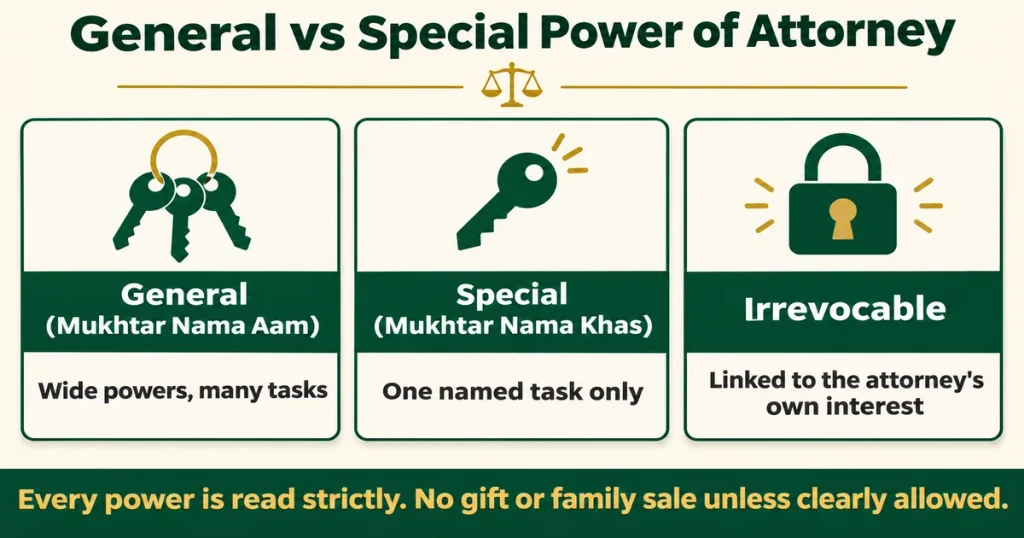
| Type | Urdu term | What it allows | Common use |
|---|---|---|---|
| General | Mukhtar nama aam | Wide powers over many matters | Managing land, dealing with offices, selling if the document says so |
| Special | Mukhtar nama khas | One named task only | Selling one plot, appearing in one case |
| Irrevocable | Interest-linked | Cannot be cancelled to hurt the attorney’s own interest (section 202, Contract Act) | When the attorney has a stake in the property |
Even a general power has limits. Power of attorney law in Pakistan reads every power strictly, so a power to manage or sell land does not automatically include a power to gift it or to sell it to the attorney’s own family. For more risks, see our guide on general power of attorney in Pakistan.
How a Valid Power of Attorney Is Made in Pakistan
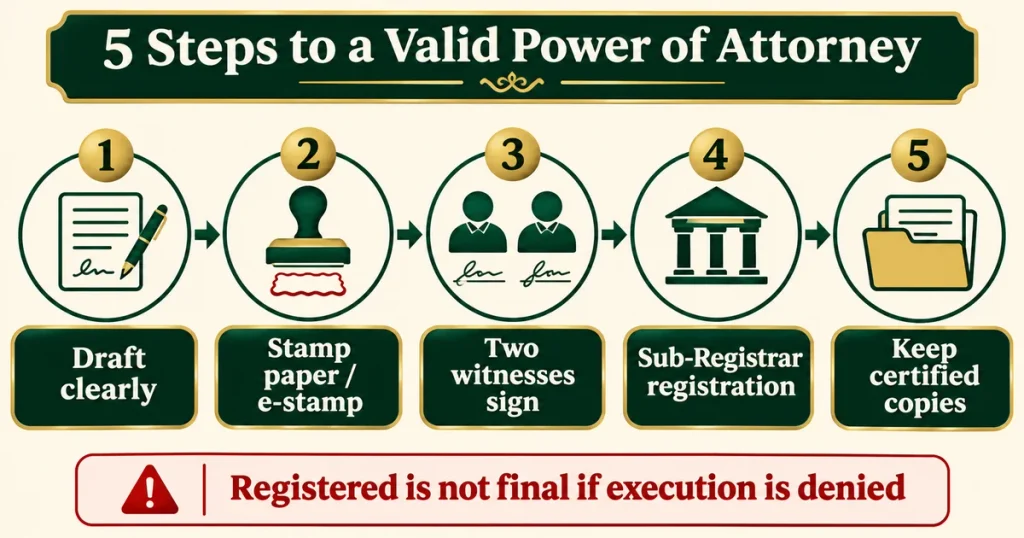
Power of attorney law in Pakistan cares most about proof. If a power of attorney will be used for land, each step below becomes evidence if the document is ever challenged.
- Draft it clearly. Name the property (khasra and khewat numbers), list each power, and say plainly whether the attorney may transfer to himself or his relatives.
- Use the right stamp paper or e-stamp. Duty depends on the type of power and the province, so confirm it at the Sub-Registrar’s office.
- Sign before two witnesses. In this judgment the Lahore High Court treated two attesting witnesses as mandatory under Article 17 of the Qanun-e-Shahadat Order.
- Execute it before the Sub-Registrar. For property, it is normally registered or authenticated there, with photographs and thumb impressions on record.
- Keep certified copies. Note the registration number and date, and tell the family.
Registration helps, but it is not a shield. Under the proviso to Article 79, a registered document can be proved without calling its attesting witnesses only when its execution is not specifically denied. In PLD 2018 SC 698 the Supreme Court explained that this denial can come from the party against whom the document is used, such as an heir. Here, the daughter flatly denied that her father ever signed any power of attorney.
Overseas Pakistanis: Embassy or NADRA Online
Power of attorney law in Pakistan also lets a Pakistani living abroad sign before a Pakistani embassy or consulate. Holders of a NICOP, CNIC or POC may instead use the NADRA online power of attorney portal, run with the Ministry of Foreign Affairs. It uses biometrics of the executant and two witnesses plus a video interview. Before using it for land, ask the Sub-Registrar or housing authority what further step it needs.
When Does a Power of Attorney End?
Power of attorney law in Pakistan also fixes when the authority stops. Under section 201 of the Contract Act, an agency ends when:
- the principal revokes it;
- the attorney gives it up;
- the work is completed;
- the principal or the attorney dies or becomes of unsound mind; or
- the principal is declared insolvent.
The main exception is an agency coupled with the attorney’s own interest (section 202). To cancel a power yourself, sign a written revocation, record it where the original was registered, and notify the attorney and the offices holding your property record. We have also explained what happens to a sale made after an attorney’s power had ended.
In this case the sale mutations came 17 days before the father’s death, so the fight was not about a power used after death. It was about whether the power existed lawfully at all.
The Story Behind 2026 MLD 320
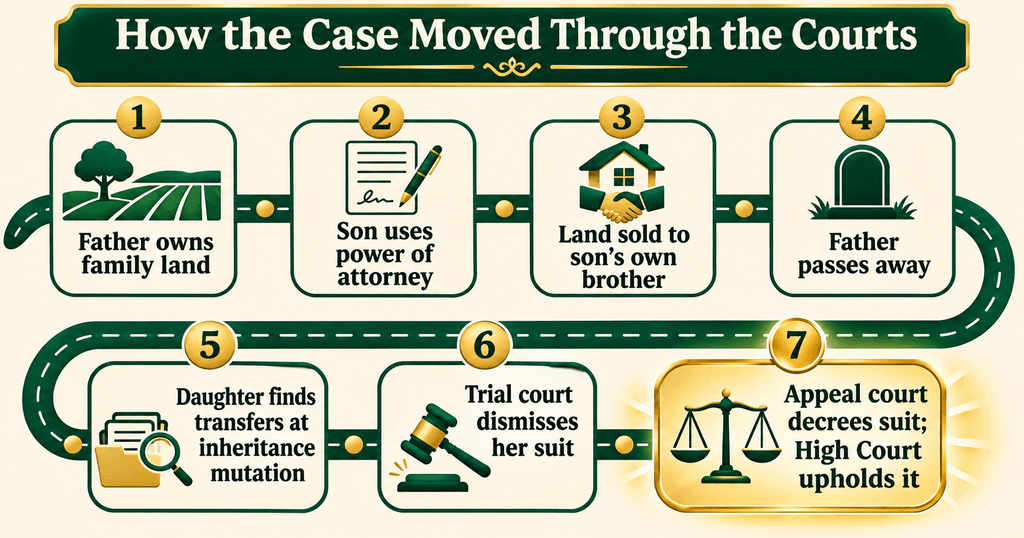
Here is how one family’s quarrel became a lesson in power of attorney law in Pakistan. Ghulam Nabi owned land in three mauzas of Tehsil Noshehra Virkan, District Gujranwala. He married twice. From his first wife, Mst. Sardaran Bibi, he had Muhammad Mansha and Saleem Bibi. From his second wife, Mst. Nazar Begum, he had petitioners Nos. 2 to 5, including Muhammad Sharif and Saifullah. Notably, Mansha, Saleem Bibi’s own full brother, stood with the petitioners.
Ghulam Nabi died on 11 March 2006. When Saleem Bibi’s husband approached the Halqa Patwari for the inheritance mutation (wirasat intiqal), the record showed earlier transfers:
- Sale mutation No. 215 (22 February 2006): 14 kanal 17 marla in Mauza Kotli Mansu.
- Sale mutation No. 448 (22 February 2006): 83 kanal 14 marla in Mauza Hardo Kalleywala.
- Gift mutation No. 452 (24 April 2000): 192 kanal in favour of the defendants.
Both sale mutations were made by Muhammad Sharif, acting as his father’s general attorney, in favour of his real brother Saifullah.
The Daughter’s Claim and the Brothers’ Defence
Saleem Bibi filed a suit for declaration and cancellation. She alleged that her father had been severely ill for four to five years before his death, was not mentally stable, and could not have recorded any statement to transfer land. She called power of attorney No. 210 bogus and said the mutations were passed in connivance with revenue officials.
The defendants contested the suit. The judgment records no separate arguments of counsel, but their stand is clear from their evidence: Muhammad Sharif said his father had appointed him general attorney, and that as attorney he transferred about 17 acres to Saifullah. Of the eight issues framed, the real contest was over Issues 1 to 3: the mutations, the declaration and the power of attorney.
The Evidence That Decided the Case
| Side | Witness | What came out |
|---|---|---|
| Daughter | Saleem Bibi (P.W.1) | Father was about 100 at death, in very bad health, and never executed a power of attorney, gift or sale |
| Daughter | Amanat Ali (P.W.2) | Fully supported her; lengthy cross-examination could not shake either witness |
| Brothers | Muhammad Sharif (D.W.1) | Claimed appointment as general attorney and the transfer to Saifullah |
| Brothers | Farooq Ahmad (D.W.2) | The only marginal witness named on the power of attorney |
| Brothers | Saifullah (D.W.3) | Admitted the Lumberdar was not present when the power of attorney was executed |
| Brothers | Mansha (D.W.4) | Appeared for the defendants; no new fact noted by the Court |
Just as important was who never came: the Sub-Registrar who registered the power of attorney, the Patwari and Tehsildar who entered and sanctioned the mutations, and any attesting witness of the gift mutation.
Why the Power of Attorney Failed in Court
The High Court tested the document against basic power of attorney law in Pakistan at every step, and it failed each test.
The Burden Moved to the Brothers
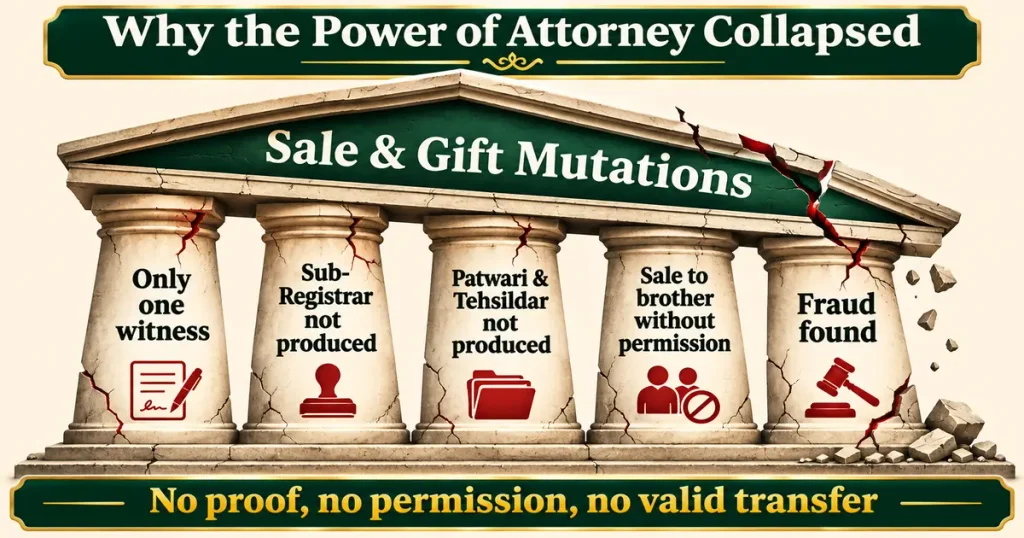
The daughter proved her case through reliable oral and documentary evidence (para 7). The burden then shifted: the brothers, as beneficiaries, had to prove the valid execution of the power of attorney and the lawful entry of the gift and sale mutations.
The Key Officials Were Never Produced
The beneficiary had to produce the Sub-Registrar who registered the document, but did not (para 8). The Patwari, the Tehsildar and the gift mutation’s witnesses were also missing. The Court called this withholding the best evidence and presumed under Article 129(g) that these witnesses would have gone against the brothers.
One Witness Is Not Enough
The power of attorney named only one marginal witness, Farooq Ahmad (para 9). The Court held that Article 17 requires at least two attesting witnesses, and Article 79 requires both to testify when execution is disputed. Failing to establish the second witness was a blatant breach of a mandatory provision.
A Dead Witness Is No Excuse
The brothers said the other witness, Haji Ilyas, had died (para 10). The Court noted they made no effort to prove the document through Article 80, which applies when no attesting witness can be found.
Fraud Pulls Down Everything Built on It
The Court held that the power of attorney rested on fraud and misrepresentation, so no later transaction based on it could create rights (para 11). Repeating a settled rule, it said “fraud vitiates the most solemn proceedings”.
Selling to a Real Brother Needs Clear Permission
Muhammad Sharif transferred the land to his real brother without any specific permission from their father (para 12). The Court held that an attorney “does not enjoy absolute power” to sell the principal’s property to a close relative; he needs explicit and unequivocal permission first. Without it, the transfer was patently illegal. The Court relied on PLD 2003 SC 494, PLD 2008 SC 389, 2016 SCMR 1781 and PLD 2025 SC 63.
This is now one of the clearest rules of power of attorney law in Pakistan, and it fits the Contract Act. Section 214 requires an agent to keep in touch with his principal and seek instructions. Section 215 lets a principal undo a deal in which the agent dealt on his own account without first getting consent after full disclosure.
Why the High Court Backed the Appellate Court
A civil revision under section 115 CPC is not a fresh trial. Here the trial court and the appellate court had reached opposite results. The High Court applied the settled rule that, in such a conflict, the appellate findings are preferred unless the record shows they are unsupported by evidence (para 13). It found the appellate judgment well reasoned and the trial court’s dismissal mistaken.
Final Decision of the Lahore High Court
On 30 April 2025 the Lahore High Court dismissed the civil revision as devoid of merit, with no order as to costs. The appellate judgment and decree of 17 May 2014, which decreed Saleem Bibi’s suit as prayed for, therefore remains in force. The lesson for power of attorney law in Pakistan is simple: paper alone does not transfer land.
What the Court Did and Did Not Decide
The Court decided that:
- the general power of attorney was not proved according to law;
- transactions resting on that document could not create any rights;
- an attorney cannot sell to a close relative without the principal’s explicit permission; and
- the appellate decree in the daughter’s favour must stand.
The Court did not:
- calculate each heir’s share in the estate;
- decide any criminal case for forgery or fraud;
- say that every power of attorney given to a family member is invalid (the problem was missing permission and missing proof); or
- discuss limitation or give a medical finding on the father’s mental condition.
7 Fraud Traps Hidden in a Power of Attorney
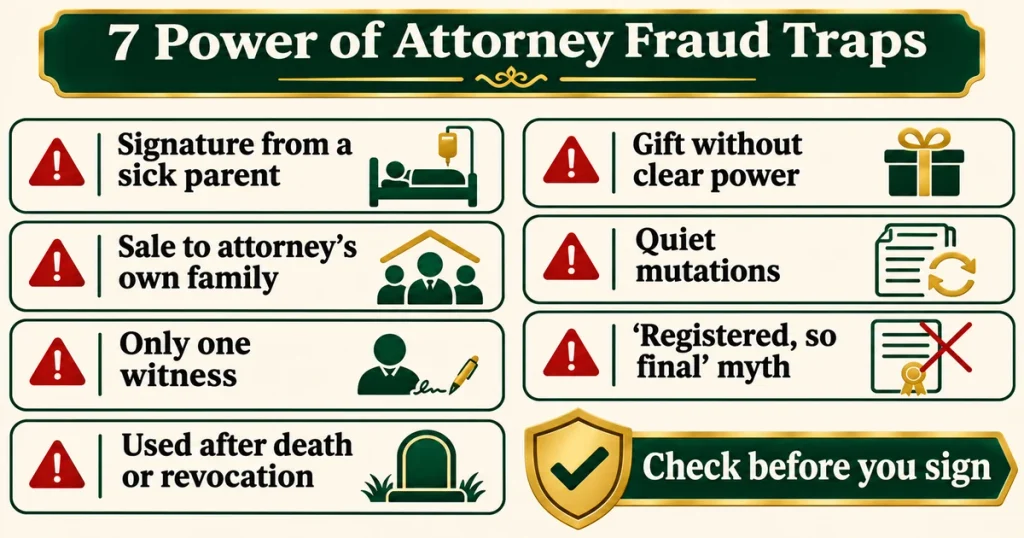
Most power of attorney misuse follows the same patterns, and these are the points where power of attorney law in Pakistan is tested most often:
- A signature from an old or sick parent. If the principal cannot understand the document, its validity is open to attack.
- A sale to the attorney’s own family. Selling to himself, his wife, son or brother needs the principal’s explicit permission.
- One witness, or witnesses who were not there. As this case shows, a single marginal witness can sink the document.
- A power used after death or revocation. The authority ends; the attorney cannot keep acting on it.
- A gift through an attorney. A gift deed made through a power of attorney is risky unless the power clearly allows gifts.
- Quiet mutations. Heirs often learn of transfers only when they apply for the inheritance mutation.
- “It’s registered, so it’s final.” Registration does not cure fraud or replace proof when execution is denied.
What Heirs Should Do If Land Moved Through a Power of Attorney
Power of attorney law in Pakistan gives heirs real remedies, but only if they act early and keep proof.
Collect These Documents First
- Fard (record of rights) and certified copies of every disputed mutation (intiqal).
- A certified copy of the power of attorney and the Sub-Registrar’s record, including the thumb-impression register.
- NADRA death certificate and Family Registration Certificate (FRC).
- The principal’s medical record, if illness or mental condition is part of your case.
- Names of the witnesses, the Lumberdar and the revenue officials involved.
Go to the Right Forum
File a civil suit before the Civil Judge where the land is situated. It usually seeks a declaration (section 42, Specific Relief Act), cancellation of the documents (section 39) and an injunction. Ask for a temporary injunction under Order XXXIX CPC so the land is not sold again during the case. An appeal usually goes to the District Court, depending on the suit’s value, and a revision to the High Court, as in this case.
Watch the Deadlines
Under the Limitation Act, 1908, a suit to cancel an instrument generally has three years from the date you learn the facts (Article 91), while a declaration suit generally has six years (Article 120). Courts look closely at fraud and inheritance claims, but do not count on that. Delay only helps the other side.
Avoid These Mistakes
Do not rely on the revenue office alone to undo a mutation, and do not sign a “family settlement” under pressure. If a sister is being pushed to give up her share, read our guide on inheritance law in Pakistan and women’s rights. And whichever side you are on, produce your key witnesses; withholding them is exactly what cost the brothers this case.
FAQs on Power of Attorney Law in Pakistan
What did the Lahore High Court decide in 2026 MLD 320?
It dismissed the brothers’ civil revision on 30 April 2025. The general power of attorney was not proved: only one attesting witness was shown, and the Sub-Registrar, Patwari and Tehsildar were never produced. The attorney also had no permission to sell to his own brother. The appellate decree for the daughter, Saleem Bibi, stands.
Can an attorney sell property to his own brother or son?
Not freely. Under power of attorney law in Pakistan, as applied in this case, an attorney does not enjoy absolute power to sell the principal’s property to a close relative. He must first obtain the principal’s explicit and unequivocal permission. Without it, the transfer is illegal and can be set aside.
What is power of attorney law in Pakistan?
Power of attorney law in Pakistan is the set of rules on how one person can authorise another to act for him. It comes mainly from the Powers-of-Attorney Act 1882 and Chapter X of the Contract Act 1872, read with the Registration Act 1908, the Stamp Act 1899 and the Qanun-e-Shahadat Order 1984.
How is a general power of attorney different from a special one?
A general power of attorney (mukhtar nama aam) gives wide authority over many matters, such as managing land and dealing with offices. A special power of attorney (mukhtar nama khas) covers one named task, such as selling a single plot. In both, the attorney can only do what the document clearly allows.
Does a power of attorney end when the owner dies?
Yes, as a general rule. Section 201 of the Contract Act says an agency ends when the principal dies or becomes of unsound mind, so the attorney cannot keep selling or transferring property afterwards. The main exception is an agency coupled with the attorney’s own interest under section 202.
Is a registered power of attorney always valid?
No. Registration makes a document stronger, but it does not cure fraud. If an heir specifically denies that the owner ever signed it, the beneficiary must still prove execution through the attesting witnesses. In this case the power of attorney was registered, yet it failed for lack of lawful proof.
How can heirs challenge a sale made through a fake power of attorney?
Collect the fard, certified copies of the mutations, the registered power of attorney and the death certificate. Then file a civil suit for declaration and cancellation before the Civil Judge where the land lies, and ask for a temporary injunction to stop further sales. Act quickly, because limitation applies.
Can overseas Pakistanis make a power of attorney online?
8Yes. Holders of a NICOP, CNIC or POC living abroad can use NADRA’s online power of attorney portal, run with the Ministry of Foreign Affairs. It involves uploading the document with biometrics of the executant and two witnesses, paying online and a video interview. The embassy route also remains open.
Conclusion
This case shows that power of attorney law in Pakistan protects the owner and his heirs, not the person holding the paper. A registered document, a sanctioned mutation and a brother’s word were not enough. With one witness, missing officials and no permission for a sale inside the family, the transfer could not stand.
If you are giving a power of attorney, write the limits clearly and use two reliable witnesses, because power of attorney law in Pakistan will judge the paper by its proof. If you are an heir, check the record early and act within time. The daughter in this case won because she pursued her claim through every court.
Disclaimer
This article is for legal awareness only and is not legal advice. Every case depends on its own facts, documents and evidence. For your specific matter, consult a qualified lawyer.