

Cancellation of gift deed in Pakistan becomes necessary when property is transferred through fraud, an unproved oral gift, a false mutation or a thumb impression allegedly obtained without informed consent. An official-looking mutation does not prove that the owner declared a gift, the donee accepted it and possession was delivered.
PLD 2026 Peshawar 53 provides the example. An elderly, illiterate and parda nasheen woman challenged Gift Mutation No. 1723 dated 23 February 2000. She denied appearing before the Revenue Officer, making a statement or affixing her thumb impression. The Trial Court decreed her suit, the Appellate Court upheld it, and the High Court dismissed the revision.
The case shows that cancellation of gift deed in Pakistan depends on evidence, not appearances.
Table of Contents
IRAC: Why the Gift Mutation Could Not Survive
| IRAC element | Court’s approach |
|---|---|
| Issue | Whether Gift Mutation No. 1723 and a later transfer could survive when the alleged donor denied the gift and its essential ingredients were not proved. |
| Rule | A valid Muslim gift requires declaration, acceptance and delivery of possession. The mutation must also be independently proved under revenue and evidence law. |
| Analysis | No reliable particulars of time, date, place or witnesses of declaration and acceptance were given. Possession was not delivered, while the parda nasheen owner lacked proved independent advice. |
| Conclusion | The alleged gift and mutation were illegal. The later transferee could not claim protection under section 41 of the Transfer of Property Act, 1882. |
Judgment at a Glance: The Entire Case in One Table
| Detail | Information |
|---|---|
| Case title | Rustam Khan v. Mst. Pathani through Legal Heirs and others |
| Citation | PLD 2026 Peshawar 53 |
| Court and judge | Peshawar High Court; Justice Muhammad Faheem Wali |
| Case number | Civil Revision No. 178-D of 2020 |
| Decision date | 12 June 2023 |
| Disputed record | Gift Mutation No. 1723 |
| Mutation date | 23 February 2000 |
| Trial Court | Suit decreed on 21 September 2019 |
| Appellate Court | Appeal dismissed on 26 August 2020 |
| High Court | Concurrent findings maintained; revision dismissed |
| Main relief | Cancellation of the illegal gift mutation |
How the Disputed Mutation Reached the High Court
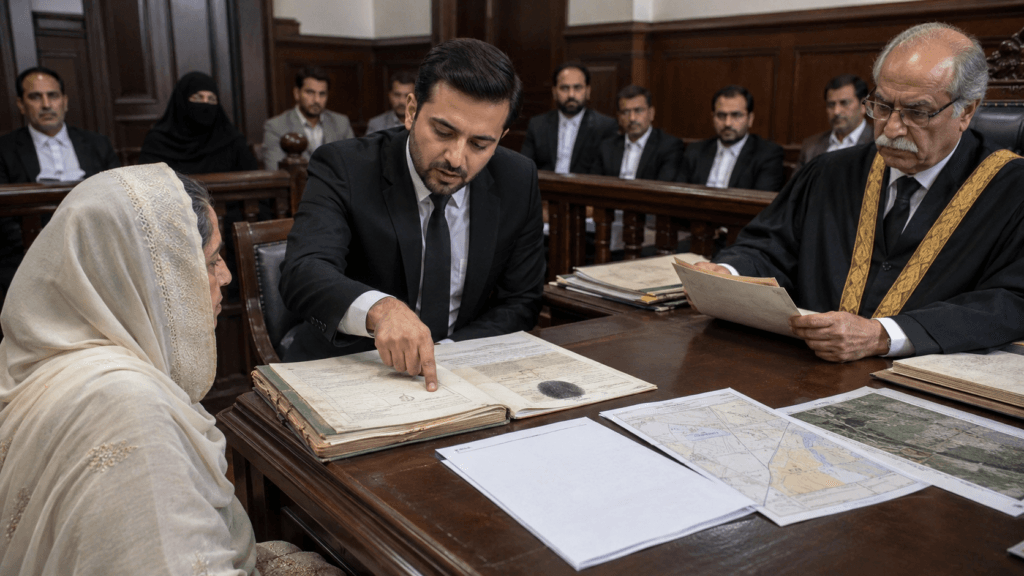
Mst. Pathani filed a civil suit seeking cancellation of Gift Mutation No. 1723. She alleged that it was fraudulent and ineffective against her property rights because she had not appeared before the Revenue Officer, made a statement or affixed her thumb impression for the alleged gift.
The opposing side denied her claim and maintained that the mutation was legally entered and attested. After recording evidence, the Civil Judge decreed the suit. The Additional District Judge dismissed the appeal, after which Rustam Khan approached the High Court.
The record showed a connected chain of transfers. The alleged first donee later transferred a portion of the property to Rustam Khan, who had also witnessed the disputed mutation. His title therefore depended on the validity of the first alleged gift.
For cancellation of gift deed in Pakistan, this point matters because a later transferee cannot normally receive a better title than the person transferring the property.
Issues Behind Cancellation of Gift Deed in Pakistan
The judgment says the Trial Court framed issues but does not reproduce their wording. The following are therefore the legal questions emerging from the pleadings and findings, not invented verbatim issues.
Was Gift Mutation No. 1723 Genuine?
The courts examined whether Mst. Pathani voluntarily gifted the land or whether the mutation was created without her consent.
The woman completely denied the alleged transaction. Therefore, the beneficiaries could not rely only on the mutation entry. They had to prove that a real and voluntary gift had taken place.
Were the Three Essentials of Gift Proved?
The beneficiaries had to establish:
- Declaration of gift by the donor;
- Acceptance by the donee; and
- Delivery of possession.
Each ingredient required reliable and independent evidence.
Was the Mutation Independently Proved?
The alleged oral gift and the revenue mutation were separate matters. Even if an oral gift was alleged, the mutation entered on its basis had to comply with the applicable revenue procedure and evidentiary requirements.
Was the Parda Nasheen Woman Properly Protected?
The courts considered whether the elderly woman understood the transaction, received independent advice and was identified by trustworthy persons.
The transaction could not be accepted merely because her alleged thumb impression appeared on a revenue document.
Could Section 41 Protect the Later Transfer?
Rustam Khan relied upon section 41 of the Transfer of Property Act, 1882. His defence depended on the alleged first donee having acquired valid title.
If the first gift was invalid, no lawful title could pass through the later transfer.
Could Late Evidence Cure the Defects?
The High Court considered whether the Tehsildar’s evidence could be introduced at a late stage or repair an unproved gift.
These questions controlled cancellation of gift deed in Pakistan.
The Woman’s Arguments for Cancellation of Gift Deed in Pakistan
The judgment says counsel’s arguments were not reproduced in full. The following position emerges from the pleadings, evidence and findings.
The woman’s side argued that she never gifted the land. She denied:
- appearing before the Revenue Officer;
- recording any statement;
- declaring an oral gift;
- accepting the contents of the mutation; and
- affixing her thumb impression for transferring the property.
She described the mutation as fake, forged and fraudulent.
Because she was elderly, illiterate and parda observing, her side maintained that the beneficiaries had to prove free and informed consent through strong evidence. It was not enough to produce a mutation containing an alleged thumb impression.
Her side also relied upon the missing particulars of the oral gift. No reliable account was given of:
- the date of declaration;
- the exact time;
- the place where the gift was made;
- the persons who heard the declaration;
- the manner in which the donee accepted it; or
- the date and method of delivery of possession.
The mutation witnesses could not automatically be treated as witnesses to the original gift. A person may witness mutation proceedings without having witnessed the earlier declaration, acceptance or delivery of possession.
The Patwari’s Khasra Girdawari evidence also supported the woman. It showed that the alleged donee and Rustam Khan were not in possession until 2004, while the mutation had been attested in 2000.
No corresponding change of possession appeared in the record of rights when the mutation was attested. This evidence supported cancellation of gift deed in Pakistan because the gift was not completed before the revenue entry.
Arguments Presented by Rustam Khan and the Beneficiaries
The petitioner denied fraud and claimed that the mutation had been lawfully entered and attested.
Rustam Khan argued that he had received part of the property through a valid later transfer from the alleged donee. He sought protection under section 41 of the Transfer of Property Act, 1882.
His position was that the later transaction should be protected even if the original mutation was challenged by the woman.
The petitioner also requested permission to examine the Tehsildar who had attested the mutation. Through this additional evidence, he intended to strengthen the formal validity of the revenue proceedings and challenge the concurrent findings of the Trial Court and Appellate Court.
These arguments faced a fundamental problem.
Rustam Khan was himself a witness to the disputed mutation. His title depended entirely upon the alleged first donee. If that person had never acquired valid title through a completed gift, the later transfer had no lawful foundation.
Similarly, the Tehsildar could explain how the mutation was attested, but he could not prove a declaration, acceptance or delivery of possession that had never been established through reliable evidence.
Why Mutation Alone Could Never Prove the Gift
The High Court treated Gift Mutation No. 1723 as a formality documenting an alleged earlier gift. The gift had to be complete before entry and attestation of the mutation.
For cancellation of gift deed in Pakistan, the oral gift must first be proved through reliable evidence. The mutation must then be independently established under the Land Revenue Act, applicable rules and the Qanun-e-Shahadat Order, 1984.
The beneficiaries gave no particulars regarding the time, date, place or witnesses of the alleged offer and acceptance. Those important details were missing from their written statements, and their evidence was also silent.
The Court explained that mutation witnesses are not automatically witnesses to the original gift. Their presence during mutation proceedings does not prove that they heard the donor declare the gift or saw the donee accept it.
The beneficiaries were required to prove the event of gift itself. They could not fill this evidentiary gap merely by pointing towards the entry and attestation of the mutation.
Accordingly, cancellation of gift deed in Pakistan may succeed even after a mutation has remained in the revenue record for years if the underlying transaction is not proved.
The Three Essential Ingredients of a Valid Muslim Gift

A valid Muslim gift requires:
- A voluntary declaration by the donor;
- Acceptance by or on behalf of the donee; and
- Delivery of possession of the gifted property.
All three requirements must form part of one genuine transaction.
A declaration without acceptance does not complete the gift. Similarly, declaration and acceptance without delivery of possession ordinarily remain insufficient.
In this case, declaration and acceptance were not proved because the beneficiaries failed to provide reliable particulars.
Delivery of possession was also missing.
Readers may also study our detailed guide on Gift Deed in Pakistan to understand the declaration, acceptance, and delivery of possession.
The Patwari Halqa recorded his statement as PW-2 on 18 July 2016. While referring to the Khasra Girdawari, he stated that neither the alleged donee nor Rustam Khan possessed the suit land until 2004.
This evidence was significant because the mutation had been attested on 23 February 2000. The record of rights also contained no entry showing that possession had changed in favour of the alleged donee and later transferee.
Possession is decisive in cancellation of gift deed in Pakistan because it shows whether the gift operated in reality or existed only on paper.
Why the Law Strongly Protected the Parda Nasheen Owner

Mst. Pathani was elderly, illiterate and parda observing. None of her close relatives was associated with the mutation proceedings to identify her.
The two persons who allegedly identified her were not her relatives. The record also failed to show that any trusted family member or independent lawyer had explained the transaction to her.
The beneficiary of a transaction involving a parda nasheen woman must prove that she:
- acted freely and voluntarily;
- understood the nature of the document;
- knew the legal consequences;
- understood that she would permanently lose ownership;
- received independent and objective advice; and
- consciously agreed to transfer the property.
The transaction had to be explained to her in a language she understood.
The High Court applied strict caution because women are frequently deprived of property and inheritance rights. Trustworthy identification, absence of conflict, independent advice and real understanding were essential.
This strengthens cancellation of gift deed in Pakistan where an old or illiterate woman is shown as surrendering valuable land without reliable family participation or legal advice.
Why Section 41 Could Not Prevent Cancellation of Gift Deed in Pakistan
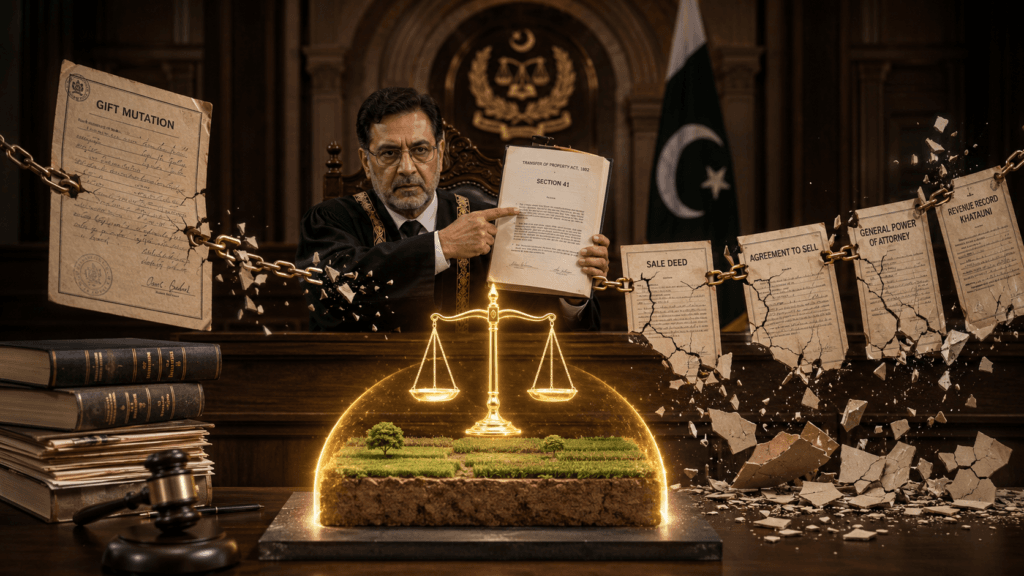
Section 41 of the Transfer of Property Act may protect a transferee in a proper case involving an ostensible owner. However, it cannot legalise an illegal root transaction.
Rustam Khan’s claim depended on the alleged first donee having acquired valid title.
Once the original gift and mutation failed, the later transfer also lost its foundation. The Court additionally considered Rustam Khan’s involvement as a witness to the disputed mutation.
This involvement weakened any suggestion that he was an innocent transferee completely unaware of the original transaction.
The judgment held that an illegal mutation cannot be perpetuated through later transfers. Cancellation of gift deed in Pakistan may therefore undo later transactions resting on the same defective title.
A later transfer does not cleanse the fraud or complete the essential ingredients of an earlier gift.
Why the Tehsildar’s Late Evidence Could Not Save the Case
The petitioner sought permission to examine the Tehsildar at the revisional stage.
The High Court rejected the request because it had been made at a belated stage. More importantly, the proposed evidence could not change the result.
A Revenue Officer may confirm that a mutation was entered or attested. However, he cannot create missing consent, declaration, acceptance or possession.
His statement could not establish that the elderly woman:
- made a genuine declaration;
- understood the transaction;
- received independent advice;
- voluntarily surrendered ownership; or
- delivered possession to the donee.
The Court concluded that the Tehsildar’s evidence would not repair the defects in the original transaction.
The lesson for cancellation of gift deed in Pakistan is simple: formal attestation cannot repair an unproved underlying gift.
Applicable Laws and Binding Precedents
The Court applied:
- Section 39 of the Specific Relief Act, 1877;
- Section 41 of the Transfer of Property Act, 1882;
- Order XLI Rule 27 of the Code of Civil Procedure;
- applicable revenue law; and
- the Qanun-e-Shahadat Order, 1984.
The Court relied upon the following precedents:
- Mrs. Khalida Azhar v. Viqar Rustam Bakhshi and others, 2018 SCMR 30;
- Peer Baksh through Legal Representatives v. Mst. Khanzadi and others, 2016 SCMR 1417;
- Ghulam Muhammad v. Zohran Bibi and others, 2021 SCMR 19; and
- Phul Peer Shah v. Hafeez Fatima, 2016 SCMR 1225.
These authorities require strict proof in cancellation of gift deed in Pakistan, especially where an oral gift or parda nasheen owner is involved.
The High Court’s Final Decision and Relief

The Peshawar High Court found no illegality or material infirmity in the concurrent judgments of the two courts below.
The alleged gift was not proved because:
- declaration was not established;
- acceptance was not established;
- delivery of possession was missing;
- the alleged donor lacked independent advice;
- close relatives did not identify her;
- the mutation witnesses did not prove the gift itself; and
- the possession record contradicted the claimed transaction.
The Court maintained the judgments of the Trial Court and Appellate Court and dismissed the civil revision without an order as to costs.
It also removed the office objection regarding court fee. Since the value of the suit had not been determined, minimum court-fee stamps worth Rs. 500 were considered sufficient.
The outcome confirms that cancellation of gift deed in Pakistan is available where an official entry creates the appearance of ownership but the transaction behind it fails judicial examination.
Practical Checklist Before Filing a Cancellation Suit
Collect the following evidence:
- certified copy of the gift deed or mutation;
- complete mutation proceedings;
- statements recorded before the Revenue Officer;
- Roznamcha entries;
- Khasra Girdawari;
- Jamabandi or record of rights;
- previous ownership documents;
- signature or thumb-impression comparison material;
- evidence showing actual possession;
- details of the donor’s age, health and education;
- witnesses familiar with the alleged gift;
- proof regarding independent legal advice;
- documents relating to later transfers; and
- a clear timeline of discovery and litigation.
A suit for cancellation of gift deed in Pakistan should identify the alleged fraud specifically. It should explain who benefited, how the owner discovered the transaction, whether possession changed and which ingredient was missing.
General or vague allegations may not be enough. The pleadings should directly address the declaration, acceptance, possession, identification and consent relied upon by the beneficiary.
Frequently Asked Questions About Cancellation of Gift Deed in Pakistan
1. Can a Gift Deed Be Cancelled in Pakistan?
Yes. A court may cancel or declare a gift ineffective where fraud, forgery, misrepresentation, absence of free consent or failure to prove a valid gift is established.
2. Is Mutation Alone Enough to Prove an Oral Gift?
No. Mutation is primarily a revenue entry. Declaration, acceptance and delivery of possession must be proved independently.
3. Who Must Prove a Disputed Gift?
The person benefiting from and relying upon the gift carries the burden, particularly when the alleged donor denies the transaction.
4. What Happens If Possession Was Never Delivered?
The gift may remain incomplete. Revenue and possession records can therefore become decisive evidence in a cancellation suit.
5. What Protection Is Available to a Parda Nasheen Woman?
The beneficiary must prove informed consent, understanding of consequences, reliable identification and independent advice through strong evidence.
6. Can a Later Transferee Keep the Property?
Not automatically. A later transfer may fail when its foundation is an illegal or unproved gift, especially where the transferee knew about the original transaction.
7. Can Additional Evidence Be Introduced in Revision?
Only in legally permissible circumstances. Late evidence cannot simply be used to fill fundamental gaps or replace proof of the original gift.
Conclusion: Revenue Papers Cannot Replace Free Consent
PLD 2026 Peshawar 53 sends a clear message: an elderly woman cannot be deprived of land merely because a mutation appears in the revenue record.
The beneficiary must prove a genuine declaration, valid acceptance, delivery of possession and conscious consent.
Cancellation of gift deed in Pakistan protects the real owner where a deed or mutation was created without genuine participation. Courts will look beyond formal entries, examine the possession record and require stronger evidence when the alleged donor is elderly, illiterate or parda nasheen.
The judgment also warns later transferees that their title cannot survive if the original gift was illegal. A defective mutation cannot become lawful merely because another transfer is subsequently recorded.
Disclaimer
This article is for general legal awareness only and does not constitute legal advice. Every property dispute depends on its pleadings, documents, evidence, limitation and procedural history. Consult a qualified advocate regarding a particular case.