
A property dispute rarely stays limited to one paper. One person may hold a registered deed, another may be in possession, a third may rely on a mutation, and an heir may claim an unpaid share. The first question under Property Dispute Law in Pakistan is therefore not simply, “Who has the document?” It is: what right is being denied, what evidence proves it, and which legal remedy fits the dispute?
That distinction matters. A title dispute may require declaration or cancellation. Threatened sale may require an injunction. A person already dispossessed may need possession. Joint owners may need partition. Forcible dispossession may also create criminal liability. This guide explains those routes and uses 2016 SCMR 1931 to show why a pending civil case does not automatically block proceedings under the Illegal Dispossession Act, 2005.
Table of Contents
2016 SCMR 1931: Judgment at a Glance
| Point | Details |
|---|---|
| Case | Shaikh Muhammad Naseem v. Mst. Farida Gul |
| Citation | 2016 SCMR 1931 |
| Court | Supreme Court of Pakistan |
| Decision Date | 22 July 2016 |
| Bench | Amir Hani Muslim, Mushir Alam, Maqbool Baqar, Faisal Arab and Khilji Arif Hussain, JJ |
| Main Statute | Illegal Dispossession Act, 2005 |
| Key Provision | Section 3 |
| Main Questions | Whether the Act was limited to professional land grabbers/Qabza Groups, and whether pending civil litigation made the complaint non-maintainable |
| Holding | The Act was not limited to a special class of offenders; civil and criminal proceedings may continue independently where the same conduct creates both kinds of liability |
| Final Order | Appeal disposed of; matter remanded to the Trial Court for decision on merits |
| Not Decided | Whether the appellant had actually proved illegal dispossession |
The reported judgment identifies the case, five-member bench and decision date, while its headnote records both the broad interpretation of Section 3 and the principle that pending civil litigation is not by itself a bar to proceedings under the Act.
IRAC: Why the Supreme Court Reopened the Complaint
| IRAC | Explanation |
|---|---|
| Issue | Could the complaint be rejected because the accused was not shown to be a professional land grabber, or because civil litigation over the property was pending? |
| Rule | Section 3 used broad words such as “no one” and “whoever.” The Court held that the statute did not restrict prosecution to persons with a history of land grabbing. |
| Analysis | The lower courts relied on a restrictive line of cases and on the pending civil revision. The Supreme Court followed the larger-bench approach in Gulshan Bibi and tested the matter against the statutory ingredients instead. |
| Conclusion | The maintainability objections were unsustainable. The case was sent back for decision on merits, not finally decided for the complainant. |
The Court explained that Section 3 describes the offence but does not create a special class of offenders; its general wording was intended to have wide application. It separately held that civil and criminal proceedings could operate independently where the conduct attracted both kinds of liability.
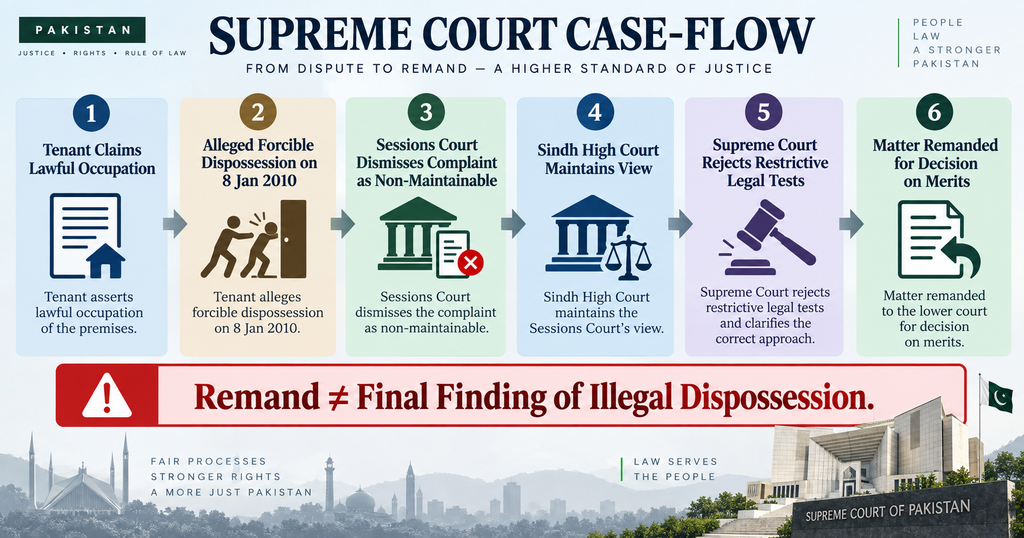
This distinction is essential for Property Dispute Law in Pakistan. A remand reopens the legal door; it does not prove the factual allegations.
What Was Alleged—and What the Supreme Court Actually Decided
The appellant claimed that he was a tenant of the respondent. He alleged that on 8 January 2010, while he was away, the respondent’s servants and hired persons entered the rented premises and forcibly took possession. He filed Criminal Complaint No. 130 of 2010 before the Sessions Court, Karachi-East. These remained allegations requiring determination on evidence.
The Additional Sessions Judge dismissed the complaint as not maintainable because a civil revision concerning restoration of possession was already pending before the Sindh High Court. The High Court maintained that approach and also relied on Bashir Ahmad v. Additional Sessions Judge (PLD 2010 SC 661), which had adopted a narrower view of the Act.
The Supreme Court referred to the five-member decision in Gulshan Bibi, which had resolved the conflict in earlier authorities. It rejected the proposition that prosecution was limited to persons already carrying the credentials or antecedents of a professional land grabber or “Qabza Group.”
The reported judgment does not set out detailed competing factual evidence or extensive party-wise oral submissions. Its central concern was the legal maintainability of the complaint and the interpretation of the Act. The Supreme Court therefore did not finally find that the respondent committed illegal dispossession.
Instead, the appeal was disposed of and the matter was remanded to the Trial Court for disposal on merits.
A reliable explanation of Property Dispute Law in Pakistan must keep allegations, legal findings and final relief separate.
Property Dispute Law in Pakistan Is Not One Single Statute
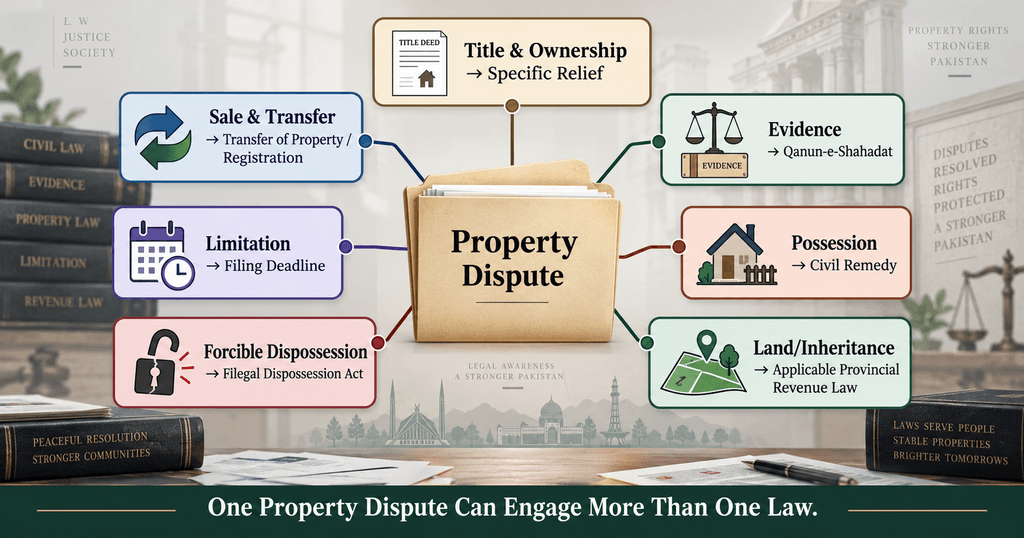
There is no single statute that resolves every property conflict. The applicable law depends on the right asserted, the transaction, the location and nature of the property, and the remedy being claimed.
Important legal sources may include the Transfer of Property Act, 1882; Registration Act, 1908; Specific Relief Act, 1877; Code of Civil Procedure, 1908; Limitation Act, 1908; Qanun-e-Shahadat Order, 1984; Illegal Dispossession Act, 2005; provincial land-revenue and tenancy laws; and applicable inheritance or personal law.
Official texts are available through the Ministry of Law and Justice, including the Illegal Dispossession Act, 2005, Specific Relief Act, 1877, Transfer of Property Act, 1882, Registration Act, 1908, Limitation Act, 1908 and Qanun-e-Shahadat Order, 1984.
That is why Property Dispute Law in Pakistan begins with classification. A forged deed, an inheritance mutation, a tenant’s eviction and an encroachment may all concern property, but they can require different forums and different prayers for relief.
Property Dispute Law in Pakistan becomes much clearer once the dispute is matched with the correct cause of action.
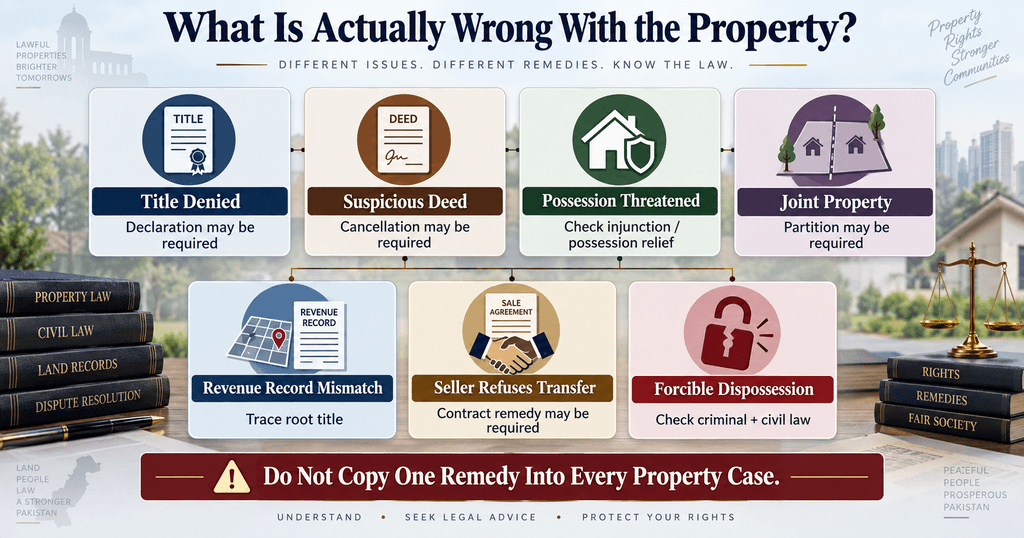
Seven Common Property Disputes—and the Remedy to Examine
1. Ownership or Title Is Denied
If another person denies your legal title, declaratory relief may become relevant. Section 42 of the Specific Relief Act allows a person claiming a right to property to seek a declaration against someone denying or interested in denying that right. Importantly, the proviso warns against seeking only a declaration where further relief is available but omitted. (Pakistan Code)
A person already out of possession may therefore need possession as well. If an adverse written instrument remains outstanding, cancellation may also need examination.
Under Property Dispute Law in Pakistan, choosing incomplete relief can create an avoidable legal objection.
For a detailed related guide, see Civil Suit for Declaration.
2. A Deed or Power of Attorney Is Alleged to Be Fraudulent
A written instrument does not disappear merely because a party calls it fraudulent or forged.
Section 39 of the Specific Relief Act deals with cancellation where a written instrument is void or voidable and leaving it outstanding may cause serious injury. (Pakistan Code)
The claimant should identify the exact document, its date and registration details, the alleged legal defect, how it affects the claimant’s rights, and what consequential relief is required.
Where a signature or thumb impression is disputed, the original instrument, registration record, admitted specimens, witnesses and legally admissible expert evidence can become important.
Related Qanooni Dastak guides include Gift Deed Law in Pakistan and Power of Attorney Law in Pakistan.
3. Possession Has Been Taken or Threatened
Possession disputes can involve different legal routes. Depending on the facts, a person may examine title-based recovery of possession, the summary remedy for dispossession, rent law, an injunction, or proceedings under the Illegal Dispossession Act.
Where property is in danger of being wasted, damaged or alienated, or another legally recognized injury is threatened, Order XXXIX Rules 1 and 2 of the Code of Civil Procedure contain the framework for temporary injunctions in appropriate civil proceedings. (Pakistan Code)
An injunction, however, is interim protection. It should not be used as a substitute for whatever final relief the dispute actually requires.
Property Dispute Law in Pakistan therefore asks two separate questions: what should be stopped immediately, and what final decree or order is ultimately required?
See also Property Possession in Pakistan.
4. Joint or Inherited Property Cannot Be Divided
Where co-owners or heirs cannot agree on shares, possession or division, partition may be the real remedy.
The proper forum can depend on whether the property is agricultural land, urban immovable property or property governed by a special statutory regime. Provincial revenue law can be particularly important.
Collect the ownership chain, inheritance record, mutation, current revenue record, property description and evidence of possession. Also identify whether the real dispute concerns shares, a particular portion, rental income, an unauthorized transfer or several issues together.
Property Dispute Law in Pakistan should not convert every inheritance conflict into a simple possession claim.
For further reading, see Partition of Inherited Land in Pakistan.
5. Revenue Record and Ground Reality Do Not Match
A fard or mutation can be important evidence, but one revenue entry should not automatically be treated as the complete answer to title.
Trace the source of the claimed right. That may be a sale deed, gift, inheritance, allotment, lease, court decree or another legally recognized transaction. Then compare it with subsequent mutations and transfers.
If boundaries or possession are disputed, a site plan, demarcation record and other location evidence may also be required.
Property Dispute Law in Pakistan requires the complete chain, particularly where one party relies on a revenue entry while the other challenges the transaction behind it.
6. A Buyer Paid but the Seller Refuses Transfer
An agreement-to-sell dispute may raise questions of specific performance, refund, damages, possession or injunction depending on the contract and facts.
Section 54 of the Transfer of Property Act defines a “sale” as transfer of ownership in exchange for a price paid or promised, or partly paid and partly promised. (Pakistan Code)
An agreement to sell should therefore not automatically be described as a completed transfer of ownership.
Check the agreement, payment trail, readiness and willingness where legally relevant, possession, registration requirements, later third-party transfers and limitation before choosing the remedy.
7. Forcible Dispossession May Also Be Criminal
This is where 2016 SCMR 1931 becomes particularly important.
The Supreme Court held that the Illegal Dispossession Act, 2005 was not confined to people already known as professional land grabbers or a “Qabza Group.” Section 3 used broad terminology, and the Court held that anyone committing the statutory offence against a lawful owner or lawful occupier could fall within its scope.
The judgment also held that pending civil litigation over the property did not automatically bar proceedings under the Act where the alleged conduct independently constituted the statutory offence.
Property Dispute Law in Pakistan can therefore have civil and criminal dimensions at the same time—but only where the facts and statutory ingredients actually support both.
Current Law: Read the 2016 Judgment with the 2017 Amendment
2016 SCMR 1931 was decided on 22 July 2016. Parliament later enacted the Illegal Dispossession (Amendment) Act, 2017. The President assented to Act XXVIII of 2017 on 21 June 2017, and it was published in the Gazette on 4 July 2017. (National Assembly of Pakistan)
The amendment inserted Section 3(3). It addresses forcible and wrongful dispossession of an owner or occupier where the act does not fall within Section 3(1), with punishment that may extend to three years, or fine, or both, in addition to other applicable punishment. It also provides for compensation. (National Assembly of Pakistan)
The 2017 amendment further changed Section 5 by allowing the Court, where local inquiry is necessary, to direct a Magistrate or revenue officer to conduct an inquiry and submit a report. The amendment states that such report is to be treated as evidence in the case. It also introduced potential compensatory costs, up to Rs.500,000, where at the conclusion of trial a complaint is found false, frivolous or vexatious. (National Assembly of Pakistan)
This update matters. Property Dispute Law in Pakistan should not freeze a statute at the date of an older judgment.
The principles decided in 2016 SCMR 1931 remain important to understanding the judgment, but a complaint filed today must be examined against the current statutory text.
Under the federal Act, “Court” means the Court of Session and “occupier” means a person in lawful possession. Section 4 provides that an offence under Section 3 is triable by the Court of Session on a complaint and classifies the offence as non-cognizable. (Pakistan Code)
Any province-specific or special property-protection legislation must also be checked separately. A procedure operating in one province should never be assumed to apply nationwide.
Evidence: Build the Property File Before Choosing the Forum
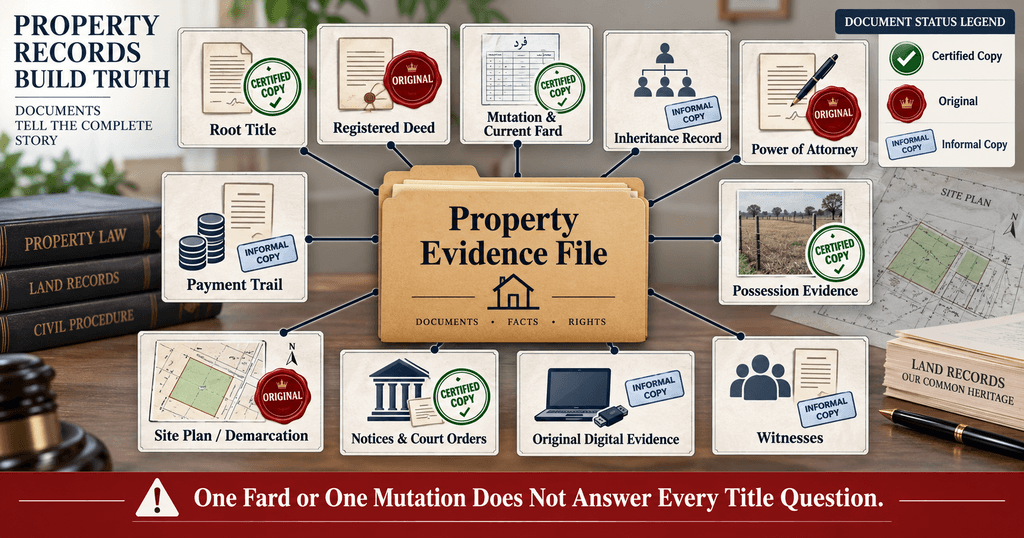
A strong property file should ordinarily be organised around what each document proves.
| Evidence | Why It Matters |
|---|---|
| Root title document | Identifies the source of ownership |
| Registered sale, gift or lease document | Shows the written transaction and its terms |
| Mutation and current fard/record | Shows revenue entries and later changes |
| Allotment, transfer or possession letter | Important for authority or society property |
| Death certificate and heir record | Supports succession or inheritance claims |
| Power of attorney | Shows the claimed authority of an agent |
| Payment trail | May prove consideration or contractual performance |
| Tax, utility and rent records | May support use and possession |
| Site plan, demarcation and photographs | Useful in boundary or encroachment disputes |
| Notices, complaints and court orders | Establish the dispute timeline |
| Original digital material | May prove admissions, communications or payment |
| Witness details | May prove execution, possession, dispossession or fraud |
Use originals or certified copies where available. Preserve the complete record rather than cropped photographs or selected pages.
The Qanun-e-Shahadat Order is the general federal law of evidence for judicial proceedings, although the exact admissibility and proof requirements depend on the evidence and proceeding involved. (Pakistan Code)
Property Dispute Law in Pakistan is evidence-driven: each document should be connected to the particular fact it is meant to prove.
In Property Dispute Law in Pakistan, a thick file is not useful merely because it is thick. The documents must prove the right facts.
Before Filing, Answer These Eight Questions
- What is the exact property—khasra, plot, flat, house or authority record?
- What is your source of right—sale, inheritance, gift, lease, allotment, decree or lawful possession?
- Who is presently in possession?
- What exact act caused the dispute—denial, sale, dispossession, forgery, refusal to transfer or refusal to partition?
- Which document or entry is being challenged?
- When did you learn of the adverse act?
- What final relief do you actually need?
- Which forum has territorial and subject-matter jurisdiction?
This exercise prevents a common mistake under Property Dispute Law in Pakistan: taking a genuine grievance to the wrong forum or framing it through the wrong remedy.
Limitation Can Defeat a Strong Property Claim
Property owners sometimes assume that time does not matter because “the land is mine.” That assumption can be dangerous.
The Limitation Act, 1908 regulates limitation for suits, appeals and certain applications, but the applicable period and starting point depend on the particular proceeding and relief. (Pakistan Code)
A declaration claim should not automatically be treated like cancellation, possession or specific performance. Special laws can also have their own deadlines.
Prepare a timeline showing:
root title → disputed document or entry → date of knowledge → objection → change of possession → third-party transfer → notice → filing.
The effect of fraud, knowledge, denial of right, possession history or disability must be assessed under the law applicable to the particular claim.
Property Dispute Law in Pakistan is often affected by dates that initially seem unimportant.
For a detailed explanation, see Limitation Act in Pakistan.
Choosing the Correct Forum in Pakistan
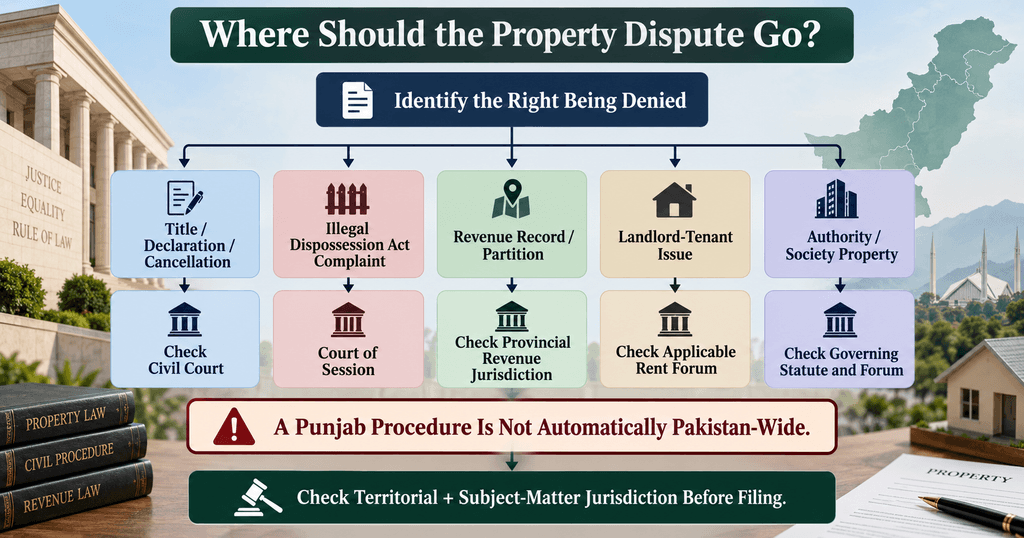
Depending on the dispute, jurisdiction may lie before a civil court, Court of Session, revenue authority, rent forum, cooperative or housing forum, development authority, property tribunal or another statutory body.
Territorial jurisdiction normally requires attention to the location of the property and the applicable procedural law. Subject-matter jurisdiction requires a separate question: has a special statute assigned this type of dispute to another forum?
The Illegal Dispossession Act itself defines its “Court” as the Court of Session. (Pakistan Code) That does not mean every ownership, inheritance, cancellation or partition dispute belongs there.
Province-specific regimes also need separate checking. A route created under Punjab legislation, for example, should not be presented as the automatic procedure for Sindh, Khyber Pakhtunkhwa, Balochistan or Islamabad.
For Property Dispute Law in Pakistan, verify the current statute, amendments, territorial jurisdiction and notified forum before filing.
A forum mistake under Property Dispute Law in Pakistan can consume years even where the underlying grievance is serious.
What 2016 SCMR 1931 Means in Practice
First, the label attached to the accused is not the legal test. A complainant does not have to establish that the accused has a historical reputation as “Qabza Mafia” merely to overcome the restriction rejected in this judgment. The focus is on whether the statutory offence is made out.
Second, lawful occupation matters. The Act expressly protects an owner or lawful occupier, and the reported case itself arose from an appellant who claimed to be a tenant.
Third, civil litigation and criminal proceedings can coexist where the conduct creates both civil liability and criminal consequences. A pending civil dispute cannot by itself authorize anyone to take possession through unlawful self-help.
Fourth, maintainability is not guilt. The Supreme Court remanded the matter to the Trial Court. Property Dispute Law in Pakistan therefore requires careful language: the Supreme Court corrected the legal approach to maintainability, but it did not finally prove the appellant’s factual allegations.
Mistakes That Make Property Disputes Harder
Avoid these common errors:
- filing only for injunction when declaration, cancellation or possession may also be necessary;
- attacking a mutation without examining the transaction behind it;
- relying only on possession while ignoring the title chain;
- assuming registration makes a document immune from legal challenge;
- ignoring limitation until the opposite side raises it;
- failing to join a necessary purchaser, co-owner, heir or authority;
- starting criminal proceedings where the statutory ingredients are absent;
- assuming a revenue entry finally answers every disputed-title question; and
- applying a province-specific procedure across Pakistan without checking jurisdiction.
A sound Property Dispute Law in Pakistan strategy is document-led, forum-specific and relief-specific.
Practical Action Plan When a Property Dispute Starts
First, obtain certified copies of the root title documents, registration record, mutations, current revenue or authority record and existing court orders.
Second, preserve original agreements, payment evidence, correspondence, photographs and other possession evidence. If electronic material matters, preserve the original device or source and the complete conversation instead of relying only on cropped screenshots.
Third, prepare two timelines: one for ownership and one for possession. Mark every transfer, inheritance event, mutation, notice, alleged dispossession and proceeding.
Fourth, identify the exact act that needs to be stopped or undone. A disputed deed may point towards cancellation; denial of title may require declaration; threatened alienation may justify consideration of interim relief; actual dispossession may require recovery of possession; unresolved joint ownership may call for partition.
Fifth, check limitation and jurisdiction before drafting the case.
Finally, where the facts suggest forcible or wrongful dispossession, separately examine the Illegal Dispossession Act, its 2017 amendment and any current law applicable in the relevant province or territory.
Property Dispute Law in Pakistan works best when the pleadings connect five things clearly: right → wrong → evidence → forum → remedy.
Conclusion: Protect the Right, Not Just the Paper
The central lesson of Property Dispute Law in Pakistan is that property cases are not solved by one document, one mutation or one slogan. Courts and statutory forums may have to examine title, lawful possession, authority, evidence, limitation, jurisdiction and the precise relief claimed.
2016 SCMR 1931 remains important because the Supreme Court rejected two legal shortcuts: limiting the Illegal Dispossession Act only to professional land grabbers, and rejecting a complaint merely because civil litigation concerning the property was pending.
But the final order matters just as much. The case was remanded for a decision on merits. The Supreme Court did not finally declare that the complainant had proved illegal dispossession.
Preserve the record early, identify the real legal issue, verify the current law in the relevant province or territory, and select the correct remedy before delay or another transfer makes the dispute more difficult.
FAQs About Property Disputes and Legal Remedies
1. What is Property Dispute Law in Pakistan?
Property Dispute Law in Pakistan is the collection of civil, criminal, revenue, registration, evidence, succession and provincial laws used to resolve disputes about ownership, possession, transfer, inheritance, partition and property documents. There is no single statute for every case. The correct law depends on the property, transaction, location, possession status and relief required.
2. Which court handles a property ownership dispute in Pakistan?
A serious private title dispute commonly requires the competent civil court, but jurisdiction can change where a special statute assigns the matter to a revenue authority, rent forum, housing or cooperative forum, tribunal or another body. Both territorial and subject-matter jurisdiction should be checked before filing.
3. Can I get a stay order to stop sale or construction?
Temporary injunction may be available where its legal requirements are satisfied, including under Order XXXIX of the Code of Civil Procedure in an appropriate suit. It is not automatic and does not replace final relief. The applicant must connect the request for interim protection with an underlying legal right and properly framed proceeding.
4. What documents are most important in a property dispute?
Begin with the root title, registered deed, mutation and current record, allotment or transfer documents, payment evidence, possession material, inheritance papers, relevant power of attorney, notices and previous court orders. Add site plans, photographs, demarcation material, original digital evidence and witnesses according to the dispute. Certified official copies should be obtained where available.
5. Does 2016 SCMR 1931 mean every illegal-dispossession complainant wins?
No. The Supreme Court held that the complaint could not be rejected on the restrictive grounds adopted below, including the view that only a professional land grabber could be prosecuted or that pending civil litigation automatically barred the complaint. The matter was remanded to the Trial Court; illegal dispossession itself was not finally proved by the Supreme Court.
6. Can a civil case and an Illegal Dispossession Act complaint continue together?
They may, where the facts legally create both civil liability and an offence under the Act. In 2016 SCMR 1931, the Supreme Court held that pending civil litigation did not automatically make proceedings under the Illegal Dispossession Act non-maintainable. Each proceeding still requires proof of its own legal ingredients.
7. Is a mutation or fard enough to prove ownership?
Not necessarily. A revenue entry can be important evidence, but a disputed property case may require examination of the underlying source of the right, such as a sale, inheritance, gift, allotment or decree. The registration record, earlier and later entries, possession and the legal validity of the underlying transaction may all matter.
8. What should I do first if someone occupies or threatens my property?
Preserve evidence immediately, obtain certified ownership and possession records, record the date and nature of the threat or dispossession, identify witnesses and avoid unlawful self-help. Then check limitation, jurisdiction and the appropriate remedy—such as injunction, possession, declaration, cancellation, partition or a statutory complaint—before starting proceedings.
Legal Disclaimer: This article is for legal awareness and educational purposes only and is not legal advice. Property disputes depend on the province or territory, property type, documents, possession, limitation, evidence, statutory amendments and forum. Consult a qualified lawyer for advice on a specific case.