
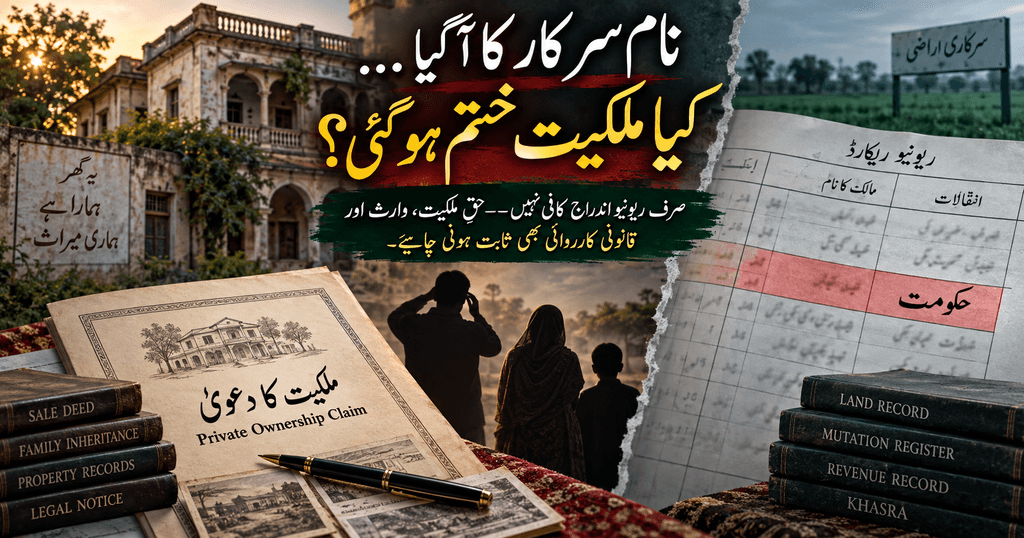
A family may lose a property case because its documents are weak. Another claimant may also fail to prove ownership. Does that automatically mean the property belongs to the Government? No. That is the question at the heart of Escheat Property in Pakistan, and PLD 2026 Supreme Court 283 gives an important warning against shortcuts.
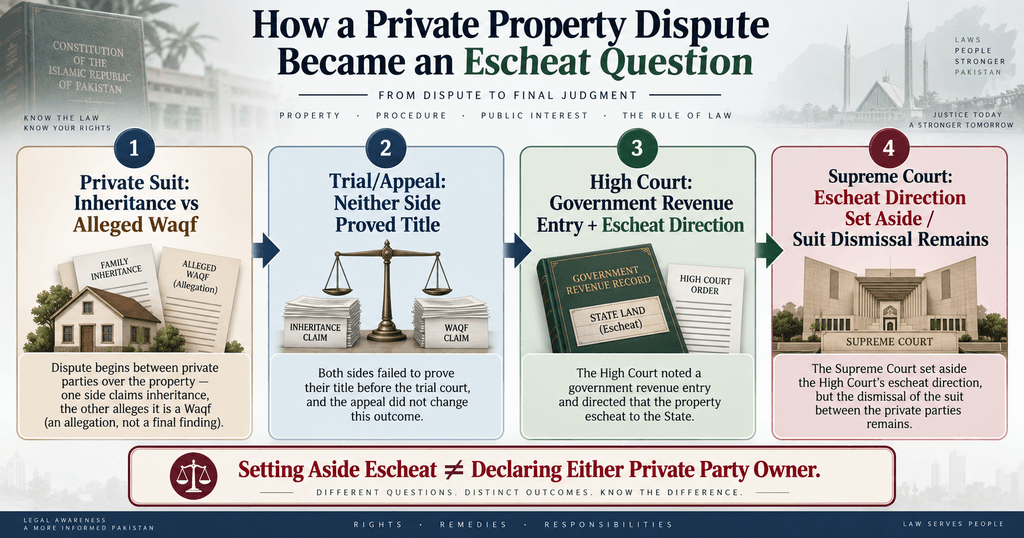
In that case, neither private side succeeded in proving title. The Lahore High Court, Multan Bench then relied on revenue entries showing the Provincial Government’s name, treated the property as escheat, and directed the Government to take possession. The Supreme Court set aside that part because escheat had not been pleaded, no issue had been framed, no evidence had been led on it, and the Government was not a party. The dismissal of the original civil suit, however, remained intact.
Table of Contents
Judgment at a Glance: PLD 2026 Supreme Court 283
| Point | Verified Detail |
|---|---|
| Citation | PLD 2026 Supreme Court 283 |
| Case | Muhammad Shafique Khan and others v. Madrisa Taleem-ul-Quran Khairul Madaris, Multan and another |
| Court | Supreme Court of Pakistan |
| Bench | Shahid Bilal Hassan and Shakeel Ahmad, JJ. |
| Decision date | 15 January 2026 |
| Main law | Article 172, Constitution of Pakistan |
| Core question | Could the High Court declare escheat in a private title dispute when Government was absent and escheat was never pleaded, framed or proved? |
| Result | Appeals partially allowed; escheat declaration and possession direction set aside |
| What remained intact | Dismissal of the civil suit because neither private side proved title or claim |
| Costs | No order as to costs |
The reported matter involved Civil Petitions Nos. 3232 and 3287 of 2023 and 5138 of 2025. The Supreme Court partially allowed the relevant appeals only to remove the High Court’s escheat observations and possession direction. Civil Petition No. 3232/2023 was withdrawn as redundant.
IRAC: Why the Escheat Order Failed
| IRAC Element | Legal Position |
|---|---|
| Issue | Could a court deciding a dispute between private parties suo motu declare the property escheat and order Government possession when Government was not a party and the issue had never been pleaded or tried? |
| Rule | Courts are bound by pleadings and issues. In the inheritance/escheat setting addressed by the Supreme Court, State vesting requires foundational facts proved through proper independent proceedings. A revenue entry alone is insufficient. |
| Analysis | The plaintiffs relied on inheritance; the competing side relied on an alleged waqf deed. Escheat was a third case introduced at the revisional stage without pleading, issue, evidence or Government participation. |
| Conclusion | The Supreme Court removed the escheat declaration and possession direction, but did not decree ownership in favour of either private side. |
The Supreme Court itself framed the question around the absence of Government, pleadings, an issue and supporting evidence.
For anyone researching Escheat Property in Pakistan, this distinction is essential: the Supreme Court corrected a jurisdictional overreach; it did not decide who ultimately owns the house.
What “Ownerless Property” Means Under Article 172
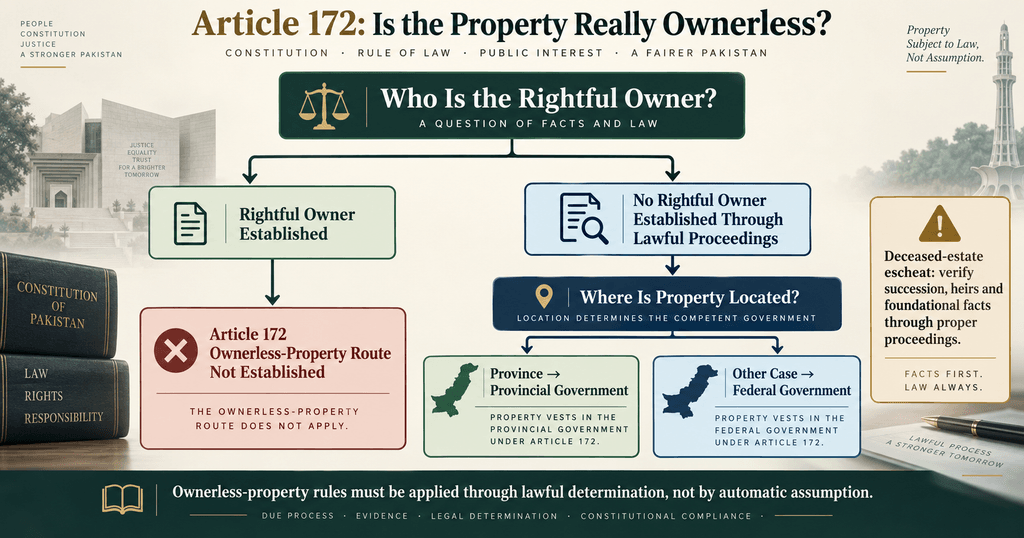
Article 172(1) of the Constitution says that property which has no rightful owner shall, if located in a Province, vest in the Government of that Province, and in every other case in the Federal Government. That remains the wording shown in the current official Pakistan Code text.
Official Constitution of Pakistan — Pakistan Code
A legally careful explanation of Escheat Property in Pakistan should therefore not reduce Article 172 to “no heirs = Government property.” The constitutional text is about a property having no rightful owner. In PLD 2026 SC 283, the Supreme Court was dealing with an alleged deceased-owner succession situation and said that State vesting in that context requires the owner to have died intestate, no legal heir to exist, and those foundational facts to be established through proper independent proceedings.
So keep two points separate:
- Article 172: asks whether the property has a rightful owner.
- PLD 2026 SC 283: explains the proof needed in the deceased-estate escheat context before the Court.
That distinction prevents an uncertain pedigree, a failed private suit or one revenue entry from becoming automatic proof of Escheat Property in Pakistan.
How the Multan Property Dispute Began
The plaintiffs claimed ownership of a house through inheritance. They pleaded that the house was jointly owned by Mst. Bismillah Begum and her mother, Mst. Hakeeman. Mst. Bismillah Begum died on 16 June 1996, and the plaintiffs asserted an inheritance-based claim through the family line.
They also alleged that the defendants had prepared a forged waqf deed and that Mst. Bismillah Begum’s thumb impression had been obtained when she was unconscious and not fit to execute it. These were allegations in the plaintiffs’ case, not final factual findings by the Supreme Court.
The competing side relied on the alleged waqf deed. One defendant filed a contesting written statement and another a conceding written statement. The trial court framed issues and the matter went to evidence.
The dispute therefore began as inheritance versus an alleged waqf claim. It was not originally litigation about Escheat Property in Pakistan.
For related succession-record issues, readers may also see our guide on Inheritance Mutation in Pakistan.
What the Lower Courts and High Court Did
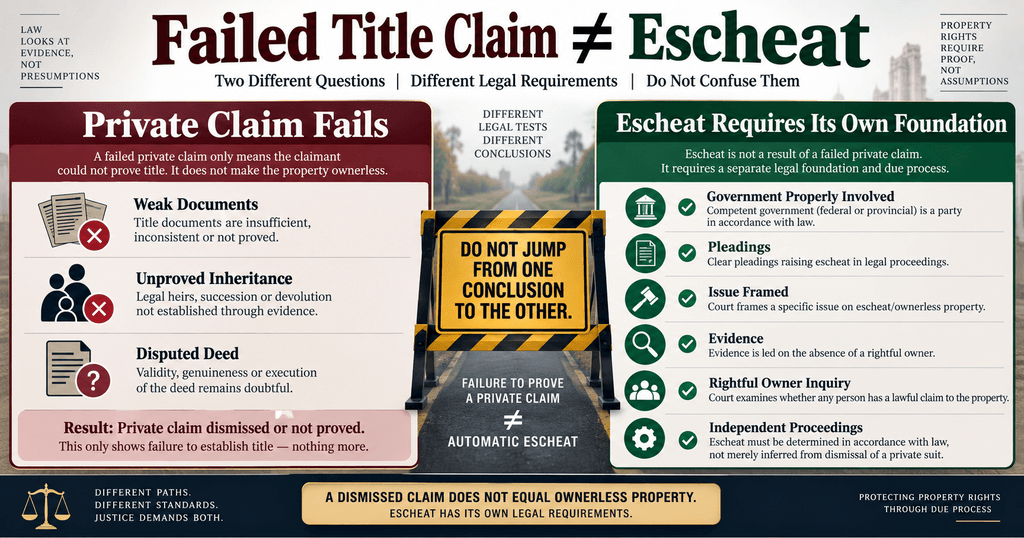
The trial court dismissed the suit, and the dismissal was maintained on appeal. The concurrent position was that neither side had established its respective title or claim.
That finding did not prove that nobody had a rightful title.
At the High Court stage, certain revenue entries reflected the Provincial Government’s name. The High Court used those entries to treat the property as escheat and directed the Government to take possession.
The Supreme Court held that this introduced a third and entirely different case into litigation that had remained a private title contest. That is one of the most important lessons in Escheat Property in Pakistan: rejecting the claims before the court does not itself prove a new State-title case that was never pleaded or tried.
Four Reasons the Supreme Court Set Aside the Escheat Direction
First, Government was not a party to the litigation.
Second, no party had pleaded escheat.
Third, no issue had been framed and no evidence had been led on the foundational facts necessary for escheat.
Fourth, the Government’s name in revenue record was not enough by itself to justify the declaration.
The Supreme Court explained that, at most, if the High Court believed neither private party had proved title and the property might belong to Government, it could leave the matter open for Government to proceed independently in accordance with law.
This makes PLD 2026 SC 283 a strong authority against using procedural shortcuts in Escheat Property in Pakistan disputes.
Escheat Property in Pakistan: What Must Be Proved?
There is no one-document shortcut. In a deceased-owner situation like the one discussed by the Supreme Court, the following questions can become central:
- Who was the last legally established owner?
- Is the owner dead, and what is the verified date of death?
- What succession law applies?
- Is there any lawful heir or successor?
- Is there a valid will, gift, sale, waqf, settlement or other transaction affecting title?
- What do the root title documents and certified revenue records show?
- Has Government lawfully asserted an escheat claim through proper proceedings?
- Have affected persons received an opportunity to contest the claim?
A missing name in one mutation or failure of one claimant to prove a family tree does not necessarily answer all these questions. Escheat Property in Pakistan requires proof of the legal foundation, not an assumption from a gap in the record.
Revenue Record Is Evidence, Not Automatic State Ownership
The Supreme Court specifically held that the mere reflection of the Provincial Government’s name in revenue record could not justify the escheat declaration in this case.
When Escheat Property in Pakistan is disputed, ask more than “whose name appears in the record?” Check:
- the source transaction or order;
- the date and authority behind the Government entry;
- the previous ownership record;
- any inheritance inquiry and pedigree;
- title documents supporting or contradicting the entry;
- possession history;
- notices and objections; and
- earlier judgments involving the property.
A revenue entry may be important evidence, but its legal effect depends on the law and the material behind it. For a related remedy discussion, see our guide on Civil Suit for Declaration.
Procedure: How an Escheat Claim Should Be Examined
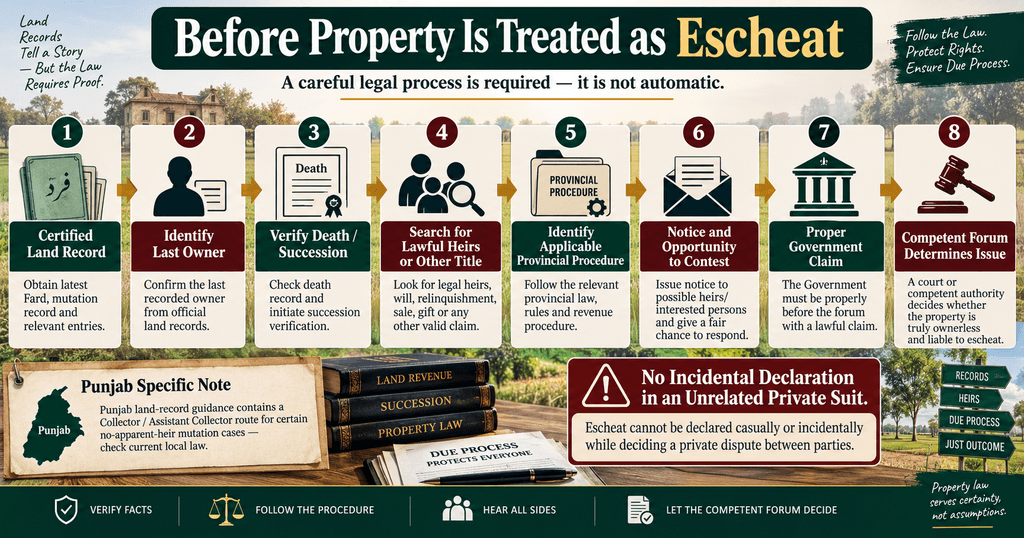
PLD 2026 SC 283 does not prescribe one nationwide administrative code for Escheat Property in Pakistan. Its minimum rule is procedural: the foundational facts must be established in proper and independent proceedings, not incidentally in an unrelated private suit where the issue was never pleaded or proved.
Land administration is provincial, so the competent authority and procedural route can vary.
In Punjab, for example, the Punjab Land Records Authority’s published land-record manual states in paragraph 7.26 that mutation cases involving deceased proprietors who leave no apparent legal or customary heirs or successors should be disposed of by the Collector or an Assistant Collector of the First Grade. It also warns against indiscriminate pressing of Government claims to escheat. This is Punjab-specific administrative guidance, not a nationwide rule. (Punjab Land Records Authority)
Official Punjab land-record guidance — PLRA
A practical sequence is:
- identify the property location and applicable provincial law;
- obtain certified title and revenue records;
- establish the last owner and chain of title;
- verify death and family/succession material where relevant;
- identify persons who may claim as heirs or owners;
- challenge a disputed entry before the competent revenue authority where appropriate;
- use civil proceedings where title, cancellation, injunction, possession or consequential relief genuinely requires adjudication; and
- implead Government where State title by escheat is actually being asserted in court.
Evidence and Documents to Preserve
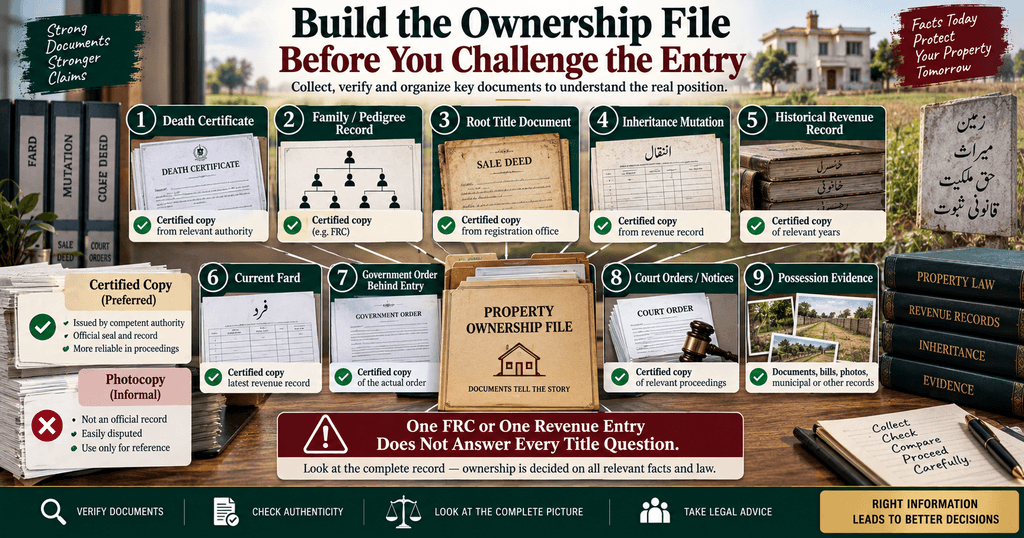
In Escheat Property in Pakistan disputes, preserve originals where available and obtain certified copies from the relevant offices. Useful material can include:
- death certificate of the last owner;
- Family Registration Certificate and other lawful family-record evidence;
- shajra nasab or pedigree from relevant proceedings;
- inheritance mutation and later mutations;
- registered sale, gift, waqf, lease or other root-of-title documents;
- current and historical fard/jamabandi/record-of-rights;
- the Government order, mutation or proceeding behind a State entry;
- court judgments, decrees, notices and objections involving the property;
- possession evidence where legally relevant.
Do not assume that an FRC alone conclusively decides every legal-heir question. The applicable personal law and full family situation still matter.
What to Do If Property Is Suddenly Shown in Government’s Name
Start with certified records, not accusations.
Obtain the entry and the underlying order or mutation. Identify the date, authority and legal basis. Compare the new entry with the previous record and your root-of-title documents.
If the problem is an incorrect mutation or revenue entry, an objection, appeal or revision may be available under the relevant provincial law. If the real dispute concerns ownership or validity of an instrument or transaction, civil relief may be required. Depending on the facts, this can include declaration, cancellation, injunction, possession or another consequential remedy.
The correct relief in Escheat Property in Pakistan depends on possession, title documents, Government’s actual claim, third-party rights and limitation. Do not copy a prayer clause from another case.
Where an old inheritance entry is involved, our guide on Limitation in Inheritance Cases in Pakistan may also be useful.
Seven Mistakes That Can Damage an Escheat Case
1. Treating “no proven claimant” as “no rightful owner”
They are not the same legal conclusion.
2. Treating one Government revenue entry as conclusive title
PLD 2026 SC 283 rejects that shortcut.
3. Failing to identify every possible heir
An incomplete pedigree can distort the entire succession inquiry.
4. Presenting allegations as judicial findings
The alleged forgery and alleged unconscious thumb impression in this case were the plaintiffs’ allegations. The Supreme Court did not finally decide the waqf deed’s genuineness in this order.
5. Choosing the wrong forum
Mutation correction, administrative State-property proceedings and a civil title suit are not interchangeable.
6. Ignoring limitation or later third-party rights
Delay, knowledge, acquiescence and later transfers can materially change available remedies.
7. Seeking relief unsupported by pleadings and evidence
Escheat Property in Pakistan is itself a reminder that courts decide cases on properly raised and proved issues.
What PLD 2026 SC 283 Did Not Decide
The Supreme Court did not declare the plaintiffs owners.
It did not finally uphold the alleged waqf claim.
It did not hold that Government can never claim the property.
It did not say every Government revenue entry is meaningless.
It did not create one uniform escheat procedure for every province and territory.
What it did was narrower: it set aside the High Court’s escheat declaration and possession direction because the issue had not been pleaded, framed, proved or litigated with Government as a party. The dismissal of the plaintiffs’ suit remained intact, and Government was left free to proceed independently in accordance with law.
That is the correct way to report the legal effect of this judgment on Escheat Property in Pakistan.
Practical Effect for Heirs, Owners and Lawyers
Heirs should build a complete file: pedigree, death record, title chain, inheritance entries and documents affecting succession. Property holders should investigate any Government entry and obtain the order behind it.
Lawyers should treat pleadings and necessary parties seriously. If State ownership by escheat is genuinely in issue, the material facts, legal basis, Government’s role and evidence should be placed before the competent forum. The Supreme Court’s message is not that State title is impossible; it is that Escheat Property in Pakistan cannot be created by procedural surprise.
Conclusion: Escheat Requires Proof, Not a Shortcut
Escheat Property in Pakistan sits at the intersection of constitutional law, inheritance, land records and procedural fairness. Article 172 protects the State’s entitlement to genuinely ownerless property, but PLD 2026 Supreme Court 283 shows that State vesting cannot be inferred merely because two private litigants fail to prove title.
The safer approach is to identify the rightful owner, investigate heirs and title documents, use the correct forum, bring necessary parties before the decision-maker and prove the foundational facts.
If a property record suddenly shows Government’s name, do not assume the family has already lost the property. Equally, do not assume a private claimant has won simply because an escheat order was set aside. In Escheat Property in Pakistan, the answer depends on title, succession, evidence, procedure and the relief actually sought.
FAQs About Escheat Property in Pakistan
1. What is Escheat Property in Pakistan?
Escheat Property in Pakistan generally refers to property claimed to vest in the State because it has no rightful owner. Article 172(1) uses the phrase “no rightful owner.” In PLD 2026 SC 283, dealing with a deceased-owner succession setting, the Supreme Court said the relevant foundational facts include intestacy and absence of a legal heir, proved through proper independent proceedings.
2. Does property automatically go to Government if no private party proves title?
No. The failure of two private parties to prove their claims may justify dismissal of their suit, but it does not automatically establish Escheat Property in Pakistan. State ownership still requires its own legal foundation, proper proceedings and evidence.
3. Is a Government name in the revenue record enough to prove escheat?
No. The Supreme Court held that the Government’s name appearing in the revenue record could not, by itself, justify the escheat declaration in this case. The source of the entry, title history, succession facts and underlying order still require examination.
4. Can a lawful heir defeat an escheat claim?
A genuine lawful heir may defeat an escheat claim based on failure of heirs, but heirship must be properly established under the applicable personal law and facts. Preserve the death record, pedigree, inheritance documents and title chain rather than relying only on an informal family statement.
5. What relief did the Supreme Court give in PLD 2026 SC 283?
The Supreme Court granted partial relief. It removed the High Court’s escheat declaration and direction that Government take possession. It did not decree title for the petitioners. The dismissal of their civil suit remained intact.
6. Can Government still start proceedings after this judgment?
Yes. The Supreme Court expressly left the matter open for Government to proceed independently in accordance with law. The judgment does not permanently bar a lawful State claim; it requires that such a claim be pursued through proper proceedings.
7. Which forum should I approach if my land is shown as Government property?
It depends on the property, province, nature of the entry and relief required. A revenue remedy may be relevant for a mutation or record issue, while a genuine title dispute may require civil relief. Check the current provincial law and forum before filing.
8. What evidence should I collect before challenging an escheat claim?
Collect certified title and revenue records, the death certificate, family or pedigree evidence, inheritance mutations, the order that placed Government’s name in the record, and any sale, gift, waqf, will, allotment or court document affecting title. Preserve notices and possession evidence where relevant.
Scope and Legal Caution for Escheat Disputes
This article is for legal awareness and general educational purposes. It is not a substitute for advice on a specific dispute. Escheat Property in Pakistan, inheritance, revenue entries, waqf, title, limitation and remedies can depend on the province, personal law, documents, dates, possession and procedural history. A qualified lawyer should review the complete record before filing or taking legal action.