
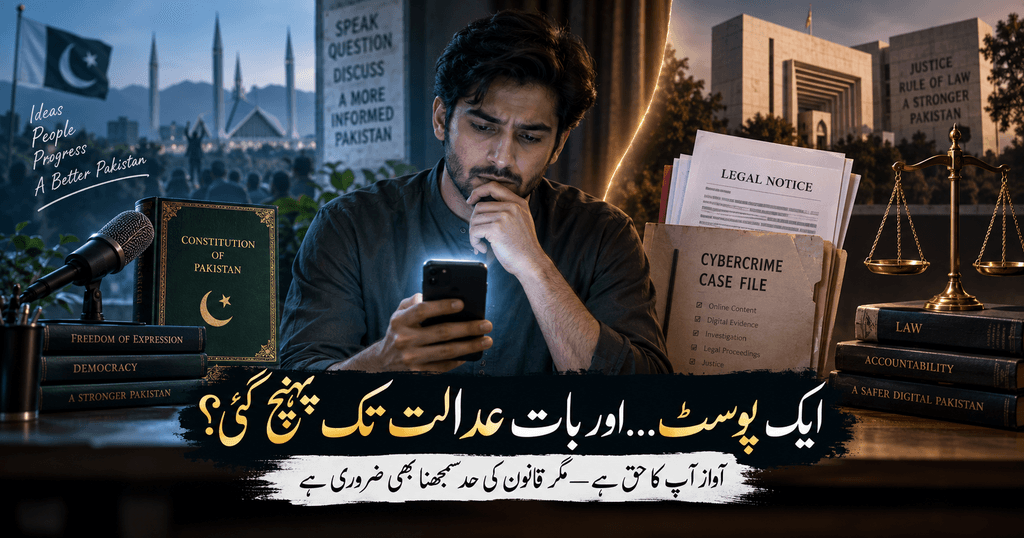
One post. One allegation. One response. Then a civil suit, a cybercrime FIR, bail proceedings, witnesses under pressure—and finally a constitutional question before the Supreme Court.
That is why Freedom of Speech in Pakistan is not merely about whether you are “allowed to speak.” The harder question is what happens after you speak. Can a person publicly complain about alleged wrongdoing? When can reputation law intervene? Can criminal proceedings silence a complainant before the truth is tested? And where does Article 19 draw the line between protected expression and unlawful conduct?
The Supreme Court confronted these difficult questions in Meera Shafi and others v. Federation of Pakistan and others, 2022 SCMR 1267. But there is one fact every reader must understand from the beginning: the reported order was not a final judgment declaring Section 20 of PECA constitutional or unconstitutional.
The Court granted leave to appeal, framed important constitutional questions and stayed proceedings arising from the relevant PECA FIR until the next date of hearing.
That distinction changes how this case should be read—and how Freedom of Speech in Pakistan should be explained today.
Table of Contents
Judgment at a Glance: What 2022 SCMR 1267 Really Decided
| Point | Verified Position |
|---|---|
| Case | Meera Shafi and others v. Federation of Pakistan through Secretary Ministry of Law and Justice, Islamabad and others |
| Citation | 2022 SCMR 1267 |
| Court | Supreme Court of Pakistan |
| Bench | Qazi Faez Isa and Muhammad Ali Mazhar, JJ |
| Decision Date | 8 June 2022 |
| Proceedings | Civil Petition No. 1431 of 2022 |
| Origin | Lahore High Court judgment dated 9 March 2022 in W.P. No. 24397 of 2021 |
| Key Law | Article 19, Article 10A, PECA Section 20 and Defamation Ordinance, 2002 |
| Central Concern | Criminal defamation, truth defence, fair trial, alleged harassment and possible silencing of complainants or witnesses |
| Supreme Court Action | Leave granted; notices issued; PECA criminal proceedings stayed until the next date |
| Not Decided Finally | Constitutionality of Section 20, truth of the harassment allegation, civil defamation liability or final criminal liability |
The reported judgment confirms the case title, bench, court and decision date.
IRAC Snapshot: The Constitutional Fight Behind the Case
| IRAC | Legal Position |
|---|---|
| Issue | Could Section 20 PECA and criminal defamation violate Article 19, undermine a truth defence, silence complainants or witnesses, and affect fair trial where civil and criminal proceedings overlap? |
| Rule | Article 19 protects speech, expression and press freedom subject to reasonable restrictions imposed by law. Article 10A protects fair trial and due process. PECA regulates specified conduct through information systems. |
| Analysis | The petitioners argued that criminal proceedings against them and witnesses created pressure while harassment-related litigation and a civil defamation suit were already pending. They also argued that their position that the tweet was true could be prejudiced. |
| Conclusion | The Supreme Court considered the issues serious enough to grant leave, issue notices and temporarily stay the criminal proceedings. It did not finally decide the constitutional challenge in the reported order. |
This IRAC point is crucial. A court agreeing to examine a constitutional question is not the same as a court finally answering it.
Freedom of Speech in Pakistan Is a Fundamental Right—But Not a Blank Cheque
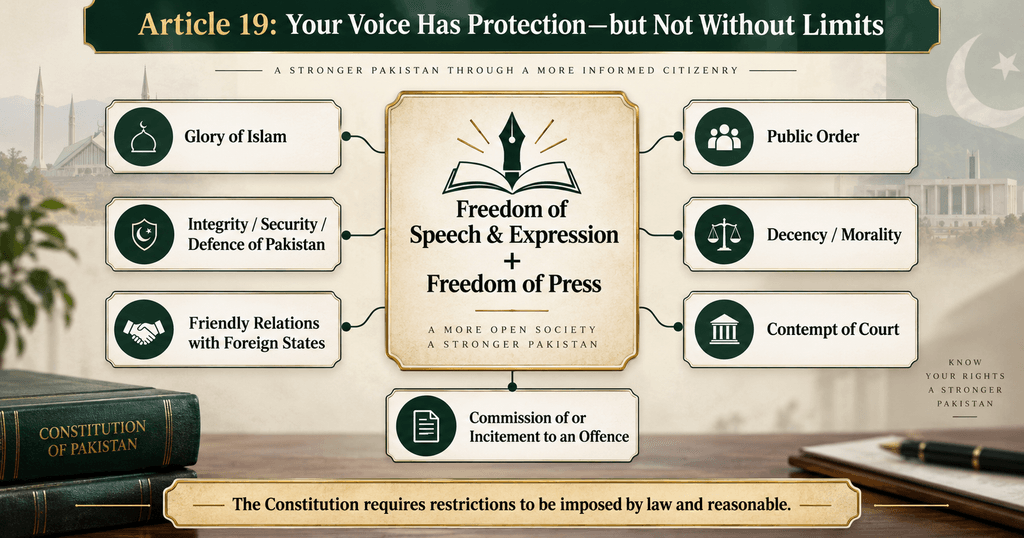
Article 19 of the Constitution gives every citizen the right to freedom of speech and expression and recognizes freedom of the press.
That is the starting point of Freedom of Speech in Pakistan.
But Article 19 itself makes clear that the right is not unlimited. It permits reasonable restrictions imposed by law in the interests of:
- the glory of Islam;
- the integrity, security or defence of Pakistan or any part of it;
- friendly relations with foreign States;
- public order;
- decency or morality;
- contempt of court; and
- commission of or incitement to an offence.
These are the grounds appearing in the constitutional text.
The official National Assembly downloads page currently provides the Constitution as amended up to 21 November 2025, making it the appropriate starting point for checking the present constitutional text. (National Assembly of Pakistan)
Read the official Constitution of Pakistan
The words “reasonable restrictions imposed by law” matter.
Criticism does not become illegal merely because it is uncomfortable. Equally, invoking “free speech” does not automatically protect threats, knowingly false statements or conduct falling within a valid criminal prohibition.
A genuine analysis of Freedom of Speech in Pakistan therefore requires both sides of Article 19: the right and its lawful limits.
A Small Constitutional Detail With a Big Legal Meaning
There is an often-missed point in Article 19.
The current text does not separately list “defamation” among its restriction grounds. The constitutional footnote records that the word “defamation” was substituted in 1975 by the expression relating to the “commission of” an offence.
That does not mean reputation has no legal protection.
It means the constitutional analysis is more sophisticated than saying: “Defamation is mentioned in Article 19, therefore every defamation restriction is automatically valid.”
The legality of a particular restriction still depends on the applicable law, constitutional principles, judicial precedent and facts.
This exact tension later became central to the PECA litigation.
One Tweet, Three Legal Battles: How the Dispute Escalated
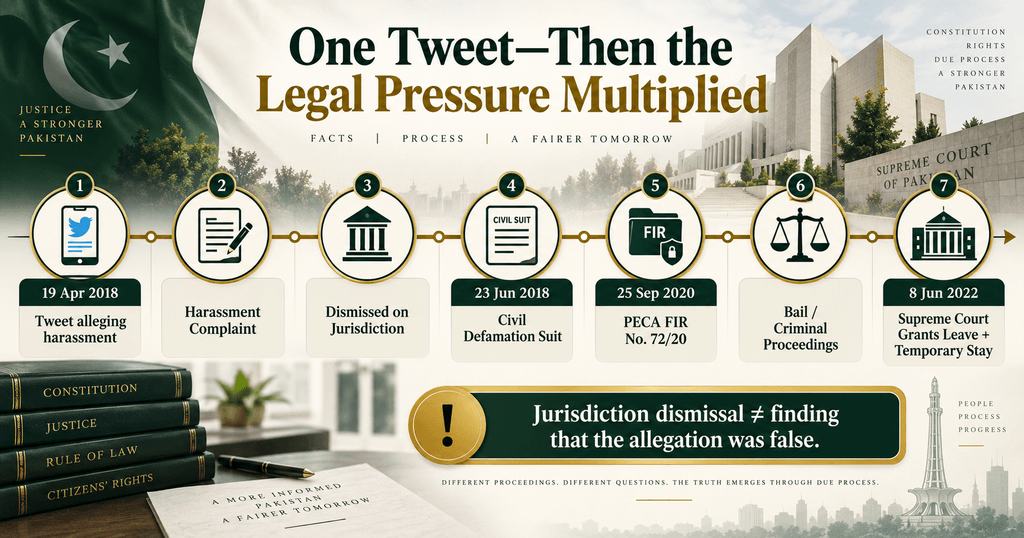
According to the Supreme Court order, petitioner No. 1 posted a tweet on 19 April 2018, alleging sexual harassment and naming respondent No. 5.
She later filed a complaint under the Punjab Protection against Harassment of Women at the Workplace Act, 2012. The Ombudsperson dismissed the complaint on the ground of jurisdiction. The designated appellate authority—the Governor—upheld that order.
The petitioner then approached the High Court. The matter eventually reached the Supreme Court, and leave in the connected harassment proceedings had been granted on 11 January 2021.
Here, legal language matters.
A complaint dismissed because a forum lacks jurisdiction is not automatically a judicial finding that the allegation was false.
“Wrong forum” and “false allegation” are two very different conclusions.
That distinction is especially important when discussing Freedom of Speech in Pakistan, because a reader should never be led to believe that a procedural dismissal settles facts that the court did not actually decide.
Then Came the Defamation Suit and PECA FIR
The dispute did not end with the harassment proceedings.
The Supreme Court recorded that respondent No. 5 filed a civil suit for damages on 23 June 2018, alleging defamation.
Later, FIR No. 72/20 dated 25 September 2020 was registered at FIA Cyber Crime Wing, Lahore under Section 20 PECA against eight persons, including petitioners and witnesses. They had obtained bail and were facing criminal proceedings.
Suddenly, the dispute had several moving parts:
an alleged harassment complaint → a civil defamation suit → a PECA criminal case → constitutional litigation.
This is where Freedom of Speech in Pakistan became more than an abstract constitutional principle.
The question became practical: can the weight of multiple legal proceedings itself affect a person’s willingness or ability to speak and defend what was said?
What the Petitioners Alleged—and What the Court Did Not Treat as Proven
The petitioners’ counsel argued that the PECA FIR had been lodged to pressurize and harass witnesses involved in the pending defamation litigation.
Counsel further submitted that the criminal proceedings jeopardized the harassment-related proceedings and the petitioners’ defence in the civil suit that what had been tweeted was true.
These were submissions by counsel.
They were not final findings that the respondent had, in fact, misused criminal law.
That difference should never disappear in a responsible legal article.
The judicial record contains several different categories:
allegation → argument → evidence → court question → final finding.
Only the last category can safely be presented as something the court finally decided.
The Respondent Raised a Different Problem: Was the Supreme Court the Right Route?
Respondent No. 5 did not only contest the merits.
His counsel raised a procedural objection: the petitioners could have filed an Intra Court Appeal (ICA) against the Lahore High Court judgment but had not used that remedy.
That produced another constitutional question.
Could the petitioners approach the Supreme Court without first exhausting that remedy? And could an exception apply where fundamental rights and potentially the rights of the wider public were involved?
Again, the Supreme Court asked these questions.
The reported order did not finally answer them.
The Eight Questions That Put Freedom of Speech in Pakistan Under the Microscope
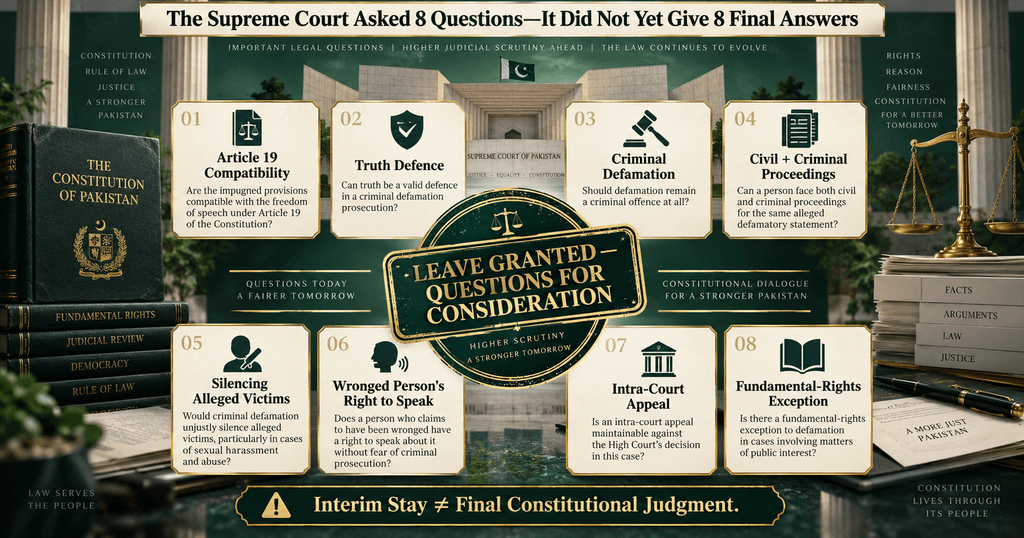
The real importance of 2022 SCMR 1267 lies in the questions the Supreme Court agreed to examine.
In simpler language, the Court asked:
- Could Section 20 PECA, or another PECA provision, violate Article 19?
- Could criminal defamation undermine a defence based on truth?
- Could criminalising defamation suppress the fundamental right of speech and expression?
- Could simultaneous civil and criminal defamation proceedings undermine fair trial and due process under Article 10A?
- Could using PECA against alleged victims of sexual harassment or other crimes silence them and perpetuate injustice?
- Could Section 20 deter a wronged person from speaking about wrongdoing?
- Could the petitioners directly invoke Supreme Court jurisdiction without first filing an ICA?
- Could enforcement of fundamental rights affecting the wider public justify an exception to that normal procedural route?
The order itself records these questions.
One of them even referred to Qur’an 4:148 while considering whether the criminal provision could deter a wronged person from speaking.
For Freedom of Speech in Pakistan, these questions are powerful precisely because they expose a difficult legal tension:
How should the law protect reputation without making genuine complainants too afraid to speak?
The Most Important Sentence in This Article: The Supreme Court Did Not Finally Strike Down Section 20
This point deserves its own section because it is the easiest part of 2022 SCMR 1267 to misreport.
The Supreme Court:
- granted leave to appeal;
- issued notices;
- notified the Attorney-General for Pakistan because a federal law was under constitutional challenge;
- notified the Advocate-General, Punjab; and
- stayed proceedings arising from FIR No. 72/20 until the next date of hearing.
It did not, through this reported order:
- finally strike down Section 20 PECA;
- finally uphold Section 20;
- permanently quash the criminal case;
- declare the harassment allegation proved;
- declare the allegation false; or
- decide the civil defamation suit.
So the accurate summary is:
2022 SCMR 1267 raised major constitutional questions and granted interim protection. It was not the final constitutional answer.
That is the legally safe way to use the case while explaining Freedom of Speech in Pakistan.
Another 2022 Judgment Cannot Be Ignored: PFUJ v. President of Pakistan
The legal landscape becomes more interesting because another court had already delivered a significant free-speech ruling in April 2022.
In Pakistan Federal Union of Journalists v. President of Pakistan, W.P. No. 666/2022, the Islamabad High Court struck down the PECA Amendment Ordinance, 2022.
The IHC also held that the offence under Section 20, to the extent of the expression concerning harm to reputation and its punishment, was unconstitutional and struck it down.
The Court further stated that complainants remained free to pursue remedies available under relevant defamation laws. (IHC Mis Portal)
Read the official Islamabad High Court order
This must also be described carefully.
It was an Islamabad High Court judgment, not a Supreme Court judgment. Therefore, it should not be carelessly converted into the statement that “the Supreme Court permanently abolished criminal defamation under PECA.”
That is not what 2022 SCMR 1267 says.
PECA Changed Again in 2025—So an Old Blog Is No Longer Enough
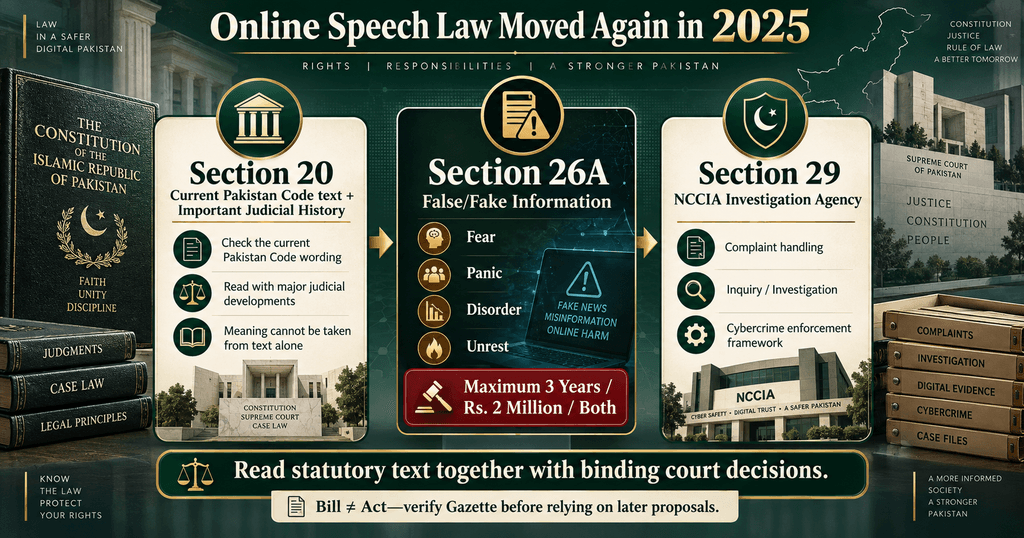
Any current guide to Freedom of Speech in Pakistan that stops at the 2022 litigation is incomplete.
Parliament enacted the Prevention of Electronic Crimes (Amendment) Act, 2025, Act II of 2025. The official Gazette records presidential assent on 29 January 2025 and states that the Act came into force at once. (Senate of Pakistan)
Read the official PECA Amendment Act 2025 Gazette
The amendment materially changed the statutory framework.
Section 20: Read the Bare Text With Its Judicial History
The current consolidated Pakistan Code text of Section 20 states, in substance, that a person commits the offence where the specified online publication is intentional, the person knows the information to be false, and it intimidates or harms the reputation or privacy of a natural person. The section carries a maximum punishment of three years, a fine up to Rs. 1 million, or both. (Pakistan Code)
But there is an important legal warning.
The consolidated statutory text still displays the reputation language while the Islamabad High Court’s 2022 judgment struck down Section 20 to the extent identified in that decision. (IHC Mis Portal)
Therefore, a lawyer or litigant should not read the bare statutory text in isolation.
For Freedom of Speech in Pakistan, the correct approach is:
read the statute + read the relevant judgment + check later appellate history + confirm jurisdiction.
Read the current official PECA text on Pakistan Code
Section 26A: The New False and Fake Information Offence
The 2025 amendment inserted Section 26A.
It applies where a person intentionally disseminates, publicly exhibits or transmits information through an information system that the person knows or has reason to believe is false or fake, and the information is likely to cause or create fear, panic, disorder or unrest in the general public or society.
The maximum punishment is:
three years’ imprisonment, a fine up to Rs. 2 million, or both. (Pakistan Code)
That wording matters.
It is not enough to reduce the provision to the slogan “wrong information = three years.”
The statutory ingredients still matter: intentional dissemination, the required state of knowledge or reason to believe, falsity or fakeness, and the specified likely public effect must be examined according to the law and evidence.
NCCIA Now Handles PECA Investigations
The 2025 amendment also substituted Section 29 and provided for the National Cyber Crime Investigation Agency (NCCIA) as the investigation agency for inquiry, investigation and prosecution of offences specified under PECA. (Pakistan Code)
This is an important practical update because older articles still tell readers simply to “go to FIA Cyber Crime Wing.”
For a current article on Freedom of Speech in Pakistan, that advice is outdated.
What About PECA Proposals Appearing in 2026?
There is another trap readers should avoid.
Official Senate records in 2026 show additional PECA amendment Bills, including proposals concerning Sections 22 and 42 and a separate proposal concerning Section 38. Some had progressed through committee or Senate stages. (Senate of Pakistan)
But:
Bill ≠ Act.
A proposal should not be presented as operative law merely because it was introduced, recommended by a committee or passed by one House.
Always confirm presidential assent and official Gazette publication before describing an amendment as enacted.
That distinction is part of reliable legal reporting.
Freedom of Speech in Pakistan on Social Media: Where Does the Risk Begin?
Imagine four different posts:
| Online Statement | Legal Risk Question |
|---|---|
| “I disagree with this government policy.” | Usually begins as political opinion or criticism; context and applicable restrictions still matter. |
| “In my experience, this happened to me.” | Evidence, wording, forum, identification and applicable law matter. |
| “This person definitely committed a crime,” when no court has decided it | Higher risk because an allegation may be presented as established fact. |
| Knowingly fabricated content designed to cause public fear or unrest | May raise PECA and other legal issues depending on ingredients and evidence. |
The difference is not whether a post is “positive” or “negative.”
The law may examine fact versus opinion, truth versus falsity, intent, context, audience, evidence, harm and the particular statutory offence alleged.
That is why Freedom of Speech in Pakistan should never be taught as either:
“You can say anything.”
or
“Criticising someone is illegal.”
Both statements are dangerously incomplete.
Before Posting a Serious Allegation, Ask Yourself Six Questions
A person speaking about harassment, fraud, corruption, abuse or another alleged wrong should not have to surrender the right to speak.
But serious allegations deserve serious preparation.
Before posting, ask:
- What exactly am I claiming?
Separate what you personally know from what somebody else told you. - What evidence do I have?
Messages, documents, witnesses, emails, recordings or other material may matter. - Am I calling an allegation a proven fact?
“I allege that…” and “the court has proved that…” are not legally identical statements. - Have I identified the correct complaint forum?
A regulator, Ombudsperson, Inquiry Committee, police authority, NCCIA or court may be more appropriate depending on the wrong. - Am I adding unnecessary abusive language?
Abuse rarely strengthens a genuine complaint. - Can I preserve the original material?
If your statement is later challenged, you may have to prove the surrounding context.
Responsible use of Freedom of Speech in Pakistan does not mean speaking timidly. It means knowing which parts of your statement you can actually support.
For workplace-related allegations, readers may also consult Qanooni Dastak’s detailed guides:
Women Harassment Law in Pakistan
Workplace Harassment in Pakistan
The Screenshot Is Not the Case: Preserve the Evidence Behind It
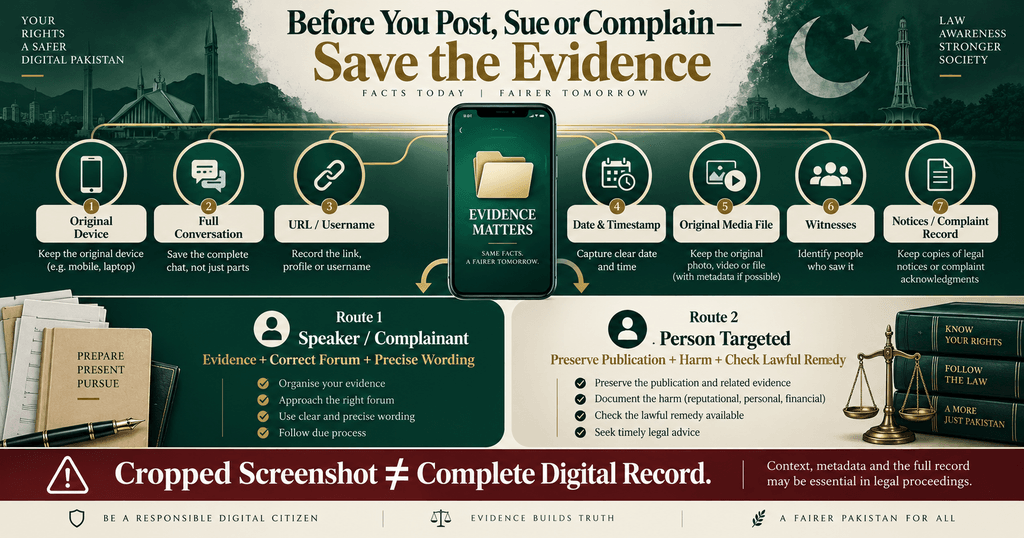
A screenshot can be useful.
But a screenshot can also be cropped, edited, stripped of context or disconnected from the account and device from which it came.
If an online statement becomes a legal dispute, preserve as much original material as reasonably possible:
- the original phone, computer or device;
- complete conversation or thread;
- original image, video or audio file;
- URL or post link;
- username and account identifier;
- visible date and timestamp;
- emails and attachments;
- notices received;
- witness details;
- complaint acknowledgments;
- records showing when the material was first received; and
- any lawful backup of the original data.
Do not “improve” the evidence.
Do not rewrite a message and present it as the original. Do not keep only the favourable half of a conversation. Do not delete material merely because it appears inconvenient.
In disputes involving Freedom of Speech in Pakistan, context may be as important as the sentence being challenged.
If You Believe You Were Wronged, Choose the Forum Before the Hashtag
Public attention and legal relief are not the same thing.
A viral post can attract thousands of views, yet still fail to secure a legal remedy.
Depending on the facts, a person alleging wrongdoing may need to approach:
- an organization’s Inquiry Committee;
- an Ombudsperson;
- police;
- NCCIA;
- a statutory regulator;
- a civil court;
- or a constitutional court.
The correct forum depends on the nature of the wrong, jurisdiction, applicable statute and relief required.
A harassment forum, for example, does not automatically become a defamation court. A cybercrime complaint does not automatically cancel civil liability. A constitutional petition is not a substitute for every ordinary statutory remedy.
This is where Freedom of Speech in Pakistan intersects with procedure.
Having a right is one question.
Enforcing the right through the correct forum is another.
If False Online Content Targets You, Do Not Destroy Your Own Case by Reacting Emotionally
Being publicly accused can be frightening and humiliating.
But an abusive counter-post may create a second dispute instead of solving the first.
First preserve the evidence:
post → URL → profile → date → full context → witnesses → proof of resulting harm.
Then identify the legal route.
Where facts may disclose a PECA offence, the official NCCIA guidance states that complaints can be reported through its complaint system, Pakistan Citizen Portal, email or a Cyber Crime Reporting Centre. For formal investigation, NCCIA states that it is the authorised agency under Section 29(1) of amended PECA. (NCCIA)
The NCCIA FAQ identifies a written application, CNIC copy and copies of evidence among the documents required for a formal complaint. It also states that in-person verification may be required. (NCCIA)
Open the official NCCIA complaint portal
Civil or other remedies may separately arise according to the governing law and jurisdiction.
Do not assume that one proceeding automatically replaces another.
Seven Mistakes That Can Turn a Strong Case Into a Weak One
Many Freedom of Speech in Pakistan disputes become harder because of avoidable mistakes.
1. Calling Allegations “Proved Facts”
If a court has not decided the allegation, do not say that it has.
2. Keeping Screenshots but Deleting the Original Conversation
Authentication and context can later become disputed.
3. Assuming Truth Requires No Evidence
Saying “it is true” and proving a legally relevant fact are different things.
4. Copying a Remedy From Someone Else’s Case
Different causes of action may require different forums and relief.
5. Treating a Stay Order as a Final Victory
An interim stay may protect a party temporarily without settling the merits.
6. Mixing Federal and Provincial Law
The applicable law can depend on jurisdiction and subject matter.
7. Treating a Bill as Current Law
Check the Gazette and official statutory text before relying on an amendment.
These are not technical niceties. They can determine whether a legal claim is accurately framed from the first day.
What 2022 SCMR 1267 Ultimately Teaches About Speech, Truth and Power
The deepest lesson of 2022 SCMR 1267 is not that speech always defeats reputation.
It is also not that reputation always defeats speech.
The case shows why legal process itself matters.
A complainant may say: “I am speaking about something that happened to me.”
The person accused may respond: “The statement is false and has destroyed my reputation.”
The State may then become involved through criminal law.
At that moment, Freedom of Speech in Pakistan becomes a constitutional balancing exercise involving speech, reputation, privacy, fair trial, evidence and access to justice.
The legal system must be capable of testing truth without creating a process that decides the dispute through fear alone.
That is precisely why the Supreme Court’s eight questions mattered.
A Practical Action Plan Before You File, Post or Reply
Before taking the next step, prepare one file containing:
- a one-page chronology;
- the exact disputed words;
- complete digital evidence;
- original documents;
- identities of relevant witnesses;
- the date you first learned of the publication or wrong;
- any legal notice or response;
- details of pending civil, criminal or administrative proceedings;
- the law and jurisdiction you believe apply; and
- the exact relief you want.
Then ask three final questions:
What can I prove?
Which forum can legally grant the relief I need?
Is there any deadline, appeal period or limitation issue I could lose by waiting?
That approach makes a Freedom of Speech in Pakistan dispute far easier to analyse than arriving with twenty screenshots but no chronology, no original data and no clear remedy.
Conclusion: The Constitution Protects a Voice, Not Carelessness
Freedom of Speech in Pakistan matters most when speaking carries a cost.
Article 19 gives constitutional protection to expression and the press. Article 10A keeps fair trial and due process in the picture. Article 19A protects access to information in matters of public importance. PECA creates a separate digital-law framework, which was materially amended in 2025.
The lesson from 2022 SCMR 1267 is equally important: do not convert constitutional questions into constitutional answers that the Court did not give.
The Supreme Court granted leave. It framed eight serious questions. It temporarily stayed the relevant criminal proceedings.
It did not finally decide the entire constitutional controversy in that reported order.
For anyone exercising Freedom of Speech in Pakistan, the safest principle is simple:
Speak precisely. Preserve evidence. Separate allegation from fact. Choose the correct forum. And never confuse the power to speak with immunity from every legal consequence.
That protects both sides of justice—the person who needs the courage to speak and the person who has the right not to be condemned without proof.
FAQs About Freedom of Speech in Pakistan
1. Did the Supreme Court strike down PECA Section 20 in 2022 SCMR 1267?
No. In 2022 SCMR 1267, the Supreme Court granted leave to appeal, framed constitutional questions and stayed the criminal proceedings until the next date. It did not finally declare Section 20 constitutional or unconstitutional in that reported order. A separate Islamabad High Court judgment in W.P. No. 666/2022 dealt directly with part of Section 20.
2. What was the practical effect of 2022 SCMR 1267?
The immediate practical effect was interim protection in the relevant criminal proceedings while the Supreme Court agreed to examine broader constitutional questions. The order did not finally prove or disprove the harassment allegation, dispose of the civil defamation suit or permanently terminate every PECA issue between the parties.
3. Is Freedom of Speech in Pakistan an absolute constitutional right?
No. Article 19 protects speech, expression and press freedom, but expressly makes them subject to reasonable restrictions imposed by law on specified constitutional grounds. Whether a particular restriction is valid requires examination of the applicable statute, constitutional basis, facts and relevant judicial precedent.
4. Can I post an allegation online if I genuinely believe it is true?
Genuine belief alone may not settle every legal issue. The wording, evidence, source of your information, context, identification of the person concerned and applicable law can all matter. Preserve original evidence, distinguish personal knowledge from hearsay, avoid presenting an unresolved allegation as a final judicial fact, and consider using the competent legal forum.
5. What is PECA Section 26A after the 2025 amendment?
Section 26A concerns intentional dissemination, public exhibition or transmission of information that a person knows or has reason to believe is false or fake and that is likely to create fear, panic, disorder or unrest in the general public or society. The maximum statutory punishment is three years’ imprisonment, a Rs. 2 million fine, or both.
6. Does the current PECA text still contain reputation wording in Section 20?
Yes, the current consolidated Pakistan Code text displays Section 20 language concerning information known to be false that intimidates or harms reputation or privacy. However, the Islamabad High Court’s 2022 judgment struck down the reputation-related part identified in its order. The bare text should therefore be read together with judicial history and any later binding appellate developments.
7. Where can I make a cybercrime complaint in Pakistan now?
The amended PECA assigns inquiry, investigation and prosecution functions to NCCIA. Its official system provides an online complaint form and Cyber Crime Reporting Centres. Before filing, prepare your written facts, identity documents and relevant evidence and confirm the appropriate complaint route for your particular grievance.
8. What evidence should I preserve in a Freedom of Speech in Pakistan dispute?
Preserve the original device and files where possible, complete conversations, URLs, usernames, timestamps, emails, attachments, audio or video, notices and witness details. Avoid relying only on cropped screenshots. Prepare a chronology showing what was said, when it was published, who received it and what happened afterward.
Legal Awareness Disclaimer
This article is for legal awareness and educational purposes only and does not constitute legal advice or guarantee any outcome. Constitutional, cybercrime, defamation and harassment matters depend on the facts, evidence, jurisdiction, applicable statutory text and current binding judicial precedent. A lawyer should examine the complete record before a specific civil, criminal or constitutional remedy is selected.