

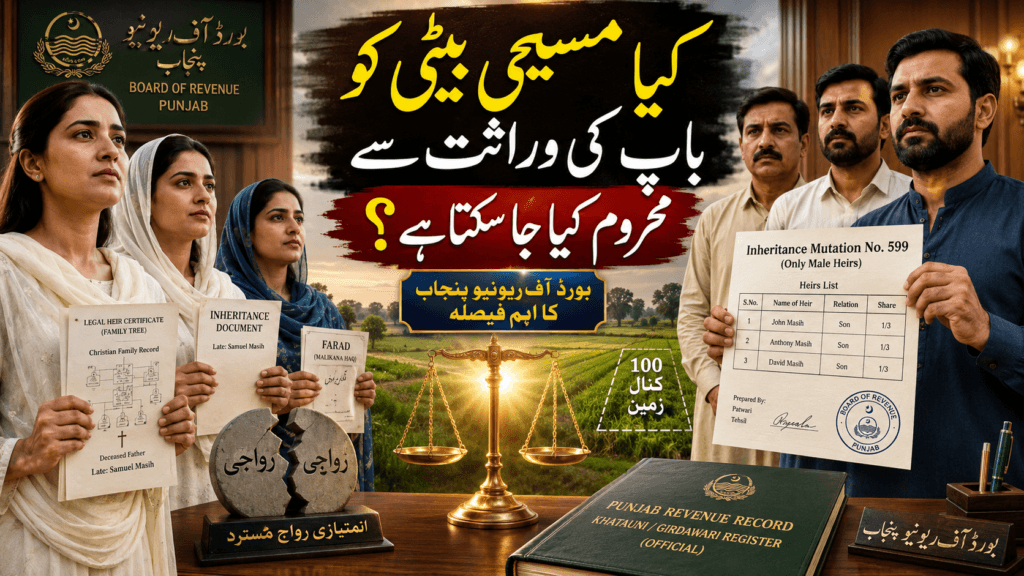
A father dies, leaving agricultural land for his children. When the inheritance record is prepared, the sons appear as heirs, but the daughters’ names are missing. For a daughter, this is not only lost property; it is the painful suggestion that her bond with her father counts less.
That was the conflict in Bashir Alam and others v. Marthan and others, reported as 2016 YLR 2721. The case asked whether Christian inheritance law in Pakistan allowed sons to exclude their sisters from government-allotted land through an alleged male-only custom. The Board of Revenue, Punjab, rejected that position and protected the daughters’ inheritance rights.
The decision shows that Christian inheritance law in Pakistan cannot be defeated by a defective mutation or displaced custom.
Table of Contents
IRAC Analysis: Why the Sons Could Not Exclude Their Sisters
| Element | Summary |
|---|---|
| Issue | Could the daughters of a deceased Christian allottee inherit his agricultural land alongside the sons? |
| Rule | Section 20 made the tenancy inheritable; the Succession Act, 1925 governed Christian intestate succession. |
| Analysis | The sons obtained Mutation No. 599 alone. The daughters challenged it, and the Board preferred statutory law over male-only custom. |
| Conclusion | The revision was dismissed, and the order setting aside the defective mutation was upheld. |
Judgment at a Glance: Christian Daughters and Mutation No. 599
| Detail | Information |
|---|---|
| Case | Bashir Alam and others v. Marthan and others |
| Citation | 2016 YLR 2721 |
| Forum | Board of Revenue, Punjab |
| Presiding Officer | Waheed Akhtar Ansari, Member (Judicial-III) |
| Decision Date | 23 July 2015 |
| Property | 100 kanals, Chak No. 135/16-L, Tehsil Mian Channu, District Khanewal |
| Deceased Allottee | Nawab Masih |
| Disputed Entry | Inheritance Mutation No. 599 dated 27 April 1992 |
| Main Laws | Section 20 of the 1912 Act and Section 29 of the Succession Act, 1925 |
| Final Result | Revision dismissed; daughters’ inheritance protected |
The report explains that the sons secured a mutation depriving the daughters of their shares.
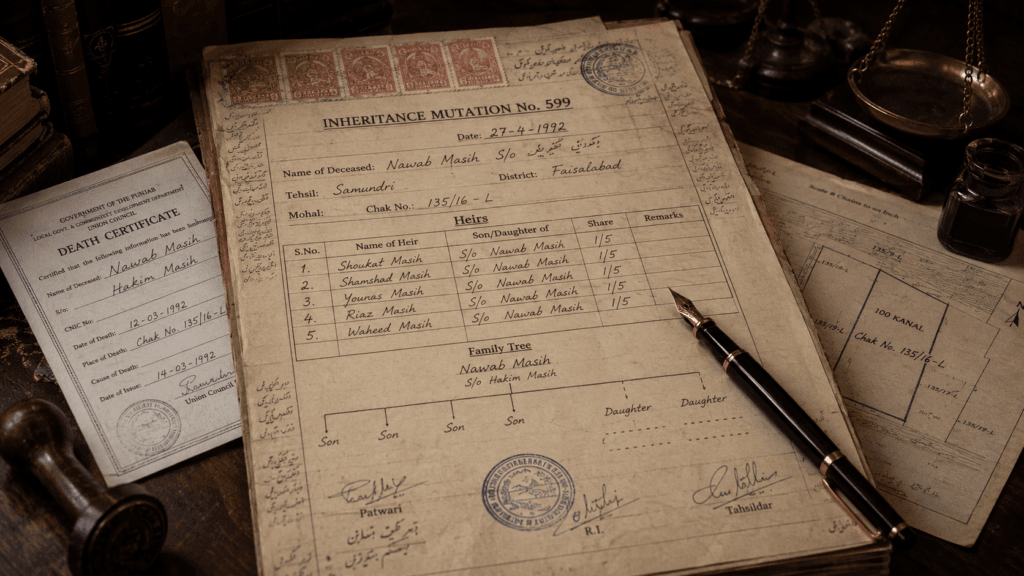
How the Daughters Were Removed from the Record
Nawab Masih held 100 kanals of land in Chak No. 135/16-L, Tehsil Mian Channu, District Khanewal. He died in 1991.
After his death, the petitioners obtained Inheritance Mutation No. 599 on 27 April 1992. It recognized the sons but excluded the deceased’s real daughters.
The daughters appealed to the Deputy District Officer Revenue, Mian Channu. On 29 December 2010, the officer accepted their appeal, set aside the mutation, and directed the preparation of a fresh entry according to law.
This is an important example of Christian inheritance law in Pakistan: a revenue entry must reflect succession rights.
A similar legal problem is explained in our detailed guide on Inheritance Mutation in Pakistan, where a daughter was also excluded from the inheritance record.
The Sons’ Arguments: Why They Defended Mutation No. 599
The petitioners argued that Section 20 controlled the dispute because the land belonged to the Provincial Government rather than private owners.
They claimed that PLD 1992 SC 385 applied only to private property and that the Succession Act did not govern allotted land. Therefore, they said female descendants could not inherit and requested the restoration of Mutation No. 599.
In effect, the sons asked the Board to interpret Christian inheritance law in Pakistan through a special succession order favouring male descendants.
They also argued that the lower revenue authorities had ignored their pleadings, documentary evidence, and the true effect of Section 20 of the Colonization of Government Lands (Punjab) Act, 1912.
The Daughters’ Reply: “We Are Also Our Father’s Heirs”

The respondents said they were Nawab Masih’s real daughters and had been denied their lawful shares. Their counsel relied on the rule that sons and daughters inherit according to law.
They maintained that the Deputy District Officer correctly cancelled the mutation and directed the Tehsildar to prepare a lawful entry. They also said the concurrent revenue orders contained no illegality.
For the daughters, Christian inheritance law in Pakistan meant recognition as their father’s children, not merely names in a register.
Their case carried an emotional truth that often appears in inheritance disputes: a daughter should not have to prove that she was equally the child of her deceased father simply because her brothers reached the revenue office first.
The Legal Questions Before the Board
The Board of Revenue effectively considered four important issues:
- Was the allotted land inheritable after Nawab Masih’s death?
- Did Section 20 create an absolute male-only right?
- Could an alleged Christian custom exclude daughters despite the Succession Act, 1925?
- Was the cancellation of Mutation No. 599 lawful?
The Board had to read the special land law and the applicable succession law together. It could not examine Section 20 in isolation while ignoring the legal framework governing Christian succession.
Why Section 20 Could Not Defeat the Daughters
Section 20 deals with succession to certain government tenancies. The Board observed that the provision itself concerned succession and confirmed that the allotted interest was inheritable.
The property therefore had to pass to the deceased allottee’s successors according to law.
The sons relied on categories appearing in Section 20, including male lineal descendants. The Board, however, refused to use those words to revive a Christian custom already displaced by statute.
The central lesson from Christian inheritance law in Pakistan is that a special land law may make property inheritable, but succession law still identifies the heirs.
Section 20 could not be interpreted as permanent permission to deprive Christian daughters of inheritance whenever the property happened to be government-allotted land.
The Succession Act Replaced the Male-Only Custom
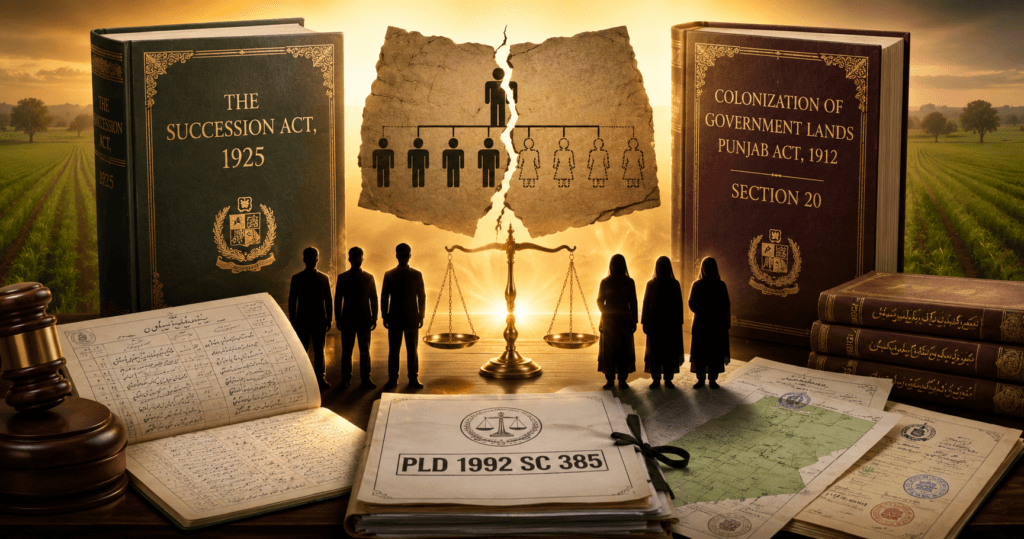
The Board relied on PLD 1992 SC 385, which held that the Succession Act, 1925 had altered Christian customary succession in Punjab.
A Christian woman could inherit with male heirs, and a contrary custom could not control succession.
Readers may consult the official text of the Succession Act, 1925 to understand the statutory framework governing succession in Pakistan.
Section 29 of the Succession Act, 1925 was central to the decision. The Act continues to appear in the Ministry of Law and Justice’s official federal-law database.
Accordingly, Christian inheritance law in Pakistan protects female heirs despite the presence of brothers. Government ownership did not remove the dispute from succession law.
Once statutory law determines the mode of succession, a family cannot rely on a contrary custom merely because that custom gives the entire benefit to male heirs.
Mutation No. 599 Could Not Erase a Legal Heir
Mutation No. 599 excluded the daughters, but it could not determine legal entitlement. A revenue entry must follow the law and genuine heirship.
When a mutation omits lawful heirs, it should be set aside and replaced with a fresh entry. That is what the Deputy District Officer ordered, and the Board found no ground to interfere.
For families applying Christian inheritance law in Pakistan, the practical message is clear: inspect the mutation after death and confirm that every relevant heir is disclosed.
The names, identity documents, and relationship of every legal heir should be checked before the inheritance mutation is attested. A daughter who discovers that her name has been omitted should immediately obtain a certified copy of the mutation and the relevant property record.
Why the Lahore High Court Remanded the Case
The petitioners challenged an earlier Board dismissal before the Lahore High Court. The High Court did not uphold the daughters’ exclusion; it found that the Board’s order lacked reasons and failed to address Section 20.
The matter was remanded for a reasoned speaking order addressing the legal questions.
This was an important procedural development. The Lahore High Court did not declare Mutation No. 599 valid or decide that only the sons were heirs. It required the Board of Revenue to examine the petitioners’ legal arguments properly and give clear reasons.
After reconsidering the law and record, the Board again dismissed the sons’ revision.
Final Decision: The Daughters Remained Heirs

The Board concluded that male and female offspring were both entitled to succeed to the deceased.
It held that the impugned revenue order followed the principle already settled by the Supreme Court and required no interference.
The revision was dismissed as meritless, and the Additional Commissioner’s order dated 15 July 2011 was upheld.
The result applied Christian inheritance law in Pakistan: the sons could not preserve a mutation that erased their sisters.
The order setting aside Mutation No. 599 therefore remained effective, allowing the revenue authorities to prepare a fresh inheritance mutation according to the applicable law.
What Christian Families Should Learn
Obtain the death certificate, relationship proof, allotment papers, and current revenue record. Check the mutation promptly and challenge any exclusion with certified documents.
Under Christian inheritance law in Pakistan, a mutation is important evidence, but it cannot override the statute governing succession.
Christian inheritance law in Pakistan must be applied through law, not family influence or unsupported local practice.
A sister asking for her lawful share is not dividing the family. The wrongful exclusion is what creates the dispute.
Christian families should particularly check the following documents:
- Death certificate of the deceased owner or allottee;
- Identity documents of all surviving heirs;
- Documents proving the relationship with the deceased;
- Original allotment or ownership record;
- Latest Jamabandi or revenue record;
- Copy of the inheritance mutation;
- Orders passed by the revenue authorities;
- Any document relied upon to exclude a legal heir.
Conclusion: A Daughter’s Name Cannot Be Erased
A daughter does not stop being an heir because her brothers control the land record. Christian inheritance law in Pakistan requires succession to follow statute and binding precedent, not a discarded custom favouring only male descendants.
By dismissing the revision, the Board protected more than a share in 100 kanals. It affirmed that Christian women are legal heirs whose property rights must appear in the official record.
The case sends a clear message: an inheritance mutation cannot be allowed to turn a daughter into a stranger to her own father’s property.
Legal Disclaimer
This article explains the judgment in 2016 YLR 2721 for general legal awareness. Outcomes may depend on the property, surviving heirs, applicable laws, and later judicial developments. Consult a qualified Pakistani lawyer for advice on a specific matter.
Frequently Asked Questions
Can a Christian daughter inherit from her father in Pakistan?
Yes. This judgment recognized that a Christian woman may inherit in the presence of male heirs and cannot be excluded merely through an alleged male-only custom.
Does government-allotted land pass to legal heirs?
In this case, the Board held that the allotted tenancy was inheritable and had to be distributed under the applicable succession law.
Can brothers obtain mutation without including their sisters?
A mutation excluding genuine heirs can be challenged and set aside. Christian inheritance law in Pakistan requires the record to include lawful heirs.
Did Section 20 give the sons an absolute right?
No. The Board rejected the attempt to use Section 20 as an absolute basis for excluding the daughters.
The provision established a succession framework, but it could not be used to revive a male-only custom that had been displaced by statutory law.
Does Christian custom override the Succession Act?
The Board, relying on Supreme Court precedent, held that the claimed contrary custom had been displaced by the Succession Act, 1925.
What happened to Mutation No. 599?
It was set aside, and the revenue authority was directed to prepare a fresh mutation according to law.
The petitioners unsuccessfully challenged that result before the higher revenue authorities.
What should an excluded Christian heir do?
The heir should obtain certified copies of the mutation and property record, gather proof of relationship, and consult a lawyer experienced in succession and revenue law.