

An abandoned intersex child grows up with no family and no shelter. A khawaja sira saves for years to perform Umrah, but an “X” on the CNIC stands in the way. A family fears that one heir could change the gender on a card and claim a bigger share of inheritance. All three worries landed in one courtroom. In May 2023, the Federal Shariat Court declared four provisions of the Transgender Act 2018 in Pakistan against the Injunctions of Islam.
Many people now believe the whole law is gone. It is not. Others think nothing changed. That is wrong too. The verdict is real, but an appeal has kept it on hold. This guide explains, in plain words, what the court decided, what survived, where the case stands today, and what khawaja sira and intersex (khusra) citizens and their families can do now.
Table of Contents
Judgment at a Glance: PLD 2023 FSC 301
| Point | Detail |
|---|---|
| Case title | Hammad Hussain and others v. Federation of Pakistan and others |
| Citation | PLD 2023 Federal Shariat Court 301 |
| Court | Federal Shariat Court of Pakistan (Article 203D jurisdiction) |
| Bench | Dr. Syed Muhammad Anwer, Acting Chief Justice (author), and Justice Khadim Hussain M. Shaikh |
| Case numbers | Shariat Petition No. 5/I of 2020 and 11 connected petitions (12 in total) |
| Decided on | 19 May 2023 |
| Hearings | 45 dates, from 30 September 2020 to 11 May 2023 |
| Law examined | Transgender Persons (Protection of Rights) Act, 2018, its Rules of 2020, and NADRA’s Regulation 13(1) of 2002 |
| Declared repugnant | Sections 2(1)(f), 2(1)(n)(iii), 3 and 7, plus the related Rules |
| Not struck down | Intersex definition, eunuch definition (with a call for clarity) and the rest of the Act |
| Result in one line | Four provisions declared against the Injunctions of Islam; three NADRA petitions disposed of as infructuous |
| Position today | Appeals pending before the Supreme Court’s Shariat Appellate Bench; the verdict waits for them |
You can read the full judgment on the Federal Shariat Court’s official website.
IRAC Analysis of the Transgender Act Case
| IRAC | Simple explanation |
|---|---|
| Issue | Do the Act’s definitions of “transgender person” and “gender identity”, the right to register a self-perceived gender (Section 3) and inheritance by CNIC gender (Section 7) conflict with the Quran and Sunnah? |
| Rule | Article 203D of the Constitution, the Injunctions of Islam, the goals of Shariah (protection of life and progeny) and the principle of blocking the means to harm (sadd al-dhara’i). |
| Analysis | The court held that Islam recognises two sexes, male and female. It said prayer, fasting, Hajj, marriage and inheritance rules follow biological sex, so self-perception cannot decide a person’s legal identity. It also found that the Act wrongly merged five different groups into one definition. |
| Conclusion | Sections 2(1)(f), 2(1)(n)(iii), 3 and 7 were declared repugnant. The intersex definition was upheld, the eunuch definition survived with a call for clarity, and the rest of the Act stayed. |
What the Transgender Act 2018 in Pakistan Promised
Parliament passed the Transgender Persons (Protection of Rights) Act in May 2018. Its aim was simple on paper: give legal recognition and basic rights to a community that has long faced exclusion. You can read the full text on Pakistan Code, the government’s official law database.
The Act has 21 sections. The main ones are:
- Section 3: recognition of a person’s self-perceived gender identity, including on the CNIC (shanakhti card), passport and driving licence.
- Sections 4 and 5: a ban on discrimination and harassment.
- Section 6: duties of the government, such as protection centres, safe houses and separate prison cells.
- Sections 7 to 16: rights to inherit, education, jobs, voting, public office, health, assembly, public places and property.
- Section 17: forcing a transgender person to beg is a crime, punishable with up to six months in jail, a fine of up to Rs 50,000, or both.
- Section 18: a complaint can go to the Federal Ombudsman, the National Commission on the Status of Women or the National Commission for Human Rights.
The federal government later made the Transgender Persons (Protection of Rights) Rules, 2020 under Section 20.
The Five-Part Definition That Started the Fight
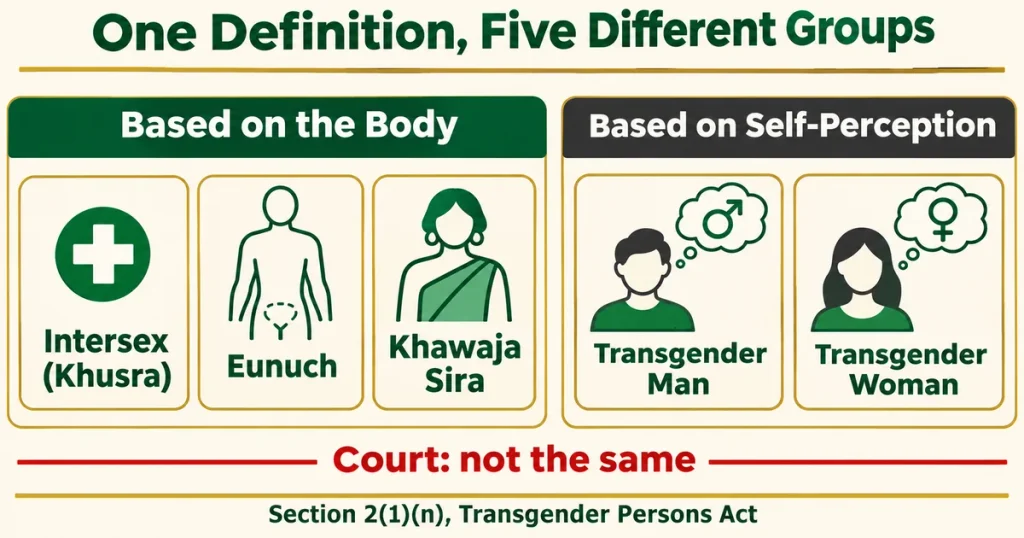
Section 2(1)(n) defined a “transgender person” in three clauses:
- Intersex (khusra): a person born with a mix of male and female genital features or congenital ambiguities.
- Eunuch: a person assigned male at birth who undergoes genital excision or castration.
- Transgender man, transgender woman, khawaja sira, or anyone whose gender identity or expression differs from social norms linked to the sex assigned at birth.
Two more definitions mattered. Section 2(1)(f) defined “gender identity” as a person’s “innermost and individual sense of self” as male, female, a blend of both or neither. Section 2(1)(e) defined “gender expression” as how a person presents that identity.
The first two clauses describe a body condition. The third describes how a person feels about themselves. That difference became the heart of the case.
Who Went to Court and Why
Twelve Shariat petitions challenged the Transgender Act 2018 in Pakistan between 2020 and 2023. The petitioners included Hammad Hussain, former Senator Mushtaq Ahmad Khan, Jamiat Ulema-e-Islam Pakistan (through senior advocate Kamran Murtaza), columnist Orya Maqbool Abbasi and the Birth Defects Foundation. Some intersex persons also joined. On the other side stood the Federation, the Ministry of Human Rights, NADRA, the provinces, and activists such as Farhatullah Babar.
Arguments Against the Law
The petitioners argued that many Islamic rules depend on biological sex, not on how a person feels. They pointed to nikah, talaq, khula, inheritance, prayer rows in a mosque, fasting and the separate ihram for men and women at Hajj.
They called the words “social norms and cultural expectations” in Section 2(1)(n)(iii) too vague for a legal definition. They also noted that Section 7(3)(iii)(d) used a medical officer’s opinion for persons under 18, while adults needed no medical evidence at all.
Their biggest fear was misuse. They argued that a biological male holding a female identity could enter women’s hostels, hospital wards, prisons and sports. Some also alleged the law could shield same-sex relations. That was an allegation; the court made no separate finding on it.
Several intersex persons made a different complaint. They said a law meant for people born with genuine physical differences had been taken over by others, while they still lived without shelter or support.
How the Government and Activists Defended It
The Ministry of Human Rights said the Act deals only with gender identity, not sexual orientation, and gives no right to marry. It relied on dignity under Article 14 of the Constitution and on international treaty obligations.
Farhatullah Babar argued that the Act gives no special quota or privilege, so there is little reason to misuse it. He said a nikahnama can only record a male and a female, that a second gender change is not automatic under the Rules, and that the World Health Organization stopped treating these issues as a mental disorder in 2019. Other respondents cited religious opinions from Egypt and Iran.
What the 45 Hearings Revealed
The record exposed serious gaps in how the law was made and run.
- Council of Islamic Ideology: the Law and Justice Division said the Bill had been sent to the Council. A petitioner then produced a letter from the Council’s Chairman, dated 18 November 2021, saying it never was. The court later allowed a referral, and the Council sent its report in May 2022.
- Changed government reply: the Ministry’s first reply of February 2022 relied on the Yogyakarta Principles. It filed amended comments in March 2022 without that reference. The court said the government had failed in its duty to be an honest litigant.
- Supreme Court orders: the court noted that the 2013 Supreme Court orders in the Dr. Muhammad Aslam Khaki case never used the word “transgender”.
- NADRA: NADRA admitted it had no rules, only an unnotified policy. It gave the same “X” card to intersex persons, eunuchs, transgender men and transgender women.
- Hajj barrier: intersex persons said an “X” card stopped them from going for Hajj and Umrah. The court called this a very serious issue (para 43) and told NADRA to develop rules or criteria for khunsa persons.
- Abandoned children: on 13 December 2022, the court asked the Ministry about shelter for abandoned intersex children and the elderly. The Ministry then formed a monitoring committee and set up protection centres.
The Four Questions Before the Court
The court framed four points of determination (para 47):
- Are the five groups in Section 2(1)(n) the same, or different?
- Does sex or gender decide whether a person is male or female in Islam?
- Do the definitions of “gender identity” and “gender expression” match the Quran and Sunnah?
- Does Islam allow medical treatment for physical problems in the sexual or reproductive organs?
How the Court Reasoned: 6 Key Findings
Intersex and Transgender Are Not the Same
The court held that intersex, eunuch and khawaja sira describe physical or biological conditions. Transgender men and women describe a self-perceived identity. Putting all five under one label, it said, was a drafting mistake that caused confusion (paras 49-58).
It also said many Pakistanis wrongly think “transgender” is the English word for khusra. The correct English word for khusra is intersex.
Intersex Persons Keep Full Protection
Islamic law recognises the intersex person, called khunsa in Arabic. The court held that Section 2(1)(n)(i) is not against Islam. It said intersex persons deserve every right in the Act and that the state may even take extra steps to support them (para 89).
Eunuch Definition Survives, but Needs a Medical Limit
The court said castration by choice is forbidden in Islam and allowed only on genuine medical advice. Paragraph 56(a) uses stronger words against the eunuch definition, but paragraphs 60 and 90 and the final order leave Section 2(1)(n)(ii) in place. The court asked for a clear medical exception. It also said the term khawaja sira, which means eunuch in Urdu, was placed in the wrong clause.
Biological Sex Comes Before Gender, Said the Court
This is the core finding. The court held that, in Islam, “the sex of any person has precedence over gender” (para 76). It said any law giving gender legal priority over sex is void, and that no one may change sex by choice through surgery or hormones.
Self-Perceived Identity and CNIC Change Failed the Shariat Test
Because identity follows sex in the court’s view, the definition of “gender identity” in Section 2(1)(f) was declared repugnant. So was clause (iii) of the transgender definition.
Section 3 fell for the same reason. The court accepted the petitioners’ concern about women’s privacy and safety in spaces meant only for women. It relied on the principle of blocking the means to harm (paras 92-93). Our guide on the Women Harassment Act explains how the law already protects women’s workspaces.
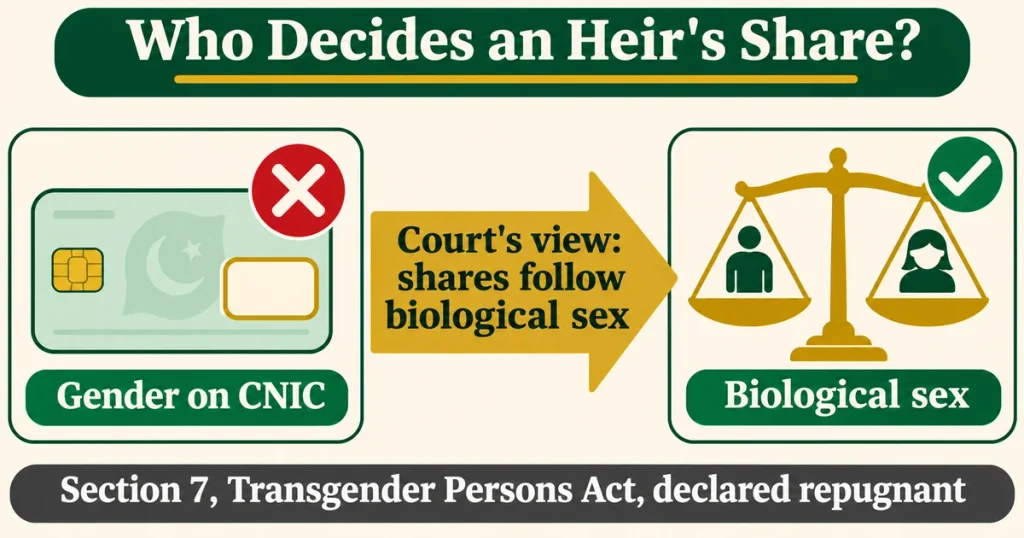
Inheritance Cannot Follow a CNIC Entry
Section 7(2) said a transgender heir’s share would follow the gender declared on the CNIC. The court held that Islamic inheritance (wirasat) shares depend on biological sex alone (para 94). A male cannot take a female’s share, and a female cannot take a male’s. Read how fixed shares work in our guide to inheritance law in Pakistan.
The court also held that medical treatment to correct a physical problem in an intersex person is allowed and even desirable. Treatment that harms sexual or reproductive ability without a valid medical reason is not (paras 83-85).
Final Order: What Fell and What Survived
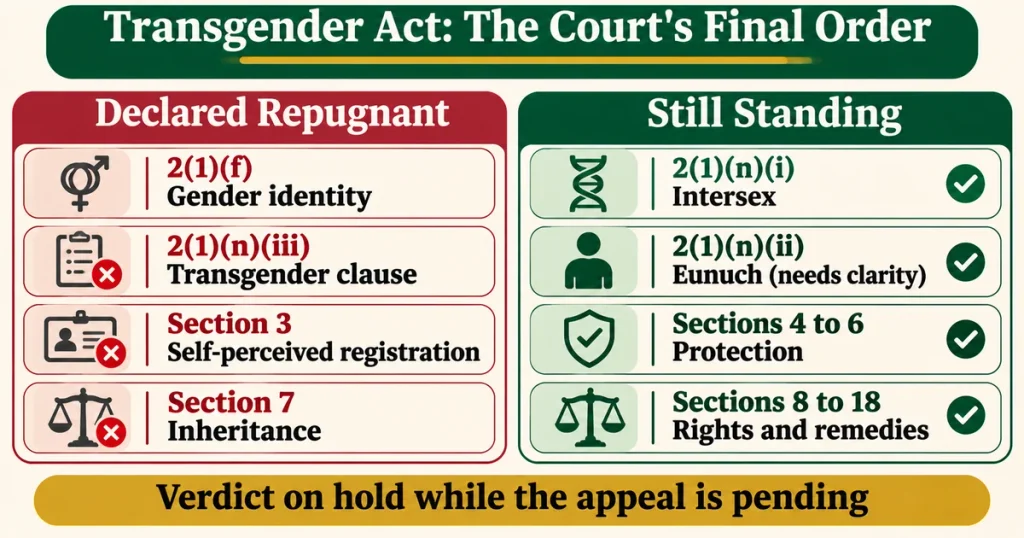
In paragraph 96, the court gave its final order.
| Provision | What it covers | Court’s decision |
|---|---|---|
| Section 2(1)(f) | Definition of gender identity | Declared repugnant |
| Section 2(1)(n)(iii) | Transgender man, woman, khawaja sira clause | Declared repugnant |
| Section 3 | Recognition and registration of self-perceived identity | Declared repugnant |
| Section 7 | Right to inherit | Declared repugnant |
| Section 2(1)(n)(i) | Intersex (khusra) | Not against Islam |
| Section 2(1)(n)(ii) | Eunuch | Survives, needs medical clarity |
| Rules of 2020 | Rules linked to the four provisions | Cease with them |
| NADRA Regulation 13(1) | Old card rule for eunuchs | Petitions infructuous; NADRA deleted it in 2022 |
The final order named Section 7 as a whole, though the reasoning focused on the link between shares and the CNIC.
Is the FSC Verdict on Transgender Act 2018 in Pakistan in Force?
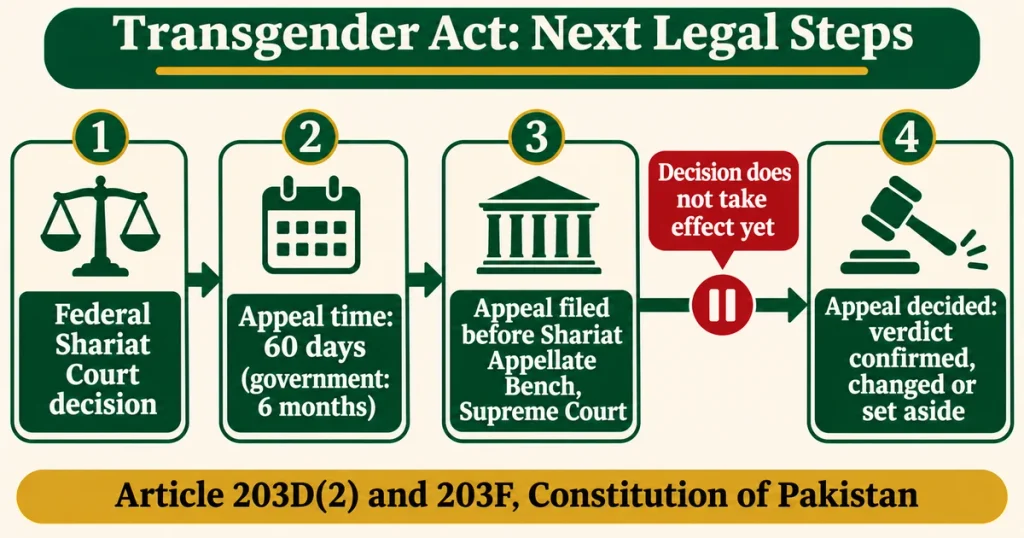
Paragraph 96 says the four provisions “will cease to have any legal effect immediately”. The Constitution says otherwise while an appeal is pending.
Under the proviso to Article 203D(2) of the Constitution of Pakistan, a Federal Shariat Court decision does not take effect until the appeal time ends. If an appeal is filed, it waits until that appeal is decided. Under Article 203F, a party may appeal within 60 days; the federal or a provincial government gets six months.
Appeals were filed. In July 2023, Farhatullah Babar and Sherkan Malik challenged the verdict before the Shariat Appellate Bench of the Supreme Court. In September 2023, NADRA resumed “X” card registration, saying the matter was before the apex court.
The 26th Amendment of 2024 added a 12-month deadline for deciding such appeals. That deadline covers only decisions given after the amendment, so it does not apply to this May 2023 judgment. As of mid-2026, the appeals were reported to be still pending. Check the latest cause list on the Supreme Court website before you rely on either position.
What the Court Did Not Decide
People often misread this judgment. Keep these limits in mind:
- It did not strike down the whole Transgender Act 2018 in Pakistan.
- It did not cancel the rights to education, jobs, health, voting, property or protection from harassment.
- It did not separately strike down Section 2(1)(e) (gender expression) or Section 4 (non-discrimination), though it discussed both.
- It did not rule on marriage of transgender persons; the Ministry itself said the Act gives no such right.
- It made no finding that the Act legalised same-sex relations.
- It did not order NADRA to cancel existing “X” cards.
- It is not the last word, because the Supreme Court can confirm, change or reverse it.
What It Means for Khawaja Sira and Intersex Families
For intersex citizens, the judgment is largely protective. Their definition stands, and the court said the state should do more for them, including shelter for abandoned children and elderly persons. Families should not hide an intersex child; medical correction of a physical problem is lawful.
For transgender citizens, the legal ground is uncertain. Self-identification has been declared repugnant, but the verdict is on hold. Practical matters, such as a CNIC, a job application or a hostel seat, may be handled differently by different offices until the Supreme Court decides.
For families settling an estate, the question is sensitive. Marriage rules such as nikah, talaq and khula, and inheritance shares, are tied to biological sex in the court’s view. Get legal advice before you divide property on the basis of a CNIC entry alone.
Documents to Keep and Next Steps
Good records protect you whichever way the appeal on the Transgender Act 2018 in Pakistan goes.
Keep these papers safe:
- Birth certificate, B-form (CRC) and every CNIC issued, including old copies.
- Medical reports, especially for intersex persons, signed by a qualified doctor.
- Written refusals from any school, hospital, employer or office.
- Messages, photos or videos of harassment, with dates and witnesses.
- Property papers and the family tree if an inheritance claim may arise.
Common mistakes to avoid:
- Relying on social media claims that the “whole Act is gone”.
- Dividing an estate without a succession certificate or legal advice.
- Waiting too long. Discrimination complaints and civil claims can face time limits, so act early.
Next lawful steps:
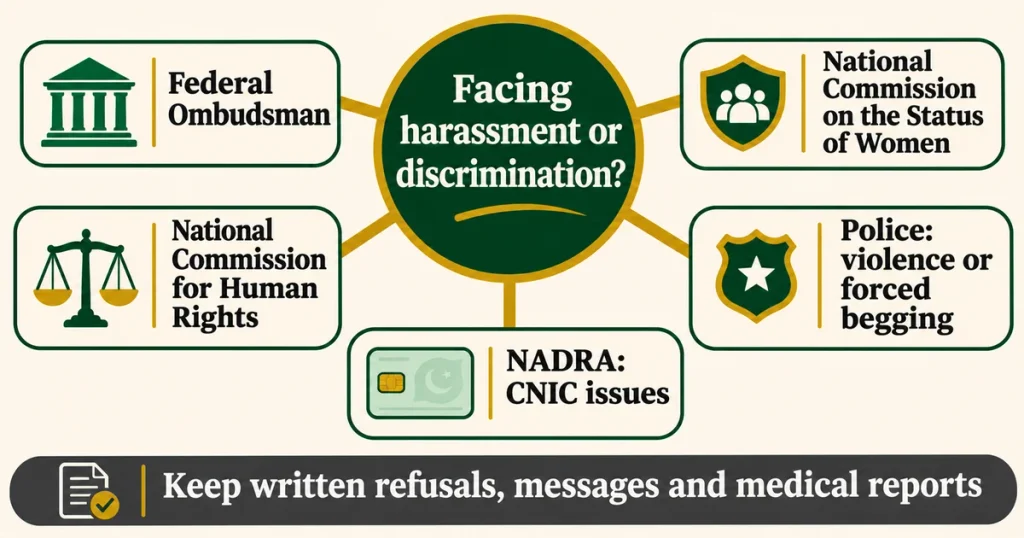
- For harassment or discrimination, complain under Section 18 to the Federal Ombudsman, the NCSW or the NCHR.
- For CNIC issues, visit a NADRA centre and check the latest rules on NADRA’s official website.
- For violence or forced begging, report to the police; forced begging is a crime under Section 17.
- For inheritance disputes, consult a lawyer about the civil court or succession route.
8 FAQs on Transgender Act 2018 in Pakistan
Did the FSC strike down the whole Transgender Act 2018 in Pakistan?
No. The Federal Shariat Court declared only four provisions against the Injunctions of Islam: Sections 2(1)(f), 2(1)(n)(iii), 3 and 7. The intersex definition was upheld, the eunuch definition survived with a call for clarity, and the rights to education, jobs, health, voting, property and protection from harassment remain in the Act.
Is the FSC verdict in force today?
Not yet, in the legal sense. Under Article 203D(2) of the Constitution, a Federal Shariat Court decision does not take effect while an appeal is pending. Appeals were filed before the Supreme Court’s Shariat Appellate Bench in 2023. Until that bench decides, the verdict is on hold. Always check the latest Supreme Court order.
What is the Transgender Act 2018 in Pakistan?
It is a federal law passed in May 2018, officially called the Transgender Persons (Protection of Rights) Act. It defines who is a transgender person, bans discrimination and harassment, and gives rights to education, jobs, inheritance, voting, health and property. It also makes forcing a transgender person to beg a crime.
What is the difference between intersex and transgender?
An intersex person (khusra or khunsa) is born with physical or biological differences in sex organs or chromosomes. A transgender person, in the Act’s words, is someone whose inner sense of gender differs from the sex assigned at birth. The court held these are different groups and should never share one definition.
Can a person change gender on a CNIC now?
The court declared Section 3, which allowed registration of a self-perceived gender, against Islam. Because the verdict is on hold during the appeal, NADRA resumed “X” card registration in September 2023. Rules and practice can change quickly, so check with NADRA directly. The court also told NADRA to frame criteria so that khunsa persons can perform Hajj.
How is inheritance decided for an intersex or khawaja sira heir?
The court held that inheritance shares must follow biological sex, not the gender written on a CNIC. In practice, such cases are sensitive and depend on medical facts and family records. Families should get a succession certificate and legal advice before dividing property, so the division is not challenged later.
Where can a transgender or intersex person complain?
Section 18 of the Act lets an aggrieved person complain to the Federal Ombudsman, the National Commission on the Status of Women or the National Commission for Human Rights. These remedies are in addition to the courts. For violence, threats or forced begging, the police can also be approached because Section 17 makes forced begging a crime.
Who can appeal a Federal Shariat Court decision, and how fast?
Any party to the case may appeal to the Supreme Court’s Shariat Appellate Bench within 60 days of the decision, under Article 203F. The federal or a provincial government gets six months. In this case, appeals were filed in 2023, and they are what keeps the verdict from taking effect.
Conclusion
The Transgender Act 2018 in Pakistan is still on the books, but four of its key provisions now stand under a heavy question mark. The Federal Shariat Court drew a clear line: intersex persons deserve full protection, but legal identity and inheritance, in its view, must follow biological sex. The final word now rests with the Supreme Court.
Until then, do not believe that everything is gone, and do not assume nothing has changed. Keep your documents ready, use the complaint forums the law still gives you, and take advice before acting on a CNIC change or an estate division. For more rulings like this, see our landmark judgments.
Disclaimer: This article is for legal awareness only and is not legal advice. Every case depends on its own facts, documents and evidence. For your specific matter, consult a qualified lawyer.