

Your cousin says the plot is clean. The dealer shows you a fard on his phone. The seller even sends a screenshot from a “CNIC property checker” app. Everything looks perfect, so you hand over the token money. A few weeks later you find out the land was already sold, mortgaged, or stuck under a court stay order.
This is exactly why property verification online by CNIC confuses so many Pakistanis. Typing a CNIC number does not open one national file of every plot a person owns. Each province keeps its own land record, and each one works in its own way. In this guide you will learn where a CNIC search really works, what it can and cannot show, how to trace your late father’s land, and which checks protect your savings before you pay a single rupee.
Table of Contents
Quick Answer: Can You Check Property by CNIC Online?
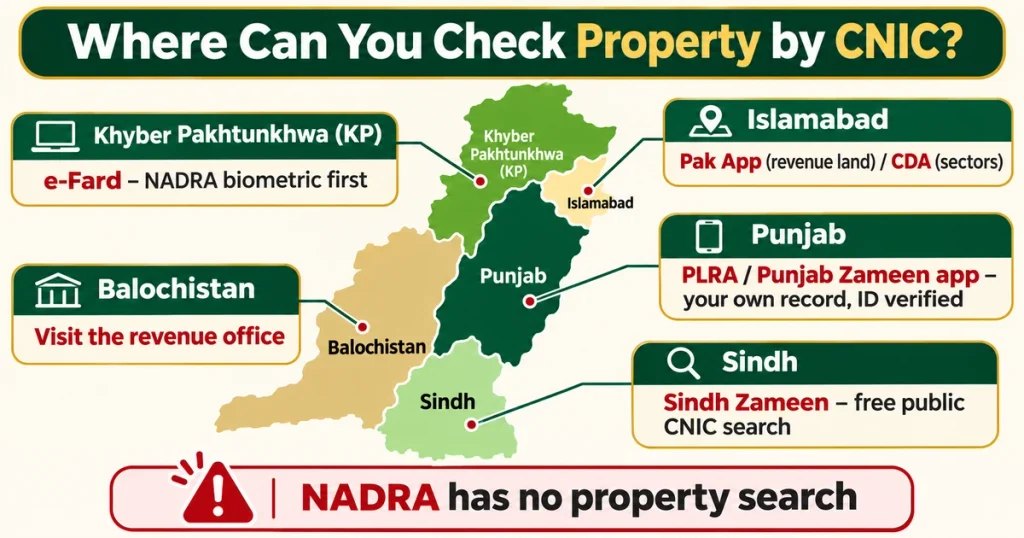
Yes, but only in some places, and only for some kinds of property. Here is the short version for every region.
| Region | Online check by CNIC? | Official route |
|---|---|---|
| Punjab | Your own record, after identity verification | PLRA website, Punjab Zameen app, Arazi Record Centre |
| Sindh | Yes, a free public search with limited details | Sindh Zameen portal of the Board of Revenue |
| Khyber Pakhtunkhwa | Your own record, after NADRA biometric verification | KP e-Fard portal |
| Islamabad (revenue land) | Through a verified Pak App account | Pak App ICT Services and Revenue Facilitation Centre G-11/4 |
| Balochistan | No confirmed public online search | Tehsil or district revenue office |
| Housing societies and authorities | No CNIC search; checks go by plot or file number | LDA, RDA, CDA, KDA, SBCA, DHA |
| NADRA | No property search at all | NADRA only verifies identity |
In short, a CNIC search can point you to a record. Only a fresh official document, plus a few offline checks, can tell you whether a property is safe to buy.
What Property Verification by CNIC Really Means
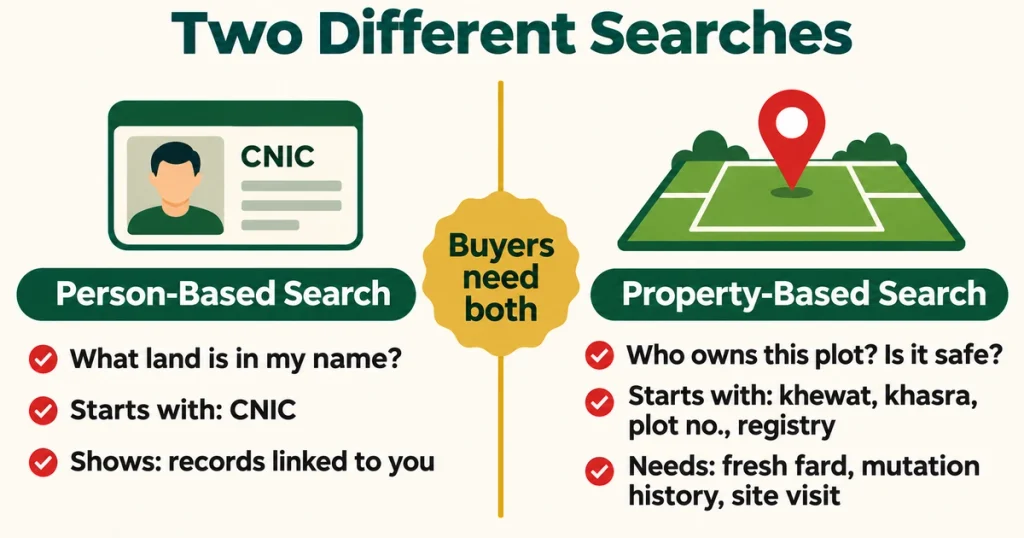
People usually mix up two very different questions:
- Person-based search: “What land is recorded in my name, or in my father’s name?” This starts with a CNIC.
- Property-based search: “Who owns this particular plot, and is it safe to buy?” This starts with the plot itself: its khewat, khasra, plot number or registry.
A CNIC search mainly answers the first question. A buyer needs the second answered too, so this guide covers both.
A few words you will see again and again:
- Fard (fard malkiat): an extract from the revenue record showing who owns the land and how much share each owner has.
- Registry (sale deed): the transfer document registered at the Sub-Registrar’s office.
- Intiqal (mutation): the entry that records a change of ownership in the revenue record.
- Khewat and khasra: the ownership account number and the field (parcel) number of the land.
- Mauza: the revenue village where the land sits.
Where Property Verification Online by CNIC Works in Pakistan
Pakistan has no single land database. Each province’s Board of Revenue or land authority runs its own system, and Islamabad has its own too. So online zameen verification always starts with the right province.
Punjab: PLRA, Punjab Zameen App and Arazi Record Centres
The Punjab Land Records Authority (PLRA) runs Punjab’s computerised land record through its website, the official Punjab Zameen app and its Arazi Record Centres (ARCs). These services are built around identity verification: you show your original CNIC and give biometrics at an ARC, or verify your identity in the app. The app’s release notes list CNIC verification, fard applications, transaction tracking, revenue court cases and nearby ARCs.
What Punjab does not offer is an open box where anyone can type a stranger’s CNIC and get a full list of their land. If you already hold a fard or a mutation, PLRA’s Verify Fard and Mutation page is the simplest land document verification online:
- Choose Verify Fard (or Verify Mutation).
- Enter the Fard ID printed on the document.
- Enter the verification code from the same document.
- Click Verify and compare every detail with the paper in your hand.
For the full steps and fees of getting a fard, read our guide on Online Fard Punjab. For ARC services, complaints and the authority’s role, see our post on the Punjab Land Record Authority. If someone applies on your behalf, they need a verified power of attorney.
Sindh: Free Public Search on Sindh Zameen
Sindh has the most open system. The Board of Revenue’s land record portal, Sindh Zameen, offers a “Search By CNIC/NIC” option and a separate “Search By Name” option. No account is needed and the public search is free.
- Open the Sindh Zameen portal and choose Search By CNIC/NIC.
- Type the 13-digit CNIC without dashes.
- Enter the captcha code shown on screen.
- Submit and review any matching record.
Keep three limits in mind. The portal shows only limited details to protect privacy and says its online information has no legal validity by itself, so get a certified copy from the People’s Service Centre at the Deputy Commissioner’s office for proof. Bodies such as KDA and KMC keep separate records, so many Karachi plots and flats will not appear. And because names repeat, always cross-check a name search with the father’s name and location.
Sindh also amended its land revenue law. The Sindh Land Revenue (Amendment) Act, 2026, published in the Sindh Gazette on 8 April 2026, recognises properly authenticated digital land records. A screenshot from the public search is still not such a record. For help, call the Board of Revenue helpline at 111-267-467.
Khyber Pakhtunkhwa: Biometric e-Fard Through NADRA e-Sahulat
Many older guides say KP has no online service. That is no longer true. In March 2026, KP’s Revenue and Estate Department published an SOP for issuing digitized fard through NADRA e-Sahulat franchises, under the Land Revenue Act, 1967 and the Land Revenue Rules, 2021. The Board of Revenue now runs the KP e-Fard portal, and the portal lists these steps:
- Create your account with your name, father’s name, CNIC, mobile number and email.
- Generate a biometric tracking ID.
- Complete biometric verification at a NADRA e-Sahulat centre.
- Sign in again and check that your biometric status is verified.
- Apply for eFard.
- Search your ownership record.
- Select the correct record.
- Generate a PSID and pay through an authorised channel.
- Download your eFard as a PDF.
The search runs on your own verified identity. Your name, father’s name and CNIC must match the revenue record. If they do not, or your record is missing, visit the nearest Service Delivery Centre or revenue office.
Islamabad: Pak App for Revenue Land, CDA for Sectors
Islamabad has two separate systems. Revenue land in the mauzas falls under the ICT Administration, whose services are now in the Pak App with a verified digital identity. For a sale, the official NITB procedure is: open ICT Services, select E-Registration, fill in the form with the khewat, khatooni and khasra numbers from the digital fard, and submit. You then visit the Revenue Facilitation Centre in G-11/4, where your original documents are checked and the sale deed is handed over.
Plots in CDA sectors sit in CDA’s own estate record. CDA’s old online verification link has not worked reliably, so the dependable route is a Property Information Report through CDA’s One Window, with your CNIC copy and allotment letter. For private schemes, CDA’s list shows each scheme’s layout plan and NOC status, and CDA says the sponsors, not CDA, allot and transfer those plots.
Balochistan: Start at the Revenue Office
The Board of Revenue Balochistan is digitising records in phases under its Land Records Management Information System, starting with districts such as Quetta, Gwadar, Jaffarabad and Pishin. There is no confirmed public CNIC search online, so visit the tehsil or district revenue office with your CNIC, the property’s location, its khasra number and any old fard or registry.
Housing Societies and Development Authorities
Society plots usually do not show up in a CNIC land search, because ownership sits in the society’s or authority’s own transfer record. So check two things separately: is the scheme approved, and does this exact plot belong to the seller?
- Lahore and Rawalpindi: LDA and RDA publish lists of approved and illegal housing schemes.
- Islamabad: CDA lists private schemes with their layout and NOC status.
- Karachi: KDA plots are handled by its Land Department, and SBCA lists approved public-sale building projects with NOC numbers.
- DHA: each DHA has its own verification service and form, such as DHA Lahore’s “Verification of Property” service.
An approved scheme does not prove the seller owns your plot. Always get written confirmation from the society or authority itself.
The NADRA Myth: There Is No All-Pakistan Property Checker
Videos and ads often promise: “Enter any CNIC and see all property through NADRA.” This is false. NADRA verifies identity through CNIC records, biometrics, family registration certificates and e-Sahulat services. In KP, a NADRA centre takes your biometrics for the e-Fard, but the land record comes from KP’s Board of Revenue. Real property verification online by CNIC always runs through a provincial land record, never a NADRA property list.
The same goes for FBR. An NTN check shows tax registration, not land ownership.
Be careful with apps and websites promising a “complete NADRA property report.” They collect your CNIC and sometimes your banking details, and Pakistan’s National CERT has warned about a fake website pretending to be NADRA. Only use links that start from an official government website.
How to Check Property Registered on Your Own CNIC
If you simply want to know what land is recorded in your name, follow these steps:
- Pick the province and district where the land is likely to be.
- Use the official route for that province, as shown in the Quick Answer table above.
- Use official links only. Whenever you verify property online, start from the government website and check that the app’s publisher is the government body.
- Write down every result: khewat, khasra, mauza and your share.
- Get an official copy (a fard or certified copy) whenever you need proof for a bank, court or sale.
- Don’t panic over an empty result. Old records may not be linked to your current CNIC, your name may be spelled differently, or the property may sit in a society’s record. Visit the service centre with your documents.
How to Find Your Late Father’s Property
There is no national service where heirs enter a late parent’s CNIC and get a full list of property. Never try to log in as the deceased or use their identity to get past a verification step. Instead, build a paper trail:
- your father’s CNIC number and death certificate
- the NADRA family registration certificate
- old fards, registries, mutations, tax bills or allotment letters at home
- names of the district, tehsil and mauza from elders in the family
In Sindh, the public CNIC or name search can help you find old entries. In Punjab and KP, take these documents to an ARC or Service Delivery Centre, where staff can search the record by owner’s name or khewat. For society property, apply to the society’s transfer office with the death certificate and proof of heirship.
Once you find the land, the next step is the inheritance mutation (intiqal wirasat). Our guide on inheritance mutation in Pakistan explains how it works.
How to Verify a Property Before You Buy
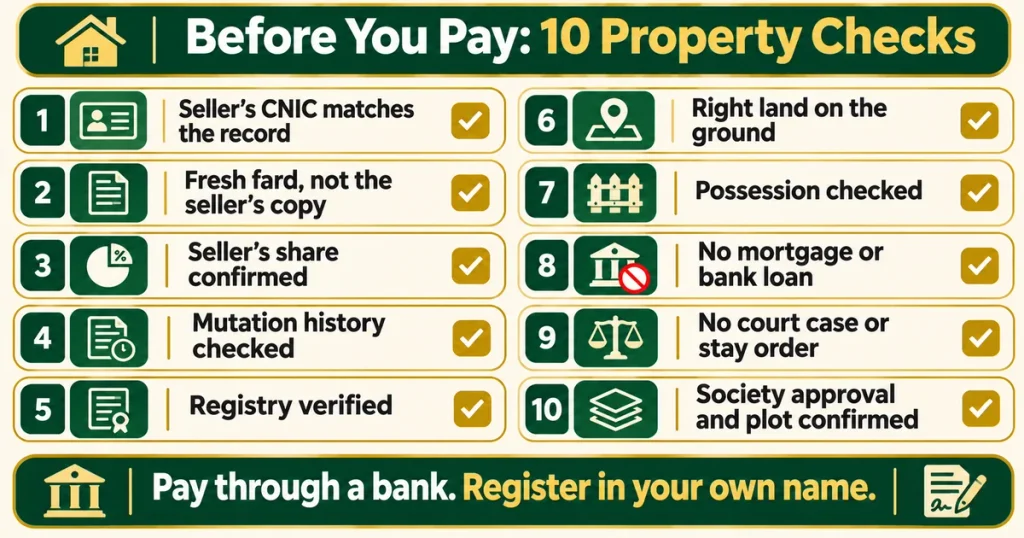
A clean online result is only the start. Before paying anything, run these checks:
| Check | Where to check | Why it matters |
|---|---|---|
| Seller’s identity | Original CNIC against a fresh fard or registry | Stops impostors selling land they don’t own |
| Fresh fard | ARC, e-Fard portal or Sindh service centre, not the seller’s copy | An old copy can hide a recent sale |
| Seller’s share | The fard’s share column | In joint land, the seller may own only a part |
| Mutation history | Revenue record and old mutations | Reveals sudden transfers or skipped heirs |
| Registry | Sub-Registrar’s record | Confirms the deed matches the record |
| Land on the ground | Khasra map, boundaries and a site visit | Makes sure you are buying the right land |
| Possession | Site visit and neighbours | Exposes occupiers and encroachment |
| Mortgage or loan | Bank NOC and the authority’s lien record | A mortgaged plot can’t pass clean title |
| Court cases and stay orders | Revenue office, revenue and civil courts | A stay order can freeze the transfer |
| Society approval and plot | LDA, RDA, CDA lists and the society’s transfer office | An approved scheme doesn’t prove the plot |
| Power of attorney | The attorney deed and the owner, if reachable | Attorneys are a common route for fraud |
Online verification of property registration is still patchy, so for an older registry ask the Sub-Registrar’s office for a certified copy.
Two more papers need their own check. If the deal uses e-stamp paper, confirm it through our e-stamp verification guide; a genuine stamp proves only that the stamp is real, not that the seller owns the land. And if the deed itself looks doubtful, read our guide on a fake sale deed in Pakistan. In Punjab, the Green Property Certificate was introduced as an extra pre-sale check, and its requirement has changed more than once, so read our guide for the current position.
Finally, pay through a bank, keep every receipt, and finish the registry and mutation in your own name.
What Each Document Proves (and What It Does Not)
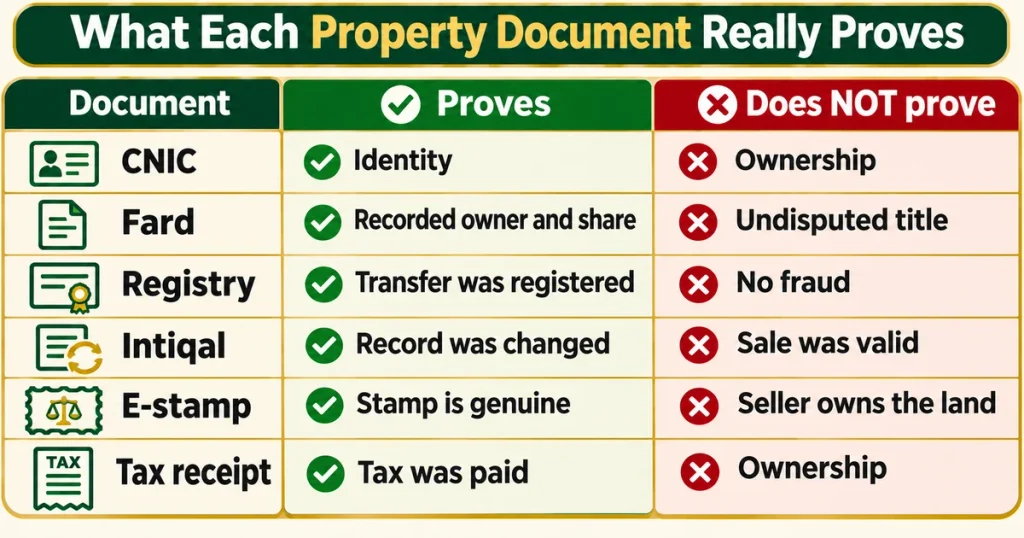
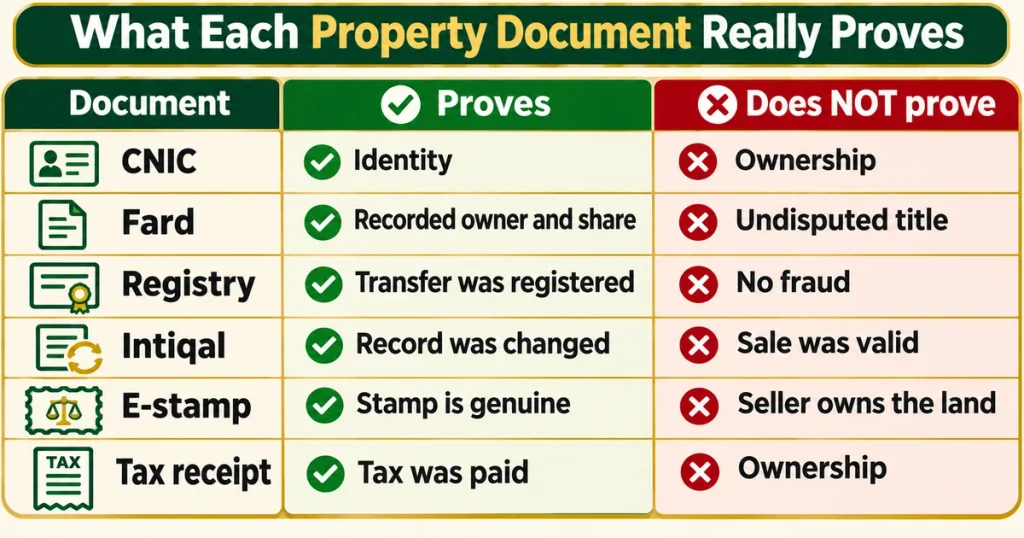
Property document verification online can confirm that a paper is genuine. This table shows why no single paper is enough on its own.
| Document | What it helps prove | What it cannot prove alone |
|---|---|---|
| CNIC | Identity | Ownership of land |
| Fard | Recorded owner and share | That the title is undisputed |
| Registry | That a transfer was registered | That no fraud took place |
| Intiqal | A change in the revenue record | That the sale or gift behind it was valid |
| E-stamp | That the stamp paper is genuine | That the seller owns the land |
| Property tax receipt | Tax paid on a property account | Ownership |
| Society NOC or approval | That the scheme is approved | That this plot belongs to the seller |
| Allotment letter | Allotment in the authority’s record | That nobody else has a claim |
| Online search screenshot | That an entry exists in the database | Legal proof of anything |
Property Tax Verification Online: Paid Tax Is Not Ownership
Many buyers think a tax receipt proves ownership. It does not. Anyone can pay tax on a property account. Property tax verification online tells you about dues, not title.
- Punjab: the Excise, Taxation and Narcotics Control Department lists a PT-10 challan check and a property tax calculator. Property tax is paid through ePay Punjab using a PSID. You need the property’s tax details, not just a CNIC. The district Excise office can help in person.
- Sindh: the Excise Department’s online property tax payment page asks for the property tax account number and a captcha, not a CNIC.
- Khyber Pakhtunkhwa: there is no reliable public online lookup yet, so contact the district Excise and Taxation office.
- Islamabad: CDA’s e-services list a duplicate property tax bill, which uses the property’s consumer number.
Wrong Property on Your CNIC? Do This
Sometimes a CNIC search shows land you never bought, or your own land is missing. Act calmly and in this order:
- Save the evidence. Take a screenshot and note the khewat, mauza and mutation number.
- Get certified copies of the entry and of the mutation that created it.
- If it is a typing error, apply for correction. In Punjab, PLRA’s Correction of Records process (fard badr) is handled at the ARC and approved by revenue officers. In Sindh, go to the People’s Service Centre; in KP, to the Service Delivery Centre.
- If your land was transferred without your consent, collect the registry and mutation copies and see a lawyer quickly. Delay can hurt your case.
- If someone misused your identity online, report it to the National Cyber Crime Investigation Agency through its helpline 1799 or its complaint portal.
Remember that fard badr fixes clerical mistakes only. A real ownership dispute goes to a revenue officer or a civil court.
7 Costly Mistakes When Checking Property by CNIC
- Trusting a screenshot or the seller’s old fard. Always get a fresh official copy yourself.
- Believing “NADRA property checker” apps. NADRA does not run one, and these apps can steal your data.
- Reading “no result” as “no problem.” An empty search may mean the record is unlinked or held by a society.
- Treating a clean fard as a clean title. Mortgages, stay orders and missing heirs may not show.
- Scanning a QR code without checking the website address. A fake QR code can open a fake website.
- Sharing your CNIC copy and OTP with dealers. Your identity can be misused in a transaction you never made.
- Skipping the site visit. Papers cannot show who is actually sitting on the land.
Frequently Asked Questions
How can I check property registered on my CNIC in Pakistan?
It depends on the province. Sindh has a free CNIC search on Sindh Zameen. KP uses the e-Fard portal after NADRA biometric verification. In Punjab, use the Punjab Zameen app or an Arazi Record Centre with your original CNIC. Islamabad uses the Pak App for revenue land, and Balochistan still needs a visit to the revenue office. Society plots need a separate check with the society.
Can I check my late father’s property by CNIC?
No single service lists a deceased person’s property from a CNIC. In Sindh, the public search can help locate entries. Elsewhere, take your father’s CNIC number, death certificate, family registration certificate and any old fard or registry to the land record centre. Never log in with the deceased person’s identity. Once you find the land, apply for inheritance mutation.
Does NADRA provide property verification by CNIC?
No. NADRA verifies identity, issues family registration certificates and runs e-Sahulat services. In KP, NADRA centres take biometrics for the e-Fard, but the land record comes from the Board of Revenue. Any app or website offering a “NADRA property report” is not an official NADRA service, so never share your CNIC or OTP with it.
Can I check someone else’s property using their CNIC?
Only in a limited way. Sindh Zameen allows a public CNIC search, but it shows limited details and restricts unauthorised use of its information. Punjab, KP and Islamabad services are tied to your own verified identity. If you are buying, ask the seller to get a fresh fard or go with you to the centre. Misusing someone’s personal data can land you in legal trouble.
How do I verify a fard or registry online?
In Punjab, open PLRA’s Verify Fard and Mutation page, enter the Fard ID and verification code printed on the document, and compare the result with your paper. For an old registry, ask the Sub-Registrar’s office for a certified copy. A matching result proves the document is genuine, not that the title is free of disputes.
Can I check property tax with my CNIC?
Usually not. Punjab’s property tax works through the property’s tax details and a PSID on ePay Punjab. Sindh’s online page asks for the property tax account number, and Islamabad’s duplicate bill uses the property consumer number. Keep an old tax bill handy, because it carries these numbers. A tax receipt never proves ownership on its own.
What should I do if the wrong property appears on my CNIC?
Save a screenshot, note the record details and get certified copies of the entry and the mutation behind it. For a typing error, apply for correction at the ARC in Punjab (fard badr), the People’s Service Centre in Sindh or the Service Delivery Centre in KP. If your land was moved without consent, see a lawyer quickly. Report online identity misuse to NCCIA on 1799.
Is property verification online by CNIC enough before buying land?
No. Property verification online by CNIC is a useful first step, but it cannot reveal everything. Before paying, get a fresh fard yourself, check the registry and mutation history, confirm the seller’s share, visit the site, and ask about bank loans and court cases. Pay through a bank and complete the registry and mutation in your name.
Conclusion
Property verification online by CNIC is real, but it is not one magic portal. Sindh offers a free public search, KP issues a biometric e-Fard, Punjab works through PLRA, and Islamabad uses the Pak App and CDA. NADRA shows no property at all. Use these tools to find records, then protect yourself with a fresh fard, a registry check and a site visit. Land is often a family’s life savings. A few hours of checking today can save years in court tomorrow.
Disclaimer: This article is for legal awareness only and is not legal advice. Every case depends on its own facts, documents and evidence. For your specific matter, consult a qualified lawyer.