


Your father passed away two years ago, and the land is still in his name. A cousin says the patwari will “sort it out later.” A buyer shows you an old iqrarnama and claims part of your khewat. Under the Punjab Land Revenue Ordinance 2026, and the Act that replaced it, each of these small delays can turn into a costly legal fight.
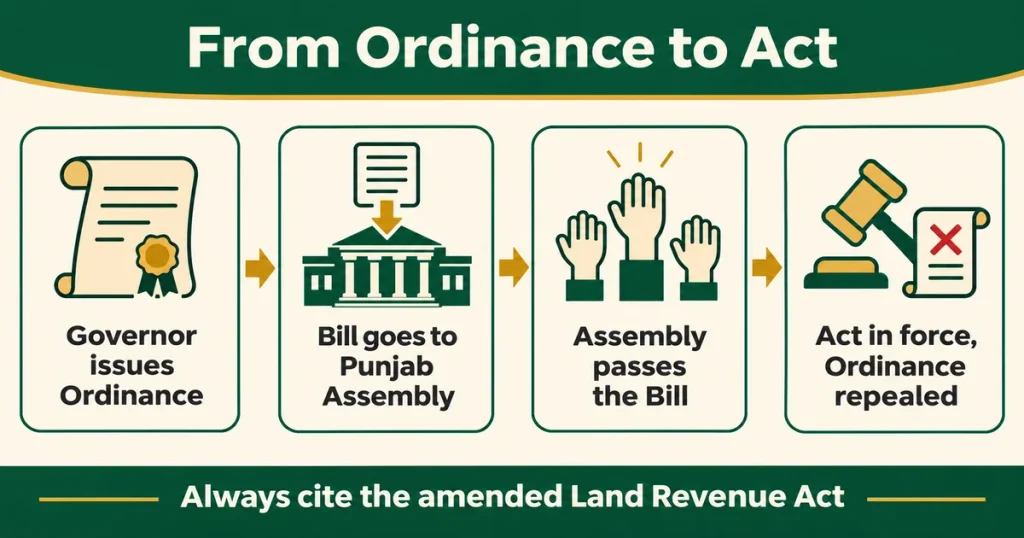
In February 2026, the Governor of Punjab issued an ordinance that rewrote large parts of the Punjab Land Revenue Act 1967. Three months later, the Punjab Assembly passed the same reform as a full Act and repealed the ordinance. Most people still search for the ordinance by name, so this guide uses it, but everything here explains the law that applies today.
You will learn what changed, which deadlines are now much shorter, how big the new fines are, and the exact steps to protect your inheritance, your partition case or your next land purchase.
Quick answer: The Punjab Land Revenue Ordinance 2026 (Ordinance III of 2026) is no longer a separate law. It was replaced by the Punjab Land Revenue (Amendment) Act 2026 (Act XLII of 2026), published on 21 May 2026, which expressly repeals the ordinance. Digital land records now have legal backing, inheritance must be reported without delay, most revenue appeals, reviews and revisions must be filed within 30 days, partition cases run on a 60-day clock, only the Board of Revenue can send a case back, and fines are far higher. Women’s inheritance shares have not changed.
Table of Contents
Punjab Land Revenue Ordinance 2026: Is It Still the Law?
Not on its own. An ordinance is a temporary law. Under Article 128 of the Constitution, a provincial governor can issue one when the assembly is not sitting, but it lapses after a limited time unless the assembly turns it into an Act. Punjab took the second route, and did it quickly.
| When | What happened |
|---|---|
| February 2026 | Governor Sardar Saleem Haider Khan promulgates the Punjab Land Revenue (Amendment) Ordinance 2026 under Article 128(1) |
| 25 February 2026 | The same reform reaches the Punjab Assembly as the Punjab Land Revenue (Amendment) Bill 2026 (Bill No. 14 of 2026) |
| 7 May 2026 | The Punjab Assembly passes the Bill |
| 21 May 2026 | The Bill becomes Act XLII of 2026 and takes effect at once. Its section 53 repeals the ordinance |
Section 53(1) of the new Act is short and clear: “The Punjab Land Revenue (Amendment) Ordinance 2026 (III of 2026) is hereby repealed.” The same section also has a saving clause, so steps lawfully taken while the ordinance was in force are generally protected.
What this means for you: if you file an application, appeal or legal notice today, cite the Punjab Land Revenue Act 1967 as amended by Act XLII of 2026, not the ordinance. Old advice written in February may still be floating around on social media, so check every deadline against the Act.
Don’t Confuse It With the Property Ownership Law
In the same week of February 2026, the Governor also issued an amendment ordinance for the Punjab Protection of Ownership of Immovable Property law. That is a different statute. It deals with illegal occupation (qabza) through district-level committees and tribunals, while the Land Revenue Act deals with land records, mutation, partition and revenue courts. News reports covered both together, which is why many people mix them up.
Similarly, if the government is taking your land for a road, canal or other public project, that is governed by land acquisition law. Our guide on land acquisition in Pakistan explains that route separately.
7 Shocking Changes Every Landowner in Punjab Must Know
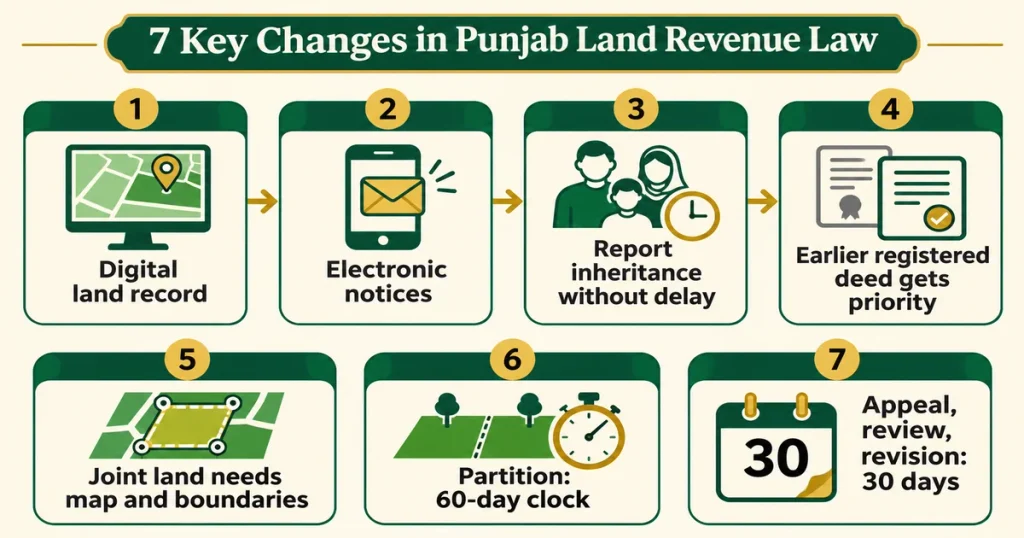
The changes first announced in the Punjab Land Revenue Ordinance 2026 now sit in an amending Act with 53 clauses. Many are small wording fixes, but seven changes can directly decide whether you keep, divide, sell or inherit land smoothly.
1. Your Land Record Goes Digital, by Law
The Act adds new definitions to section 4 of the 1967 Act, including digital cadaster (a computer map of land), parcel (a uniquely numbered piece of land on that map), survey, and the Punjab Land Records Authority (PLRA). A new section 41-C gives legal backing to computerised records, payments, proceedings and orders.
In simple words, the online record and the digital map are no longer just an office convenience. They are part of the legal system. When a re-survey reaches your village, your khasra number may be linked to a parcel number, so check your fard and map carefully at that stage.
2. Notices Can Now Reach You Electronically
Amended sections 21, 22, 24 and 26 allow digital appearance before revenue officers, electronic notices and electronic proclamations. Notices can be sent by registered post and electronic means at the same time.
This is helpful, but it carries a risk. If your mobile number or address in the record is old, a hearing can go ahead without you. Keep your contact details updated with the revenue office, and never ignore an official-looking message about your land without checking it.
3. Inheritance Must Be Reported Without Delay
Amended sections 42 and 42-A now require inheritance to be reported “forthwith”, meaning without delay, through the Patwari or the designated Arazi Record Centre route. The older three-month reporting window that applied in notified areas should no longer be treated as a safe rule.
The Act also separates two routes: inheritance and similar acquisitions are reported through the land record system, while sales and other registered transfers move through the Registering Authority. If your elders’ land is still unmutated, read our step-by-step guide on inheritance mutation in Pakistan and start now.
4. An Earlier Registered Deed Wins the Mutation Race
New section 42(12) says that where competing transfers exist, the earlier executed registered instrument gets priority for mutation. A later paper deal, an unregistered iqrarnama or a verbal promise will struggle against an older registered deed.
For buyers, this means one thing: before paying, check whether the seller has already transferred the same land through a registered document. For sellers, it means a double sale is easier to catch.
5. Joint Land Deals Need a Map and Boundaries
New section 42(13) deals with transfers of a share in joint property (shamilat khewat). The registered document covered by this rule must identify the land with reference to a government map or survey, with its area and boundaries.
The days of selling “2 kanal somewhere in a 40-kanal khewat” are ending. A vague share without a mapped location can stall the mutation and invite a dispute with co-owners.
6. Partition Gets a 60-Day Clock and Real Possession
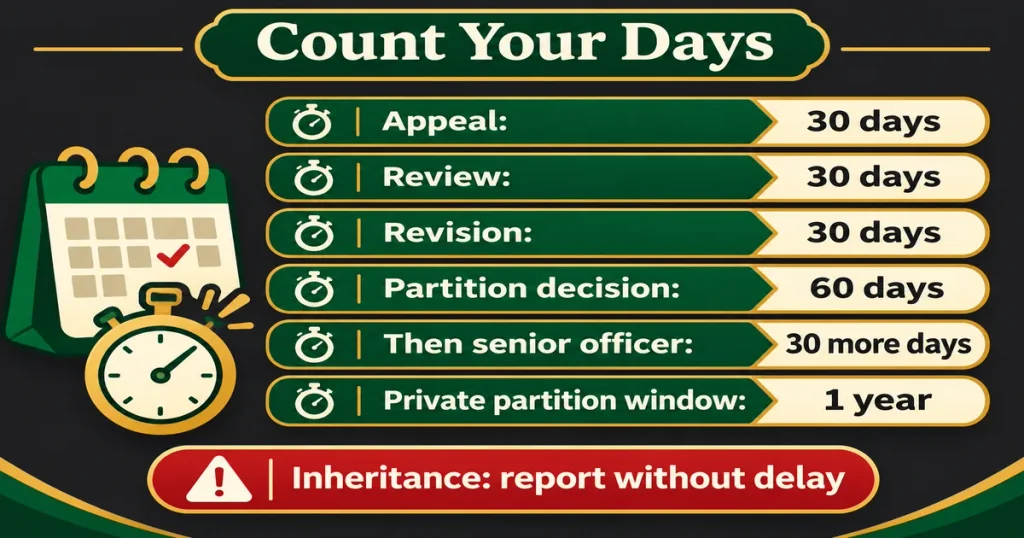
Under amended section 142-A, a partition (taqseem) case should be decided within 60 days instead of the earlier 180. If the Revenue Officer fails, the case can move to the Collector of the Sub-Division, who gets a further 30 days.
The Act also links partition to the instrument of partition, delivery of possession, and mesne profits (compensation for using more than your share). Section 141 lets the Revenue Officer deal with questions of title or possession that arise during partition. Co-heirs can also agree a private partition under amended sections 135-A and 135-B, which gives eligible heirs a one-year window.
7. Appeals, Reviews and Revisions Now Have Only 30 Days
This is the change most likely to hurt people who rely on old advice. Earlier, section 162 allowed 30 days for an appeal to the Collector, 60 days to the Commissioner and 90 days to the Board of Revenue. Now the general appeal period is 30 days, unless the Act says otherwise.
Review under section 163 and revision under section 164 also run on 30 days; revision used to allow 90. New section 164-A says only the Board of Revenue can remand (send back) a case. Section 165 now lists what a stay needs: substantial loss, an arguable case, balance of convenience, prompt filing and, where required, security.
New Deadlines: Count Every Day From the Order
| Step | Time limit now | Earlier position | What to do |
|---|---|---|---|
| Reporting inheritance | Without delay (“forthwith”) | Three months in notified areas | Visit the Arazi Record Centre soon after the death |
| Private partition by co-heirs | One-year window in eligible cases (s.135-A) | Narrower private-partition rules | Agree the scheme in writing and file it in time |
| Partition decision | 60 days (s.142-A) | 180 days | Attend every hearing, keep the case moving |
| Partition not decided in time | Moves to the Collector of the Sub-Division for a further 30 days | No such route | Track the date and follow up |
| Revenue appeal | 30 days (s.162), unless the Act says otherwise | 30, 60 or 90 days by forum | Get a certified copy of the order the same week |
| Review | 30 days (s.163) | Varied by officer | File with the correct authority |
| Revision | 30 days (s.164) | 90 days | Don’t wait for “better timing” |
A practical tip: apply for a certified copy of any order on the day you hear about it. Time spent getting copies may be excluded in some cases, but do not plan around that. Treat the 30 days as your real deadline.
Arbitration and Partition Appeals Work Differently Now
Sections 150 to 159 change how partition disputes go to arbitration. The Board of Revenue can notify Arbitration Committees, the Act fixes a timetable for the award, and old section 155 has been omitted. If you were told about the older arbitration practice, check the amended route before relying on it.
Partition appeals also get special treatment. Under amended section 161, appeals in specified partition matters go to the District Collector, and that decision is treated as final. Getting the forum right matters more than ever.
Fines Jumped From Hundreds to Lakhs
The old fines were so small that many people simply paid and carried on. The Act raises them sharply.
| Section | What it covers | Old fine | New fine |
|---|---|---|---|
| 35 | Not complying with certain revenue processes | Rs 500 | Rs 10,000 |
| 118 | Not complying with survey requisitions | Rs 50 | Rs 10,000 |
| 134 | Removing or damaging boundary marks | Up to Rs 500 | Up to Rs 1,000,000 |
| 175-A | Encroaching on specified common land | Rs 500, plus Rs 50 a day | Rs 100,000, plus Rs 10,000 for each day it continues |
These are revenue penalties under the Land Revenue Act. They are separate from criminal cases for land grabbing under other laws. If someone has occupied your land, see our illegal possession and dispossession guides for the right remedy.
Is the Patwari Gone? What Really Changed for Revenue Staff
No. This is one of the biggest myths about the Punjab Land Revenue Ordinance 2026. New section 11-A actually sets out the appointment and duties of Kanungos and Patwaris. What has changed is the route: inheritance and similar entries move through the Arazi Record Centre system, and registered transfers move through the Registering Authority, so citizens depend less on one person’s pen.
A few other office-level changes are worth knowing:
- Section 44: disputes about record entries, including possession-related entries, go to an officer not below the Collector of the Sub-Division.
- Sections 46, 48 and 53: ordinary correction of an entry goes to the Revenue Officer. A claim to ownership (declaration of right) is a different matter.
- Section 84: during recovery proceedings, the District Collector can place a restriction on selling land in the revenue record.
Shamlat, Abadi Deh and Laal Lakeer: Why the Re-Survey Matters
Amended sections 39 and 40 allow PLRA or another notified agency to carry out special revision of records, including built-up areas, Shamlat Deh (village common land), Abadi Deh and Laal Lakeer areas. The Government’s own presumptions over land are protected in this process.
For families living in old village abadis, this is a big moment. Many houses there have never had a clean record. When a revision team comes, be present with your documents, check what is written against your name, and object in writing if anything is wrong.
Neighbour Holding Extra Land? Section 117 Can Help
Amended section 117 helps an owner who has less land in possession than the record shows. You can seek demarcation (hadbandi or nishandahi) and, where the facts support it, eviction of the adjoining owner who holds the excess area. The detailed procedure is in the Punjab Land Revenue Rules 1968, from rule 67-A onwards.
Section 117 is for boundary and excess-possession problems. If the real fight is about who owns the land, or a fraudulent document, you may need a civil suit for declaration instead.
Inheritance Mutation (Virasati Intiqal) Under the New Law
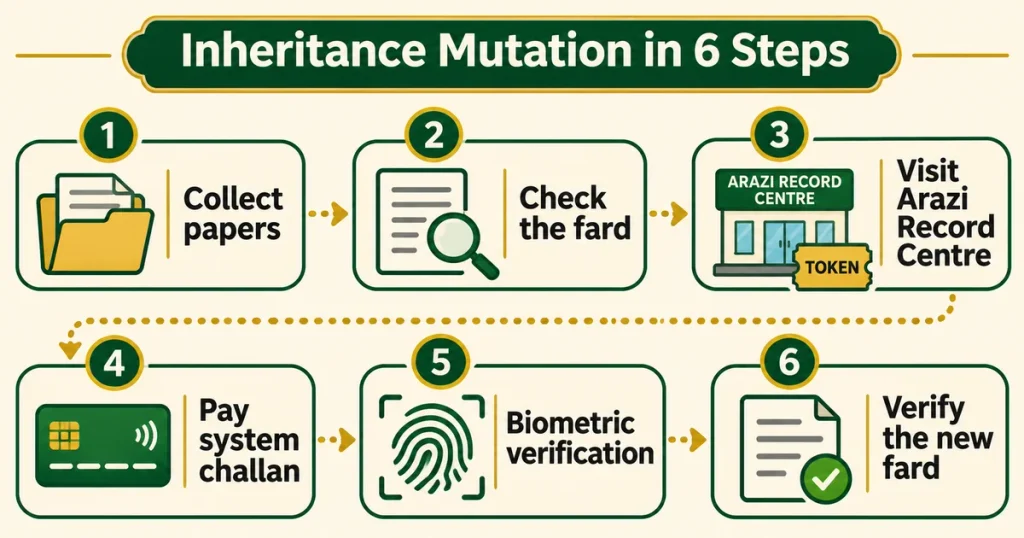
Inheritance is where the new “without delay” rule matters most. PLRA’s published process for mutation looks like this:
- Collect the basic papers. The death certificate, CNICs of all heirs and the NADRA Family Registration Certificate are commonly needed. Make sure every legal heir is listed; our guide on legal heirs in Pakistan explains who counts.
- Check the record. Get the latest fard malkiat and confirm the deceased’s name, khewat, khatooni, khasra numbers, area and share.
- Visit the Arazi Record Centre. Go to the reception, complete identity checks and take a token. Find your nearest office on the PLRA service centres page.
- Pay the system challan. The fee is generated by the system for your case. PLRA lists Bank of Punjab counters and online PSID payment.
- Biometric verification and attestation. Heirs and witnesses are photographed and verified, then the competent revenue officer reviews and attests the mutation.
- Verify the result. Check the new fard for correct names and shares. You can confirm issued documents on the online verification portal.
The 2026 amendments did not change anyone’s share. A daughter, sister, widow or mother gets exactly what the law of inheritance gave her before. If a woman’s name is being dropped, read our guide on women’s inheritance rights in Pakistan. For the official process, see the PLRA mutation page.
Buying Land in Punjab Now? 10 Checks Before You Pay
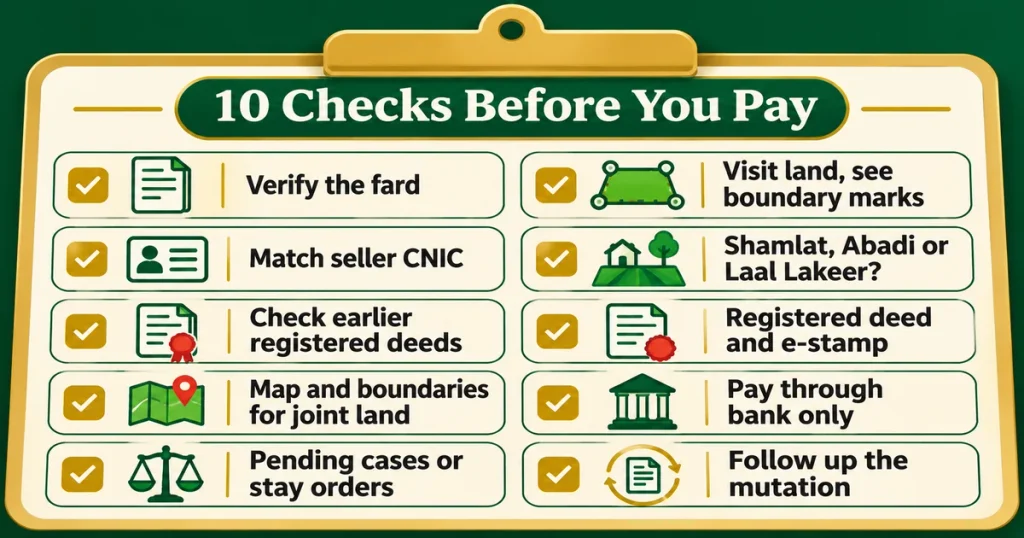
The Punjab Land Revenue Ordinance 2026 reforms reward careful buyers. Run these checks before any money changes hands.
- Get the latest fard from the Arazi Record Centre or the online fard portal, and verify it.
- Match the seller’s CNIC with the record, and confirm the share of every co-owner.
- Ask whether any registered deed already exists for the same land. Under section 42(12), the earlier registered deed wins.
- For joint land, make sure the deed names the land by government map or survey, with area and boundaries.
- Check for pending mutations, stay orders and revenue recovery restrictions under section 84.
- Visit the land, check possession and look for boundary marks.
- Confirm whether the land falls in Shamlat, Abadi Deh or Laal Lakeer.
- Use a registered sale deed and an e-stamp from the official portal. The Board of Revenue was reported in late 2025 to have restricted mutations based only on oral sales, so never rely on a verbal deal.
- Pay through a bank, never in cash, and keep every receipt.
- After the registry, follow up until the mutation is attested and the new fard shows your name.
Documents Every Landowner Should Keep Safe
Keep both paper and scanned copies of these:
- CNICs of owners and heirs
- Latest fard malkiat and jamabandi copy
- Aks shajra (field map) and any demarcation report
- Registered sale, gift or exchange deeds
- Mutation copies (intiqal) and the approved mutation number
- Death certificate and NADRA Family Registration Certificate
- Partition orders, the instrument of partition and possession papers
- E-stamp papers, bank challans and fee receipts
- Every notice received and certified copies of every order
Official PLRA Services You Can Use
| Service | Official link | Use it for |
|---|---|---|
| Online fard | onlinefard.punjab-zameen.gov.pk | Checking computerised ownership records |
| Verify a document | Verification portal | Confirming an issued fard or mutation is genuine |
| E-registration | eregistration.punjab-zameen.gov.pk | Registration services |
| E-stamp | Punjab e-Stamp portal | Stamp challans |
| Partition | PLRA partition page | Partition service details |
| Record correction | PLRA correction page | Fixing wrong entries |
| Complaints | PLRA complaint system | Service complaints |
| Helpline | 042-111-22-22-77 | Monday to Saturday, 8 am to 5 pm, as listed by PLRA |
You can also read the Punjab Land Revenue Act 1967 and the Punjab Land Revenue Rules 1968 on the PLRA website. The Act copy there is an older compilation, so read it together with the 2026 changes explained above.
5 Costly Myths About the Punjab Land Revenue Ordinance 2026
Myth 1: “The ordinance is still the law.” It was repealed by section 53 of Act XLII of 2026. Cite the Act.
Myth 2: “The patwari system has been abolished.” It hasn’t. Section 11-A still sets out Patwari and Kanungo duties.
Myth 3: “Heirs lose their share after 90 days.” There is no such rule. Inheritance must be reported without delay, but your share comes from the law of inheritance, not from the mutation date.
Myth 4: “Partition is guaranteed in 60 days.” Sixty days is the deadline for the officer, not an automatic decree. Delay moves the case to a senior officer.
Myth 5: “I still have 60 or 90 days to appeal.” In most revenue matters you now have 30 days. Old advice can cost you your case.
Common Mistakes That Can Cost You Your Land
- Ignoring an SMS or electronic notice because it “looks unofficial”
- Buying land on an unregistered iqrarnama
- Treating a record correction as if it settles ownership
- Filing in the wrong forum and losing days while the 30-day clock runs
- Getting a partition order but never taking possession
- Leaving a deceased parent’s land unmutated for years
Frequently Asked Questions
Is the Punjab Land Revenue Ordinance 2026 still in force?
No. The Punjab Land Revenue Ordinance 2026 (Ordinance III of 2026) was repealed by section 53 of the Punjab Land Revenue (Amendment) Act 2026, which was published on 21 May 2026. The reform now lives in the Punjab Land Revenue Act 1967 as amended by Act XLII of 2026. Steps lawfully taken under the ordinance are generally saved.
How many days do I have to file a revenue appeal in Punjab now?
Generally 30 days under amended section 162, unless the Act gives a different period for a particular matter. The old 60-day and 90-day periods for appeals to the Commissioner and the Board of Revenue no longer apply as a general rule. Review and revision also run on 30 days.
Is there a fixed deadline for inheritance mutation?
The amended law requires inheritance to be reported “forthwith”, meaning without delay. It does not set a 90-day cut-off after which heirs lose their share. However, every month of delay gives room for fake sales, family disputes and record errors, so start the mutation at the Arazi Record Centre as soon as possible.
Has the patwari system been abolished in Punjab?
No. New section 11-A sets out the appointment and duties of Patwaris and Kanungos. What has changed is that inheritance entries move through the Arazi Record Centre route and registered transfers go through the Registering Authority, which reduces dependence on the patwari for these steps.
How long does land partition take under the new law?
The Revenue Officer should decide a partition case within 60 days under section 142-A, down from 180 days. If not, the case can move to the Collector of the Sub-Division for a further 30 days. Disputes, objections and survey work can still cause delay, so 60 days is a target, not a guarantee.
Did the 2026 amendment change women’s inheritance shares?
No. The amendments change procedure: reporting, mutation, partition and appeals. They do not change how much a daughter, widow, mother or sister inherits. Her share still comes from the law of inheritance that applies to the deceased. Faster partition and possession rules can, however, help women actually receive their land.
Is it the same as the Protection of Ownership law?
No. They are separate laws, even though both were amended by ordinances in February 2026. The Land Revenue Act covers records, mutation, partition and revenue courts. The Protection of Ownership law deals with illegal occupation through committees and tribunals. Even the Lahore High Court’s December 2025 suspension order concerned that other law.
Where can I read the official text of the new law?
Official laws are published in the Punjab Gazette and on Punjab Laws Online (punjablaws.gov.pk). PLRA hosts a copy of the Punjab Land Revenue Act 1967 and the Land Revenue Rules 1968 on punjab-zameen.gov.pk. Since the ordinance has been repealed, read the Amendment Act 2026 rather than an old ordinance PDF.
Conclusion: Act Fast, Keep Records, Count Days
The Punjab Land Revenue Ordinance 2026 started the biggest change to Punjab’s land revenue law in years, and the Amendment Act made it permanent. The message for every landowner is simple. Report inheritance quickly, buy only through registered deeds with clear maps, take possession after partition, keep your contact details updated, and never let the 30-day appeal clock run out.
The law is moving online, and the fines are now real. Families who act early will protect their land. Families who wait for “later” may find that later is too late.
Disclaimer: This article is for legal awareness only and is not legal advice. Every land matter depends on its own facts, documents and record entries. For your specific case, consult a qualified lawyer.