
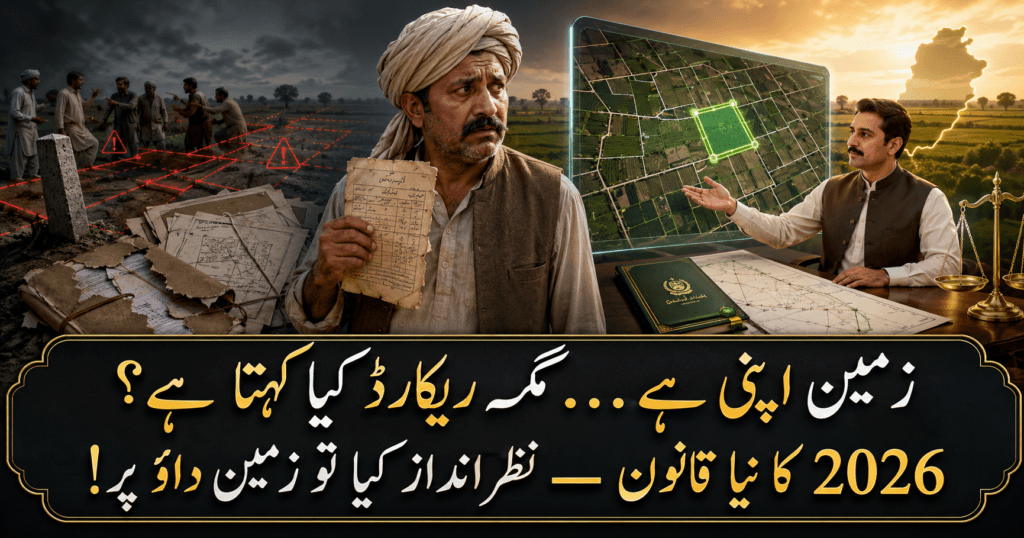
A family can spend its entire life building one piece of land—and lose years fighting over one wrong mutation, one unclear boundary, one missing heir, or one delayed partition.
That is why Punjab Land Revenue Ordinance 2026 matters to farmers, buyers, sellers, legal heirs, women, overseas Pakistanis and every family holding land in Punjab.
But there is one critical update you must know before reading anything else.
The Punjab Land Revenue Ordinance 2026 was not the final stage of the law. Ordinance III of 2026 was promulgated on 14 February 2026. Later, the Provincial Assembly passed the Punjab Land Revenue (Amendment) Act 2026, Act XLII of 2026. It received assent on 21 May 2026, came into force at once, and repealed the earlier Ordinance while saving actions already taken under it.
You can read the official Punjab Land Revenue (Amendment) Act 2026 from the Government of Punjab. The updated parent law is the Punjab Land Revenue Act, 1967.
So, people may still search for Punjab Land Revenue Ordinance 2026, but this guide explains the current legal position after the 2026 Amendment Act.
This distinction can save a landowner from relying on outdated information.
Table of Contents
Punjab Land Revenue Ordinance 2026 Changed—So What Law Applies Today?
The first mistake a landowner can make is reading an old article and believing that the February Ordinance is still the final law.
It is not.
The legal journey is simple:
| Stage | Legal Position |
|---|---|
| 14 February 2026 | Punjab Land Revenue (Amendment) Ordinance 2026, Ordinance III of 2026, promulgated |
| 7 May 2026 | Amendment Bill passed by Provincial Assembly of Punjab |
| 21 May 2026 | Governor gave assent |
| Current law | Punjab Land Revenue (Amendment) Act 2026, Act XLII of 2026 |
| Effect on Ordinance | Ordinance III of 2026 repealed; earlier lawful actions saved |
| Parent law | Punjab Land Revenue Act, 1967 |
The official Punjab Code also lists the Amendment Act as Act XLII of 2026.
Therefore, this article keeps Punjab Land Revenue Ordinance 2026 as its search-focused phrase because that is what many people still type into Google, while explaining the law that actually applies today.
Why Should an Ordinary Landowner Care About These 2026 Changes?
Land law sounds technical until the problem enters your own home.
Imagine that:
- your sister’s name is missing from an inheritance mutation;
- another co-owner occupies more land than his recorded share;
- your registry describes a share but does not clearly identify the land;
- two registered documents appear for the same property;
- brothers have remained joint owners for twenty years because partition never finishes;
- the map and physical boundary do not match;
- someone damages an official survey or boundary mark; or
- an appeal is filed late because somebody still thinks the limitation is 60 or 90 days.
These are no longer small technical details.
Punjab Land Revenue Ordinance 2026 started a major reform process, but the current Amendment Act gives us the legal rules that must now be followed.
The changes deal with digital cadastral records, parcels, mutation, inheritance reporting, registered transfers, joint ownership, surveys, demarcation, partition, electronic notices, appeals, review, revision, arbitration and revenue administration.
Digital Cadaster: Can a Map Become as Important as the Fard?

One of the most important 2026 reforms is the express recognition of a Digital Cadaster.
In simple words, a digital cadaster is an electronic land-mapping system linked with land records. It can show the spatial identity of individual parcels rather than leaving every dispute dependent only on old paper descriptions.
The amendments also introduce the concept of a parcel—a separately recordable portion of land or building with a unique identification linked with the digital cadaster.
This makes Punjab Land Revenue Ordinance 2026 especially important for future land identification.
The direction is clear:
record + map + parcel identity should increasingly work together.
The Punjab Government is not simply converting old registers into computer files. The law creates a framework in which surveys, maps and land records can increasingly become digitally connected.
Citizens can use the Punjab Land Records Authority official portal for available computerized land-record services.
But Does a Digital Entry Automatically Make It Correct?
No.
Digitization improves accessibility and traceability, but a wrong entry does not become legally correct merely because it appears on a computer screen.
A landowner should still check:
- owner names;
- CNIC details;
- Khewat;
- Khatooni;
- Khasra or parcel number;
- total area;
- ownership share;
- mutation history;
- possession entries where relevant; and
- map/boundary details.
If your problem is specifically about a wrong mutation excluding an heir, read our detailed guide on Inheritance Mutation in Pakistan.
Did the 2026 Law Abolish the Patwari? The Answer May Surprise You
There is a dangerous oversimplification circulating about Punjab Land Revenue Ordinance 2026:
“Patwari can now deal only with inheritance.”
That statement is too broad.
The current amendment expressly provides statutory duties for both Kanungo and Patwari.
A Kanungo is responsible within the Kanungo Circle for supervision, inspection and verification of land records and revenue surveys, along with other prescribed duties.
A Patwari remains responsible within the Patwar Circle for preparing, maintaining and keeping custody of land records, conducting revenue surveys and performing other prescribed duties.
This means the 2026 reform does not simply erase the Patwari from land administration.
What has changed is how different transactions, reports, registered documents and computerized land-record processes interact.
That is a much more accurate understanding of Punjab Land Revenue Ordinance 2026 than saying “the Patwari system has ended.”
Inheritance Mutation: Forget the Old 90-Day Rule

This correction is extremely important.
Some early explanations of Punjab Land Revenue Ordinance 2026 stated that an heir must report inheritance within 90 days.
The final 2026 Act does not use that 90-day rule in the amended provisions being discussed here.
For the relevant acquisition by inheritance or letter of administration, section 42 and section 42-A use the word “forthwith.”
In simple English:
Do not wait unnecessarily after inheritance opens. Report the acquisition promptly through the legally prescribed revenue/land-record channel.
Where the relevant computerized area and notified system applies, section 42-A connects reporting to the designated official of the Arazi Record Centre.
For practical information about mutation services, citizens may check the official PLRA mutation guidance.
Why Is Fast Inheritance Reporting So Important?
Because delay can create a chain of problems.
One deceased owner may leave:
- sons;
- daughters;
- widow;
- mother;
- minor children; or
- other lawful heirs.
If the inheritance record remains incomplete, later sales, gifts, partitions and possession disputes may become much harder.
Women should be particularly careful.
A daughter should never assume:
“My brothers will enter my name later.”
If you want a deeper court-based explanation of this problem, read Women Inheritance Rights.
Punjab Land Revenue Ordinance 2026 should therefore be read as a warning against sleeping over revenue records—not as permission to delay inheritance reporting for a fixed 90-day period.
Registered Documents Now Carry an Important Priority Rule

Suppose two conflicting registered transfer documents appear.
Which one should control mutation and delivery of possession?
The 2026 amendment added an important rule to section 42:
an earlier executed registered transfer document takes precedence over a later one for purposes of recording mutation and delivery of possession under that section.
This is one of the most practical changes connected with Punjab Land Revenue Ordinance 2026.
It is especially important in situations involving:
- repeated sale documents;
- competing transfers;
- fraud allegations;
- subsequent purchasers; and
- disputed possession.
But do not misunderstand this provision.
It does not mean that every complicated title dispute can be decided merely by looking at two dates. Fraud, validity, authority, legal capacity and other questions may still require examination under the applicable law.
The safe lesson is much simpler:
before buying land, investigate the complete registered-document and mutation history—not just the latest Fard.
Buying a Share in Joint Land? The Map May Now Matter More Than Ever
Joint ownership creates some of Punjab’s longest family disputes.
A document may say that a buyer purchased “five kanals out of a joint Khewat,” but everyone later fights about which five kanals.
The 2026 amendment addresses this problem directly.
For a registered document transferring possession of land or immovable property held in joint ownership, the document is required to specify reference to a Government land-record map or survey together with area, boundary measurements and sufficient description to identify the property.
This is a major practical rule arising from Punjab Land Revenue Ordinance 2026.
Before buying from a co-sharer, ask:
Can this exact property be identified on the official record and map?
A vague document today can become a bitter boundary dispute tomorrow.
Wrong Boundary or Excess Possession? Section 117 Can Become Crucial
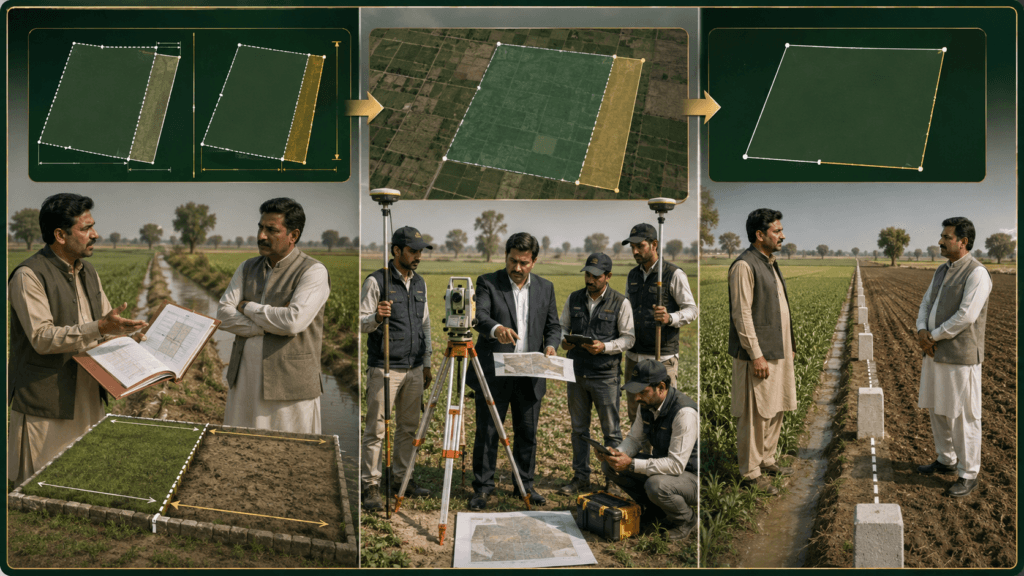
A common rural dispute sounds like this:
“My title says ten kanals, but I possess only eight. My neighbour occupies the missing two.”
The 2026 amendment strengthened section 117 for this type of situation.
Where a person is deficient in possession of his titled property in a parcel and an adjacent owner holds land in excess of his title, the Revenue Officer may define their limits according to title and proceed with demarcation and eviction from land.
This makes Punjab Land Revenue Ordinance 2026 much more than a mutation reform.
It also connects official title, survey and physical possession.
However, do not confuse this provision with every illegal-possession case in Punjab.
Different facts may attract different laws and forums.
For the separate anti-illegal-possession framework, read our guide on Punjab Protection of Ownership of Immovable Property.
Shamlat Deh, Abadi Deh and Laal Lakeer: Why the New Record Rules Matter
The amendment also expands the importance of record preparation and special revision.
Where required, the Board of Revenue may direct preparation or special revision of record-of-rights through the Punjab Land Records Authority or another revenue agency.
Importantly, the amended section expressly refers to areas including:
Shamlat Deh, Abadi Deh and Laal Lakeer.
This is a meaningful part of Punjab Land Revenue Ordinance 2026 because old village areas often suffer from unclear maps, historical entries and boundary disputes.
But special revision does not automatically destroy every previously existing legal presumption. The statutory text itself protects certain presumptions already arising in favour of Government from previous record-of-rights.
If you are specifically dealing with village common land, read our detailed guide on Shamilat Land.
Can Revenue Notices Now Reach You Digitally?
Yes, the procedural system has also changed.
The amendments allow greater use of electronic or digital means for appearances, applications, notices and proclamations.
More importantly, amended section 24 provides for summons to be served simultaneously through registered post and electronic or digital means.
That word “simultaneously” matters.
Punjab Land Revenue Ordinance 2026 should therefore not be described simply as a system where physical notice has disappeared.
The current law uses a hybrid structure.
This can make it harder for a party to later claim:
“I never knew about the case.”
Landowners should therefore keep their official:
- address;
- mobile number;
- identity details; and
- available digital contact information
accurate wherever legally required.
Ignoring an electronic message connected with a revenue proceeding may become costly.
Partition Within 60 Days: Can Joint Land Finally Be Separated Faster?

Partition is one of the most important parts of the 2026 reforms.
Families remain trapped in joint Khewats for generations because one co-owner refuses to cooperate.
The amended framework places a strong emphasis on deciding partition proceedings within specified timelines.
Where the statutory scheme applies, the Revenue Officer is required to move the partition case toward decision within 60 days.
The law also allows procedural scheduling aimed at deciding the partition case within that period.
If the Revenue Officer fails to decide within the prescribed period, the statutory scheme provides for transfer upward to the Collector of the Sub-Division, together with consequences concerning responsibility for delay and further decision-making.
This makes partition one of the strongest practical features associated with Punjab Land Revenue Ordinance 2026.
If brothers, sisters or other heirs are already fighting over undivided inherited property, also read Partition of Inherited Land in Pakistan.
Does 60 Days Guarantee Every Case Will Physically Finish in Exactly 60 Days?
Not necessarily.
Real proceedings may involve:
- service problems;
- title objections;
- possession disputes;
- appeals;
- revision;
- survey work; or
- other legally relevant complications.
The statute creates a powerful timeline and accountability structure, but readers should not turn it into the misleading promise:
“Every land dispute in Punjab is guaranteed to end in 60 days.”
That would be legally unsafe.
Legal Heirs Can Use Private Partition—but There Is a Deadline
The amendments also recognize an important opportunity for legal heirs holding rights jointly in multiple holdings.
In specified circumstances, legal heirs may submit a mutually agreed scheme of private partition within the statutory period.
The 2026 amendment provides a one-year window connected with sanction of inheritance mutations or issuance of the relevant notices for the category covered by the section.
This can be extremely useful.
Instead of allowing inherited land to remain tangled for another generation, heirs can agree:
- who receives which holding;
- how value will be balanced;
- what portion goes to each heir; and
- how the final arrangement should be reflected in the revenue record.
The lesson from Punjab Land Revenue Ordinance 2026 is simple:
family agreement should be converted into a proper legal record before memory, relationships and possession change.
An oral family understanding may feel sufficient today but become impossible to prove twenty years later.
One Co-Owner Occupies More Than His Share—Can Mesne Profit Follow?
The 2026 partition provisions do not focus only on dividing land.
They also address the economic effect of one person holding land beyond his title.
During partition, the Revenue Officer may determine mesne profit relating to excess land held by a joint owner or occupant beyond his title from the relevant statutory point connected with the partition application, with proportionate payment to deficient landowners on application.
The law also contains a stronger consequence concerning continued occupation of excess land beyond the final order.
This makes Punjab Land Revenue Ordinance 2026 particularly important where one co-sharer has enjoyed the best or largest part of joint property while others remain deprived.
Possession is therefore not always financially neutral.
Can a Revenue Officer Decide Title and Possession Questions During Partition?
The amended section 141 is important.
Where a question of title or possession in the holding is raised during partition proceedings, the Revenue Officer is required to inquire into the substance of that question and decide it after hearing the parties.
This is another area where old articles on Punjab Land Revenue Ordinance 2026 may now be incomplete.
But there is an important distinction.
A correction of a revenue entry is not always the same thing as a declaration of ownership/title.
The 2026 amendment also clarifies that correction of an entry in a record-of-rights or periodical record, other than a declaration of right, is to be pursued before the Revenue Officer.
Where a genuine declaration of title, cancellation of a transaction, fraud or another civil right is involved, the correct forum depends on the nature of the controversy and applicable law.
For a Supreme Court-based discussion about declaration proceedings and disputed mutation, read Civil Suit for Declaration.
Appeals Are Now a 30-Day Matter—Do Not Rely on the Old 60-Day Rule
This is another major correction to the earlier version of this blog.
The current amended section 162 provides that, unless the Act says otherwise, the limitation period for an appeal under section 161 is:
30 days from the date of the order appealed against.
Not 60 days.
Not 90 days.
For anyone reading old material about Punjab Land Revenue Ordinance 2026, this difference can decide whether a remedy remains available.
There is also a special rule for partition matters: an appeal relating to partition lies against the original order before the Collector of the District, whose decision thereon is stated to be final under the amended provision.
Because limitation questions can become technical, an aggrieved party should obtain the order promptly and seek legal advice without waiting for the last day.
Review and Revision: Another 30-Day Trap You Should Know
The time pressure does not stop with appeals.
The amended law also changes review and revision.
Review
An application for review is generally required within 30 days from the passing of the order, subject to the statutory framework governing review.
Revision
The 2026 amendment changes important 90-day references in section 164 to 30 days.
That means Punjab Land Revenue Ordinance 2026 has moved revenue litigation toward much tighter timelines.
A person who receives an adverse order should immediately ask:
- Is the remedy appeal, review or revision?
- Which authority has jurisdiction?
- When was the order passed?
- When did limitation start?
- Is a certified copy or record required?
- Is any stay application necessary?
Waiting because “revenue cases always take years” is no longer a safe strategy.
Can Every Revenue Authority Remand a Case Back? No
Repeated remands can keep litigation alive for years.
The amended framework contains an important restriction:
no Revenue Officer other than the Board of Revenue has power to remand a case to a lower authority.
This is another major procedural reform connected with Punjab Land Revenue Ordinance 2026.
The idea is important for litigants because an appellate proceeding should not automatically become another cycle of “go back, start again, come back again.”
However, remand is only one procedural issue. Parties must still understand the exact scope of appeal, review, revision and any available stay.
Arbitration Has Changed Too—And the Clock Can Be Short
The law continues to recognize arbitration for specified revenue disputes.
The amended provisions permit reference of certain matters to an Arbitration Committee notified by the Board of Revenue.
The order of reference must identify the precise matter being referred, and the statutory framework contemplates an award within 30 days.
Hearings may also be conducted in person or through electronic or digital means.
The effect of the award is significant because the amended provision treats the Arbitration Committee’s award as final and as the decision of the Revenue Officer for the specified reference.
This part of Punjab Land Revenue Ordinance 2026 should not be confused with ordinary private commercial arbitration. It operates inside the statutory land-revenue framework.
Destroying a Survey or Boundary Mark Can Now Become Very Expensive
Survey marks may look like small physical objects, but legally they can protect the identity of land.
Section 134 deals with willful destruction, injury or unauthorized removal of survey or boundary marks.
The 2026 amendment dramatically increases the possible fine under the relevant provision.
The Collector of the District may impose a fine extending up to Rs1 million for the conduct covered by section 134.
This is one of the clearest deterrent changes arising from Punjab Land Revenue Ordinance 2026.
Do not confuse this Rs1 million amount with a general fine for every land dispute. It specifically relates to the statutory misconduct covered by section 134.
Before Buying Land in Punjab, Follow This 12-Step Safety Check
The best land case is often the case you never have to file.
Before paying serious money for agricultural or revenue-record property, check:
- Obtain a fresh official Fard.
- Verify the seller’s CNIC and identity.
- Read the complete mutation history.
- Examine the registered title documents.
- Check whether an earlier registered transfer exists.
- Match Khewat, Khatooni and Khasra/parcel details.
- Check the Government map or survey where relevant.
- Physically inspect possession and boundaries.
- Identify every co-sharer in joint land.
- Check pending partition, stay or revenue proceedings.
- Verify inheritance if the seller claims through a deceased owner.
- Complete registration, biometric and mutation requirements through lawful official channels.
The Punjab Land Records Authority provides official land-record and property-transfer services, including information about Fard, mutation and available digital facilities.
Punjab Land Revenue Ordinance 2026 should therefore be used as a practical reminder: never buy land from one paper alone.
What Documents Should Every Punjab Landowner Keep Safe?
A proper land file can save months of confusion.
Keep copies of:
- CNICs;
- registered sale deed, gift deed or other title documents;
- old and current Fard;
- mutation copies;
- inheritance mutation;
- death certificate where inheritance is involved;
- legal-heir documents;
- Shajra/map and survey material;
- Khewat and Khatooni details;
- Khasra/parcel information;
- partition orders;
- instrument of partition;
- possession-delivery documents;
- revenue court orders;
- appeal/review/revision papers;
- challans and fee receipts; and
- any official digital verification record.
Never hand over the only original document to an unofficial intermediary.
Five Dangerous Myths About Punjab Land Revenue Ordinance 2026
Myth 1: “The Ordinance is still the current final law.”
Wrong. Ordinance III of 2026 was repealed by Act XLII of 2026. The current amendments must be read through the 2026 Act and updated Punjab Land Revenue Act.
Myth 2: “Inheritance must be reported within exactly 90 days.”
That is not the current wording of the amended provisions discussed above. The law uses forthwith for the relevant inheritance reporting.
Myth 3: “Every appeal still has 60 or 90 days.”
The amended general limitation in section 162 is 30 days, unless the Act specifically provides otherwise.
Myth 4: “Patwari has completely disappeared from land administration.”
No. The amended law expressly sets out duties for the Patwari and Kanungo.
Myth 5: “Digital record means ownership can never be disputed.”
No. Digitalization improves the system, but legality still depends on valid rights, transactions, statutory procedure and the facts of each case.
Understanding these five points can prevent Punjab Land Revenue Ordinance 2026 from being misunderstood through outdated internet summaries.
Frequently Asked Questions About Punjab Land Revenue Ordinance 2026
What is Punjab Land Revenue Ordinance 2026?
Punjab Land Revenue Ordinance 2026 commonly refers to Ordinance III of 2026, which introduced major amendments to the Punjab Land Revenue Act, 1967. However, the Ordinance was later repealed and replaced in legislative effect by the Punjab Land Revenue (Amendment) Act 2026, Act XLII of 2026.
Is Punjab Land Revenue Ordinance 2026 still in force?
The Ordinance itself is no longer the final operative amendment instrument. Act XLII of 2026 repealed Ordinance III of 2026 while saving actions already taken under it. Current legal research should therefore use the amended Punjab Land Revenue Act and the 2026 Amendment Act.
When was Punjab Land Revenue Ordinance 2026 promulgated?
The official Punjab legislation record gives 14 February 2026 as the promulgation date of Ordinance III of 2026.
What replaced the Punjab Land Revenue Ordinance 2026?
The Punjab Land Revenue (Amendment) Act 2026, Act XLII of 2026, received assent on 21 May 2026 and came into force at once.
Is there a 90-day inheritance mutation rule under the current amendment?
The amended sections dealing with the relevant acquisition by inheritance or letter of administration use forthwith reporting. Landowners should therefore avoid relying on the outdated claim that the current law gives a general 90-day reporting period.
Has the Patwari lost all powers?
No. The amended law still assigns the Patwari duties concerning preparation, maintenance and custody of land records, revenue survey and other prescribed functions.
Can an earlier registered document defeat a later registered transfer for mutation purposes?
The amended section 42 provides that an earlier executed registered transfer document takes precedence over a later one for recording mutation and delivery of possession under that section. Complicated title or fraud disputes may still require separate legal determination.
What happens when jointly owned land is transferred?
The amended law requires greater identification detail in the registered document transferring possession of jointly owned land, including reference to Government land-record map or survey, area and boundary measurements sufficient to identify the property.
How quickly should a partition case be decided?
The amended partition framework creates a 60-day decision structure, with further statutory consequences where the Revenue Officer fails to decide within the prescribed period.
Can legal heirs privately divide inherited property?
Yes, the amended provisions recognize a mutually agreed private-partition scheme for specified legal heirs and holdings, subject to the statutory requirements and time period.
What is the limitation period for a land-revenue appeal?
Unless otherwise provided by the Act, amended section 162 provides 30 days from the date of the order appealed against.
How long do I have to file a review?
The amended review provision generally requires the review application within 30 days from the passing of the order, subject to the statutory conditions.
What about revision?
Important references in section 164 were changed from 90 days to 30 days by the 2026 amendment. Do not delay in obtaining legal advice after an adverse revenue order.
Can every Revenue Officer remand a case?
No. Under the amended framework, the power to remand a case to a lower authority is restricted to the Board of Revenue.
Can digital notices be legally used?
Yes. The amended law recognizes electronic and digital modes, while summons under the amended section 24 are structured around simultaneous registered-post and electronic/digital service.
Can a Revenue Officer remove excess possession from an adjoining owner?
Under amended section 117, where a person is deficient in possession of titled property and the adjacent owner holds land beyond his title, the Revenue Officer may define limits according to title and proceed with demarcation and eviction, subject to the law and facts.
Where can I read the official law?
Read the Punjab Land Revenue (Amendment) Act 2026 official Gazette, the Punjab Land Revenue Act, 1967 on Punjab Code, and use the Punjab Land Records Authority for official land-record services.
Final Warning: One Wrong Land Entry Can Outlive a Generation
The real importance of Punjab Land Revenue Ordinance 2026 is not the name of the law.
It is what happens to ordinary people.
A daughter may lose access to her share because nobody checked the inheritance mutation.
A buyer may pay millions for a joint share without identifying the actual land.
A farmer may cultivate less land than his title because a neighbour crossed the boundary.
Brothers may remain trapped in a joint Khewat because nobody completes partition.
A genuine appeal may fail because an old article told the owner that he had 60 or 90 days when the current statutory period was 30.
The law cannot protect someone who never looks at his own record.
Check your Fard. Check your mutation. Check your registry. Check the map. Check the heirs. Check the limitation date.
And most importantly, when reading about Punjab Land Revenue Ordinance 2026, remember that the February Ordinance was only one stage. The current position must be understood through the Punjab Land Revenue (Amendment) Act 2026 and the updated Punjab Land Revenue Act, 1967.
Disclaimer
This article is written for legal awareness and general education. Land-revenue disputes depend on the nature of the property, revenue record, title documents, possession, applicable notifications, procedural history and facts of each case. It is not a substitute for advice from a qualified lawyer after examination of the complete record.