


You have found a buyer. The bayana is paid, the registry date is fixed, and then someone at the counter says, “Pehle green certificate lao.” The buyer goes quiet. Your agent shrugs. Nobody can tell you whether the rule still applies or whether your deal is now stuck.
That confusion is real. The green property certificate was launched as Punjab’s new proof of verified land ownership. It was made compulsory on 1 July 2026, relaxed within days, and then reported as suspended for six months in August. Yet many guides online still call it mandatory.
This guide clears it up in plain words. You will see where the rule stands in November 2026, how the 10-step process works, what the fee really is, and how to protect your land whether the certificate is demanded or not.
Table of Contents
Quick Answer: Is the Certificate Compulsory Today?
Short answer: No, not as a general rule. Based on the orders and announcements made public so far, you do not need a Green Property Certificate (GPC) for every land deal in Punjab today. Here is the position in five points:
- 1 July 2026: GPC was made compulsory for sale, purchase, mortgage, gift and other transfers across Punjab.
- 11 July 2026: a PLRA notification allowed deals again on the Fard or a certified copy of the land record (Naqal Arazi Record).
- 27 August 2026: Punjab’s Finance Minister told the Punjab Assembly that the green certificate had been suspended for six months.
- The certificate was not abolished. PLRA still explains the GPC service on its website, and application camps were held in Sargodha and Faisalabad after the announcement.
- No official order bringing the compulsory rule back had been made public by late November 2026.
Practical tip: before you take or pay bayana, ask your Arazi Record Centre (ARC) which document it will accept for your mauza, and keep that answer in writing.
What Is a Green Property Certificate?
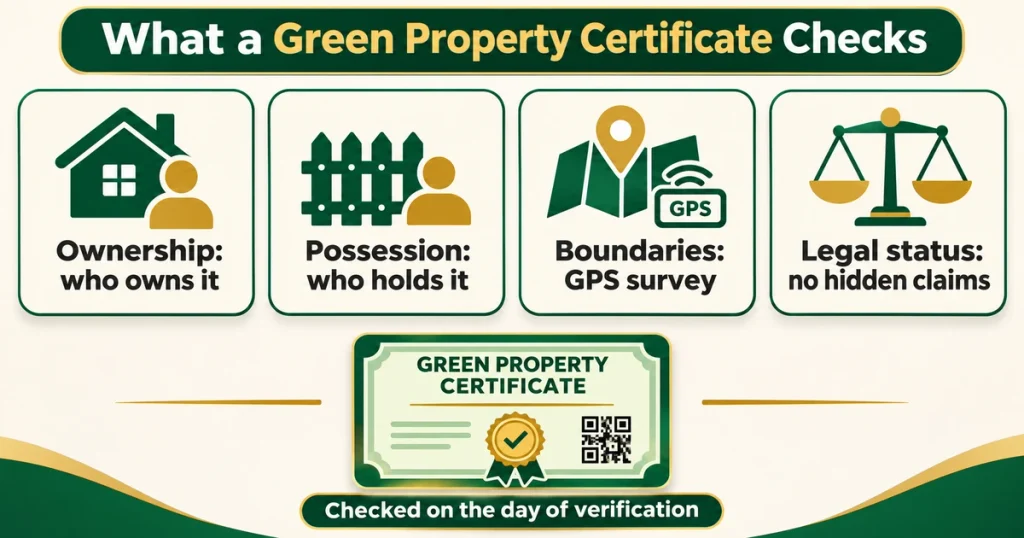
A green property certificate is a digital, QR-coded document issued by the Punjab Land Records Authority (PLRA) with the Board of Revenue Punjab. It tells a buyer that the property has passed a set of official checks, not just that a name appears in the record.
A Fard only repeats what is written in the land record. The GPC goes further. Officials check the record, visit the land and confirm four things:
- Ownership: who the record shows as owner, and how the title reached them.
- Possession (qabza): who is actually in physical control of the land.
- Boundaries: the location and area, measured on site through a GPS survey.
- Legal status: any mortgage, court order, pending dues or other restriction.
The certificate and its property reports are issued under PLRA’s land-record regulations, which the official notification says were framed under sections 14, 15 and 16 of the Punjab Land Records Authority Act 2017.
What “Green Status” Really Means
Green Status means the property cleared every check on the day it was verified. It is a clean bill of health, not a lifetime guarantee. PLRA has said the details on a certificate stay unchanged only until a new transaction or update happens on that property.
So if the land is later sold, inherited, mortgaged or divided, the record changes and the old certificate no longer tells the full story. Always ask for the latest record before you pay anyone.
How the GPC Rules Changed in 2026: Full Timeline
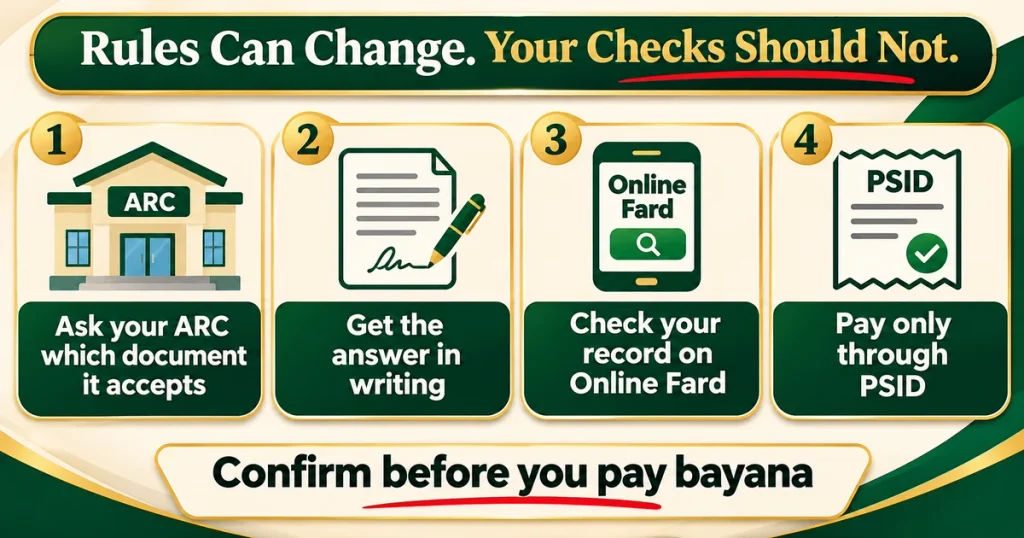
The rule moved fast. In eight months it went from a pilot to a province-wide must, and then back to optional. Here is the sequence, based on official statements and the notifications as reported:
| Date | What happened |
|---|---|
| January 2026 | GPC issuance expands to more districts in phases. |
| 1 May 2026 | Sahiwal pilot: transactional Fard suspended and transfers moved to GPC. |
| 22 June 2026 | Board of Revenue notification suspends transactional Fard in most districts from 1 July. |
| 1 July 2026 | GPC becomes compulsory for sale, purchase, mortgage, gift and other transfers across Punjab. |
| 11 July 2026 | PLRA notification makes the Fard or Naqal Arazi Record valid again for transactions. |
| Late July 2026 | Computerised land record extracts allowed again in computerised revenue estates. |
| 27 August 2026 | Finance Minister tells the Punjab Assembly the green certificate is suspended for six months. |
| End Aug to mid-Sep 2026 | PLRA application camps held in Sargodha and Faisalabad districts. |
What the Six-Month Suspension Does Not Mean
It does not mean the certificate is cancelled. Owners can still apply where the ARC offers the service. No order cancelling certificates that were already issued has been made public.
It does not make the Fard risk-free. A Fard only copies the record. Fraud, missing heirs and boundary fights were the very problems GPC was built to catch, so your own checks matter even more now.
It does not come with a fixed restart date. When the suspension was announced, the Assembly Speaker himself asked under which law it was taken, and the signed order has not been made public. Counted from 27 August, six months would end around late February 2027, but no official restart date has been announced.
Green Property Certificate vs Fard, Registry and Intiqal
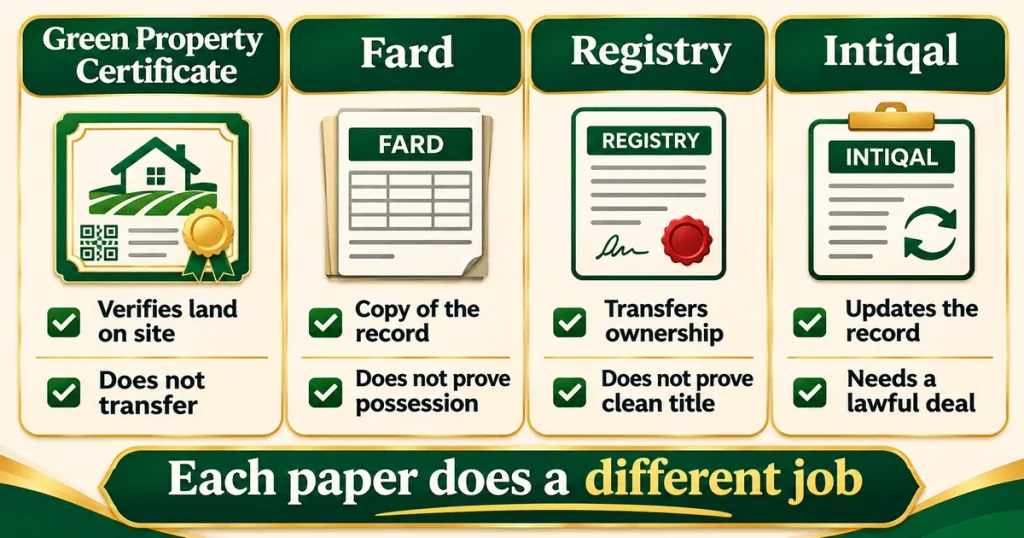
These papers are often mixed up, but each does a different job. None of them replaces the others, and a buyer usually needs more than one.
| Document | What it does | What it cannot do on its own |
|---|---|---|
| Green Property Certificate | Verifies ownership, possession, boundaries and legal status after a field check | Transfer the land or make a title unchallengeable |
| Fard-e-Malkiat | Shows the owner and share as written in the land record | Prove who is in possession today |
| Fard-e-Bai / Naqal Arazi Record | Certified record copy used for a sale or transfer | Complete the sale |
| Registry (registered sale deed) | The legal instrument that transfers the property | Prove the seller had a clean title |
| Intiqal (mutation) | Updates the revenue record after a sale, gift or inheritance | Create ownership without a lawful transaction behind it |
The law on transfer has not changed. A sale deed of land must still be registered under section 17 of the Registration Act 1908, and the change is then entered in the record through mutation under section 42 of the Punjab Land Revenue Act 1967. A GPC checks the land. It does not move ownership.
If you received the land through wirasat, first make sure the record is updated. Our guide on inheritance mutation in Pakistan explains that step in detail.
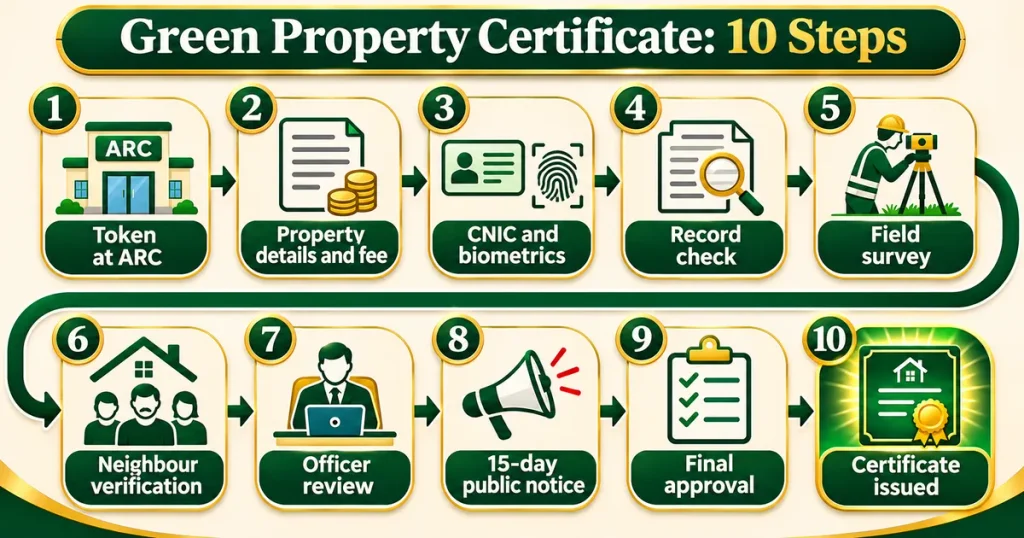
Green Property Certificate Process: 10 Steps at the ARC
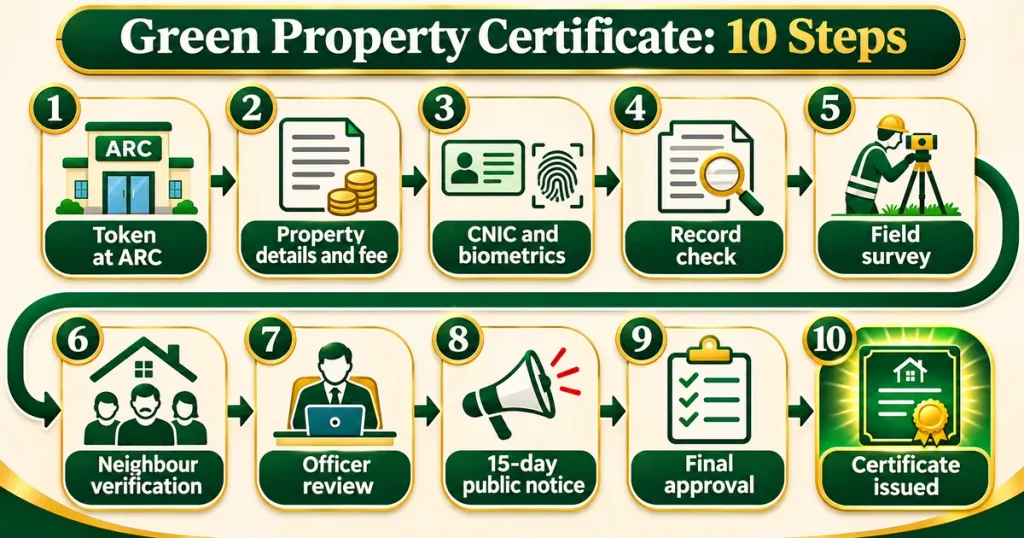
The process starts in person at your nearest Arazi Record Centre, because it needs your biometrics and a site visit. PLRA describes these steps on its official GPC page:
- Token and application: a Service Centre Official opens your case.
- Property details and fee: you give the mauza, khewat and khasra details and receive the payment slip (PSID).
- Identity check: your original CNIC, NADRA biometric verification and a mobile number registered in your name.
- Record check: staff review the ownership history, mutations, mortgages, dues and any court restriction.
- Field survey: a surveyor visits the land and records its location, area, boundaries and possession through GPS.
- Neighbour verification: usually two neighbouring owners, whose record is computerised, confirm the boundaries and possession.
- Supervisory review: senior officers check the survey report and clear any mismatch.
- 15-day public notice: the details go online so anyone with a claim can object.
- Final approval: the competent officer decides, after looking at any objections.
- Issuance: the property gets Green Status and the Assistant Director Land Records (ADLR) issues the QR-coded certificate.
How Long Does It Take?
The only fixed period PLRA states is the 15-day public notice. The total time depends on how clean your record is, how soon the survey happens and whether anyone objects. At the Sargodha district camps, for example, applications ran until mid-September and certificates were scheduled for the end of that month.
Green Property Certificate Documents: What to Carry
PLRA has not published one complete checklist for every type of property, so carry more rather than less. A missed paper usually means a second trip.
- Original CNIC (you must be present for biometrics)
- Mobile number registered in your own name
- Property details: district, tehsil, mauza, khewat, khatauni and khasra numbers
- Latest Fard copy, if you have one
- Copies of the registry and every mutation (intiqal) in your chain of title
- Inheritance mutation and legal heirs’ details, if the land came through wirasat
- Bank release letter or NOC, if the land was ever mortgaged
- Certified copies of any court order, stay order or decree about the land
- Receipts of paid government dues on the property
Special Cases: Inherited, Joint, Overseas and Women Owners
Inherited land: complete the inheritance mutation first, with every legal heir on record, including daughters and sisters. A certificate cannot lawfully cut out an heir. Read who counts as an heir in our guide on legal heirs in Pakistan.
Joint khata (mushtarka khewat): owning a share on paper is not the same as owning a marked piece of land. The site survey may expose a possession dispute, and partition may be needed before a clean certificate is possible.
Overseas Pakistanis: the official process needs biometrics and a field survey, and PLRA has not published a full remote route. Be careful of agents who promise an online GPC from abroad. A properly made power of attorney may help with some steps, so confirm with the ARC first. See our power of attorney guides.
Women owners: there is no separate rule or restriction for women. Check that your name, share and khewat are recorded correctly, because a wrong entry is one way a woman’s share quietly disappears. Our article on women’s inheritance rights in Pakistan explains how to protect it.
Green Property Certificate Fee in Punjab: Why Figures Differ
PLRA’s own GPC page lists Rs900 as the initial processing fee. That is the figure to start with. You may have seen other numbers too, because the fee was quoted differently at different times:
| Figure | When and where it was quoted |
|---|---|
| Rs700 | The earlier fee, before an increase in January 2026 (as reported) |
| Rs950 | Announced in January 2026, and again by PLRA before 1 July 2026 |
| Rs900 | A subsidised rate that reportedly ended on 30 June 2026; also shown as the initial processing fee on PLRA’s GPC page |
| Other amounts | Revised land-record service charges reported in July 2026 |
These figures may cover different services or different periods. The safe rule is simple: pay only the amount printed on your system-generated PSID or challan, and never hand cash to a middleman.
How to Pay the Fee Safely
- At the Bank of Punjab counter inside the ARC, or at any BOP branch
- Through the PSID number using JazzCash, Easypaisa or online banking
- Keep the receipt and token slip until the certificate is in your hand
- Remember that paying online does not mean applying online; the application still starts at the ARC
Can You Apply or Check a Green Property Certificate Online?
Apply online: not fully. PLRA has not published a complete online application for the GPC. The case opens at the ARC because your biometrics and a field survey are part of the process.
Websites that call themselves a “green property certificate online” portal are not PLRA services unless PLRA itself says so. Never send them your CNIC copy, registry, OTP code or any advance payment. A government-style logo proves nothing.
Check online: carefully. Each certificate carries a QR code. PLRA has not published a separate public page to verify a GPC by number, so if you scan the QR, make sure the link opens on the official punjab-zameen.gov.pk website and nowhere else.
How to Check Your Property by CNIC in Punjab
The official way to see your own land record is PLRA’s Online Fard portal or its Punjab Zameen mobile app:
- Open the Online Fard portal or the Punjab Zameen app.
- Sign up with your CNIC and mobile number, and complete identity verification.
- Select your district, tehsil and mauza, then your property record.
- Request the Fard service you need and pay the charges shown.
- Download or collect the official record.
If your CNIC is not linked to your land record, visit any ARC to get it updated. Do not expect to type someone else’s CNIC and see all their property; access is built around your own verified identity.
Can Someone Still Challenge a Green Property Certificate?
Yes. Green Status is strong evidence, but it is not the final word on title. Under section 52 of the Punjab Land Revenue Act 1967, an entry in the record of rights is presumed true only until the contrary is proved. Section 53 lets a person aggrieved by an entry file a suit for a declaration of their right.
So a forged registry, a skipped legal heir, an earlier valid sale or a court decree does not vanish because a property went green. Think of the GPC as the best due-diligence report you can get, not an unbreakable shield. Our guide on the civil suit for declaration explains how such claims reach court.
What If Your Property Fails Verification?
A failed check does not end your ownership. It means a problem in the record or on the ground must be fixed first. Match your problem to the lawful next step:
| Problem found | Your next lawful step |
|---|---|
| Name or CNIC mismatch | Apply for correction at the ARC with proof |
| Inheritance mutation pending | Complete the inheritance mutation with all legal heirs |
| A legal heir missing from the record | Seek correction before the revenue officer, or in civil court |
| Boundary or area difference | Apply for demarcation (had-bandi) or partition |
| Someone else in possession | Take the proper civil remedy to recover possession |
| Mortgage or unpaid dues | Get the bank release letter or dues clearance |
| Court stay order | Follow the order; apply to the same court if it should be changed |
| Objection during the 15-day notice | Give your documents to the officer handling the objection |
Revenue appeals and reviews have short deadlines, so act quickly and keep a copy of every order. If someone has taken over your land, read our guides on illegal possession in Pakistan.
Housing Society Plots: A Separate Ownership Certificate
Plots in private housing schemes follow a different track. Under the reform, the Board of Revenue said private housing schemes would issue certificates through PLRA’s Housing Society Management System (HSMS). Punjab’s 2026 amendments to its affordable private housing scheme rules also require an ownership certificate through HSMS once the buyer has paid in full.
Two points matter for buyers. First, the suspension of the land-record green property certificate does not automatically change a society’s own rules. Second, an allotment letter is not an ownership certificate. Before buying a plot, ask the society and the development authority which ownership document applies to it.
7 Shocking Mistakes That Can Cost You Your Land
- Trusting a viral post. Some posts say GPC is compulsory, others say it is finished. Neither is fully right, so check with your ARC.
- Paying an “online GPC” agent. Your CNIC, OTP and money can be misused, and you will still have to visit the ARC.
- Treating the green property certificate as a sale. No registry and no intiqal means no transfer, however green the paper looks.
- Leaving out a sister’s share. Skipping a legal heir in the inheritance mutation can unravel the deal years later.
- Ignoring the 15-day notice. If you have a claim on land someone else is certifying, this is the time to object.
- Buying a joint share as a plot. A share in a mushtarka khata is not a marked piece of land until partition.
- Paying bayana before checking. Check for mortgages, stay orders and actual possession before any money changes hands.
Evidence to Keep and Your Next Lawful Step
Paper protects you when memory fails. Keep these in one file, with copies on your phone:
- Latest Fard or GPC, with the date you got it
- PSID receipts and token slips
- Any survey report or notice the ARC gives you
- Any objection notice and your reply
- Photos of boundary marks and the land
- Names and numbers of neighbouring owners
- Written replies from the ARC or revenue office
Your next step depends on your side of the deal:
- Buyer: get the latest Fard or GPC, check it on the Online Fard portal, confirm possession on site, then register the sale deed and follow up the intiqal.
- Seller: fix record errors and pending mutations before you take bayana.
- Heir or co-owner: make sure your name and share are in the record before anyone else’s certificate is approved.
For complaints about service, use the complaint channel listed on the official PLRA website. If a dispute has already started, speak to a lawyer early, because delay rarely helps in land cases.
Frequently Asked Questions
1. What is a green certificate for property in Pakistan?
It is a QR-coded certificate issued by the Punjab Land Records Authority after checking a property’s ownership, possession, boundaries and legal status. It is a Punjab scheme, not a federal one. Unlike a Fard, which only copies the record, the green property certificate comes after a field survey, neighbour verification and a 15-day public notice for objections.
2. Is the green property certificate mandatory in Punjab now?
Not as a general rule. It became compulsory on 1 July 2026, but a PLRA notification on 11 July allowed deals on the Fard again. On 27 August 2026, the Punjab government told the Assembly it was suspended for six months. No order restoring the compulsory rule had been made public by late November 2026.
3. Can I sell property without a Green Property Certificate?
Yes, in most cases today. Since the July notification, a sale can again be completed using the Fard or a certified land record, followed by registry and intiqal. Rules can differ for some areas and for housing society plots, so confirm with your ARC, Sub-Registrar or society before you fix a date.
4. Can I apply for a Green Property Certificate online?
PLRA has not published a complete online application. You start at the Arazi Record Centre, where your CNIC, biometrics and property details are checked and a field survey is arranged. You can pay the fee online through the PSID. Avoid private websites that promise an online certificate or ask for advance payment.
5. Can I check a green property certificate online?
Each certificate carries a QR code. PLRA has not published a separate public verification page, so scan the code and make sure it opens on the official punjab-zameen.gov.pk website. If it opens anywhere else, treat the document as suspicious and get it checked at the ARC that issued it.
6. How can I check my property by CNIC in Punjab?
Use PLRA’s Online Fard portal or the Punjab Zameen app. Sign up with your CNIC and mobile number, complete identity verification, select your mauza and property, and request the Fard. If your CNIC is not linked to your land record, visit your nearest ARC to have it updated.
7. What is the Green Property Certificate fee in Punjab?
PLRA’s GPC page lists Rs900 as the initial processing fee. Other figures, such as Rs700 and Rs950, were quoted at different times in 2026. Pay only the amount on your system-generated PSID or challan, through the Bank of Punjab, JazzCash, Easypaisa or online banking, and keep the receipt.
8. Does a Green Property Certificate expire?
No fixed expiry period has been announced. PLRA has said the details stay unchanged until a new transaction or update happens on the property. After a sale, inheritance, mortgage or partition, the record changes, so a buyer should always ask for a fresh record instead of relying on an old certificate.
Conclusion
The green property certificate is a good idea that arrived faster than Punjab’s land records could handle. Today it is not a must for most deals. But its four checks, ownership, possession, boundaries and legal status, are exactly what every careful buyer should want before paying a rupee.
So use the certificate as a shield where it is available, keep the Fard route clean where it is not, and never let an agent or a viral post rush you. Check with your ARC, keep every receipt, and get legal advice the moment a dispute appears. The rules may change again, and we will update this guide when they do.
Disclaimer: This article is for legal awareness only and is not legal advice. Every case depends on its own facts, documents and evidence. For your specific matter, consult a qualified lawyer.