


It often starts as a “joke” in the staff room. Then come the late-night messages, the “friendly” advice about her promotion, and the cold treatment when she ignores them. Many working women in Balochistan face moments like this and stay silent because they do not know where to turn. The Women Harassment Act Balochistan gives them a clear legal route, with fixed timelines and real penalties.
But the law also has traps. A complaint written in vague words can collapse. A missed 30-day deadline can end an appeal. And the Balochistan High Court has quashed proceedings where an ordinary office dispute was dressed up as harassment. This guide explains the law as it stands after the 2025 amendment: what counts as harassment, where to complain, what penalties apply and how to protect your case.
Table of Contents
Judgment at a Glance: PLD 2024 Balochistan 6
This guide is built around a key Balochistan High Court ruling on the Act. Here it is in brief; the full story follows later.
| Point | Details |
|---|---|
| Case | Prof. Dr. N.H. v. Province of Balochistan and others |
| Citation | PLD 2024 Balochistan 6 |
| Case number | Constitution Petition No. 1639 of 2022 |
| Court | High Court of Balochistan, under Article 199 |
| Bench | Justice Muhammad Hashim Khan Kakar and Justice Shaukat Ali Rakhshani |
| Author judge | Justice Muhammad Hashim Khan Kakar |
| Hearing and decision | Heard 19 June 2023; decided 27 June 2023 |
| Law involved | Sections 2(j) and 12 of the Balochistan workplace harassment Act |
| Result | Petition allowed; summons declared illegal, mala fide and void ab initio |
IRAC Analysis: Why the Harassment Summons Failed
| Element | Explanation |
|---|---|
| Issue | Did a complaint of harsh treatment, verbal orders and undignified behaviour disclose harassment under section 2(j), and could the committee lawfully summon the Pro-Vice Chancellor? |
| Rule | Section 2(j) read with the 2021 Nadia Naz test (later set aside on review, as explained below): misconduct is actionable only if shown to be sexual in nature. Section 12 keeps other laws open, and Article 199 lets the High Court strike down action taken without jurisdiction or in bad faith. |
| Analysis | The complaint made only general allegations about office conduct. The Vice Chancellor and the committee did not apply their minds, and the wider dispute over salary, committees and repeated notices showed bad faith. |
| Conclusion | Petition allowed. Summons declared illegal, mala fide and void ab initio, three explanations declared void, and the petitioner ordered back onto university committees. |
Quick Answer: What This Law Gives You
- Official name: The Balochistan Protection Against Harassment of Women at the Workplace Act, 2016, as amended in 2025.
- Who can complain: A woman or a man, including contract and daily-wage staff, interns and apprentices.
- Where to complain: Your organisation’s Inquiry Committee or the Provincial Ombudsperson. You choose.
- Penalties: From censure to dismissal from service, plus a fine of Rs 50,000 up to Rs 500,000.
- Key deadline: 30 days to appeal a decision.
What Is the Women Harassment Act Balochistan?
The law people search for as the Women Harassment Act Balochistan is officially called the Balochistan Protection Against Harassment of Women at the Workplace Act, 2016 (Balochistan Act I of 2016). The Provincial Assembly passed it on 16 January 2016, the Governor assented on 21 January 2016, and it was published in the Gazette on 22 January 2016.
In Balochistan, it replaced the federal Protection Against Harassment of Women at the Workplace Act, 2010, to the extent that law applied in the province (section 15). The Act stands on three pillars:
- An Inquiry Committee inside every organisation (section 3).
- A Provincial Ombudsperson who hears complaints and appeals (sections 6 to 10).
- A Code of Conduct in the Schedule, which every employer must adopt and display (section 11).
You can read the current amended text of the Act on the official Balochistan Code website.
What Changed in the 2025 Amendment?
The Assembly passed Act No. XIX of 2025 on 28 July 2025, and the Governor assented on 31 July 2025, as shown in the Provincial Assembly’s official list of Acts. The main changes are:
- Whole province covered: The exception for the Provincially Administered Tribal Areas was removed from section 1(2).
- A woman Ombudsperson: She is now appointed on the recommendation of a search committee chaired by the Chief Secretary, which includes two female members of the Provincial Assembly.
- Stricter eligibility: A candidate from government service needs BPS-20 or above, an LLB and at least ten years of legal experience, and must be a local or domicile holder of Balochistan. A person qualified to be a High Court judge remains eligible.
- Own staff: A new section 10-A provides for the office’s staff. Posts of BPS-16 and above will go through the Balochistan Public Service Commission, starting two years after the amendment.
What did not change matters just as much. The definition of harassment in section 2(j), the complaint procedure, the penalties and the appeal deadlines remain as they were.
What Counts as Harassment Under Section 2(j)?
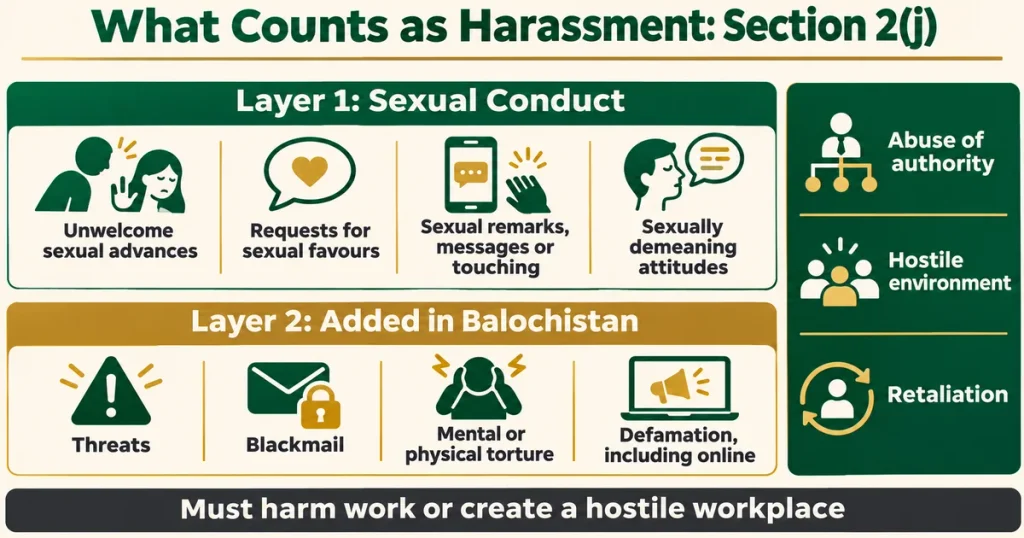
Section 2(j) is the heart of the Women Harassment Act Balochistan. It works in two layers.
Layer one: sexual conduct. This part matches the old federal law. It covers unwelcome sexual advances, requests for sexual favours, verbal or written communication or physical conduct of a sexual nature, and sexually demeaning attitudes.
Layer two: words added only in Balochistan. The provincial Assembly added threats of any kind, blackmail, mental and physical torture, and defamation or attempted defamation, including through modern techniques such as phones and social media.
Either layer must also cause harm at work. The conduct must interfere with work performance or create an intimidating, hostile or offensive work environment. The definition also covers punishing someone for refusing a sexual demand, or making such a demand a condition of the job.
The Code of Conduct explains three common forms:
- Abuse of authority: a supervisor demanding sexual favours in exchange for a raise, promotion, training, transfer or the job itself.
- Hostile environment: unwelcome sexual conduct that makes work intimidating or offensive. Usually a pattern is needed, but one severe incident, such as physical contact, is enough.
- Retaliation: punishing a refusal, for example through blocked promotions, distorted evaluation reports or gossip.
One detail is often missed. The Code’s own definition in the Schedule does not repeat the extra Balochistan words about threats, blackmail and torture. Anyone drafting or answering a complaint should keep this difference in mind.
Is Every Harsh Word at Work Harassment?
Not under this Act. Rudeness, strict supervision, a transfer you dislike or an office feud is not automatically “harassment” in the legal sense. In PLD 2024 Balochistan 6, the Balochistan High Court quashed summons where the complaint only alleged being called into an office, given verbal orders and treated in an undignified way. The exact boundary is still disputed, as explained later in this guide.
Who Is Protected, and Where?
The Women Harassment Act Balochistan is wider than many people think. Under section 2:
- Complainant: a woman or a man.
- Employee: regular or contractual staff paid daily, weekly, monthly or hourly, including interns and apprentices.
- Accused: an employee or an employer of the organisation.
- Organisation: government departments, autonomous bodies, educational institutes, medical facilities, registered civil society bodies, companies and private businesses.
- Workplace: not just the office building, but also factories, transport, open areas and any situation linked to official work outside the office.
So a lecturer harassed on a university bus, or a nurse harassed during an official field visit, is still protected. For more on women’s legal protections, read our guides on women’s rights in Pakistan.
Two Doors to Justice: Inquiry Committee or Ombudsperson
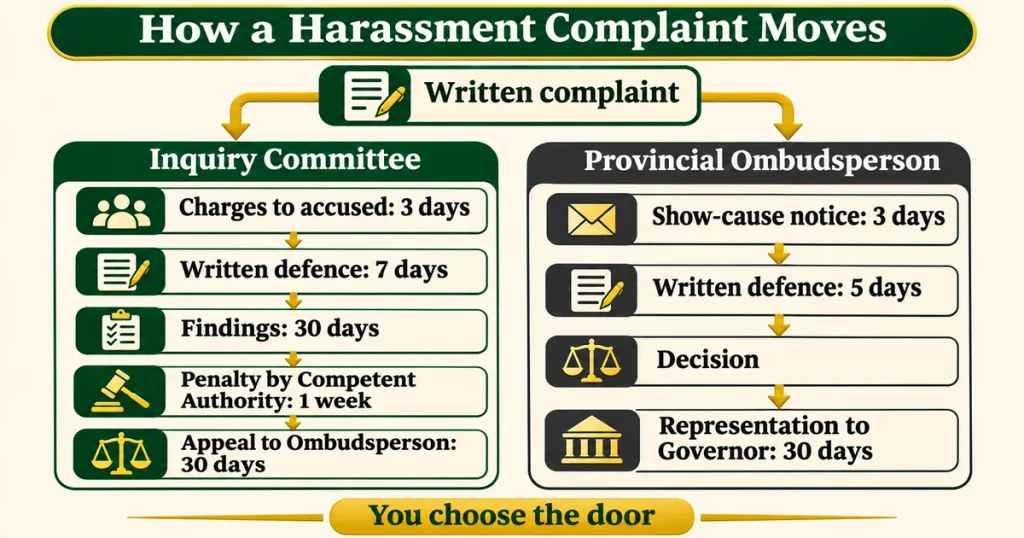
Section 8(1) gives every employee a choice. You can complain to your organisation’s Inquiry Committee, or go straight to the Provincial Ombudsperson. You do not have to try the committee first.
| Point | Inquiry Committee | Provincial Ombudsperson |
|---|---|---|
| Where it sits | Inside your organisation | Independent provincial office |
| Notice to accused | Charges within 3 days of a written complaint | Show-cause notice within 3 days |
| Accused’s reply | Written defence within 7 days | Written defence within 5 days |
| Outcome | Findings within 30 days to the Competent Authority | Decision sent to both parties and management |
| Penalty imposed by | Competent Authority, within 1 week | Ombudsperson directly |
| Challenge | Appeal to Ombudsperson within 30 days | Representation to Governor within 30 days |
How the Inquiry Committee Works
The committee has five members, at least two of them women, including senior management and a senior employee representative. Outsiders can be co-opted, and a member accused in a complaint must be replaced for that case. The committee can summon people, take evidence on oath or affidavit and order a medical examination. Both sides may cross-examine witnesses, and an accused who ignores the deadline can be heard ex parte (in his absence).
How the Ombudsperson Works
The Ombudsperson has civil court powers to summon witnesses, compel evidence and inspect premises, can punish contempt like a High Court, and can impose any penalty directly. This route helps when there is no committee, the committee seems biased, or the accused heads the institution. The Women Development Department, which also runs the helpline under section 13, lists the Provincial Ombudsperson on its official website. Confirm the current address there before you travel.
Step-by-Step: How to File a Harassment Complaint in Balochistan
- Write it down early. Note the date, time, place, exact words or acts, and anyone who saw or heard.
- Choose informal or formal. The Code allows informal resolution through a supervisor or committee member, but you can file a formal complaint at any time.
- Draft a written complaint. Name the accused and his role, describe each incident separately and list your evidence and witnesses.
- Submit it properly. Hand it to any committee member, through your supervisor or CBA (union) nominee, or directly to the Ombudsperson. Keep a dated, stamped copy.
- Ask for interim protection. Under the Code, the employer can change seating or reporting lines, send the accused on leave or suspend him.
- Take part in the hearing. You may bring a CBA representative, a friend or a colleague.
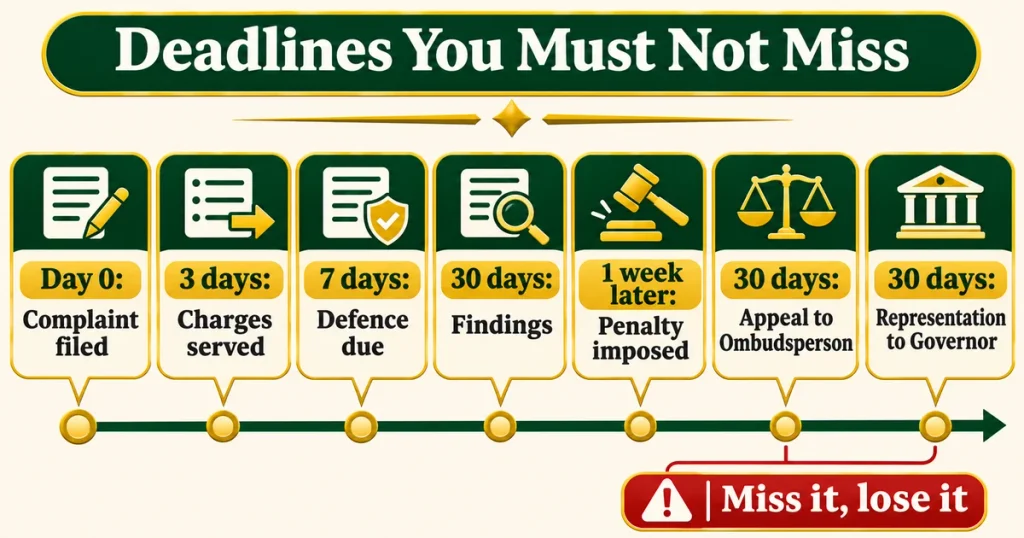
- Watch the clock. Findings are due within 30 days, the penalty within a week after that, and any appeal within 30 days.
Penalties Under the Women Harassment Act Balochistan
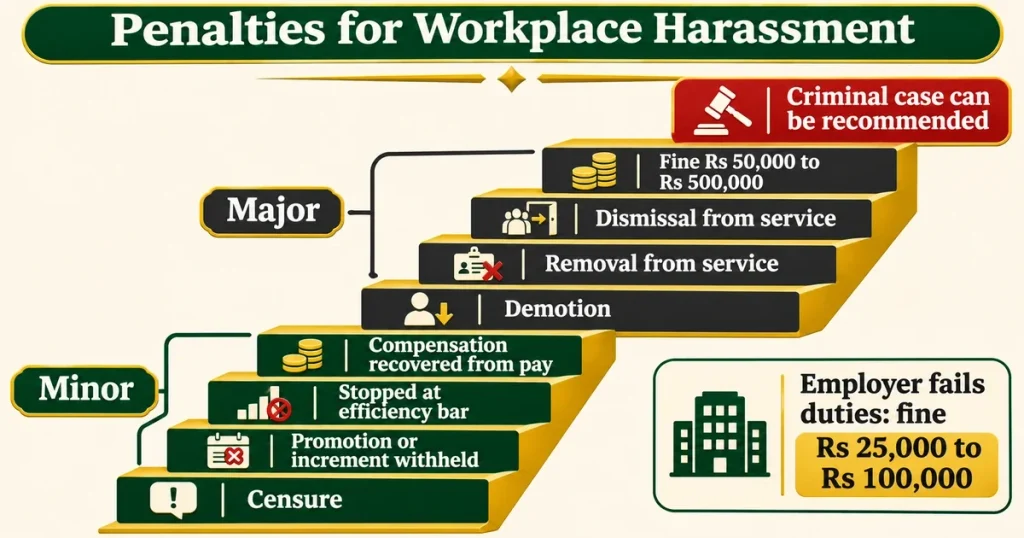
If the accused is found guilty, the committee recommends penalties under section 4(4), and the Competent Authority must impose them within one week.
| Type | Penalties |
|---|---|
| Minor | Censure; withholding promotion or increment for a set period; stoppage at an efficiency bar; recovery of compensation for the complainant from the accused’s pay |
| Major | Reduction to a lower post or pay stage; removal from service; dismissal from service; fine of Rs 50,000 up to Rs 500,000 |
The fine, or part of it, can be paid to the complainant as compensation, and the committee can also recommend criminal proceedings.
Employers are not off the hook either. If an organisation fails to form a committee or adopt and display the Code in English, Urdu and the language most staff understand, any employee can complain to the Ombudsperson. A guilty employer faces a fine of Rs 25,000 to Rs 100,000 under section 11(3).
Appeal Deadlines You Must Not Miss
- Against the Competent Authority’s decision: appeal to the Ombudsperson within 30 days. Both a penalised accused and an unhappy complainant can appeal (section 6).
- Decision on that appeal: the Ombudsperson must decide within 30 days.
- Against the Ombudsperson’s decision on a complaint: make a representation to the Governor within 30 days. The Governor’s decision is final (section 9).
- Against an employer fine: representation to the Governor within 30 days (section 11(4)).
The Act does not fix a time limit for filing the first complaint, and the Code says late reporting should not by itself affect the merits. Still, memories fade and messages get lost, so complain as early as you safely can. Where a committee acts without jurisdiction or in bad faith, a constitutional petition under Article 199 may be possible, as the case below shows.
Your Protections During the Inquiry
- Statements and evidence are confidential.
- No adverse action may be taken against the complainant or witnesses.
- The employer and the accused must not create a hostile atmosphere to pressure the complainant.
- If the complainant is in trauma, the organisation must arrange counselling or medical treatment and additional medical leave.
- The organisation may offer compensation for lost salary.
Evidence to Preserve Before You Complain
Harassment usually happens when no one else is around, as the Code itself admits. Your own record-keeping is vital:
- Screenshots showing the sender’s number or name and the date. Keep the original phone and do not delete the chat.
- Emails, letters, and any sudden show-cause notices, transfers or bad evaluations after you refused or objected.
- A diary written at the time of each incident.
- Names of colleagues who saw or heard anything, and of anyone you told soon after.
- Medical or counselling records, if any.
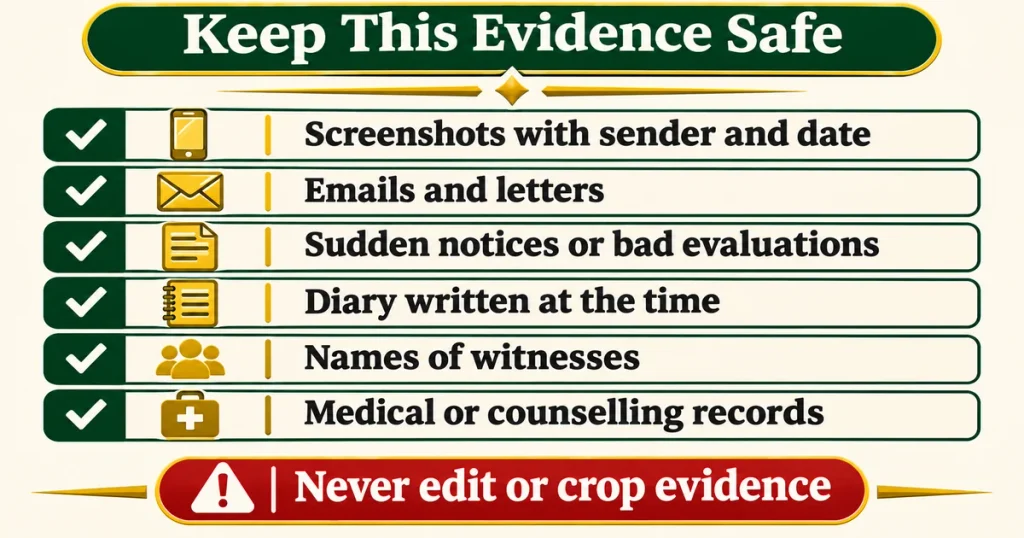
Never edit, crop or alter evidence. A doctored screenshot can destroy an otherwise strong case.
7 Dangerous Mistakes That Can Sink a Complaint
- Using labels instead of facts. “Mental torture” means little without dates, exact words and witnesses.
- Dressing up a service dispute. Salary, postings and committee seats belong under service rules unless the facts also show harassment.
- Missing the 30-day window. Appeal time runs from the written communication of the decision.
- Going public first. Posting evidence on social media can create defamation risk and weaken the inquiry.
- Ignoring conflicts of interest. If a committee member is the accused, a rival or a witness, ask in writing for replacement under section 3(3).
- Filing a false complaint. If allegations are found false and mala fide, the committee may recommend action against the complainant (section 5(3)).
- Telling no one. The Code recommends telling someone you trust, even before a formal complaint. That person may become your witness.
If you are the accused, answer each allegation separately, keep official records safe, and raise any objection to jurisdiction or bias at the first hearing.
Inside the Case: What the High Court Decided
What Happened in the University Case
The petitioner was the Pro-Vice Chancellor of a women’s university in Quetta. From 2 September 2021, she also held acting charge as Vice Chancellor after the Vice Chancellor was removed. When the Vice Chancellor returned on the strength of a High Court judgment, the petitioner said a personal grudge began: her salary package was revised, she was removed from committees, she received repeated show-cause notices, and she was summoned on a harassment complaint.
That complaint, dated 13 September 2022, was filed by a department chairperson. Summons followed on 21 and 28 September 2022. It alleged that the petitioner called the complainant to her office, treated her in an undignified manner and gave verbal orders.
Why the High Court Quashed the Summons
The Court examined the complaint itself and held that it did not disclose harassment under the Women Harassment Act Balochistan. The Vice Chancellor and the Harassment Committee had failed to apply their minds before summoning the petitioner.
Relying on the Supreme Court’s 2021 decision in Nadia Naz (PLD 2021 SC 784), the Court said workplace misconduct “is not actionable per-se” unless shown to be sexual in nature (para 4). It warned that the wider Balochistan definition was being misused, and observed that the petitioner, also a woman, appeared to have been made a scapegoat and discriminated against on a linguistic basis.
The summoning was declared illegal, mala fide (in bad faith) and void ab initio (invalid from the start). Explanations dated 20 May 2022, 29 June 2022 and 25 August 2022 were declared void for lack of jurisdiction, and the petitioner was ordered to be included in committees under the Balochistan Universities Act, 2022.
What the Court Did Not Decide
- It did not expressly restore her salary package, although that relief was prayed for.
- It did not order any action against the complainant.
- It did not say harassment complaints in universities are suspect. The bad-faith finding rested on this case’s own facts.
- The prayer clause dates one explanation 26 August 2022, while the final order says 25 August 2022. This difference is in the judgment itself.
Is the Narrow “Sexual Nature” Test Still the Law?
This is where the law becomes unsettled, and every complainant in Balochistan should understand why.
- July 2021: In Nadia Naz, the Supreme Court read harassment under the federal 2010 Act narrowly, as conduct of a sexual nature only.
- 2022: Parliament amended the federal law to add discrimination on the basis of gender, whether sexual or not.
- Review heard on 14 March 2023: The Supreme Court allowed review petitions and set aside its 2021 judgment, holding that “sexual” can also mean relating to gender. Read the official review judgment, reported as PLD 2023 SC 588.
- June 2023: The Balochistan High Court decided PLD 2024 Balochistan 6 relying on the 2021 judgment. Its judgment does not mention the review.
- 2026: The Federal Constitutional Court judgment in Usman Shahid v. Nadia Sarwar has been reported as returning to a narrower reading of the federal definition. A National Assembly committee has said the ruling appears inconsistent with PLD 2023 SC 588 and urged the federal government to pursue a review petition.
What does this mean in practice? Section 2(j) was never amended to add gender discrimination, as the federal law was. Its extra words about threats and blackmail are wide on paper, but the High Court read them narrowly. Until a higher court settles the Balochistan definition, write your complaint so that it clearly shows sexual conduct, a gender-based demeaning attitude, or one of the specific acts named in section 2(j), with facts behind each claim.
Other Legal Remedies Outside This Act
Section 12 says this Act is in addition to, not in place of, other laws. Depending on the facts, you may also have:
- a criminal complaint under section 509 of the Pakistan Penal Code;
- disciplinary action under your department’s service rules;
- a civil or criminal defamation case;
- remedies under cybercrime law where the abuse happens online;
- a constitutional petition where an authority acts without jurisdiction or in bad faith.
Browse more of our workplace harassment guides for related rights and remedies.
Frequently Asked Questions
What is the Women Harassment Act Balochistan?
It is the common name for the Balochistan Protection Against Harassment of Women at the Workplace Act, 2016. It creates Inquiry Committees inside organisations, a Provincial Ombudsperson and a Code of Conduct, and it sets timelines, penalties and appeals for workplace harassment complaints in the province. It was last amended by Act No. XIX of 2025.
Can a man file a complaint under this law?
Yes. Section 2(f) defines a complainant as a woman or a man aggrieved by harassment. The title focuses on women because they are most often affected, but male employees, interns and apprentices can also approach the Inquiry Committee or the Ombudsperson if the conduct falls within section 2(j).
Do I have to complain to my office committee first?
No. Section 8(1) lets any employee choose either the Inquiry Committee or the Provincial Ombudsperson. Going straight to the Ombudsperson often makes sense when your organisation has not formed a committee, when committee members are close to the accused, or when the accused heads the institution.
Is there a deadline to file a harassment complaint?
The Act does not fix a time limit for the first complaint, and the Code says late reporting alone should not hurt the merits. Appeals, however, are strict: 30 days to appeal to the Ombudsperson and 30 days for a representation to the Governor. Early complaints are also much easier to prove.
What punishment can a harasser face?
Minor penalties include censure, withholding promotion or increment, and recovery of compensation from pay. Major penalties include reduction in rank, removal or dismissal from service, and a fine of Rs 50,000 up to Rs 500,000. The committee can also recommend criminal proceedings against the accused.
What happens if a harassment complaint turns out to be false?
If the Inquiry Committee finds the allegations false and made with mala fide intent, it may recommend action against the complainant to the Ombudsperson under section 5(3). A complaint that fails for lack of evidence is not automatically false. Bad faith needs its own clear finding on the facts.
What did the Balochistan High Court decide in PLD 2024 Balochistan 6?
It allowed a Pro-Vice Chancellor’s petition and declared her summoning on a harassment complaint illegal, mala fide and void ab initio. The Court found the complaint contained only general allegations about office conduct, not harassment under the Act, and ordered her inclusion in university committees.
Did the 2025 amendment change the definition of harassment?
No. Act No. XIX of 2025 changed how the Ombudsperson is appointed and qualified, provided for the office’s staff and extended the Act to the whole province. Section 2(j), the complaint procedure, penalties and appeal deadlines were left unchanged, so the definition debate is still live.
Conclusion
The Women Harassment Act Balochistan is a strong shield when it is used well. It gives every employee two doors to justice, short timelines and penalties that reach dismissal and heavy fines, and the 2025 amendment has strengthened the Ombudsperson’s office.
But the shield works best with facts. A clear, dated, evidence-backed complaint is hard to brush aside, while a vague one built on an office quarrel can be quashed, as PLD 2024 Balochistan 6 shows. If you are facing harassment, start recording today, choose your forum wisely and watch every 30-day deadline.
Disclaimer
This article is for legal awareness only and is not legal advice. Every case depends on its own facts, documents and evidence, and the meaning of “harassment” is still being argued in Pakistan’s higher courts. For your specific matter, consult a qualified lawyer.