

Barely two months after the nikah, the marriage ended in divorce. The wife’s Nikahnama said he would pay her Rs500,000 if he ever divorced her. The Family Court refused to enforce that line, calling it an illegal curb on his right of divorce. For many families asking about wife property divorce rights, that is exactly where the story ends.
This one did not end there. Her case reached the Islamabad High Court together with a second dispute over a house on a B-17 plot. In 2026 CLC 580, the Court held that a Nikahnama must be read by what the couple really intended, not by the printed heading of a column. But it also stopped short of handing her the money.
Below is what the Court decided, what it did not decide, the newer rulings that changed the picture in 2026, and the papers you need before filing any claim.
Table of Contents
Judgment at a Glance: 2026 CLC 580
| Point | Detail |
|---|---|
| Court | Islamabad High Court |
| Bench | Justice Arbab Muhammad Tahir (single bench) |
| Citation | 2026 CLC 580 |
| Case numbers | W.P. No. 4233 of 2021 (lead case), with W.P. Nos. 322 of 2022, 672 of 2023 and 1906 of 2023 |
| Hearing and decision | Heard on 24 June 2025; decided on 10 July 2025 |
| Jurisdiction | Constitutional (writ) jurisdiction under Article 199 |
| Law involved | Muslim Family Laws Ordinance, 1961 (section 5) and its Nikahnama form; Family Courts Act, 1964 (section 5 and Schedule) |
| Result in the cash case | Appellate judgments set aside; appeals sent back for a fresh decision |
| Result in the B-17 case | Both writ petitions dismissed; joint-ownership finding stays |
IRAC: How the Court Read the Nikahnama
| IRAC | Explanation |
|---|---|
| Issue | Can money or property promised in a Nikahnama “in case of divorce” be claimed, and can a Family Court hear claims based on columns other than Column 13? |
| Rule | Nikahnama columns guide the parties but do not conclusively fix their intention (PLD 2022 SC 686; Supreme Court, C.P. Nos. 768 and 827 of 2022). Family Courts have exclusive jurisdiction over dower and a wife’s personal property. |
| Analysis | The lower courts rejected a Rs500,000 entry as an unlawful curb on divorce. The High Court held that a husband who freely agrees to such a term is bound by it, absent fraud or misrepresentation. In the B-17 case, the Nikahnama pointed to a signed joint-ownership agreement. |
| Conclusion | The cash claim goes back for a fresh appellate decision. The joint-ownership finding stays. A column heading alone cannot defeat a written promise, but the claim must still be proved. |
The Facts: Two Marriages, Two Nikahnama Promises
The High Court decided four writ petitions together because they raised the same question of law. They came from two separate marriages.
Case 1: Rs500,000 Promised If He Divorced Her
The couple married on 16 November 2019. Column 13 fixed dower at 2.5 tolas of gold ornaments, valued at Rs228,000, plus Rs5,000 as prompt dower. Column 17 said that if the groom divorced the bride, he would be bound to pay her Rs500,000. Column 20 fixed maintenance at Rs5,000 a month.
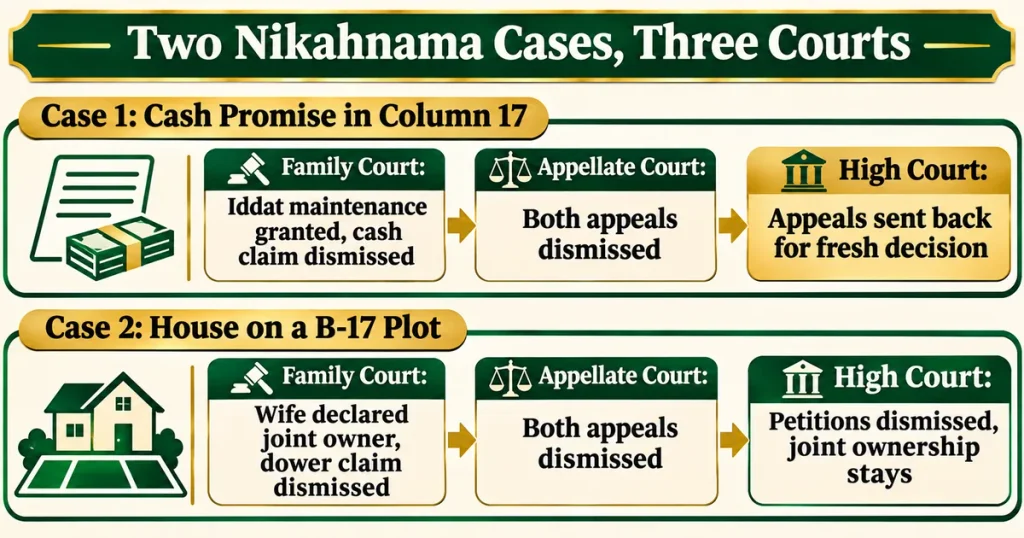
The marriage ended in divorce on 24 January 2020. On 12 February 2020, the wife sued for maintenance and the Rs500,000. The husband contested the suit, but both sides admitted the Nikahnama. On 12 July 2021, the Family Court awarded her iddat maintenance at Rs10,000 a month and dismissed the Rs500,000 claim. Both sides appealed, and both appeals were dismissed on 2 October 2021.
Case 2: A House on a B-17 Plot in Islamabad
The second couple married on 26 May 2020. Column 13 recorded Rs500,000 as prompt dower: Rs100,000 in cash and gold ornaments worth Rs400,000. Columns 16, 17 and 20 referred to a separate agreement (iqrarnama) signed on 21 May 2020 about Plot No. 2464, Block E, B-17, Islamabad, measuring 30 x 60 feet. One of its terms said the house built on that plot would be jointly owned by husband and wife.
According to the husband’s written statement, the marriage ended in divorce on 11 December 2020. The wife sued that same day for maintenance at Rs50,000 a month, Rs500,000 dower and the plot. On 14 May 2022, the Family Court gave her maintenance at Rs20,000 a month (Rs60,000 in total), dismissed the dower claim and declared her joint owner of the B-17 property. Both appeals failed on 26 November 2022.
| Stage | Case 1: Rs500,000 promise | Case 2: B-17 house |
|---|---|---|
| Family Court | Iddat maintenance granted; Rs500,000 claim dismissed | Maintenance granted; dower claim dismissed; wife declared joint owner |
| Appellate court | Both appeals dismissed | Both appeals dismissed |
| Islamabad High Court | Appellate judgments set aside; appeals sent back | Both writ petitions dismissed; findings kept |
What Each Side Argued
The Husbands’ Case
- Islam gives the husband the right of divorce, and that right cannot be tied to a financial penalty.
- A Column 17 condition against the injunctions of Islam is void and unenforceable.
- Column 17 entries are really in lieu of the Column 13 dower, so once dower is paid nothing more is owed.
- A Column 17 promise is a civil contract, outside the Family Court’s jurisdiction.
The Wives’ Case
- Marriage is a civil contract, and both sides accepted its terms with free will.
- The Nikahnamas were admitted, and a Nikahnama is a public document with a presumption of truth.
- Columns 13 to 17 are undertakings that should be read together, by the parties’ intention.
- In the B-17 case, the wife argued she should have been declared sole owner, not joint owner.
The Law: Nikahnama Columns and Family Court Powers
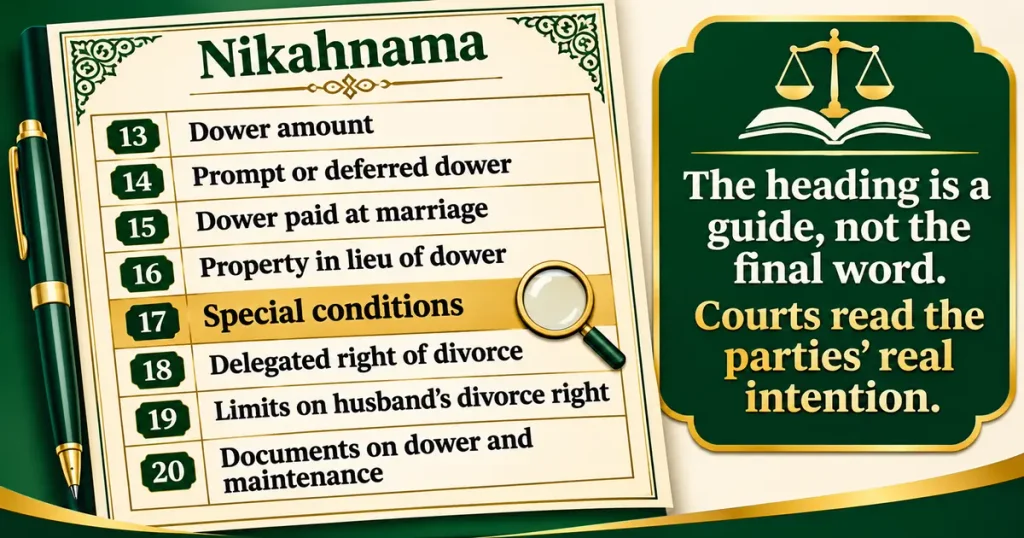
Section 5 of the Muslim Family Laws Ordinance, 1961 requires every Muslim marriage to be registered. Under Rule 8 of the rules made under the Ordinance, Nikah Registrars use the prescribed Nikahnama (Form II). Every claim about wife property divorce rights starts with these columns:
| Column | What the printed form asks |
|---|---|
| 13 | Amount of dower (haq mehr) |
| 14 | How much dower is prompt (mu’ajjal) and how much is deferred (ghair mu’ajjal) |
| 15 | Whether any dower was paid at the time of marriage |
| 16 | Whether any property was given in lieu of all or part of the dower |
| 17 | Special conditions, if any |
| 18 | Whether the husband has delegated the right of divorce to the wife |
| 19 | Whether the husband’s right of divorce is curtailed in any way |
| 20 | Whether any document was drawn up about dower, maintenance and similar matters |
The forum comes from section 5 of the Family Courts Act, 1964. It gives Family Courts exclusive jurisdiction over the matters in Part I of its Schedule, which include dissolution of marriage, dower, maintenance, dowry and the personal property and belongings of a wife. The Court relied on that last item, which it called item 9. In Punjab, the 2015 amendment also brought other matters arising out of the Nikahnama within Family Court jurisdiction.
Inside the Court’s Reasoning
Four points carry the judgment, and each one shapes wife property divorce rights in practice.
Column Headings Guide, They Do Not Decide
A Lahore High Court larger bench (2023 CLC 1021) had read Nikahnama entries in the groom’s favour and treated the headings as decisive. The Supreme Court set that judgment aside on 28 November 2024 in C.P. Nos. 768 and 827 of 2022, relying on PLD 2022 SC 686: a Nikahnama is a contract, and its columns must be read in the light of the parties’ intention.
The High Court followed that rule. In its words, the columns “are meant for guidance of the parties” and do not conclusively decide what husband and wife intended (para 13).
Family Court Can Hear a Column 17 Claim
The husbands called a Column 17 promise an ordinary civil contract. The Court disagreed. It relied on PLD 2016 SC 613, where the Supreme Court held that a Nikahnama undertaking to transfer land to the wife may be treated as dower or a gift in consideration of marriage, and so falls within the Family Court’s exclusive domain.
It added a second reason. When a husband freely agrees that divorce will bring the wife a benefit, that property becomes her personal property once he pronounces divorce, and the Schedule covers a wife’s personal property. As the Court put it, divorce “may culminate the relationship of the spouses, but it is a matter arising out of the matrimonial bond” (para 12).
A Divorce-Linked Promise Is Not Void by Default
This was the heart of the case. The Court described the Nikahnama as a civil contract built on offer, acceptance and free consent. Where nobody alleges fraud, misrepresentation or lack of free will, both parties must honour its terms. A husband who signs a condition promising money or property on divorce does so with his own consent. Declaring that entry un-Islamic and dismissing the claim on that basis was an erroneous interpretation of the law (para 14).
Why the Court Would Not Re-Weigh the Evidence
Writ jurisdiction under Article 199 is not a second appeal. Relying on PLD 1973 SC 24 and 2023 SCMR 68, the Court said it only checks whether the lower courts acted lawfully, so it left the maintenance findings in both cases alone. It also refused to disturb the dismissal of the dower claim in the B-17 case, which rested on evidence that included an FIR lodged by the wife’s brother alleging that gold ornaments and other articles were snatched.
Final Decision: What the Court Did and Did Not Decide
In Case 1, the High Court set aside the appellate judgments of 2 October 2021. Both appeals are treated as pending, and the appellate court was asked to hear the parties and decide, preferably within one month of receiving a certified copy. In Case 2, both writ petitions were dismissed, so the joint-ownership finding and the other concurrent findings stand.
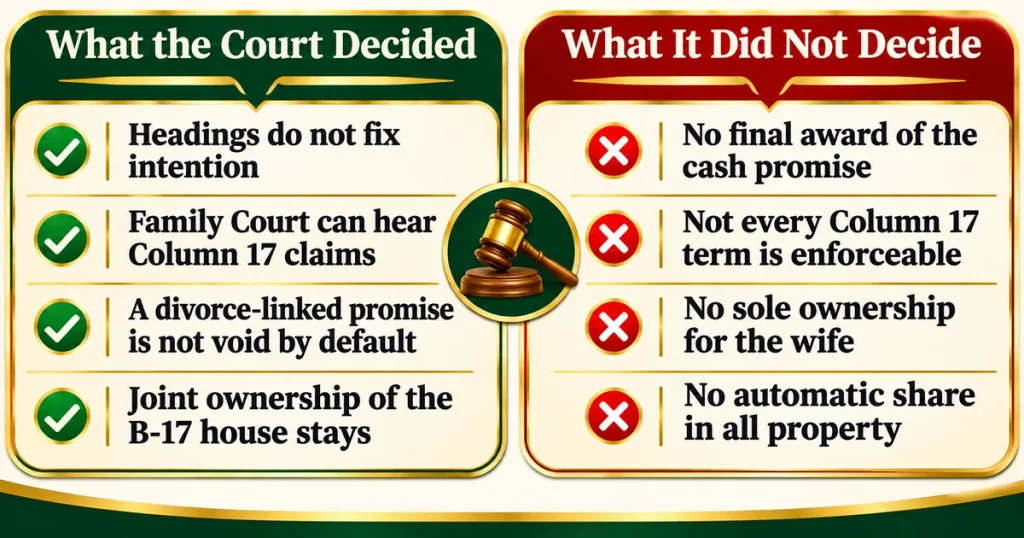
What the Court did decide
- Nikahnama column headings do not conclusively fix the parties’ intention.
- A Family Court can hear claims based on Column 17 entries.
- A freely agreed divorce-linked benefit cannot be thrown out simply as a curb on divorce.
- The B-17 joint-ownership finding, based on the Nikahnama and the iqrarnama, stays.
What the Court did not decide
- It did not award the Rs500,000. The appellate court must still decide that claim.
- It did not say every Column 17 condition is automatically enforceable.
- It did not make the B-17 wife sole owner; that request failed.
- It did not give divorced wives a general share in all of a husband’s property.
Wife Property Divorce Rights After the 2026 Rulings
2026 CLC 580 was decided in July 2025 and reported in 2026, and the law kept moving. Three rulings shape how wife property divorce rights are read today.
Supreme Court: Dower Is Her Property, Not a Price
In September 2026, a larger Supreme Court bench headed by Justice Shahid Waheed held that dower is the wife’s exclusive proprietary right, not her price. If property promised as dower cannot be transferred, the husband must pay its value, and a court can fix market value where the Nikahnama is silent. Payment cannot depend on the wife’s conduct or on whether she seeks divorce. Nikah Registrars must fill every relevant column and record Column 17 conditions as the parties agreed them.
Islamabad High Court: Assets Bought During Marriage
In W.P. No. 365 of 2023, announced in March 2026, Justice Mohsin Akhtar Kayani first restated the settled rule: a wife has no automatic legal right to share in her husband’s assets. He then treated a car and household articles bought after marriage as matrimonial property she could share in, sent the case back to the Family Court, and urged Parliament to legislate and add a Nikahnama column for equal division.
The judgment has reportedly been challenged before higher forums. Until a higher court settles the point, treat it as an important but developing Islamabad ruling, not a nationwide 50/50 rule.
Supreme Court: When Column 17 Is Unclear
In 2024 SCMR 1078, the Supreme Court dealt with a plot written in Column 17 and refused to let the heading “special conditions” defeat the wife’s claim. Where entries are ambiguous and the bride was not informed of her rights at the nikah, the benefit goes to her. The husband’s appeal was dismissed.
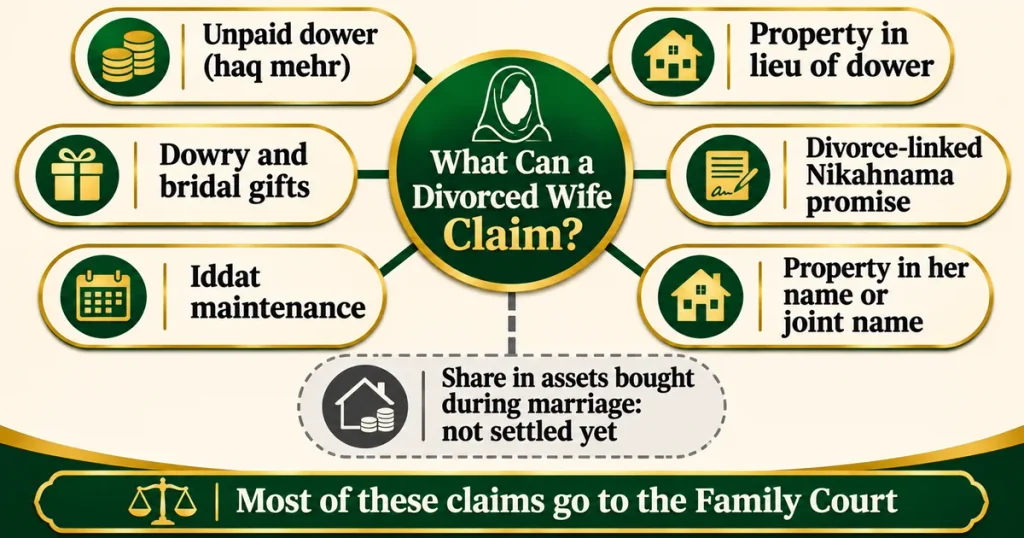
What a Divorced Wife Can Claim, and Where
Put simply, wife property divorce rights in Pakistan rest on a legal source, not on the divorce itself. Use this table to find yours.
| What she may claim | Legal basis | Usual forum |
|---|---|---|
| Unpaid dower, prompt or deferred | Nikahnama Columns 13 to 15 | Family Court |
| Property given in lieu of dower | Column 16 or a connected deed | Family Court |
| Cash or property promised on divorce | Column 17 or a connected agreement, read by intention | Family Court, as dower, gift or her personal property |
| Dowry (jahez) and bridal gifts | Section 5, Dowry and Bridal Gifts (Restriction) Act, 1976 | Family Court |
| Iddat maintenance and unpaid past maintenance | Muslim personal law; Family Courts Act Schedule | Family Court |
| Property in her name or jointly owned | Title papers or a written agreement | Family Court for matrimonial claims; civil court for pure title disputes |
| Share in assets bought during marriage | W.P. No. 365 of 2023 (Islamabad, under challenge) | Not settled law yet |
A promise of land can also be a gift in consideration of marriage, so our gift (hiba) dispute guides may help. For a pure title fight, a civil suit for declaration may be the route.
The way the marriage ends matters too. Both marriages here ended in divorce. If a wife seeks khula instead, different dower rules apply, so read our guide on khula law and dower return. To check whether a talaq is legally complete, see divorce procedure in Pakistan.
Evidence to Keep and Your Next Steps
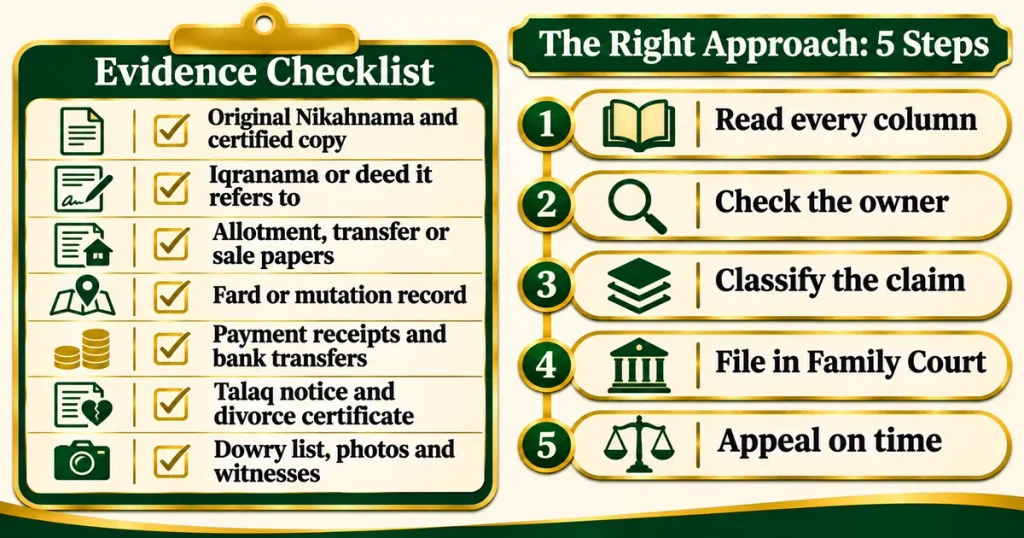
Wife property divorce rights are won on paper. The B-17 wife kept joint ownership because her claim rested on a signed iqrarnama and a precisely described plot. Before filing, collect:
- The original Nikahnama, a certified copy, and any iqrarnama or deed it refers to.
- Title papers for the promised property: allotment letter, transfer letter, sale deed, fard or mutation (intiqal).
- Proof of payment: receipts, bank transfers and jewellery bills.
- The talaq notice and divorce certificate from the Union Council.
- The dowry list, photos, witnesses and any written admissions by the husband.
Then take these steps:
- Read every column word for word, especially Columns 13 to 17 and 20.
- Check who owns the property today. If it belongs to a parent or a co-owner, getting the property itself can be hard, though for dower the September 2026 ruling says the husband may still owe its value.
- Classify the claim: dower, gift, joint ownership or a divorce-linked condition.
- File in the Family Court and bring all your matrimonial claims together.
- If you lose, appeal on time. A writ petition is not a second appeal.
Do not sit on the claim either. Under the Limitation Act, 1908, a dower suit generally has to be filed within three years, counted from demand and refusal for prompt dower, or from the divorce for deferred dower. Ask a lawyer to check the period for your claim. For more, browse our women’s rights in Pakistan section.
7 Shocking Mistakes to Avoid After Divorce
Most lost claims about wife property divorce rights fail on avoidable errors, not on the law.
- Assuming divorce gives you half of everything. It does not, even after the 2026 Islamabad ruling.
- Treating every Column 17 line as dower. Its legal character must be proved.
- Ignoring the title record. A promise is only as strong as the owner’s power to keep it.
- Losing the original Nikahnama or agreement. Originals settle doubts.
- Accepting vague wording. Plot number, block, sector and size make a promise enforceable.
- Choosing the wrong forum. The wrong court can cost years.
- Calling a remand a victory. A case sent back is still undecided.
FAQs About Wife Property Divorce Rights
Does a wife automatically get half the property after divorce?
No. Wife property divorce rights in Pakistan still do not include an automatic 50/50 split. A wife needs a legal source, such as dower, a gift, joint ownership, her own title or a freely agreed Nikahnama condition. The Islamabad High Court’s March 2026 matrimonial property ruling is important, but it has reportedly been challenged and is not settled law.
Can a wife claim money or property written in Column 17?
Often, yes. 2026 CLC 580 holds that a Column 17 entry cannot be rejected just because of its heading or because it is linked to divorce. The court will still examine the exact wording, the parties’ intention, consent, ownership of the property and the evidence before deciding the claim.
Did the wife in 2026 CLC 580 get the Rs500,000?
Not from the High Court. It held that rejecting the Column 17 claim as un-Islamic was legally wrong, set aside the appellate judgments and sent the appeals back. The appellate court must now hear both sides and decide the Rs500,000 claim afresh.
What happened to the B-17 house in the connected case?
The Family Court declared the wife joint owner of the B-17 house, based on the Nikahnama and the iqrarnama it referred to, and the appellate court agreed. The High Court dismissed both sides’ petitions, so joint ownership stands, while her request to be declared sole owner failed.
Is property written in a Nikahnama always haq mehr?
No. It may be dower, property given in lieu of dower, a gift in consideration of marriage, a joint-ownership arrangement or another condition. Courts read the whole document, any connected agreement and the parties’ intention. That classification decides your wife property divorce rights, the remedy and the right court.
Can the husband’s family keep jahez or gold after divorce?
No. Under section 5 of the Dowry and Bridal Gifts (Restriction) Act, 1976, dowry and bridal gifts vest absolutely in the bride. She can claim them, or their value, in the Family Court. Keep the dowry list, receipts, photos and witnesses, because proof of what was handed over often decides these cases.
Which court hears a wife’s property claim after divorce?
Usually the Family Court, which has exclusive jurisdiction over dower, dowry, maintenance and a wife’s personal property. 2026 CLC 580 confirms that claims based on Column 17 entries can be heard there too. A pure title dispute with no matrimonial link may belong in a civil court.
How long does a wife have to claim dower after divorce?
Act quickly. Under the Limitation Act, 1908, a dower suit is generally subject to a three-year period, counted from demand and refusal for prompt dower or from the divorce for deferred dower. Delay also weakens evidence, so speak to a family lawyer as soon as the marriage ends.
Conclusion: A Written Promise Still Counts
2026 CLC 580 does not hand every divorced wife a share in her husband’s property. What it does is protect the promises written in her Nikahnama from being brushed aside by a printed heading or by the claim that divorce cannot carry a cost.
Wife property divorce rights begin with a clear source: dower, a gift, joint ownership or a freely agreed condition. Read the Nikahnama, check the title, keep the papers and choose the right court before you file.
Disclaimer
This article is for legal awareness only and is not legal advice. Every case depends on its own facts, documents and evidence. For your specific matter, consult a qualified lawyer.