


Imagine filing a case over your family home. You pay the lawyer, pay the court fee and wait for months. Then the judge throws out your plaint before a single witness is heard. That is the power of rejection of plaint in Pakistan. One order under Order VII Rule 11 of the Code of Civil Procedure, 1908 (CPC) can end a civil suit at the very first step.
It happened to a son in Hyderabad. He said his father had gifted him a bungalow. The father said the gift papers were forged. Three courts rejected the son’s plaint without recording any evidence. Then the Supreme Court stepped in. In PLD 2025 Supreme Court 302, it explained when a court may close the door early and when it must hold a trial.
This guide explains the four legal grounds, the test courts must follow, the difference between rejection, return and dismissal, and what you can do next. Whether you are filing a suit or defending one, these rules can decide your case before it even starts.
Table of Contents
Judgment at a Glance: PLD 2025 SC 302
| Point | Details |
|---|---|
| Case title | Ahmed Ali Talpur v. Sub-Registrar Latifabad, Hyderabad and others |
| Citation | PLD 2025 Supreme Court 302 |
| Court | Supreme Court of Pakistan |
| Bench | Justice Muhammad Ali Mazhar (author) and Justice Syed Hasan Azhar Rizvi |
| Case number | Civil Petition No. 290-K of 2024 |
| Date of decision | 24 December 2024 |
| Appeal from | Sindh High Court, Circuit Court Hyderabad, Second Appeal No. 39 of 2023 |
| Law involved | Order VII Rules 11 and 12 CPC; Sections 39, 42 and 54 of the Specific Relief Act, 1877; Section 100 CPC |
| Dispute | A son claimed a bungalow under an oral gift from his father; the father alleged forgery |
| Result | Petition converted into an appeal and allowed; rejection set aside; case sent back for trial |
| Full judgment | Read the judgment on the Supreme Court website |
IRAC Analysis of PLD 2025 SC 302
| IRAC | Legal Position |
|---|---|
| Issue | Could the trial court reject the son’s plaint under Order VII Rule 11 CPC when the real dispute was whether the father’s gift was genuine or forged? |
| Rule | A plaint can be rejected only on the four grounds in Order VII Rule 11. The court must read the plaint meaningfully, ignore disputed defence pleas, consider only admitted outside material, avoid rejecting a plaint in parts, hear the plaintiff and record reasons under Rule 12. |
| Analysis | The plaint pleaded a gift, an allotment in the son’s name, its cancellation without notice and a later lease to the father. Whether the gift was forged needed evidence. The father’s registered lease did not wipe out the son’s pleaded cause of action, and “unclean hands” was no ground for rejection. |
| Conclusion | Rejection was premature. All three orders were set aside. The father was told to file a written statement, and the trial court was directed to frame a preliminary issue on the gift, record evidence and decide within four months. |
What Is Rejection of Plaint in Pakistan?
A plaint (arzi dawa) is the written claim that starts a civil suit. It states the facts, the cause of action, the court’s jurisdiction, the value of the suit, the court fee paid and the relief asked for.
Rejection of plaint in Pakistan means the court refuses to go ahead with that plaint because it suffers from one of the defects listed in Order VII Rule 11 CPC. The suit ends at the threshold, often before the defendant has even filed a defence.
The Supreme Court called this power “drastic in nature” (para 11). Its purpose is fair: a suit that is bound to collapse should be buried early so courts can give time to genuine cases. But the same judgment warns that the rule is no licence to drag out lawsuits, and courts must not allow it to be used as a delay trick (para 10).
You can read the CPC and other federal laws on the official Pakistan Code portal. Provinces and the Islamabad Capital Territory have amended parts of the CPC, so always check the version that applies to your court.
The 4 Grounds Under Order VII Rule 11 CPC
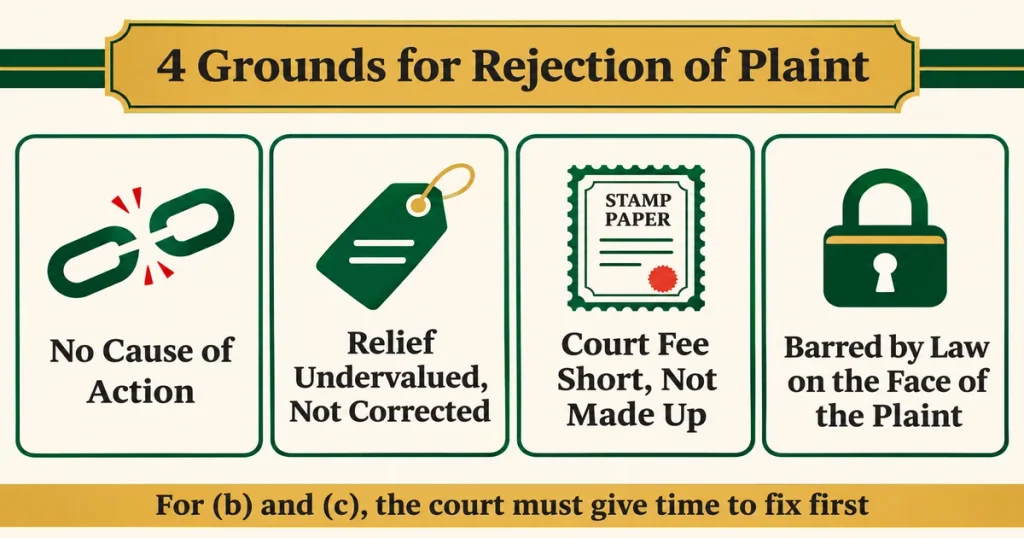
Every rejection of plaint in Pakistan must fit one of the four grounds in Order VII Rule 11, and each ground has its own test. A court should name the exact clause it relies on instead of writing a vague line that the suit is “not maintainable”. The Supreme Court restated all four in paragraph 8 of the judgment.
| Clause | Ground | Chance to fix it first? |
|---|---|---|
| (a) | The plaint discloses no cause of action | Sometimes, through a lawful amendment |
| (b) | The relief is undervalued and not corrected within the time fixed by the court | Yes, the court must give time |
| (c) | The court fee or stamp paper is short and not supplied within the time fixed | Yes, the court must give time |
| (d) | The suit appears, from the plaint itself, to be barred by any law | Usually no |
Ground 1: The Plaint Discloses No Cause of Action
A cause of action is the bundle of facts that gives you a legal right to ask the court for relief. A plaint should show a legal right, an act or threat that harmed it, the defendant’s link to that harm, and that your right to sue still existed on the day you filed.
That last point matters. The Supreme Court held that a plaintiff must show not only that a right was infringed, but also that the right to seek relief was still “subsisting” when the suit was filed (para 10).
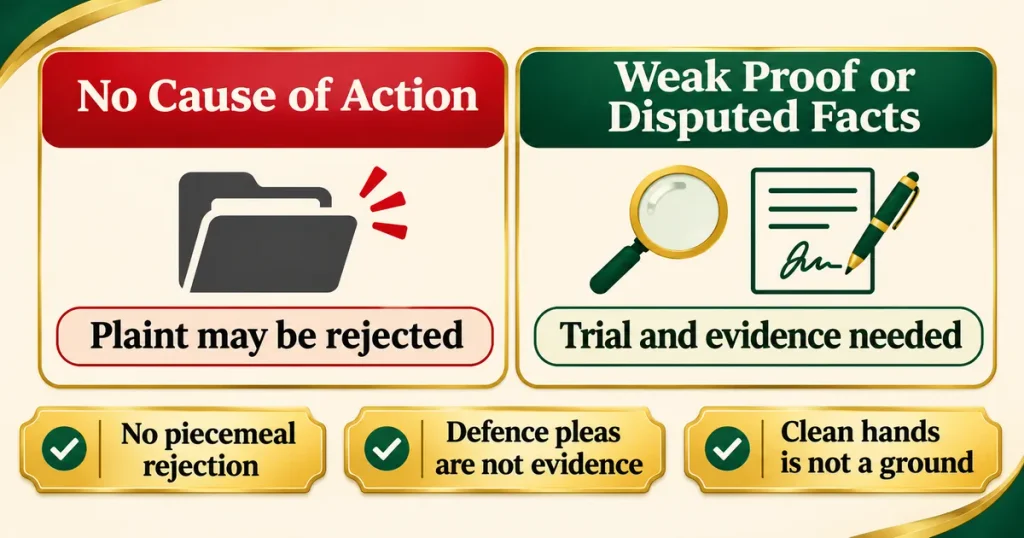
The test is simple. Assume the facts in the plaint are true. Can the law give any relief on them? If yes, the plaint survives, even if the defendant holds stronger papers. In the court’s words, “a dearth or weakness of proof” does not mean no cause of action is disclosed (para 10).
For example, a plaintiff says he owns land, names the disputed mutation (intiqal), says when he learned of it and asks for declaration and cancellation. That plaint discloses a cause of action. Whether he can prove fraud is a question for the trial.
Ground 2: Relief Undervalued and Not Corrected
Every suit must be valued for jurisdiction and, where needed, for court fee. If the court finds the relief undervalued, it cannot reject the plaint straight away. It must first direct the plaintiff to correct the valuation within a fixed time. Rejection under clause (b) follows only if the plaintiff fails to comply.
A fair order states the correct value, or at least the basis for it. A plaintiff should not lose a claim because an order left him guessing.
Ground 3: Court Fee Short and Not Made Up
Court fee and valuation are linked but different. Where the value is right but the stamp paper or court fee is short, clause (c) applies. Here too, the court must first direct the plaintiff to make up the shortfall within a fixed time. Sections 148 and 149 CPC allow the court to enlarge time and accept the missing fee.
Ignoring a clear direction to pay is risky. A plaintiff who keeps delaying without good reason can lose the suit on this ground alone, even if the claim itself was strong.
Ground 4: Suit Barred by Law on Its Face
Under clause (d), the plaint is rejected if the suit appears “from the statement in the plaint” to be barred by any law. The bar must be visible from the plaint read as a whole, not from the defendant’s version.
Common legal bars include:
- Limitation, where the plaint’s own dates show the suit is late
- Res judicata, where the same matter was finally decided earlier
- A special law that sends the dispute to another exclusive forum
- Order II Rule 2 CPC, where a claim was left out of an earlier suit
- Withdrawal of an earlier suit without permission to file again
Limitation is not decided against you just because the defendant alleges delay. If your plaint pleads a later date of knowledge, hidden fraud or an acknowledgement, and those facts are disputed, the court will usually need evidence. Our limitation judgments section shows how courts handle old property claims.
The Father-Son Bungalow Case: What Happened
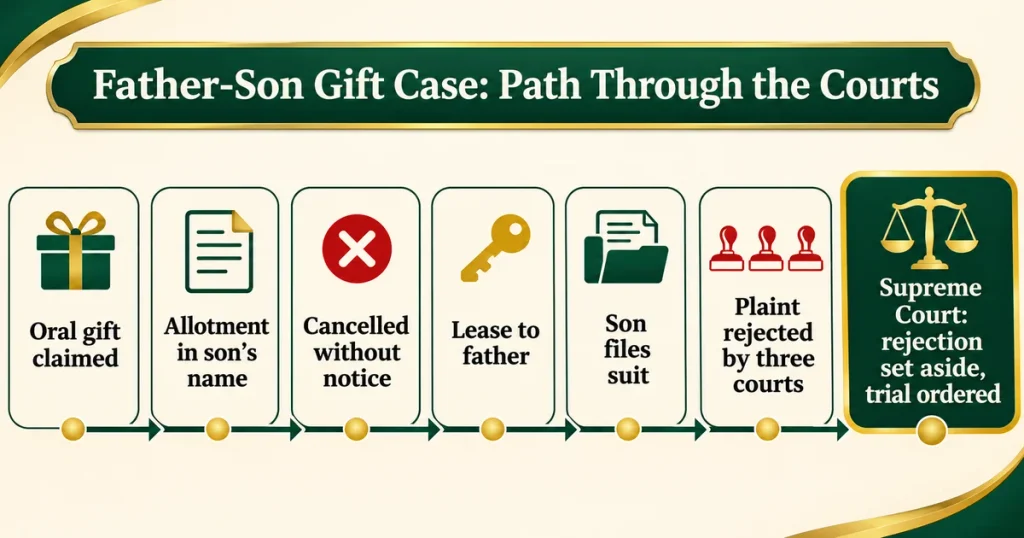
The son filed a civil suit (F.C. Suit No. 327 of 2023) before the IVth Senior Civil Judge, Hyderabad, against his real father and official respondents. He said his father had gifted him a bungalow in Latifabad, Hyderabad through a declaration of oral gift (hiba) dated 8 October 2007.
What the Son Asked the Court For
- A declaration that he owned the property, based on an allotment order dated 20 November 2007
- Cancellation of a lease deed dated 6 February 2023 made in his father’s favour
- A direction to the official respondents to register the lease in his name
- A permanent injunction against any transfer, third-party interest or dispossession
Why the Father Wanted the Plaint Rejected
After receiving summons, the father applied under Order VII Rule 11. He argued that the court lacked jurisdiction, the suit was barred under Sections 42 and 54 of the Specific Relief Act, the son had no locus standi, the suit was undervalued and the plaint was insufficiently stamped. He added that the son held no registered document, the suit suffered from misjoinder and non-joinder, and the son came with unclean hands (para 3).
How Three Courts Shut the Door
On 28 February 2023, the Senior Civil Judge rejected the plaint. The son’s appeal was dismissed by the VIIIth Additional District Judge, Hyderabad on 15 May 2023. His second appeal was dismissed by the Sindh High Court on 22 January 2024. He then sought leave to appeal in the Supreme Court.
Arguments Before the Supreme Court
| Party | Main argument |
|---|---|
| Son (petitioner) | Only the plaint should have been examined. It raised triable issues: the property was gifted, allotted to him, then cancelled without notice and leased to his father. None of this could be settled without evidence. |
| Father (respondent No. 4) | The son’s pleas were mutually destructive, a gift in the plaint but papers suggesting a purchase. The father’s signatures were forged to grab his property and deprive the son’s sisters of their shares. The transfer was cancelled on 9 January 2023, and the property is now leased in the father’s name. |
| Additional Advocate General (official respondents) | Whether the gift was genuine or forged could not be decided summarily. It needed evidence from both sides. |
What the Record Showed
The Supreme Court noted that numerous documents were already on record. On the basis of the same unregistered gift, the property was transferred to the son on 20 November 2007. That transfer was cancelled by a letter dated 9 January 2023 from the Director of Land, Hyderabad Municipal Corporation, without prior notice (para 12).
The cancellation followed the father’s own application, in which he alleged that his son had secured the allotment through fabrication. The son, for his part, had set out the facts forming his cause of action in paragraphs 8, 9 and 19 of the plaint. No witness had been examined, which is exactly why the dispute needed a trial.
Why the Supreme Court Said Rejection Was Premature
The trial court rejected the plaint on one idea: the son relied on an unregistered gift deed while the father held a registered lease, so the son had no standing. The Supreme Court “completely” disagreed, at least for the purpose of rejecting the plaint (para 12). It accepted that the father may have a strong case if fraud is proved, but held that such a dispute cannot be decided without issues and evidence.
On the Section 42 objection, the court explained that “legal character” means legal status, and that “right” in Section 42 is read in a wide sense, not limited to strict ownership (para 9). So a declaration suit was not barred on its face.
No Piecemeal Rejection
The law does not allow a plaint to be rejected in parts. If even one prayer is maintainable, the plaint cannot be cut down prayer by prayer under Rule 11 (para 10).
Defence Pleas Are Not Evidence
At this stage, the court cannot act on pleas raised by the defendant, because they are only contentions without evidence. Material outside the plaint may be used only if it is on record and admitted by the plaintiff. Mixed questions of law and fact should move to written statement, discovery, preliminary issues or a regular trial (para 10).
Clean Hands Is Not a Rule 11 Ground
Whether the son came with clean or unclean hands was “irrelevant” for rejecting the plaint once triable issues were visible. Summary rejection, the court said, would unjustly leave the parties without a remedy (para 12).
Parties Are Bound by Their Pleadings
The father said the son’s story kept changing. The court answered that the whole suit was built on a gift, not a purchase. A party cannot prove a case beyond its pleadings, and evidence outside them can be ignored (para 13). So the son must stand or fall on the gift he pleaded.
Concurrent Findings Cannot Hide Errors
Three courts had agreed, and the father relied on that. The Supreme Court held that concurrent findings are not sacred when they break the law or carry an obvious defect. Neither appellate court had dealt with the plaint’s averments or the core dispute between father and son (para 14).
Final Order: Six Directions to the Trial Court
The petition was converted into an appeal and allowed. The court recorded that, just as it was about to remand the case, counsel for both sides agreed on terms for its disposal (para 15). The directions in paragraph 16 were:
- The trial court order, the first appellate judgment and the Sindh High Court judgment in Second Appeal No. 39 of 2023 were all set aside.
- The father must file a written statement within three weeks, with an advance copy to the son.
- The trial court must then frame a preliminary issue: did the father execute the gift deed of his own free will, or is it forged, manipulated or fabricated?
- Evidence will be recorded on that issue, and either party may apply to send the gift deed to a handwriting expert or for forensic testing.
- After hearing both parties and any summoned officials or witnesses, the trial court must decide the suit on merits within four months.
- No unnecessary adjournments, and a compliance report must be submitted.
What the Court Did and Did Not Decide
| Decided | Not decided |
|---|---|
| Rejecting the plaint at the threshold was wrong | Whether the son owns the bungalow |
| The gift dispute needs issues and evidence | Whether the gift deed is genuine or forged |
| Concurrent findings did not save a flawed order | Whether the father’s lease should be cancelled |
| The trial must be finished within four months | Who finally wins the suit |
In short, survival of the plaint is not a victory on merits. It only means the son gets his day in court, and the father gets the chance to prove forgery. You can explore similar family property fights in our gift and hiba disputes section.
The Court’s 8-Step Test Before Rejecting a Plaint
Read together, paragraphs 8 to 11 of the judgment give courts a clear sequence before any rejection of plaint in Pakistan:
- Read the plaint as a whole and meaningfully, not in a “slipshod or perfunctory” way.
- Identify the exact clause of Rule 11 the objection relies on.
- Treat the facts in the plaint as true for this limited check.
- Ignore disputed pleas in the defendant’s application or written statement.
- Look at outside material only if it is on record and admitted by the plaintiff.
- Ask whether the defect is clear and fatal, or a mixed question that needs evidence.
- Give time to fix valuation or court fee, and hear the plaintiff before rejecting.
- Record a reasoned order under Rule 12.
This was not a one-off view. In an earlier Hyderabad case, Civil Petition No. 49-K of 2022, the Supreme Court also said a plaint cannot be rejected piecemeal.
When Can a Plaint Be Rejected?
The rule fixes no stage. The Supreme Court held that its application is independent and does not need to wait for the written statement (para 11). The court may even reject a plaint on its own, but only after giving the plaintiff a hearing, and it must record its reasons under Rule 12.
A rejection application must state clearly how and why the plaint fails. Sweeping or trivial objections filed only to delay the case waste the court’s time (para 11).
Some provinces and the Islamabad Capital Territory have amended the CPC to set strict timelines. In some forums, a pending rejection application does not excuse a defendant from filing the written statement on time. Check the rules of your own court before treating an application as a pause button.
Rejection vs Return vs Dismissal of Suit
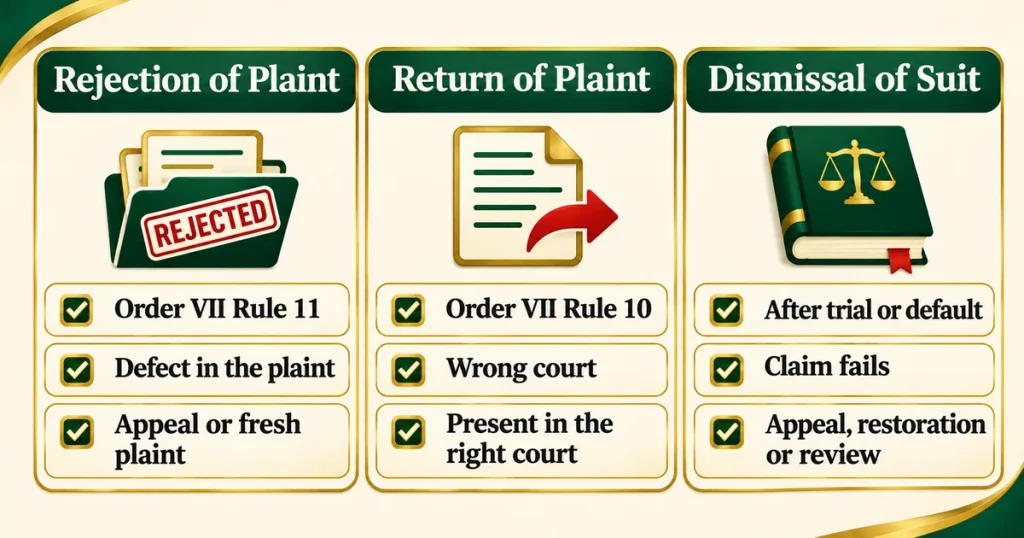
| Point | Rejection of plaint | Return of plaint | Dismissal of suit |
|---|---|---|---|
| Provision | Order VII Rule 11 CPC | Order VII Rule 10 CPC | After trial, or under other rules such as default |
| Reason | No cause of action, unfixed valuation or court fee, or a clear legal bar | Filed in a court that lacks jurisdiction | The claim fails on merits or on a procedural ground |
| Effect | Treated as a decree under Section 2(2) CPC | The plaint goes to the proper court | The suit ends by judgment or order |
| Next step | Appeal, and sometimes a fresh plaint | Present it in the competent court | Appeal, restoration or review, depending on the order |
A plaint filed in the wrong court should normally be returned, not rejected. The difference matters, because each route leads to a different remedy.
Remedies After Rejection of Plaint in Pakistan
Appeal Against the Rejection Order
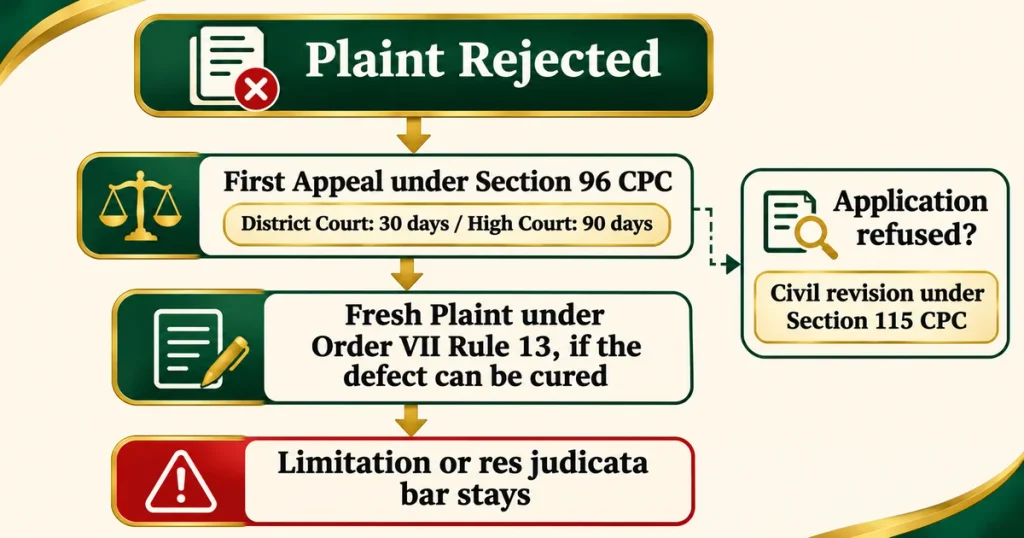
Because Section 2(2) CPC treats rejection as a decree, the plaintiff can file a regular first appeal under Section 96 CPC. Under the Limitation Act, 1908, an appeal to the District Court is generally due within 30 days and an appeal to the High Court within 90 days. Count from the date of the order and apply for certified copies at once.
Challenging a Refusal to Reject
An order refusing to reject a plaint is not a decree. Depending on the forum, a civil revision under Section 115 CPC may be filed where its conditions are met. Constitutional petitions are exceptional and are no substitute for an available remedy.
Filing a Fresh Plaint Under Rule 13
Rule 13 says rejection does not, by itself, stop the plaintiff from filing a fresh plaint on the same cause of action. A fresh plaint can cure a fee, valuation or drafting defect. But a suit barred by limitation or res judicata does not come alive just because it is filed again.
What This Judgment Means for Ordinary Litigants
If you are a plaintiff, a stronger document on the other side does not end your case at the start. If your plaint pleads facts that would give you relief if proved, you deserve a trial.
If you are a defendant, a rejection application must point to a clear legal defect in the plaint, not to your own version of events. Fraud and forgery claims usually mean a trial, not a shortcut.
Family property disputes over gifts, inheritance or mutation often turn on facts, so expect evidence. Our guide on the civil suit for declaration explains how such claims are framed, and our article on inheritance mutation covers a common source of these disputes.
Plaintiff’s Checklist: Draft a Plaint That Survives
- State the legal right, how it was denied, and when and where the cause of action arose
- Show why your right to sue still existed on the filing date
- Answer limitation with exact dates of knowledge, denial or concealment
- Plead fraud with particulars: who did what, when and how
- Claim every necessary relief, such as cancellation, possession or injunction
- Value the suit and pay court fee under your province’s rules
- Keep one consistent story and check that your annexures support it
- Preserve originals and certified copies of deeds, allotments, mutations, notices and letters
Defendant’s Checklist: File a Rejection Plea That Works
- Name the exact clause of Order VII Rule 11
- Show the defect from the plaint itself or from documents the plaintiff admits
- Do not build the plea on disputed facts or forgery claims
- Ask whether the real issue is jurisdiction, which calls for return instead
- Do not ask the court to reject only some prayers
- Keep it short and file early, without missing your written statement deadline
Common Mistakes That Sink a Plaint
- Writing conclusions like “the mutation is illegal” instead of material facts
- Leaving out dates, which invites a limitation objection
- Claiming a bare declaration when consequential relief was also needed
- Attaching documents that contradict the pleaded story
- Ignoring a court order to correct valuation or pay the missing fee
FAQs About Rejection of Plaint in Pakistan
What is rejection of plaint in Pakistan?
Rejection of plaint in Pakistan means a civil court refuses to proceed with a plaint because it falls under Order VII Rule 11 CPC. The plaint may disclose no cause of action, carry an uncorrected valuation or court fee defect, or show on its face that the suit is barred by law. The suit then ends at the start, before evidence.
What are the four grounds under Order VII Rule 11 CPC?
The four grounds are: no cause of action is disclosed; the relief is undervalued and the plaintiff fails to correct it within the time fixed; the court fee is short and is not made up within the time fixed; and the suit appears from the plaint itself to be barred by any law, such as limitation or res judicata.
Can a plaint be rejected if the other side has stronger papers?
No. In PLD 2025 SC 302, the father held a registered lease and the son relied on an unregistered gift, yet the Supreme Court refused to let the plaint die. A weakness of proof does not mean no cause of action exists. Who holds the better document is decided after evidence.
Can a court reject only one prayer in a plaint?
No. The Supreme Court held that the law does not permit piecemeal rejection. If even one prayer in the plaint is maintainable, the plaint cannot be rejected in parts under Rule 11. A weak prayer can still be refused later, after issues are framed and evidence is recorded.
Can a court reject a plaint on its own, without an application?
Yes. The court may act on its own if the plaint is genuinely hit by Rule 11, and it does not have to wait for a written statement. But the plaintiff must be heard first, and the judge must record reasons for the rejection under Order VII Rule 12 CPC.
Can limitation lead to rejection of a plaint?
Yes, if the delay is clear from the plaint itself, it counts as a bar under clause (d). But if the plaint pleads a later date of knowledge, hidden fraud or an acknowledgement, and those facts are disputed, the court should usually frame an issue and record evidence instead of rejecting the plaint.
How do I appeal against an order rejecting my plaint?
Rejection is treated as a decree under Section 2(2) CPC, so a regular first appeal lies under Section 96 CPC. An appeal to the District Court is generally due within 30 days and one to the High Court within 90 days. Get certified copies quickly and speak to your lawyer about the correct forum.
Can I file a fresh suit after my plaint is rejected?
Often, yes. Order VII Rule 13 CPC says rejection does not, by itself, bar a fresh plaint on the same cause of action. You must cure the defect first, such as a fee, valuation or drafting gap. A suit barred by limitation or res judicata stays barred, even if filed again.
Conclusion
Rejection of plaint in Pakistan is a strong tool. It lets courts bury suits that are legally dead from day one, and it saves years of wasted litigation. But PLD 2025 SC 302 shows the other side of the coin. When a case turns on forgery, fraud, ownership or competing documents, closing the door early can leave a family without any remedy at all.
The lesson is simple. Plaintiffs should plead clear facts, exact dates and complete relief. Defendants should target a real legal defect, not argue their whole defence at the threshold. And courts should read the plaint meaningfully, hear the plaintiff and give reasons. For more rulings like this, browse our Supreme Court judgments section.
Disclaimer
This article is for legal awareness only and is not legal advice. Every case depends on its own facts, documents and evidence, and local amendments to the CPC can change the procedure. For your specific matter, consult a qualified lawyer.