

A paper dated 1969 can look powerful. But when it is used decades later to say that a daughter has no share in her father’s property, the court asks a harder question: was the transaction ever legally proved?
That is the central lesson of Tamleek Law in Pakistan from the Peshawar High Court judgment reported as 2026 CLC 176. The case involved an old tamleek allegedly made by a father in favour of his three sons. His daughter claimed her Shari share. The High Court examined the original document, thumb impressions, witnesses, burden of proof, possession, limitation and an earlier settlement proceeding before restoring the Trial Court decree.
Table of Contents
Judgment at a Glance of 2026 CLC 176
| Point | Details |
|---|---|
| Citation | 2026 CLC 176 |
| Court | Peshawar High Court, Mingora Bench |
| Judge | Sabit Ullah Khan, J. |
| Case | Mst. Bibi Fathul Bari v. Ubaid ur Rahman and others |
| Revision | C.R. No. 311-M of 2021 |
| Decision Date | 26 June 2025 |
| Disputed Document | Tamleek dated 20 May 1969 |
| Main Claim | Father had gifted his properties to three sons |
| Trial Court | Suit decreed on 19 December 2018 |
| First Appeal | Decree reversed on 17 March 2021 |
| High Court | Appellate judgment set aside; Trial Court decree restored |
The dispute concerned property in Kabal Chindakhwara, Tehsil Kabal, District Swat, along with three residential houses. The petitioner said she was entitled to her Shari share in the estate of her late father, Abdul Mateen.
IRAC: Why the 1969 Tamleek Failed
| IRAC | Summary |
|---|---|
| Issue | Could the respondents rely on the 1969 tamleek to exclude the petitioner from her father’s estate? |
| Rule | A beneficiary relying on a disputed gift must prove the transaction and the evidence supporting it. |
| Analysis | The original tamleek was not produced, its three thumb impressions were not identified, the main explanation was hearsay, and reliable proof of offer, acceptance and delivery of possession was missing. |
| Conclusion | The respondents failed to prove the alleged tamleek. The High Court restored the Trial Court decree. |
The case is a useful guide to Tamleek Law in Pakistan because the Court tested the whole evidentiary chain instead of treating an old paper as automatic title.
Tamleek Law in Pakistan: What Does Tamleek Mean?
“Tamleek” broadly means making another person owner of property or a right. In 2026 CLC 176, the disputed tamleek was defended as a lifetime gift by the father to his sons.
There is no single federal statute titled “Tamleek Law in Pakistan.” The legal result depends on the real nature of the transaction, applicable personal law, property law and evidence.
For Muslims, section 2 of the West Pakistan Muslim Personal Law (Shariat) Application Act, 1962 makes Muslim Personal Law the rule of decision in matters including succession and gifts, subject to other applicable enactments. (Pakistan Code) Official text: Muslim Personal Law Act, 1962 on Pakistan Code
The Transfer of Property Act, 1882 defines a gift as a voluntary transfer of existing movable or immovable property without consideration, accepted by or on behalf of the donee. Section 129 expressly preserves rules of Muslim law. (Pakistan Code) Official text: Transfer of Property Act, 1882
So a court does not stop at the word “tamleek.” It asks what was actually transferred, whether the donor made the gift, whether the donee accepted it, whether possession was delivered where required, and whether those facts have been legally proved.
How the 1969 Tamleek Became an Inheritance Dispute
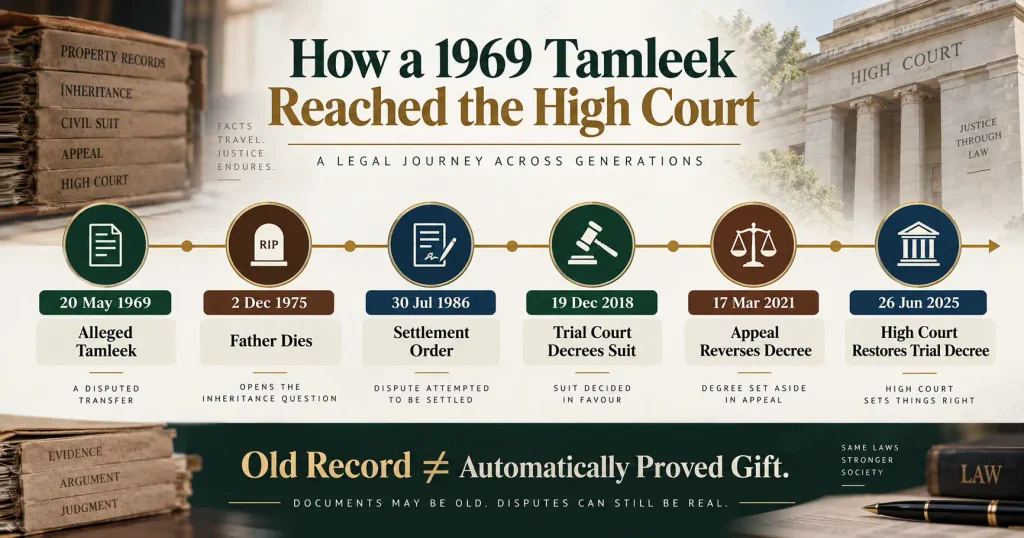
Mst. Bibi Fathul Bari said the properties belonged to her late father and that she was entitled to her lawful share. The relationship was admitted: Abdul Mateen left three sons and three daughters.
The respondents did not deny the father’s ownership. Instead, they said he had disposed of his properties during his lifetime by gifting them to his three sons through a tamleek dated 20 May 1969. They also referred to a local custom under which female heirs allegedly did not receive land.
A genuine lifetime gift can affect what remains in an estate at death. But if the alleged gift is not proved, it cannot simply be used to defeat an heir.
The Trial Court decreed the suit in 2018. The Additional District Judge reversed that result in 2021. The daughter then approached the High Court in revision.
Why the Original Tamleek Mattered
One major weakness was straightforward: the original tamleek dated 20 May 1969 was not produced before the Trial Court.
The High Court also noted that the pleadings did not say the original was missing and did not provide another valid explanation for its non-production. Together with the other evidentiary gaps, this made the alleged tamleek suspicious and unreliable.
This does not mean every case automatically fails when an original document is unavailable. The Qanun-e-Shahadat recognizes circumstances in which secondary evidence may be given.
But under Tamleek Law in Pakistan, a party relying on secondary evidence should first establish its legal foundation. Preserve the original wherever possible; if it is genuinely unavailable, explain and prove why the substitute evidence is admissible.
Why Three Thumb Impressions Raised Doubt
The disputed tamleek contained three thumb impressions, but the document did not identify whose impressions they were.
The respondents’ sole witness was also their special attorney. He tried to connect those impressions with named persons, but the High Court noted that his knowledge was hearsay because the alleged document had been written before his birth. No independent witness supported that explanation.
The Court did not rule that every unidentified thumb impression automatically proves forgery.
The narrower point is more useful: under Tamleek Law in Pakistan, where execution is disputed, signatures or thumb impressions should be connected to the alleged transaction through reliable and legally admissible evidence.
Who Had to Prove the Tamleek?
The appellate court had shifted the burden towards the petitioner because fraud and forgery were alleged. The High Court disagreed with that approach on the pleadings and facts before it.
Article 117 of the Qanun-e-Shahadat Order, 1984 says that a person who asks a court to decide a legal right or liability on the basis of asserted facts must prove those facts. (Pakistan Code)
Here, the respondents relied on the 1969 tamleek to say that the father had already transferred the property to his sons. The High Court held that the beneficiaries relying upon the document had to prove it and found that they had failed to discharge that burden.
This is a central principle of Tamleek Law in Pakistan: the beneficiary of a disputed gift cannot simply produce a paper and require the opposing heir to disprove the entire transaction.
Official evidence law: Qanun-e-Shahadat Order, 1984
Why Article 79 Became Important
Article 79 of the Qanun-e-Shahadat Order governs proof of documents that the law requires to be attested. Where the Article applies, at least two attesting witnesses generally have to be called if they are alive, subject to the court’s process and capable of giving evidence. It also contains a proviso concerning certain registered non-will documents. (Pakistan Code)
The High Court relied on Rahmat Noor v. Zulqarnain, 2023 SCMR 1645 while discussing failure to prove the gift and emphasized that proof of a revenue entry could not substitute for proof of the original transaction.
A sound Tamleek Law in Pakistan analysis therefore starts by asking: what kind of document is this, was attestation legally required, was execution specifically denied, and which evidence rule applies?
Article 79 should not be applied mechanically without answering those questions.
Does a 30-Year-Old Document Prove Itself?
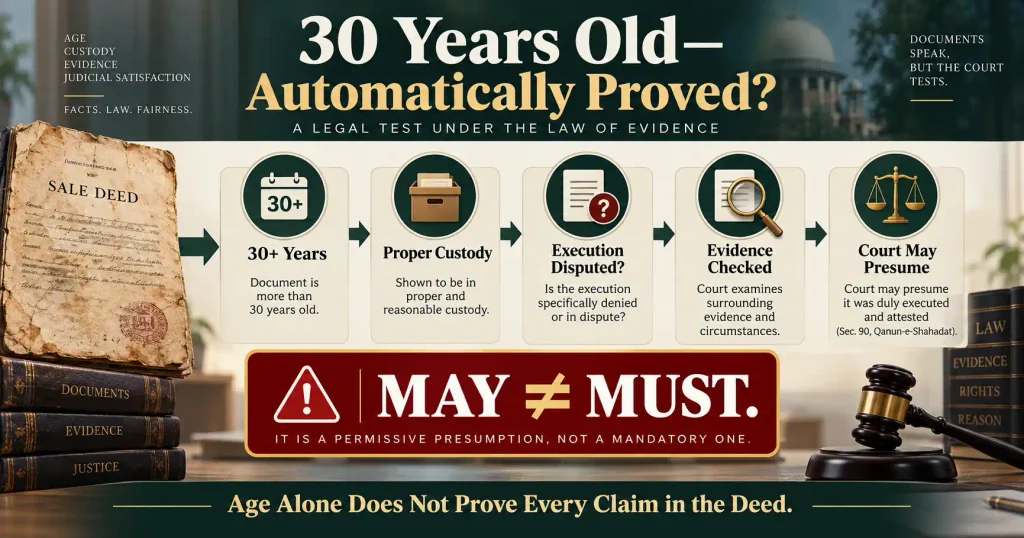
No. Age can matter, but age does not turn every old deed into unquestionable proof.
Article 100 of the Qanun-e-Shahadat Order provides that where a document purports or is proved to be thirty years old and comes from custody considered proper, the court may presume specified matters concerning handwriting, execution and attestation. (Pakistan Code)
The word “may” matters.
In 2026 CLC 176, the High Court rejected the idea that age alone could cure the proof problems surrounding the disputed tamleek.
Under Tamleek Law in Pakistan, a thirty-year-old document can be evidentially important, but it does not automatically prove every disputed fact contained in it.
Three Ingredients of a Valid Gift
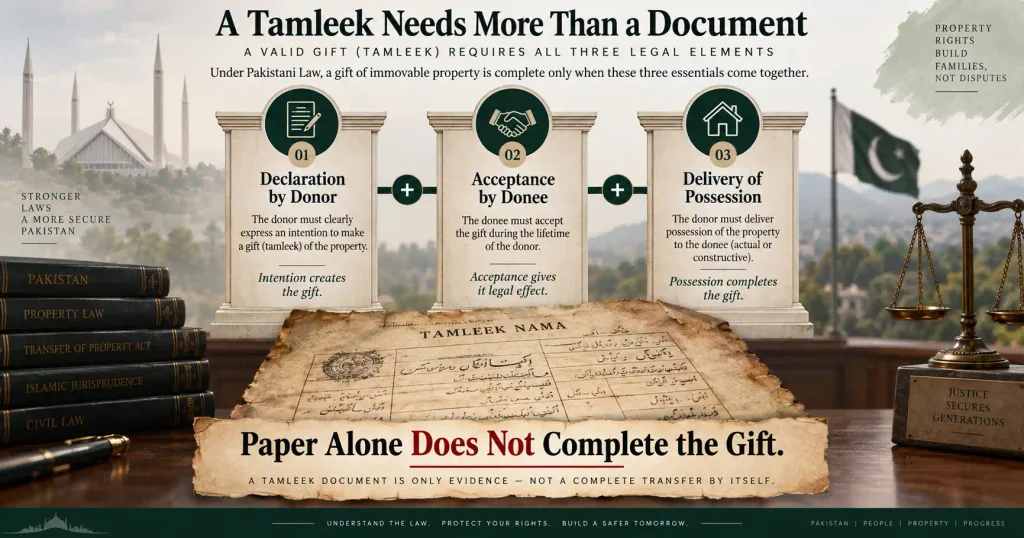
The High Court found that the respondents had not proved three essential ingredients of the alleged gift:
- Declaration or offer by the donor
- Acceptance by the donee
- Delivery of possession
The failure to establish these ingredients through cogent and reliable evidence was fatal to the claimed transaction.
A gift is therefore a legal transaction, not merely a document carrying the word “tamleek.”
For Tamleek Law in Pakistan, two questions should always be separated: Was there a legally complete gift? And has that gift been legally proved?
A party may fail at either stage.
For related reading, see Qanooni Dastak’s and .
Why Mutation Could Not Replace the Gift
A mutation can support a transaction, but it cannot substitute for the original gift.
The High Court relied on Supreme Court reasoning that proving an entry in the revenue record could not replace evidence proving the essential ingredients of the original transaction.
That distinction is central to Tamleek Law in Pakistan.
A mutation may corroborate a genuine gift. It cannot create an offer, acceptance or delivery of possession that never occurred or was never proved.
Anyone relying upon a gift mutation should therefore preserve the underlying gift evidence, mutation proceedings, witnesses and possession record instead of treating the mutation number as the whole title case.
Can a Custom Exclude a Daughter?
The respondents also relied on an alleged local custom under which female heirs did not receive land.
The High Court rejected reliance on such a custom against Muslim inheritance rights. It discussed authorities holding that Muslim Personal Law governs succession despite customs excluding female heirs.
The Court also referred to Supreme Court authorities calling for extra vigilance where purported gifts or other instruments are used to deprive daughters and widows of what would otherwise constitute their inheritance.
This does not mean a father can never make a genuine lifetime gift to his sons.
The legally accurate point is that Tamleek Law in Pakistan requires that lifetime transfer to be independently valid and proved. An unproved document or contrary custom cannot erase a lawful inheritance claim.
For the broader inheritance position, see .
Why the 1986 Order Was Not Res Judicata
The respondents argued that the petitioner’s husband had earlier approached the Tehsildar (Settlement) and that an order dated 30 July 1986 had not been challenged.
The High Court examined those proceedings and found that the dispute had not been conclusively adjudicated on proper evidence and merits. The essential requirements of res judicata were therefore absent.
For Tamleek Law in Pakistan, an old revenue or administrative order should be examined for what it actually decided.
Its age alone does not make it a final judicial determination of disputed civil title.
Why Limitation Did Not Defeat This Suit
This part of the judgment must be stated carefully. It should not be converted into a broad statement that inheritance litigation never faces limitation.
The respondents raised limitation, but the High Court found no evidence showing that the petitioner had waived her right, acquiesced in the alleged tamleek or accepted the gift as valid. They also failed to establish a specific earlier occasion from which her cause of action should run, while she maintained that her right had recently been denied.
The High Court discussed authorities concerning female inheritance, fraud and co-sharer rights and held the suit to be within time on the facts before it.
Section 18 of the Limitation Act, 1908 may affect computation where fraud keeps a person from knowledge of a right or where a necessary document is fraudulently concealed. (Pakistan Code) Official text:
Tamleek Law in Pakistan does not justify unnecessary delay. Limitation may depend on the relief claimed, knowledge, conduct, alleged fraud, denial of rights and third-party interests.
For a focused explanation, see .
Which Court and Relief May Be Needed?
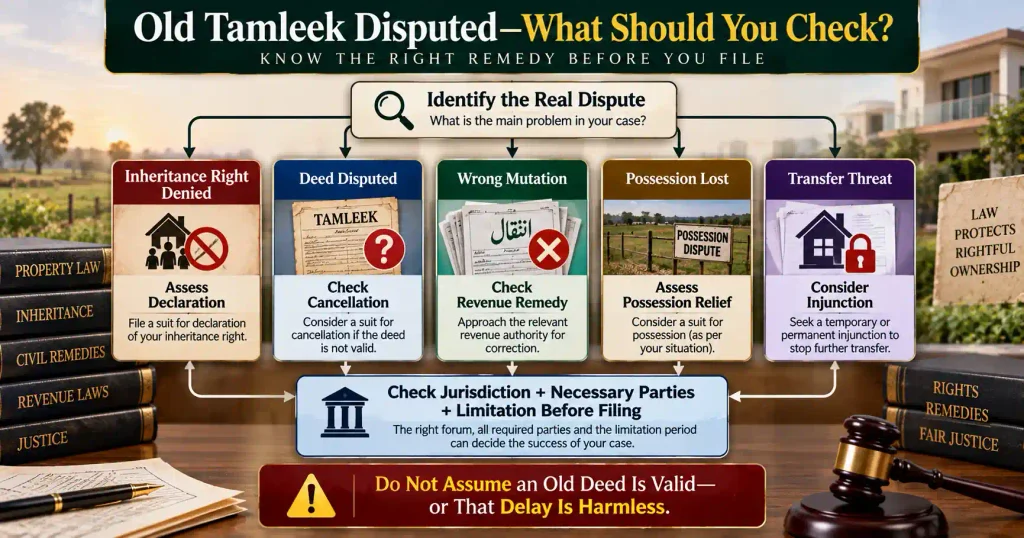
A disputed tamleek may require more than one remedy: declaration, cancellation or setting aside of an instrument where legally necessary, correction of entries, possession, permanent injunction or interim protection against further transfer.
Section 42 of the Specific Relief Act, 1877 permits a person claiming a legal character or right to property to seek declaration against someone denying or interested to deny that right. Its proviso is important: where further relief is available, a plaintiff should not omit it and seek declaration alone. (Pakistan Code) Official text:
Revenue authorities may address matters within their jurisdiction, but a serious civil title dispute may require the competent civil court. Territorial, pecuniary and subject-matter jurisdiction, necessary parties and the exact relief should be checked before filing.
In this case, the petitioner challenged entries, mutations and deeds affecting her share, sought declaration and perpetual injunction, and included persons claiming through later transactions.
Evidence to Preserve Before Filing
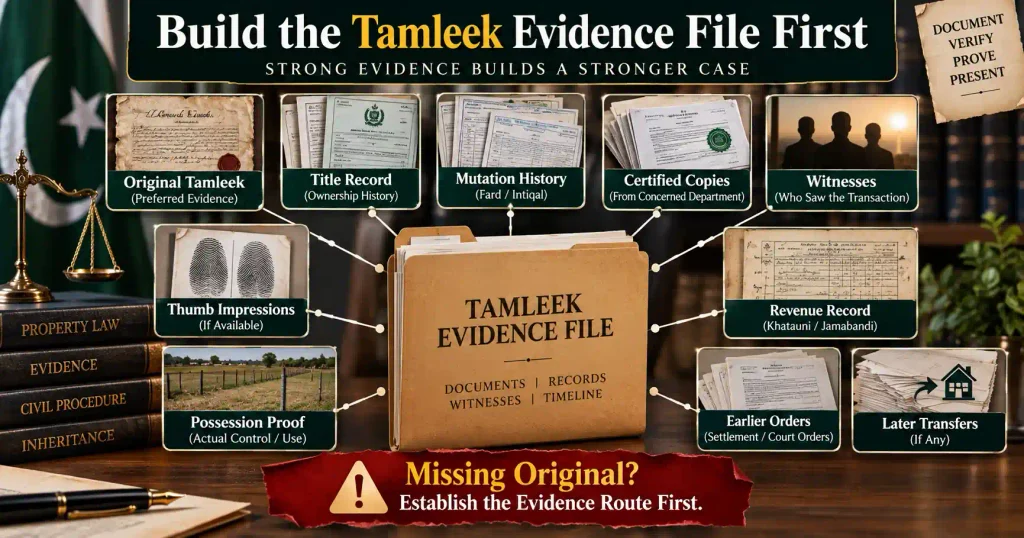
For Tamleek Law in Pakistan, build the evidence file before litigation becomes urgent.
Preserve the original tamleek if available, certified copies, title chain, complete mutation history, relevant revenue record, possession evidence, witnesses, thumb-impression or signature material, earlier proceedings, death and heirship documents and all later transfers.
Also record when the adverse claim first became known. If the original is missing, investigate where it was kept and what legal foundation exists for secondary evidence.
Certified and traceable records are generally more useful than cropped screenshots or isolated photocopies.
Seven Proof Rules From 2026 CLC 176
- The beneficiary of a disputed tamleek must prove the claim built on it.
- An old deed does not become conclusive merely because decades have passed.
- A missing original requires a legally acceptable evidentiary foundation.
- Unidentified thumb impressions can weaken proof of execution.
- Offer, acceptance and delivery of possession must be established.
- Mutation cannot substitute for proof of the original gift.
- A custom excluding female heirs cannot rescue an unproved transfer.
These are practical lessons from the judgment, not automatic answers to every future dispute. Tamleek Law in Pakistan remains fact-sensitive.
What the High Court Actually Decided
The High Court found that the tamleek dated 20 May 1969 had not been proved according to the requirements of the Qanun-e-Shahadat Order and that the respondents had failed to establish the essential ingredients of the alleged gift.
It also rejected the res judicata and limitation objections on the record before it.
Both connected revision petitions were allowed. The appellate judgment and decree dated 17 March 2021 were set aside, and the Trial Court judgment and decree dated 19 December 2018 were restored. No order as to costs was made.
What the Court Did Not Decide
The Court did not hold that every old tamleek is void.
It did not hold that every lifetime gift to sons is unlawful, that every thirty-year-old document is worthless, or that limitation can never apply to inheritance litigation. It also did not treat every disputed thumb impression as proof of forgery.
The narrower holding is important for Tamleek Law in Pakistan: this particular 1969 tamleek was not proved on this record, and the legal objections raised against the petitioner did not defeat her claim.
Practical Effect for Families and Heirs
If a genuine lifetime gift is intended, make the declaration clear, record acceptance, complete possession in the legally appropriate way, preserve original documents and witnesses, and complete the relevant registration, mutation or authority formalities where required.
If you are an heir facing an old tamleek, do not assume the paper is automatically valid or automatically void. Obtain certified records, trace the donor’s ownership and possession, identify witnesses, inspect the original, check later mutations and transfers, and assess limitation and the proper remedy before filing.
That evidence-first approach is the safest way to apply Tamleek Law in Pakistan.
Related Property and Inheritance Guides
If your dispute involves a tamleek, it may help to understand the wider rules that often appear with it. Read our Gift Deed in Pakistan guide to understand written hiba and proof requirements, and see Gift in Pakistan for the broader law on valid gifts and ownership transfer. Where a disputed document affects a daughter or another female heir, our Female Rights in Pakistan guide explains inheritance protections, while Limitation Act in Pakistan explains how delay, knowledge, fraud and denial can affect a claim. If relatives say the property was divided privately within the family, also check our Family Settlement in Pakistan guide before assuming that an old arrangement is legally binding.
Frequently Asked Questions about 2026 CLC 176
What is Tamleek Law in Pakistan?
Tamleek Law in Pakistan is a common expression for legal principles governing ownership transfers described as tamleek. There is no single federal Act with that exact title. Where the transaction is a Muslim gift, courts consider Muslim Personal Law, applicable property statutes, evidence law and the facts showing whether the gift was declared, accepted, delivered and legally proved.
Is tamleek the same as hiba?
Not in every context. “Tamleek” broadly refers to conferring ownership, while hiba specifically refers to a gift. In 2026 CLC 176, the disputed tamleek was defended as a lifetime gift, so declaration, acceptance and delivery of possession became central. The legal character of the transaction matters more than the label printed on the paper.
Can an old tamleek defeat a daughter’s inheritance?
A genuine lifetime gift can affect what remains in an estate, but the gift must be valid and proved. In 2026 CLC 176, the respondents failed to prove the 1969 tamleek, so it could not defeat the petitioner’s claim. The age of the document did not cure the evidentiary defects.
Who must prove a disputed tamleek?
The party relying on the transaction for a legal benefit generally has to prove the facts supporting that claim. Article 117 reflects this basic burden principle. Here, the respondents relied on the tamleek to say the father had already transferred the property, and the High Court held that they had not discharged the burden.
Does a 30-year-old tamleek prove itself?
No. Article 100 permits a court to draw a presumption in specified circumstances, including proper custody, but it uses the word “may.” The presumption is not automatic. Where genuineness is disputed, the court may still scrutinize execution, custody, attestation and surrounding evidence.
Is mutation enough to prove tamleek?
No. A mutation can support an already proved transaction, but it cannot replace proof of the original gift. The beneficiary may still need to prove declaration, acceptance, possession, execution and other legally required facts. Tamleek Law in Pakistan therefore treats mutation as supporting evidence rather than the entire title case.
Can a woman challenge tamleek after many years?
Possibly, but limitation depends on the facts, relief, knowledge, conduct, alleged fraud and third-party interests. In 2026 CLC 176, the respondents failed to establish waiver or an earlier starting point for limitation. A delayed claim should still be assessed promptly instead of assuming that limitation can never apply.
What should I collect before filing a case?
Collect the alleged tamleek, original title documents, certified mutations, inheritance record, death and heirship documents, possession evidence, witness details, thumb-impression or signature material, earlier proceedings and later transfers. Also record when the adverse claim became known and identify every person whose interest may be affected by the requested relief.
Conclusion: Old Paper Is Not Enough
A 56-year-old document may look impressive, but Tamleek Law in Pakistan asks the decisive question: can the transaction behind it be legally proved?
2026 CLC 176 shows why original documents, reliable witnesses, identification, burden of proof, offer, acceptance, possession, limitation and the effect of earlier proceedings all matter. An unproved lifetime gift cannot simply be used to erase a lawful inheritance claim.
Disclaimer
This article is for general legal awareness in Pakistan. Gift, inheritance, evidence, registration, revenue, limitation and civil procedure can vary with the facts, province, property and relief claimed. It is not a substitute for advice from a lawyer who has reviewed the original record and current applicable law.