

A registered gift deed can look powerful. A mutation in your name can look even stronger. But in a Property Ownership Dispute in Sindh, neither document should be read alone. The real questions are whether the transferor had title, whether the underlying transaction is proved, and whether older official records tell a different story.
That is what happened in Nadir Hassan v. Province of Sindh and others, reported as 2026 CLC 141. The Sindh High Court, Circuit Court Hyderabad, examined a 1999 gift and mutation against official records showing that large portions of the same survey numbers had formed part of Pinyari Canal since 1953. The revision was dismissed on 19 September 2025.
The complete decision can also be checked through the official Sindh High Court judgment database.
Table of Contents
Judgment at a Glance of 2026 CLC 141
| Point | Details |
|---|---|
| Reported citation | 2026 CLC 141 |
| Court | Sindh High Court, Circuit Court Hyderabad |
| Judge | Justice Tasneem Sultana |
| Case | Nadir Hassan v. Province of Sindh and others |
| Proceeding | Civil Revision Application No. 183 of 2013 |
| Decision date | 19 September 2025 |
| Property | Survey Nos. 355/A and 355/B, Deh Ghangra, Hyderabad |
| Claimed title | Registered gift deed dated 15 April 1999 |
| Mutation | Entry No. 94 dated 3 June 1999 |
| Official record | Disputed portions shown as Pinyari Canal since 1953 |
| Final result | Revision dismissed; lower-court findings maintained |
| Core lesson | Mutation alone does not prove ownership; donor title matters |
IRAC: Why the Ownership Claim Failed
| IRAC | Court’s Approach |
|---|---|
| Issue | Could the applicant prove ownership through a gift and mutation when older official records showed the disputed land as part of Pinyari Canal? |
| Rule | Mutation is mainly a fiscal entry and is not by itself a document of title. The claimant had to prove the donor’s title, the gift relied upon, and evidence strong enough to rebut the official record. |
| Analysis | The applicant produced mutation and a legal notice but not the alleged gift deed, its witnesses, prior proof of his mother’s title, demarcation, cadastral map, or technical survey evidence. Official witnesses produced the Field Book, Ghat Wadh Form and Deh Form. |
| Conclusion | The High Court found no illegality or material irregularity in the concurrent findings and dismissed the revision. |
The High Court specifically recorded that mutation alone could not establish ownership and that the applicant had failed to establish both the donor’s title and the alleged gift on which the mutation rested.
How This Property Ownership Dispute in Sindh Began
The suit concerned Survey No. 355/A measuring 0.05 acres and Survey No. 355/B measuring 0.19 acres in Deh Ghangra, Tapo Ghangra, Taluka City, District Hyderabad.
The applicant said his mother, Mst. Khadija, gifted the land to him through a registered gift deed dated 15 April 1999. Mutation Entry No. 94 dated 3 June 1999 was then recorded in his favour in Deh Form VII-B.
In February 2001, he sought certified copies from the Settlement Department. He learned that 0.04 acre from Survey No. 355/A and 0.15 acre from Survey No. 355/B had been recorded as part of Pinyari Canal since 1953. He said that record was wrong because the canal lay at a distance.
He served a legal notice on 22 February 2001 and then filed a suit for mandatory and permanent injunction.
The lesson for any Property Ownership Dispute in Sindh is immediate: a recent mutation may not be the beginning of the title story. Older settlement, survey and public-land records can become decisive.
The Case Had a Long Court History
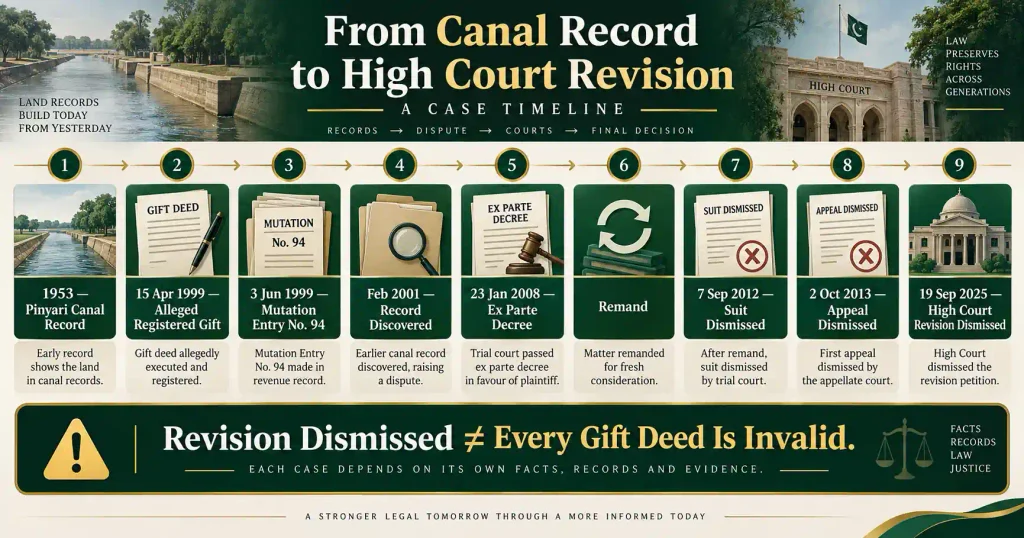
The suit was initially decreed ex parte on 23 January 2008. The government side appealed, the ex parte decree was set aside, and the matter was remanded so that the Irrigation Authorities and Mukhtiarkar could be impleaded as necessary parties.
After remand, the trial court dismissed the suit through judgment dated 7 September 2012 and decree dated 19 September 2012.
The appellate court maintained that result through judgment dated 2 October 2013 and decree dated 5 October 2013.
The applicant then invoked Section 115 CPC.
That was important because revision is not a second full appeal. The High Court had to examine jurisdictional error, illegality or material irregularity rather than re-try the whole factual record.
The Court expressly explained that concurrent findings supported by the record cannot ordinarily be disturbed in revision merely because another view of the evidence may also be possible.
What Each Side Said—and What Was Actually Proved
The applicant argued that the 1999 registered gift deed transferred ownership to him and that mutation supported the transfer.
He also said the older departmental record was wrong, the land was about 500 feet from the canal, and the authorities ignored his legal notice. He invoked Articles 23 and 24 of the Constitution.
Those were arguments, not automatically proved facts.
The government relied on official records showing the disputed portions as part of Pinyari Canal since 1953. Its witnesses produced the original Field Book, Ghat Wadh Form and Deh Form.
It also argued that the donor’s title was never established, the gift deed was not produced, possession was not proved, and no independent survey or demarcation displaced the official record.
A Property Ownership Dispute in Sindh should therefore be written and argued by separating allegation, evidence, admission and court finding.
The Evidence Gap That Damaged the Gift Claim
The High Court focused on the applicant’s own evidence and admissions.
He produced the mutation entry and legal notice. But in cross-examination he admitted that he had not produced the alleged gift deed.
He also accepted that the Settlement Department maintained the record and that the Field Book reflected major portions of the survey numbers under Pinyari Canal.
He further admitted that he had not approached the revenue authorities for correction before filing the proceedings.
Most importantly, neither the alleged gift deed nor its witnesses were produced, and no prior record showed what title his mother possessed when she allegedly made the gift in 1999.
In a Property Ownership Dispute in Sindh, a donee cannot safely rely only on the fact that his name later appeared in mutation. The donor’s title and the underlying transaction must also withstand proof.
Mutation Is Evidence, but It Is Not Title
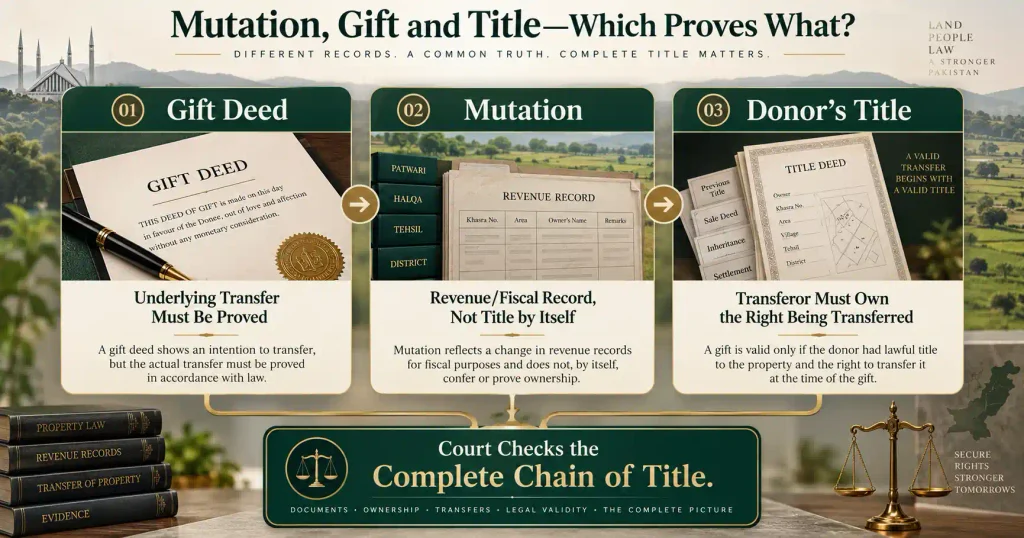
The clearest rule from this Property Ownership Dispute in Sindh is that mutation should not be treated as a title deed.
The High Court relied on Supreme Court authority including Muhammad Sarwar v. Mumtaz Bibi and others, 2020 SCMR 276, and Rehmat Noor v. Zulqarnain, 2023 SCMR 1645.
It reiterated that mutation entries are maintained for fiscal purposes and do not by themselves confer or extinguish proprietary rights.
Mutation is not useless.
It may form part of the evidentiary chain. But when the underlying transaction is disputed, the person relying on it may need affirmative proof of the sale, gift, inheritance or other transfer.
For a Property Ownership Dispute in Sindh, ask not only whose name is in mutation, but what lawful transaction put that name there and whether that transaction can be proved.
Current Section 52 Gives a Rebuttable Presumption
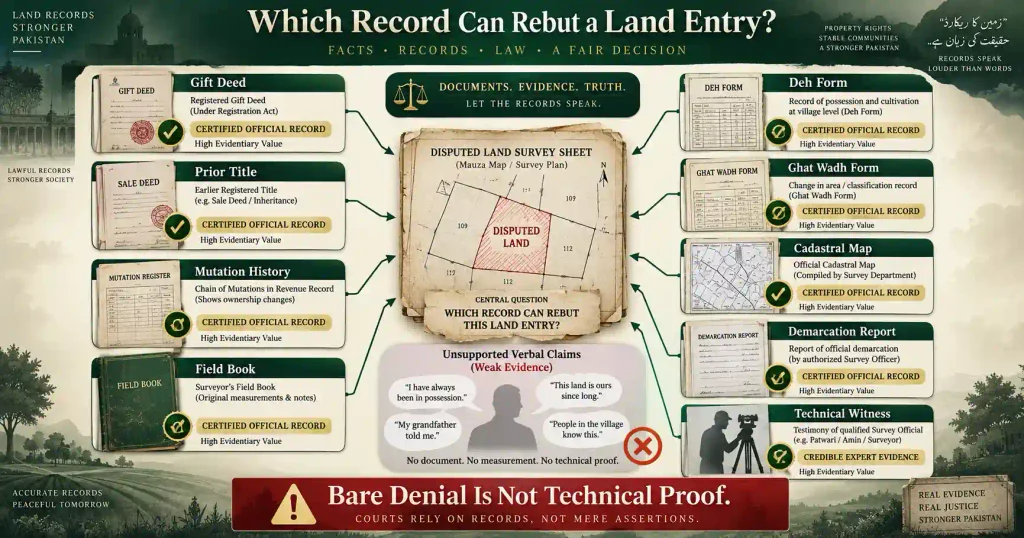
Official records are not automatically conclusive either.
As of 2026, Section 52 of the Sindh Land Revenue Act, 1967 provides that an entry in a record of rights made in accordance with law is presumed true until the contrary is proved or a new entry is lawfully substituted.
The substituted Section 52 was published in the Sindh Gazette in August 2022. (Sindh Laws) The exact amendment is available through the official Sindh Gazette notification.
In a Property Ownership Dispute in Sindh, that presumption is rebuttable. But bare denial is rarely enough.
In this case, the High Court had the original Field Book, Ghat Wadh Form and Deh Form before it, while the applicant produced no competing demarcation, cadastral map, survey record or technical witness capable of displacing those records.
The Court held that the official records had been prepared by public functionaries and had not been displaced by cogent, reliable and independent evidence.
That is why a Property Ownership Dispute in Sindh can turn on technical land evidence as much as private deeds.
The Donor’s Title Was the Missing Link
The High Court also applied a basic property principle: a person cannot transfer a better title than he or she possesses.
The applicant’s mother was said to have gifted the land in 1999. But the applicant did not establish what subsisting title she held over the disputed portions at that time.
The official record indicated that those portions had already been treated as canal land since 1953. Without proof of the donor’s title, the later mutation could not repair the missing link.
For a gift-based Property Ownership Dispute in Sindh, start the title check with the donor.
Ask:
- Where did the donor acquire the property?
- Did the donor own the complete area being gifted?
- Is the prior title document available?
- Does the deed match the historical survey record?
- Was the transferred area already shown for another public or private purpose?
- Is the physical location consistent with the documents?
The latest entry should never be examined without the earlier title chain.
Possession and the Correct Relief Also Matter
The trial court found that the plaintiff had not proved possession over the disputed area.
It also noted that he had not sought possession or compensation for the area said to have been used for the canal.
This is a pleading lesson.
If a person is out of possession, correction or injunction alone may not answer the real problem. If a deed is disputed, declaration or cancellation may need examination. If possession has been lost, possession relief may be necessary.
There is no single prayer for every Property Ownership Dispute in Sindh. The remedy should match the actual wrong.
For related guidance, read our Civil Suit for Declaration guide and Gift Deed Law in Pakistan guide.
Revenue Correction and Civil Title Are Different Questions
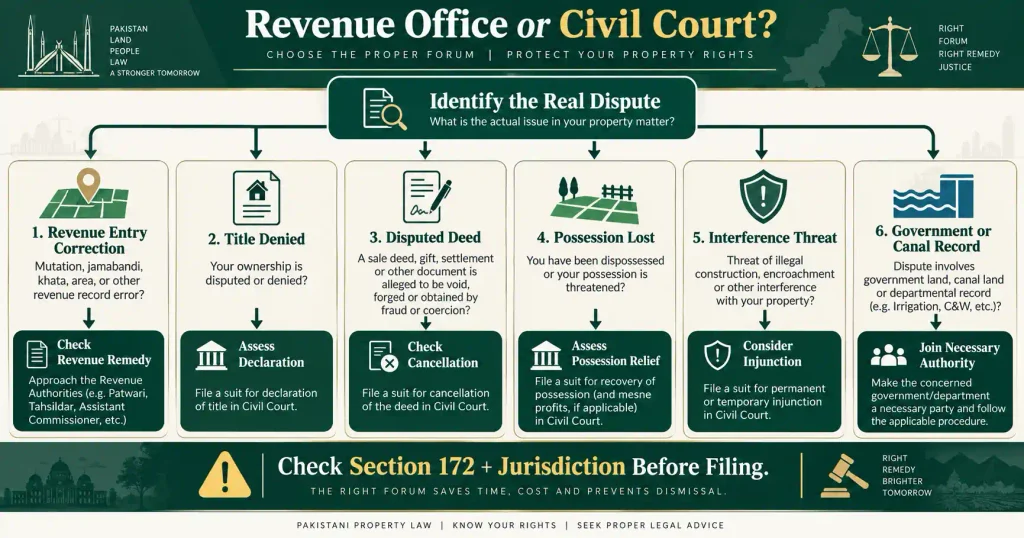
Short property guides often say “go to civil court” or “go to the revenue office” without first identifying the relief.
The respondents relied on Section 172 of the Sindh Land Revenue Act and Section 11 of the Sind Revenue Jurisdiction Act, 1876. They argued that correction of revenue record should be pursued through the competent revenue authorities.
The High Court also noted the applicant’s admission that he had not approached those authorities before litigation.
Section 172 deals with exclusion of civil-court jurisdiction in specified matters assigned to revenue authorities, including correction of certain revenue entries. The issue has also been discussed in official Sindh High Court case law. (Case Law)
The underlying Sind Revenue Jurisdiction Act, 1876 is available on the Government of Sindh’s law portal.
But 2026 CLC 141 should not be stretched into a rule that every Property Ownership Dispute in Sindh belongs only to revenue authorities.
Correction of an entry, disputed title, cancellation of a deed, possession and injunction can raise different jurisdictional questions.
A Property Ownership Dispute in Sindh should start by identifying the legal wrong first. Then match the forum and relief to it.
Which Forum and Evidence Should You Check First?
Use this practical sequence before filing a Property Ownership Dispute in Sindh:
- Obtain certified copies of the deed, mutation history and relevant Village Forms.
- Trace the title backward to the donor, seller or predecessor.
- Compare the latest record with older Field Book, Deh and survey entries.
- If location is disputed, obtain proper demarcation and technical survey material.
- If only a revenue entry is wrong, examine the statutory correction, appeal or revision route.
- If title, deed validity, possession or injunction is disputed, examine the competent civil remedy as well.
- Identify necessary parties, especially government departments whose records are directly challenged.
- Check territorial jurisdiction, court fee, limitation and consequential relief before filing.
In a Property Ownership Dispute in Sindh, this sequence prevents a strong factual grievance from becoming a weakly framed case.
Build the Property Evidence File First
For a Property Ownership Dispute in Sindh, preserve certified and original material wherever possible:
| Record | Why It Matters |
|---|---|
| Registered deed or gift instrument | Shows the transaction relied upon |
| Prior title deed | Shows whether the donor or seller had title |
| Mutation history | Tracks later revenue changes |
| Village Form VII-A / VII-B | Helps examine rights and mutations |
| Field Book | May show historical survey position |
| Deh Form and map | Helps identify recorded land and location |
| Ghat Wadh Form | Can matter in canal or irrigation disputes |
| Demarcation report | Tests boundaries and physical location |
| Cadastral or survey map | Connects the record with the site |
| Possession evidence | Supports actual control or use |
| Revenue orders | Shows previous statutory proceedings |
| Legal notices and replies | Helps prove dispute history |
The Board of Revenue Sindh land-record portal provides online access to various land-record searches, maps, property registers and some registry information.
However, the Board itself warns that online information is for public information and carries no legal validity. Certified records should be obtained from the relevant service centre or official office where the material is required for legal proceedings. (Sindh Zameen)
Do Not Guess the Limitation Period
The respondents pleaded that the suit was time-barred.
But the High Court’s final reasoning in 2026 CLC 141 did not rest on a separate finding that a particular limitation article had expired.
Do not turn this judgment into a universal “three-year rule” for every Property Ownership Dispute in Sindh.
Limitation depends on:
- the relief being claimed;
- the relevant Article in the First Schedule;
- when the right to sue accrued;
- when a disputed document became known;
- whether possession is involved;
- whether fraud or another statutory rule changes the analysis.
The official Limitation Act, 1908 on Pakistan Code should be checked against the exact relief. For a simpler explanation, see our Limitation Act in Pakistan guide.
Check limitation before waiting for informal settlement, pursuing the wrong forum for years, or drafting the plaint.
What the High Court Did Not Decide
The High Court did not say that every registered gift deed is weak.
It did not hold that every mutation is false.
It did not create a rule that an old government entry can never be challenged.
And it did not say that land merely claimed by a department automatically becomes government property.
The Court decided the evidence before it.
In this Property Ownership Dispute in Sindh, the applicant failed to produce the gift deed he relied on, failed to establish the donor’s title, failed to produce technical evidence strong enough to rebut the 1953 official record, and faced concurrent findings of two courts below.
The High Court found no revisional ground to interfere.
For a Property Ownership Dispute in Sindh, that is narrower—and more accurate—than saying “government record always wins.”
Seven Mistakes That Can Weaken a Property Claim
A Property Ownership Dispute in Sindh can be damaged by avoidable mistakes:
- Treating mutation as final proof of ownership.
- Showing the donee’s record but not the donor’s chain of title.
- Relying on a deed without proving it when its execution or validity is disputed.
- Ignoring older settlement, survey or irrigation records.
- Filing before identifying whether the real remedy is correction, declaration, cancellation, possession or injunction.
- Leaving out a necessary department or person whose record or right is directly challenged.
- Delaying until limitation, missing documents or changed possession creates another dispute.
Map the title chain, the physical land, the official record and the required relief before drafting.
Practical Effect of 2026 CLC 141
The practical effect is not that mutation has no value.
It is that mutation cannot carry an unproved or defective title by itself.
A claimant in a Property Ownership Dispute in Sindh should be ready to prove three connected layers:
- the lawful source of title;
- the identity and boundaries of the land; and
- the evidence needed to challenge any conflicting official record.
The judgment is also important for procedure.
Under Section 115 CPC, the High Court would not reappraise the entire case merely because another view of the evidence was possible. The revision was dismissed because no jurisdictional defect, material illegality or irregularity justifying interference was established.
Conclusion
A Property Ownership Dispute in Sindh is rarely decided by one paper.
Mutation, a registered deed and possession may all matter, but the court can still ask the deeper question: where did the title legally come from?
In 2026 CLC 141, the applicant’s claim failed because the underlying gift was not proved in court, the donor’s title was not established, old official records pointed to canal land, and no strong technical evidence displaced those records.
The High Court therefore maintained the concurrent findings and dismissed the revision.
Before filing a Property Ownership Dispute in Sindh, collect the complete title chain, certified revenue and settlement records, technical land evidence, possession material and the documents required for the exact relief you seek.
FAQs About Property Ownership Dispute in Sindh
1. Does mutation prove ownership in Sindh?
No. Mutation can be relevant evidence and records changes for revenue purposes, but 2026 CLC 141 reiterates that mutation by itself is not a document of title. If the underlying transaction is disputed, the person relying on mutation may need to prove the sale, gift, inheritance or other lawful source behind it.
2. Why did the gift claim fail in 2026 CLC 141?
The applicant did not produce the alleged gift deed or its witnesses, did not establish what title his mother held over the disputed portions, and did not produce technical evidence strong enough to rebut the official record showing the land as part of Pinyari Canal since 1953.
3. Can an old revenue record be challenged?
Yes. An official record is not necessarily conclusive. Current Section 52 of the Sindh Land Revenue Act gives a lawful record-of-rights entry a presumption of truth until the contrary is proved or a new entry is lawfully substituted. Strong certified, survey and technical evidence may therefore be needed to rebut it.
4. What documents should I collect first?
Start with the deed relied upon, prior title documents, certified mutation history, Village Forms, Field Book, Deh map, survey record, possession evidence and revenue orders. If location or boundary is disputed, obtain demarcation and technical survey material. Do not rely only on screenshots from an online portal.
5. Should I go to civil court or revenue authorities?
It depends on the relief. Correction of a revenue entry may engage the statutory revenue route, while disputed title, deed cancellation, declaration, possession or injunction can raise civil remedies. Section 172 of the Sindh Land Revenue Act can restrict civil jurisdiction in specified revenue matters, so forum and relief should be checked before filing.
6. Is every registered gift deed enough to win a title case?
No. Registration may be important, but the claimant must still prove what the dispute legally requires. In 2026 CLC 141, the applicant did not produce the alleged gift deed in evidence and did not prove the donor’s title. The judgment does not say that registered gift deeds are generally invalid.
7. What if the land is shown as canal or government land?
Do not assume that a later private mutation automatically defeats the older public record. Obtain certified settlement, irrigation, survey and revenue documents, identify the exact land on the ground, and consider demarcation or technical evidence. Also identify the government department that must be joined if its record is directly challenged.
8. Is there one limitation period for every ownership case?
No. There is no single limitation period for every property dispute. The applicable period and starting point depend on the relief, facts and relevant article of the Limitation Act. In 2026 CLC 141, limitation was pleaded, but the High Court’s final dismissal rested on other grounds.
Legal Disclaimer
This article is for general legal awareness and educational purposes only. It is based primarily on 2026 CLC 141 and the legal principles discussed in that judgment. Property disputes can involve different title documents, revenue laws, limitation rules, possession facts, forums and procedural requirements. A qualified lawyer should review the complete record before legal action is taken.