

A family property gift can look simple until years later someone denies it, a mutation disappears, or a second deed appears in another person’s favour. That is why Gift in Pakistan disputes often turn less on labels and more on proof: what was declared, what was accepted, who had possession, what the official record showed, and how the parties behaved after the transfer.
The Supreme Court judgment reported as 2026 SCMR 929, Ghulam Asghar Khan v. Muhammad Arif Khan and others, is a strong example. The Court accepted an earlier oral gift of a 50% share because the surrounding evidence supported it, restored the decree in favour of the appellant, and held that the donor did not have that same 50% share available when he later purported to gift the property to his wife.
Table of Contents
Judgment at a Glance of 2026 SCMR 929
| Point | Details |
|---|---|
| Citation | 2026 SCMR 929 |
| Case | Ghulam Asghar Khan v. Muhammad Arif Khan and others |
| Court | Supreme Court of Pakistan |
| Decision Date | 7 October 2025 |
| Main Dispute | Earlier oral gift of 50% versus later registered gift |
| Earlier Gift | Oral gift dated 5 January 1984 |
| Written Confirmation | Declaration dated 21 May 1986 |
| Later Deed | Registered gift in favour of donor’s wife in 1989 |
| Mutation Recall | 10 June 1998, without notice to the appellant |
| Result | Appeal allowed; Single Judge’s decree restored |
The reported case concerned an alleged oral gift followed by mutation, its later recall, and a subsequent registered gift in favour of the donor’s wife. The Supreme Court ultimately allowed the appeal and restored the Single Judge’s order.
IRAC: Why the Earlier Oral Gift Survived
| IRAC | Explanation |
|---|---|
| Issue | Whether the appellant already owned 50% through the earlier oral gift and whether the donor could gift that same share to his wife in 1989. |
| Rule | A Gift in Pakistan must be proved under the law governing the transfer. For Muslim hiba, declaration, acceptance and delivery of possession remain central, while documents, official records and conduct may prove whether the gift was acted upon. |
| Analysis | The appellant relied on the 1986 declaration, mutation, donor’s correspondence with the Military Estate Office, witness evidence and custody of original title documents after bank redemption. |
| Conclusion | The Supreme Court found the earlier oral gift proved on the framed issues, allowed the appeal and restored the Single Judge’s order. |
The Supreme Court stressed that the dispute could not be resolved merely through the donor’s later denial. It examined the consequential effect of the earlier transaction, including the mutation and surrounding evidence.
What Gift in Pakistan Means Under Current Law
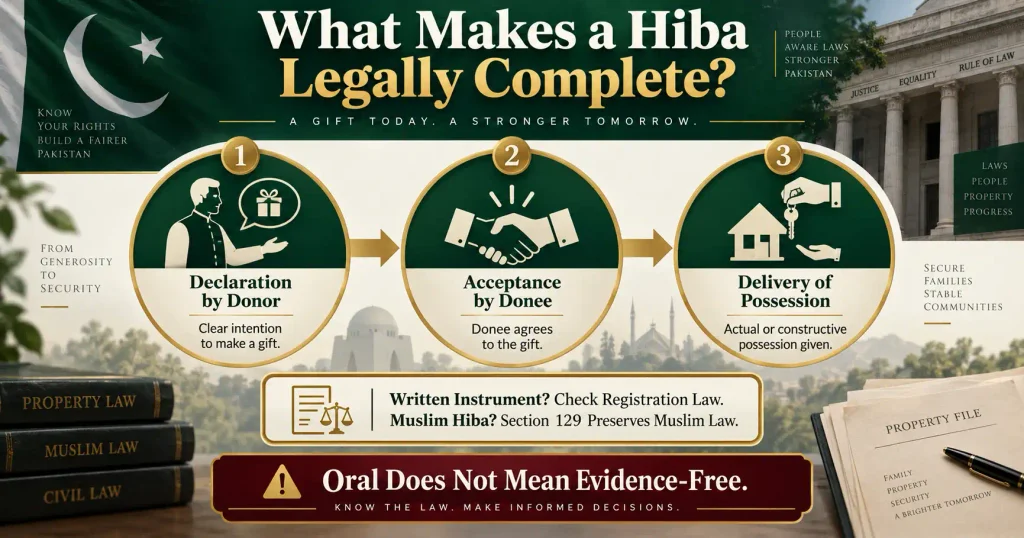
Section 122 of the Transfer of Property Act, 1882 describes a gift as a voluntary transfer of existing movable or immovable property without consideration, accepted by or on behalf of the donee during the donor’s lifetime. Section 123 gives the general statutory mode for gifting immovable property through a registered instrument.
Importantly, section 129 states that the chapter on gifts does not affect rules of Muslim law. Readers can check the official Transfer of Property Act, 1882 on Pakistan Code.
That distinction matters. A written instrument that itself operates as a statutory gift of immovable property may attract registration requirements. At the same time, Muslim law of hiba is preserved, so an oral hiba is not automatically invalid merely because no registered deed exists. The claimant must still prove a legally complete gift.
The Registration Act, 1908 also lists instruments of gift of immovable property among documents requiring registration. (Pakistan Code) The official text is available through the Registration Act, 1908 on Pakistan Code. These provisions must be read with the governing personal law and the true nature of the transfer being asserted.
In many Muslim property disputes, three practical elements remain central: a clear declaration by the donor, acceptance by the donee, and delivery of possession. A Gift in Pakistan case therefore cannot safely rest on a mutation number or a family statement alone. In practice, Gift in Pakistan should be documented as if a future court may need to reconstruct the entire transfer.
The Property Dispute Behind 2026 SCMR 929
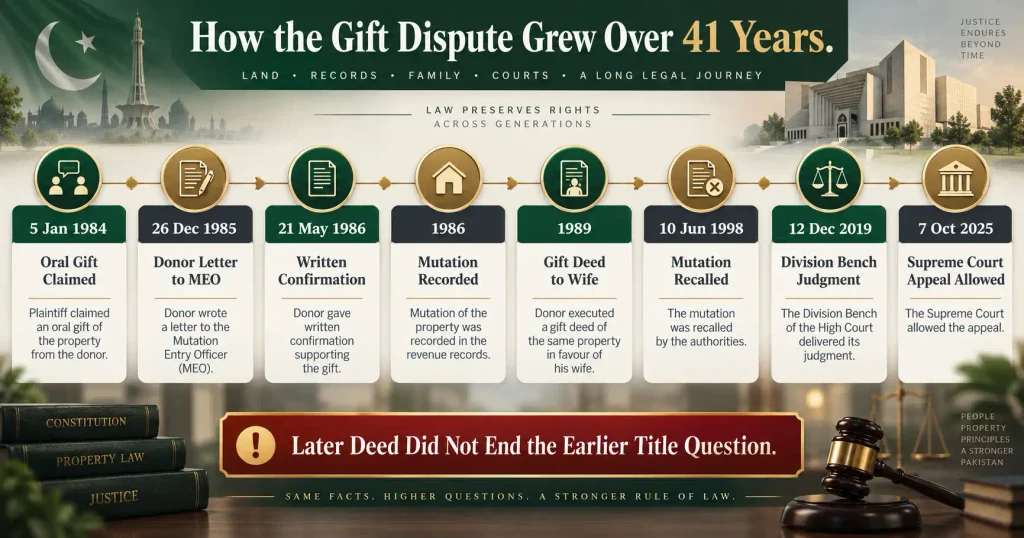
The dispute concerned Plot No. 2/A(B), Link Street, Pakistan Defence Officers Housing Authority, Karachi, measuring 1059 square yards with construction. Ghulam Asghar Khan claimed that Muhammad Arif Khan had orally gifted him a 50% share on 5 January 1984.
A written declaration confirming that oral gift followed on 21 May 1986, and the official record reflected a mutation in the appellant’s name. The dispute became serious when the donor later denied the earlier transfer and executed a registered gift deed in 1989 in favour of his wife.
On 10 June 1998, the earlier mutation was recalled. The appellant said this happened without notice. He sought declaration of 50% ownership, restoration of his mutation, cancellation of the later mutation in favour of the wife, permanent injunction and related relief.
The procedural history is important. A learned Single Judge of the Sindh High Court, exercising original jurisdiction, decreed the suit. A Division Bench later reversed that decree. The Supreme Court appeal arose directly from that reversal.
What Each Side Claimed Before the Courts
Why the Appellant Said Half the Property Was His
The appellant said the 1984 oral gift had been confirmed in writing, acted upon through mutation, acknowledged in correspondence with the Military Estate Office, and supported by later conduct. He also challenged the 1998 recall because he had not been given notice.
For Gift in Pakistan litigation, that is a useful reminder: the court may examine the transaction, the official record and the procedure used to disturb that record.
Why the Donor and His Wife Rejected the Earlier Gift
The donor denied making the oral gift. The respondents relied on the later registered gift deed in favour of the wife and challenged the earlier declaration and witnesses. One witness connected with the declaration also turned hostile in part.
The Supreme Court did not treat the donor’s later denial as automatically decisive. It tested that denial against the rest of the evidence. That evidence-first approach is especially important in Gift in Pakistan disputes involving family members.
The Evidence That Changed the Supreme Court’s View
The 1986 Declaration and Mutation Supported the Claim
The appellant produced evidence of the declaration confirming the oral gift and relied on the mutation entered by the relevant authorities. The Supreme Court treated the official record as part of the evidence showing that the earlier transaction had been acted upon.
This does not mean mutation itself creates title. In Gift in Pakistan disputes, mutation may support a genuine transfer, but the underlying gift still needs proof.
The Donor’s 1985 Letter Strengthened the Earlier Story
A Military Estate Office witness produced a letter dated 26 December 1985 in which the donor had informed the office that he had gifted his share to the appellant. The office had received and acknowledged the letter.
Contemporaneous correspondence can matter greatly when a donor later denies a Gift in Pakistan. Letters, applications and official acknowledgments created before litigation may reveal how the parties themselves treated the transaction.
The Hostile Witness Did Not Erase His Signature
One attesting witness later denied that the oral gift had taken place in his presence. But he did not deny his signature on the declaration when confronted with it.
The Court considered that admission with the written record. The practical point is simple: a hostile witness can damage a case, but the court may still test each part of the testimony against documents and surrounding circumstances.
Why the Original Title Papers Mattered
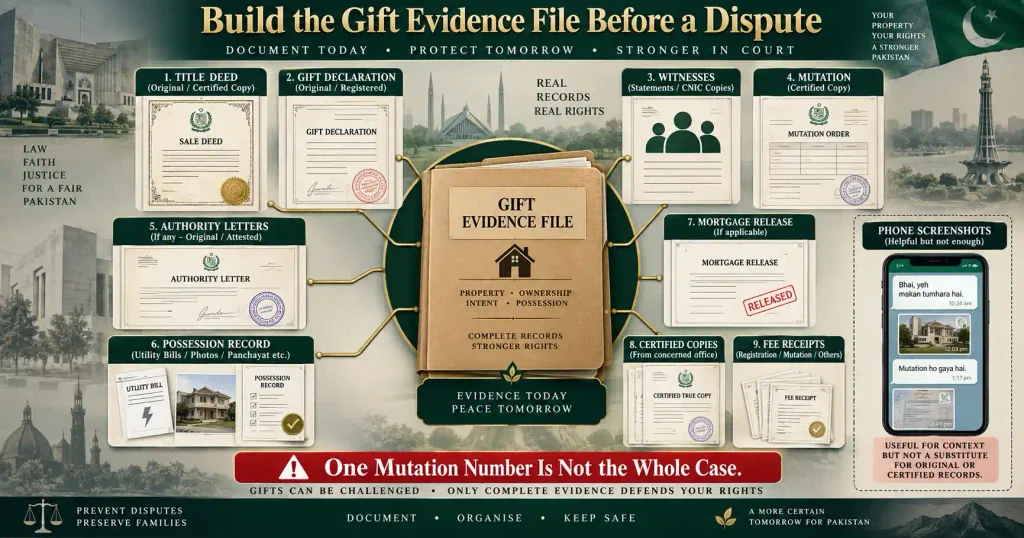
The property had been mortgaged with Habib Bank Limited and the original title documents were deposited with the bank. The record showed that the appellant later redeemed or obtained release of those documents. The donor admitted that he had not delivered the originals to his wife and had not paid the outstanding amount for their release.
The later gift in favour of the wife had been registered on the basis of a certified copy rather than the original title document. At that time, the earlier mutation was still on record.
This was not a universal rule that whoever holds original papers owns the property. In this Gift in Pakistan dispute, the chain of custody was one part of a wider evidentiary picture.
Why the 1989 Registered Gift Did Not End the Case
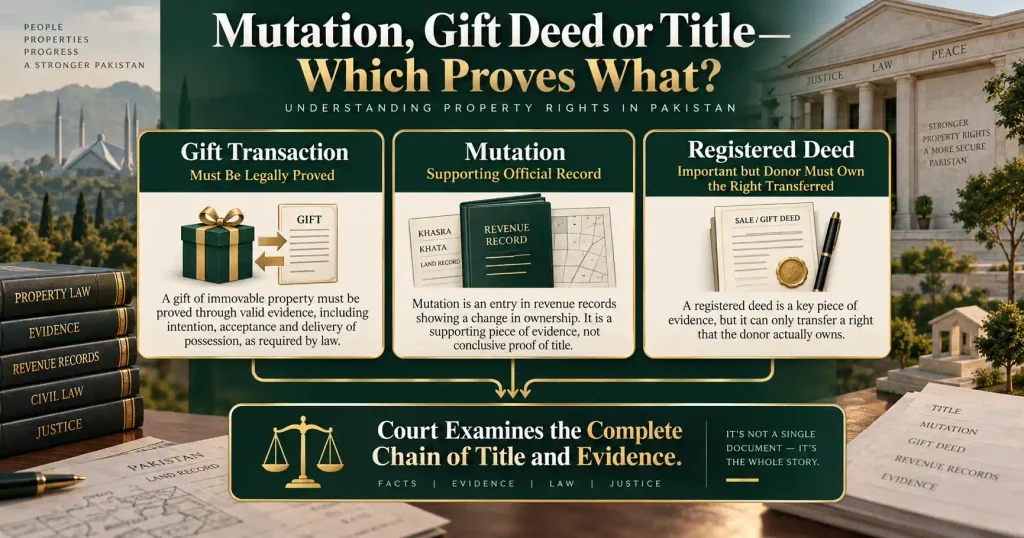
A registered document is important, but a donor cannot transfer an interest he no longer owns. The real question was therefore whether the donor still owned the disputed 50% share in 1989.
The Supreme Court found, within the issues framed and evidence led, that the earlier oral gift had occurred and the related mutation had been recorded. It concluded that the donor was not enjoying that 50% share when he later purported to gift the property to his wife.
For Gift in Pakistan, this is a useful title principle: a later registered deed does not automatically defeat an earlier completed transfer if the earlier transfer is legally proved.
Why the 1998 Mutation Recall Was Unlawful
The Supreme Court concluded that the earlier mutation had been withdrawn without notice to the appellant. It therefore treated the recall as unlawful and restored the Single Judge’s order.
Authorities can correct records where the law permits, but adverse action should follow lawful procedure. A Gift in Pakistan dispute may therefore involve both the validity of the original transfer and the legality of a later record change.
What the Supreme Court Did—and Did Not—Decide
The Court expressly limited itself to the pleadings and issues framed.
It decided that, on this record, there was an oral gift to the appellant to the extent of 50%, the mutation based on it had been recorded, the mutation was later unlawfully withdrawn without notice, and the donor did not have that 50% share available when he later gifted property to his wife.
It did not declare that every oral Gift in Pakistan is valid without proof. It did not hold that mutation alone creates ownership. It did not say that custody of original documents always proves title. It also did not remove registration requirements from written instruments that fall within the applicable statutory regime.
That narrower reading is both legally safer and more useful.
How to Make Gift in Pakistan Safer Before a Dispute
Before transferring property, confirm that the donor actually owns the property or the exact share being gifted. Check whether the title is joint, mortgaged, disputed or subject to a development authority, society, cantonment or revenue restriction.
Make the declaration clear. Identify the donor, donee, property and share, and show that the transfer is voluntary and without consideration. Record acceptance by the donee and complete delivery of possession in the legally appropriate manner.
If a written deed is used, make sure it reflects the real transaction. Complete registration, stamp, mutation and authority-specific steps where required. Provincial and authority procedures can differ, so do not assume one office checklist applies everywhere.
Most importantly, preserve the evidence. A careful Gift in Pakistan should not depend on one witness remembering a conversation decades later.
Documents Worth Preserving Before a Dispute Starts
Keep the title document, current ownership record, CNIC copies, gift deed or written confirmation where used, proof of acceptance, witness details, mutation or transfer order, authority correspondence, fee or tax receipts, possession evidence, mortgage-release papers and certified copies of important entries.
For revenue land, preserve the fard, mutation history and possession-related record. For urban authority or society property, keep allotment, lease, transfer and NOC documents where relevant. A complete Gift in Pakistan file should show both the transfer and what happened after it.
If litigation begins, proof of documents, signatures and other evidence is governed by the Qanun-e-Shahadat Order, 1984. The official law is available through Qanun-e-Shahadat Order, 1984 on Pakistan Code. The Order also places the burden of proving asserted facts on the party seeking the court to act on them.
For more focused reading, see Oral Gift in Pakistan when the alleged transfer was verbal, and Gift Deed in Pakistan where a written instrument itself is disputed.
How to Challenge a Disputed Gift or Mutation
Choose the Right Relief Before Filing
A title dispute may require declaration, cancellation or setting aside of an instrument, possession, injunction, correction or restoration of mutation, or a combination of reliefs.
Section 42 of the Specific Relief Act, 1877 permits a person claiming a right to property to seek a declaration against a person denying that right. Its proviso also prevents a plaintiff from seeking only a declaration where further relief is available but omitted. (Pakistan Code) See the official Specific Relief Act, 1877 on Pakistan Code.
That pleading choice can be critical in Gift in Pakistan litigation.
Check Forum and Jurisdiction First
Serious questions of title, declaration, cancellation, possession and injunction normally require the competent civil court or another court with lawful original jurisdiction, subject to territorial, pecuniary and subject-matter rules.
Revenue officers and housing authorities may deal with their own entries and transfer records, but a record entry is not a substitute for final adjudication of a contested civil title.
Do Not Ignore Limitation
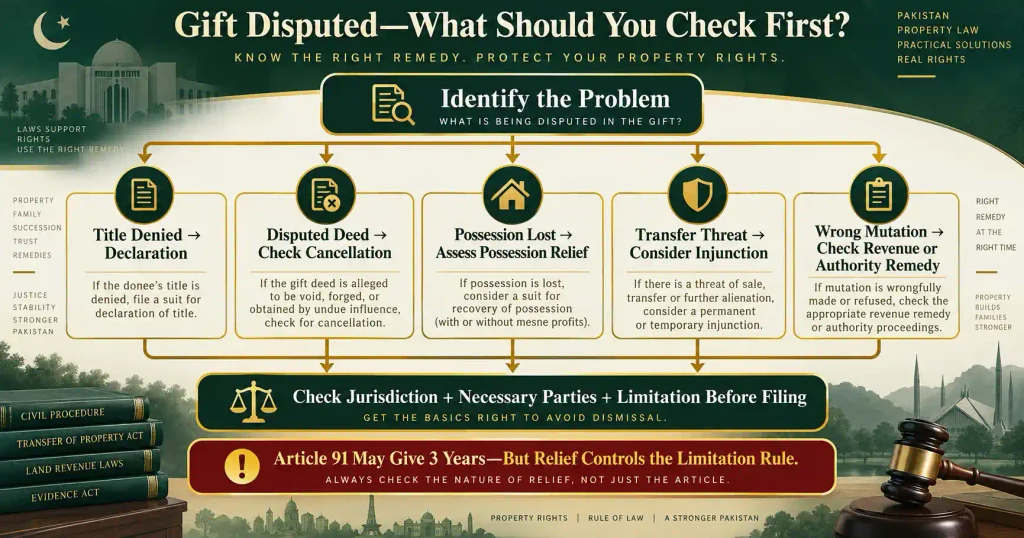
Article 91 of the Limitation Act, 1908 generally provides three years for a suit to cancel or set aside an instrument not otherwise provided for, beginning when the facts giving the plaintiff a right to seek cancellation become known. (Pakistan Code)
Article 120 provides a six-year residual period for suits not otherwise provided for, running from accrual of the right to sue. (Pakistan Code) Section 18 addresses situations where fraud kept a person from knowledge of the right or concealed a necessary document. (Pakistan Code) The official legislation can be checked in the Limitation Act, 1908 on Pakistan Code.
These periods should not be applied mechanically. The correct provision depends on the relief and cause of action. In a Gift in Pakistan case, limitation should be checked before the plaint is drafted, not after an objection is raised. Gift in Pakistan litigation can fail on limitation even where the factual grievance appears strong.
Seven Rules to Remember From This Judgment
- A later denial does not automatically erase earlier documentary and conduct evidence.
- Mutation can support a gift, but it does not replace proof of the underlying transaction.
- A later registered deed cannot transfer an interest the donor already validly parted with.
- Official correspondence made before litigation can be strong corroboration.
- A hostile witness must be tested against signatures, documents and the wider record.
- Original title papers may matter, but their custody must be explained in context.
- An adverse mutation recall should follow lawful procedure, including notice where required.
These are practical evidentiary lessons, not a substitute for the full legal test governing Gift in Pakistan.
Practical Effect for Families and Property Owners
If you are making a genuine family gift, make the donor’s intention clear, record acceptance, complete possession, comply with applicable registration and authority requirements, update the official record and preserve originals. Good Gift in Pakistan planning is mainly about completing the transfer before a dispute starts.
If you are challenging a gift, build a timeline and obtain certified copies. Identify who had possession, who held the originals, which authority received correspondence and which witnesses can prove the transaction.
The Supreme Court’s approach in 2026 SCMR 929 shows why Gift in Pakistan cases are often decided through a coherent chain of evidence rather than one dramatic document.
Frequently Asked Questions
1. Is an oral gift of property valid in Pakistan?
A Muslim oral hiba may be recognized if the governing requirements are proved, including declaration, acceptance and delivery of possession. Gift in Pakistan does not become invalid merely because a Muslim hiba was oral. Section 129 of the Transfer of Property Act preserves Muslim law. However, the absence of a registered deed does not reduce the need for reliable evidence of a complete transfer.
2. What did 2026 SCMR 929 decide about the earlier gift?
The Supreme Court held that the earlier oral gift of the 50% share was proved on the record before it. It relied on the declaration, mutation, donor’s correspondence, witness evidence and original title documents, then restored the Single Judge’s decree after setting aside the Division Bench judgment.
3. Is mutation enough to prove Gift in Pakistan?
No. Mutation is not a substitute for the underlying gift. It may support a genuine transaction when the declaration, acceptance, possession and surrounding evidence are established. A doubtful mutation cannot by itself create a valid hiba or cure missing proof of the original transfer.
4. Does a registered gift deed always defeat an oral gift?
No. Registration is important where the law requires it, but a later registered deed cannot transfer property that the donor had already validly gifted and no longer owned. The earlier oral gift must first be proved as legally complete. If it is not proved, the legal result may be different.
5. Can a donor cancel a completed gift by changing mutation?
Changing or recalling a mutation does not automatically undo a completed transfer of title. Revocation depends on the governing law and facts. In 2026 SCMR 929, the mutation recall was held unlawful because it was withdrawn without notice to the appellant.
6. What evidence should I keep for a property gift?
Keep the title papers, gift deed or written confirmation if any, identity documents, witness details, proof of acceptance and possession, mutation or transfer order, authority correspondence, fee receipts, mortgage-release record and certified copies. The exact evidence depends on the property and the authority maintaining its record.
7. Where should I challenge a disputed gift deed?
The forum depends on the relief and property. Serious questions of title, declaration, cancellation, possession and injunction usually require the competent civil court or another court with lawful original jurisdiction. Revenue or housing authorities may correct their records, but they cannot always finally decide a contested civil title.
8. What is the limitation period for challenging a gift?
There is no single limitation period for every gift dispute. Article 91 generally gives three years for cancellation or setting aside of an instrument from relevant knowledge, while Article 120 gives a six-year residual period where no other article applies. Fraud may affect computation under section 18. The exact relief must be matched to the correct provision.
Conclusion: Evidence Decides More Than Labels
The real lesson from 2026 SCMR 929 is not that oral gifts are easy to prove. It is that courts may look behind a later denial or later registered document and examine the complete evidentiary history.
A careful Gift in Pakistan should be clear, complete, acted upon and properly recorded. A disputed one should be tested through title, possession, documents, witnesses, official correspondence, mutation history and limitation. That is how families reduce the risk of a transfer becoming decades of litigation.
Disclaimer
This article is for general legal awareness in Pakistan. Property, registration, revenue, limitation and personal-law issues can vary with the facts, province, authority and relief claimed. It is not a substitute for advice from a lawyer who has reviewed the original documents and current local law.