

Property possession disputes can become serious very quickly. One person may have title documents, another may be physically occupying the land, and both may insist that the disputed area belongs to them. But does every disputed occupation amount to the criminal offence of illegal dispossession?
The Lahore High Court answered an important part of that question in Syed Basharat Hussain Shah v. The State and others, 2026 MLD 594. The case involved agricultural land in District Jhelum, competing possession claims, civil litigation, revenue proceedings and disputed demarcation. The High Court ultimately acquitted the appellant because the evidence did not establish the criminal intent required in the circumstances of that case.
For anyone facing a property possession problem, the judgment carries a practical warning: first identify what the dispute really is. A boundary dispute, title dispute, recent forcible dispossession and deliberate land grabbing may require different legal routes.
Table of Contents
Judgment at a Glance: What 2026 MLD 594 Decided
| Point | Details |
|---|---|
| Citation | 2026 MLD 594 |
| Court | Lahore High Court, Rawalpindi Bench |
| Judge | Sadaqat Ali Khan, J. |
| Case | Criminal Appeal No. 1101 of 2025 |
| Hearing date | 6 November 2025 |
| Law involved | Sections 3 and 4, Illegal Dispossession Act, 2005 |
| Property | 2 kanals 1 marla in Mouza Nathwala, Dina, Jhelum |
| Core dispute | Exact location and alleged illegal occupation of land |
| Critical evidence | Demarcation report and prior litigation |
| High Court finding | Criminal intent was not shown in the circumstances |
| Final order | Appeal allowed; conviction set aside; appellant acquitted |
The reported judgment is 2026 MLD 594, although the appeal itself was heard on 6 November 2025.
IRAC: Civil Property Possession or Criminal Dispossession?
| IRAC | Analysis |
|---|---|
| Issue | Did the appellant commit criminal illegal dispossession, or was the disagreement actually about the location of adjoining parcels? |
| Rule | Section 3 requires an unlawful act together with the necessary criminal intent in the circumstances addressed by the judgment. |
| Analysis | Earlier civil and revenue proceedings existed, the land location remained disputed, and the fresh demarcation report was found unreliable. |
| Conclusion | The High Court treated this dispute as civil in nature, set aside the conviction and acquitted the appellant. |
The conclusion must be read with the facts. The judgment does not establish that every dispute described as “civil” automatically falls outside the Illegal Dispossession Act.
Facts: Where the Property Possession Fight Began
The complainant alleged that the appellant and others had illegally dispossessed him from land bearing Khasra Nos. 192, 193 and 194/2, measuring 2 kanals and 1 marla, situated in Mouza Nathwala, Tehsil Dina, District Jhelum.
But the dispute had a much longer history.
On 17 November 2017, the complainant filed a civil suit for declaration concerning the same property. The appellant appeared and maintained that he was possessing his own land and had not grabbed the complainant’s property.
A demarcation report was later prepared on 22 April 2019.
On 15 September 2020, the complainant sought possession through revenue proceedings based on that report. The Assistant Commissioner dismissed the application, while the appellant’s challenge to the demarcation report was accepted by the appellate authority.
This history became highly relevant because the real controversy was not simply: “Who is physically standing on the land?”
It was also:
Where exactly was each person’s land located?
That distinction became central to the final decision.
A Civil Suit Was Already Pending Before the Complaint
On 7 April 2021, the complainant’s father filed a suit for possession against the appellant.
While that civil suit was pending, the complainant filed the private complaint under sections 3 and 4 of the Illegal Dispossession Act on 3 February 2022, more than ten months later.
The father subsequently withdrew his possession suit with permission to file a fresh one. According to the judgment, a fresh suit had not yet been filed when the High Court decided the criminal appeal.
The sequence mattered because it helped the Court understand the actual nature and history of the property possession controversy.
But there is an important qualification.
The existence of a civil suit by itself does not automatically prevent proceedings under the Illegal Dispossession Act. Courts have recognized that civil and criminal proceedings may coexist where the ingredients of the criminal offence are independently made out.
That nuance was missing from the old article and is important for legal accuracy.
The Case Had Already Been Remanded Once
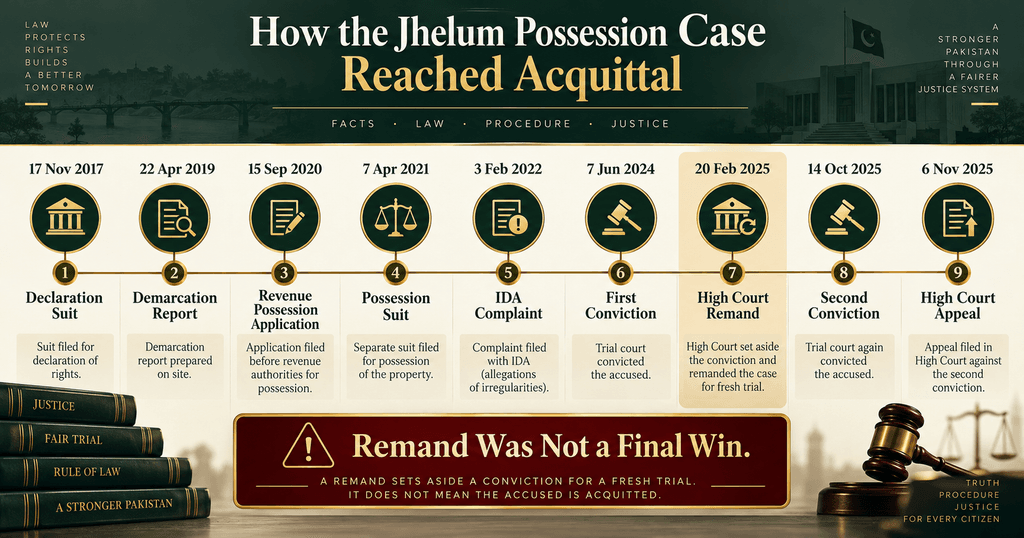
This was not the appellant’s first conviction.
The trial court had earlier convicted him on 7 June 2024. He challenged that decision in Criminal Appeal No. 505 of 2024.
On 20 February 2025, the Lahore High Court set aside that earlier judgment only to the extent of this appellant and remanded his case. The trial court was directed to appoint the concerned Tehsildar for fresh demarcation according to law.
This was a remand, not an acquittal and not a final declaration of property ownership.
After remand, a fresh demarcation was conducted.
The trial court then convicted the appellant again on 14 October 2025. This time it imposed:
- three years’ simple imprisonment;
- Rs.100,000 fine;
- Rs.250,000 compensation to the complainant; and
- restoration of the disputed property to the complainant.
The appellant challenged that second conviction in the appeal that produced 2026 MLD 594.
Why the Fresh Demarcation Report Failed
This is one of the strongest practical lessons from the judgment.
After remand, the complainant relied on the fresh demarcation report to show that the appellant was encroaching upon his land.
But the Lahore High Court identified a fundamental weakness.
The Revenue Officer had treated Khasra No. 201 as a permanent point because the persons present said so. The officer then started measuring the disputed khasra numbers from that point without first determining its exact location.
The report also failed to show that three permanent points from different directions had been properly determined before carrying out the demarcation.
The High Court therefore considered the demarcation unreliable.
This demonstrates why property possession litigation can be lost even when a document is labelled “demarcation report.” The court can examine how that report was prepared.
What Punjab Demarcation Rules Actually Require
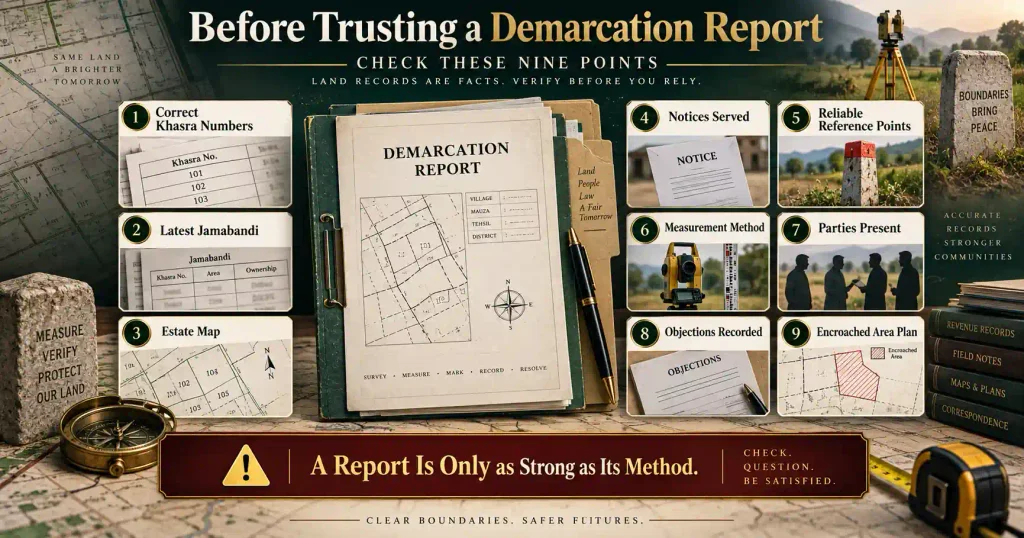
For Punjab land, the official Punjab Land Revenue Rules, 1968 contain a detailed demarcation procedure.
Rule 67-A requires, among other things, an application containing a proper description of the land, supported by an attested latest entry from the Register Haqdaran-Zamin or Jamabandi and the relevant estate map. Notice must also be given to the parties and specified revenue officials. The measurement is to be conducted under the personal supervision of the Revenue Officer. (Punjab Zameen)
The resulting report should record matters such as:
- date, time and place of demarcation;
- full description of the land;
- mode and details of measurement;
- persons present;
- objections raised;
- limits of existing possession; and
- exact dimensions of any encroached area.
Rule 67-B then addresses eviction following qualifying demarcation proceedings. Importantly, where the matter substantially involves title or an intricate question of law, the Collector is not to decide the merits under that summary route and must refer the parties to the civil court. (Punjab Zameen)
Read the official Punjab Land Revenue Rules, 1968
For a property possession case involving agricultural land, this makes certified revenue maps, demarcation notices, field measurements and objections highly important evidence.
When Does Property Possession Become a Criminal Case?
The relevant federal statute is the Illegal Dispossession Act, 2005.
Section 3 protects owners and lawful occupiers against unlawful entry, occupation, grabbing or control with the prohibited intention described by the Act. The offence can carry imprisonment extending up to ten years as well as fine and compensation.
Read the official Illegal Dispossession Act, 2005
In 2026 MLD 594, the High Court emphasized that every property possession or dispossession dispute does not automatically satisfy section 3.
The Court said the complainant had to show both an unlawful act—actus reus—and criminal intent—mens rea.
On the facts before it, even if it were ultimately established that the appellant was occupying an area belonging to the complainant, the High Court found no indication of the necessary criminal intent. Instead, the underlying controversy concerned the exact location of the parties’ respective parcels.
That distinction resulted in acquittal.
Civil Dispute Does Not Always Mean “No Criminal Case”
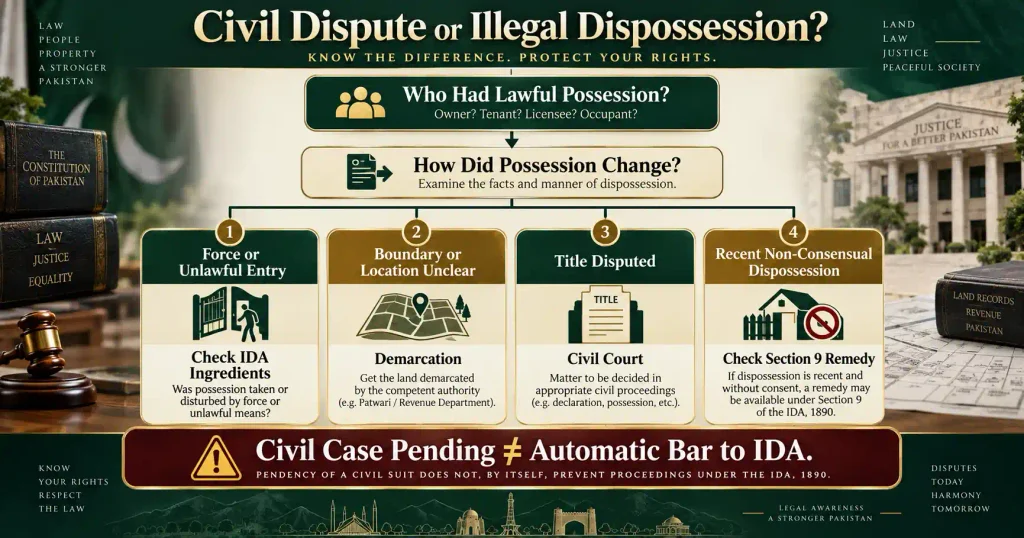
This point deserves special attention.
Do not read 2026 MLD 594 as saying:
“If civil litigation exists, the Illegal Dispossession Act can never apply.”
That would go too far.
Pakistani courts have also held that merely because civil proceedings are pending does not protect someone who has actually committed an offence satisfying the Illegal Dispossession Act. Civil and criminal consequences can operate independently where their respective ingredients exist.
The better question is:
What does the evidence show about the nature of entry, occupation, force, authority, prior possession and intention?
The Supreme Court’s later guidance discussed in Abbas Asif Zaman v. The State, which 2026 MLD 594 itself relied upon, also emphasizes the distinction between genuine forcible or unlawful dispossession and possession arising from circumstances such as permissive family occupation without the necessary criminal element. (Research Center)
This is why labels such as “civil matter,” “family matter” or “qabza” cannot replace proof.
How an Illegal Dispossession Complaint Proceeds
A property possession complainant should also understand the special procedure.
Section 4 provides that an alleged contravention of section 3 is tried by the Court of Session on a complaint. The offence under the Act is non-cognizable, although the Court has powers regarding arrest during proceedings. (Case Law)
Under section 5, the Court may direct the officer in charge of a police station to investigate and submit a report within 15 days, subject to an extension for recorded reasons. A Magistrate or Revenue Officer may also be asked to conduct a local inquiry where necessary. (Case Law)
After cognizance, section 5 also contemplates day-to-day trial and a decision within 60 days, with reasons required for delay.
Section 7 provides for interim restoration in appropriate cases during trial, while section 8 deals with restoration on conclusion of trial where illegal dispossession is established. (Case Law)
These provisions show why an IDA complaint is not simply another name for an ordinary FIR.
What the Lahore High Court Finally Decided
The Lahore High Court accepted the appellant’s criminal appeal.
It:
- set aside the trial court conviction;
- set aside the sentences;
- acquitted the appellant;
- discharged his sureties; and
- noted that the complainant could file a fresh civil suit for possession if he wished.
The Court regarded the controversy as a civil dispute over the exact location of the respective parcels and found no basis on the record for the necessary criminal intent.
For property possession litigation, that final point is crucial: failure of this criminal case did not establish that the complainant could never recover the land through an appropriate civil proceeding.
What the Court Did Not Decide
The judgment is equally important for what it did not decide.
The Lahore High Court did not finally declare that the complainant owned no land.
It did not conclusively determine the precise boundary between the parties’ parcels.
It did not hold that every person already involved in civil litigation is immune from prosecution under the Illegal Dispossession Act.
It did not say that all demarcation reports are unreliable.
And it did not bar the complainant from seeking possession through a fresh civil suit.
In fact, the Court expressly stated that a fresh suit for possession could be filed if desired.
This distinction prevents the acquittal from being wrongly presented as a final title judgment.
Which Remedy Fits Your Property Possession Problem?
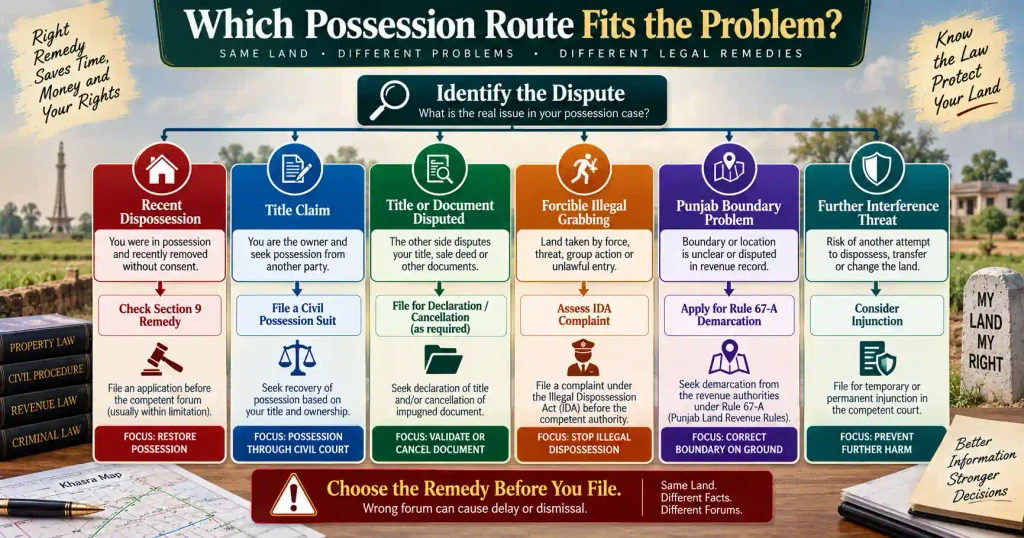
The correct route depends on what actually happened.
| Situation | Possible route to examine |
|---|---|
| Recent dispossession without consent | Section 9 Specific Relief Act |
| Title-based claim to recover property | Appropriate civil suit for possession |
| Title or document also disputed | Declaration/cancellation plus consequential relief where required |
| Forcible unlawful grabbing with criminal intent | Illegal Dispossession Act complaint |
| Unclear Punjab agricultural boundary | Rule 67-A demarcation |
| Wrongful possession found after demarcation | Rule 67-B route, subject to its limits |
| Threat of sale/construction/further interference | Injunctive relief may need consideration |
The remedy should follow the facts—not the other way around.
For further detail, see Qanooni Dastak’s guides on Illegal Dispossession Act 2005, Illegal Possession of Property in Pakistan and Civil Suit for Declaration.
Section 9 Gives a Fast but Time-Sensitive Civil Route
Section 9 of the Specific Relief Act, 1877 is particularly important where a person says he was dispossessed from immovable property without consent and otherwise than through due course of law.
The provision allows recovery of possession without making title the central question in that summary proceeding. It also preserves the right to later establish title through an appropriate suit. (Pakistan Code)
Read the official Specific Relief Act, 1877
But there is a major deadline.
Article 3 of the Limitation Act, 1908 provides six months from the date of dispossession for a suit under section 9. (Pakistan Code)
Check the official Limitation Act, 1908
This is why someone who has just lost property possession should not spend months trying random remedies without first checking limitation.
A title-based possession suit is different and its limitation must be assessed according to its own cause of action and applicable article. Do not automatically apply the six-month section 9 rule to every possession suit.
Build the Evidence File Before Filing Anything
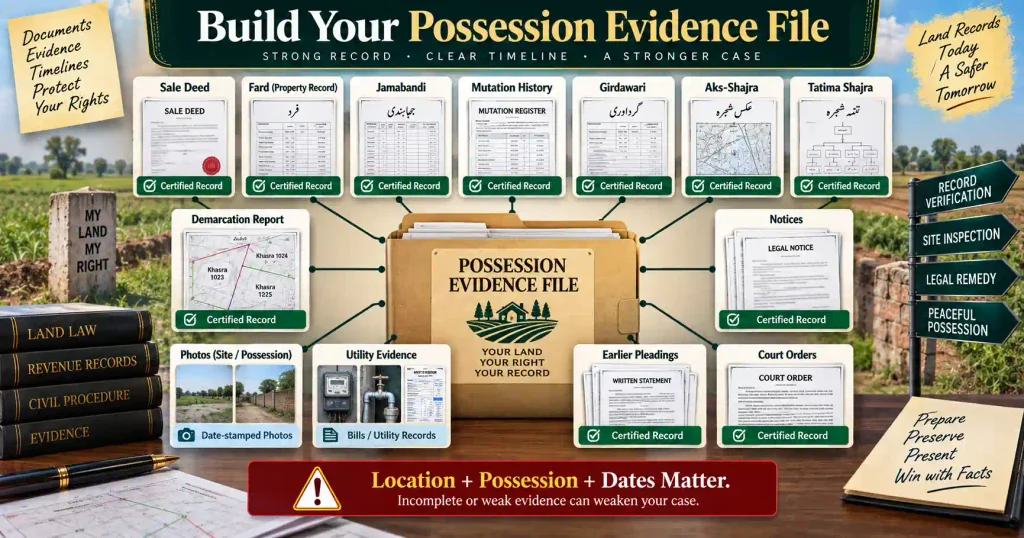
A property possession dispute is often won or lost on chronology and identification of the land.
Preserve certified or original records where available, including:
- sale deed, gift deed or other title document;
- inheritance documents;
- latest Fard or Jamabandi;
- complete mutation history;
- Register Haqdaran-Zamin entries;
- Aks-Shajra and relevant estate map;
- Tatima Shajra where relevant;
- Girdawari/cultivation record;
- earlier demarcation applications and reports;
- notices served before demarcation;
- field measurement notes and plans;
- objections recorded at the spot;
- photographs and videos showing possession;
- utility, crop or construction evidence where relevant;
- prior civil pleadings and court orders;
- revenue appeals and orders;
- police complaints or inquiry reports; and
- names of independent witnesses.
Do not depend only on cropped screenshots.
In 2026 MLD 594, years of earlier litigation and the technical reliability of the demarcation exercise directly influenced the criminal outcome.
7 Critical Checks Before Starting a Possession Case
Before choosing a property possession remedy, check these seven points.
1. Identify the exact land.
Confirm khasra, khewat, khatauni, plot number, area and boundaries.
2. Separate ownership from possession.
Being an owner and being the person in actual or lawful possession are related but legally distinct questions.
3. Record when possession changed.
The exact date may affect limitation and the remedy available.
4. Identify how the other side entered.
Was possession forcible, permissive, inherited, contractual, mistaken or based on a competing title?
5. Audit the demarcation.
Check notices, maps, reference points, measurement procedure and objections.
6. Review every earlier case.
Previous pleadings can reveal admissions, inconsistent positions and previous remedies.
7. Choose the forum before drafting relief.
A revenue proceeding, civil suit and criminal complaint perform different legal functions.
Using the wrong route can add years to a dispute without deciding the real issue.
Practical Effect of 2026 MLD 594
For landowners, the case shows that merely proving a paper title may not be enough to obtain a criminal conviction where the precise location of the alleged encroachment itself remains doubtful.
For a person accused of illegal possession, the judgment does not give a general licence to retain another person’s property. An accused must still face the evidence where unlawful entry, grabbing or forcible dispossession with the required criminal intent is shown.
For lawyers and litigants, property possession cases should begin with a map of the dispute:
title → location → prior possession → manner of dispossession → intention → evidence → remedy → forum → limitation.
That sequence can prevent a genuine civil boundary dispute from being wrongly pleaded as a criminal land-grabbing case—or a genuine forcible dispossession case from being dismissed merely because civil litigation also exists.
FAQs About Property Possession in Pakistan
1. Is every property possession dispute a criminal case?
No. 2026 MLD 594 confirms that every possession or dispossession dispute does not automatically fall under section 3 of the Illegal Dispossession Act. The factual ingredients of the criminal offence must be established. A genuine boundary or title controversy may require civil or revenue adjudication, depending on the circumstances.
2. Why was the accused acquitted in 2026 MLD 594?
The High Court considered the demarcation unreliable and found the dispute concerned the exact location of the parties’ respective parcels. Even if occupation of the complainant’s area were later established, the Court found no indication of the necessary criminal intent on the evidence before it.
3. Can civil and criminal property proceedings run together?
Potentially, yes. The mere existence of a civil dispute does not automatically defeat proceedings under the Illegal Dispossession Act where its independent criminal ingredients are established. The facts, lawful possession, manner of entry or ouster and criminal intent must therefore be assessed rather than relying only on the label “civil dispute.”
4. What evidence proves property possession?
Relevant evidence may include title documents, Fard or Jamabandi, Girdawari, mutation history, maps, demarcation records, possession photographs, utility records, cultivation evidence, witnesses and earlier court proceedings. Which evidence matters most depends on whether the dispute concerns title, boundaries, actual occupation or forcible dispossession.
5. Can a defective demarcation report prove encroachment?
Not necessarily. In 2026 MLD 594, the Lahore High Court found the fresh report unreliable because the starting permanent point had not been properly located and the required reference methodology was not demonstrated. Punjab’s official demarcation rules also prescribe notice, measurement, reporting and mapping requirements.
6. Where is an Illegal Dispossession Act complaint filed?
Section 4 provides that the offence is triable by the Court of Session on a complaint. It is a special statutory procedure rather than an ordinary assumption that every property possession allegation should begin as an FIR. The Sessions Court can use the investigation and inquiry mechanisms provided by the Act.
7. Is there a deadline for recovering recent possession?
A summary suit under section 9 of the Specific Relief Act is subject to a six-month limitation period from dispossession under Article 3 of the Limitation Act, 1908. Other title-based or statutory remedies may have different limitation rules, so the six-month period should not be generalized to every property case.
8. What should I do first after alleged illegal dispossession?
Secure your title and possession evidence, note the exact date and manner of dispossession, obtain certified revenue records, preserve photographs or communications, check the land map and previous litigation, and immediately assess limitation and jurisdiction. Do not alter evidence or attempt to recover possession through force.
Conclusion: First Identify the Real Property Dispute
Property possession is not decided simply by who makes the stronger allegation. Courts examine the property, prior possession, documents, boundaries, manner of entry, intention, previous proceedings and reliability of technical evidence.
In 2026 MLD 594, the Lahore High Court did not finally award the disputed land to the appellant. It set aside his criminal conviction because the case before it was essentially a dispute about the exact location of neighbouring parcels, the demarcation evidence was unreliable, and the required criminal intent was not established. The complainant remained free to pursue an appropriate civil possession remedy.
The practical lesson is simple: before filing any property possession case, identify whether you need demarcation, civil recovery, declaration, injunction or the special criminal remedy under the Illegal Dispossession Act. Choosing the correct route—and preserving the right evidence—can be as important as the underlying ownership claim.
Disclaimer
This article is for legal awareness and educational purposes only. It is not legal advice or a guarantee of any outcome. Property possession disputes depend on the applicable province, nature of land, documents, possession history, limitation, jurisdiction and evidence. A qualified lawyer should review the complete record before proceedings are filed.