

Your grandfather cleared the bushes. Your father dug the well. You have ploughed the same field all your life. Then one day the patwari shows you the record: the field is Shamilat Land, and your long possession (qabza) may not make you its owner.
That fear is real. In 2025 SCMR 174, the Supreme Court of Pakistan decided a common-land dispute from village Daggar Aulakh, District Bhakkar, that had been running since the 1960s. By a 2-1 majority, it held that possession and cultivation alone do not create ownership when a person has no right in the village proprietorship (malkiyat) khata.
Below, we explain what the land is, what each side argued, why one judge disagreed, and which records you must check before your own claim is ever tested.
Table of Contents
Judgment at a Glance: 2025 SCMR 174
| Point | Detail |
|---|---|
| Citation | 2025 SCMR 174 |
| Case | Muhammad Ramzan and others v. Member (Judicial-II), Board of Revenue, Punjab, Lahore and others |
| Court | Supreme Court of Pakistan |
| Bench | Yahya Afridi, Amin-ud-Din Khan and Ayesha A. Malik, JJ. |
| Case numbers | Civil Appeals Nos. 936, 937 and 938 of 2012 |
| Appeal against | Lahore High Court judgment dated 02.07.2010 in W.Ps. Nos. 10329 and 8274 of 2005 |
| Decided on | 16 September 2024 |
| Land | Shamlat Deh (Khata No. 304) of village Daggar Aulakh, District Bhakkar |
| Law involved | MLR-64 (Paras 3 and 22), 1960 Notification (Para 6), Punjab Land Revenue Act 1967 (Ss. 39 and 42), Articles 185 and 199 of the Constitution |
| Majority | Amin-ud-Din Khan, J. (author); Yahya Afridi, J. agreeing |
| Dissent | Ayesha A. Malik, J. |
| Result | Appeals dismissed 2-1: possession alone gave no title in the Shamlat Deh |
IRAC Summary of the Shamilat Land Case
| IRAC | Summary |
|---|---|
| Issue | Could people who possess and cultivate the Shamlat Deh become its owners on that basis, relying on MLR-64, the 1960 Notification and earlier court judgments? Can a court create a right that has no legal basis? |
| Rule | Para 22 of MLR-64 abolished Ala-Malkiat. Para 6 of the 1960 Notification made Adna Maliks full proprietors of land “held by them as such”. A revenue entry stays until it is lawfully replaced. Courts under Articles 185 and 199 cannot create a new right. |
| Analysis | The appellants could not show any recorded status as Adna Malik or Ala-Khud-Adna Malik in the proprietorship khata. The earlier Ladhoo judgments decided a different dispute and gave them no right. Shamlat is shared by the proprietary body in proportion to its ownership. |
| Conclusion | The appeals were dismissed by majority. Justice Ayesha A. Malik dissented and would have turned Adna Malik possession as of 03.03.1960 into ownership. |
What Is Shamilat Land (Shamlat Deh)?
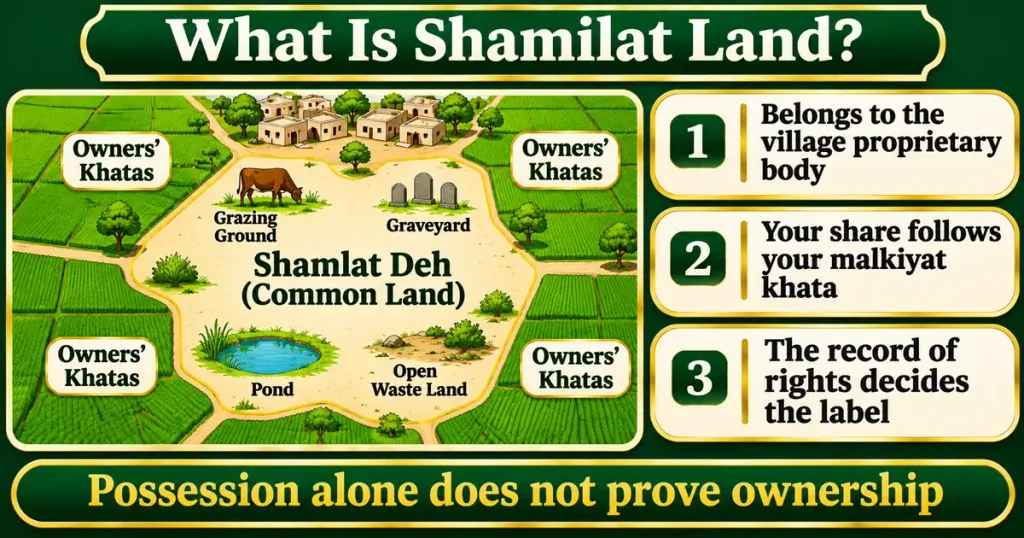
Shamilat Land is village common land. In revenue papers it is usually written as Shamlat Deh. It belongs to the proprietary body of the village as a group, not to one family. The dissent explains its history: it was the wasteland (banjar) around cultivated fields, plus open space for the village to grow.
Landowners did not own a fixed piece of it. They held hissadari, a share in the joint property of the village. That share was tied to their ownership in the village itself. So two people may farm the same common land side by side, yet hold very different legal rights in it.
Punjab law also defines it by the record. Under the Punjab Land Dispositions (Saving of Shamilat) Ordinance, 1959, land described as Shamilat in the record of rights is deemed Shamilat, even if one owner or any other person holds part or all of it. The record sets the label, not the person sitting on the land.
The rules of each village sit in its papers. The Wajib-ul-Arz records village custom on common land. The Jamabandi (Register Haqdaran Zamin) shows owners in column 5 and cultivators in column 6. Hasab Rasad Khewat shows each owner’s share by the revenue assessed on his holding.
Ala Malik, Adna Malik and Ala-Khud-Adna Malik
| Term | Who they were | Position after MLR-64 |
|---|---|---|
| Ala Malik | Original settlers and superior owners of the village land | Ala-Malkiat abolished by Para 22 of MLR-64, with no compensation |
| Adna Malik | Cultivators who entered the land through Ala Maliks and paid them dues | Made full proprietors of land “held by them as such” under Para 6(a) |
| Ala-Khud-Adna Malik | An Ala Malik who was himself in cultivating possession | Treated as full proprietor under Para 6(d), as the majority read it |
Justice Ayesha A. Malik noted that this dual system was found in only three areas of Punjab: Bhakkar, Muzaffargarh and Layyah. In other villages these labels may not exist at all, and common-land rights depend on the village record and custom, which differ from village to village.
How the Daggar Aulakh Dispute Began
The Shamilat Land in dispute was the Shamlat Deh, Khata No. 304, of village Daggar Aulakh. The village proprietary land, Khata No. 303, measured 19,920 kanals. The majority put the Shamlat still in litigation at 96,312 kanals, because 50,688 kanals had been acquired by the Thal Development Authority. Revenue officials told the Court that some appellants held thousands of kanals.
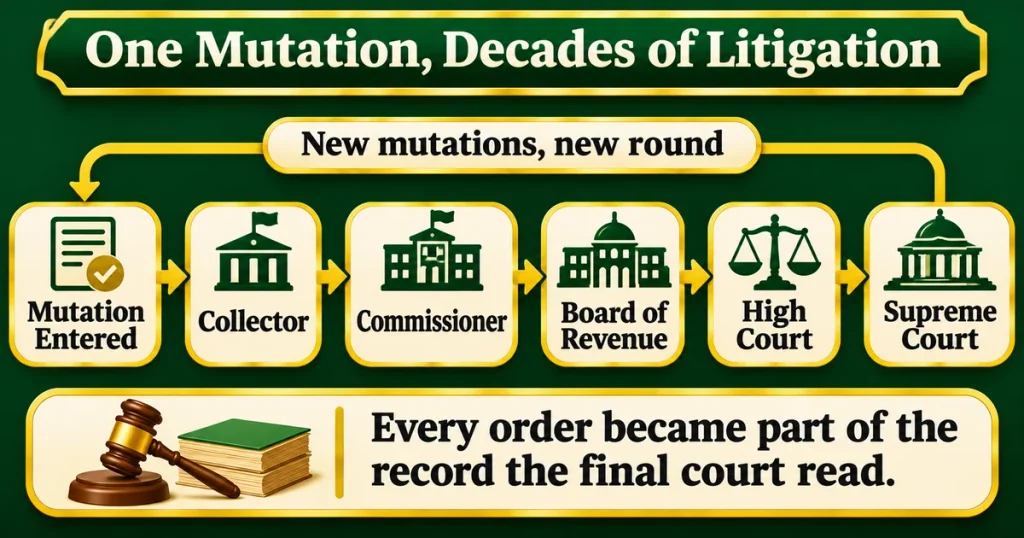
The fight started with a mutation (intiqal) in 1962 and moved through almost every revenue and constitutional forum.
| Date | What happened |
|---|---|
| 13.06.1962 | Mutation No. 1655 records the Shamlat by Hasab Rasad Khewat, showing Ala Maliks as owners |
| 28.01.1967 to 01.06.1967 | Collector (Consolidation) cancels it and remands; Additional Commissioner agrees; on remand, Assistant Collector-II again follows Hasab Rasad Khewat |
| 19.09.1970 to 18.05.1983 | Collector Mianwali, Commissioner Sargodha and the Board of Revenue side with the Adna Maliks |
| 29.07.1990 | Lahore High Court dismisses the Ala Maliks’ writ petitions (Ladhoo v. B.O.R., 1991 MLD 99) |
| 01.04.1991 | Supreme Court dismisses C.Ps. 823-L and 824-L of 1990; review dismissed on 02.02.1992 |
| 27 and 28.02.1994 | Mutations Nos. 2064 to 2067 again follow Hasab Rasad Khewat |
| 07.02.2001 to 30.03.2005 | Collector Bhakkar, EDO (Revenue) and Member (Judicial-II), Board of Revenue reject the appellants’ challenge |
| 02.07.2010 | Lahore High Court dismisses their writ petitions |
| 08.10.2012 | Supreme Court grants leave to appeal |
| 16.09.2024 | Supreme Court dismisses the appeals 2-1 |
Most of the 1962 to 1992 history comes from the dissent. The majority read that earlier round differently. In its view, the Ala Maliks had claimed the whole Shamlat for themselves and lost, because common land is shared in proportion to ownership in the village.
What Each Side Argued in the Supreme Court
The Appellants’ Case
- Para 22 of MLR-64 abolished Ala-Malkiat, so the Ala Maliks kept no superior right in the Shamlat Deh.
- Para 3 of MLR-64 overrides custom, so the Wajib-ul-Arz could not decide how the land is shared.
- The 1990 High Court and 1991 Supreme Court judgments had recognised their rights, and revenue officers had to implement them.
- They asked the Court to set aside the 1994 mutations and the new Jamabandis made after partition of Khata No. 304, and to let them keep the Shamilat Land in their possession as full proprietors.
The Respondents’ and Punjab Government’s Case
- Neither MLR-64 nor the Ladhoo judgments changed the recognised way of dividing Shamlat: by share in the village proprietorship, not by possession.
- They relied on the Wajib-ul-Arz and Hasab Rasad Khewat.
- According to the dissent, they accepted that Adna Maliks owned land in their possession, but only as shown in the undisputed 1945-46 Jamabandi. Anything more had to be returned.
- The Punjab Government supported them and said the land in the appellants’ physical control was more than their entitlement. The Member, Board of Revenue, summoned by the Court, said there was no other formula for distribution.
The Evidence: Which Revenue Records Decided the Case
This Shamilat Land case was decided on records, not witnesses. Each side leaned on old revenue papers.
- Jamabandi 1945-46: undisputed; the dissent read its column 5 as showing Adna Malik possession in the Shamlat Deh.
- Khasra Girdawari 1958-62: the crop inspection record around the MLR-64 period, also undisputed, showing the extent of Adna Malik possession.
- Wajib-ul-Arz: the village administration paper on sharing common land, followed by the Board of Revenue in 2005.
- Hasab Rasad Khewat: shares measured by revenue on each holding, used in the 1962 and 1994 mutations.
- Mutations: No. 1655 of 1962 and Nos. 2064 to 2067 of 1994.
One admission weighed heavily. The majority recorded that the appellants’ counsel admitted they were not recorded as Adna Malik or Ala-Khud-Adna Malik in the village proprietary land. Their claim rested on possession and on the earlier judgments.
The Law Behind the Case: MLR-64 and the 1960 Notification
For this Shamilat Land, the starting point is the West Pakistan Land Reforms Regulation, 1959, known as MLR-64. Para 22 abolished Ala-Malkiat and similar intermediary interests, without compensation. Para 3 says the Regulation overrides any other law, court decree, custom, contract or document.
The West Pakistan Land Commission then issued the Notification of 3 March 1960. Its Para 6 said:
- (a) and (b): Adna Maliks become full proprietors of land held by them as such, paying no compensation;
- (c): they stop paying rent or dues to Ala Maliks from Rabi 1958-59;
- (d): a person entered as both Ala Malik and Adna Malik, or an Ala Malik with no Adna Malik under him, is treated as full proprietor;
- (e) and (f): a person who engaged with Government to pay land revenue is treated as an Adna Malik, and Ala Maliks get no compensation.
The record side is governed by the Punjab Land Revenue Act, 1967. Section 39 provides the record-of-rights. Section 42 requires a person acquiring a right to report it to the Patwari within three months, so it can be entered in the mutation register.
Three current-law notes matter. First, MLR-64 was later repealed by the Land Reforms Regulation, 1972 (MLR-115), yet the Court still applied the 1959 abolition, because these rights took shape then. Second, the majority noted that MLR-64 had been declared against the injunctions of Islam, so its Para 13 no longer applied. Third, Punjab amended its land revenue law by ordinance in February 2026, so check the version in force on the day you file.
Why the Majority Said Possession Is Not Ownership
Justice Amin-ud-Din Khan wrote the majority opinion, and Justice Yahya Afridi agreed. The appellants could not state any status except that they were in possession and cultivating. Without a legal right or a valid entry upon the land, the majority said, no one can claim ownership.
The earlier judgments did not help them. The 1990-91 round was about the Ala Maliks’ claim to the whole Shamlat, not about these appellants. They had picked lines from those judgments, but the full paragraphs said otherwise. The Court added that a wrong picture of 1991 MLD 99 had been shown at the leave stage.
The majority then fixed the formula. “Held” in the 1960 Notification meant land in possession within the malkiyat khata. So entitlement in the proprietorship khata is the benchmark, and a person with no right in that khata cannot be given Shamilat Land.
Only two categories remain after MLR-64: Adna Maliks and Ala-Khud-Adna Maliks. They share the Shamlat in proportion to their proprietorship, and “none else will be entitled for grant of land on the basis of possession only” (majority, para 10). The Court said this rule flows from the Land Revenue Act, 1967 and is supported by the Wajib-ul-Arz.
7 Shamilat Land Rules From This Judgment
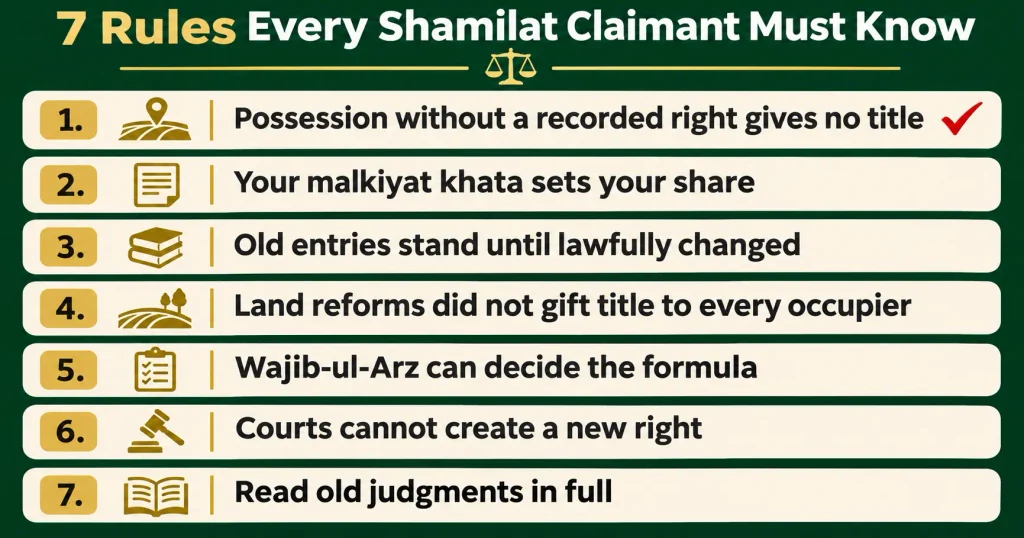
1. Possession Without a Recorded Right Gives No Title
Farming, fencing or a tubewell proves physical control, not ownership. The first question is always: what legal right put you on this land?
2. Your Malkiyat Khata Sets Your Share
Your share in Shamilat Land follows your entitlement in the village proprietorship khata. No right in that khata means no share, however large your possession.
3. Old Revenue Entries Stand Until Lawfully Changed
An entry stays in force until a court decree or a valid mutation replaces it. If an entry was changed unlawfully, the old entry is treated as continuing.
4. MLR-64 Was Not a Free Title for Every Occupier
The abolition of Ala-Malkiat helped those recorded as Adna Maliks or Ala-Khud-Adna Maliks. It did not turn every occupier into an owner.
5. The Wajib-ul-Arz Can Decide the Formula
For the majority, the Wajib-ul-Arz supported sharing common land across the whole proprietary body. It cannot be ignored because someone developed a plot.
6. Courts Cannot Create a Right That Never Existed
Under Articles 199 and 185, courts enforce existing rights. Granting new proprietary rights is a policy matter for the Government under law.
7. Read Old Judgments Whole, Not in Pieces
One favourable line from an old judgment proves nothing. Check the parties, the question decided and the final order.
Justice Ayesha A. Malik’s Dissent: The 3 March 1960 Test
Justice Ayesha A. Malik disagreed with both the reasoning and the result. In her view, MLR-64 ended the Ala Maliks’ superior rights, including their hissadari. Adna Maliks became full proprietors of the Shamilat Land in their possession under Para 6(a).
She held that the Wajib-ul-Arz and Hasab Rasad Khewat could not defeat MLR-64, because both predate it and Para 3 makes the Regulation override custom. She read the 1990 and 1991 judgments as recognising Adna Malik rights, since they upheld removing the Ala Maliks’ names from the 1945-46 Jamabandi.
Her test was date-based. Whatever Adna Maliks lawfully possessed on 03.03.1960 becomes their property, with the 1945-46 Jamabandi as the starting point and the 1958-62 Khasra Girdawari as the check. Land acquired later must be proved by a grant, lease, inheritance or other lawful transfer.
Her guideline for revenue officers was plain: “Possession acquired after MLR 64 has to be explained” (dissent, para 17). After notice and due process, and subject to Clause 6(d), excess land with no legal backing should be resumed by the Government. She would have allowed the appeals.
Majority vs Dissent at a Glance
| Question | Majority | Dissent |
|---|---|---|
| Is possession enough? | No, not without a right in the proprietorship khata | Adna Malik possession as of 03.03.1960 becomes ownership |
| Earlier Ladhoo judgments | Created no right for these appellants | Recognised Adna Malik rights under MLR-64 |
| Wajib-ul-Arz | Supports sharing by the proprietary body | Cannot defeat MLR-64 |
| Key records | Malkiyat khata and lawful entitlement | 1945-46 Jamabandi and 1958-62 Khasra Girdawari |
| Land taken after 1960 | Bare possession gives nothing | Must be proved by grant, lease, inheritance or transfer |
| Result and weight | Appeals dismissed; binding | Appeals allowed; persuasive only |
Final Decision of the Supreme Court
By a majority of two to one, with Ayesha A. Malik, J. dissenting, Civil Appeals Nos. 936, 937 and 938 of 2012 were dismissed. The Lahore High Court judgment of 02.07.2010 and the revenue orders upholding the 1994 mutations therefore stand.
The majority reasoning controls the result. The dissent is useful for future argument but did not change the order. Reported orders can be searched on the Supreme Court of Pakistan website.
What the Court Did and Did Not Decide
What it decided:
- Possession and cultivation, without a right in the proprietorship khata, gave the appellants no title in this Shamlat Deh.
- The Ladhoo judgments of 1990 and 1991 created no right for these appellants.
- The Shamlat is shared among Adna Maliks and Ala-Khud-Adna Maliks in proportion to their proprietorship.
- Courts cannot create a new proprietary right under Article 185 or 199.
What it did not decide:
- It did not say possession never matters; possession backed by a recorded right still counts.
- It did not work out each person’s exact area. That is for the revenue officers.
- The final order does not separately deal with mesne profits, although the leave order had kept that question open.
- It applied Punjab law to one village’s record. It does not set Shamilat Land rules for other provinces.
What This Judgment Means for Ordinary Landholders
If your family farms Shamilat Land, ask one question first: which record gives us this right? The answer should be a khata entry, a mutation or a lawful transfer, not family memory. Then match your possession against that right.
If you inherited a share in the village khata, the common-land share tied to it passes through the same inheritance chain. Check that the inheritance mutation was entered correctly and that every legal heir is shown. A missing heir today can become a case tomorrow.
Can Shamilat Land Be Sold or Partitioned?
Sale: Under Section 3 of the 1959 Saving of Shamilat Ordinance, general words in a sale or gift of land do not carry the Shamilat share. The Shamilat must be specifically mentioned as the subject of the transfer, so a buyer should see it named in the deed and the mutation.
Partition (taqseem): Joint agricultural land is partitioned by the Revenue Officer under Chapter XI of the Punjab Land Revenue Act, 1967. Under Section 135, a co-owner can apply if his share is recorded, decreed or acknowledged in writing by all interested persons.
Section 136 adds limits that often touch common land. Places of worship and burial grounds held in common stay common. The Revenue Officer may also refuse to divide a grazing ground, village site, well or watercourse if partition would harm the co-sharers. If title is disputed, Section 141 lets him send the question to a civil court or decide it himself.
Evidence Checklist and Next Steps
Documents to Collect for a Shamilat Land Claim
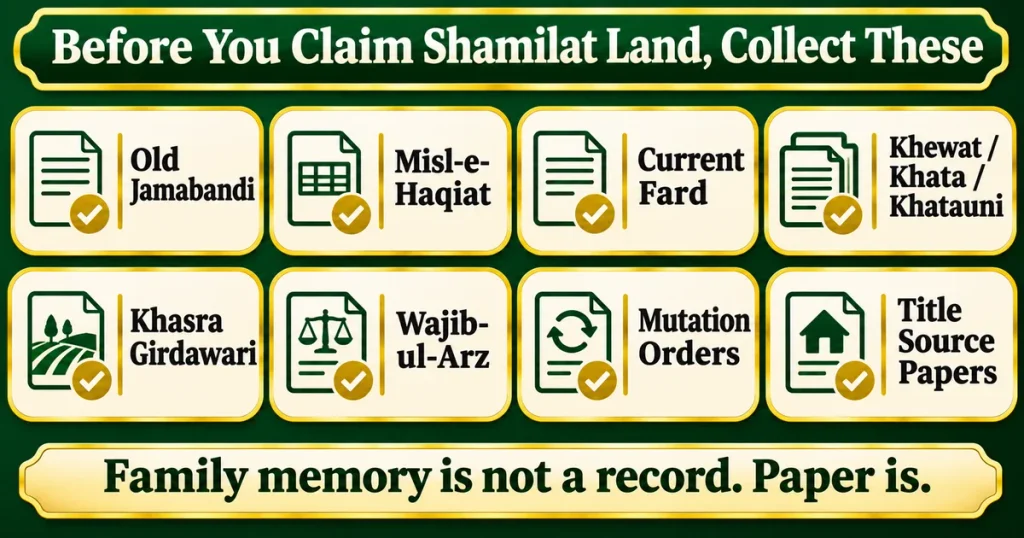
- The oldest Jamabandi and Misl-e-Haqiat (settlement record), not only today’s Fard
- Your current Fard from the Punjab Land Records Authority
- Khewat, Khata and Khatauni numbers of your land and of the Shamlat khata
- Khasra Girdawari over many years, to show the history of possession
- The village Wajib-ul-Arz
- Every mutation number with its sanction order, plus certified copies of earlier orders and judgments
- Papers for any land taken later: grant, lease, inheritance, sale or gift
5 Costly Mistakes to Avoid
- Treating cultivation as a title deed. Crops prove control, not ownership.
- Checking only the latest computerised Fard. The reason for today’s entry may sit in a record that is decades old.
- Buying without checking the Shamilat share. If the deed does not name it, you may not get it.
- Ignoring a wrong mutation. The 1962 and 1994 mutations here fuelled decades of litigation. A disputed entry may need a revenue appeal or a civil suit for declaration.
- Using force. Taking land by force can lead to criminal cases. See our guides on illegal possession and dispossession.
Which Forum Handles What?
| Problem | Usual forum |
|---|---|
| Wrong entry or mutation | Revenue Officer, then appeal and revision up to the Board of Revenue |
| Partition of joint agricultural land | Revenue Officer under Chapter XI of the Land Revenue Act |
| Dispute over title or ownership | Civil Court |
| Revenue order passed without lawful authority | High Court under Article 199 |
| Forcible occupation by land grabbers | Sessions Court under the Illegal Dispossession Act, 2005 |
Revenue appeals and revisions carry short time limits counted from the order date. Get certified copies at once and speak to a lawyer the same week.
Frequently Asked Questions About Shamilat Land
What is Shamilat Land in Pakistan?
It is village common land, usually recorded as Shamlat Deh. It belongs to the village proprietary body as a group, and each owner’s share depends on his ownership in the village. In Punjab, land described as Shamilat in the record of rights stays Shamilat even if someone holds it.
Can long possession make me the owner of Shamilat Land?
Not by itself. In 2025 SCMR 174, the majority held that possession and cultivation create no ownership when a person has no right in the proprietorship khata. Possession helps only when it is linked to a recorded right or a lawful transfer such as inheritance, grant or sale.
Can Shamilat Land be sold or bought?
A recorded co-owner’s share can pass in a transfer, but only if the Shamilat is specifically mentioned. Under the Punjab Saving of Shamilat Ordinance, 1959, general words in a sale deed do not carry the common-land share. Check the deed, the mutation and the Wajib-ul-Arz before paying.
How is Shamilat Land divided among villagers?
Usually by each owner’s share in the village proprietary khata, often worked out through Hasab Rasad Khewat and the Wajib-ul-Arz. In this case, the majority said the Shamlat must be shared among Adna Maliks and Ala-Khud-Adna Maliks in proportion to their proprietorship, not by possession.
What did 2025 SCMR 174 decide?
The Supreme Court dismissed Civil Appeals 936 to 938 of 2012 by a 2-1 majority on 16 September 2024. It held that the appellants had no title in the Shamlat Deh of Daggar Aulakh because possession alone was not enough. Justice Ayesha A. Malik dissented.
What is the difference between Ala Malik and Adna Malik?
Ala Maliks were the original settlers and superior owners. Adna Maliks were cultivators who entered through them and paid dues. MLR-64 abolished Ala-Malkiat, and the 1960 Notification made Adna Maliks full owners of land held by them as such. This system existed in Bhakkar, Muzaffargarh and Layyah.
Which documents prove a right in Shamilat Land?
Start with the old and current Jamabandi, Khewat and Khata entries, Misl-e-Haqiat, Khasra Girdawari and the Wajib-ul-Arz. Add every mutation with its sanction order and papers showing how your family got its share. One current Fard is rarely enough in a contested case.
Where should I go if a wrong Shamilat mutation is entered?
First, get a certified copy of the mutation and the order behind it. A revenue appeal or revision usually lies before the higher revenue officer within a short time. If ownership itself is disputed, a civil court may decide it. A lawyer can tell you which route fits your record.
Conclusion: Possession Tells a Story, the Record Decides the Claim
2025 SCMR 174 shows how Shamilat Land disputes can outlive generations. Two families can farm side by side for decades, and the case can still turn on a 1945 Jamabandi, a 1962 mutation or one line in the Wajib-ul-Arz.
The majority refused to turn bare possession into ownership. The dissent would have protected Adna Malik possession as it stood in March 1960. Both point to the same habit: before money or inheritance gets tied to common land, check the proprietary khata, trace every mutation and keep the old papers safe.
For more rulings like this, read our Supreme Court judgments section.
Disclaimer
This article is for legal awareness only and is not legal advice. Shamilat Land and revenue disputes depend on their own facts, old settlement records, local custom and earlier litigation. For your specific matter, consult a qualified lawyer.