
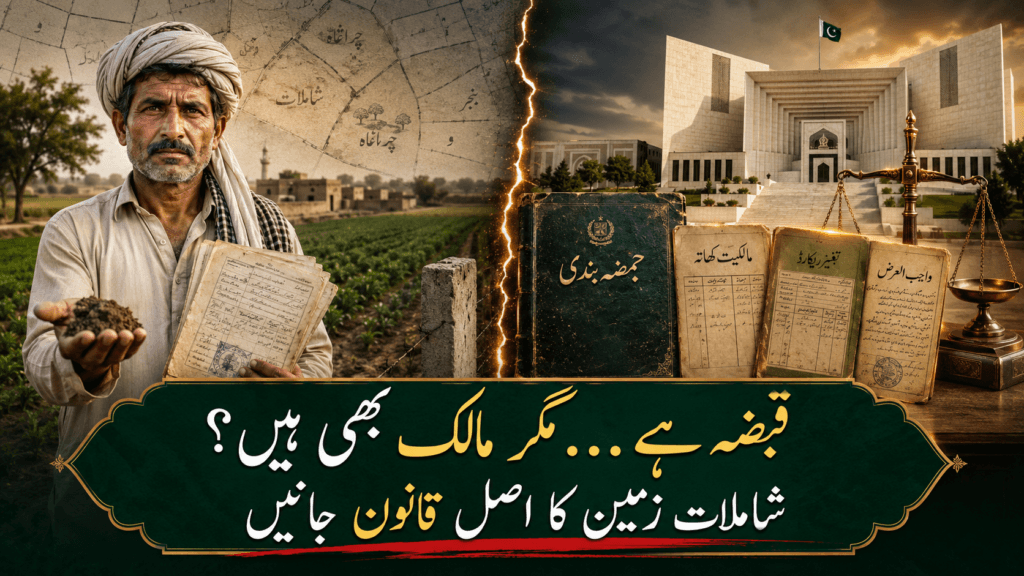
A family may cultivate the same field for decades and believe nobody can question its ownership. But when land is recorded as village common land, that belief can collapse in court. Shamilat Land disputes are often decided not by memory or physical control alone, but by old revenue records, proprietary status and the legal source of the claimant’s right.
The Supreme Court judgment reported as 2025 SCMR 174, Muhammad Ramzan and others v. Member (Judicial-II), Board of Revenue, Punjab, Lahore and others, is a major warning for anyone dealing with Shamilat Land. By a two-to-one majority, the Court dismissed the appeals and held that possession or cultivation alone could not give the appellants ownership where they failed to establish the required right in the proprietorship or malkiyat khata. Justice Ayesha A. Malik dissented and gave a different reading of MLR-64, the 1960 Notification and the old possession record.
Table of Contents
Shamilat Land Judgment at a Glance
| Point | Detail |
|---|---|
| Citation | 2025 SCMR 174 |
| Case | Muhammad Ramzan and others v. Member (Judicial-II), Board of Revenue, Punjab, Lahore and others |
| Court | Supreme Court of Pakistan |
| Bench | Yahya Afridi, Amin-ud-Din Khan and Ayesha A. Malik, JJ. |
| Decision Date | 16 September 2024 |
| Land | Shamlat Deh of village Daggar Aulakh, District Bhakkar |
| Main Dispute | Whether possession/cultivation could support proprietary rights in the disputed Shamlat Deh |
| Majority | Amin-ud-Din Khan, J.; Yahya Afridi, J. agreeing |
| Dissent | Ayesha A. Malik, J. |
| Majority Rule | Mere possession was not enough without the required legal entitlement in the proprietorship khata |
| Final Result | Civil Appeals Nos. 936, 937 and 938 of 2012 dismissed by majority |
The Shamilat Land case is important because it separates three ideas that are commonly mixed together: possession, cultivation and ownership. The majority treated legal entitlement in the village proprietary record as the controlling benchmark. The dissent, however, considered possession of Adna Maliks as of 03 March 1960 capable of translating into proprietary rights under MLR-64 and the 1960 Notification.
What Is Shamilat Land?
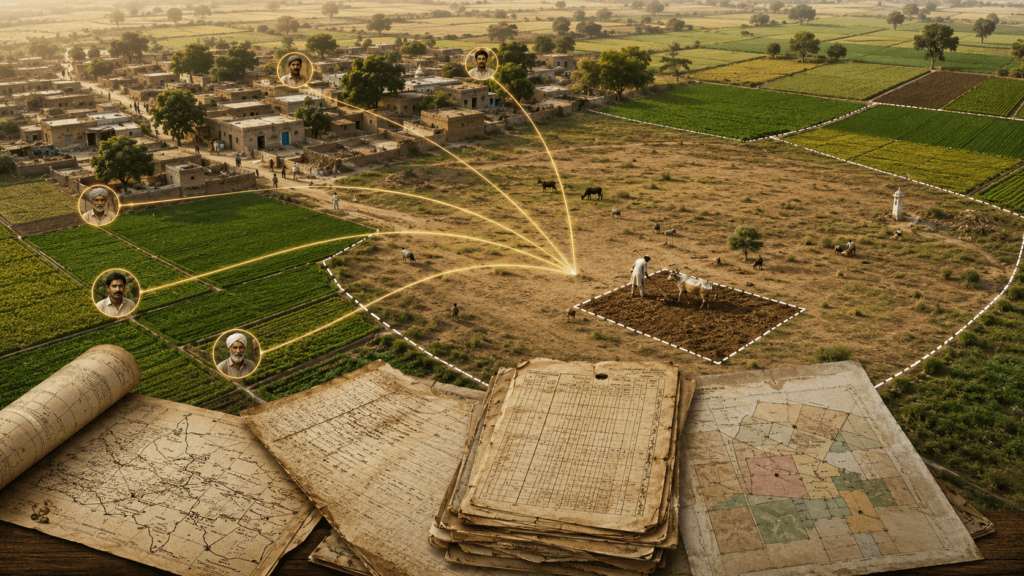
Shamilat Land, also written as Shamlat or Shamlat Deh in revenue records and judgments, broadly refers to common land connected with a village or its proprietary body. In the historical system discussed in 2025 SCMR 174, it included uncultivated or waste land around cultivated holdings, land available for village expansion, and areas used or managed according to village custom.
The judgment explains that the system was based on hissadari, or a share in the joint property of the village. The rights were not necessarily identical to an ordinary individually owned field. Old settlement documents, the Wajib-ul-Arz, Jamabandi, Khewat, Khasra Girdawari and the nature of the proprietary khata could therefore become extremely important.
This is the first public-awareness lesson: never assume that Shamilat Land is ordinary private property simply because one family has physically occupied or cultivated a portion of it. Before buying, selling, claiming, partitioning or litigating over such land, identify how the land is described in the record of rights and what legal status the claimant actually holds.
Ala Malik, Adna Malik and Ala-Khud-Adna Malik: Why These Terms Matter

A Shamilat Land dispute of this kind cannot be understood without three historical categories discussed by the Supreme Court.
Ala Malik
Ala Maliks were historically treated as superior or original landholders. Their claimed superior interest in the village and Shamlat Deh became central to the controversy.
Adna Malik
Adna Maliks were cultivators or inferior right-holders who entered upon and cultivated land through the old landholding system. Their possession and the effect of MLR-64 upon that possession became one of the most contested questions in the case.
Ala-Khud-Adna Malik
An Ala-Khud-Adna Malik was an Ala Malik who was himself in cultivating possession. The 1960 Notification became important because it dealt with the circumstances in which an Ala Malik who was also an Adna Malik, or who held land where there was no Adna Malik under him, could be treated as full proprietor.
Justice Ayesha A. Malik’s dissent explained that this dual system was particularly associated with Bhakkar, Muzaffargarh and Layyah. For readers researching Shamilat Land today, these terms should not be treated as labels only; they may determine which historical rights and revenue entries are legally relevant.
The Dispute Began Long Before the 2024 Supreme Court Decision
The Shamilat Land litigation concerned the Shamlat Deh of village Daggar Aulakh, District Bhakkar. The appellants relied on their status and possession as Adna Maliks and argued that MLR-64, the 1960 Notification and earlier litigation had protected or recognized their proprietary rights.
The respondents relied on the village proprietary system, Wajib-ul-Arz and Hasab Rasad Khewat. Their position was that the common land could not simply be distributed according to whoever happened to possess or cultivate it; entitlement had to follow the legally recognized proprietary arrangement.
This difference eventually produced decades of revenue proceedings and constitutional litigation. The case is not merely about who occupied the land. It asks what legal event converted—or failed to convert—possession into ownership.
MLR-64 and the 1960 Notification Changed the Old System
For Shamilat Land rights in this case, Paragraph 22 of the West Pakistan Land Reforms Regulation, MLR No. 64 of 1959, abolished Ala-Malkiat and similar intermediary interests. The 1960 Notification then addressed the consequences of that abolition.
Among other things, it provided that Adna Maliks were to be made full proprietors of land held by them as such. It also dealt with a person entered as both Ala Malik and Adna Malik, and with an Ala Malik holding land where there was no Adna Malik under him.
The appellants viewed these reforms as the legal bridge from possession to ownership. The majority did not accept that the reforms gave every person in physical possession an automatic title. Its reasoning focused on whether a claimant had the legally required entitlement in the malkiyat or proprietorship khata.
That distinction is essential when examining Shamilat Land: abolition of an old superior interest does not automatically prove that every person occupying common land acquired proprietary title.
The 1962 Mutation: The Conflict Became a Revenue Record Battle
After MLR-64 and the 1960 Notification, Mutation No. 1655 was entered on 13 June 1962 by the Assistant Collector-II, Bhakkar. In the dissent’s account of the history, the mutation followed customary practice and Hasab Rasad Khewat rather than giving effect to the possession-based claim advanced by Adna Maliks. Ala Maliks were consequently recorded as owners in the Shamlat Deh.
In this Shamilat Land dispute, the Adna Maliks challenged the mutation. On 28 January 1967, the Collector (Consolidation) set it aside and remanded the matter for determination of proprietary rights. The appeal by Ala Maliks was dismissed by the Additional Commissioner (Revenue) on 28 April 1967.
On remand, however, the Assistant Collector-II again did not grant the Adna Maliks the proprietary result they sought and continued to rely on Hasab Rasad Khewat. The conflict therefore remained alive.
A mutation may start a dispute lasting generations. Anyone dealing with Shamilat Land should preserve certified copies of the entire mutation chain rather than relying only on the latest Fard.
Revenue Proceedings From 1970 to 1983
The Shamilat Land matter again reached the Collector, Mianwali, who on 19 September 1970 accepted the position advanced by the Adna Maliks and directed treatment of the record in light of MLR-64 and the 1960 Notification.
The Commissioner, Sargodha dismissed the challenge by Ala Maliks on 30 March 1971. The matter then went to the Member (Revenue), Board of Revenue, Punjab, where the revision was dismissed on 20 May 1982. A review was also dismissed on 18 May 1983.
These stages matter because the record contained years of competing revenue interpretations about the same Shamilat Land.
The 1990 High Court and 1991 Supreme Court Litigation
The earlier litigation resulted in the Lahore High Court judgment reported as Ladhoo v. Board of Revenue, 1991 MLD 99. The case then reached the Supreme Court through Civil Petitions Nos. 823-L and 824-L of 1990. Those petitions were dismissed on 01 April 1991, and a review was dismissed on 02 February 1992.
In the later Shamilat Land appeals, the present appellants argued that these earlier decisions had already recognized the rights they were asserting. The majority in 2025 SCMR 174 rejected that reading. It held that the earlier litigation did not create a new right in favour of the present appellants merely because some passages could be read in their favour.
This is a vital legal-awareness point: never build a Shamilat Land claim by quoting one favourable line from an old judgment. The identity of the parties, the exact issue decided, the relief sought and the final operative order must all be examined.
The 1994 Mutations Started a New Round of Litigation

Mutations Nos. 2064, 2065, 2066 and 2067 were sanctioned on 27 and 28 February 1994. These entries became the foundation of the later challenge.
The appellants wanted the mutations and the subsequent revenue orders set aside. They argued that the earlier High Court and Supreme Court decisions, read with MLR-64 and the 1960 Notification, required recognition of their proprietary rights over the land in their possession and cultivation.
Their appeal before the Assistant Commissioner/Collector, Bhakkar was dismissed on 07 February 2001. Their revision was dismissed by the Executive District Officer (Revenue), Bhakkar on 26 November 2001. On 30 March 2005, the Member (Judicial-II), Board of Revenue also maintained the position against them and treated Wajib-ul-Arz as important to the distribution formula.
The Lahore High Court later dismissed their writ petitions on 02 July 2010. Leave to appeal was granted by the Supreme Court on 08 October 2012, and the final decision was delivered on 16 September 2024.
What Exactly Did the Appellants Ask the Supreme Court to Do?
The appellants wanted the challenged 1994 mutations and the later revenue orders declared illegal and ineffective. They also sought implementation of the earlier judgments in the manner they understood them.
In substance, their case was that they should be allowed to retain the land in their possession and cultivation as full proprietors. Their argument combined physical possession, the abolition of Ala-Malkiat, the 1960 Notification and the earlier Ladhoo litigation.
For a landowner, this shows why a Shamilat Land claim must identify the precise source of title. “My family has always cultivated it” is a factual statement. It is not, by itself, a complete legal chain of ownership.
What Did the Respondents and Punjab Government Argue?
In the Shamilat Land dispute, the respondents argued that the land was to be distributed according to the lawful share of the village proprietary body, not according to bare physical occupation. They relied on Wajib-ul-Arz, Hasab Rasad Khewat and the entitlement reflected in the village proprietary record.
The Government of Punjab also opposed the appellants’ broad possession-based claim. The dispute therefore became a direct contest between possession on one side and the legal formula for entitlement in the proprietary record on the other.
Seven Supreme Court Rules Every Shamilat Land Claimant Should Understand

1. Possession Alone Does Not Automatically Create Ownership
The majority’s clearest rule was that the appellants could not obtain title merely because they were in possession and cultivating the land. They failed to show the required legal status in the proprietary record.
This does not mean possession is always irrelevant. It means possession must be connected to a legally recognized right. In a Shamilat Land case, the first question should therefore be: what is the legal source of this possession?
2. The Malkiyat or Proprietorship Khata Is Crucial
The majority treated entitlement in the malkiyat khata as the benchmark for distribution. A person with no right in the proprietorship khata could not demand a share merely because he physically occupied common land.
For practical verification, obtain the old and current:
- Jamabandi;
- Khewat and Khata entries;
- relevant mutation orders;
- Khasra Girdawari;
- Misl-e-Haqiat; and
- Wajib-ul-Arz.
Do not depend only on oral statements from relatives or local intermediaries.
3. Old Revenue Entries Continue Until Lawfully Replaced
The judgment also restated an important revenue-record principle: an existing entry remains in the field until it is replaced through a valid legal process, such as a binding court decree or valid correction or mutation. If an entry is found to have been unlawfully changed, the earlier lawful entry may continue to operate.
This makes the history of Shamilat Land records as important as the latest computerized extract. A new entry should always be traced back to the order or mutation through which it arose.
4. MLR-64 Did Not Give an Automatic Windfall to Every Possessor
The majority accepted the legal effect of the abolition of Ala-Malkiat but rejected the idea that the reforms converted every occupation into ownership. The claimant still had to fit within the legal framework recognized by the Regulation, the Notification and the proprietary record.
That is why anyone relying on MLR-64 should identify exactly which category he or his predecessor fell into and how that status appeared in the relevant record.
5. Wajib-ul-Arz Can Be Highly Important
For the majority, Wajib-ul-Arz supported the distribution of Shamlat according to the ownership of the village proprietary body. It could not simply be ignored because someone had developed or cultivated a piece of common land.
But the dissent gave Wajib-ul-Arz a different weight where it conflicted with MLR-64. This difference between the majority and dissent is important: the document must be read together with the governing law and the historical record, not in isolation.
6. Courts Cannot Create a Property Right That Has No Legal Foundation
The Supreme Court majority made a broader constitutional point. The High Court under Article 199 and the Supreme Court under Article 185 cannot manufacture a new proprietary right for a litigant who has no existing legal basis for that right.
This is especially important in emotional Shamilat Land disputes. Long occupation, hardship or family history may explain why a case matters, but the court still requires a legally enforceable right.
7. Distribution Follows the Legally Entitled Proprietary Body, Not a Race to Occupy
The majority ultimately held that the relevant distribution was between the recognized categories forming the proprietary body—Adna Maliks and Ala-Khud-Adna Maliks under the 1960 framework discussed by the Court—in proportion to their proprietorship. Bare possession by a person with no right in the proprietorship khata could not become the basis of a grant.
This rule is a protection against the dangerous idea that common village property can be privatized simply by taking physical control first.
The Majority Judgment: Why the Appeals Were Dismissed
Justice Amin-ud-Din Khan authored the majority opinion, with Justice Yahya Afridi agreeing. The majority found that the appellants could not satisfactorily establish their legal status beyond possession and cultivation. They were not shown as the relevant Adna Malik or Ala-Khud-Adna Malik right-holders in the proprietary land on which their claim depended.
The majority further held that the earlier Ladhoo decisions had been misread. Those judgments did not create a proprietary right in favour of the present appellants. A court could not convert an earlier decision involving a different issue into a new title.
It then linked Shamlat distribution to entitlement in the proprietorship khata and the village proprietary body. Under this reasoning, a person with no proprietary right could not obtain Shamilat Land merely because he occupied or cultivated it.
In the Shamilat Land appeals, the majority therefore found no ground to interfere with the High Court and revenue authorities. All three civil appeals were dismissed.
Justice Ayesha A. Malik’s Dissent: A Different Route to Ownership

Justice Ayesha A. Malik disagreed with both the reasoning and the result. Her dissent examined the history of village common land, the old dual system of Ala and Adna ownership, MLR-64, the 1960 Notification, the old settlement record and the earlier litigation in detail.
In her view, MLR-64 abolished the superior rights of Ala Maliks. The 1960 Notification then made Adna Maliks full proprietors of land held by them as such. She relied heavily on the uncontested Jamabandi of 1945-46 and Khasra Girdawari for 1958-62 as evidence of Adna Malik possession.
The dissent treated 03 March 1960 as the critical point. According to Justice Malik, whatever relevant land the Adna Maliks lawfully possessed at that time could translate into proprietary rights under MLR-64 and the Notification.
She did not, however, say that every later occupation should automatically become ownership. If an Adna Malik claimed additional land acquired after the relevant period, the claimant had to show a lawful source such as:
- grant;
- lease;
- inheritance; or
- another valid transfer of title.
If excess land had no legal backing, the revenue authority had to determine that question through due process, and the land could be resumed by the Government where the law so required.
Even the dissent did not endorse unlimited possession-based ownership; it demanded a date-specific, record-based inquiry.
Majority vs Dissent: The Difference in One Table
| Question | Majority | Justice Ayesha A. Malik’s Dissent |
|---|---|---|
| Is physical possession enough? | No, not without legal entitlement in proprietorship khata | Possession as of 03 March 1960 could translate into proprietary rights for Adna Maliks under MLR-64 |
| Earlier Ladhoo litigation | Did not create the claimed new right for present appellants | Recognized Adna Malik rights when read with MLR-64 and the record |
| Wajib-ul-Arz | Supported distribution according to the proprietary body | Could not defeat MLR-64 where inconsistent with it |
| Key record | Proprietorship/malkiyat khata and lawful entitlement | 1945-46 Jamabandi and 1958-62 Khasra Girdawari were crucial |
| Post-1960 excess possession | Bare possession insufficient | Must be justified by grant, lease, inheritance or lawful transfer |
| Result | Appeals dismissed | Appeals should have been allowed |
| Legal effect | Binding majority decision | Persuasive dissent, not the final order |
What Documents Should You Collect in a Shamilat Land Dispute?
Do not walk into a revenue office or court with only a current Fard and a statement that your family has occupied the land for years. Build a documentary chain.
Collect, where relevant:
- current and historical Jamabandi / Register Haqdaran Zamin;
- Khewat, Khata and Khatoni details;
- Misl-e-Haqiat or settlement record;
- Khasra Girdawari showing cultivation and possession over time;
- Wajib-ul-Arz of the village;
- all relevant mutation numbers and sanction orders;
- partition orders or maps, if any;
- sale deeds, grants, leases, inheritance mutations or gift documents relied upon as the source of later title;
- certified copies of earlier revenue, High Court or Supreme Court orders; and
- documents showing how your predecessor acquired the proprietary status you now claim.
Punjab landowners can also use the official Punjab Land Records Authority and its Fard guidance for available land-record services. The PLRA guidance page also provides the Punjab Land Revenue Act, 1967 and revenue rules.
For current mutation, inheritance and revenue-procedure changes, readers may also consult our guide on the Punjab Land Revenue Ordinance 2026.
Five Costly Mistakes People Make With Shamilat Land
Mistake 1: Treating Cultivation as a Title Deed
A crop, tube-well, boundary wall or long possession may prove physical control, but it does not necessarily prove the proprietary right required by the majority in 2025 SCMR 174.
Mistake 2: Checking Only the Latest Computerized Record
The dispute in this case travelled through records and mutations stretching back decades. Old Jamabandis, Khasra Girdawari, settlement papers and the order behind a mutation may explain why the present entry exists.
Mistake 3: Buying a Share Without Investigating the Nature of the Land
Before paying money for Shamilat Land, verify whether the seller actually has the proprietary share being sold, whether the land is still joint, and whether the claimed right is supported by the historical revenue chain.
Mistake 4: Ignoring a Wrong Mutation Until the Next Generation
The 1962 and 1994 mutations in this case became central to decades of litigation. If a mutation appears unlawful or inconsistent with your claimed right, obtain the underlying order and legal advice instead of assuming the problem will disappear.
Where a mutation is alleged to be fraudulent or legally ineffective, our guide on a Civil Suit for Declaration explains another property-law context in which the underlying title and evidence become decisive.
Mistake 5: Using Force Instead of Legal Process
A co-sharer or claimant should not try to settle a disputed land right through force. If a dispute involves alleged forcible occupation or dispossession, the legal issues can be different from a revenue-title dispute. Our guide on the Illegal Dispossession Act 2005 explains that separate remedy.
A Practical 8-Step Action Plan Before Claiming Shamilat Land
- Identify the exact Khewat, Khata, Khatoni and Khasra numbers.
- Confirm whether the land is actually recorded as Shamlat/Shamilat and in whose name or proprietary body.
- Obtain the oldest relevant Jamabandi and settlement record, not only the current Fard.
- Trace every mutation through which the claimed right changed.
- Compare physical possession with Khasra Girdawari.
- Read the village Wajib-ul-Arz and determine the applicable proprietary formula.
- Identify the lawful source of any possession acquired later: inheritance, grant, lease, purchase, gift or another valid transfer.
- Before filing a case, read earlier judgments and revenue orders as a whole and determine what right was actually decided.
If the land is inherited and remains joint, the issues of partition can also become important. Our guide on Partition of Inherited Land in Pakistan explains why possession of one particular portion does not automatically erase the shares of other co-owners.
What 2025 SCMR 174 Means for Ordinary Citizens
The biggest value of this judgment is not a technical definition. It is a warning about proof.
A villager may know who has cultivated a field for forty years. A family may remember which elder cleared the land. Neighbours may know who fenced it. But a Shamilat Land dispute can still turn on a century-old settlement entry, the proprietorship khata, Wajib-ul-Arz, a mutation order, or the legal status of the person who first entered possession.
The majority says possession cannot replace the missing legal foundation. The dissent says historical possession of Adna Maliks could have proprietary consequences under MLR-64, but even that approach requires the correct date, record and legal source.
Both opinions therefore teach the same practical discipline: preserve the record before the dispute becomes irreversible.
Final Decision of the Supreme Court
For Shamilat Land law, the final order is important. By a majority of two to one, with Justice Ayesha A. Malik dissenting, Civil Appeals Nos. 936, 937 and 938 of 2012 were dismissed.
That means the majority reasoning controls the result of 2025 SCMR 174. The dissent remains valuable for legal analysis and future argument, but it did not change the operative order.
For Shamilat Land claimants, the safest takeaway is not “possession never matters” and not “possession always wins.” The safer rule is:
Possession must be tied to the correct legal status, proprietary record and source of title.
Frequently Asked Questions About Shamilat Land
What is Shamilat Land?
It is common village land recorded or historically treated as Shamlat/Shamilat and connected with the village proprietary body. Its ownership and use may depend on settlement records, proprietary shares, Wajib-ul-Arz and other revenue documents rather than physical possession alone.
Can long possession make me owner of Shamilat Land?
Under the majority in 2025 SCMR 174, possession or cultivation alone did not create ownership where the claimant lacked the required legal right in the proprietorship khata. The legal source of possession and the revenue record must be examined.
What is the most important document in a Shamilat dispute?
There is no single document for every case. Relevant records may include Jamabandi, proprietorship Khewat/Khata, Misl-e-Haqiat, Khasra Girdawari, Wajib-ul-Arz and mutation orders. Their value depends on the dispute and the history of the land.
What did MLR-64 do?
Paragraph 22 of MLR No. 64 of 1959 abolished Ala-Malkiat and similar intermediary interests. The 1960 Notification dealt with the consequences, including full proprietary treatment of Adna Maliks in land held by them as such. The majority and dissent disagreed about how these provisions applied to the appellants’ claim.
What did Justice Ayesha A. Malik say about possession on 03 March 1960?
Her dissent treated possession of Adna Maliks as of 03 March 1960 as capable of translating into proprietary rights under MLR-64 and the 1960 Notification. For additional land acquired later, she required proof of a lawful source such as grant, lease, inheritance or valid transfer.
Can an old court judgment automatically create ownership for me?
No. The majority held that the High Court and Supreme Court cannot create a new proprietary right where no existing legal right supports it. An earlier judgment must actually have decided the right you now claim.
What should I do before filing a Shamilat Land case?
First collect the historical and current revenue record, trace the mutation chain, identify your proprietary status, compare possession with Khasra Girdawari, read Wajib-ul-Arz and earlier orders, and obtain case-specific legal advice. Do not rely only on possession, family memory or one current Fard.
Conclusion: Possession Tells the Story, but Legal Entitlement Decides the Claim
2025 SCMR 174 shows why village common-land disputes can survive for generations. The parties fought over old proprietary categories, land reforms, possession, Wajib-ul-Arz, revenue mutations and the meaning of earlier judgments.
The Supreme Court majority ultimately refused to convert bare possession into ownership without the required proprietary entitlement. The dissent would have protected proven Adna Malik possession existing at the critical 1960 stage, while requiring a lawful basis for later excess possession.
For anyone dealing with Shamilat Land, the practical message is simple: do not wait for litigation to discover what the record says. Verify the proprietary khata, preserve old documents, trace every mutation and identify the legal source of possession before money, inheritance or family expectations become tied to the land.
Disclaimer
This article is for legal awareness and education. Shamilat and revenue disputes are highly fact-specific and may depend on historical settlement records, provincial law, amendments, local custom, and previous litigation. Obtain advice from a qualified lawyer or revenue-law professional before acting on a particular property claim.