
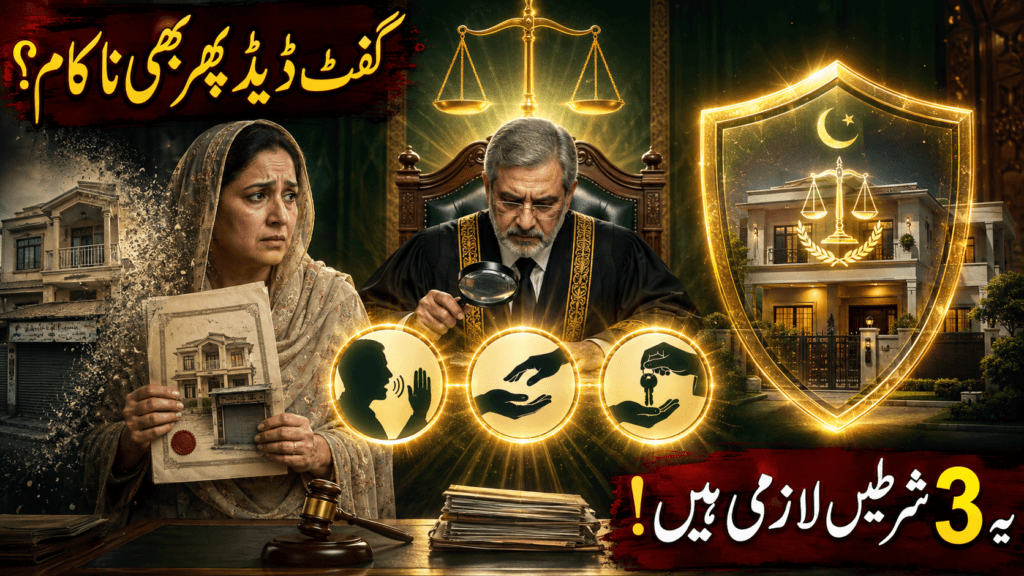
A husband signs a gift deed in favour of his wife. The document mentions a house and a shop. Years later, the wife goes to court believing that the paper proves her ownership. The Trial Court accepts her claim—but the Appellate Court reverses the decision, the High Court agrees, and finally the Supreme Court refuses to protect the alleged gift.
Why did a written gift deed fail?
Because a valid gift in Pakistan is not created by paper alone. The person relying on the gift must prove that the donor clearly offered the property, the donee accepted it, and possession was actually or legally delivered.
This is the powerful lesson from Mst. Edan Bibi v. Naseem Khan and others, reported as 2026 SCMR 499. The case involved a wife, a disputed gift deed, a house, a shop, dower property and an inheritance mutation. The wife kept the house transferred to her in lieu of dower, but she lost the house and shop claimed under the gift deed because the essential ingredients of the gift were not proved.
For every parent, spouse, property owner and legal heir, this judgment carries one clear warning:
Do not confuse a signed document with a completed gift.
Table of Contents
Judgment at a Glance: Supreme Court Gift Case
| Detail | Information |
|---|---|
| Case | Mst. Edan Bibi v. Naseem Khan and others |
| Citation | 2026 SCMR 499 |
| Court | Supreme Court of Pakistan |
| Bench | Justice Naeem Akhter Afghan and Justice Muhammad Shafi Siddiqui |
| Case number | Civil Petition No. 1189 of 2025 |
| Decision date | 22 April 2025 |
| Impugned judgment | Peshawar High Court, Abbottabad Bench |
| Gift deed date | 11 May 2010 |
| Property allegedly gifted | One house and one shop |
| Separate transaction | House transferred to wife in lieu of dower |
| Challenged mutation | Inheritance Mutation No. 949 dated 28 July 2011 |
| Main defect | Offer, acceptance and delivery of possession not proved |
| Supreme Court result | Petition dismissed and leave refused |
The Supreme Court heard the petition against the Peshawar High Court judgment dated 27 February 2025.
IRAC Analysis: Why the Gift Deed Could Not Save the Property
| IRAC Element | Court’s Position |
|---|---|
| Issue | Whether the wife had proved ownership of the house and shop through the Gift Deed dated 11 May 2010 and whether the Supreme Court should interfere with the concurrent findings below. |
| Rule | A completed Muslim gift requires a clear offer or declaration, acceptance by the donee and delivery of possession. A party challenging concurrent findings must identify material misreading, non-reading, illegality or irregularity. |
| Analysis | The Appellate Court examined the witnesses and exhibited documents in detail. It found that the alleged gift lacked proof of offer, acceptance and delivery of possession. The High Court maintained that finding. Before the Supreme Court, the petitioner could not identify which part of the evidence had been ignored or misread. |
| Conclusion | The Supreme Court refused to interfere, dismissed the petition and refused leave to appeal. |
What Is a Valid Gift in Pakistan?
A gift is a voluntary transfer of existing property from one person to another without receiving a price in return. Under Muslim law, it is commonly known as hiba.
The person who gives the property is called the donor. The person who receives it is called the donee.
A valid gift in Pakistan requires more than affection, family understanding or a paper carrying the word “gift.” The transaction must show that the donor intended to transfer ownership immediately and that the donee accepted and received the property.
Readers dealing with a written instrument should also study our detailed guide on Gift Deed in Pakistan, which explains how courts examine written hiba, retained possession, registration and inheritance mutations. The linked Qanooni Dastak article is live and deals specifically with a failed gift claim. (Qanooni Dastak)
The general statutory framework is found in the official Transfer of Property Act, 1882. Section 129 preserves the rules of Muslim law relating to gifts. The official Act is available through Pakistan Code, an initiative of the Ministry of Law and Justice.
Valid Gift in Pakistan: The Three Requirements That Decide the Case

Pakistani courts repeatedly examine three essential ingredients:
- Declaration or offer by the donor.
- Acceptance by the donee.
- Delivery of possession.
The claimant must prove all three as parts of one genuine and completed transaction.
1. A Clear and Voluntary Declaration by the Donor
The donor must clearly declare that the identified property is being gifted to the donee.
The declaration should show an immediate intention to transfer ownership. A statement that property “will belong” to someone in the future may not prove a present gift.
The declaration should answer these questions:
- Who is making the gift?
- Who is receiving it?
- What exact property is being gifted?
- What share or area is included?
- When is ownership being transferred?
- Is the donor acting voluntarily?
- Does the donor understand the transaction?
A valid gift in Pakistan may become doubtful where the donor:
- remains unaware of the deed;
- denies the transaction;
- was made to sign blank papers;
- was elderly, seriously ill or dependent;
- could not understand the document;
- was subjected to pressure or deception; or
- intended the transfer to operate only after death.
A genuine gift transfers an existing property through a present and voluntary decision. It should not remain a secret future arrangement known only to the beneficiary.
2. Acceptance by the Donee
The donee must accept the gift during the donor’s lifetime.
Acceptance may be proved through:
- signatures on the deed;
- a statement before witnesses;
- appearance before the registering or revenue authority;
- taking possession;
- taking control of tenants;
- receiving rent;
- obtaining keys;
- managing the property; or
- another clear act showing acceptance.
Where the donee is a minor, acceptance may be made through a legally competent guardian. The document and evidence should identify the guardian and explain how the gift was accepted on the minor’s behalf.
A valid gift in Pakistan may fail where the alleged donee did not know about the gift, never accepted it, or first claimed it after the donor’s death.
3. Delivery of Actual or Constructive Possession
Possession is usually the most disputed ingredient.
The court asks whether the donor genuinely surrendered control and whether the donee obtained control.
Delivery may be actual or constructive, depending on the nature of the property and the relationship between the parties.
Actual possession may include:
- physical occupation;
- delivery of house or shop keys;
- removal of the donor from exclusive control;
- cultivation of agricultural land;
- management of the property; or
- physical control over the gifted portion.
Constructive possession may be established through:
- transfer of rent collection;
- instructions to tenants;
- society ownership records;
- revenue entries supported by the original transaction;
- property tax records;
- control over title documents;
- utility accounts; or
- another legally meaningful change in control.
A person cannot safely prove a valid gift in Pakistan by merely saying, “Possession was delivered.” The evidence must explain when, where and how it happened.
The Emotional Story Behind 2026 SCMR 499
Mst. Edan Bibi filed a civil suit against Naseem Khan and other defendants for:
- declaration;
- injunction; and
- possession.
She claimed that her husband had transferred a house to her in lieu of dower. She also claimed that he had gifted a separate house and shop to her through a Gift Deed dated 11 May 2010.
She further challenged Inheritance Mutation No. 949 dated 28 July 2011 concerning the disputed properties.
The Civil Court at Haripur framed issues, recorded evidence and decreed the suit through its judgment dated 15 September 2021.
At that stage, the wife appeared to have won.
But the dispute did not end there.
Why the Appellate Court Split the Two Property Transfers

The respondents challenged the Trial Court decree before the Additional District Judge-III, Haripur.
The Appellate Court partly accepted their appeal. It treated the two transactions separately instead of assuming that both had the same legal foundation.
The Court:
- upheld the house transferred to the wife in lieu of dower;
- set aside the Trial Court decree relating to the Gift Deed dated 11 May 2010; and
- restored Inheritance Mutation No. 949.
The Peshawar High Court later examined the matter in revision and agreed with the Appellate Court.
This distinction is one of the strongest lessons in the judgment.
A dower transfer and a gift are not automatically the same transaction. A transfer in satisfaction of dower may have its own legal basis, documents and evidence. A gratuitous gift must independently satisfy the requirements of Muslim gift law.
A valid gift in Pakistan cannot borrow legal strength from another transaction merely because both properties were allegedly transferred by the same husband to the same wife.
Why Did the Gift Deed Fail Before the Supreme Court?
Before the Supreme Court, the petitioner’s lawyer argued that the Appellate Court and High Court had wrongly appreciated the evidence.
However, a general allegation of incorrect appreciation is not enough.
The Supreme Court examined:
- the Trial Court judgment;
- the Appellate Court judgment;
- the High Court judgment;
- the witnesses’ depositions; and
- the documents produced in evidence.
The Court noted that the First Appellate Court had discussed the witnesses and documents in detail.
The two courts below had found the gift incomplete because of the absence of satisfactory proof of:
- offer;
- acceptance; and
- delivery of possession.
The petitioner could not show:
- which witness statement was misread;
- which document was ignored;
- which material evidence was not considered;
- what illegality had occurred; or
- how proper consideration of that evidence would have changed the result.
The Supreme Court therefore refused to interfere with the concurrent findings and dismissed the petition.
Valid Gift in Pakistan Does Not Mean “Valid Gift Deed Only”
Many families make the dangerous mistake of treating the deed as the entire transaction.
A deed can help prove:
- the identity of the donor;
- the identity of the donee;
- the description of the property;
- the date;
- the donor’s stated intention;
- the signatures or thumb impressions; and
- the presence of witnesses.
But a deed may not prove that possession was actually delivered.
It may also fail where:
- its execution is denied;
- its witnesses are not produced;
- the donor did not understand it;
- the property description is uncertain;
- it contains a future condition;
- it contradicts the mutation;
- the donor remained in exclusive possession; or
- the deed was created only to defeat natural heirs.
A person relying on a valid gift in Pakistan must prove the complete chain, not one isolated paper.
Is an Oral Gift Legally Possible?

Under Muslim law, a gift may be oral if its essential ingredients are properly pleaded and proved.
An oral gift does not mean that evidence is unnecessary. It usually requires even greater factual clarity because there is no formal deed recording the transaction.
The claimant should plead and prove:
- the exact date;
- the approximate time;
- the place;
- the persons present;
- the words used by the donor;
- the donee’s acceptance;
- the property description; and
- the method of delivering possession.
Our article on Oral Gift in Pakistan explains how the Supreme Court treats vague oral gift claims and mutations used to exclude female heirs. That live article is based on 2026 SCMR 587 and emphasises independent proof of the original gift. (Qanooni Dastak)
An oral valid gift in Pakistan is legally possible, but a vague family story unsupported by dates, witnesses and possession is not enough.
Is Registration Compulsory for Every Gift?
This question requires careful treatment.
The Transfer of Property Act, 1882 contains the general provisions concerning gifts of property, while section 129 preserves Muslim law relating to gifts.
The official Registration Act, 1908 regulates the registration of documents affecting immovable property. (Pakistan Code)
The legal result may depend on whether:
- the gift was completed orally before the document;
- the writing merely records an already completed oral gift;
- the document itself creates or declares the property right;
- possession was delivered;
- Muslim personal law applies; and
- registration is required by the nature of the instrument.
Therefore, it is unsafe to apply one general sentence to every case.
Registration creates an official record and reduces future disputes, but it does not automatically prove declaration, acceptance and possession.
Similarly, the absence of a registered deed does not automatically defeat every Muslim oral gift where a completed hiba is proved through reliable evidence.
For practical safety, obtain case-specific legal advice before relying on an unregistered document.
Is Mutation Enough to Establish Ownership?
Mutation records a change in the revenue record. It is important, but it is not a substitute for proof of the original transaction.
The beneficiary must first prove that the gift genuinely occurred. The mutation should then be proved through the relevant revenue proceedings and witnesses where it is disputed.
A mutation may become suspicious where:
- the donor never appeared before the Revenue Officer;
- the donor’s statement is missing;
- the identifying witnesses are not produced;
- the mutation was entered secretly;
- possession never changed;
- the donor continued treating the property as his or her own;
- natural heirs remained unaware; or
- the mutation surfaced only after the donor’s death.
For Punjab land, readers can review the official Entry and Attestation of Mutations guidance published by the Punjab Land Records Authority. PLRA states that transfers through sale, gift, inheritance or court order should be entered and verified in the official land record through the prescribed mutation process. (Punjab Land Records Authority)
A valid gift in Pakistan becomes stronger where the deed, mutation, possession and subsequent conduct all support the same transaction.
Who Carries the Burden of Proving the Gift?
The person who relies on the gift and claims ownership through it must prove the transaction.
The burden becomes especially serious where the alleged gift:
- excludes daughters or sisters;
- benefits one child over all others;
- appears after the donor’s death;
- involves an elderly donor;
- involves an illiterate or parda nasheen woman;
- benefits a person who controlled the donor’s affairs;
- covers nearly all the donor’s property;
- is based on a disputed thumb impression;
- lacks independent witnesses; or
- contradicts long-standing possession.
Where an aged or parda nasheen woman denies making a gift, our article on Cancellation of Gift Deed in Pakistan explains how courts examine consent, mutation, thumb impressions, possession and the beneficiary’s burden. The linked page is active and concerns a Peshawar High Court judgment protecting a parda nasheen property owner. (Qanooni Dastak)
A valid gift in Pakistan should be capable of surviving strict scrutiny even after the donor is no longer available to testify.
Evidence That Can Save a Genuine Gift
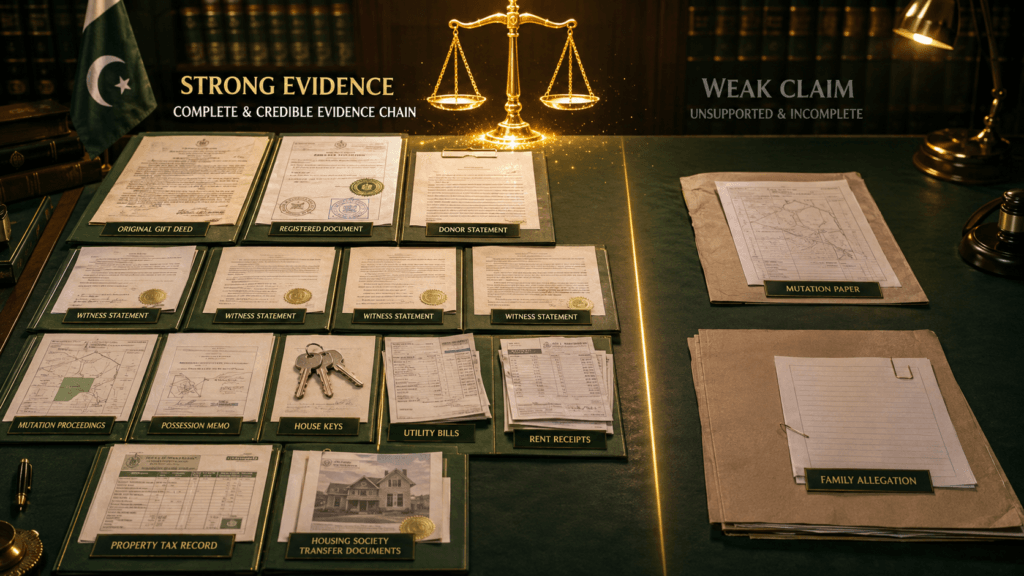
A strong gift claim usually contains a connected chain of evidence.
Documentary Evidence
Preserve:
- the original gift deed;
- certified registration record;
- title documents;
- mutation order;
- donor’s recorded statement;
- society transfer documents;
- property tax record;
- utility account changes;
- tenancy documents;
- rent receipts;
- possession memo;
- identity documents; and
- a clear property plan or description.
Oral Evidence
Produce witnesses who actually saw or heard:
- the declaration;
- the acceptance;
- the signing or thumb impression;
- the delivery of keys;
- the change of possession; and
- the donor’s voluntary conduct.
A witness who learned about the gift later may not prove what happened at the original transaction.
Conduct After the Gift
Courts may examine:
- who occupied the property;
- who received rent;
- who cultivated the land;
- who paid taxes;
- who dealt with tenants;
- who kept the keys;
- who repaired the property;
- who exercised ownership; and
- whether the donor later sold or transferred the same property.
A valid gift in Pakistan becomes much easier to defend when the conduct after the transaction matches the documents.
Seven Shocking Mistakes That Can Destroy a Gift
Mistake 1: Signing a Deed Without Delivering Possession
This is the central mistake highlighted by 2026 SCMR 499.
A donor may sign a deed, but if control remains unchanged and the donee cannot prove possession, the court may find that the gift was never completed.
Mistake 2: Depending Only on Mutation
Mutation may support the gift, but it cannot replace proof of declaration, acceptance and possession.
The original transaction and the revenue entry should both be proved.
Mistake 3: Keeping the Gift Secret Until the Donor Dies
A claim first announced after death naturally becomes difficult to test.
The donor cannot explain the circumstances, and the heirs may allege fraud, forgery or fabrication.
Mistake 4: Using Witnesses Who Were Never Present
A relative who merely heard about the gift cannot reliably prove the donor’s exact declaration or delivery of possession.
Use credible witnesses who personally observed the transaction.
Mistake 5: Giving an Unclear Property Description
A deed should identify the property through relevant details such as:
- plot or house number;
- khasra number;
- area;
- share;
- boundaries;
- location;
- title document; and
- society or revenue particulars.
A court cannot safely enforce an uncertain transfer.
Mistake 6: Using a General Power of Attorney Without Gift Authority
A property owner may appoint an attorney for management, litigation or sale-related work. That does not automatically authorise the attorney to gift away the property.
Our live guide on Gift Deed Through Power of Attorney explains that express authority is crucial where an attorney attempts to make a gift on behalf of the owner.
A valid gift in Pakistan through an attorney requires careful examination of the exact authority granted by the principal.
Mistake 7: Assuming a Trial Court Victory Ends the Dispute
Edan Bibi initially obtained a favourable Trial Court decree. However, the Appellate Court reassessed the evidence, separated the dower transfer from the gift claim and reversed the decree concerning the gift deed.
Winning before one court does not cure weak evidence.
The original evidence must be complete enough to survive appeal and revision.
Can Property Be Gifted to a Wife or One Child?
A person may make a genuine lifetime gift to:
- a wife;
- a husband;
- a son;
- a daughter;
- another legal heir;
- a relative; or
- an unrelated person.
The relationship between donor and donee does not remove the legal requirements.
A gift to one child is not proved merely because the donor loved that child or lived with him. Similarly, a gift to a wife is not proved only through the marital relationship.
A valid gift in Pakistan made to a close relative must still show declaration, acceptance and delivery of possession.
Where a disputed gift is used to deprive daughters or sisters, readers should also review Women Inheritance Rights in Pakistan. That active article explains how courts protect female heirs against old mutations and unsupported exclusion claims. (Qanooni Dastak)
A Sister’s Inheritance Is Not a Gift
Inheritance and gift are legally different.
A daughter or sister receives inheritance by operation of succession law after the owner’s death. Her inherited share is not a favour or voluntary gift from her brothers.
A lifetime gift, on the other hand, depends on the donor voluntarily completing the transfer before death.
This distinction matters where male heirs claim that the deceased gifted all property to them and therefore left nothing for the daughters.
The alleged donees must prove the gift. Female heirs do not have to accept a vague family claim merely because a mutation exists.
Can a Donor Keep Living in the Gifted House?
Continued residence does not produce the same answer in every case.
The court may consider:
- the relationship between the parties;
- whether the donor and donee lived together;
- whether legal control changed;
- who collected rent;
- who held the keys;
- whether the donor expressly retained a limited right;
- whether the transfer was immediate or postponed; and
- whether the conduct supports constructive possession.
However, where the donor remains the exclusive controller and the donee exercises no ownership, continued possession may seriously weaken the gift.
Readers dealing with retained possession or future conditions should review Conditional Gift in Muslim Law, which examines how conditions may affect the completion of hiba. The page is active and addresses conditional gift disputes. (Qanooni Dastak)
Can a Completed Gift Be Cancelled?
Cancellation and revocation are technical legal questions.
The result may depend on:
- whether the gift was ever completed;
- whether possession was delivered;
- the relationship between the parties;
- whether the property still exists;
- whether the donee transferred it onward;
- whether either party has died;
- whether consideration was involved; and
- whether fraud, coercion or forgery is alleged.
A donor should not assume that signing a cancellation deed automatically restores ownership.
Similarly, a donee should not assume that every document described as a gift is irrevocable.
The first question is often whether a valid gift in Pakistan was completed in the first place.
What Court Case Can Be Filed Against a False Gift?
The proper remedy depends on the documents and possession.
A claimant may require:
- a suit for declaration;
- cancellation of the gift deed;
- cancellation or correction of mutation;
- recovery of possession;
- permanent injunction;
- mandatory injunction; or
- another appropriate relief.
In 2026 SCMR 499, the underlying suit sought declaration, injunction and possession under the Specific Relief Act framework.
The official Specific Relief Act, 1877 is available on Pakistan Code.
Readers facing a fraudulent deed or revenue entry can also read Civil Suit for Declaration in Pakistan, which explains declaration, cancellation, possession and injunction in property disputes. (Qanooni Dastak)
The exact prayer clause should be drafted according to:
- the document being challenged;
- the person in possession;
- the date of knowledge;
- the limitation position;
- the nature of the mutation; and
- the relief required.
Why Witnesses and Best Evidence Matter
The court does not decide a disputed gift through emotional claims alone.
Where execution, possession or mutation is denied, relevant witnesses and original documents become important.
The official Qanun-e-Shahadat Order, 1984 contains Pakistan’s federal evidentiary framework.
Depending on the dispute, the best available evidence may include:
- the scribe;
- marginal witnesses;
- the registering officer;
- revenue officials;
- identifying witnesses;
- the person who delivered possession;
- tenants;
- neighbours;
- original registers; and
- certified public records.
Withholding important evidence may damage the credibility of the beneficiary’s story.
Why Concurrent Findings Are Difficult to Reverse
The Supreme Court did not simply decide whether it personally preferred one version of the evidence.
It examined whether the petitioner had identified a material legal or evidentiary defect in the concurrent findings of the Appellate Court and High Court.
She could not identify:
- a specific misreading;
- a specific non-reading;
- an illegal conclusion;
- a material irregularity; or
- ignored evidence capable of changing the outcome.
That is why the Supreme Court refused leave.
This teaches litigants to build the record at the Trial Court stage. A weak claim to a valid gift in Pakistan cannot always be rebuilt after losing before two courts.
Practical Checklist Before Making a Property Gift
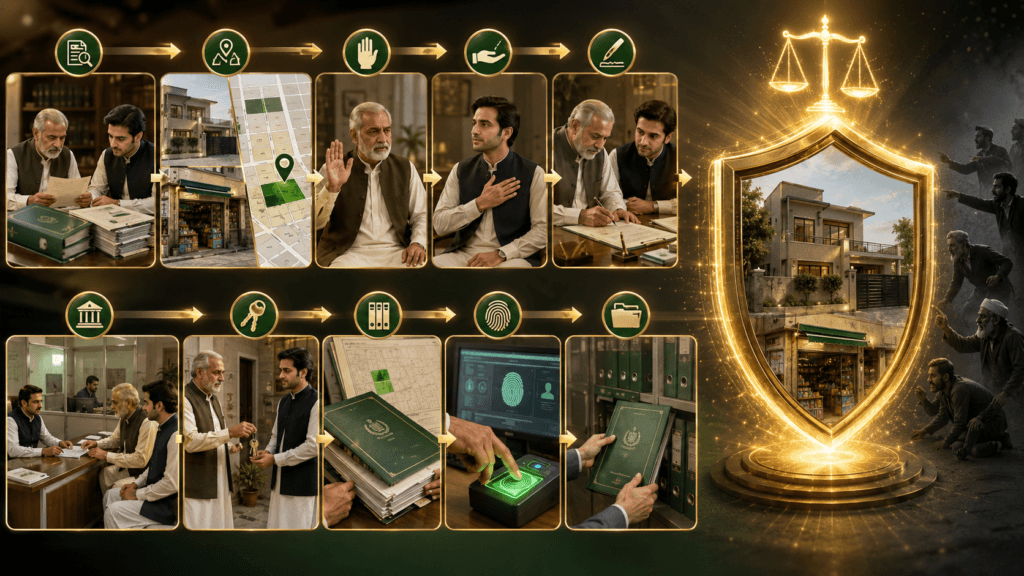
| Step | What You Should Verify |
|---|---|
| Donor’s ownership | Confirm that the donor legally owns the property or gifted share |
| Donor’s capacity | Confirm age, mental capacity, understanding and free consent |
| Property details | Record the exact area, boundaries, khasra, plot or house number |
| Declaration | State clearly that the gift is immediate and voluntary |
| Acceptance | Record acceptance by the donee or lawful guardian |
| Possession | Deliver actual or constructive possession |
| Witnesses | Use credible witnesses who are genuinely present |
| Documentation | Prepare an accurate deed or written memorandum |
| Registration | Complete registration where legally required or advisable |
| Mutation | Record the transfer through the relevant revenue process |
| Other records | Update society, tax, tenancy and utility records where applicable |
| Evidence | Preserve originals, certified copies and possession proof |
| Legal review | Obtain advice before excluding heirs or using an attorney |
This checklist cannot guarantee that litigation will never arise, but it can prevent the most common evidentiary failures.
Final Decision: The Paper Survived, but the Gift Did Not
The Supreme Court dismissed Mst. Edan Bibi’s petition and refused leave to appeal.
The house transferred to her in lieu of dower remained protected. The separate house and shop claimed through the Gift Deed dated 11 May 2010 did not remain protected because the essential ingredients of the alleged gift were not proved.
Inheritance Mutation No. 949 was restored.
The final message of 2026 SCMR 499 is direct:
A valid gift in Pakistan is not proved by the name of the document. It is proved by a voluntary declaration, real acceptance, delivery of possession and credible supporting evidence.
A carefully completed gift may protect a loved one.
An incomplete gift deed may instead begin years of family conflict, appeals and property litigation.
Frequently Asked Questions
What are the three requirements of a valid gift in Pakistan?
The claimant must prove:
A clear declaration or offer by the donor.
Acceptance by the donee.
Delivery of actual or constructive possession.
A document or mutation cannot automatically replace any missing ingredient.
Is a registered gift deed enough to prove ownership?
No. Registration is strong documentary evidence, but courts may still examine consent, acceptance, possession, witnesses and subsequent conduct.
A registered deed may fail if the underlying transaction was fraudulent, involuntary or incomplete.
Can an oral gift of immovable property be valid?
A Muslim oral gift may be recognised where its declaration, acceptance and delivery of possession are properly pleaded and proved.
The claimant should provide clear particulars of the date, place, witnesses and transfer of possession.
Is mutation compulsory for a valid gift in Pakistan?
Mutation is important for updating revenue records, particularly for land, but mutation alone is not conclusive proof of the original gift.
The underlying declaration, acceptance and possession must still be established when disputed.
Who must prove a disputed gift?
The person claiming ownership through the gift normally carries the burden of proving it.
The court may apply closer scrutiny where the gift excludes natural heirs, benefits one dominant family member or involves an elderly, illiterate or dependent donor.
Why did the gift fail in 2026 SCMR 499?
The Appellate Court and High Court found that offer, acceptance and delivery of possession had not been proved.
The petitioner also failed to identify any specific evidence that the lower courts had ignored or misread. The Supreme Court therefore dismissed the petition.
Can a gift deed be challenged after the donor’s death?
Yes, depending on the facts, limitation and relief claimed.
Legal heirs may challenge a deed or mutation on grounds such as fraud, forgery, lack of consent, incomplete gift, absence of possession or failure to prove execution. Prompt legal advice is important because delay can affect the available remedy.
Disclaimer
This article provides general legal awareness about property gifts and 2026 SCMR 499. It does not provide case-specific legal advice.
The validity of a gift depends on personal law, the nature of the property, provincial land procedures, documents, possession, limitation and evidence. Anyone making or challenging a gift should consult a qualified Pakistani lawyer.