


The last date has gone. FBR’s extended deadline for the FBR Tax Return for Tax Year 2026 ended on 31 October 2026, and no further extension has been announced. On 1 November, FBR updated the Active Taxpayers List (ATL), and anyone who had not filed, or applied for an extension, was left off.
You can still file today. But your return now counts as late, and late filing has a price: a Rs25,000 surcharge to get back onto the ATL, higher withholding tax until you do, and a possible penalty notice. Waiting longer only makes it worse.
Rushing has its own danger. A forgotten bank account, a car bought from unexplained cash or the wrong tax year can turn a quick filing into a notice months later.
This guide starts with 7 urgent steps for late filers, then explains the full process in simple English: who must file, NTN vs ATL, IRIS steps, Form 114(I), the Wealth Statement, salary rates, refunds, the ATL surcharge and revision.
Table of Contents
FBR Tax Return 2026: Quick Answers at a Glance
| Question | Short answer |
|---|---|
| What is the last date? | It was 31 October 2026. No further extension has been announced, so a return filed now is late. |
| Which period does Tax Year 2026 cover? | Normally 1 July 2025 to 30 June 2026 |
| What about companies? | Generally 31 December 2026 for a normal tax year |
| Where do I file? | Online through FBR’s IRIS portal |
| Is an NTN enough? | No. Registration, annual filing and ATL status are different |
| What does an individual complete? | Return of Income and Wealth Statement |
| When is filing complete? | When both forms move from Draft to Completed Task |
| What does late filing cost for ATL? | Rs25,000 for an individual under section 182A |
| Can I still file now? | Yes. IRIS still accepts the return, but late-filing consequences apply. |
The safest FBR Tax Return is not the one with the lowest tax. It is the one you can still explain a year later.
Last Date Passed? 7 Urgent Steps to File Your FBR Tax Return Late
Missing the deadline is not the end of the road. What you do in the next few days decides how much it finally costs you. Follow these steps in order.
- Stop waiting for another extension. FBR has not extended the date beyond 31 October 2026. Believe a new date only if FBR itself announces it.
- Check whether you applied for an extension in time. If you submitted an extension application under section 119 before the deadline, your status depends on the Commissioner’s decision. Check IRIS for the order first.
- Collect records for the right period. Tax Year 2026 covers 1 July 2025 to 30 June 2026. Gather salary certificates, bank statements, withholding certificates and asset papers for that period only.
- File both forms in IRIS. Complete the Return of Income and the Wealth Statement, and make sure both move from Draft to Completed Task.
- Pay any tax due. If your return shows tax payable, pay it through a PSID and keep the CPR. The ATL surcharge is a separate payment.
- Deal with the ATL surcharge. An individual pays Rs25,000 under section 182A to get back onto the ATL. FBR has also published a draft “no property purchase for six months” undertaking (Form ATL-U), but do not rely on it until the final rule is notified and the form appears in IRIS.
- Confirm your ATL status and watch for notices. After paying, send ATL [space] 13-digit CNIC to 9966. Keep the acknowledgement, CPRs and screenshots, and reply on time if a section 182 penalty notice arrives.
FBR Tax Return Deadline Passed on 31 October 2026: What Happened
On 15 October 2026, FBR issued Circular No. 04 of 2026-27 under section 214A of the Income Tax Ordinance, 2001. It extended the date to 31 October 2026 for persons who were required to file by 30 September 2026 and whose date had already moved to 15 October 2026. FBR said it acted on requests from trade bodies and tax bar associations.
| Date | What happened |
|---|---|
| 30 September 2026 | Original due date for individuals and AOPs |
| 30 September 2026 | Circular No. 3 of 2026-27 extended it to 15 October 2026 |
| 15 October 2026 | Circular No. 04 of 2026-27 extended it to 31 October 2026 |
| 31 October 2026 | Extended deadline ended; no further extension announced |
| 1 November 2026 | FBR updated the ATL; those who had not filed were left off |
This extension does not cover everyone. A company with a normal tax year still generally files by 31 December 2026. A special tax year or a separate individual extension can change your date.
By the 31 October deadline, more than 7.8 million returns had been filed, according to media reports citing FBR sources. Tax bar associations asked for more time, but FBR has not granted another extension. If you were not among those who filed, your Tax Year 2026 return is now a late return.
Official FBR Income Tax Due Dates
Beware Fake “New Extension” Messages After 31 October
On 30 September 2026, FBR publicly called one circulating “extension circular” fake. Its genuine extension came later that same day. Messages like these spread fast on WhatsApp.
Requests for more time from tax bar associations are not an extension. Trust only FBR’s website, its official social media accounts or a numbered circular issued under section 214A. Until FBR itself announces a new date, treat your Tax Year 2026 return as late and file it now. Waiting for a rumour only keeps you off the ATL for longer.
First Check: Are You Filing the Right Tax Year?
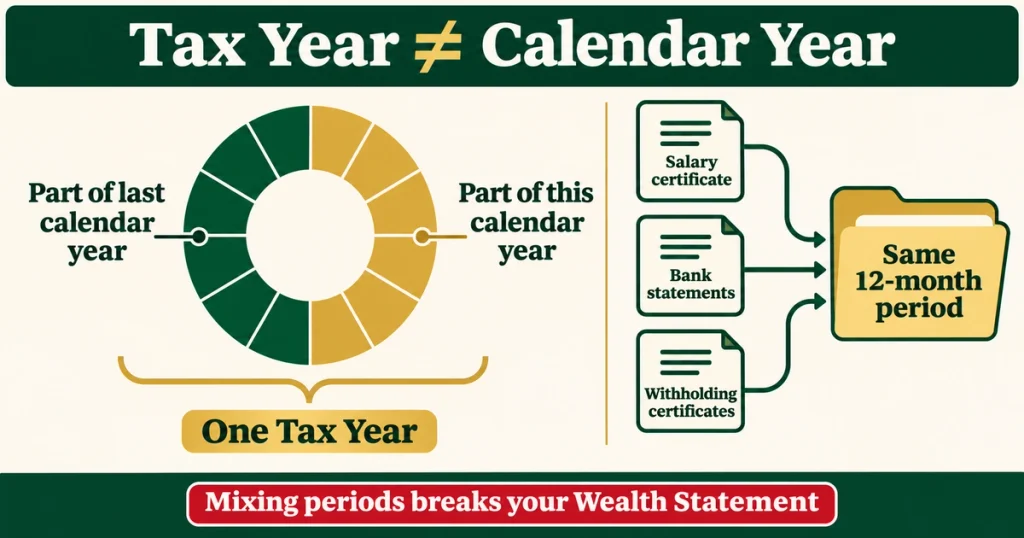
“2026” does not mean January to December 2026.
Note: The image above shows 30 September 2026, the standard due date. For Tax Year 2026, FBR has extended the FBR Tax Return deadline to 31 October 2026.
“2026” does not mean January to December 2026.
FBR treats a normal tax year as the twelve months ending on 30 June. So the FBR Tax Return for Tax Year 2026 normally covers 1 July 2025 to 30 June 2026.
Your salary certificate, business receipts, bank profit, rent, asset purchases, withholding tax and expenses should all come from that period. Mixing calendar-year records places income from one year beside assets from another, and the Wealth Statement stops making sense.
Who Must File an FBR Income Tax Return in Pakistan?
Most people ask only one question: “Did I earn enough to pay tax?” That is the wrong test.
Section 114 of the Income Tax Ordinance, 2001 creates the filing duty on more than one basis. Depending on the conditions for the tax year, it can cover companies, persons whose taxable income crosses the threshold, certain business and asset categories, persons claiming carried-forward losses and others named in the section.
So no tax payable does not automatically mean no return required. Thresholds change through Finance Acts, so check the current section rather than an old social-media list. For a simple explanation of the law, read our Income Tax Ordinance 2001 Guide.
Even where filing is not compulsory, many people file by choice. A filed FBR Tax Return documents your income and assets. That record helps when a bank, a property buyer or a tax officer later asks where your money came from.
Filer vs Non-Filer: What You Lose by Not Filing
Skipping the return is rarely a real saving. In most cases it costs more over time.
| Area | On the ATL | Not on the ATL |
|---|---|---|
| Withholding tax | Normal rates | Higher rates on many transactions |
| Property, vehicles, securities | Normal processing | Higher deductions and possible section 114C limits |
| Getting onto the ATL | Immediate if filed on time | Only after the section 182A surcharge |
| Your financial record | Income and assets documented | Savings and purchases harder to explain |
| Legal exposure | Lower if figures are true | Possible notice and section 182 penalty |
Withholding tax is deducted on many everyday transactions, such as bank profit, property deals, vehicle registration and contracts. For many of these, a person not on the ATL pays at a higher rate. FBR publishes current figures in its withholding tax rate card.
Section 114C, added by the Finance Act 2025, introduced the idea of an “eligible person”. It allows limits on ineligible persons for high-value vehicles, immovable property, securities and certain cash withdrawals. These limits work from dates and thresholds the Federal Government notifies, so check the current position before a big purchase.
Broadly, an eligible person has filed the previous year’s return and declared enough resources in the Wealth Statement. That is one more reason a truthful, complete FBR Tax Return matters: it is the record you will rely on later.
NTN, Return and ATL: Three Different Things
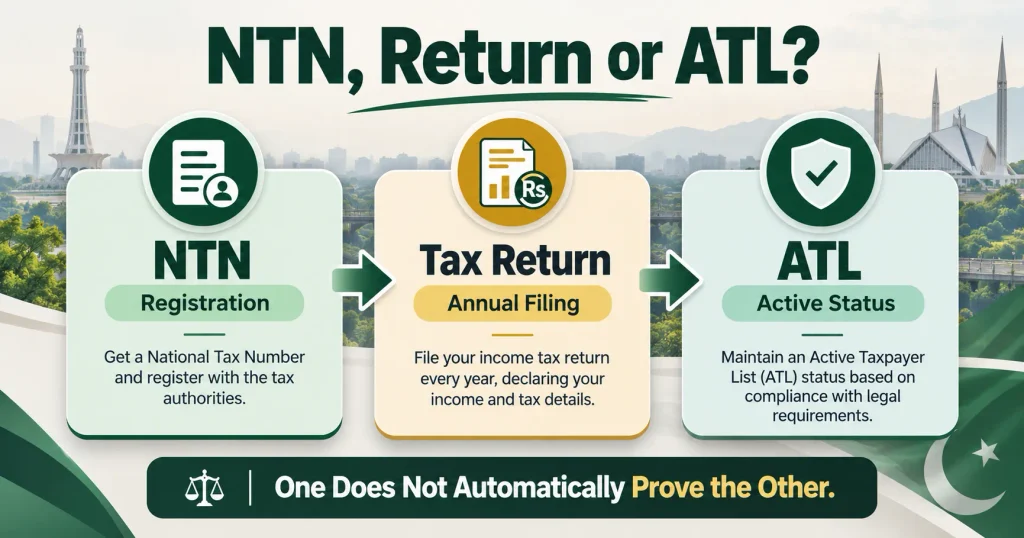
Having an NTN does not prove you filed this year’s return.
| Record | What it generally proves | What it does not prove |
|---|---|---|
| NTN or registration | Registration with FBR | Latest annual return was filed |
| FBR Tax Return | Return submitted for a tax year | Every figure is correct |
| CPR | Tax payment was made | Annual return was submitted |
| Completed Task | IRIS task was completed | ATL status by itself |
| ATL status | Active status under current ATL rules | Accuracy of complete tax history |
For an individual, the CNIC generally works as the registration number after registration. If you are unsure, use our guide on Online NTN Verification by CNIC. For the registration certificate, see our FBR NTN Certificate Guide.
An “NTN tax return” is not a separate tax. The NTN identifies you; the annual return reports one tax year.
Documents to Collect Before You Open IRIS
A good FBR Tax Return starts before login.
| Taxpayer | Useful records |
|---|---|
| Salaried person | Salary certificate, banks, withholding, investments and assets |
| Government employee | Salary/tax certificate, allowances, banks and property |
| Freelancer | Invoices, contracts, platform statements, bank receipts and expenses |
| Business owner | Sales, purchases, expenses, stock, banks, assets and loans |
| Landlord | Tenancy, rental trail, ownership and withholding evidence |
| Investor | Bank profit, brokerage/CDC records, dividends and disposals |
| Pensioner | Pension certificate, banks, investments and other income |
| Overseas Pakistani | Travel/residence evidence, remittances and Pakistan records |
Compare it with last year’s return and Wealth Statement, but do not copy old figures blindly. An old mistake does not become correct just because nobody questioned it.
Salaried People: Is Form 114(I) Right for You?
Most employees want the simplest lawful route. FBR provides Declaration Form 114(I) for persons who earn only from salary and other sources, where salary is more than 50% of income.
But “salaried” does not mean salary is your only financial activity. Bank profit, rent, investments, capital gains, freelance work, vehicles and property may still need reporting. Government employees should also reconcile allowances, withholding and assets.
Your FBR Income Tax Return should match your real financial life, not merely the shortest form available.
Freelancers and Businesses: Follow the Money
For freelancers, consultants and sole proprietors, bank deposits should make sense against declared receipts. Keep invoices, contracts, platform statements, foreign-payment evidence and genuine expense documents.
A transfer between your own accounts should not be counted twice. Money from abroad is not automatically tax-free just because the bank calls it a “remittance”; residence, source and the nature of the receipt still matter.
A defensible FBR Tax Return explains what each large receipt actually was.
Pensioners and Overseas Pakistanis Need Care
A pensioner may also receive bank profit, rent or investment income, so do not simply copy a salary calculation into the return.
For an FBR Tax Return filed by an overseas Pakistani, residence and source are the key tests. Citizenship, a NICOP and receiving remittances are not the same legal question. Keep travel history, remittance records and evidence of any Pakistan-source income or Pakistani assets before claiming special treatment.
How to File FBR Income Tax Return Online Through IRIS
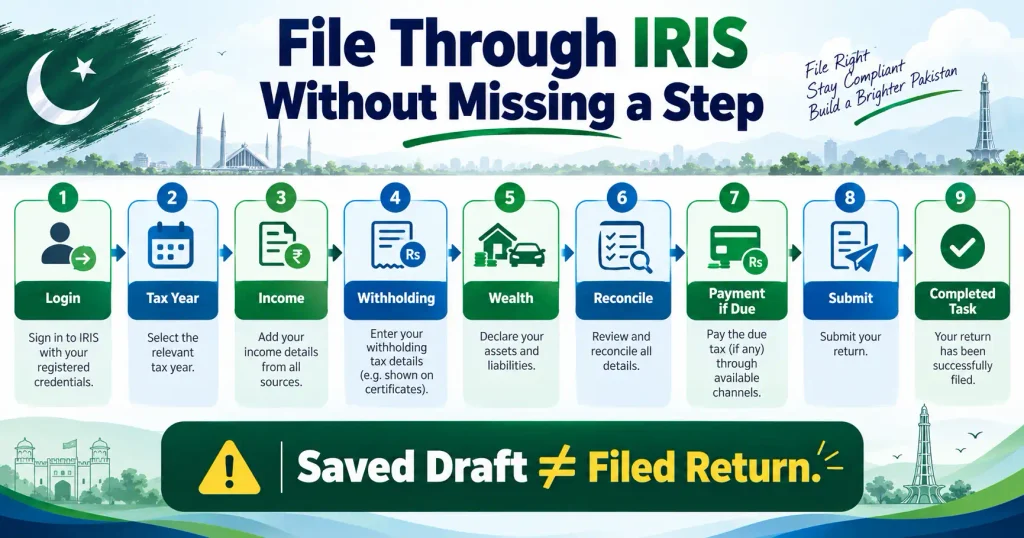
Online filing becomes much easier when you follow one order.
| Step | What to do | Main check |
|---|---|---|
| 1 | Log in to IRIS | Use the official FBR portal |
| 2 | Open Declaration | Choose the return-filing route |
| 3 | Select tax year | Confirm the correct tax year |
| 4 | Choose the form | Match it to your income profile |
| 5 | Enter income | Salary, property, business, gains and others |
| 6 | Review withholding | Match deductions with records |
| 7 | Complete wealth details | Assets, liabilities, cash, banks and expenses |
| 8 | Reconcile wealth | Investigate unexplained difference |
| 9 | Pay tax if due | Use the correct payment reference and keep CPR |
| 10 | Submit | Confirm Completed Task |
FBR’s official guide confirms that an individual completes both the Return of Income and the Wealth Statement in IRIS. First-time filers must register before they can file.
Official FBR Income Tax Return Filing Guide
FBR also offers the Tax Asaan mobile app for many individuals; check that your return type is supported there first. Never share your IRIS password, PIN or OTP with an unknown agent, caller or WhatsApp “helper”.
IRIS Slow or Stuck? 5 Practical Tips
Many taxpayers reported IRIS slowdowns this season. These habits reduce last-minute stress:
- File now. You cannot get back onto the ATL until your return is filed.
- Try quieter hours, such as early morning or late night.
- Save your work often, but remember a saved draft is not a filed return.
- Keep the CPR and screenshots of any error message.
- After submitting, check Completed Task and save the acknowledgement the same day.
Five Income Heads That Change the Tax Result
Pakistan’s income tax law broadly uses five heads: Salary, Property, Business, Capital Gains and Other Sources.
Classification matters. A property sale price is not automatically a taxable gain. A loan is not income just because money entered your bank. Freelance receipts should not be hidden inside salary. Your FBR Income Tax Return should show the true legal character of each large amount.
Why the Wealth Statement Refuses to Balance

For many individuals, this is the hardest part of an FBR Tax Return.
FBR says the Wealth Statement will submit only when your wealth has changed from last year by the same amount that your income exceeded, or fell short of, your expenses. A useful working idea is:
Opening Wealth + Explained Inflows − Expenses/Outflows = Closing Wealth
Suppose money already in your bank buys a car. You have mostly changed one asset into another; you have not created the whole car value as new wealth. A genuine loan may raise your cash while also creating a liability. A genuine inheritance or gift may explain an increase, but the paper trail should exist.
Common errors include omitted accounts, guessed cash, missing household expenses, purchases with no funding source and transfers counted twice. Never invent a gift, loan or cash figure just to make the FBR Tax Return reconcile.
Tax Year 2026 Salary Rates: Use the Right Table
Your FBR Tax Return for Tax Year 2026 concerns income from 1 July 2025 to 30 June 2026. The salaried rates for that period came through the Finance Act 2025 framework. Do not swap in later Tax Year 2027 rates just because you are filing in October 2026.
| Annual taxable income | Tax Year 2026 rate |
|---|---|
| Up to PKR 600,000 | 0% |
| PKR 600,001–1,200,000 | 1% above PKR 600,000 |
| PKR 1,200,001–2,200,000 | PKR 6,000 + 11% above PKR 1,200,000 |
| PKR 2,200,001–3,200,000 | PKR 116,000 + 23% above PKR 2,200,000 |
| PKR 3,200,001–4,100,000 | PKR 346,000 + 30% above PKR 3,200,000 |
| Above PKR 4,100,000 | PKR 616,000 + 35% above PKR 4,100,000 |
For Tax Year 2026, a 9% surcharge on income tax also applied to a salaried individual whose taxable income exceeded PKR 10 million. Finance Act 2026 later removed it for the next framework, so do not apply that change backwards to Tax Year 2026 income.
These rates are not a universal table for business individuals, AOPs or companies.
Withholding Tax Is Not Automatically a Refund
Tax may be deducted through salary, bank profit, contracts, property, vehicles and other transactions. But not every deduction is refundable. Before claiming an amount, check:
- whose CNIC or NTN carries the deduction;
- which tax year it belongs to;
- the provision under which it was deducted; and
- whether its legal treatment is adjustable, minimum, final or otherwise.
A refund built on misclassified withholding makes an FBR Tax Return much harder to defend later.
What If Your FBR Tax Return Shows a Refund?
A refund figure inside the return is not the same as money in your bank.
FBR runs a separate refund process. It asks taxpayers to add the IBAN of the same bank account already listed in their IRIS profile so refunds can be paid electronically.
Official FBR Income Tax Refund Guidance
Keep your filed return, withholding certificates, payment evidence and refund application. Claim a refund only where the amount is legally refundable and belongs to the correct taxpayer and tax year.
Submitted or Still Draft? Check This Before Exit
This takes seconds and can prevent a major mistake.
FBR says successful online submission is confirmed when the Return of Income and Wealth Statement move from Draft to Completed Task. A filled form, a saved draft or a CPR alone does not prove your FBR Tax Return was submitted.
After filing, save the acknowledgement, the submitted return, the Wealth Statement, the computation and payment evidence.
Missed 31 October? The Rs25,000 ATL Surcharge Explained

You can still file after 31 October 2026. But a late FBR Tax Return and a timely one do not carry the same consequences.
FBR’s ATL rules say a return filed by the due date or within an extension puts you on the ATL straight away. A return filed after that date gets you onto the ATL only after you pay the surcharge under section 182A. Finance Act 2026 raised that surcharge:
| Taxpayer | Section 182A surcharge | Earlier amount |
|---|---|---|
| Individual | PKR 25,000 | PKR 1,000 |
| Association of Persons | PKR 50,000 | PKR 10,000 |
| Company | PKR 100,000 | PKR 20,000 |
Official FBR Finance Act 2026 Page
Do not mix up three different things: the section 182A surcharge for getting onto the ATL, a penalty under section 182 for not filing on time, and the tax you actually owe. They are separate legal consequences. Paying one does not cancel the others.
Being outside the ATL has other effects too. While you are off the list, refunds may be held back, and a late filer can lose the right to carry forward business losses for that tax year. If you expect a refund or have business losses, filing late costs more than the surcharge alone.
Is there a way to join the ATL without paying Rs25,000? On 6 October 2026, FBR published a draft rule (SRO 1691(I)/2026) introducing Form ATL-U. Under the draft, an individual who files late could join the ATL without the surcharge by undertaking, through IRIS, not to buy or acquire any property for six months. At the time of this update, we could not find a final notification. Until FBR notifies the final rule and the form appears in IRIS, plan on paying the Rs25,000 surcharge.
How to Check Your ATL Status After Filing
Some older FBR pages still mention weekly Monday updates. Through S.R.O. 1638(I)/2024, FBR moved ATL updating to a daily basis.
FBR Announcement on Daily ATL Updates
An individual can send ATL [space] 13-digit CNIC to 9966. An AOP or company sends ATL [space] 7-digit NTN to the same number. If you filed late, your status may change only after the surcharge is paid.
Found an Error After Filing? Use Revision Lawfully
IRIS accepting an FBR Tax Return does not make a wrong figure legally correct.
If you discover an omission or wrong statement, use the revision route available under section 114 and the current IRIS procedure. Do not hide the error in next year’s figures. A Wealth Statement has its own revision rules, and the route can change once a notice or proceeding has started.
9 FBR Tax Return Mistakes That Can Cost You
Most FBR Tax Return problems come from a few repeated habits. Check yourself against this list.
| Mistake | Why it matters |
|---|---|
| Waiting for another extension after 31 October | You stay off the ATL longer and keep paying higher withholding |
| Using January–December records | It mixes two tax years |
| Treating NTN as annual filing | Registration is not filing |
| Copying prefilled data blindly | Third-party data may be incomplete |
| Leaving out freelance or side income | Bank records may tell a different story |
| Guessing closing cash | Wealth reconciliation becomes unreliable |
| Calling every foreign receipt a remittance | Source and residence still matter |
| Claiming every withholding as refundable | Legal treatment differs |
| Paying tax but leaving forms in Draft | Payment and filing are separate |
Final FBR Income Tax Return Checklist Before You Submit
- Taxpayer details and Tax Year 2026 are correct
- All income heads are entered, including side income
- Withholding matches certificates and statements
- Banks, cash, property, vehicles and investments are complete
- Loans, gifts, inheritance, asset sales and foreign receipts have records
- The Wealth Statement reconciles truthfully
- Any tax due is paid and the CPR is saved
- Both forms show in Completed Task and the acknowledgement is saved
- If filing late, the section 182A surcharge is paid and its CPR saved
A final FBR Tax Return review now is far easier than explaining an invented balancing figure later.
Frequently Asked Questions about FBR Tax Return
1. How do I file an FBR Tax Return online in Pakistan?
Log in to FBR’s official IRIS portal, select Tax Year 2026 and the right form, and enter your income and withholding. Complete the Wealth Statement, reconcile it honestly and pay any balance tax through the proper route. Then submit and confirm both forms appear under Completed Task. Some individuals can also use FBR’s Tax Asaan app. A saved draft is not a filed return.
2. What is the last date for FBR Tax Return 2026?
The last date was 31 October 2026 for persons who were originally due on 30 September 2026. FBR first extended it to 15 October through Circular No. 3 of 2026-27, then to 31 October through Circular No. 04 of 2026-27 under section 214A. No further extension had been announced at the time of this update, so a return filed now is late. Companies with a normal tax year generally file by 31 December 2026.
3. What happens if I file my FBR Income Tax Return after 31 October?
Your return is accepted, but it counts as late. You are not added to the Active Taxpayers List until you pay the section 182A surcharge: Rs25,000 for an individual, Rs50,000 for an AOP and Rs100,000 for a company. Until then, higher withholding rates can apply, refunds may be held back, and a separate penalty under section 182 is possible. File as soon as you can.
4. Do I need to file if my income is below the taxable limit?
Possibly. Section 114 creates a filing duty on several grounds, not income alone, so “no tax payable” does not always mean “no return required”. Even where filing is optional, a filed FBR Tax Return keeps you on the ATL, helps you avoid higher withholding and documents your income and assets. Check the current section 114 conditions against your own facts.
5. Which FBR income tax return form should a salaried person use?
FBR provides Declaration Form 114(I) for persons whose income comes only from salary and other sources, where salary is more than 50% of income. But the right filing depends on your actual facts. Salary plus freelance work, rent, investments, property or other activity may need additional reporting in the income heads and Wealth Statement.
6. Why is my Wealth Statement not reconciling?
Usually something is missing, duplicated or placed in the wrong year. Check opening wealth, cash, bank balances, assets, liabilities, income, household expenses, loans, gifts, inheritance, remittances and asset sales. Every large purchase should have an explainable source. Never invent a gift, loan or cash figure just to force the difference to zero.
7. Can I revise an FBR Income Tax Return after submission?
Yes, revision can be available where you discover an omission or wrong statement, subject to section 114 and the current IRIS procedure. The Wealth Statement follows its own revision rules. The route may differ once a notice or proceeding has started, so check the current FBR process before changing important past figures.
8. How do I claim an FBR tax refund?
First confirm the tax is legally refundable and correctly shown in your filed return. Then use the IRIS refund process, keep withholding and payment evidence, and add the IBAN of the same bank account listed in your IRIS profile. A refund figure in your FBR Tax Return is not automatic approval or immediate payment.
9. Can I join the ATL without paying the Rs25,000 surcharge?
Possibly, in future. On 6 October 2026, FBR published a draft Form ATL-U under which a late-filing individual could join the ATL without the surcharge by undertaking not to buy or acquire any property for six months. It is a draft, not a final rule. Until FBR notifies it and the form appears in IRIS, paying the Rs25,000 surcharge is the way back onto the ATL.
Conclusion: Make Your FBR Tax Return Explainable
The 31 October 2026 deadline is gone, but your FBR Tax Return still matters. A late return filed today is far better than no return at all, and you cannot get back onto the ATL until it is filed.
Use the right period and the right FBR Income Tax Return route. Keep your records, reconcile honestly and confirm Completed Task before you log out. If you find a mistake later, use the lawful revision route.
The strongest return is the one you can still explain when someone looks at it again. File it today, and share this guide with someone who is still waiting for an extension.
Disclaimer
This article is for legal and tax awareness only and is not legal, tax or financial advice. It was reviewed against official FBR material and reported FBR circulars available on 4 November 2026. Every case depends on its own facts, documents and evidence. For your specific matter, consult a qualified tax lawyer or tax practitioner, and check the latest official FBR information before acting.