
FBR Tax Return 2026: 17 Checks That Could Save You From a Costly Mistake

FBR Tax Return filing guide for Pakistani taxpayers

You can press “Submit” and still leave a serious problem behind. The wrong tax year, a missed bank account, an unexplained asset, or tax placed in the wrong field may not look dangerous on the screen. It can matter later when you buy property, apply for a visa, seek financing, receive a notice, or try to explain where your money came from.

This guide makes the FBR income tax return process understandable for salaried people, freelancers, small business owners, landlords, pensioners, overseas Pakistanis, and families with mixed income.

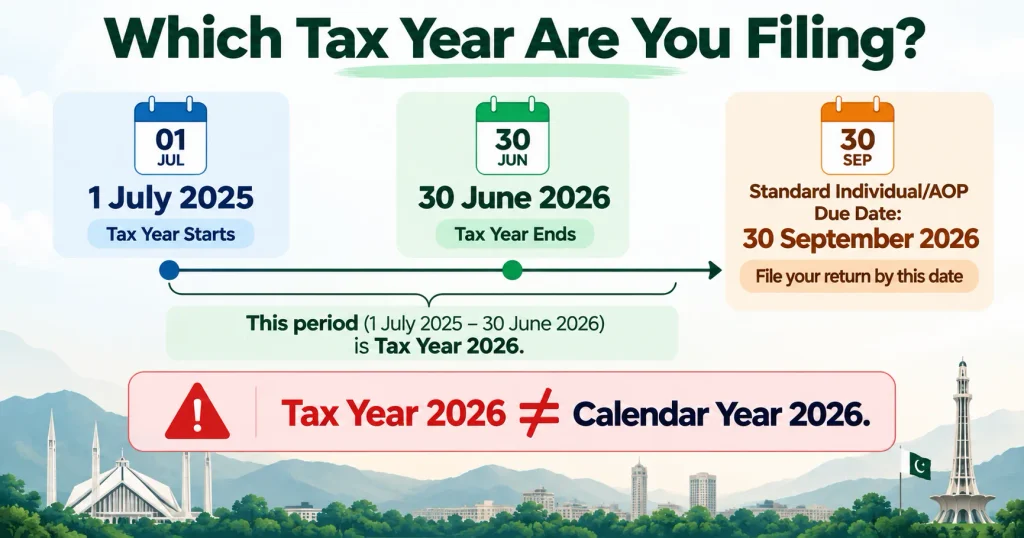
For Tax Year 2026, the normal income period is 1 July 2025 to 30 June 2026. The standard filing date for an individual or Association of Persons is 30 September 2026, while a company with a normal tax year generally files by 31 December 2026. A special tax year or an official extension can change a date, so check the current FBR due-date page before relying on a social-media post.

The one-minute answer: Select the correct tax year, collect evidence for every income source and major asset movement, check prefilled withholding data, reconcile the wealth statement to zero, pay any balance through the correct PSID, and confirm that both required forms appear under Completed Task. Filing early is safer than filing blindly.

Table of Contents

Which Tax Year Are You Actually Filing? One Wrong Click Can Change the Whole Story

Tax Year 2026 timeline from July 2025 to June 2026 with standard filing dates

Pakistan’s normal tax year is the twelve-month period ending on 30 June and is named after the calendar year in which it ends. Therefore, Tax Year 2026 normally covers 1 July 2025 through 30 June 2026. It does not cover January to December 2026.

This distinction controls the salary certificates, bank statements, invoices, rent, profit on debt, property transactions, and withholding evidence used in an FBR Tax Return. A January-to-December file mixes six months from two different tax years and can distort income, expenses, assets, and tax.

Use this simple rule:

What you are filingNormal period to reviewStandard due date
Individual or AOP, Tax Year 20261 July 2025–30 June 202630 September 2026
Company with normal tax year, Tax Year 20261 July 2025–30 June 202631 December 2026
Person using an approved special tax yearThe approved twelve-month periodCheck the applicable legal date

Do not assume that last year’s extension will return. An extension exists only when FBR or the competent authority lawfully issues it. Prepare for the standard deadline.

Must You File Even When No Tax Is Payable? Section 114 Has a Wider Answer

“My salary is below the taxable limit” is not a complete filing test.

Section 114 of the Income Tax Ordinance, 2001 contains several filing triggers. They include every company, persons whose taxable income exceeds the applicable non-taxable amount, non-profit organisations, persons carrying forward certain losses, and people falling within other listed categories. Depending on the current statutory conditions, a filing duty may also arise from an NTN, specified property ownership, a vehicle above the stated engine capacity, a high commercial or industrial electricity bill, membership of a recognised professional or trade body, earlier tax history, or a foreign income and assets statement obligation.

The details and thresholds can change through a Finance Act. Do not copy an old checklist without checking the Ordinance amended up to 30 June 2026. If one trigger applies, an FBR Tax Return may be required even when the final calculation shows no balance tax.

These people should pay special attention:

  • a salaried employee with tax already deducted;
  • a freelancer receiving local or foreign payments;
  • a sole proprietor using personal and business bank accounts;
  • a landlord receiving rent;
  • a person who sold property, shares, securities, or another capital asset;
  • an individual holding an NTN but believing that registration alone is enough;
  • a professional registered with a listed professional body;
  • a resident with foreign income or assets;
  • a person carrying forward a business or capital loss; and
  • an AOP or company, which has separate compliance needs.

When facts are uncertain, check Section 114 itself or obtain advice before the deadline. A filing obligation should never be decided from one salary figure alone.

NTN, Registration, Filing, Tax Payment, and ATL: Which Proof Do You Really Have?

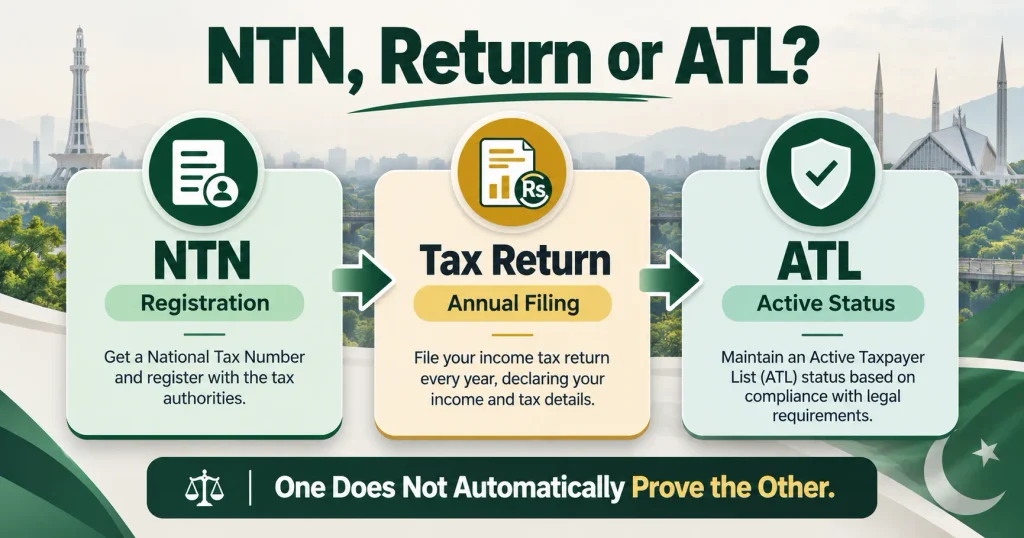
Comparison of NTN registration, annual return, CPR, Completed Task, and ATL status

Five different things are often called “filer.”

Record or actionWhat it provesWhat it does not prove
NTN or Form 181 registrationThe taxpayer is registered with FBRThe latest FBR Tax Return was filed
FBR Tax Return under section 114Income and tax information was submitted for a named tax yearEvery figure was correct
CPR or payment receiptA stated amount reached the government under a payment referenceThe FBR Tax Return and wealth statement were submitted
Completed Task statusThe selected IRIS form moved out of Draft after submissionCurrent ATL status by itself
ATL verificationThe person appears in the relevant active-taxpayer recordFull registration or filing history

Before starting an FBR Tax Return, confirm the taxpayer’s identity and registration. An individual generally uses the CNIC as the tax number, but the registration must still exist. Read Qanooni Dastak’s guide to Online NTN Verification by CNIC if you are unsure whether the profile is genuine. If a bank or client wants registration proof, use the separate FBR NTN Certificate guide.

Registration is the door; annual filing is the journey. Neither a CNIC-based NTN nor an old ATL screenshot replaces the current FBR Tax Return.

What Should You Collect Before IRIS Opens? Your Documents Depend on Your Income

A good FBR Tax Return begins outside the portal. First-time filers should build a clear tax-year folder and name every file clearly. An FBR Tax Return is easier to defend when every important number has a source document.

Salaried person: is your employer certificate enough?

Keep the annual salary and tax-deduction certificate, monthly payslips where needed, bank statements for the tax-year period, details of allowances and benefits, evidence of any eligible deductions or credits, and proof of income outside employment. Compare employer figures with IRIS data instead of assuming that both match.

Freelancer or online earner: was it income, export proceeds, or only a remittance?

Keep platform statements, client contracts, invoices, bank or wallet statements, foreign-currency conversion evidence, payment-realisation records, expense invoices, withholding certificates, and any applicable registration or export documentation. A transfer from abroad is not automatically exempt merely because the bank labels it a remittance.

Sole proprietor: can your sales explain your bank deposits?

Prepare a sales summary, purchase and expense evidence, stock information where relevant, business and personal bank statements, asset purchases, loan records, depreciation schedules, withholding certificates, and prior-year closing balances. Separate personal transfers from business receipts.

Landlord, investor, or asset seller: what changed during the year?

Collect tenancy agreements, rent receipts, property tax or eligible expense evidence, purchase and sale documents, broker statements, CDC or mutual-fund records, withholding evidence, and the original cost of the asset. Advance tax collected on a transaction does not always settle the complete liability.

Pensioner or person with savings income: are all receipts taxed the same way?

Keep pension statements, age and employment records where relevant, bank profit certificates, National Savings statements, withholding details, and evidence of other income. Pension, salary, profit on debt, and investment returns can follow different rules.

Overseas Pakistani or non-resident: did your residence status change the answer?

Keep travel history, passport pages, residency evidence, foreign tax documents, Pakistan-source income records, remittance trails, property records, and any NICOP or POC evidence relevant to a special procedure. Residence, source of income, and the route by which money arrived are separate legal questions.

Gifts, inheritance, loans, and family support: can you prove the source?

Preserve gift deeds where appropriate, succession or inheritance records, identity and financial capacity of the giver, banking trail, loan agreements, repayment terms, and receipts. Writing “gift” or “loan” in IRIS does not create evidence.

An AOP should also keep its partnership or constituting document, member information, accounts, tax deductions, and allocation details. A company requires corporate accounts and disclosures beyond this individual-focused guide; it should use qualified professional review.

Document checklist for salaried people freelancers businesses landlords pensioners and overseas Pakistanis

Which Filing Route Fits You? Choosing the Wrong Form Can Hide Income

FBR provides Declaration Form 114(I) for a person deriving income from salary and other sources where salary is more than 50 percent of total income. Form 114 is broader; Form 114(I) does not suit every employee.

Choose the route by facts:

  • Salary only: Verify salary, benefits, employer deduction, bank profit, assets, liabilities, and household expenses.
  • Salary plus freelance work: Report employment and business or professional receipts under their correct heads; do not bury freelance earnings inside salary.
  • Full-time freelancer or IT professional: Reconcile invoices, receipts, foreign conversion, allowable costs, withholding, and any separate provincial sales-tax duty.
  • Sole proprietor: Declare turnover, cost and admissible expenses, profit, assets, and applicable normal or minimum-tax issues.
  • Rental-income recipient: Report rent under the correct property provisions and review deductions allowed for that year.
  • Property or share seller: Calculate the relevant capital gain and separately check transaction tax collected under the applicable section.
  • Pensioner: Identify pension treatment, investment income, rent, business receipts, and filing triggers instead of assuming retirement ends compliance.
  • Overseas or non-resident person: Separate Pakistan-source income from foreign-source income and test residence for the year.
  • No taxable income: Check whether another Section 114 trigger still requires an FBR Tax Return.
  • Mixed-income household: File each taxpayer’s own FBR Tax Return; one spouse’s filing does not automatically cover the other.

An eligible small shopkeeper should also review FBR’s special Tax Year 2026 procedure before opting for it. The procedure has conditions, exclusions, and consequences; it is not a shortcut for every retailer, professional, or multi-shop business.

How Do You File an FBR Income Tax Return Through IRIS? Follow These 12 Checks

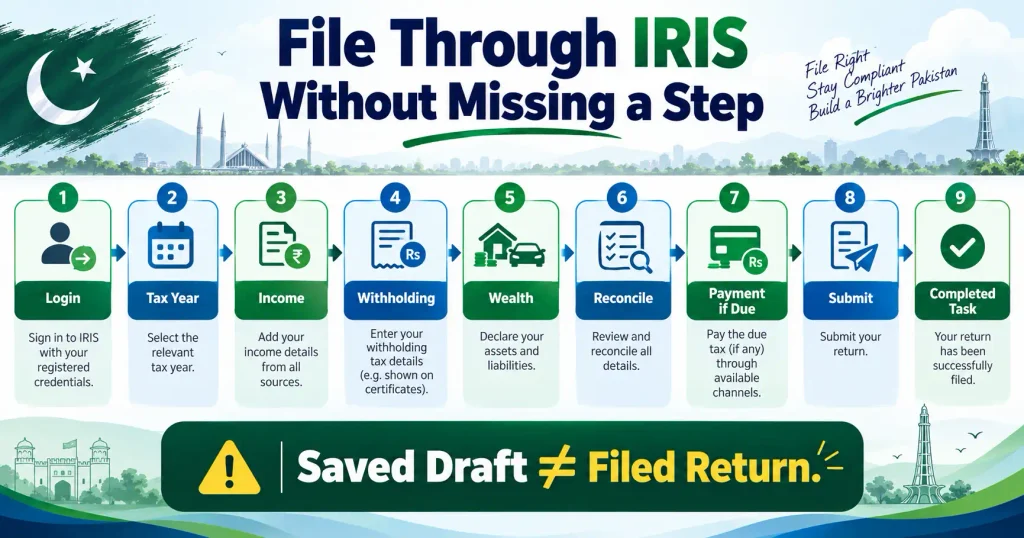
The current electronic route is IRIS 2.0. Portal labels can move, but the legal information does not disappear. Work from records, save drafts, and review before submission.

Check 1: Enter only through the official domain

Type the official address yourself. Do not open a login page from an unknown WhatsApp message, sponsored advertisement, or agent’s shortened link. Your CNIC, password, PIN, and OTP can expose years of financial data.

Check 2: Confirm the taxpayer profile before creating another account

Recover an existing account if the CNIC or NTN is already registered. Duplicate or conflicting registrations can create a harder problem than a forgotten password.

Check 3: Select Tax Year 2026, not the current calendar period

Open the FBR income tax return for the correct tax year and read its date range carefully. An FBR Tax Return for Tax Year 2026 normally uses records ending 30 June 2026.

Check 4: Review registration and personal details

Check name, address, contact information, business activity, bank accounts, and taxpayer type. Use the proper Form 181 modification route when information is wrong; do not “correct” it only inside a private spreadsheet.

Check 5: Study prefilled information but do not worship it

IRIS may show salary, bank profit, property, vehicle, withholding, or other third-party data. Prefilled does not mean complete or legally classified. Compare each entry with evidence, remove duplication carefully, and investigate unfamiliar transactions.

Check 6: Enter income under the correct head

Use salary, property, business, capital gains, or other sources according to the nature of the receipt. Also identify exempt, final, minimum, or separately taxed amounts where the law requires.

Check 7: Claim only lawful deductions, allowances, reductions, and credits

A personal expense is not deductible merely because money left a bank account. Business costs normally require a connection with income and proper evidence. Eligibility for Zakat, donation, pension, foreign-tax, or other relief depends on current law and facts.

Check 8: Match withholding entries with certificates and sections

Confirm the payer, section, amount, and adjustable or final character. Do not claim every deduction appearing in IRIS as a refundable credit.

Check 9: Complete assets, liabilities, and personal expenses

List reportable bank balances, cash, property, vehicles, investments, business capital, receivables, valuable assets, loans, and other liabilities at the required date and basis. Include the household and personal-expense information requested by the form.

Check 10: Reconcile wealth before generating a payment

Explain how opening wealth became closing wealth. Income, expenses, gifts, inheritance, remittances, loans, and asset sales must fit the movement.

Check 11: Calculate, create the correct PSID, and verify payment

If tax remains payable, generate the payment reference for the right taxpayer, tax year, and payment nature. Pay through an authorised channel and confirm the CPR.

Check 12: Submit both forms and preserve proof

According to FBR’s completion guidance, individual filing requires the Return of Income and Wealth Statement. Success is confirmed when the required forms move from Draft to Completed Task. Download or print the acknowledgement, computation, wealth statement, and payment proof.

These checks make an FBR Tax Return auditable rather than merely clickable. Never let an agent submit without first showing you the final income, assets, expenses, tax, and refund position.

FBR income tax return filing through IRIS in Pakistan

IRIS Shows an Error? Try This Before You Start Again

A grey Submit button means a required field, calculation, payment, or wealth figure is incomplete. An unreconciled amount means movement does not balance. If a CPR is missing, compare the taxpayer, tax year, payment head, bank confirmation, and posting status before paying again. When a draft freezes, save screenshots, sign out, clear the browser cache if appropriate, and reopen the same task. Never create a second FBR Tax Return to escape an error. If an unfamiliar transaction appears, keep evidence and contact FBR rather than deleting it. For technical failure, note error text, task number, and complaint reference from FBR support.

Where Does Each Rupee Belong? Five Income Heads Prevent Costly Mixing

FBR broadly divides income into five heads:

  1. salary;
  2. income from property;
  3. income from business;
  4. capital gains; and
  5. income from other sources.

Classification changes the calculation. Salary from employment is not the same as freelance receipts. Rent is not a casual bank transfer. Profit on debt is not salary. Sale proceeds are not automatically the capital gain because the original cost and applicable rules matter.

An FBR Tax Return should also distinguish three ideas that competitors frequently mix:

  • Normal tax: income enters the normal calculation and applicable slab or rate.
  • Adjustable tax: advance or withholding tax may be credited against the final liability, subject to the law and evidence.
  • Final or minimum tax: the deduction may have a special character, and the underlying income or turnover may still need disclosure in the correct place.

Do not decide the treatment from the percentage deducted. Read the section under which tax was collected and the law applicable to that taxpayer and transaction.

Is foreign money taxable when it arrives as a remittance?

A genuine transfer of your own already-explained funds may be different from income earned by providing services. For a resident person, foreign-source income and foreign assets can create reporting or tax questions. For a non-resident, Pakistan-source rules remain important. Preserve the contract, source, banking trail, residence facts, and foreign tax proof.

Is agricultural income simply left out?

Agricultural income is dealt with separately from federal income tax under Section 41, while provincial agricultural-income laws may apply. Disclosure and wealth reconciliation can still matter because farmland, receipts, expenses, and asset growth must make sense. Do not convert ordinary business receipts into “agriculture” without facts.

Can deductions and exemptions be entered from memory?

No. A deduction reduces income, a tax credit or reduction affects tax, and an exemption removes or treats income according to a specific rule. The labels are not interchangeable. Verify the current Ordinance, Second Schedule, and evidence before claiming relief in an FBR Tax Return.

Is Every Withholding Entry Your Refund? This Is Where Many Returns Go Wrong

Tax can be deducted or collected from salary, bank profit, contracts, imports, utilities, property transactions, vehicle matters, cash withdrawal, and other activities. IRIS may show part of that data, but the FBR Tax Return must give each amount its correct legal treatment.

Use a four-part test:

  1. Identity: Was tax deducted against your CNIC or NTN?
  2. Period: Does it fall within the tax year being filed?
  3. Section: Which provision caused the deduction or collection?
  4. Character: Is it adjustable, final, minimum, or otherwise restricted?

Ask the employer, bank, client, registrar, or other withholding agent for a certificate when needed. Compare it with the official Tax Year 2026 withholding rate card. Do not force an amount into an unrelated field just to reduce payable tax.

For example, tax collected when buying property and tax deducted from salary arise from different events. A bank deduction can relate to profit on debt or another transaction. An export-related deduction may depend on the person, service, documentation, and regime. The label “advance tax” does not guarantee identical treatment.

An FBR Tax Return showing a refund should be supported by certificates, CPRs, and the correct legal character of each credit. A large unsupported adjustment can attract questions instead of cash.

Why Does the Wealth Statement Refuse to Submit? The Missing Rupee Is Usually a Story

The wealth statement explains the financial movement of a resident individual. FBR’s stated reconciliation principle is that the increase or decrease in current wealth compared with previous wealth must match income minus expenses, after accounting for relevant inflows and outflows.

A useful working equation is:

Opening wealth + explained inflows − personal expenses and other outflows = closing wealth

The portal’s exact fields control the final entry, but this equation helps you find the missing story.

An FBR Tax Return can show correct income yet fail at wealth reconciliation because:

  • a bank account was omitted;
  • closing cash was guessed;
  • a car or property purchase was entered without reducing bank or cash;
  • sale proceeds were shown without removing the sold asset;
  • a loan was treated as income or ignored as a liability;
  • a gift had no matching source;
  • inherited property appeared without an inheritance trail;
  • foreign remittance was counted twice;
  • family expenses were unrealistically low;
  • dependants’ costs were forgotten;
  • business capital did not match the accounts; or
  • last year’s closing wealth was changed without explanation.

Example 1: A salaried person buys a car

Suppose opening net wealth was PKR 3,000,000. During the year, after-tax salary and other explained inflows were PKR 2,400,000, while household and personal outflows were PKR 1,500,000. Expected closing net wealth is about PKR 3,900,000. Buying a PKR 2,000,000 car does not by itself increase total wealth by that full amount if the purchase came from an existing bank balance; it changes the form of the asset.

Example 2: A freelancer receives PKR 4,000,000

Gross receipts are not automatically closing wealth. Business costs, tax, household expenses, asset purchases, liabilities, and year-end balances must be traced. If the person declares tiny expenses but has school fees, rent, travel, and normal living costs, the statement may be mathematically balanced yet factually weak.

Example 3: Parents give money for a house

The recipient should record the inflow in the proper field and preserve evidence of the transfer, relationship, donor’s identity, source, and financial capacity. The donor’s own records should not contradict the gift. Cash claims made only after a notice are harder to explain.

For cost versus market value, follow the form and applicable law. Do not increase old assets to today’s market price merely to remove an unreconciled figure. Reconciliation should reach zero through truth and evidence, not a plug number.

Wealth statement reconciliation using opening wealth income expenses and closing wealth

How Much Tax Applies for Tax Year 2026? Do Not Use the 2027 Table

The Finance Act passed in June 2026 generally governs income from 1 July 2026 onward, which normally belongs to Tax Year 2027. Tax Year 2026 income is mainly governed by the law applicable from 1 July 2025 through 30 June 2026. Mixing the two years can change the result.

For a salaried individual whose salary exceeds 75 percent of taxable income, FBR’s Finance Act 2025 explanatory circular sets out these Tax Year 2026 slabs:

Annual taxable incomeTax for Tax Year 2026
Up to PKR 600,0000%
PKR 600,001–1,200,0001% of the amount above PKR 600,000
PKR 1,200,001–2,200,000PKR 6,000 + 11% above PKR 1,200,000
PKR 2,200,001–3,200,000PKR 116,000 + 23% above PKR 2,200,000
PKR 3,200,001–4,100,000PKR 345,000 + 30% above PKR 3,200,000
Above PKR 4,100,000PKR 615,000 + 35% above PKR 4,100,000

The circular should control if a table copied elsewhere differs. A surcharge can also apply above the statutory income level. Business individuals, AOPs, companies, special regimes, capital gains, property income, and separately taxed receipts need their applicable calculation.

Treat an online calculator as an estimate. The final FBR Tax Return must reflect the taxpayer’s full facts, current law, deductions, credits, withholding treatment, and tax year.

PSID Paid—Are You Finished? Only the CPR and Final Submission Complete the Trail

A Payment Slip ID is the reference used to pay a tax amount. A Computerised Payment Receipt is evidence generated after the payment is received and posted. Neither document should be confused with the FBR Tax Return acknowledgement.

Before paying:

  • confirm the CNIC or NTN;
  • confirm Tax Year 2026;
  • select the correct tax-payment nature;
  • compare the amount with the FBR Tax Return computation;
  • use an authorised bank or payment route; and
  • save the PSID before leaving the screen.

After paying, obtain the CPR and check whether it appears against the correct period and liability. If it does not post, preserve bank confirmation and raise the issue through the official route; do not pay a second time without checking.

Return-related tax, ATL surcharge, advance tax, and other liabilities can use different payment heads. A payment under the wrong head may require correction and will not necessarily clear the intended amount. An FBR Tax Return is not complete merely because a bank app displayed “successful.”

Did IRIS Really Accept Your FBR Income Tax Return? Check Completed Task

FBR states that individual completion requires both the Return of Income and Wealth Statement, and successful submission is confirmed when both move from Draft to Completed Task. This is the test competitors often omit.

Perform a post-filing audit:

  1. Open Completed Task and locate the correct tax year.
  2. Confirm that the FBR Tax Return is submitted.
  3. Confirm that the wealth statement is submitted.
  4. Save the acknowledgement or print view.
  5. Save the final computation and declared forms.
  6. Match the CPR with any payable amount.
  7. Check email or IRIS inbox for system messages.
  8. Verify ATL status separately when the applicable update occurs.

If one form remains in Draft, your FBR Tax Return journey may be unfinished. A screenshot of the calculate page or an agent’s message saying “done” is not enough.

Will Filing Today Make You an Active Filer Tomorrow? ATL and Late-Filer Status Are Different

The Active Taxpayer List is a status record, not an NTN certificate. FBR explains that inclusion depends on filing the FBR Tax Return relevant to the current ATL. You can verify an individual by sending ATL space 13-digit CNIC to 9966, or verify an AOP or company with ATL space 7-digit NTN.

Filing by the lawful due date is important because some transactions now distinguish among filer, late filer, and non-filer. Property advance-tax rates are a clear example. An overseas Pakistani should also read FBR’s special property-rate FAQs for qualifying non-residents instead of assuming that one rule applies to everyone.

A late FBR Tax Return can still be filed. FBR’s published guidance says ATL inclusion after late filing may require the applicable surcharge. It has listed PKR 1,000 for an individual, PKR 10,000 for an AOP, and PKR 20,000 for a company; confirm the current amount and payment head in IRIS before generating a PSID because rules can change.

Submitting an FBR Tax Return after the deadline does not erase the delay, possible penalty exposure, default surcharge on unpaid tax, or a transaction-specific late-filer rate. It is usually better than remaining unfiled, but it is not identical to timely compliance.

Missed the Deadline? These Four Actions Are Safer Than Waiting for a Notice

First, finish the correct FBR Tax Return instead of carrying the mistake into another year. Second, pay any admitted tax and applicable ATL surcharge through the correct references. Third, preserve evidence explaining any genuine cause of delay. Fourth, monitor the IRIS inbox and obtain advice if a notice or penalty proceeding begins.

Section 182 contains penalties for specified failures. Exact exposure depends on the current provision, duration, tax, facts, and any lawful relief, so a generic website should not promise one fixed amount for every person.

Do not backdate documents, invent expenses, or submit an empty FBR Tax Return merely to obtain a status. A late truthful filing is safer than a timely false one.

FBR’s official revision guidance says an FBR Tax Return can be revised within five years of its original filing to correct an omission or wrong statement. Its stated IRIS process requires an application for revision and, after approval, filing the revised FBR Tax Return.

The timing rule needs one extra explanation. The judgment records that written Commissioner approval is not required when a revised return is filed within sixty days of the original filing. Beyond sixty days, written approval is generally required, subject to the statutory conditions and any deemed-approval rule then applicable. A notice under Section 122(9), an audit, tax, default surcharge, or penalties can change the route and consequences. Therefore, do not assume that a five-year outer limit gives five years of unrestricted editing. Start the correct IRIS task, state the genuine omission or wrong statement, attach supporting material, and obtain professional advice when an FBR Tax Return is already under examination.

The wealth statement has a different route. FBR says it can be revised in IRIS before receipt of a notice under Section 122(9), without first applying for approval. Timing and notice history therefore matter.

What did the Sindh High Court say about a rejected revision request?

In OBS Pakistan (Pvt.) Limited v Federation of Pakistan and others, 2026 SHC KHI 1388, C.P. D-2456 of 2021, decided 9 July 2026, the Sindh High Court considered a company’s request to revise an FBR Tax Return. The Court distinguished an application seeking permission under Section 114(6) from an actual revised FBR Tax Return addressed by Section 114(6A). It set aside the rejection and directed the authority to hear the revision application afresh and pass a proper speaking order in accordance with law. The official judgment is available from the Sindh High Court.

The public lesson is narrow but valuable: a request to revise and a filed revised FBR Tax Return are not the same procedural event. The case involved a company and its own facts; it does not grant automatic permission to every taxpayer. If a material error appears in an FBR Tax Return, act quickly, preserve the reason and documents, and follow the correct IRIS and legal route.

Does a Refund Appear Automatically? A Negative Balance Is Only the Beginning

FBR says a refund can be claimed only where the person filed electronically and the refundable amount is clearly reflected in IRIS. A separate refund application must then be filed through IRIS.

The official refund guidance also states that a return-based refund may be claimed later, but within two years from the filing or assessment date, or the tax-payment date, whichever is later. Late filers face additional ATL-related limits described on that page.

Before claiming:

  • reconcile every withholding certificate;
  • remove duplicate credits;
  • confirm the correct tax year and section;
  • ensure the bank account and contact details are current;
  • keep the filed FBR Tax Return, computation, CPRs, and application reference; and
  • monitor IRIS and the relevant tax office route.

Never pay a stranger who promises an instant percentage-based refund. An FBR Tax Return can establish the figure, but verification, application, and processing remain separate stages.

Could a Small Mismatch Trigger a Notice? These Red Flags Deserve a Second Look

FBR can compare information received from employers, banks, registrars, withholding agents, utilities, and other sources. A notice does not automatically prove wrongdoing, but ignoring it can worsen the position.

Common red flags include:

  • bank deposits far above declared receipts;
  • property, vehicles, travel, or investments unsupported by declared resources;
  • repeated gifts without credible donors;
  • a sudden change in cash or business capital;
  • tax credits claimed against the wrong section;
  • missing bank accounts or assets;
  • very low household expenses;
  • inconsistent opening and closing wealth;
  • foreign receipts described only as remittances;
  • sales that do not match withholding or third-party data; and
  • an FBR Tax Return revised only after enforcement begins.

If a transaction in IRIS is unfamiliar, save the screen, check the source, secure the account, and contact FBR. Do not delete genuine data merely to make the form look clean.

Who Can See Your Financial Life? Protect IRIS Like a Bank Account

An FBR Tax Return can reveal CNIC details, addresses, bank balances, property, vehicles, family expenses, clients, and income. Use your own mobile number and email, a unique password, and a trusted device.

Never share an OTP or full password with a caller. If professional help is required, review the completed figures before authorising submission and change credentials when access is no longer needed. Mask private identifiers in ordinary emails, avoid public Wi-Fi, and store downloaded forms in an encrypted or access-controlled folder.

FBR’s privacy rules do not make careless sharing safe. A fake “tax consultant” with your login can alter registration details, view past records, or file false information.

Why Keep Six Years of Records? Today’s Easy Number May Be Tomorrow’s Hard Question

FBR’s record-keeping guidance says persons having taxable income must keep FBR Tax Return records for six years. As a practical safety rule, every filer should preserve a complete annual folder, and records connected with an open audit, appeal, notice, asset cost, carried-forward loss, or continuing dispute may need to be retained longer.

Keep:

  • final filed forms and acknowledgements;
  • salary and withholding certificates;
  • invoices, accounts, and expense evidence;
  • complete bank statements;
  • contracts and payment records;
  • purchase and sale documents for assets;
  • gift, inheritance, remittance, and loan evidence;
  • PSIDs, CPRs, refund applications, and orders;
  • notices and replies; and
  • a note explaining unusual transactions.

Name the folder by tax year, not calendar year. Back it up securely in two places. Six-year safety turns an FBR Tax Return from a memory test into an evidence file. Evidence protects everyone.

Post-filing decision map for ATL late filing revision refund and six-year records

Can You File Yourself, or Is This the Moment to Call a Professional?

Self-filing can work when income is only salary, records are complete, assets are simple, withholding matches, and the person understands reconciliation. Even then, read every field before submission.

Professional review is sensible when there is business income, foreign income or assets, residence uncertainty, property or securities gains, multiple bank accounts, unexplained earlier wealth, a large refund, a carried-forward loss, an AOP or company, a notice, an audit, a revision, or a deceased taxpayer’s affairs.

Choose a qualified person who explains the numbers and gives you copies. Avoid anyone who guarantees ATL status without reviewing documents, invents expenses, asks for an OTP by chat, or refuses to show the final FBR Tax Return.

The 17-Point Final Check: Would Your File Survive a Calm Second Review?

Before pressing Submit, ask:

  1. Is the selected tax year correct?
  2. Does a Section 114 trigger require filing?
  3. Is the taxpayer profile accurate?
  4. Are all income sources included?
  5. Is each receipt under the correct income head?
  6. Were business and personal transfers separated?
  7. Does every deduction have legal and documentary support?
  8. Were prefilled entries verified?
  9. Is withholding claimed under the right section and character?
  10. Are all material bank accounts and assets included?
  11. Are liabilities, gifts, loans, inheritance, and remittances supported?
  12. Are household expenses realistic?
  13. Does wealth reconcile to zero without a plug figure?
  14. Is the tax based on Tax Year 2026 law?
  15. Does the CPR match the correct PSID and period?
  16. Did both required forms move to Completed Task?
  17. Were the final forms and evidence stored safely?

If one answer is “I do not know,” pause the FBR Tax Return and investigate. Ten careful minutes before submission can prevent months of explanation.

Frequently Asked Questions People Ask Before and After Filing

How do I file an FBR income tax return online in Pakistan?

To file an FBR income tax return online, register or recover your taxpayer profile and log in through the official IRIS 2.0 portal. Select the correct tax year, report your income under the proper heads, verify withholding tax, complete and reconcile the wealth statement, calculate your tax liability, pay any outstanding amount through PSID, and submit the return. Finally, check Completed Task to confirm that your FBR Tax Return and wealth statement were successfully submitted.

What is the last date for filing for Tax Year 2026?

The standard date is 30 September 2026 for an individual or AOP and 31 December 2026 for a company with a normal tax year. Special tax years can differ. Check the official due-date page for any lawful change or extension.

Can I file when my income is below PKR 600,000?

Yes, and you may still be legally required to do so. The non-taxable salary slab is not the only test. Section 114 has additional filing triggers linked to taxpayer status, assets, registration, earlier tax history, professional membership, and other facts.

Is NTN registration the same as filing an FBR Tax Return?

No. Registration creates the taxpayer profile or number. Filing submits information for a particular tax year. ATL status and tax payment are separate again.

Which form should a salaried person use?

FBR says Form 114(I) may be used by a person deriving income from salary and other sources where salary exceeds 50 percent of total income. A person with business, professional, or more complex income should use the route matching the facts.

What documents are needed for an FBR Tax Return?

The list depends on income. Common records include salary and withholding certificates, tax-year bank statements, invoices, business accounts, rent or investment documents, asset purchase and sale records, loan evidence, remittance records, and last year’s filed FBR Tax Return and wealth statement.

What is a wealth statement in FBR?

It is a statement of assets, liabilities, expenses, and related financial movement. Its change in wealth must reconcile with declared income, expenses, and explained inflows or outflows.

Why is my wealth statement unreconciled?

Usually an opening balance, asset, bank account, liability, expense, gift, loan, remittance, purchase, or sale has been omitted or entered twice. Trace the movement from opening wealth to closing wealth rather than inserting a false balancing amount.

Is all withholding tax adjustable or refundable?

No. Treatment depends on the section, taxpayer, transaction, and current law. Some tax is adjustable, while other amounts can be final, minimum, or restricted. Verify certificates and legal character before claiming a credit.

How do I pay tax through PSID?

Generate a PSID in the correct IRIS payment area for the right CNIC or NTN, tax year, payment nature, and amount. Pay through an authorised channel, then save and verify the CPR against the liability.

How do I know whether my FBR Tax Return was successfully submitted?

FBR says the Return of Income and Wealth Statement should move from Draft to Completed Task. Save the acknowledgement, final forms, computation, and any CPR.

How can I check my filer or ATL status?

Use FBR’s online ATL service or send ATL followed by a space and the individual’s 13-digit CNIC to 9966. For an AOP or company, use ATL followed by a space and the seven-digit NTN.

Can a late filer enter ATL?

A late FBR Tax Return can be filed, and FBR guidance provides an ATL-surcharge route for inclusion. However, the delay may still affect transaction rates, refund rights for the relevant period, and penalty exposure. Confirm the current surcharge and status.

Can an FBR Tax Return be revised after filing?

FBR says an FBR Tax Return may be revised within five years to correct an omission or wrong statement, using the prescribed application and approval process in IRIS. Wealth-statement revision has a separate rule, especially before a Section 122(9) notice.

How do I claim an income-tax refund?

The refund must appear in the electronically filed return, and a separate refund application is then submitted through IRIS. FBR states a two-year claim window measured from the relevant filing, assessment, or payment date as explained in its guidance.

How long should tax records be kept?

FBR says persons with taxable income must keep return records for six years. Keep documents longer when they support asset cost, a continuing loan, a carried-forward loss, an unresolved notice, audit, appeal, or litigation.

Does receiving money from abroad make it tax-free?

No automatic rule makes every foreign transfer tax-free. Determine residence, source, nature of the receipt, services performed, foreign tax, and evidence. A genuine remittance and foreign-earned service income are not necessarily the same.

Does one spouse’s return include the other spouse?

No. Each person’s filing duty, income, assets, and registration are tested separately. Jointly owned assets and family expenses should be reported consistently without double counting.

Your Return Is a Financial Story—Make Every Page Tell the Same Truth

The safest filing is not the one completed fastest. It is the one in which the tax year, income heads, withholding, assets, expenses, payment, and evidence agree.

Start early, use official sources, and keep control of your own login. If the facts are complex, obtain qualified advice before submission rather than after a notice. A carefully prepared FBR income tax return can protect your compliance history, reduce avoidable transaction costs, and give you a clear record when a bank, authority, court, client, or future transaction asks how your finances were built.

This original article is for general legal and tax awareness. It is not personalised accounting, tax, legal, investment, or financial advice and does not create a lawyer-client relationship. Tax law, forms, IRIS menus, SROs, rates, due dates, and procedures can change. Verify the current position from FBR and consult a qualified professional for your own income, residence, assets, notices, or transactions.

Editorial source note

This guide was independently written from official public material, including the Income Tax Ordinance amended up to 30 June 2026, FBR filing and due-date guidance, the Tax Year 2026 withholding rate card, official refund and ATL information, and the reported Sindh High Court judgment discussed above. Competitor text has not been copied.

Leave a Comment

Your email address will not be published. Required fields are marked *

Scroll to Top