

Your salary is late again. Your boss says there is no appointment letter, no leave and no gratuity “because this is a private company.” Thousands of workers accept this and lose money the law already gave them. Labour laws in Pakistan say something very different. Factories, shops, offices and many contract jobs are covered by written rules on wages, hours, leave, notice and old-age pension.
The trouble is that these rules are scattered. After the 18th Amendment, each province makes most of its own labour law, so a worker in Lahore, Karachi, Peshawar, Quetta or Islamabad may have different rights. This guide explains labour laws in Pakistan in plain words: the latest minimum wage, working hours, leave, termination, gratuity, EOBI and the deadlines that decide whether your claim survives. The figures were checked against official government sources in November 2026.
Table of Contents
Labour Laws in Pakistan: The Quick Answer
Quick answer: Labour laws in Pakistan are federal and provincial laws that protect people working in factories, shops, offices, homes and other workplaces. In most jobs they give you a minimum wage (Rs40,000 a month in Punjab and Rs43,000 in Sindh for unskilled workers under the latest notices), a normal limit of 48 working hours a week, double pay for overtime, paid annual, casual and sick leave, one month’s notice before a permanent worker is removed without misconduct (three months in Balochistan), gratuity in many jobs and an EOBI old-age pension. Your exact rights depend on three things: your province, your type of workplace and the work you actually do.
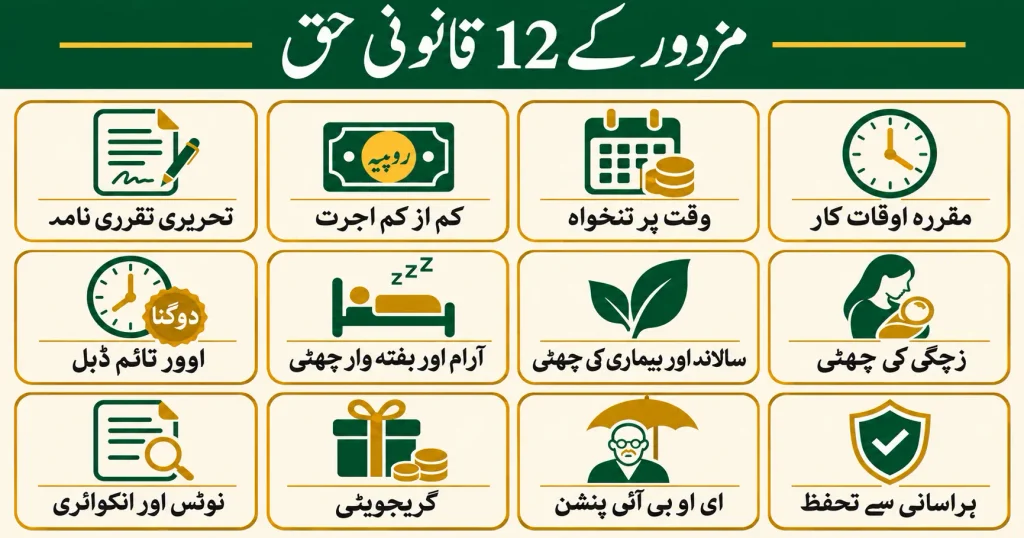
12 Rights at a Glance
| No. | Your right | What the law generally gives you |
|---|---|---|
| 1 | Written terms | A written appointment order showing your job, pay and status |
| 2 | Minimum wage | No adult worker paid below the notified provincial rate |
| 3 | Pay on time | Wages paid on time, with only lawful deductions |
| 4 | Fixed hours | Normally 9 hours a day and 48 hours a week (8 a day under the Punjab Code) |
| 5 | Overtime | Double the ordinary rate under factory and shop laws |
| 6 | Rest | A rest break during the day and a weekly holiday |
| 7 | Paid leave | Annual, casual, sick and festival leave |
| 8 | Maternity leave | 12 to 16 weeks under provincial laws; more in some federal jobs |
| 9 | Fair removal | Notice or pay in lieu, and an inquiry before dismissal for misconduct |
| 10 | Terminal dues | Gratuity or provident fund, plus unpaid salary and leave pay |
| 11 | Pension and treatment | EOBI old-age pension and social security medical cover |
| 12 | Dignity and voice | A harassment-free workplace, a trade union and a forum to complain |
These are the general rules under labour laws in Pakistan. The sections below explain where each right comes from and when it may not apply.
Which Labour Laws in Pakistan Apply to Your Job?
Before you claim anything, answer three questions. The answers decide which labour act Pakistan applies to you.
- Where do you work? Punjab, Sindh, Khyber Pakhtunkhwa (KP) and Balochistan each have their own labour laws. Federal laws still apply in Islamabad (ICT) and to establishments working in more than one province.
- What kind of workplace is it? A factory is covered by factory laws. A shop, office, bank, software house or private school is usually a “commercial establishment” covered by shops and establishments laws. Domestic workers now have special laws in Punjab, Sindh and Islamabad.
- What do you actually do? Labour courts look at your real duties, not your job title. A person employed mainly in managerial or administrative work may fall outside some protections, but calling someone a “manager” does not settle it.
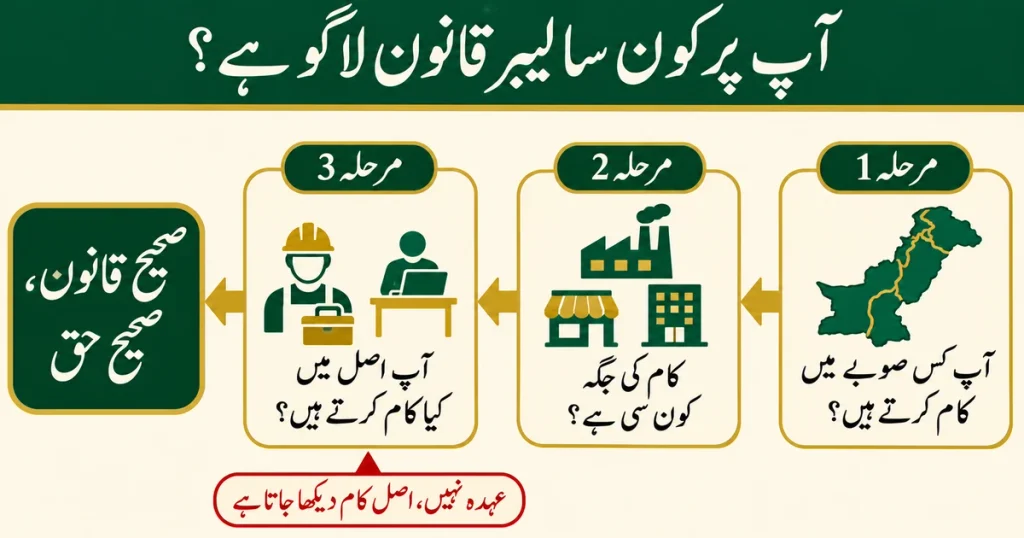
In short, labor law in Pakistan is not one book, and the labor laws of Pakistan change from province to province. It is a set of laws, and the right one depends on these three answers. Employment law in Pakistan also includes your written contract, but no contract can take away a right the law gives you.
What Is the New Labour Rule? Punjab Labour Code 2026
The biggest change in labour laws in Pakistan this year is the Punjab Labour Code 2026 (Punjab Act IX of 2026). The Punjab Assembly passed it on 4 February 2026, the Governor signed it on 10 February 2026, and it was published in the Punjab Gazette the same day. It replaces 26 old Punjab labour laws with one Code, including the Factories Act 1934, the Payment of Wages Act 1936, the Standing Orders Ordinance 1968, the Shops and Establishments Ordinance 1969 and the Punjab Minimum Wages Act 2019 (section 435).
Key changes in the Code include:
- Covers all workers in every sector of Punjab, including contract, agency, casual, intern, self-employed and digital platform workers; only civil servants, defence and police are left out (sections 2 and 4)
- No contract can take away a right the Code gives (section 3)
- A written employment agreement, with a copy before work starts, and an employment card (sections 141 and 143)
- Probation of no more than three months (section 144)
- An 8-hour day and 48-hour week; overtime only with your consent, at double pay, and triple pay on public holidays (sections 176 and 179)
- Salary paid into your bank account, for a pay period of no more than one month (section 165)
- 18 days of annual leave, 8 days of sick leave, 10 days of casual leave, and up to 130 days of paid iddat leave for workers not covered by social security (sections 192 to 196)
- Maternity leave of 6 weeks before and 8 weeks after childbirth, and 7 days of paternity leave (sections 197 and 198)
- 30 days’ notice or pay before termination, except for gross misconduct (section 150)
- Gratuity after one year of service in establishments with 20 or more workers (section 159)
- Non-compete clauses are void for most employees, and an employer cannot stop you discussing your salary (sections 162 and 163)
- No work by children under 16, except listed light work from age 14 (sections 22 to 24)
- A termination grievance and the Labour Court case must both be filed within three months of termination (section 335(11))
Is it in force? The official text on the Punjab Laws website shows it was published in the Punjab Gazette on 10 February 2026. Under section 1(3), the Code takes effect from a date the Government notifies separately, and the Punjab Government announced in late May 2026 that the Code had been enforced. Cases already pending before a court or authority when the Code started continue under the old laws (section 435(2)). Before you file a new case, confirm with the Punjab Labour Department or your lawyer which law applied on the date of your dispute.
Other new rules this year: Sindh passed a Domestic Workers Welfare Act (Act XVIII of 2026), Balochistan raised its child-employment age from 14 to 16 in September 2026, and federal amendment bills for the Industrial Relations Act and EOBI are still pending in the National Assembly. Pending bills are not law yet.
Minimum Wage in Pakistan 2026: Province-Wise Table
Labour laws in Pakistan do not fix one minimum wage for the whole country. Each province notifies its own rate, and the federal government covers Islamabad. Here is the latest official position for an unskilled adult worker:
| Area | Latest official figure | Status |
|---|---|---|
| Punjab | Rs40,000 a month (Rs1,538.46 a day, Rs192.31 an hour) | Notified 8 September 2025, effective 1 July 2025. Check the Labour Department for any 2026-27 update |
| Sindh | Rs43,000 unskilled, Rs44,484 semi-skilled, Rs53,350 skilled, Rs55,626 highly skilled | Notified 17 August 2026, effective 1 July 2026 |
| Khyber Pakhtunkhwa | Rs45,000 proposed (up from Rs40,000) | Proposed in the 2026-27 budget; confirm the final notification |
| Balochistan | Check the latest notification | Not confirmed on an official site at the time of writing |
| Islamabad (ICT) | Federal budget proposed a 10% rise; federal government employees get a minimum gross pay of Rs40,700 from 1 July 2026 | Confirm the ICT private-sector notice with the ICT Labour Department |
So what is the minimum salary of labour in Pakistan? For an unskilled adult worker, it is currently Rs40,000 a month in Punjab and Rs43,000 a month in Sindh. The Punjab notification covers adult and adolescent workers in industrial and commercial establishments. The Sindh notification expressly covers permanent, temporary, contract, daily-wage and piece-rate workers.
If you are paid less, keep your salary slips or bank statements. You can claim the shortfall through the provincial labour department or the Payment of Wages Authority, as explained later in this guide.
Labour Laws in Pakistan for Private Companies
Many employers say labour law is “only for government jobs.” That is wrong. Labour laws in Pakistan for private companies apply in full. Shops and establishments laws cover offices, shops, banks, software houses and other commercial establishments, and Standing Orders laws cover industrial and commercial establishments above a set number of workers (20 under the federal and old Punjab law, 10 in Sindh and KP).
Three points matter most for private-company staff:
- Your title is not final. The Industrial Relations Act 2012 excludes people employed mainly in managerial or administrative work, but courts check your actual powers. In Nazia Tariq v. K-Electric (Sindh High Court, C.P. D-2361/2022, decided 25 March 2026), the court held that real duties decide worker status, found the termination unlawful and held the worker entitled to reinstatement with back benefits. Read the judgment.
- Contract and outsourced staff are not automatically excluded. The worker definition in the Industrial Relations Act includes people engaged through a contractor. This does not make every contractor’s employee a permanent employee of the main company, but it keeps the door open.
- An IT office is usually not a factory. Software houses and call centres are normally commercial establishments, so shop-law hours, leave and overtime rules usually apply.
For a wider view of what you can claim when a job ends, see our guide on employee benefits in Pakistan.
Appointment Letter: Your First Proof of Employment
An appointment letter is the single most useful document in any labour dispute. Standing Orders laws expect covered employers to give workers a written order of appointment. A good letter shows:
- Your name, job title and start date
- Your status: permanent, probationer, temporary, badli, apprentice or contract
- Your salary, allowances and payment date
- Working hours and weekly holiday
- Notice period and leave entitlement
No letter? You can still prove your job through bank salary credits, attendance records, an office card, payslips, emails, WhatsApp messages from managers, EOBI or social security records, and witnesses. Start saving these on day one, not on the day you are fired.
If you keep working on repeated short contracts for work that is permanent in nature, ask a lawyer whether you have become entitled to permanent status. Courts look at the real nature of the work, not just the label on the contract.
Working Hours in Pakistan Labour Law
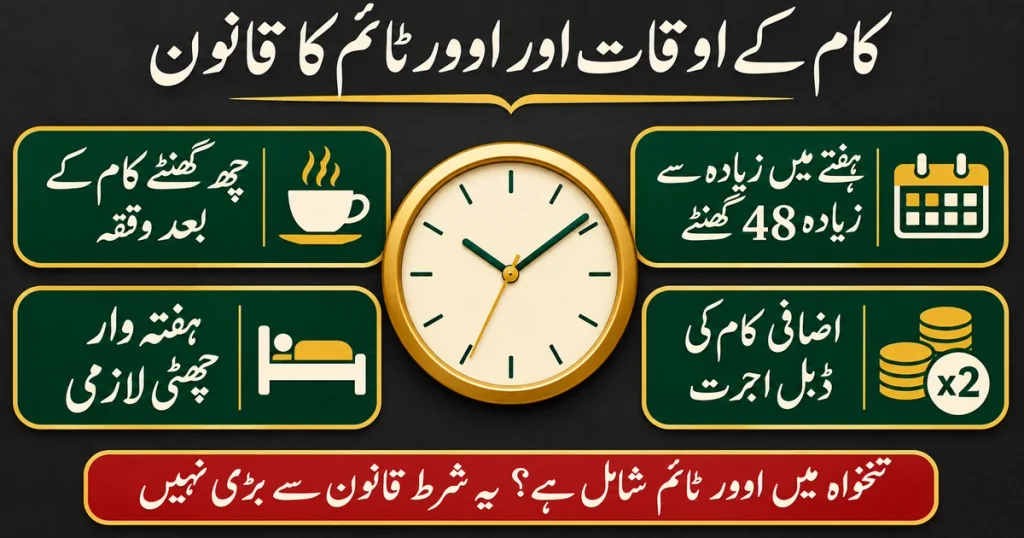
Working hours in Pakistan labour law follow a simple rule for adults: about 9 hours a day and no more than 48 hours a week. Extra work must be paid as overtime.
| Workplace | Daily limit | Weekly limit | Overtime rate |
|---|---|---|---|
| Factories (ICT, Sindh, KP, Balochistan, old Punjab law) | 9 hours | 48 hours | Double the ordinary rate |
| Shops, offices and commercial establishments | 9 hours | 48 hours | Double the ordinary rate |
| Punjab Labour Code 2026 | 8 hours | 48 hours | Double; triple on public holidays (section 179) |
The Factories Act 1934 Pakistan text still governs factories in Islamabad, while Sindh (2015), KP (2013) and Balochistan (2021) have their own Factories Acts. In Sindh, a 2026 amendment says the 9-hour daily limit is subject to the 48-hour weekly limit.
Breaks and rest: an adult worker should get a rest break of at least one hour after no more than six hours of work (factory laws also allow a half-hour pattern after five hours). Every worker is entitled to a weekly holiday. The Punjab Code also gives 12 hours of daily rest and 24 hours of weekly rest (sections 181 and 182).
Overtime example: at the Punjab minimum wage of Rs192.31 an hour, one hour of overtime at double rate is about Rs384.62. A contract line saying “salary includes all overtime” cannot reduce what labour laws in Pakistan guarantee.
How Much Paid Leave Can You Take?
Leave under labour laws in Pakistan depends on whether you work in a factory or in a shop or office, and on your province. Annual leave usually starts after 12 months of continuous service.
| Law | Annual | Casual | Sick | Festival |
|---|---|---|---|---|
| Shops and offices: Punjab (old law), Sindh, Balochistan | 14 days | 10 days | 8 days, full pay | 10 days |
| Shops and offices: KP | 14 days | 10 days | 8 days, full pay | As the government declares |
| Factories: ICT, KP, Punjab (old law) | 14 days | 10 days, full pay | 16 days, half pay | Declared festival days |
| Factories: Sindh | 14 days | 10 days, full pay | 16 days, full pay | Declared festival days |
| Factories: Balochistan | 20 days | 15 days, full pay | 20 days, full pay | Declared festival days |
| Punjab Labour Code 2026 | 18 days | 10 days | 8 days | Public holidays as notified |
Some shop-law leave sections do not cover certain commercial establishments. In KP, for example, the leave sections do not apply to commercial establishments with fewer than ten employees. In those cases, check the Standing Orders leave rules. Do not add two laws’ annual leave together; the law that covers your workplace decides.
Maternity and Paternity Leave in Pakistan
Maternity rights are where labour laws in Pakistan are most often misread. The well-known 180-day rule comes from the federal Maternity and Paternity Leave Act 2023, which covers public and private establishments under the federal government’s administrative control. It does not automatically cover every private company in every province.
| Law | Maternity leave | Paternity leave |
|---|---|---|
| Federal Act 2023 (federal-controlled establishments) | 180 days (1st child), 120 days (2nd), 90 days (3rd) | Up to 30 days, full pay |
| Punjab Labour Code 2026 | 14 weeks (6 before, 8 after birth) | 7 days |
| Punjab Maternity Benefit Ordinance 1958 (old law) | 12 weeks | Not provided |
| Sindh Maternity Benefits Act 2018 | 16 weeks (4 before, 12 after birth) | Not provided |
| KP Maternity Benefits Act 2013 | 12 weeks (6 before, 6 after birth) | Not provided |
| Balochistan Maternity Benefits Act 2022 | 14 weeks (6 before, 8 after birth) | Not provided |
Most provincial laws require four months of service before childbirth; Sindh requires one year and the Punjab Code six months. Under the Code, a father who already has two or more surviving children does not get paternity leave (section 198). Domestic workers get six weeks of paid maternity leave under the domestic-worker laws of Sindh and Islamabad. Pregnancy must never become a reason to push a woman out of her job.
Termination Law in Pakistan: Notice, Inquiry and Dismissal
Termination law in Pakistan separates two situations: ending a job for ordinary reasons, and dismissing a worker for misconduct.
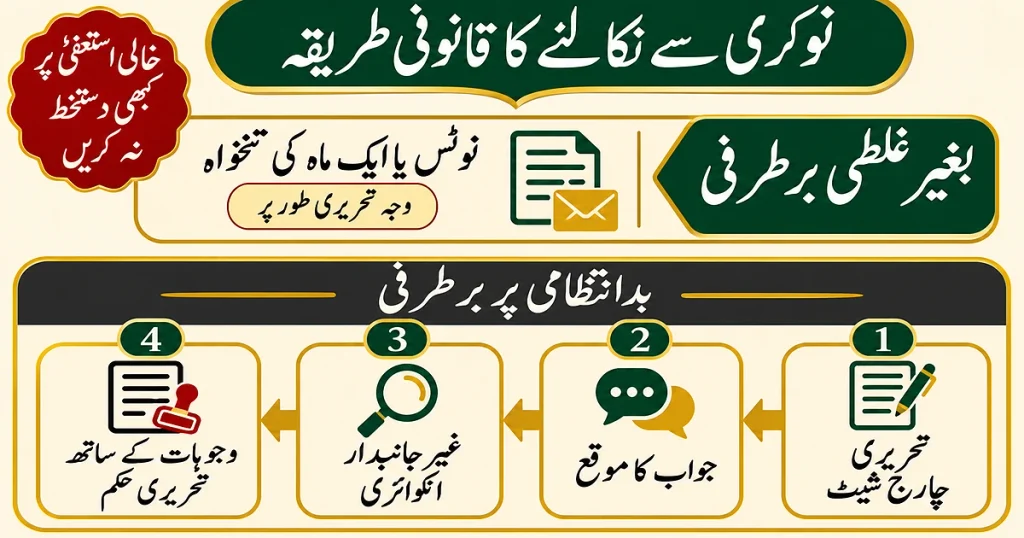
Termination without misconduct. A permanent worker is entitled to one month’s notice or one month’s wages instead, with the reason in writing (federal and old Punjab Standing Order 12, Sindh Standing Order 16, KP Standing Order 17). In Balochistan, the notice is three months (Standing Order 16 of the 2021 Act). Probationers, temporary and contract workers have different rules.
Under the Punjab Labour Code. Every employee gets 30 days’ written notice or 30 days’ pay, unless guilty of gross misconduct; in micro-enterprises with fewer than ten workers, it is 14 days (section 150). Probation cannot exceed three months (section 144). Union work, a complaint against the employer, maternity leave or sick leave is never a valid reason to fire someone (section 147).
Dismissal for misconduct. The employer must follow a fair process:
- A written charge sheet, usually within one month of the incident or of the employer learning about it (one week for gross misconduct in Balochistan)
- A real chance for you to explain your side
- An independent inquiry
- A written order with reasons
Retrenchment. When jobs are cut, the rule is generally “last in, first out” within the same category, and retrenched workers get preference if the employer hires again.
Never sign a blank resignation. If you are pressured to resign, send a written objection to the employer as soon as possible and keep proof of delivery. A forced resignation can be challenged; a signed “full and final” receipt for money you never received is much harder to undo.
Gratuity, Provident Fund and Final Dues
Gratuity is one of the most valuable benefits under labour laws in Pakistan: a lump sum paid for your years of service when a qualifying job ends. Under Standing Orders laws, it is generally paid when a permanent worker resigns or is terminated for reasons other than misconduct.
| Law | Gratuity formula |
|---|---|
| Federal (ICT), KP and old Punjab Standing Orders | 30 days’ wages for each completed year, or any part over six months |
| Sindh Standing Orders Act 2015 | One month’s wages for each completed year, or any part over six months |
| Balochistan Standing Orders Act 2021 | Two months’ wages for each completed year, or any part over six months |
| Punjab Labour Code 2026 | 30 days’ pay per year after one year of service, on resignation or termination (except gross misconduct), in establishments with 20 or more workers (section 159) |
Example: a worker whose last monthly wage was Rs60,000 completes five years and three months in Islamabad. Gratuity is roughly 5 x Rs60,000 = Rs300,000. The exact figure depends on how the law defines “wages” for your job. Under the Punjab Code, employees earning more than five times the minimum wage get gratuity only on redundancy, capped at 12 or 6 months’ pay (section 160).
Provident fund: where a proper provident fund with an employer contribution exists, the law may allow it in place of gratuity. In Sindh and KP, the fund payout cannot be less than the gratuity the law would give. Your credited fund balance, including the employer’s share, is protected when you leave. Final dues also include unpaid salary and pending leave pay where the law allows it.
EOBI and Social Security: Two Different Shields
Many workers think EOBI and social security are the same. They are not.
EOBI (old-age pension) runs under the federal Employees’ Old-Age Benefits Act 1976:
- The employer pays 5% and the worker pays 1% on the wage base the law fixes (sections 9 and 9B)
- Pension starts at age 60 for men and 55 for women, after at least 15 years of contributions (section 22)
- A worker with 2 to 15 years of contributions may get a one-time old-age grant (section 22A)
- The minimum pension is Rs11,500 a month, effective 1 January 2025. In August 2026, EOBI said any further increase depends on an actuarial review of the fund.
Provincial social security gives medical treatment and cash help during sickness, injury and maternity. The employer pays 6% for covered workers in Punjab (PESSI), Sindh (SESSI), KP and Balochistan, and cannot cut this share from your salary. Coverage depends on notified areas and a wage ceiling.
Ask your employer for your EOBI registration number and check it with EOBI. If your employer took a deduction but never registered you, that is a serious complaint.
Harassment, Child Labour and Domestic Workers
Workplace harassment. Labour laws in Pakistan also protect dignity at work. The Protection against Harassment of Women at the Workplace Act 2010, amended in 2022, requires every organisation to form an inquiry committee of three members, at least one of them a woman. A complaint can go to that committee or directly to the Ombudsperson: the federal FOSPAH or the provincial harassment Ombudsperson. Read our detailed guides on women harassment law in Pakistan and how to file a harassment complaint.
Child labour. In Punjab, the Labour Code bars work by any child under 16 and allows only listed light work from age 14, for up to four hours a day (sections 22 to 24). The age is 14 in Sindh and KP (KP allows narrow light work alongside family) and 16 in Balochistan after its September 2026 amendment. In Islamabad, the Employment of Children Act 1991 bans children under 14 from listed hazardous jobs. Adolescents (generally under 18) cannot do hazardous work.
Domestic workers. Islamabad’s Domestic Workers Act 2022 bars any child under 16 from household work and gives weekly rest, sick leave, festival leave and one month’s notice. In Punjab, the Labour Code has replaced the Domestic Workers Act 2019: domestic workers get an 8-hour day, double pay after 48 hours a week and, for live-in and full-time workers, at least the minimum wage (section 223). Sindh’s new Domestic Workers Welfare Act sets the minimum age at 16 and creates a dispute system for domestic workers.
Trade Union Laws in Pakistan
Article 17 of the Constitution protects the freedom to form unions. Trade union laws in Pakistan are now mostly provincial: the Industrial Relations Act 2012 (Islamabad and establishments in more than one province), the Punjab Industrial Relations Act 2010, the Sindh Industrial Relations Act 2013, the KP Industrial Relations Act 2010 and the Balochistan Industrial Relations Act 2022.
Two points are often confused. Registering a union is not the same as becoming the collective bargaining agent (CBA); the CBA is decided through a separate legal process. And punishing a worker for union activity is treated as an unfair labour practice under these laws.
Salary Not Paid or Job Ended? Deadlines and Forums
Most genuine cases under labour laws in Pakistan are lost for one reason: the worker waits too long or goes to the wrong forum. These are the main routes.
| Your problem | Where to go | Deadline |
|---|---|---|
| Unpaid salary or unlawful deduction | Payment of Wages Authority of your province or ICT | Generally within 3 years; a late claim needs sufficient cause |
| Termination grievance: Islamabad or multi-province employer | Written grievance to employer, then NIRC | Notice within 90 days; employer replies in 15 days; case within 60 days (IRA 2012, s.33) |
| Termination grievance: Punjab (old law) | Written grievance, then Punjab Labour Court | 3 months; 15 days; 60 days (Punjab IRA 2010, s.33) |
| Termination grievance: Punjab Labour Code | Grievance and Labour Court application | Both within 3 months of termination (s.335(11)) |
| Termination grievance: Sindh | Written grievance, then Sindh Labour Court | 3 months; 15 days; 60 days (Sindh IRA 2013, s.34) |
| Termination grievance: KP | Written grievance, then KP Labour Court | 3 months; 15 days; 2 months (KP IRA 2010, s.37) |
| Termination grievance: Balochistan | Written grievance, then Balochistan Labour Court | 3 months; 15 days; 2 months (Balochistan IRA 2022, s.36) |
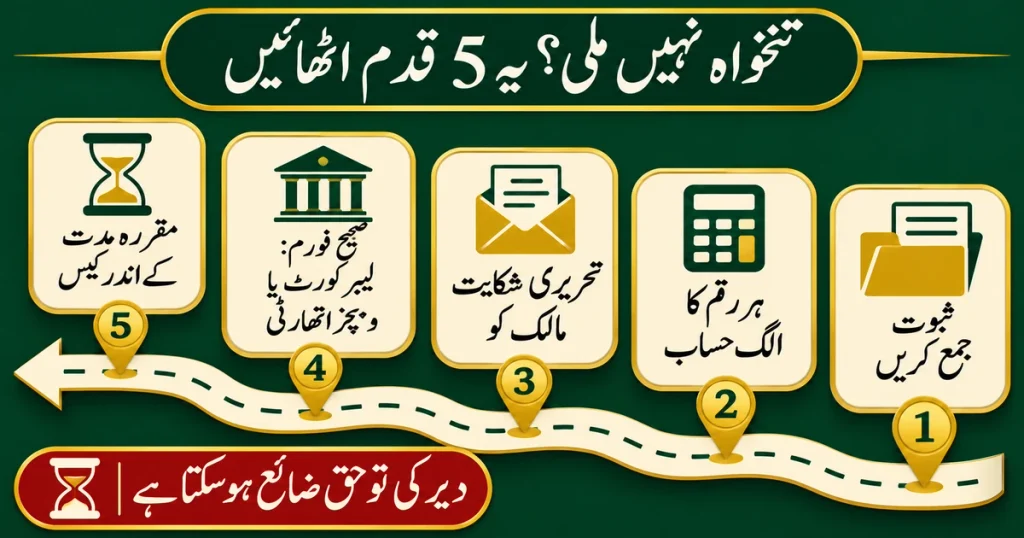
Step-by-step action plan:
- Collect your proof of employment and salary.
- Calculate each claim separately: unpaid salary, notice pay, gratuity, leave pay and overtime.
- Send a written grievance to the employer by courier, registered post or email, and keep the receipt. In the Nazia Tariq case, the Sindh High Court accepted that a grievance does not need a rigid format if it clearly states the complaint.
- File at the correct forum before the deadline. Ask a labour lawyer to check jurisdiction.
- Use helplines alongside, not instead of, the legal route. A complaint on a portal does not stop the limitation clock.
Official complaint routes: Punjab Labour Department online complaint form and helpline 1314; Sindh Directorate of Labour; KP Labour Department; Balochistan Labour Department; Islamabad ICT Labour Department.
Evidence to Save Before Any Dispute
Labour laws in Pakistan help only those who can prove their case. A labour case is won with paper, not with anger. Keep copies of these outside the office, in your phone or email:
- Appointment letter, contract renewals and promotion letters
- Salary slips and bank statements showing salary credits
- Attendance records, duty rosters and office card
- Emails and WhatsApp messages about duties, overtime and salary
- EOBI and social security card or record
- Show-cause notice, charge sheet, inquiry papers and termination letter
- Your written grievance and its courier or email receipt
- A simple sheet calculating each amount you claim
Mistakes That Weaken Genuine Claims
- Trusting verbal promises and never asking for anything in writing
- Signing a “full and final settlement” receipt before the money arrives
- Deleting chats or emails after an argument with the employer
- Filing before the wrong court or authority
- Missing the grievance deadline while waiting for “one more meeting”
- Claiming inflated amounts that damage your credibility
List of Labour Laws in Pakistan (Official PDFs)
Many people search for labour laws in Pakistan PDF files and end up with old books that contain repealed laws. Use only official sources. Here is a list of labour laws in Pakistan with official download links:
| Area | Law | Official PDF |
|---|---|---|
| Federal / ICT | Factories Act 1934 | Pakistan Code |
| Federal / ICT | Standing Orders Ordinance 1968 | Pakistan Code |
| Federal / ICT | Payment of Wages Act 1936 | Pakistan Code |
| Federal / ICT | Minimum Wages Ordinance 1961 | Pakistan Code |
| Federal | Employees’ Old-Age Benefits Act 1976 | Pakistan Code |
| Federal / ICT | Industrial Relations Act 2012 | Pakistan Code |
| Federal | Maternity and Paternity Leave Act 2023 | Pakistan Code |
| Federal | Harassment at the Workplace Act 2010 (amended 2022) | FOSPAH |
| Punjab | Punjab Labour Code 2026 | Punjab Laws |
| Punjab | Provincial Employees’ Social Security Ordinance 1965 | Punjab Laws |
| Sindh | Sindh Factories Act 2015 | Sindh Laws |
| Sindh | Sindh Terms of Employment (Standing Orders) Act 2015 | Sindh Laws |
| Sindh | Sindh Minimum Wages Act 2015 | Sindh Labour |
| KP | KP Factories Act 2013 | KP Code |
| KP | KP Standing Orders Act 2013 | KP Code |
| Balochistan | Balochistan Factories Act 2021 | Balochistan Assembly |
| Balochistan | Balochistan Standing Orders Act 2021 | Balochistan Assembly |
For labour laws in Punjab Pakistan, remember that the Code lists 26 older Punjab laws for repeal, so an old Punjab PDF may no longer be the law that governs your case.
Labour Laws in Pakistan in Urdu
The Punjab Government keeps official Urdu texts of many labour laws in its Urdu labour law section, including the Factories Act 1934 and the Punjab Industrial Relations Act 2010. An official Urdu version of the Punjab Labour Code 2026 was not available at the time of writing. Be careful with “free download” Urdu books from unknown websites; many are outdated and mix repealed laws with current ones.
Frequently Asked Questions
What is the new rule of labour in Pakistan?
The biggest new rule is the Punjab Labour Code 2026, which merges 26 old Punjab laws into one Code. It gives an 8-hour working day, 18 days of annual leave, 7 days of paternity leave, a ban on most non-compete clauses and wider coverage for contract, domestic and app-based workers. The Punjab Government announced its enforcement in May 2026. Sindh also passed a new domestic workers law, and Balochistan raised its child-employment age to 16.
What is the minimum wage in Pakistan for 2026?
Labour laws in Pakistan do not set a single national figure. Under the latest official notices, an unskilled adult worker must get at least Rs40,000 a month in Punjab (effective 1 July 2025) and Rs43,000 a month in Sindh (effective 1 July 2026). KP proposed Rs45,000 in its 2026-27 budget. Federal government employees get a minimum gross pay of Rs40,700 from 1 July 2026. Always check your province’s latest notification.
Do labour laws in Pakistan apply to private companies?
Yes. Labour laws in Pakistan apply to private factories, shops, offices, banks and software houses, not just government jobs. Shops and establishments laws cover commercial offices, Standing Orders laws cover larger industrial and commercial establishments, and EOBI and social security cover registered private employers. Your job title alone does not remove your rights; courts look at your actual duties.
How many working hours are legal in Pakistan?
Under labour laws in Pakistan, adult workers in factories, shops and offices normally work up to 9 hours a day and 48 hours a week. Under the Punjab Labour Code 2026, the ordinary limit is 8 hours a day and 48 hours a week. Work beyond the legal limit must be paid as overtime, generally at double the ordinary rate, and you should get a rest break and a weekly holiday.
Can my employer fire me without notice?
Not if you are a permanent worker and there is no misconduct. Under labour laws in Pakistan, you are generally entitled to one month’s notice or one month’s wages instead, with written reasons (three months in Balochistan). For dismissal on misconduct, the employer must give a written charge, hear your side and hold an inquiry. Probationers, temporary and contract workers follow different rules.
Where can I complain if my salary is not paid?
Send a written demand to your employer first and keep proof. For unpaid wages or unlawful deductions, file a claim before the Payment of Wages Authority, generally within three years. For termination disputes, send a grievance notice within the deadline in your province and then approach the Labour Court or NIRC. The Punjab Labour Department also runs helpline 1314 and an online complaint form.
What are the four main types of labour?
In general use, labour is divided into unskilled, semi-skilled, skilled and professional labour. Pakistani minimum wage notices use a similar idea. Sindh’s 2026 notices fix separate rates for unskilled (Rs43,000), semi-skilled (Rs44,484), skilled (Rs53,350) and highly skilled (Rs55,626) workers. This skill category is different from your job status, such as permanent, probationer or contract.
Where can I download labour laws in Pakistan PDF in Urdu?
Use official government websites only. Federal laws are on Pakistan Code, Punjab laws on the Punjab Laws and Punjab Code portals, and Sindh, KP and Balochistan laws on their own official portals. The Punjab Code website also has an Urdu section with official Urdu texts of many labour laws. Avoid “free download” books from unknown sites because they often contain repealed laws.
Conclusion: Know Your Rights Before You Sign
Labour laws in Pakistan protect far more workers than most employers admit: factory hands, shop staff, office workers, software developers, domestic workers and many contract employees. The law gives you a minimum wage, fixed hours, overtime, paid leave, fair notice, gratuity and pension. But these rights only help if you can prove your job and act on time.
Start today. Ask for an appointment letter, save your salary record, check your EOBI registration and note the grievance deadline for your province. Women workers can also read our guide on women’s rights in Pakistan. If your salary is stopped or your job is ended unfairly, speak to a labour lawyer before the deadline runs out.
Legal Disclaimer
This article is for legal awareness only and is not legal advice. Labour laws in Pakistan differ by province, workplace and job status, and every case depends on its own facts, documents and evidence. For your specific matter, consult a qualified lawyer.