
A young trader can buy USDT in a few seconds, but one careless P2P transfer can freeze a bank account, connect the buyer with stolen money, or turn a simple investment into a fraud complaint. That is why so many people now ask, “Is crypto legal in Pakistan?” The answer matters to students, freelancers, investors, miners and families – not only to technology companies.
The short answer has changed. Pakistan now has a permanent law for virtual assets, but crypto is still not legal tender and the market is not a free-for-all. To answer “Is crypto legal in Pakistan?”, we must look at what a person actually does: holding coins for yourself, trading for your own account, running an exchange, keeping customers’ assets, issuing a token and moving money for other people are treated differently. This guide explains the current position in simple English, without pretending that every crypto activity carries the same legal risk.
Table of Contents
Is Crypto Legal in Pakistan? The Short Answer Most People Need
Yes, Pakistan now recognises and regulates virtual assets through the Virtual Assets Act, 2026. The Act does not create a blanket criminal offence for merely owning a virtual asset or dealing only for your own account. In fact, Schedule I excludes a person who trades solely on his or her own account from the broker-dealer category when that person does not execute customer orders or hold customer assets.
However, this answer needs four warnings:
- Crypto is not legal tender in Pakistan.
- A person cannot run a virtual asset service as a business without the required PVARA licence.
- Fraud, money laundering, market manipulation, false documents and other crimes remain punishable even when crypto is involved.
- An exchange’s NOC is only an early regulatory step; it is not the same as a full operating licence.
This is why “Is crypto legal in Pakistan?” is best treated as an activity-based question.
Therefore, when someone asks is crypto legal in Pakistan, the safest answer is: private ownership and genuine own-account activity are not subject to a blanket ban under the 2026 Act, but professional services, customer-facing businesses and token issuance fall inside a strict licensing and compliance system.
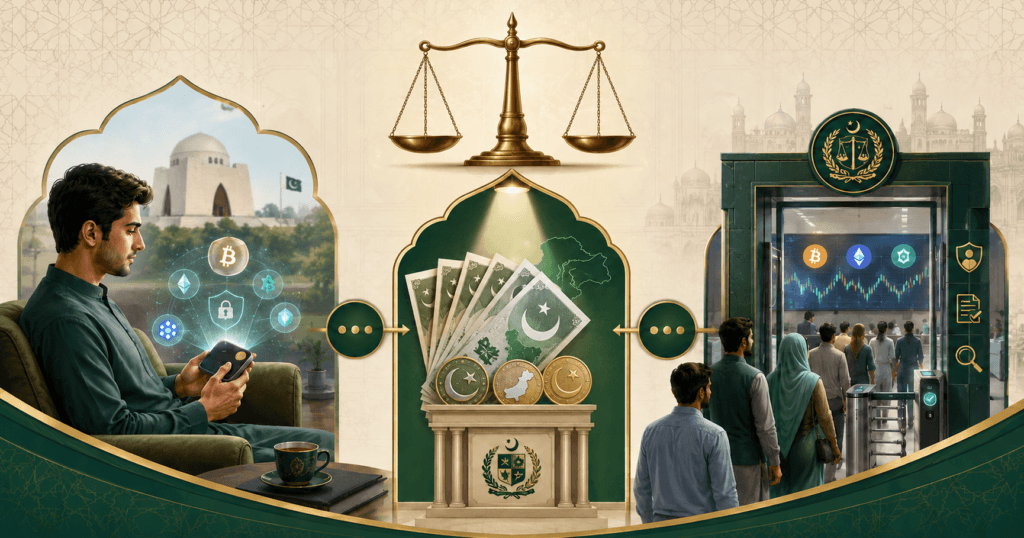
The Legal Position at a Glance
| Activity | Current legal position | Main caution |
|---|---|---|
| Holding Bitcoin or another virtual asset for yourself | Not made a blanket offence by the 2026 Act | The asset is not legal tender and may be highly risky |
| Buying or selling only for your own account | Expressly separated from broker-dealer services if no customer orders or assets are involved | Fraud, AML, banking and tax rules still apply |
| Occasional private P2P trade | Not automatically a criminal offence merely because it is P2P | Source of funds, third-party payments and fraud links can create serious risk |
| Running an exchange, brokerage or custodial wallet | Requires the correct PVARA licence | An NOC alone is not a full licence |
| Trading or managing crypto for other people | May amount to brokerage, advisory, management or another licensed service | Do not call yourself an adviser or manager without checking the licensing rules |
| Issuing or publicly marketing a token | Controlled by the Act and PVARA rules | Unauthorised offerings and misleading marketing can be offences |
| Mining only for your own account | Excluded from mining-related VASP services in Schedule I | Electricity, equipment, tax and other laws still apply |
| Mining or managing customer funds for others | Falls within the regulated service perimeter | PVARA authorisation may be required |
| Paying for goods in crypto | Crypto may be transferred by agreement, but it is not legal tender | Do not assume it lawfully replaces a PKR obligation in every situation |
This table explains why is crypto legal in Pakistan cannot be answered with one careless “yes” or “no”. The identity of the person, the purpose of the transaction and control over customer money all matter.
Reader’s rule: Before relying on any “Is crypto legal in Pakistan?” answer, identify whether you are a private owner, own-account trader, adviser, broker, custodian, exchange, issuer or miner. Then verify the platform’s status, the source of money and records. The same token may appear in a personal transaction, a regulated service or a criminal offence depending on those facts.
Pakistan’s Crypto Law Changed: Do Not Rely on Old 2018 Advice
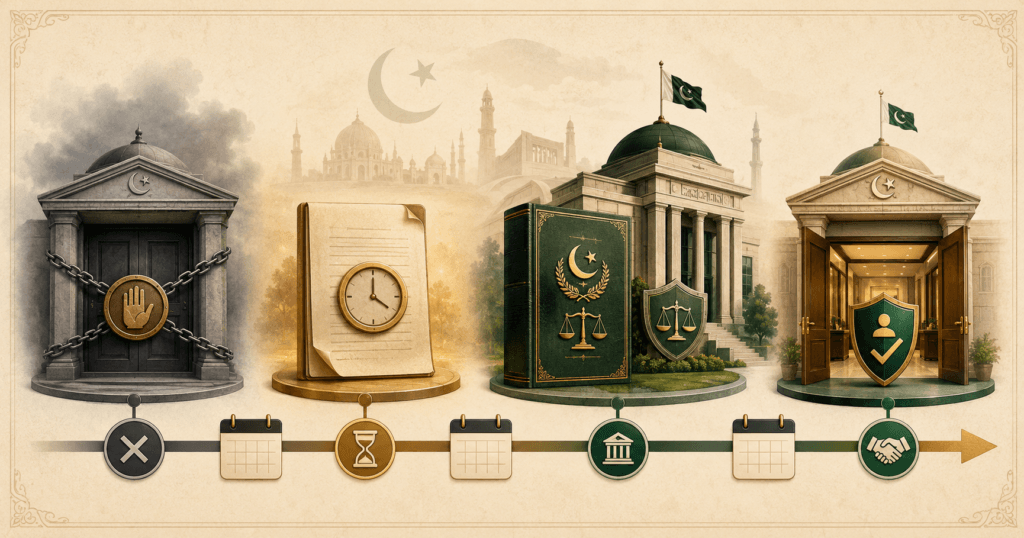
For years, most online articles repeated the State Bank of Pakistan’s 2018 circular. That circular directed banks and other regulated entities not to facilitate virtual-currency transactions. It was important, but it did not itself create a new criminal offence for every private individual.
The regulatory story then changed:
- In 2025, Pakistan introduced a temporary Virtual Assets Ordinance and established a new regulatory direction.
- In March 2026, Parliament enacted the permanent Virtual Assets Act, 2026, which extends to the whole of Pakistan and came into force immediately.
- The Act established the Pakistan Virtual Assets Regulatory Authority, commonly called PVARA.
- In April 2026, the State Bank replaced its 2018 circular with BPRD Circular Letter No. 10 of 2026.
- Banks may now open accounts for duly licensed VASPs under strict conditions. NOC holders may receive limited-purpose accounts to complete licensing formalities, but virtual asset transactional services require a full licence.
So, is crypto legal in Pakistan under today’s law? It is part of a regulated virtual-asset system, not the old policy vacuum. Any article that discusses only the 2018 circular or the temporary 2025 Ordinance is incomplete for readers in 2026.
Pakistan Crypto Council or PVARA? Do Not Confuse Policy With Regulation
The Pakistan Crypto Council helped develop policy discussion and coordinate work on digital assets during 2025. PVARA has a different legal position: it is the statutory authority established by the 2026 Act to license, regulate and supervise VASPs and issuers.
This difference matters. A council statement, policy proposal, international meeting, memorandum of understanding or pilot announcement is not a VASP licence. PVARA has specifically warned that an announced partnership or pilot involving virtual-asset services may still need its prior authorisation.
Therefore, a reader asking “Is crypto legal in Pakistan?” should check enacted law and PVARA’s written regulatory status, not treat every policy announcement as permission to trade, issue tokens or offer services.
Rule 1: Crypto Is a Virtual Asset, Not Pakistani Legal Tender
The Virtual Assets Act defines a virtual asset as a digital representation of value that can be traded, transferred or used for payment or investment. The same definition expressly says that virtual assets are not legal tender.
This distinction is vital. Pakistani rupees are official currency. A creditor, shop, employer or government department is not automatically required to accept Bitcoin, USDT or another token in place of PKR. A crypto transfer may have value between willing parties, but it does not receive the legal status of currency merely because people use it as money.
When answering is crypto legal in Pakistan, “regulated asset” and “legal tender” must never be treated as the same thing. The law can regulate an asset without forcing everyone to accept it as payment.
Rule 2: Owning Crypto and Running a Crypto Business Are Different

The Act defines a Virtual Asset Service Provider, or VASP, as a person who provides one or more virtual asset services to third parties professionally and as a business. This definition protects an important boundary between personal activity and customer-facing business.
Schedule I goes further. A person dealing solely on his or her own account is excluded from the broker-dealer service description if that person does not execute orders for customers and does not hold or control customer assets. Pure mining for one’s own account is also excluded from the mining-service category. Mere software or hardware that lets a user retain exclusive control of private keys is excluded from custodial service.
That does not give personal traders a licence to commit another offence. A private wallet can still hold stolen assets. A P2P transfer can still form part of fraud or money laundering. Insider trading and market manipulation are expressly prohibited. The point is narrower: personal ownership is not automatically the same as operating an exchange, broker, adviser or custodian.
This is the most important practical answer for an ordinary investor asking, “Is crypto legal in Pakistan?”
Rule 3: A Crypto Service Business Needs a PVARA Licence
Section 50 of the Act says that no person may, by way of business, provide or claim to provide virtual asset services in or from Pakistan unless that person is an incorporated company and holds a valid PVARA licence.
The regulated categories cover services such as:
- personalised virtual-asset advice;
- broker-dealer services;
- exchange services;
- custody and administration;
- lending and borrowing;
- virtual-asset derivatives;
- investment and portfolio management;
- transfer and settlement for customers;
- token issuance; and
- mining services involving customer assets or funds.
If a social-media trader collects money from several people, promises returns, buys coins on their behalf and controls their wallets, calling the arrangement a “friends’ investment group” may not keep it outside the law. Courts and regulators look at the real activity, not only the label.
For businesses asking is crypto legal in Pakistan, the answer begins with the PVARA licensing framework, the exact service category and written regulatory status.
Rule 4: NOC, AML Registration and Full Licence Are Not the Same
PVARA currently describes a staged journey:
| Stage | What it means | What it does not mean |
| PVARA NOC | Preliminary approval to move forward with the formal process | It is not a full VASP licence |
| AML registration | Registration with the Financial Monitoring Unit for AML/CFT obligations | It does not replace PVARA licensing |
| Local incorporation | A Pakistani company or subsidiary is established | Incorporation alone does not authorise virtual-asset services |
| Full VASP licence | Formal authorisation for specified service categories | It does not authorise every possible service outside the licence scope |
As of 7 August 2026, PVARA’s public licensing page still says that it is accepting NOC applications and that the full licensing framework will be available soon. Because this position can change, readers should check the official page on the date of any transaction or business decision.
The Act also created a six-month transition for a person who was already providing virtual-asset services immediately before it commenced. Such an operator had to apply within that period or stop providing the service, and a person who submitted a complete application could continue existing services subject to interim directions and core AML and customer-protection duties. In early August 2026, that transition was still relevant, but it did not convert every platform or NOC holder into a fully licensed VASP. This temporary detail is another reason a current answer to is crypto legal in Pakistan must carry a review date.
This distinction prevents a common mistake in articles about is crypto legal in Pakistan: describing an NOC holder as if it has already received an unrestricted exchange licence.
Rule 5: Is Binance Legal in Pakistan?
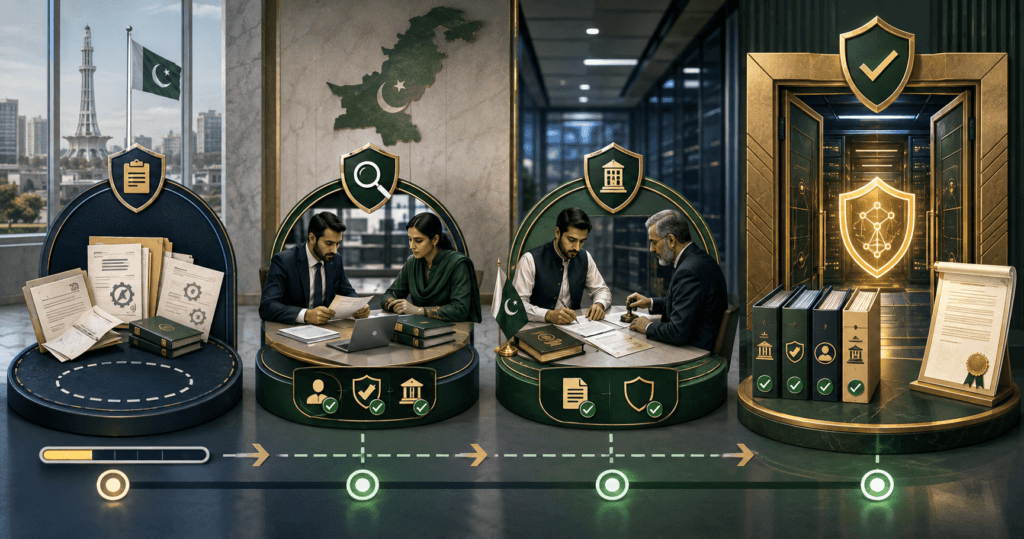
PVARA announced that Binance and HTX received NOCs in December 2025. According to PVARA’s own FAQ, an NOC is preliminary approval that allows an applicant to continue towards AML registration, local incorporation and the formal licensing process.
Therefore, the careful answer is not simply “Binance is fully licensed.” The accurate position is that Binance received an initial PVARA NOC, while PVARA’s public licensing material still distinguishes that stage from a full VASP licence.
Access to an app or website also does not prove full legal approval. A platform may remain technically accessible while its exact regulatory permissions are limited, transitional or still under review. Before depositing money, check PVARA’s latest public information, the platform’s Pakistani legal entity, the service being offered and the complaint route.
Anyone searching for “Is crypto legal in Pakistan?” because they want to use Binance should understand this difference before trusting marketing posts or screenshots.
Rule 6: P2P Crypto Trading Is Not Automatically a Crime – But It Is Not Risk-Free
In Hammad Ali and others v. The State and another, reported as 2026 LHC 4849, the Lahore High Court considered allegations arising from USDT P2P transactions conducted during 2021-2023. The Court confirmed pre-arrest bail and explained that the 2018 SBP circular applied to regulated financial institutions; it did not itself criminalise private P2P transactions.
The Court also found that receiving funds in a bank account or participating in a crypto transaction did not, by itself, prove cheating, forgery or electronic fraud. The prosecution still had to establish the legal ingredients of the offences alleged. Readers can examine the official Lahore High Court judgment.
But this decision must not be stretched beyond its facts. It was a bail judgment, it concerned transactions before the 2026 Act, and the Court noted that the new Act was not retrospective. It did not create a permanent safe harbour for every present-day merchant, high-volume trader or person dealing for customers.
The safest conclusion to the question “Is crypto legal in Pakistan?” is that a genuine private P2P trade is not automatically proof of a crime, but current licensing, AML, banking, fraud and evidence rules can still apply.
Why P2P Payments Can Freeze an Innocent Person’s Bank Account
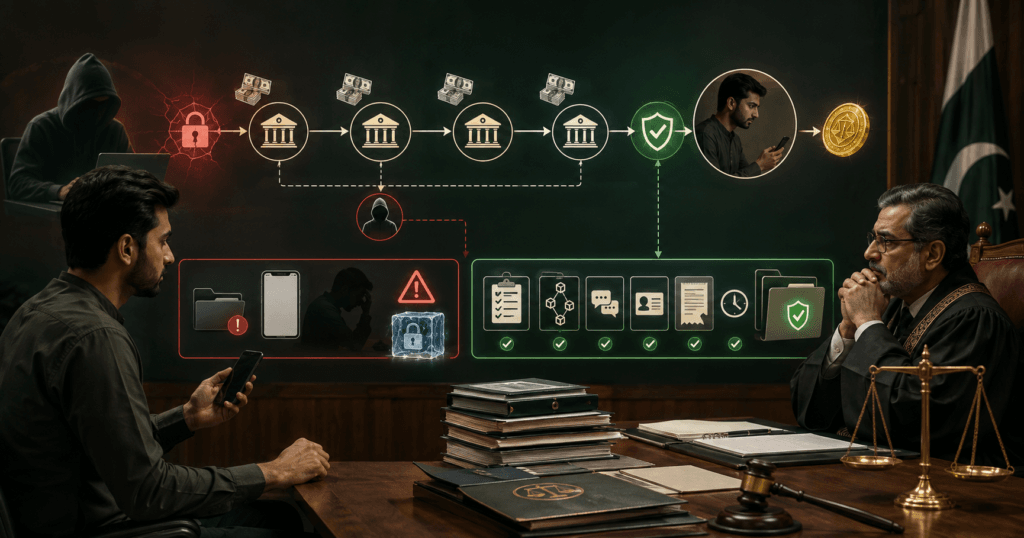
A seller may receive PKR from a buyer whose account is connected with a stolen card, hacked account, fake business or wider fraud chain. The seller may have delivered USDT honestly, yet the suspicious payment can still trigger a bank review or investigation.
Reduce the risk by following these habits:
- Use an account in your own verified name.
- Do not accept payment from an unrelated third party.
- Match the platform user’s identity with the bank-account title.
- Keep the order ID, transaction hash, wallet address, complete chat and bank receipt.
- Never release crypto only because a buyer sends a screenshot; confirm cleared funds in your own banking channel.
- Avoid splitting suspiciously large payments across many accounts.
- Stop if the buyer asks you to hide the purpose, use another person’s account or move money immediately.
These steps do not guarantee safety, but they create a clearer evidence trail if a dispute begins.
A clean record does not decide is crypto legal in Pakistan, but it can help prove what you actually did.
Rule 7: Banks Can Serve Licensed VASPs, but Strict Checks Remain
The State Bank’s 2026 circular replaced the old 2018 restriction. Banks may open accounts for PVARA-licensed VASPs after verifying the licence. They must keep customer money separate through client money accounts where required, apply due diligence and report suspicious transactions.
Banks may also open limited-purpose accounts for NOC holders so they can complete licensing formalities. Additional virtual-asset transactional services may be extended only after PVARA grants a licence. Banks themselves remain prohibited from investing, trading or holding virtual assets using their own funds or customer deposits.
This means “Is crypto legal in Pakistan?” is no longer answered by saying “banks are completely banned from everything related to crypto.” Formal banking has opened for compliant licensed businesses, but ordinary customers should still expect source-of-funds questions, transaction monitoring and possible restrictions when activity appears suspicious.
If a bank restricts your account, ask for the complaint/reference number and the documents required for review. Give truthful records. Do not create fake invoices, edit screenshots or invent a source of funds; that can turn a compliance problem into a criminal one.
Rule 8: Unlicensed Services and Market Abuse Carry Heavy Penalties
The law’s highest-profile punishment is not written as a penalty for every person who owns Bitcoin. Section 54(1) applies where a person wilfully provides an unlicensed virtual asset service.
| Prohibited conduct | Maximum statutory consequence |
| Wilfully providing an unlicensed virtual asset service | Up to 5 years’ imprisonment, fine up to PKR 50 million, or both |
| Conducting an unlawful initial virtual asset offering | Up to 3 years, fine up to PKR 25 million, or both |
| Market manipulation or insider trading by a natural person | Up to 3 years, fine up to PKR 25 million, or both |
| Knowingly filing false or misleading documents with PVARA | Up to 3 years, fine up to PKR 20 million, or both |
| Obstructing an authorised PVARA officer | Up to 2 years, fine up to PKR 10 million, or both |
PVARA can also take administrative action and may direct access to an unlicensed service, app, advertisement or payment link to be blocked. The exact charge and punishment depend on the proved facts, intention and statutory provision.
Asking “Is crypto legal in Pakistan?” does not remove separate offences committed through a virtual asset.
Headlines about “five years for crypto” give a misleading answer to the question “Is crypto legal in Pakistan?” The offence is tied to wilfully providing an unlicensed service, not simply holding a coin in a personal wallet.
Rule 9: Which Crypto Wallet Is Allowed in Pakistan?
Pakistan does not presently publish a simple list declaring every consumer wallet “allowed” or “banned.” The correct legal question is who controls the assets and whether a business is providing custody to customers.
A self-custody wallet normally leaves the user in exclusive control of the private keys. Schedule I excludes the mere provision of software or hardware that allows a customer to retain exclusive control from the custody-service description. By contrast, a custodial wallet provider that holds or controls customer assets as a business falls inside the licensing framework.
Before using a custodial wallet, check:
- the provider’s current PVARA status;
- whether it has only an NOC or a full licence;
- the legal entity responsible for customers in Pakistan;
- withdrawal and account-freeze terms;
- security history and two-factor authentication;
- the complaint and recovery process; and
- whether you, or the company, controls the private keys.
Do not select a wallet only because an influencer answers is crypto legal in Pakistan with a confident video. Security, custody and legal status are separate questions.
Rule 10: Is Crypto Mining Legal in Pakistan?
The Act defines virtual-asset mining. Its Schedule I says pure mining for one’s own account is excluded from mining-related virtual asset services. Licensing applies where a mining operation provides services to third parties involving customer assets or funds.
This is useful, but it is not a complete exemption from every Pakistani law. A mining project may still involve lawful electricity connections, tariffs, imported equipment, taxation, environmental requirements, land use and local permissions. Electricity theft or an illegal connection does not become lawful because the equipment mines Bitcoin.
So, is crypto legal in Pakistan for a home or commercial miner? Own-account mining is outside the listed customer-service category, but the scale, energy source, business model and involvement of other people’s funds must still be checked.
Rule 11: Crypto Tax Is Not a Fixed Rumour You Can Copy From Social Media
Section 66 of the Virtual Assets Act requires every licensed VASP to comply with Pakistan’s income-tax law and rules or regulations issued by the Federal Board of Revenue. The law does not support inventing one universal retail crypto-tax percentage for every person and every transaction.
Income from frequent trading, business operations, mining, professional services or disposal of an asset may receive different treatment depending on facts and current tax law. Until the Federal Board of Revenue publishes a clear activity-specific rule for your situation, do not assume that crypto profits are automatically tax-free or that an online “5% crypto tax” claim is enacted law.
Keep acquisition dates, PKR cost, sale value, fees, wallet records, exchange statements and bank entries. A tax practitioner can only give reliable advice when the transaction history is complete. This record-keeping point belongs in every responsible answer to is crypto legal in Pakistan.
Is Crypto Haram in Islam? Law and Sharia Are Separate Questions
Whether an activity is lawful under state legislation and whether it is permissible under Sharia are not identical questions. The Virtual Assets Act creates a Shariah Advisory Committee for regulatory advice, but that does not mean every coin, leverage product, staking return or speculative trade has automatically received religious approval.
In June-July 2026, a leading Pakistani seminary issued a restrictive opinion concerning cryptocurrency-based transactions, while PVARA sought clarification between speculative coins and asset-backed digital tokens. Reporting on that continuing discussion shows why a one-line online answer is unsafe.
Questions may differ according to the asset, ownership, backing, uncertainty, leverage, interest, deception, gambling-like speculation and purpose. A person seeking a religious ruling should give the full product and transaction structure to a qualified Sharia scholar. “Is crypto legal in Pakistan?” is a question of state law; it cannot, by itself, answer whether a particular transaction is halal or haram.
Can You Use Crypto to Pay for Goods, Services or Freelance Work?
The Act recognises that virtual assets may be used for payment or investment, but it expressly denies them legal-tender status. This means two willing parties may discuss a virtual-asset transfer, yet the legal and tax treatment of the underlying sale, service, remittance or foreign-exchange transaction still matters.
PVARA has also warned that pilots, stablecoin arrangements, custody, exchange, transfer and payment-related services may require prior authorisation. A public announcement, partnership or memorandum does not itself authorise a service. Businesses should read the PVARA advisory on virtual-asset activities before launching a payment product.
For a freelancer, the safest approach is to keep a written contract, invoice, agreed PKR value, transaction hash, wallet details, date of receipt and tax record. Do not use crypto to hide income, evade foreign-exchange rules or disguise the real parties.
This is another reason is crypto legal in Pakistan needs a factual answer: receiving an asset for genuine work is different from operating a remittance or transfer service for customers.
What to Do If You Lose Money in a Crypto Scam
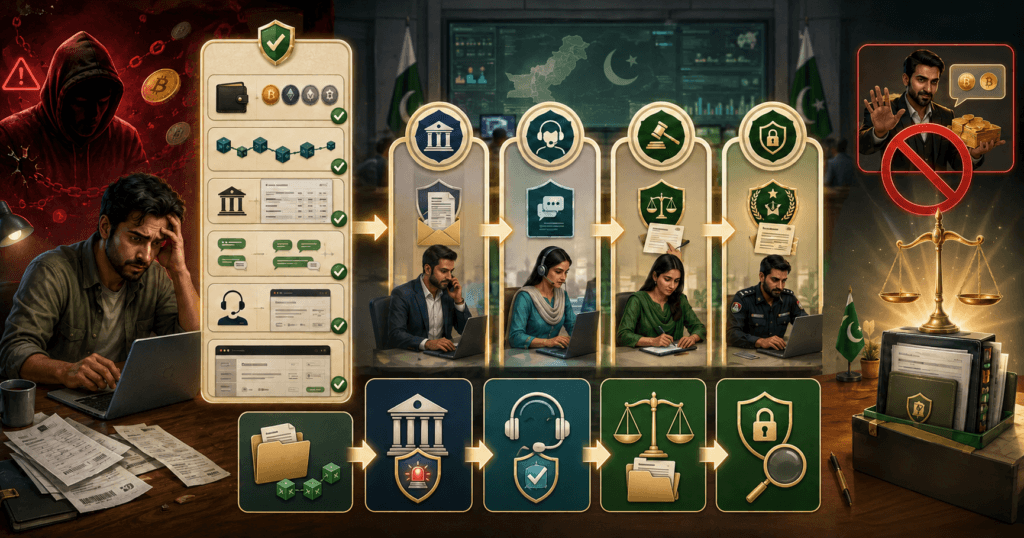
Speed matters because virtual-asset transfers can be difficult to reverse. Take these steps without promising yourself that recovery is guaranteed:
- Stop further transfers and do not pay a “recovery agent” who demands more crypto.
- Contact your bank and the exchange or wallet provider through verified support channels. Request preservation or freezing where possible.
- Save wallet addresses, transaction hashes, order IDs, bank entries, account titles, phone numbers, email headers, complete chats, profile URLs and support tickets.
- Report suspected fraud, an unlicensed VASP or provider misconduct through the PVARA grievance portal.
- For hacking, impersonation or online financial fraud, file through the official NCCIA complaint portal or call 1799 for guidance.
- Obtain a complaint reference and keep a dated follow-up record.
- Consult a lawyer promptly where the loss is serious, several accounts are involved or an FIR/inquiry has begun.
Our step-by-step guide on filing a cyber crime online complaint in Pakistan explains how to preserve online material and use the current NCCIA route. The Qanun-e-Shahadat evidence guide also explains why an allegation and lawful proof are not the same thing.
PVARA says it accepts complaints about suspected fraud, unlicensed providers and provider misconduct. Its page states that an acknowledgment is normally sent within two business days and a full investigation may take 30-60 days depending on complexity. These are regulatory timelines, not a promise that every victim will recover money.
When a victim asks is crypto legal in Pakistan after a scam, the first priority is not debating the market. It is preserving the evidence trail before accounts, messages or transaction records disappear.
Evidence Checklist: Save This Before You Need It
Keep the following material in one organised folder:
- CNIC and verified account details used on the platform;
- exchange profile and KYC confirmation;
- complete order history and account statements;
- transaction hashes and blockchain explorer links;
- sending and receiving wallet addresses;
- bank statements and payment confirmations;
- counterparty account title, mobile number and username;
- complete chats with dates and times;
- advertisements, profit promises and referral messages;
- support tickets and provider responses;
- screen recordings showing the account status; and
- a short date-by-date chronology of what happened.
Do not crop away dates or usernames. Do not edit original screenshots. Keep copies in a safe place and protect sensitive data from public sharing.
An evidence file does not decide “Is crypto legal in Pakistan?”, but it may decide whether an innocent transaction can be separated from a scam, stolen-money trail or false allegation.
How to Verify a Crypto Platform Before You Deposit a Rupee
A polished app, celebrity post or local payment option does not prove regulatory approval. Before opening an account, identify the company that will contract with you. Record its legal name, Pakistani registration details, physical address, support channel and the exact service it claims to provide.
Check each point carefully:
- Confirm whether the provider holds a preliminary NOC or a full licence for the service you plan to use.
- Read deposit, withdrawal, account-freeze, dispute and customer-money terms before transferring funds.
- Test support with a question and save the reply from a verified channel.
- Search the official complaint page and recent advisories for warnings, impersonation notices or restricted activities.
- Make a small test withdrawal before placing a larger balance on the platform.
- Never install an app through an unknown message, sponsored clone page or unofficial download file.
A genuine provider should explain which Pakistani entity serves you, who keeps customer assets, how withdrawals work and where a complaint can be filed. Silence, pressure, guaranteed returns, secret deposit instructions or payment to a stranger’s bank account are serious warning signs.
Regulation improves accountability but cannot guarantee profit, prevent hacking or recover every loss.
A Safer Crypto Checklist for Ordinary Pakistanis
Before risking money, ask these questions:
- Am I trading only for myself, or am I handling customer money?
- Is the provider fully licensed, only an NOC holder, or unverified?
- Does the bank payer’s name match the verified platform user?
- Can I explain the source of funds with real documents?
- Am I being promised fixed or guaranteed profit?
- Who controls the private keys?
- Have I enabled two-factor authentication and withdrawal protection?
- Can I afford to lose the entire amount without borrowing?
- Am I preserving records for banking and tax questions?
- Does the transaction involve leverage, interest, deception or another Sharia concern?
If the answer is unclear, pause. A missed trade is usually cheaper than a frozen account, lost wallet or criminal inquiry.
This checklist turns “Is crypto legal in Pakistan?” from an abstract search into a practical decision about identity, licence status, source of funds and proof.
Frequently Asked Questions About Is Crypto Legal in Pakistan
Is crypto trading allowed in Pakistan?
Own-account trading is not treated as broker-dealer activity under Schedule I when a person does not execute customer orders or hold customer assets. That does not protect fraud, money laundering, market manipulation or an unlicensed customer-facing business. This is the practical answer to is crypto legal in Pakistan for an individual trader.
Is Binance legal in Pakistan?
Binance received a PVARA NOC in December 2025, but an NOC is a preliminary approval and not the same as a full VASP licence. Check the latest PVARA position before using any service.
For this FAQ, “Is crypto legal in Pakistan?” does not mean that every service visible inside the Binance app has received final Pakistani authorisation.
Is crypto haram in Islam?
Pakistani scholars have expressed different views, and a restrictive seminary opinion in 2026 led PVARA to seek further clarification. State-law regulation does not make every token or product Sharia-compliant. Consult a qualified scholar about the exact asset and transaction.
In short, “Is crypto legal in Pakistan?” and “Is a particular crypto product halal?” are two separate questions.
How much is one Bitcoin in PKR?
The price changes continuously. When this article was reviewed on 7 August 2026, one Bitcoin was approximately PKR 17.9 million, but readers should check a live BTC-to-PKR price before relying on any figure. Price information does not answer is crypto legal in Pakistan or make an investment safe.
Which crypto wallet is allowed in Pakistan?
There is no simple official list approving every wallet. Self-custody software is treated differently from a business that controls customer assets. Verify the provider’s current PVARA status and understand who holds the private keys.
The question “Is crypto legal in Pakistan?” cannot tell you whether a wallet is secure, custodial or properly authorised.
Is buying crypto illegal in Pakistan?
The 2026 Act does not create a blanket offence of merely buying a virtual asset for oneself. The legality can change where fraud, stolen funds, unlawful foreign exchange, unlicensed services or another offence is involved. Therefore, is crypto legal in Pakistan depends on the complete conduct, not the buy button alone.
Is P2P crypto trading legal in Pakistan?
The Lahore High Court held that private P2P transactions under the old 2018 circular were not automatically criminal and that receiving money alone did not prove fraud. The decision concerned pre-Act facts and a bail case, so it should not be treated as blanket permission for every current transaction.
For P2P users, “Is crypto legal in Pakistan?” therefore requires a second question: can you prove the identity, source and genuine purpose of the payment?
Is Bitcoin legal tender in Pakistan?
No. The Virtual Assets Act, 2026 expressly says virtual assets are not legal tender. No one is automatically required to accept Bitcoin instead of Pakistani rupees.
This legal-tender limit remains part of the answer to “Is crypto legal in Pakistan?” even though virtual assets now have a regulatory framework.
Can my bank account be frozen because of P2P trading?
A bank may restrict or review an account when a payment appears connected with fraud, stolen funds or suspicious activity. Preserve the complete trade record, ask for a reference number and respond with genuine documents.
A bank review does not by itself settle “Is crypto legal in Pakistan?” or prove that the customer committed an offence.
Do I have to pay tax on crypto profit?
Do not assume crypto profit is automatically tax-free. The correct treatment depends on current tax law and the nature of the activity. Keep complete records and obtain advice from a qualified tax professional.
No responsible answer to “Is crypto legal in Pakistan?” should invent a fixed tax rate without a current FBR basis.
What is the punishment for illegal crypto activity?
Wilfully providing an unlicensed virtual asset service may lead to imprisonment up to five years, a fine up to PKR 50 million, or both. This punishment should not be falsely described as applying to every personal holder.
That difference is central to “Is crypto legal in Pakistan?”: the offence concerns the prohibited conduct proved under the Act.
Can I run a crypto exchange from Pakistan?
Not lawfully without incorporation and the correct PVARA licence. Exchange, custody, brokerage, advisory and other services may require separate regulatory permissions.
For an operator, “Is crypto legal in Pakistan?” is ultimately a licensing-perimeter question, not merely a question of website access.
Is Bitcoin mining legal in Pakistan?
Pure mining for one’s own account is excluded from the mining-service category in Schedule I. Third-party mining involving customer funds may require licensing, while electricity, tax, equipment and local laws still apply.
Mining shows again why “Is crypto legal in Pakistan?” depends on whether the activity is personal or a service for others.
Can I receive freelance payment in USDT?
The parties may agree on a virtual-asset transfer, but USDT is not legal tender. Keep the service contract, invoice, PKR value, wallet record and tax evidence, and check foreign-exchange and payment-service implications where relevant.
For freelancers, “Is crypto legal in Pakistan?” should never be used as an excuse to hide income or abandon proper invoices.
Where can I complain about a crypto scam?
Report provider fraud, misconduct or an unlicensed VASP to PVARA. Report hacking, impersonation and online financial fraud to NCCIA. Also notify the bank and platform immediately and preserve all transaction evidence.
After a loss, the debate about “Is crypto legal in Pakistan?” should not delay an urgent complaint or evidence-preservation step.
So, is crypto legal in Pakistan in one sentence?
Pakistan regulates virtual assets rather than imposing a blanket ban on personal ownership, but crypto is not legal tender, and anyone providing virtual-asset services as a business needs the required PVARA licence.
Final Answer: Regulation Does Not Mean Guaranteed Safety
The honest answer to is crypto legal in Pakistan is neither an excited “everything is legal” nor an outdated “all crypto is banned.” Pakistan now has a permanent Virtual Assets Act, a statutory regulator and a controlled path towards licensed services. The law also separates own-account activity from professional services provided to customers.
At the same time, virtual assets are not legal tender. An NOC is not a full licence. P2P trading can expose an innocent person to stolen funds. Crypto transfers can be difficult to reverse, and an unlicensed service business can face severe punishment.
These limits explain why “Is crypto legal in Pakistan?” must always be answered together with the words “for which activity and under what authorisation?”
If you remember only one lesson, remember this: check the activity, the provider’s exact regulatory status, the source of funds and the evidence trail before sending money. That careful approach gives the most useful answer to is crypto legal in Pakistan for ordinary people in 2026.
Important Legal and Financial Disclaimer
This article is for general legal awareness and educational purposes only. It is not personal legal, financial, investment, tax or Sharia advice. Virtual-asset law, regulations and licensing status can change quickly. Every transaction depends on its facts, parties, source of funds, platform, purpose, documents and applicable law. Check the latest official information and consult an appropriately qualified professional before acting.
Because “Is crypto legal in Pakistan?” is a fast-changing legal question, readers should confirm the Act, regulations and provider status again after the last-reviewed date.