

A family can own land for generations and still face trouble because one name, share, boundary, or transfer is wrong in the record. A missing heir may be discovered years later. A buyer may pay for an undefined part of joint land. A co-sharer may wait for partition while another person controls the best portion.
That is why Punjab land revenue is not a subject only for Patwaris, lawyers, or Revenue Officers. It matters to every landowner, heir, buyer, seller, farmer, and co-sharer in Punjab.
The main framework is the Punjab Land Revenue Act, 1967, read with the Punjab Land Revenue Rules, 1968, the Punjab Land Records Authority Act, 2017, and later amendments. In 2026, major reforms strengthened digital records, mutation procedure, surveys, demarcation, partition, appeals, review, revision, stay, and revenue administration.
This article is deliberately an evergreen pillar guide. It explains how the whole system works today. It does not repeat every clause of the separate 2026 amendment article.
Table of Contents
Punjab Land Revenue at a Glance
| Question | Practical Answer |
|---|---|
| Main statute | Punjab Land Revenue Act, 1967, as amended |
| Main procedural rules | Punjab Land Revenue Rules, 1968 |
| Digital land-record authority | Punjab Land Records Authority |
| Common record issues | Fard, Khewat, Khatooni, Khasra, mutation, ownership shares |
| Boundary remedy | Survey and demarcation before the competent revenue authority |
| Joint ownership remedy | Partition under the statutory revenue framework |
| Wrong record entry | Correction may be available depending on the real dispute |
| Adverse revenue order | Appeal, review, revision and stay may be relevant |
| 2026 direction | Digital cadaster, computerized records, faster partition and tighter timelines |
The official Punjab Land Records Authority lists the Punjab Land Revenue Act, 1967, Punjab Land Revenue Rules, 1968 and PLRA Act, 2017 among its governing legal resources. (Punjab Land Records Authority)
Official Punjab Land Records Authority laws and regulations
IRAC: How to Analyse a Land Revenue Problem
| IRAC | Practical Question |
|---|---|
| Issue | Is the real dispute about record, mutation, inheritance, title, boundary, possession, partition or an order? |
| Rule | Which statute, section, rule, document or succession principle controls it? |
| Analysis | Do the official record, title papers, mutation history, map, possession, notices and previous orders agree? |
| Conclusion | Which authority has jurisdiction, what remedy is available, what evidence is needed and what deadline applies? |
This simple method prevents a common revenue-law mistake: choosing an office or court before identifying what legal right actually needs to be decided.
What Does Punjab Land Revenue Law Actually Cover?
The 1967 Act is mainly a land-administration statute. It deals with Revenue Officers, records-of-rights, surveys, assessment, partition, appeals and connected revenue functions.
For ordinary citizens, the law becomes important when a right in land must be:
- recorded;
- verified;
- transferred;
- corrected;
- measured;
- partitioned;
- enforced; or
- challenged before the proper revenue authority.
But the revenue record is not the whole law of ownership.
A person’s right may arise through inheritance, sale, gift, a decree or another lawful source. The revenue machinery records and administers that right. An entry cannot make an otherwise invalid transaction valid merely because somebody’s name appears in the record.
A safer way to understand Punjab land revenue is:
legal right → document → revenue record → map → possession → remedy
Each part should support the others.
Which Laws Should a Punjab Landowner Check?
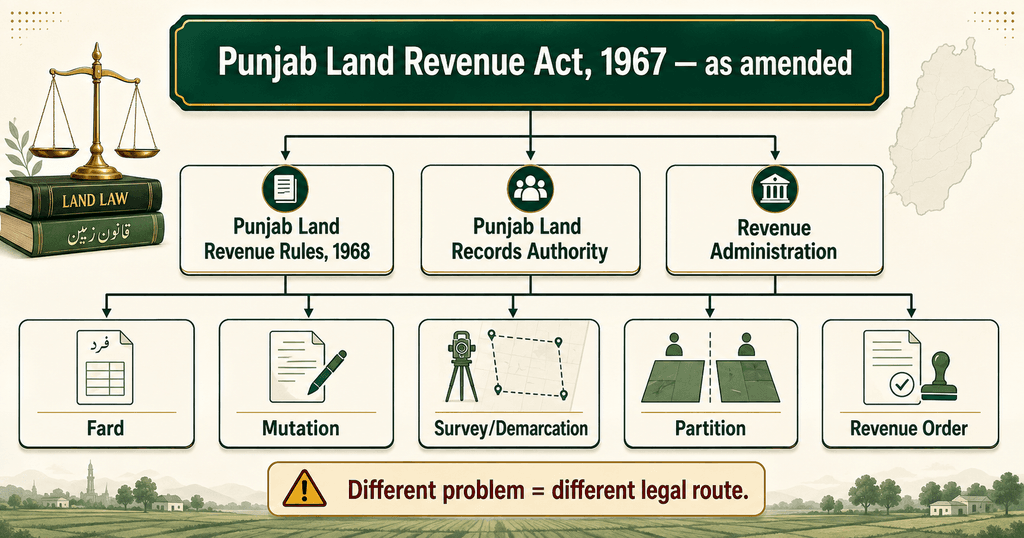
The starting statute is the Punjab Land Revenue Act, 1967. Procedural questions may also require the Punjab Land Revenue Rules, 1968. Computerized land-record services and the role of the Punjab Land Records Authority must be considered under the PLRA framework. (Punjab Land Records Authority)
The PDF supplied for this article is the Punjab Land Revenue (Amendment) Ordinance 2026, Ordinance III of 2026, published in the Punjab Gazette in February 2026. It introduced extensive amendments dealing with digital records, new statutory definitions, Patwari and Kanungo functions and later procedural changes across the Act.
That February Ordinance was later superseded by the Punjab Land Revenue (Amendment) Act 2026, Act XLII of 2026. Therefore, the February document should be treated as important legislative history, not as a substitute for checking the currently amended Act.
For current provincial legislation, the safest external source is the official Punjab Code database:
Punjab Code — official provincial legislation database
This article concerns Punjab only. Its procedures should not automatically be applied to Sindh, Khyber Pakhtunkhwa, Balochistan, Islamabad Capital Territory or another jurisdiction.
Patwari, Kanungo, Revenue Officer and PLRA: Who Does What?
People often use these terms as if they mean the same thing. They do not.
The 2026 reform expressly addressed the functions of Patwari and Kanungo. Broadly, the Kanungo supervises, inspects and verifies Patwari work within the Kanungo Circle. The Patwari prepares, maintains and keeps custody of prescribed land records and performs revenue-survey and other assigned functions.
The Punjab Land Records Authority operates computerized land-record services and Arazi Record Centres. Its official portal currently provides services connected with Fard, mutation, property registration, partition, document verification and Revenue Court information. (Punjab Land Records Authority)
A Fard request, mutation entry, boundary demarcation, partition application and appeal against a Revenue Officer’s order are not the same proceeding. Start by identifying the problem rather than merely asking which office is nearest.
Fard, Khewat, Khatooni and Khasra: Read the Record Carefully
A Fard is an official extract from the land record containing important details about the property and recorded interests. PLRA provides Fard issuance through Arazi Record Centres and official digital channels. (Punjab Land Records Authority)
A landowner should also understand the connected record. Depending on the record and area:
- Khewat generally relates to ownership holdings;
- Khatooni relates to cultivation or tenancy details;
- Khasra identifies a surveyed field or parcel; and
- the Government map or Shajra helps connect the written record to land on the ground.
Before buying, selling, inheriting or litigating, compare the latest Fard with the mutation history, registered document, Khasra or parcel information, Government map and physical possession.
The 2026 amendments introduced concepts such as Digital Cadaster and parcel-linked land information. The Gazette defines Digital Cadaster in terms of electronic maps linked with land records and spatial representation of parcels.
Digitalization can improve traceability. It does not make a legally wrong entry correct.
Mutation: Important, But Not Title by Itself
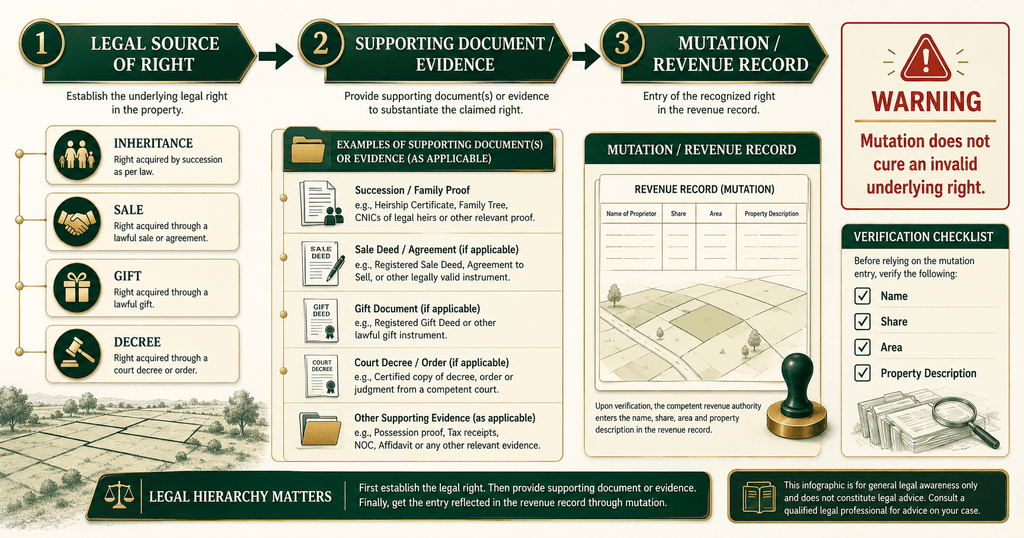
Mutation, commonly called Intiqal, records a change in the official land record following matters such as sale, inheritance, gift or another recognized acquisition.
PLRA provides a formal mutation process involving documents and record verification. (Punjab Land Records Authority)
Official PLRA mutation guidance
Mutation is extremely important in Punjab land revenue administration, but it should not be confused with the legal source of ownership.
For example, if:
- a purported sale is legally invalid;
- a gift is not proved according to applicable law;
- an inheritance mutation excludes a lawful heir; or
- the underlying document is forged,
the mere existence of a mutation does not automatically cure the underlying defect.
After an important acquisition, preserve the source document, complete the mutation process and obtain the updated record. Check the names, shares, area and property description rather than assuming the system has entered everything correctly.
What if the Patwari Does Not Record the Report?
The amended section 42 contains a practical safeguard. Where a Patwari fails to record or display the relevant report, the person may make a written report to the concerned Revenue Officer so the required entry can be caused to be made in the mutation register. The Gazette also strengthens the connection between registered transfers, mutations and land identification.
This is the type of remedy a landowner should know before a record problem becomes a larger dispute.
Inheritance: Check Every Heir and Every Share
Inheritance problems frequently begin because the deceased owner’s name remains in the record and one family member keeps control of the documents.
After a landowner dies, collect:
- death certificate;
- legal-heir documents;
- old and current Fard;
- mutation history;
- CNIC information;
- original title papers; and
- any later transfer or partition document.
Then ask two separate questions:
Has every lawful heir been recorded?
Has each heir’s correct share been recorded?
A missing heir is not always a simple typing mistake. It may expose a genuine dispute about succession, an earlier mutation or a later transfer.
Women, minors, overseas heirs and family members who do not possess the original papers require particular care.
For the Supreme Court’s treatment of an inheritance mutation that excluded a daughter, read Qanooni Dastak’s separate guide:
Inheritance Mutation in Pakistan — Qanooni Dastak
Keeping that judgment analysis separate prevents this pillar article from duplicating an existing case-based page.
Registered Transfers: Follow the Deed Into the Revenue Record
A registered deed should not be treated as the end of the process. The deed, mutation, official record, map and possession should support the same transaction.
The amended section 42 contains an important priority provision: a property transfer executed earlier through a registered document takes precedence over a later registered transfer for recording mutation and delivery of possession under that section.
For jointly owned property, the amended wording also requires stronger identification through reference to the Government land-record map or survey, including relevant area and boundary measurements.
Before signing, ask:
- Does the seller actually own the stated share?
- Is the land joint or partitioned?
- Is there an earlier registered transfer?
- Does the Khasra or parcel match the deed?
- Are the measurements and boundaries identifiable?
- Who is in physical possession?
- Is there a pending partition, stay or inheritance dispute?
PLRA also provides an official property-registration process and public registration portal. (Punjab Land Records Authority)
Official PLRA property registration guidance
Wrong Entry: Record Correction or a Real Ownership Dispute?
A wrong name, area, share or entry should be addressed early. But the correct remedy depends on what you are asking the authority to decide.
A genuine land-record correction may fall within the revenue framework. A very different question arises where the dispute concerns:
- validity of a sale deed;
- cancellation of an instrument;
- a forged document;
- validity of a gift;
- fraud;
- competing ownership; or
- another substantive civil right.
Do not disguise a title dispute as a simple record correction. At the same time, do not turn a straightforward revenue-record problem into unnecessary litigation.
Before filing, clearly state the relief:
“I want this particular entry corrected because…”
or
“I want this instrument/right declared invalid because…”
Those may lead to very different forums.
Boundary Dispute: Use Demarcation, Not Guesswork
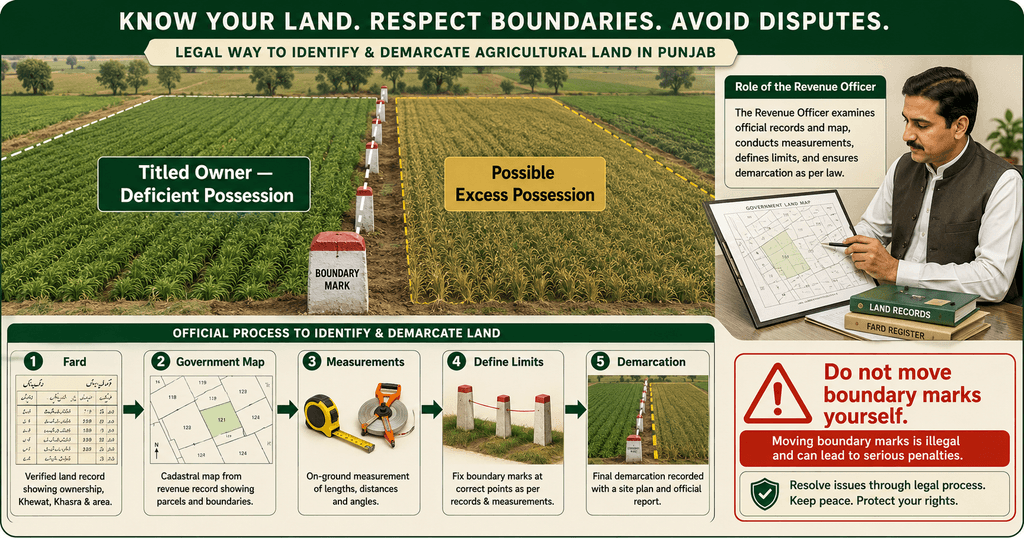
Where neighbours disagree about a boundary, the legal answer should come from the official record, map, survey and prescribed measurement process—not from where somebody believes the boundary once stood.
The 2026 amendment strengthened this area. Amended section 117 addresses a situation where a person is deficient in possession of titled property and the adjacent owner has land beyond his title. The Revenue Officer may define the limits according to title and proceed with demarcation and eviction as permitted by law.
For a demarcation dispute, preserve:
- Fard;
- title documents;
- Khasra or parcel information;
- Government map or Shajra;
- earlier demarcation material;
- notices and revenue orders;
- photographs where useful; and
- evidence showing actual possession.
Do not remove, shift or damage survey or boundary marks yourself.
Joint Land: A Share Is Not Always One Specific Piece
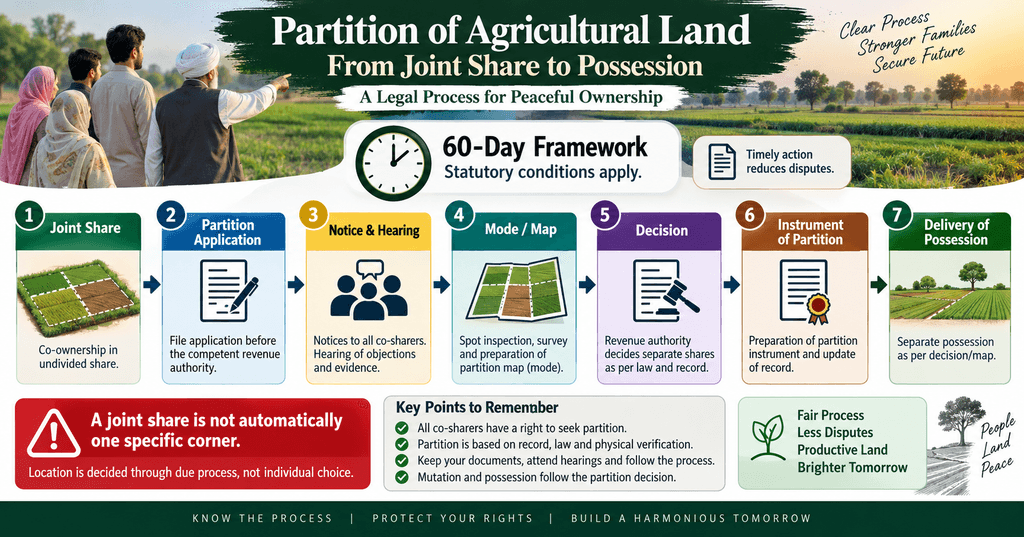
A co-sharer may own a fractional interest in joint land without owning one selected corner exclusively.
This distinction is central to many Punjab land revenue disputes.
One brother may cultivate the eastern portion. Another may use the land near the road. A sister may own a recorded share but possess no particular field. Until lawful partition takes place, current possession does not automatically convert one particular location into the exclusive ownership of a co-sharer.
The Act provides a formal partition framework. The 2026 reform strengthened inheritance-based partition, private partition schemes, scheduling, control of adjournments and later delivery of possession.
For a detailed Board of Revenue judgment dealing with inherited joint land and possession-based objections, see:
Partition of Inherited Land in Pakistan — Qanooni Dastak
The 60-Day Partition Rule: Do Not Oversimplify It
It is misleading to say:
“Every partition case must finish in exactly 60 days.”
The amended framework is more detailed.
It creates a structured schedule for relevant partition proceedings, deals with service and hearing, restricts adjournments and provides for transfer of the case where the Revenue Officer cannot complete the matter within the statutory period. The Collector of the Sub-Division is then given a further role, including deciding the transferred matter and dealing with responsibility for delay.
The amendment also addresses mesne profits where a joint owner or occupant possesses land beyond his title in the circumstances covered by the provision.
The practical lesson is therefore broader than “60 days.”
Track:
notice → hearing → objections → map → mode of partition → adjournment → order → instrument of partition → possession
The statutory timeline is intended to control delay, not remove due process.
Possession After Partition: A Paper Order Is Not the End
Winning a partition order is not the same as receiving the land allotted under it.
The statutory framework also deals with the instrument of partition and delivery of possession. The 2026 changes strengthen the consequences connected with excess occupation after partition.
Keep together:
- partition application;
- notices;
- map;
- proposed mode of partition;
- objections;
- interim orders;
- final order;
- instrument of partition;
- possession-delivery documents; and
- appellate or revisional orders.
The practical chain should ultimately become:
joint share → partition → final allocation → instrument → possession → updated record
A paper victory has limited practical value if the legal process never reaches the land itself.
Appeal, Review and Revision: Check the Deadline Immediately
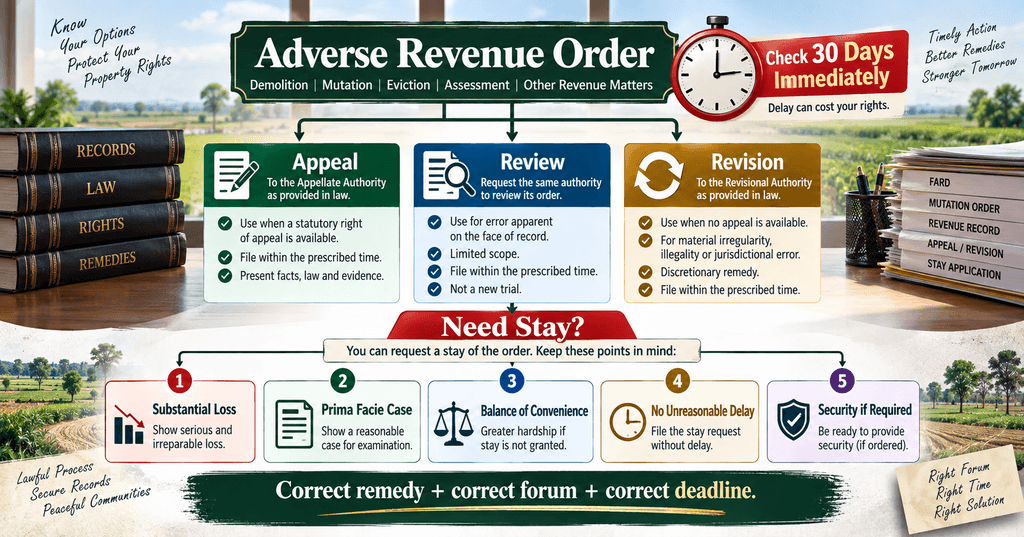
Appeal, review and revision are not different names for the same remedy.
An appeal challenges an order before the statutory appellate authority.
A review is narrower and depends on the grounds and conditions provided by law.
A revision is a supervisory remedy within the statutory revenue hierarchy.
The 2026 amendments tightened important limitation periods. The amended law uses a 30-day general appeal period under the relevant appellate provision unless another rule applies. Review and significant revision provisions also contain strict 30-day structures. Partition has a special appellate mechanism.
After receiving an adverse Punjab land revenue order:
- obtain the complete order immediately;
- note the exact order date;
- identify the correct remedy;
- confirm the competent authority;
- calculate limitation carefully; and
- consider whether interim protection is required.
Do not wait for the other side to act first.
Stay and Remand: Filing an Appeal Does Not Freeze Everything
Filing an appeal or revision does not automatically suspend the challenged order.
The amended stay framework requires consideration of matters including:
- substantial loss;
- a prima facie arguable case;
- balance of convenience;
- whether the applicant delayed unreasonably; and
- security where legally required.
The 2026 amendment also inserted section 164-A concerning remand. It restricts the power to remand a matter to a lower Revenue Officer to the Board of Revenue.
A stay application should therefore explain the actual legal harm. A bare request for “status quo” is not a substitute for satisfying the statutory test.
Revenue Forum or Civil Court?
Choosing the wrong forum can waste years.
Section 172 restricts Civil Court jurisdiction in matters that the Government, Board of Revenue, Revenue Officer or Revenue Court is empowered under the Act to decide or take cognizance of, subject to the wording and exceptions of the statute. The 2026 Gazette amended this jurisdictional provision.
But this must not be turned into the inaccurate rule that every dispute involving land belongs only before a Revenue Officer.
A mutation matter, demarcation, partition or statutory revenue appeal may fall within the revenue system.
A dispute involving cancellation of an instrument, fraud, substantive ownership or another independent civil right may require different analysis.
Before filing, complete one sentence:
“I want the authority or court to ______.”
If you cannot clearly state the relief, you may not yet know the correct forum.
PLRA also operates an official Revenue Court Management System for case information and tracking. (Punjab Land Records Authority)
Official Revenue Court Management System information
What Changed in 2026? A Short Pillar-Page Summary
This pillar article does not need to reproduce 52 amendment clauses.
For ordinary landowners, the major direction of the 2026 reform can be understood through these areas:
- Digital Cadaster and parcel-linked mapping;
- electronic and computerized records;
- express Patwari and Kanungo functions;
- revised mutation and registered-transfer procedure;
- stronger survey and demarcation mechanisms;
- structured partition proceedings;
- tighter control over adjournments;
- arbitration changes in specified revenue matters;
- shorter appeal, review and revision periods;
- statutory stay considerations;
- restricted remand power;
- changes to civil-court jurisdiction; and
- stronger penalties for specified violations.
The Gazette’s Statement of Objects and Reasons itself emphasizes computerized mutations, digital cadastral mapping, clearer revenue administration, streamlined partition, arbitration and revenue-court jurisdiction.
Readers who want the legislative changes section by section should use the dedicated Qanooni Dastak article:
Punjab Land Revenue Ordinance 2026 — detailed amendment guide
This separation avoids unnecessary content duplication. This page explains the system; that page explains the 2026 reform.
Documents Every Landowner Should Preserve
Keep these where relevant:
- original registered deed or other title document;
- current and older Fard;
- mutation copies and mutation history;
- death certificate and heir documents;
- Khewat, Khatooni and Khasra details;
- Government map and survey material;
- demarcation reports;
- partition proceedings and orders;
- instrument of partition;
- possession-delivery papers;
- certified revenue orders;
- appeal, review, revision and stay papers;
- challans and official fee receipts; and
- electronic verification records.
Keep the originals secure.
For a dispute, prepare a separate chronological file showing each death, transfer, mutation, notice, hearing, order, appeal and possession event.
Good evidence is not simply a large bundle of documents. It is a clear chain showing what happened, when it happened and which official record supports it.
Before Buying Land: 11 Checks That Can Prevent a Case
Before paying substantial money:
- Obtain a fresh official Fard.
- Verify the Fard or mutation through the official PLRA verification system.
- Confirm the seller’s CNIC, identity and authority.
- Examine the registry and underlying title documents.
- Check previous mutations and earlier transfers.
- Match Khewat, Khatooni, Khasra, parcel, area and boundaries.
- Compare the official map with the actual site.
- Verify physical possession.
- Identify co-sharers and inheritance issues.
- Check pending partition, demarcation, stay, appeal or court proceedings.
- Complete registration and mutation through lawful official channels.
PLRA provides a dedicated official page for verification of Fard and mutation. (Punjab Zameen)
Official Fard and Mutation Verification Portal
Do not rely only on screenshots, WhatsApp documents, photocopies or an intermediary’s verbal statement when valuable land is involved.
Which Remedy Fits Your Problem?
| Problem | Likely Starting Point | Important Evidence |
|---|---|---|
| Wrong name or share | Record-correction analysis | Fard, mutation, title or inheritance papers |
| Inheritance not entered | Mutation/reporting process | Death certificate, heir documents, existing record |
| Boundary overlap | Demarcation | Fard, map, Khasra/parcel and title |
| Adjacent owner holds excess land | Section 117 analysis | Title, map, measurements and possession |
| Joint land cannot be divided by agreement | Partition | Share record, Fard, mutation and map |
| Private partition already made | Affirmation procedure may apply | Scheme, map and possession material |
| Adverse revenue order | Appeal/review/revision analysis | Order, complete file and limitation dates |
| Fraud or ownership dispute | Forum depends on substantive relief | Title chain, disputed instrument and evidence |
This table identifies a likely starting point only. It does not guarantee jurisdiction or outcome.
Common Mistakes That Create Long Land Disputes
The most common Punjab land revenue mistake is trusting one Fard without checking the title chain.
Other frequent mistakes include:
- treating mutation as conclusive ownership;
- leaving inheritance unrecorded;
- buying a “specific piece” from an unpartitioned co-sharer;
- relying only on oral family partition;
- ignoring an official notice;
- failing to compare the map with possession;
- not preserving earlier land records; and
- missing appeal, review or revision limitation.
A safer routine is:
document → record → mutation → map → possession → forum → limitation
Frequently Asked Questions
1. What is Punjab land revenue?
Punjab land revenue is the statutory system dealing with Revenue Officers, land records, mutations, surveys, partition, revenue proceedings and related remedies in Punjab. The core statute is the Punjab Land Revenue Act, 1967, read with its Rules, PLRA legislation and later amendments.
2. Is the Punjab Land Revenue Ordinance 2026 still the final law?
No. The uploaded February 2026 Gazette is Ordinance III of 2026. It was later superseded by the Punjab Land Revenue (Amendment) Act 2026, Act XLII of 2026. Current legal work should therefore use the amended 1967 Act and verify the latest official statutory text rather than relying on the February Ordinance alone.
3. Does mutation make a person the legal owner?
Not by itself. Mutation is an important revenue entry, but it cannot cure an invalid underlying sale, gift, inheritance claim or forged document. The legal source of the claimed ownership must independently satisfy the law applicable to that transaction, succession or right.
4. How can I verify a Fard or mutation in Punjab?
Use the official Punjab Land Records Authority services. PLRA provides online Fard services and an official verification page for Fard and mutation. For an important purchase or dispute, also compare the verified record with the registry, previous mutations, map and actual possession.
5. What should I do if my inheritance share is missing?
Collect the death certificate, heir documents, title papers, old and current Fard and mutation history. First determine whether the problem is only a missing entry or whether another person disputes your underlying inheritance right. Then approach the competent forum with complete evidence.
6. Can I seek demarcation if my neighbour occupies part of my land?
Yes, where the statutory conditions are satisfied. Amended section 117 addresses a situation where a titled owner is deficient in possession while an adjacent owner holds land beyond his title. The official map, title papers, revenue record, measurements and possession evidence are particularly important.
7. How long do I have to challenge a revenue order?
Important appeal, review and revision provisions now contain tight 30-day periods, although the exact remedy depends on the order and section involved. Obtain the order quickly, identify the proper authority and calculate limitation before filing. Do not assume the same route applies to every revenue order.
8. What is the safest way to buy land in Punjab?
Verify the seller, fresh Fard, registry, mutation history, earlier transfers, recorded shares, Khewat, Khatooni, Khasra or parcel information, Government map, possession, co-sharers, inheritance issues and pending proceedings. Complete registration and mutation through lawful official channels rather than relying on unofficial assurances.
Conclusion: Verify First, Sign Later
Punjab land revenue becomes easier to understand when the record is treated as one part of a connected legal chain.
A lawful right should be supported by the correct document, reflected in the official record, connected with the correct land on the map, consistent with possession and protected through the proper remedy within limitation.
Do not wait for a failed sale before checking the record. Do not leave inheritance unresolved because the family is peaceful today. Do not assume a joint share means ownership of one chosen corner. Do not assume filing an appeal automatically gives a stay.
The strongest Punjab land revenue habit is simple:
verify first, sign later.
A regularly checked record cannot prevent every land dispute, but it can expose problems early, preserve evidence and make the next lawful step much clearer.
Disclaimer
This article is for general legal awareness and education only. It is not a legal opinion or a substitute for advice on a specific matter. Land disputes may involve different statutes, local records, title documents, succession rules, limitation periods, court orders and factual histories. Before signing, transferring, relinquishing, partitioning or litigating a land right, obtain advice after the complete record has been examined.