

A family property dispute can sometimes expose a much deeper wound than land, papers, or revenue entries. It can show how a lawful heir is pushed into silence, how a widow is made to wait, and how documents are used to turn a clear legal right into a lifelong battle.
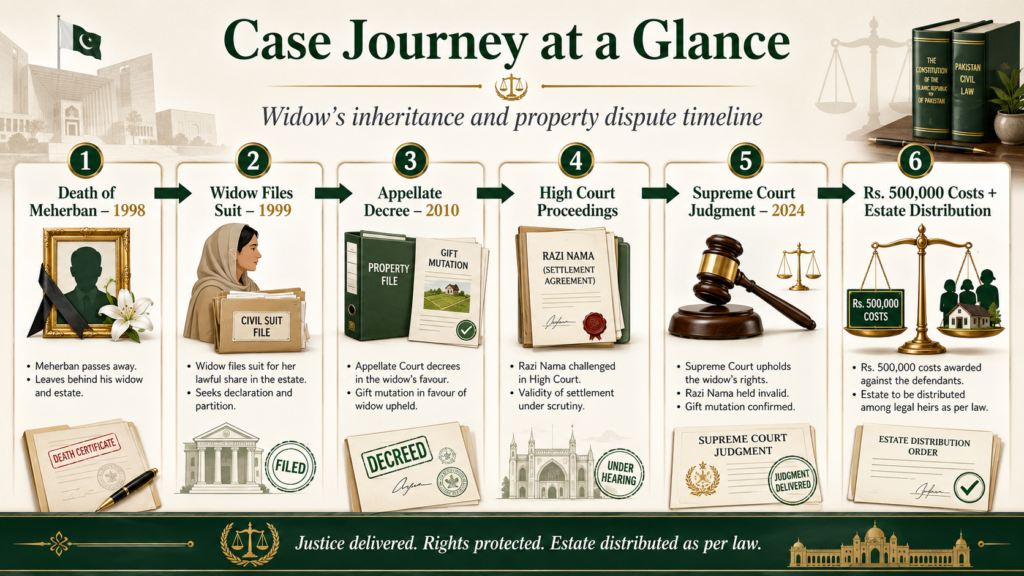
The Supreme Court judgment reported as 2025 SCMR 88 is one such powerful case. It involved Mst. Shamim Akhtar, a widow who had to fight for nearly twenty-five years after her lawful share was resisted through alleged gift mutations and a doubtful Razi Nama. The Court treated the matter not as a small technical dispute, but as a serious case of denial of inheritance to a female legal heir.
This judgment matters for every Pakistani family because it gives a strong message: a legal share is not charity. It cannot be taken away through pressure, silence, suspicious papers, or procedural tactics. When a person dies, the estate must be distributed according to law.
Table of Contents
Judgment at a Glance: Widow’s Fake Gift Mutation Case
| Point | Details |
| Case Citation | 2025 SCMR 88 |
| Case Title | Mst. Aksar Jan and others v. Mst. Shamim Akhtar and others |
| Court | Supreme Court of Pakistan |
| Main Dispute | Property left by Meherban |
| Key Documents | Alleged gift mutations and undated Razi Nama |
| Core Issue | Denial of a widow’s lawful share |
| Final Result | Appellate decree restored; Rs. 500,000 costs imposed |
Short IRAC Summary
| IRAC | Short Points |
| Issue | Could a widow be deprived of her lawful share through alleged gift mutations and an undated Razi Nama? |
| Rule | Legal heirs become owners of their shares after the death of a Muslim. Suspicious documents, fake entries, or doubtful agreements cannot be used lightly to defeat a lawful right. |
| Analysis | The alleged gift mutations were close to the death of Meherban and covered the entire land holding. The Razi Nama was undated, unsupported by consideration, and not properly proved as an informed surrender. The High Court also failed to focus on the real controversy, which was denial of inheritance. |
| Conclusion | The Supreme Court restored the Appellate Court decree, imposed Rs. 500,000 costs, and directed revenue authorities to distribute the estate according to Islamic Shariah. |
Important Legal Key Points
| Key Point | Simple Explanation |
| Widow fought for 25 years | Delay itself became injustice |
| Gift mutations were questioned | Suspicious property entries cannot defeat lawful heirs |
| Razi Nama was doubtful | Surrender of rights must be proved properly |
| No consideration was shown | A paper without legal substance cannot erase a share |
| High Court missed the main issue | The real question was denial of inheritance |
| Supreme Court restored decree | Substantive justice was preferred |
| Costs were imposed | Fraudulent tactics should have consequences |
Background: A Simple Share Turned into a Long Legal Battle
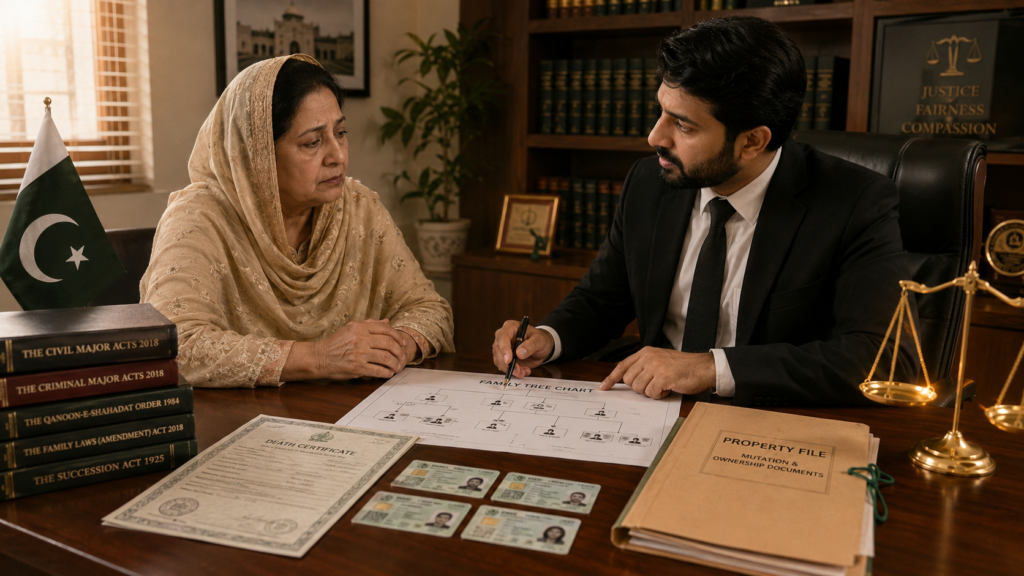
The dispute started after the death of Meherban, a Muslim man of Sunni sect, who died on 26 June 1998. He left behind two widows: Mst. Aksar Jan and Mst. Shamim Akhtar. According to the case record, an attempt was made to deprive the widows of their share through two gift mutations allegedly made by Meherban shortly before his death. The entire land holding was shown to have been gifted to petitioners Nos. 2 to 6, who were nephews of Mst. Aksar Jan.
This fact made the dispute serious. If the alleged gift mutations were accepted without careful scrutiny, the widows could practically lose the estate. That is why this case is not only about a revenue entry. It is about whether suspicious documents can be used to defeat inheritance.
Mst. Shamim Akhtar filed a suit in 1999 to obtain her share. The Appellate Court decreed the matter in her favour on 16 January 2010, but the litigation continued. The Supreme Court noted that she had been struggling for almost twenty-five years.
This was not an ordinary property fight; it was an inheritance dispute where a widow was forced to prove a right that already belonged to her under law.
The Alleged Gift Mutations: Why the Court Looked Deeper

The petitioners relied on gift mutations to show that Meherban had transferred his entire land holding before death. But the surrounding circumstances made the matter doubtful. The alleged transfers were close to death, the whole property was involved, and the beneficiaries were nephews of one widow.
In property cases, a mutation is not enough by itself. Courts look at the timing, beneficiaries, possession, surrounding circumstances, and the effect on legal heirs. If a document appears to remove widows, daughters, sisters, or other heirs from their lawful shares, it must be examined carefully.
Whenever a gift mutation appears close to the death of a property owner, courts must examine whether it is a genuine transfer or an attempt to defeat inheritance.
This judgment is powerful because it shows that inheritance cannot be defeated merely by producing papers that look formal on the surface. The real question is whether those papers are genuine, lawful, and fair.
The Razi Nama: Why a Thumb Impression Was Not Enough
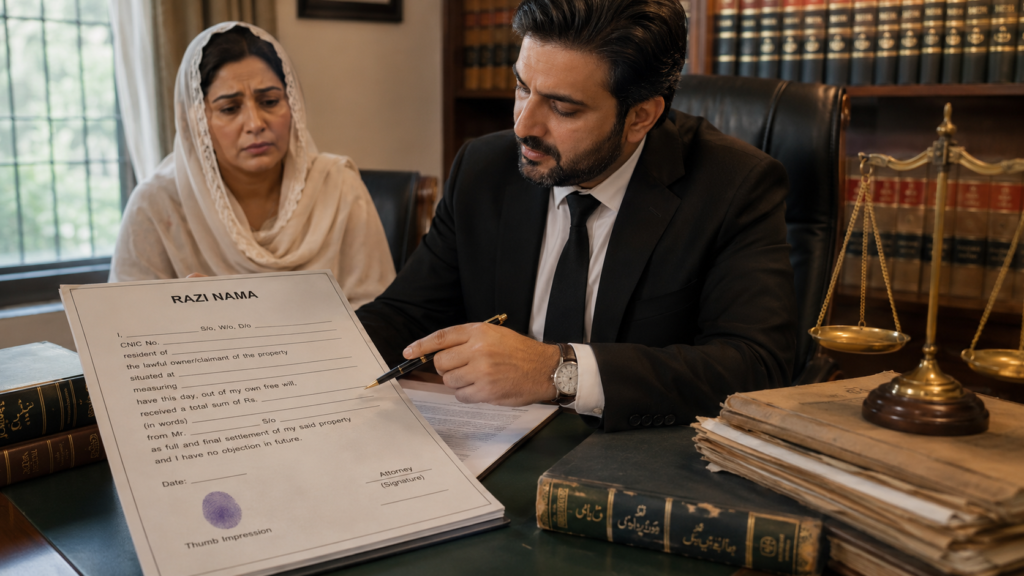
The petitioners also relied on an undated Razi Nama to suggest that Mst. Shamim Akhtar had given up her claim. The document reportedly carried a fingerprint or thumb impression said to be hers. However, the Supreme Court noticed serious weaknesses. The document was undated. The special attorney mentioned in it had not signed it. No consideration was given to Mst. Shamim Akhtar for giving up her claim.
This part of the judgment has great public importance. A widow who has already filed a case for her share cannot be presumed to have suddenly surrendered everything without proper proof. The Court was concerned that the document had been accepted without ensuring that she executed it with full knowledge of its contents.
A Razi Nama may be valid in proper circumstances, but it must be genuine, voluntary, clear, and legally meaningful. It cannot become a weapon to erase inheritance through pressure or confusion.
A doubtful Razi Nama cannot become a shortcut to remove a widow from inheritance, especially when the document is undated and unsupported by consideration.
Court Issues in This Judgment
The Supreme Court’s reasoning shows that the real issues were clear:
| Issue | Why It Was Important |
| Were the gift mutations genuine? | They allegedly transferred the entire land holding |
| Could the Razi Nama defeat the widow’s claim? | It was used to show surrender of rights |
| Did the High Court focus on the real issue? | The main issue was denial of inheritance |
| Were female heirs being deprived through documents? | The Court strongly noticed this social problem |
| Should the Appellate Court decree be restored? | The widow had already succeeded before the Appellate Court |
The Supreme Court treated the matter as a serious inheritance issue because the real harm was not procedural; the real harm was denial of a lawful share.
The Court made it clear that the main issue was not a technical side matter. The main issue was the denial of a lawful share.
Petitioners’ Arguments
The petitioners tried to rely on two points. First, they argued through the alleged gift mutations that the deceased had transferred the property during his lifetime. Second, they relied on the Razi Nama to show that Mst. Shamim Akhtar had given up her claim.
But the problem was the suspicious nature of the documents. The alleged gift covered the whole land holding. The Razi Nama was undated. The attorney mentioned in the document had not signed it. No consideration was shown. These facts weakened the petitioners’ position and made the case look less like a genuine transfer and more like an attempt to defeat inheritance.
Respondent Widow’s Arguments
Mst. Shamim Akhtar’s position was simple and strong. She was a widow of Meherban and a legal heir. She had filed a suit to obtain her lawful share, and the Appellate Court had already decreed the matter in her favour.
Her claim was not based only on sympathy. It was based on law. The Supreme Court observed that the shares in the estate of a Muslim are stipulated, and legal heirs become owners upon death. This principle supported her right and weakened any attempt to casually remove her from the estate.
Important Legal Principles from the Judgment
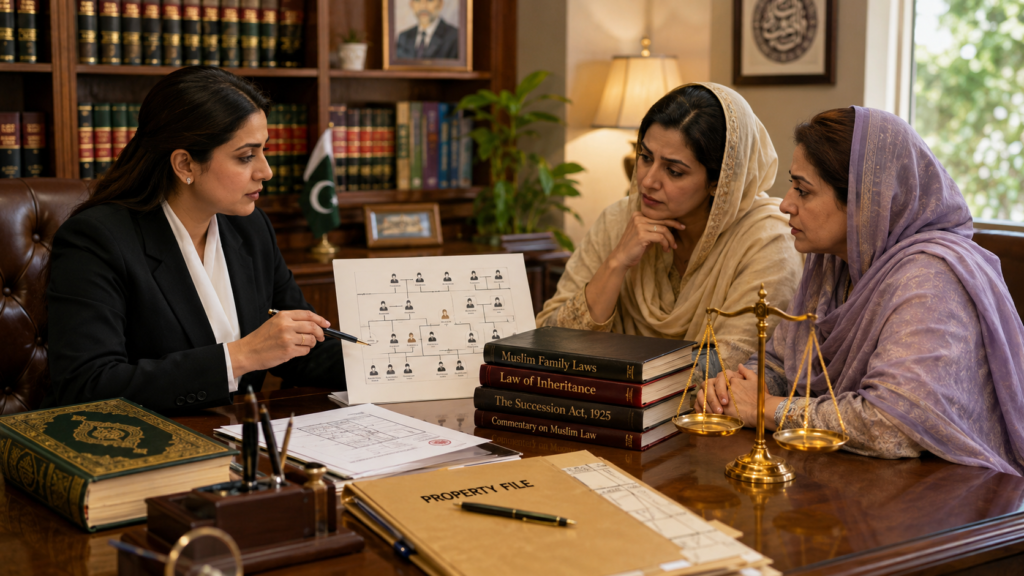
1. Legal heirs become owners after death
The Court emphasized that the estate of a deceased Muslim must go to the legal heirs according to their fixed shares. This means that a widow, daughter, mother, sister, or any other lawful heir does not need permission from powerful relatives to claim a legal right.
2. Suspicious documents must be examined carefully
A gift mutation, agreement, Razi Nama, or thumb impression cannot automatically defeat inheritance. Courts must examine whether the document is genuine, voluntary, and legally effective.
3. Female heirs need stronger protection
The Supreme Court strongly observed that females are often deprived through bogus documentation, fraudulent statements, and tactics involving revenue officials and some advocates. The Court said this practice must be stopped.
4. Technicalities should not protect injustice
The judgment shows that courts should not allow procedural technicalities to help those who use doubtful documents to defeat lawful shares.
5. Costs can be imposed for fraudulent tactics
The Supreme Court imposed Rs. 500,000 costs on petitioners Nos. 2 to 6. This was not only compensation; it was also a warning that fraudulent conduct in family property disputes can have serious consequences.
Why This Case Matters for Pakistani Families
This judgment matters because many families still treat women’s property rights as negotiable. A widow may be told to stay quiet. A sister may be pressured to “forgive” her share. A daughter may be made to feel guilty for asking what the law already gives her.
The Supreme Court’s message is clear: inheritance is not a favour. It is a right. A legal heir does not become greedy by asking for a lawful share. The real wrong is not the demand for a share; the real wrong is creating documents, stories, and pressure to deny it.
This case should be read by families, lawyers, revenue officials, and anyone dealing with property after death. It reminds everyone that silence is not consent, pressure is not compromise, and a thumb impression is not always proof of free will.
You may also read our detailed guide on legal heirs in Pakistan law to understand how family property shares are protected after death.
Practical Checklist for Legal Heirs

After the death of a family member, legal heirs should act carefully and timely:
| Document / Step | Why It Matters |
| Death certificate | Confirms date of death |
| CNIC copies | Identifies heirs |
| Family Registration Certificate | Helps prove family relationship |
| Revenue record | Shows agricultural land details |
| Mutation entries | Reveals suspicious transfers |
| Property file | Shows ownership history |
| Legal advice | Prevents harmful signatures |
| No blank papers | Protects against misuse |
| Copies of all documents | Helps future litigation |
| Timely legal action | Prevents long delay |
No heir should sign any Razi Nama, affidavit, statement, blank paper, or compromise document without understanding its effect. A single careless signature can create years of litigation.
Final Decision of the Supreme Court
The Supreme Court converted the petition into an appeal and allowed it. The High Court’s orders were set aside, and the judgment and decree dated 16 January 2010 passed by the Additional District Judge, Rawalpindi were restored. The petitioners Nos. 2 to 6 were directed to pay Rs. 500,000 as costs to Mst. Shamim Akhtar within three months. If they failed, the amount could be recovered as arrears of land revenue.
The Court also directed the concerned revenue authorities to implement the decree and ensure that Meherban’s estate was distributed among legal heirs according to Islamic Shariah. This final direction made the judgment practical, not merely symbolic.
For readers who want to understand the official court system, they can visit the official website of the Supreme Court of Pakistan.
Social Awareness Note
This case should not be seen as only one widow’s dispute. It reflects a common social problem. Many women lose property not because the law is silent, but because families, documents, and pressure are used against them.
A just family does not wait for litigation to distribute shares. A fair family does not ask a woman to surrender her right for honour. A responsible family does not create papers to hide the truth.
The lesson is simple: when a person dies, distribute the estate honestly. Do not force the weakest heir to spend decades in court for something the law already gives.
A society cannot claim fairness if women are forced to fight for an inheritance that should have been given to them without litigation.
Conclusion: A Lawful Share Is Not a Favour
This Supreme Court judgment is powerful because it turns a family property dispute into a lesson for society. A widow waited for almost twenty-five years while alleged gift mutations and a doubtful Razi Nama were used against her. But the Court finally brought the matter back to its real point: a lawful heir cannot be pushed out through suspicious paperwork.
The judgment reminds every family that inheritance belongs to legal heirs by law. It is not controlled by the strongest voice in the house. It cannot be denied through silence, pressure, or doubtful documents.
For widows, daughters, mothers, and sisters, this case carries hope. For those who manipulate records, it carries a warning. And for society, it carries a lesson: justice should begin at home, but when home fails, courts must protect the rightful heir.
Important Disclaimer: This blog is written for legal awareness and education only. It is based on the reported Supreme Court judgment 2025 SCMR 88. It should not be treated as legal advice for any individual case.
FAQs
What is the main lesson of this judgment?
The main lesson is that lawful heirs cannot be deprived through suspicious gift mutations, doubtful agreements, or procedural technicalities.
Why was the Razi Nama doubtful?
It was undated, the mentioned attorney had not signed it, no consideration was shown, and proper proof of informed surrender was missing.
Can a widow claim her share after her husband dies?
Yes. A widow is a legal heir and can claim her lawful share from the estate of her deceased husband.
What did the Supreme Court say about female heirs?
The Court observed that females are often deprived through bogus documents, fraudulent statements, and other tactics, and that this practice must stop.
Can gift mutations be challenged?
Yes. A gift mutation can be challenged if it appears suspicious, fraudulent, incomplete, or intended to defeat legal heirs.
Why did the Court impose Rs. 500,000 costs?
The Court imposed costs because the matter had been dragged for years through fake documents and fraudulent tactics.
Did the widow win the case?
Yes. The Supreme Court restored the decree in favour of Mst. Shamim Akhtar.
What should heirs check after a death?
They should check death certificate, CNICs, FRC, revenue record, property files, mutation entries, and any suspicious transfer documents.
Is a thumb impression always enough to prove surrender of rights?
No. The Court must see whether the person understood the document and executed it voluntarily.
Is this article legal advice?
No. This article is for legal awareness only. For any personal property dispute, consult a qualified lawyer with complete documents.